Legal requirements for using Apivar in your country

TL;DR
- Apivar (amitraz 3.3% strips) is a prescription-free, EPA-registered varroa treatment in the United States.
- In the EU, Canada, Australia, and New Zealand it is either approved under national veterinary medicine rules or sold under equivalent amitraz products.
- Three rules apply almost everywhere: keep honey supers off during treatment, follow the label withdrawal period, and keep written treatment records where required.
What is Apivar and why does its legal status matter?
Apivar is a slow-release polymer strip that holds 3.3% amitraz, a miticide that kills Varroa destructor by contact. Each hive gets two strips placed between brood frames for 6 to 10 weeks depending on mite load and temperature. It works. But amitraz is a regulated veterinary or agricultural chemical in every country that sells it, which means the label is law, not a suggestion.
In the United States the Federal Insecticide, Fungicide, and Rodenticide Act (FIFRA) makes it a federal offense to use a registered pesticide inconsistently with its label [1]. That sentence sounds like paperwork until you realize it covers timing, dosage, and the honey-super restriction that keeps amitraz residues out of your crop. Most hobbyists know the basics. Many miss the record-keeping rules that some states and almost every export market pile on top of the EPA label.
The stakes are real. Amitraz residues turn up in commercial honey and beeswax at levels that trigger rejections in EU import testing. Sell honey at a farmers market, and the full legal picture is suddenly yours to manage.
Is Apivar legal in the United States, and what does the EPA label require?
Yes. Apivar holds EPA Registration Number 92647-1, issued to Veto-Pharma, and any beekeeper can use it without a veterinarian's prescription. That sets it apart from some in-hive antibiotics. The current label (check the EPA pesticide product label system for the latest version) requires the following.
- Two strips per brood chamber, centered between frames 3 and 4, and frames 6 and 7.
- Minimum treatment duration 6 weeks. Maximum 10 weeks.
- Honey supers must come off before strips go in and stay off until strips come out. This is the single most commonly violated rule.
- Strips must be removed and thrown out after treatment. No reuse. No leaving them in the hive.
- Chemical-resistant gloves during handling. The label specifies nitrile or rubber, not fabric.
- Do not apply if temperatures will stay below 50°F (10°C) for extended periods. Efficacy drops sharply in the cold.
The EPA label states: "Do not apply this product in a way that will contact workers or other persons, either directly or through drift. Keep people and pets out of the area during application." [1]
States can layer more on top of the federal label. California requires a Pest Control Adviser (PCA) recommendation for certain pesticide uses, though Apivar for home apiary use has generally been exempt. Check your state department of agriculture site before you assume you're covered.
For a broader picture of the mite this product targets, see our guide on the varroa mite.
What are the legal requirements for Apivar in Canada?
In Canada, Apivar is regulated by Health Canada's Pest Management Regulatory Agency (PMRA) under the Pest Control Products Act, registration number PCP 30652. No veterinarian's prescription is required, same as the US. The rules track the EPA label closely, with a few Canadian specifics.
Canadian beekeepers who sell honey commercially are strongly advised by the Canadian Honey Council to keep treatment records as part of food safety due diligence, even though no federal law forces a private log.
The PMRA-approved label requires the same honey super removal, the same 6-to-10-week window, and the same disposal of used strips. Here's where Canada diverges: provincial apiarists (government bee inspectors) in provinces like Ontario and British Columbia run active monitoring programs and can request treatment logs during inspections. Ontario's Bees Act gives provincial apiarists authority to enter apiaries and inspect records [2].
Quebec has the strictest provincial overlay. Under Quebec's Pesticides Management Code, every pesticide application, Apivar included, must be logged with the date, quantity used, hive identification, and the name of the person applying the product. That log stays on file for five years.
Selling honey across a border adds one more layer. If you import Canadian honey into the US or EU, amitraz Maximum Residue Limits (MRLs) apply at customs. The EU MRL for amitraz in honey is 200 µg/kg (200 ppb) [3].
Is Apivar approved in the European Union, and how do EU rules differ?
The EU is where this gets genuinely complicated. Apivar as a brand is approved in several member states, but amitraz-based varroa treatments across the EU fall under Regulation (EU) 2019/6 on veterinary medicinal products, in force since January 28, 2022 [4]. Under that regulation, amitraz strips are veterinary medicines in most member states, not agricultural pesticides.
What that means on the ground:
- In France, Apivar is a Médicament Vétérinaire and needs a veterinary prescription for commercial beekeepers above a colony threshold (thresholds vary and were under revision as of 2024). Hobbyists can often buy it over the counter depending on the pharmacy.
- In Germany, Apivar is not registered. The approved amitraz products are Biovar and Apitraz, and even those require a veterinary prescription.
- In the UK (post-Brexit), Apivar is authorized under the Veterinary Medicines Directorate (VMD) as a veterinary medicine (VM 50041/4001). No prescription is currently required for beekeepers in England and Wales, but the VMD keeps this under review.
- In Spain, Italy, and the Netherlands, amitraz products are authorized with prescription requirements for commercial beekeepers.
Treatment record-keeping is mandatory across EU member states under Regulation (EU) 2016/429 (the Animal Health Law) for keepers of managed bees above national thresholds, which vary by country.
The EU MRL for amitraz in honey (200 µg/kg) and beeswax (3,000 µg/kg) is set under Regulation (EU) No 37/2010 and its updates [3]. Sell honey above those limits and you've committed a food safety offense in any member state.
What are the rules for Apivar in Australia and New Zealand?
Australia kept amitraz off its beekeeping shelves for years over trade concerns. That changed. Apivar received registration from the Australian Pesticides and Veterinary Medicines Authority (APVMA) under registration number 87501. For beekeepers who had leaned on oxalic acid and flumethrin as their main acaricides, it opened a real option.
Australian rules under the Agricultural and Veterinary Chemicals Code Act 1994 demand strict label compliance. The honey super removal rule matches the US label word for word. State rules stack on: in New South Wales and Victoria, beekeepers must register with the state department of primary industries, and that registration carries an implied duty to keep treatment records.
New Zealand runs on a different track. Apivar is registered by the Environmental Protection Authority (EPA NZ) under the Hazardous Substances and New Organisms Act 1996. The NZ label carries the same core restrictions. One addition is specific to NZ: under the Agricultural Compounds and Veterinary Medicines Act 1997, amitraz treatment has a honey withholding period of zero days (strips must be fully removed before supers go back, but no extra delay after removal) [5]. That sounds permissive. It only holds if the strip removal rule was followed correctly.
Both countries run export residue monitoring. Ship honey with amitraz above the importing country's MRL (the EU's 200 µg/kg is the usual reference), and the shipment gets rejected.
Which countries have NOT approved Apivar or amitraz for bee use?
This matters if you keep bees in more than one country or source queens internationally.
Amitraz has no approved bee use in several countries, for three reasons: the manufacturer never sought registration, the country restricts certain acaricide classes outright, or the regulator simply hasn't processed the application.
As of 2024, amitraz-based varroa treatments have no approved bee registration in Japan, where tau-fluvalinate and oxalic acid are the main options. Regulatory status in several Southeast Asian countries with growing beekeeping sectors stays unclear. Brazil approved amitraz for veterinary use in livestock, but MAPA (Ministry of Agriculture, Livestock and Food Supply) registration for honeybee-specific Apivar use was pending as of early 2024.
Using Apivar where it isn't registered is illegal under that country's pesticide or veterinary medicine law, no matter what the EPA label says. The EPA label carries zero legal weight outside US borders.
Unsure about your country? Contact the national pesticide registration authority. For the EU, that's the European Chemicals Agency (ECHA) for the active substance and the national competent authority for the product.
Do you need a veterinarian's prescription to buy Apivar?
In the US and Canada, no. You can order Apivar from any licensed beekeeping supplier without a veterinarian anywhere in the picture. That's one practical edge over antibiotics like oxytetracycline (sold as Terramycin), which needs a Veterinary Feed Directive in the US.
The Honey Bee Health Coalition's Varroa Management Guide still recommends consulting a veterinarian or extension specialist if you're unsure about treatment timing or fighting a resistant mite population, even though no prescription is legally required [6].
In the EU, the prescription rule shifts by member state and by the scale of your operation (see the EU section above). In Germany and most of Western Europe, expect a prescription for commercial work. In the UK, as of 2024, no prescription is required for beekeepers.
Australia and New Zealand require no prescription for Apivar under their current registrations.
To source Apivar legally in the US, buy from suppliers that stock EPA-registered products. Our overview of beekeeping supply companies points to reputable vendors, and our beekeeping supplies guide covers the rest of the kit.
What record-keeping is legally required when you use Apivar?
This is where most hobbyist beekeepers are quietly non-compliant. Here's the honest breakdown by jurisdiction.
United States: The EPA Apivar label doesn't explicitly mandate a written treatment log for private beekeepers. But sell honey commercially and you may fall under the Food Safety Modernization Act (FSMA), where the FDA expects records of chemical inputs. Commercial packers often demand supplier declarations. Practical answer: keep records even though federal law doesn't force you to.
Canada: No mandatory federal log. Quebec mandates a five-year pesticide log. Ontario inspectors can and do ask for records. Producers selling to packers or co-ops are almost always contractually bound to keep them.
European Union: Mandatory for keepers above national threshold colony counts (which vary by country, often starting around 50 colonies). Records must include the product name, batch number, purchase date, treatment date, quantity used, hive identification, and the prescribing veterinarian's details if applicable [4].
UK: Voluntary for hobby beekeepers, but the British Beekeepers Association (BBKA) and VMD both push for a simple log. VMD guidance on veterinary medicine record-keeping for beekeepers sits on the GOV.UK site.
Australia and New Zealand: State and territorial rules vary. In Queensland, the Biosecurity Act 2014 requires biosecurity plans that include treatment records for registered beekeepers.
A minimal log that covers you almost anywhere: treatment date, hive ID, number of strips used, batch number from the package, strip removal date, and whether supers were off during treatment. Two minutes per hive per cycle. It holds up in nearly any regulatory review.
VarroaVault's free protocol tools include a printable treatment log template if you want a ready-made format.
What is the legal honey super removal rule and why is it non-negotiable?
Every country that has approved Apivar or any amitraz strip requires honey supers to be completely absent from the hive for the entire treatment period. This is not a best-practice nudge. It's label law in the US under FIFRA, and product authorization law in every other country covered here.
The reason is chemistry. Amitraz and its primary metabolite, 2,4-dimethylaniline (DMA), are lipophilic. They move into beeswax readily and into honey to a lesser degree. Treat with supers on, and amitraz accumulates in honey headed for jars you sell or eat. The EU MRL of 200 µg/kg for honey exists because amitraz above that level raises human health concerns and triggers import bans.
Wax is the harder problem. A 2010 PLOS ONE study of pesticide residues in North American apiaries by Mullin and colleagues found amitraz breakdown products among the most common contaminants in wax, and later European sampling reported median amitraz in commercial beeswax exceeding the EU wax MRL of 3,000 µg/kg in some samples [7]. Wax accumulation is tough to prevent, which is exactly why the honey super rule is so strict.
Remove supers before strips go in. Put strip removal day on your calendar. This one rule, done right, keeps your honey legal and your bees healthier.
How do amitraz MRLs (maximum residue limits) affect hobbyist honey sales legally?
Sell one jar of honey and MRLs are your legal concern. A Maximum Residue Limit is the highest concentration of a pesticide residue allowed in food. Regulators set it, not you, and exceeding it is a food safety violation.
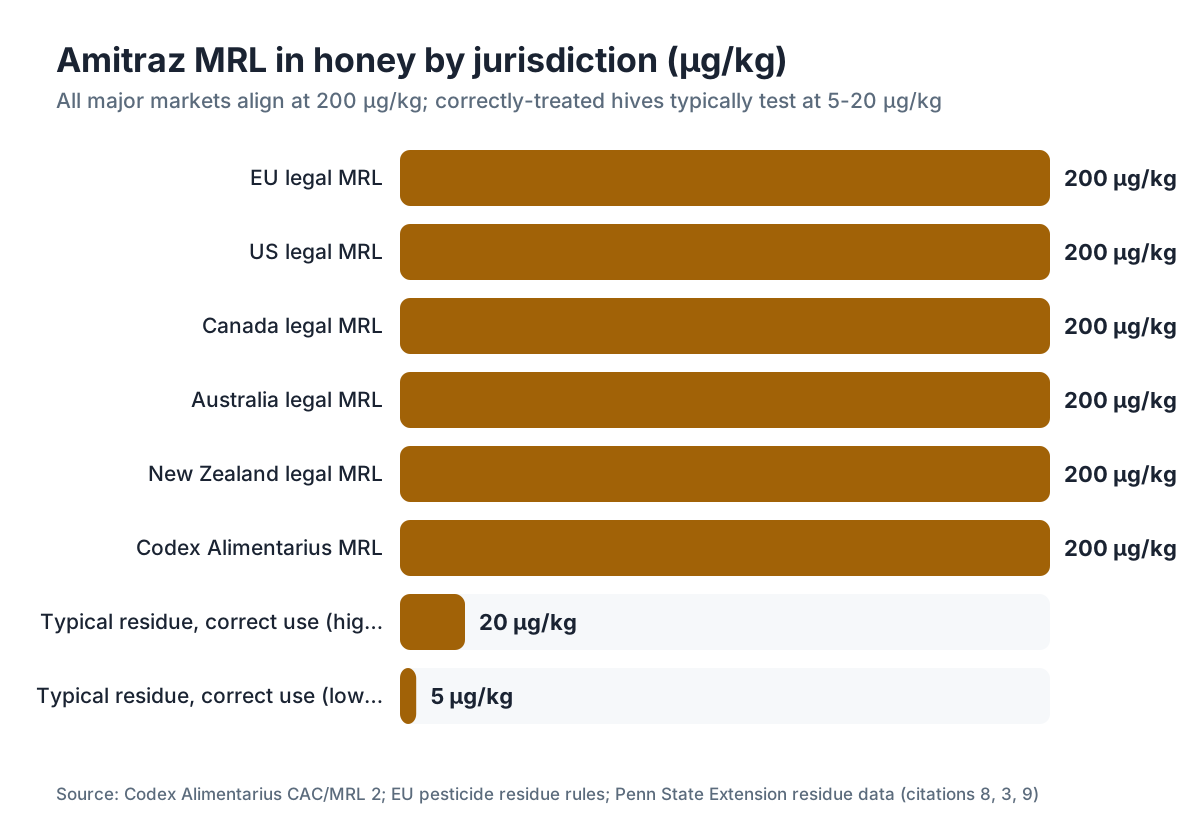
Here's the current landscape for amitraz in honey across major jurisdictions.
| Jurisdiction | MRL for amitraz in honey | Legal basis |
|---|---|---|
| European Union | 200 µg/kg (200 ppb) | EU Regulation 37/2010 |
| United States | 200 ppb (=200 µg/kg) | FDA/EPA (mirrors Codex) |
| Canada | 200 µg/kg | Health Canada PMRA |
| Australia | 200 µg/kg | FSANZ Food Standards |
| New Zealand | 200 µg/kg | MPI Food Standards |
| Codex Alimentarius | 200 µg/kg | CAC/MRL 2 |
The Codex Alimentarius MRL, set by FAO/WHO, is 200 µg/kg, and most countries align with it [8]. Follow the label (supers off, strips out after 6 to 10 weeks, no reuse), and residues in honey stay well below that ceiling. Penn State Extension residue work found honey from correctly-treated hives typically tests at 5 to 20 µg/kg, far under the MRL [9].
Selling to a packer or retailer? They may require a certificate of analysis from a food safety lab. That test runs roughly $50 to $150 per sample depending on the lab and panel. Money well spent if you sell volume.
Can you use Apivar in organic or treatment-free beekeeping, and what do certification rules say?
No. Apivar is not permitted under any organic honey certification standard in the US, EU, or Canada.
The USDA National Organic Program (NOP) has no specific organic honey standard at the federal level as of 2024 (the proposed rule has been in development for years). But third-party certifiers like Oregon Tilth and CCOF prohibit synthetic acaricides, amitraz included, in hives producing organic-labeled honey.
The EU's organic regulation (Regulation (EU) 2018/848) explicitly bans synthetic acaricides in organic apiaries [13]. Only organic acids (oxalic acid, formic acid) and thymol-based products appear on the EU approved inputs list for organic beekeeping.
In Canada, the Canada Organic Standards (CAN/CGSB-32.310) similarly prohibit synthetic pesticides in organic production.
Certified organic, or working toward it? Apivar disqualifies honey from that hive for a period your certifier defines. Some certifiers require a 12-month transition after synthetic acaricide use before honey can carry an organic label again. Check your certification body's specific rules.
Treatment-free beekeeping has no legal restrictions on what you use, because it's a personal philosophy rather than a regulatory category. By definition, it's incompatible with Apivar.
How do US state-level regulations add to the EPA Apivar label requirements?
The EPA label is the federal floor. States build on top of it. Here are the common additions.
Registration requirements: Most states require beekeepers to register their apiaries with the state department of agriculture, and registration sets up a framework for inspections. As of 2024, 48 states have some form of apiary registration or licensing requirement.
Record-keeping: Some states now require pesticide application records for beekeepers, especially those in state pollination contracts or selling honey commercially. California's Department of Pesticide Regulation maintains some of the most detailed requirements in the country.
Restricted Use: Apivar is a General Use Pesticide under the EPA label. It is not a Restricted Use Pesticide (RUP) and needs no applicator's license. If a state reclassifies a product, that state's own RUP list governs within its borders.
Inspector access: Every state with an apiary law gives state apiarists some inspection authority, which can include reviewing treatment records. Can't show you followed the Apivar label? You could face fines or lose your apiary registration.
Easiest way to check your state: go to your state department of agriculture website and search "apiary regulations" or "beekeeper registration." University extension programs (Penn State, University of Florida, UC Davis) publish state-specific compliance guides that fill in the rest.
What happens if you use Apivar illegally or off-label?
The consequences scale with your operation size and whether you sell honey.
Run two hives, treat with supers on, and never sell honey? The practical enforcement risk is low. Inspectors focus on apiaries with disease issues or commercial operations. You're still in violation of federal law (FIFRA), though, and could in theory face civil penalties up to $500 per violation for a private applicator under 7 U.S.C. § 136l [10].
For a sideliner selling at markets, the risks compound. If a buyer tests your honey and finds amitraz above 200 µg/kg, you're looking at a food safety recall, possible FDA enforcement action, a lost retail relationship, and reputational damage that's hard to undo.
For commercial operations or exporters, off-label use can trigger shipment rejections, import bans, and in the EU, criminal prosecution under food safety law.
The most common real-world outcome for hobbyists isn't a fine. It's ruining a honey crop by treating with supers on, then selling that honey without knowing. That's a legal problem and an ethical one.
VarroaVault's seasonal treatment tracker helps you schedule Apivar around honey flows so supers are never on during treatment.
Frequently asked questions
Can I use Apivar in a hive that has honey supers on?
No, and it isn't optional. Every country that has approved Apivar requires honey supers off before strips go in and kept off until strips come out. The rule exists because amitraz is lipophilic and migrates into honey and wax. Violating it breaches the EPA label in the US (a federal offense under FIFRA) and equivalent laws elsewhere. Remove supers, treat, remove strips, then return supers.
Do I need a prescription to buy Apivar in the US?
No. Apivar is a General Use Pesticide under EPA Registration 92647-1 and needs no veterinarian's prescription in the United States. Beekeeping suppliers sell it without any professional authorization. That differs from countries like Germany, where amitraz-based products require a veterinary prescription for commercial operations.
How long do Apivar strips need to stay in the hive according to the label?
The EPA-approved label specifies a minimum of 6 weeks and a maximum of 10 weeks per treatment cycle. Below 6 weeks, efficacy against mites in sealed brood cells drops. Beyond 10 weeks, there's no added benefit and you raise the chance of residue buildup in wax. Set a calendar reminder at insertion and again at week 6 to assess and plan removal.
Is Apivar the same product in all countries?
Apivar is a brand name from Veto-Pharma. The active ingredient, amitraz at 3.3%, is the same formulation sold internationally. The legal status shifts, though: it's an agricultural pesticide in the US and Canada, a veterinary medicine in most EU member states and the UK, and registered under pesticide codes in Australia and New Zealand. Each country's label is the binding legal document within its borders.
What amitraz residue level in honey is considered legal?
The maximum residue limit (MRL) for amitraz in honey is 200 µg/kg (200 ppb) in the EU, US, Canada, Australia, New Zealand, and under Codex Alimentarius. Honey above that level cannot be legally sold. Penn State Extension residue data found honey from correctly-treated hives typically contains 5 to 20 µg/kg of amitraz, well below the MRL, provided label instructions (including super removal) were followed.
Can I reuse Apivar strips in a second hive or a second treatment?
No. The Apivar label explicitly prohibits reuse. After removal, strips must be disposed of according to local pesticide disposal rules. Reuse is off-label use and a federal violation in the US. The active ingredient releases progressively over the treatment period, so a used strip won't deliver a reliable dose and could feed amitraz resistance in your mite population.
What temperature is too cold for Apivar to work legally and effectively?
The Apivar label advises against application when temperatures stay below 50°F (10°C) for extended periods. Amitraz efficacy depends partly on bee movement spreading the active ingredient through the colony. In cold clusters, bees move less, so the treatment spreads poorly. The restriction is both legal and practical: treating below that threshold is off-label and may not control mites well.
Are there countries where Apivar is completely banned?
Amitraz-based varroa treatments are not approved for bee use in Japan, where oxalic acid and tau-fluvalinate are the primary legal options. Several other Asian countries have not registered amitraz for apiary use. Using Apivar where it lacks registration is illegal under that country's pesticide or veterinary medicine law, no matter what the EPA label says, since the EPA label only has legal force within the United States.
Does using Apivar disqualify my honey from organic certification?
Yes. Amitraz is a synthetic acaricide prohibited under the EU's organic regulation (EU 2018/848), the Canada Organic Standards, and all major third-party organic certifiers in the US. No federal US organic honey standard exists yet, but private certifiers prohibit it. After Apivar use, you typically need a 12-month transition before honey from those hives can carry organic labeling again, though requirements vary by certifier.
What records should I keep when treating with Apivar?
At minimum: date strips went in, hive identification, number of strips used, batch number from the package, date strips came out, and a note confirming supers were absent throughout. That covers you for US commercial honey programs, Canadian provincial inspections, and EU veterinary medicine records. In Quebec, records must be kept for five years. In EU states with mandatory veterinary medicine logs, records may also need the prescribing vet's details.
How does the UK's post-Brexit Apivar approval differ from EU rules?
In the UK, Apivar is authorized by the Veterinary Medicines Directorate (VMD, registration VM 50041/4001) as a veterinary medicine. As of 2024, no veterinary prescription is required for UK beekeepers, unlike most EU member states where commercial beekeepers need one. The UK follows its own MRL standard, currently aligned with the former EU MRL of 200 µg/kg for amitraz in honey, but the VMD reserves the right to update this independently.
Is Apivar approved for package bees, nucs, or queen-rearing operations?
The US EPA label covers use in established colonies. Queen-rearing nucs and package bee operations fall under the same label restrictions. Treating a queenright nuc is fine in practice; the honey super rule still applies. There's no separate label approval for mating nucs. Some queen breeders treat full colonies holding breeder queens with Apivar and use an oxalic acid dribble on nucs instead, since nucs have no capped brood.
Can a bee inspector in the US or Canada confiscate my hives if I misuse Apivar?
Confiscation is uncommon but legally possible under state apiary laws when colonies pose a disease or chemical risk. Most inspectors issue a written warning first. Repeated or egregious violations, like selling contaminated honey or treating with supers on at commercial scale, can escalate to pesticide enforcement actions by the state department of agriculture, civil fines, and in extreme cases a criminal referral under FIFRA.
Sources
- US EPA, Apivar Product Label (EPA Reg. No. 92647-1): Apivar holds EPA Registration Number 92647-1; using a pesticide inconsistently with its label is a federal offense under FIFRA
- Ontario Ministry of Agriculture, Food and Rural Affairs, Bees Act R.S.O. 1990 c. B.6: Ontario's Bees Act gives provincial apiarists authority to enter apiaries and inspect records
- European Commission, EU Pesticides Database (amitraz honey MRL): EU MRL for amitraz in honey is 200 µg/kg and 3,000 µg/kg in beeswax under EU residue rules
- European Parliament, Regulation (EU) 2019/6 on veterinary medicinal products: Amitraz-based strips are classified as veterinary medicines in EU member states under Regulation 2019/6, which entered force January 28, 2022
- New Zealand Environmental Protection Authority, Hazardous Substances register: Apivar is registered by EPA NZ under the Hazardous Substances and New Organisms Act 1996 with a zero-day honey withholding period if label strip-removal rules are followed
- Honey Bee Health Coalition, Varroa Management Guide (4th edition): Honey Bee Health Coalition recommends consulting an extension specialist on treatment timing even though no prescription is required for Apivar in the US
- Mullin et al. (2010), PLOS ONE, High Levels of Miticides and Agrochemicals in North American Apiaries: A study found amitraz breakdown products among the most common contaminants in beeswax, with later European sampling exceeding the EU wax MRL of 3,000 µg/kg in some samples
- FAO/WHO Codex Alimentarius, Codex MRL for amitraz in honey (CAC/MRL 2): Codex Alimentarius MRL for amitraz in honey is 200 µg/kg, the international reference standard adopted by most national authorities
- Penn State Extension, Honey Bee Pesticide Residue and Varroa Management resources: Honey from correctly-treated hives typically tests at 5 to 20 µg/kg amitraz, well below the 200 µg/kg MRL
- US EPA, Federal Insecticide Fungicide and Rodenticide Act (FIFRA), 7 U.S.C. § 136l: Private applicators who misuse registered pesticides can face civil penalties up to $500 per violation under FIFRA 7 U.S.C. § 136l
- European Commission, Regulation (EU) 2018/848 on organic production: EU organic farming regulation 2018/848 explicitly prohibits synthetic acaricides including amitraz in organic apiaries
- UK Veterinary Medicines Directorate, Apivar authorization VM 50041/4001: Apivar is authorized in the UK by the VMD under registration VM 50041/4001 as a veterinary medicine; no prescription required for UK beekeepers as of 2024
Last updated 2026-07-09