Using Apivar strips: the complete guide for varroa control
TL;DR
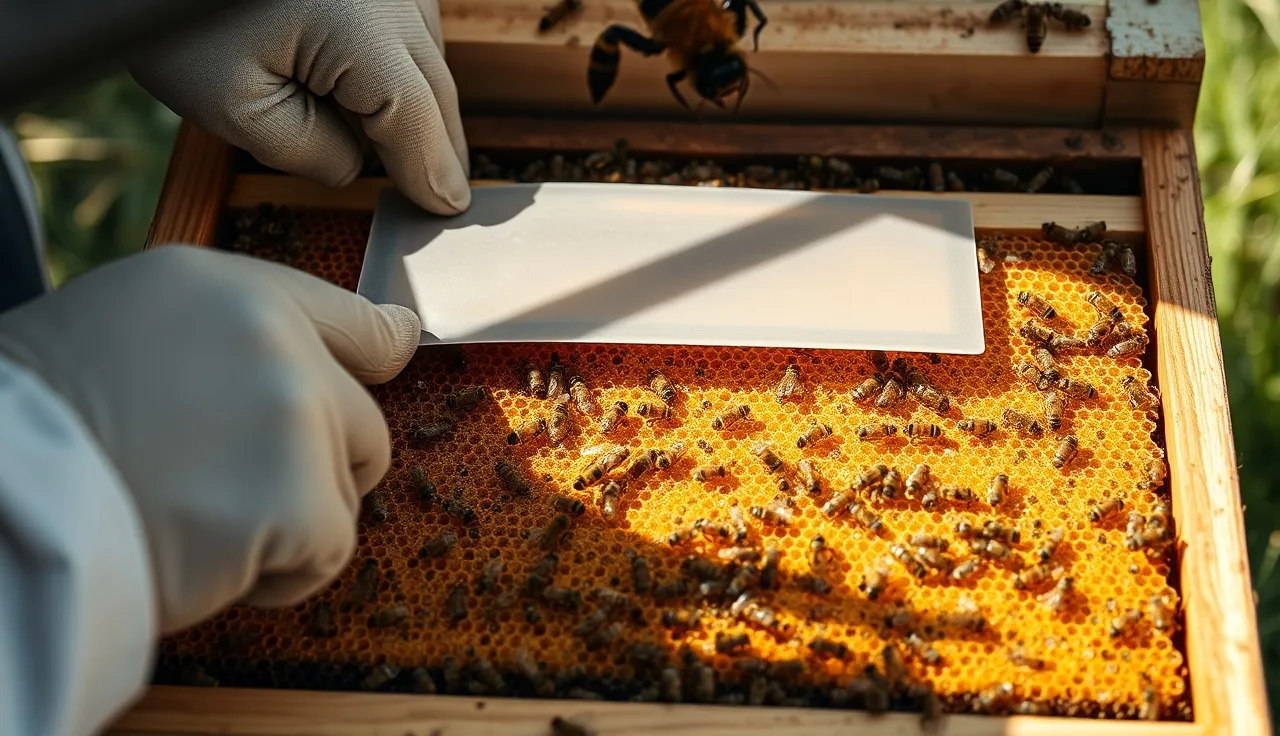
- Apivar (amitraz 3.3%) strips hang between brood frames for 6 to 10 weeks and kill varroa as mites emerge from capped brood and while they ride adult bees.
- Two strips treat a colony up to 10 frames of bees.
- Efficacy runs 90 to 97% in solid trials when resistance is absent.
- Pull all honey supers before you treat.
What is Apivar and how does it work against varroa?
Apivar is an amitraz-based acaricide the EPA registers for varroa control in honey bee colonies [1]. Each plastic strip holds 3.3% amitraz, an active ingredient in the formamidine class. Bees walk across the strips, pick up tiny amounts on their bodies, and spread it through the colony by normal contact. Mites feeding on adult bees or moving between them pick up a lethal dose.
Amitraz acts as an octopamine agonist. It overstimulates a neuroreceptor that insects and arachnids use to run movement and feeding. Varroa get hit hard. Honey bees, which do not carry the relevant receptor at the same density, tolerate the compound at label rates. That selectivity is the whole reason amitraz became the backbone of the Apivar formula.
The strips do not evaporate into the air the way oxalic acid or formic acid do. Kill rate depends almost entirely on bee-to-strip and bee-to-bee contact, which means colony population matters a lot. A strong colony spreads the active ingredient far better than a weak one. If your cluster barely covers three or four frames, expect a lower kill rate, because fewer bees are touching the strips.
Veto-Pharma makes Apivar and sells it in packs of 10 strips, enough for five colonies at the standard two-strip dose [11]. It is a restricted-use pesticide in a handful of states but available over the counter to beekeepers across most of the US under the existing EPA registration. Check your state's rules before you buy.
How do you use Apivar strips correctly?
The EPA-registered label is the legal document that governs every part of application. Here is what it says, paraphrased closely from Veto-Pharma's current registration [1]:
- Use 2 strips per colony of up to 10 frames of bees, or 1 strip per 5 frames if the colony is smaller.
- Hang each strip between frames of the brood nest, not in empty space and not flat on the bottom board.
- Leave strips in place a minimum of 6 weeks and a maximum of 10 weeks.
- Remove all honey supers before inserting strips and keep them off for the whole treatment period.
- Do not treat with a queen excluder blocking movement through the brood area. Bees need to move freely.
- Wear chemical-resistant gloves when you handle strips.
Placement matters more than most beekeepers think. Push each strip down so it hangs centered in a brood frame gap, ideally in the middle third of the hive body where nurse bees pile up. Strips hung near the outer walls of a box with a small cluster miss a lot of bees. If your colony fills two deep boxes, split the two strips between boxes rather than stacking both in the bottom, though the label does not specifically require this.
After 42 to 70 days, pull the strips with gloved hands and dispose of them per your local rules. Never leave them past 10 weeks. Extended exposure ramps up selection pressure for amitraz resistance and breaks the label.
Many beekeeping supply companies carry Apivar alongside hive hardware, and some run free shipping honey bee supply companies deals during spring ordering season.
When is the best time to apply Apivar?
Timing is where most mistakes happen. Apivar works best when brood is present but past its seasonal peak, because the treatment needs time to reach mites under cappings across several brood cycles. The active ingredient never penetrates capped cells directly. It kills mites when they emerge with adult bees and when phoretic mites touch treated bees.
The Honey Bee Health Coalition's Varroa Management Guide, the most widely cited practical reference for US beekeepers, recommends treating in late summer or early fall as the primary annual window [2]. The logic is clean. Colonies still hold enough population to spread the compound, and treatment clears the mite load before winter bees are raised. Winter bees carry mites into spring, and a heavy load in September or October turns into dead colonies by February or March.
A second window opens in early spring before the first honey flow, once daytime temperatures sit consistently above about 50 degrees Fahrenheit, because amitraz efficacy falls off in the cold. Cold slows bee movement and cuts contact with the strips [9].
Summer treatment is possible but awkward. Honey supers on the hive make Apivar illegal to apply. You would pull the supers, treat for six to ten weeks, then reinstall. That schedule rarely fits a productive honey operation. Most sideliners skip summer Apivar and reach for an oxalic acid dribble or vaporization when they need a mid-season knockdown.
Wash before you decide to treat. If your count runs above 2 mites per 100 bees (2%), the Honey Bee Health Coalition treats that as the threshold for action [2]. Do not treat by the calendar.
What efficacy can you realistically expect from Apivar?
Trials and field studies put Apivar between 90 and 97% mite kill in colonies where resistance is not established [8]. A 2016 study in PLOS ONE by Gregorc and colleagues found amitraz-based treatments hit high efficacy in colonies without documented resistance, while noting that field conditions consistently produce lower numbers than controlled trials [3].
The Honey Bee Health Coalition pegs the practical field expectation at roughly 90% under normal conditions [2]. That sounds great until you run the math. Start with 500 mites, kill 90%, and 50 mites are still crawling around at strip removal. Those survivors breed fast once the strips come out and the colony rolls into spring buildup. This is why beekeepers who treat once with Apivar and then ignore mites until the next fall keep watching populations crash.
Four conditions drag efficacy down:
- Amitraz resistance. Documented in the US, Europe, and elsewhere. If you treated with Apivar last year and again this year with no wash before or after, you may be missing a quiet treatment failure [4].
- Low colony population. Sparse clusters distribute the compound poorly.
- Temperatures below 50 degrees Fahrenheit. Amitraz release from the plastic slows in the cold.
- Treatment cut short. Six weeks is the floor, not the target. Eight or nine weeks catches more mites cycling through brood.
Do a mite wash two to four weeks after you pull the strips to confirm the treatment worked. If the post-treatment count still sits above 2%, switch to a different mode of action before the next cycle.
Does Apivar work with brood present?
Yes, and that is one of Apivar's real advantages over oxalic acid. Oxalic acid dribble and vaporization work best in broodless colonies because oxalic acid cannot reach mites under cappings. Apivar works right through the brood cycle. It kills mites on emerging bees and on nurse bees tending open brood, catching them at several life stages across the six-to-ten-week window.
The catch: the treatment still cannot kill mites sealed inside capped cells. What it does is kill those mites the moment they exit with an emerging bee, as long as the strip is still there. That is exactly why the minimum period is six weeks. A worker brood cycle runs about 21 days, so six weeks covers roughly two and a half cycles. Eight or nine weeks is better.
For sideliners running multiple colonies, this means Apivar works at full population, which makes it a fit for late summer even in a busy hive. You just cannot have honey supers on. Plenty of beekeepers treat in August, right after pulling summer honey, which solves the super problem and hits mites before the winter bee generation is raised.
Heavy-brood colonies may need an earlier post-treatment wash than you expect. Mites from late-cycle capped brood that emerged after the strips came out never met the amitraz. A wash three weeks after removal catches those.
How do you monitor mite levels before and after Apivar treatment?
Monitoring is not optional. Treating without a pre-treatment count is guessing. Treating without a post-treatment count means you never learn whether it worked.
The two reliable methods are the alcohol wash and the sugar roll. The alcohol wash is more accurate and is the method the Honey Bee Health Coalition recommends [2]. Collect about 300 bees (roughly half a cup) from a brood frame, add 70% isopropyl alcohol, shake for 30 to 60 seconds, and count the mites in the liquid. Divide mites by total bees to get your infestation rate. The University of Minnesota Bee Lab describes the same 300-bee sample and 2% action threshold [7].
Treatment threshold: 2 mites per 100 bees (2%) during the main foraging season is the widely cited action point from the Honey Bee Health Coalition [2]. Some researchers push for a 1% threshold in late summer, when winter bees are being raised, because mites double or triple over winter and a high fall load almost guarantees spring losses.
Run a pre-treatment wash. Run a post-treatment wash two to four weeks after strip removal. If mite levels did not drop by at least 90%, write it down and ask whether resistance is building. Rotating to a different active ingredient the following season, like oxalic acid or formic acid, is reasonable insurance [12].
VarroaVault has a free varroa mite load tracker for logging wash results across seasons and spotting trends before they turn into emergencies. Two or three data points per year per hive is genuinely useful. Zero is how beekeepers lose colonies they never saw coming.
Can Apivar contaminate honey?
The honest answer is yes: amitraz and its breakdown products can build up in wax and, to a smaller degree, in honey if strips are present during a flow or if contaminated wax gets reused over many years [5].
The EPA label bans Apivar use when honey supers are on or will go on during the treatment period, precisely because of this [1]. Follow the label and the contamination risk to harvestable honey stays very low. Studies of properly managed colonies treated per label have found amitraz residues in honey below detection limits in most samples [5].
Wax is a different story. Amitraz and its primary metabolite, 2,4-dimethylaniline (DMA), are lipophilic, so they bind to wax. Comb used over and over in treated colonies accumulates residue. A survey of US managed colonies by Traynor and colleagues found amitraz-related compounds in a large share of beeswax samples [5]. That is a solid argument for rotating old comb out of your brood nest every three to five years, no matter which treatments you run.
For hobbyists with a few hives: follow the label, pull supers before treatment, put them back only after strips are out, and do not render brood comb into wax for cosmetic or food products.
What are the risks of amitraz resistance developing?
Amitraz resistance in varroa is real and documented. A 2020 paper in Scientific Reports by Gonzalez-Cabrera and colleagues identified mutations in the octopamine receptor gene tied to reduced amitraz sensitivity in European varroa populations [4]. US extension services flag resistance as a growing concern, though nobody has cleanly quantified how common it is across US apiaries.
Resistance builds faster when you apply the same active ingredient over and over, especially at sub-lethal doses or for shorter periods than the label allows. The practical rules for slowing it down:
- Treat for the full labeled duration (6 to 10 weeks). Do not pull strips early.
- Rotate active ingredients across seasons. Use Apivar in fall, then oxalic acid or formic acid for a spring emergency treatment rather than Apivar again [12].
- Monitor before and after so you catch a treatment failure early instead of discovering it when the colony dies.
- Do not treat below threshold. Treating low-mite colonies for no reason exposes mites to sub-lethal contact and selects for resistance.
The Honey Bee Health Coalition explicitly recommends rotating modes of action as a resistance strategy [2]. Nobody has nailed down exactly how many years of back-to-back amitraz use trips field-level resistance in a given apiary, but the direction of the evidence is clear enough to take rotation seriously.
How does Apivar compare to other varroa treatments?
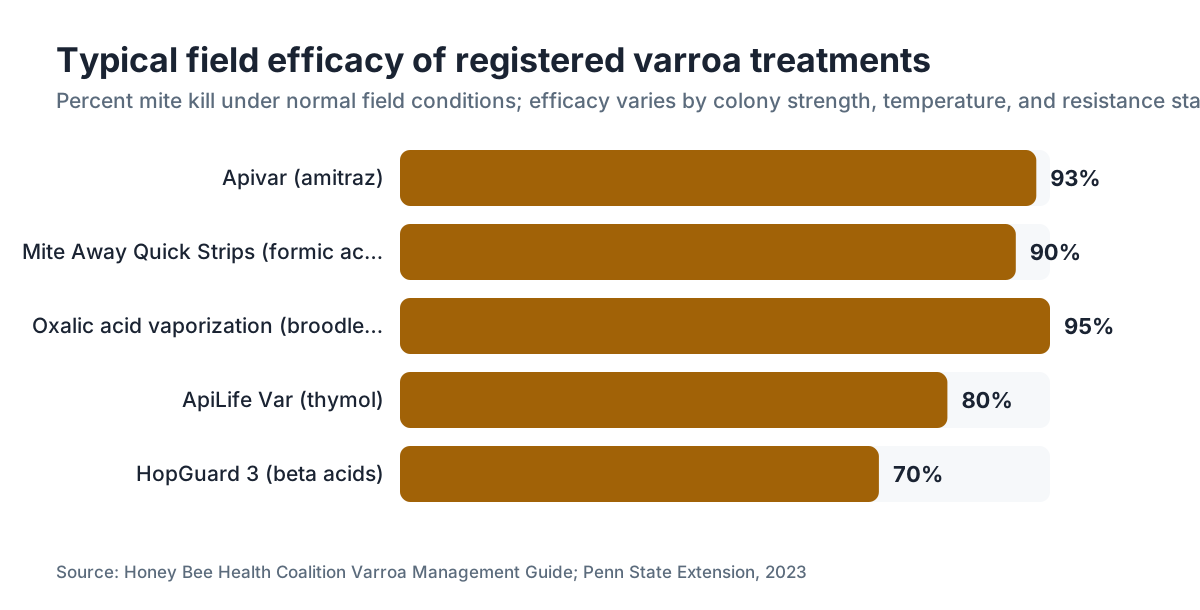
Here is a comparison of the main registered varroa treatments, based on published efficacy data and label requirements [2][6]:
| Treatment | Active Ingredient | Efficacy (typical field) | Works with brood? | Honey supers off? | Temp range |
|---|---|---|---|---|---|
| Apivar | Amitraz 3.3% | 90-97% | Yes | Yes | Above 50°F |
| Mite Away Quick Strips | Formic acid | 85-95% | Yes (partially) | Yes | 50-85°F |
| ApiLife Var | Thymol blend | 74-87% | Limited | Yes | 59-69°F |
| Oxalic acid (OAV) | Oxalic acid | 90-99% (broodless) | No (broodless best) | Yes | Above 40°F |
| Oxalic acid (dribble) | Oxalic acid | 90-99% (broodless) | No (broodless best) | Yes | Above 40°F |
| HopGuard 3 | Beta acids | 50-90% | Limited | No | Wide range |
Apivar's strengths are simple application (hang strips, come back in two months), high efficacy with brood present, and an easy monitoring schedule. Its weaknesses are the honey super restriction, the need for resistance rotation, and wax buildup over the long haul.
Oxalic acid vaporization beats Apivar on efficacy in broodless conditions and leaves no wax residue issue, but it needs either broodless timing or repeated treatments every five days across the brood cycle to match Apivar's convenience. For hobbyists short on time, one Apivar treatment in late August often beats a series of OAV treatments that get skipped because life got busy.
My honest take: Apivar is the right call for late-summer treatment in colonies with brood and moderate to high mite loads. Oxalic acid vaporization is the right call for midwinter, for colonies heading into spring, or when you need to treat during a flow without pulling supers (OAV is allowed with supers on under its current label). Use both across the year, not one instead of the other.
What does the Honey Bee Health Coalition say about Apivar?
The Honey Bee Health Coalition's Varroa Management Guide is the most thorough free resource US beekeepers have, and it is worth reading in full [2]. On amitraz specifically, the guide sorts it as a "hard" chemical treatment (as opposed to "soft" treatments like oxalic acid and thymol) and recommends it as a high-efficacy option for the late summer window.
The guide's take on amitraz efficacy is worth quoting: the Coalition rates amitraz as "high" efficacy with the qualifier that "resistance has been reported and may be increasing." That line captures both why Apivar gets recommended so often and why complacency is a bad idea [2].
The Coalition recommends the 2% mite threshold for starting treatment during the main foraging season and a lower informal target of around 1 to 2% in late summer, when the colony is raising winter bees. A mite load that stays manageable in June can collapse a colony if it rides into September.
For beekeepers who want a structured way to track treatments and mite counts across seasons, VarroaVault's free protocol tools match the Coalition's threshold and timing recommendations, so you can document decisions without rebuilding a spreadsheet every year.
Are there situations where you should not use Apivar?
Several. The label is explicit on some. Others are practical judgment calls.
Do not use Apivar when honey supers meant for human consumption are on the colony. That is a legal requirement under the EPA registration [1].
Do not use Apivar if you already treated with it earlier the same season without confirming resistance is absent. Back-to-back Apivar treatments in one year speed up resistance selection and are usually unnecessary if you did the first treatment right.
Skip Apivar in very weak colonies (fewer than three or four frames of bees). The contact mechanism falls apart when the cluster is too small to move the compound around. A better move for a weak colony is an oxalic acid dribble if it is broodless, or a small OAV dose if it has brood. Fix the weakness first (find and solve the queen problem) before you throw chemicals at it.
Do not treat if temperatures will stay below 50 degrees Fahrenheit for most of the window. Cold cuts amitraz efficacy hard [9]. If you are in a northern state and it is already October with cold nights, a broodless OAV treatment in November or December may serve you better.
If you suspect amitraz resistance, another round of Apivar will not fix the problem and will make resistance worse. Switch modes of action, then circle back to amitraz after a season or two if you want to rotate.
What do you need to buy and what does Apivar cost?
Apivar sells in packs of 10 strips. Through 2024 and 2025, US retail runs roughly $25 to $40 per 10-strip pack depending on the supplier [6]. That works out to $5 to $8 per colony at the standard two-strip dose. Set that against colony replacement (a package or nucleus runs $150 to $250) and the math is not close.
You also need chemical-resistant gloves, which the label requires. Thin nitrile disposables do not cut it. The label calls for gloves rated against chemical exposure. A box of thicker nitrile or neoprene gloves costs $10 to $20 and lasts a season.
Beyond that, nothing special. No vaporizer, no respirator, no dedicated gear. That is a big part of Apivar's appeal for hobbyist and sideliner beekeepers who do not want to buy OAV equipment for a small operation.
The full list of beekeeping supplies you want for a treatment season also includes alcohol wash gear (a mason jar, a strainer, 70% isopropyl alcohol) and a notebook or app for logging mite counts. The treatment is cheap. The monitoring supplies are cheaper. Skipping monitoring is where the real cost shows up.
Frequently asked questions
How many Apivar strips do I use per hive?
The label calls for 2 strips per colony of up to 10 frames of bees, and 1 strip per 5 frames for smaller colonies. For a standard 10-frame Langstroth at full population, 2 strips is correct. Do not add extra strips thinking more is better. It does not raise efficacy and it wastes product.
Can I use Apivar with honey supers on?
No. The EPA-registered label prohibits Apivar use when honey supers meant for harvest are on the colony. Remove all supers before inserting strips and keep them off for the whole 6 to 10 week treatment period. Putting supers back before strip removal breaks the label and creates contamination risk.
How long do Apivar strips stay in the hive?
A minimum of 6 weeks and a maximum of 10 weeks, per the label. The 6-week minimum covers about two and a half brood cycles, catching mites as they emerge from capped cells. Leaving strips in past 10 weeks does not improve efficacy and raises selection pressure for amitraz resistance.
Where exactly do you put Apivar strips in the hive?
Hang each strip vertically between two frames in the brood nest, at the center of the cluster where nurse bee activity peaks. Do not lay strips flat on the bottom board. The contact mechanism only works when bees walk across the strip surface repeatedly. In a two-box colony, splitting one strip per box reaches more of the cluster.
Does Apivar work in cold weather?
Efficacy drops below about 50 degrees Fahrenheit. Amitraz release from the polymer matrix slows in the cold, and bee movement through the hive falls off, cutting contact with strips. If your treatment window runs into late fall with sustained cold nights, use oxalic acid vaporization during a broodless period instead.
How do I know if Apivar treatment worked?
Run an alcohol wash or sugar roll 2 to 4 weeks after removing the strips. Compare the post-treatment count to your pre-treatment count. Effective treatment should cut mite levels by 90% or more. If the post-treatment count still sits above 2 mites per 100 bees, suspect treatment failure and check for resistance or application problems.
Can varroa mites become resistant to Apivar?
Yes. Amitraz resistance is documented in European and some US varroa populations, linked to mutations in the octopamine receptor gene. Resistance risk climbs with repeated use of the same active ingredient. Rotating to oxalic acid or formic acid in alternate seasons and always treating for the full labeled duration are the main ways to slow it.
Can I use Apivar in a new package or nucleus colony?
Yes, but only if mite levels warrant treatment. New packages from reputable suppliers often start with low mite loads, so wash first before committing. If your count exceeds 2%, Apivar is appropriate. In a nucleus colony with fewer than 5 frames of bees, use only 1 strip and watch the colony's population response.
Is Apivar safe for the queen?
At label rates, Apivar is generally considered safe for queens. Still, some beekeepers report queen losses or brood pattern disruption after treatment, mostly in weaker colonies or during high-stress periods. There is no strong controlled data establishing a direct causation rate. If you lose a queen during or shortly after treatment, other stressors are usually in play.
What temperature is too hot to use Apivar?
The label sets no upper temperature limit, and amitraz efficacy does not fall with heat the way it does with cold. Very hot conditions (above 95 degrees Fahrenheit) stress colonies and can hurt queen performance and brood survival independent of the treatment. Plan treatments for late summer when temperatures moderate rather than peak heat.
Can I use Apivar and oxalic acid at the same time?
No label prohibits concurrent use, and some beekeepers run oxalic acid vaporization alongside Apivar to hit mites not reached by contact. Combining treatments adds complexity and is not standard practice. The more common rotation is Apivar in late summer followed by OAV in winter. Simultaneous use has limited published efficacy data compared to either alone.
How do I dispose of used Apivar strips?
Used strips still hold some amitraz and should not go in compost or stay in the hive. Wrap them in newspaper or a sealed bag and dispose with household trash per your local rules. Do not burn them. Check your state's pesticide disposal guidance. Some states run collection programs for used agricultural chemicals.
Do I need a prescription or license to buy Apivar?
In most US states, Apivar is available to beekeepers without a prescription under the existing EPA registration. A few states classify it as a restricted-use pesticide requiring a certified applicator's license or supervision. Check with your state department of agriculture before buying. The EPA registration number on the label is 72997-8.
How does Apivar affect other pests or diseases in the hive?
Apivar targets varroa specifically and has no meaningful effect on American foulbrood, European foulbrood, nosema, or small hive beetles. It is not a general hive treatment. If your colony has secondary problems alongside a mite load, address those separately after confirming mite levels with a wash.
Sources
- EPA, Apivar pesticide registration (EPA Reg. No. 72997-8), Veto-Pharma product label: Apivar contains 3.3% amitraz, requires 2 strips per colony up to 10 frames, prohibits use with honey supers, and mandates 6 to 10 week treatment duration per the registered label
- Honey Bee Health Coalition, Varroa Management Guide: 2% mite infestation rate (2 mites per 100 bees) is the treatment threshold; amitraz is rated high efficacy with the note that resistance has been reported and may be increasing; rotation of modes of action is recommended
- Gregorc A et al., PLOS ONE 2016, amitraz efficacy study: Amitraz-based treatments achieved high efficacy in colonies without documented resistance; field conditions consistently produce lower results than controlled trials
- Gonzalez-Cabrera J et al., Scientific Reports 2020, amitraz resistance mechanisms in varroa: Mutations in the octopamine receptor gene associated with reduced amitraz sensitivity identified in European varroa populations
- Traynor KS et al., Scientific Reports 2021, pesticide exposures in US managed honey bee colonies: Amitraz and its metabolites found in a significant proportion of US commercial beeswax samples; lipophilic compounds accumulate in wax with repeated colony use
- Penn State Extension, Varroa mite management for beekeepers: Retail pricing for Apivar strips and comparative efficacy data for registered varroa treatments including formic acid, thymol, and oxalic acid products
- University of Minnesota Bee Lab, varroa management resources: Alcohol wash method for mite sampling described; 300-bee sample size and 2% threshold for treatment action cited
- USDA Agricultural Research Service, Bee Research Laboratory, varroa treatment efficacy data: Comparative efficacy of registered varroa treatments under US apiary conditions; amitraz field efficacy range of 90 to 97% in non-resistant populations
- Oregon State University Extension, Varroa mite management in Oregon: Temperature effects on amitraz efficacy; treatment timing recommendations for late summer and early fall windows
- Florida Department of Agriculture and Consumer Services, Apiary Inspection program: State-level guidance on varroa treatment registration requirements and beekeeper licensing for restricted-use pesticides
- Veto-Pharma, Apivar product page and technical data sheet: Apivar sold as 10-strip packages for five colony treatments at standard two-strip dose; product registered under EPA Reg. No. 72997-8
- Cornell University College of Agriculture and Life Sciences, honey bee extension: Resistance rotation strategy for varroa treatment: alternating amitraz with oxalic acid or formic acid across seasons reduces resistance selection pressure
Last updated 2026-07-09