Tracking MAQS Treatments: Timing, Temperature Restrictions, and Efficacy
MAQS, or Mite Away Quick Strips, contains formic acid as the active ingredient. It is one of the few registered varroa treatments that can be used with honey supers on the hive, which makes it uniquely valuable during the honey production season. But it is also the most temperature-sensitive and colony-stress-inducing treatment in the common toolkit. If you are not tracking MAQS applications carefully, you are taking unnecessary risks.
What Makes MAQS Different
Most varroa treatments work only on phoretic mites or require broodless conditions for full efficacy. MAQS is exceptional because formic acid vapor penetrates capped brood cells. This means it kills mites in the reproductive phase as well as phoretic mites, making it effective even when the colony has a full brood nest. Applied correctly, MAQS delivers efficacy rates of 90% or higher.
The tradeoff is volatility. Formic acid vaporizes rapidly at warm temperatures, which creates a high-intensity treatment period that can stress queens and in some cases cause brood mortality if hive ventilation is poor or temperatures exceed the upper limit. The same volatility that makes formic acid effective also makes it hazardous to work with. Always wear nitrile or rubber gloves and eye protection when handling MAQS strips.
Temperature Window
The registered temperature window for MAQS is 50 to 85 degrees Fahrenheit. This is the ambient temperature range during the treatment period, not just at time of application.
Below 50 degrees, formic acid does not volatilize adequately and treatment efficacy drops significantly. Above 85 degrees, volatilization is too rapid, which can cause queen loss and brood damage. The upper limit is the more dangerous constraint in practice. On a warm August day, temperatures can exceed 85 degrees even if mornings are cooler.
When tracking a MAQS treatment, log the temperature at time of application and the expected temperature forecast for the seven-day treatment period. A MAQS application that starts at 78 degrees on a day forecasted to reach 90 degrees the following afternoon is a risk. Consider waiting for a cooler window or switching to a different treatment.
Application Protocol
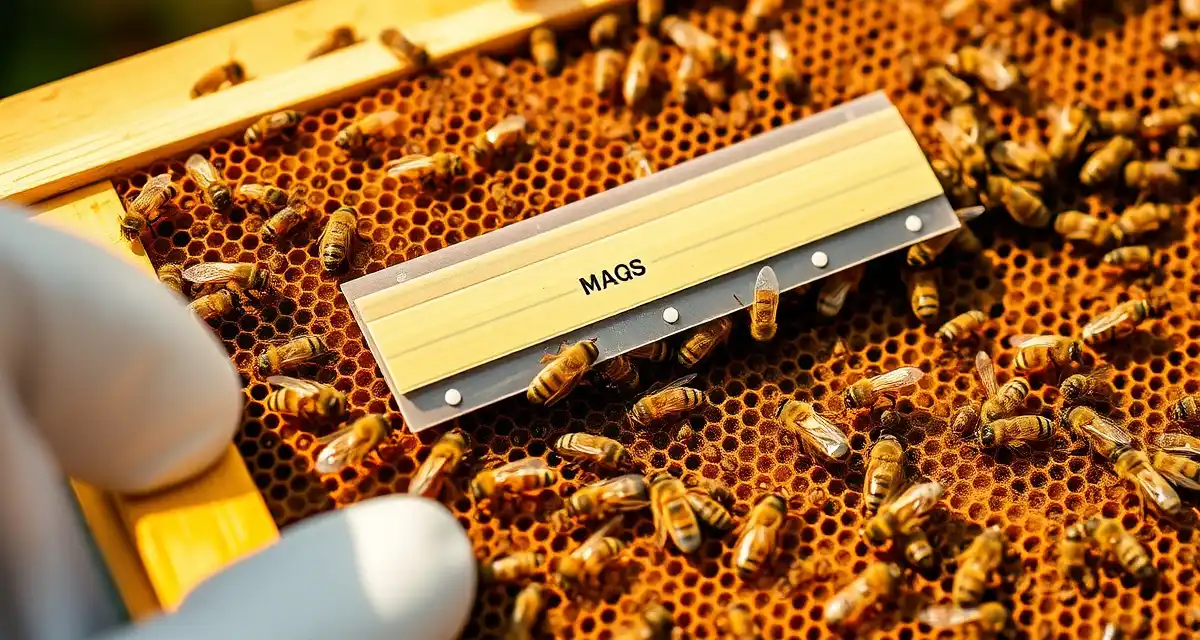
MAQS is sold in packs of two strips. For a standard colony, both strips are placed flat on top of the upper brood box frames with the foil side up, gel side down. The treatment period is seven days. Remove any remaining gel or strip material after seven days.
The entrance must be fully open during treatment to allow formic acid vapor to escape. Full-width open bottom boards with screened bottom inserts removed also help. Restricted ventilation concentrates vapor inside the hive and increases the chance of queen and brood damage.
Do not split or move hives during the treatment period. Physical disruption combined with formic acid stress increases colony losses.
A reduced-rate protocol using one strip per week for two consecutive weeks exists and can reduce stress on colonies during warmer conditions, though this requires twice the labor and a second visit.
What to Track in Your Records
For every MAQS application, record:
- Date strips placed
- Date strips removed or treatment complete
- Ambient temperature at time of application
- Temperature range during treatment period (reference your weather records)
- Colony population assessment at time of application (strong colonies tolerate MAQS better than weak ones)
- Mite count before treatment
- Mite count 10 to 14 days after strips removed
- Queen status check post-treatment (verify queen is present and laying)
The queen status check is important. If you apply MAQS and the queen disappears in the following two weeks, the treatment is the most likely explanation. Document it, requeen, and note it in your treatment records. Repeated queen loss after MAQS in a given yard may indicate that your application temperatures are too warm or that the product is not suitable for your summer conditions.
Calculating Efficacy
Efficacy is calculated the same way as for any varroa treatment: (pre-treatment count minus post-treatment count) divided by pre-treatment count, expressed as a percentage. A pre-treatment count of 4% and a post-treatment count of 0.4% represents 90% efficacy, which is within the expected range for MAQS under good conditions.
Efficacy below 70% after MAQS suggests one of the following: temperatures were outside the optimal range during treatment, ventilation was inadequate, the treatment period was shortened, or the colony had some other issue that limited exposure. Check these variables before concluding you have product failure.
VarroaVault's treatment log captures all of these fields and calculates efficacy automatically when you enter pre- and post-treatment mite counts. The treatment efficacy calculator gives you a consistent way to compare MAQS results across hives and seasons, and helps identify which colonies or conditions are associated with suboptimal outcomes.
MAQS in a Rotation Program
Because MAQS has a different mode of action than amitraz (Apivar) and oxalic acid, it plays an important role in treatment rotation planning to prevent resistance. A common rotation includes Apivar in fall, OAV during the broodless period, and MAQS as a mid-season treatment during honey flow when supers cannot be removed. This cycle keeps selection pressure varied and reduces the risk of any single treatment losing efficacy over time.
FAQ
What is Tracking MAQS Treatments: Timing, Temperature Restrictions, and Efficacy?
MAQS (Mite Away Quick Strips) treatment tracking is the practice of recording application dates, temperatures, colony conditions, and mite counts when using formic acid strips for varroa control. Because MAQS is temperature-sensitive and can stress colonies, keeping accurate records helps beekeepers time treatments correctly, evaluate efficacy, and avoid repeating mistakes. Tracking also supports better decision-making across multiple hives and seasons, turning each treatment into data you can act on.
How much does Tracking MAQS Treatments: Timing, Temperature Restrictions, and Efficacy cost?
MAQS strips themselves typically cost $20–$40 per package depending on quantity and supplier. The broader cost of tracking includes whatever record-keeping system you use — paper logs are free, while dedicated beekeeping software like VarroaVault may involve a subscription. Given that a failed or mistimed treatment can cost you a colony, the investment in proper tracking is modest compared to the risk of flying blind.
How does Tracking MAQS Treatments: Timing, Temperature Restrictions, and Efficacy work?
MAQS works by releasing formic acid vapor inside the hive. Unlike most varroa treatments, formic acid penetrates capped brood cells, killing mites in the reproductive phase as well as phoretic mites on adult bees. Strips are placed on the bottom bars for 7 days. The vapor spreads through the hive naturally. Efficacy depends heavily on temperature staying within the 50–92°F range, adequate ventilation, and colony size — all factors that good tracking helps you monitor.
What are the benefits of Tracking MAQS Treatments: Timing, Temperature Restrictions, and Efficacy?
The primary benefit is significantly reduced varroa mortality risk. MAQS can achieve 90%+ efficacy when applied correctly, and it is one of the only treatments approved for use with honey supers in place. Tracking treatments lets you confirm timing, flag temperature exceedances, compare efficacy across hives, and build a seasonal mite management history. This turns reactive beekeeping into a proactive system, helping you intervene before mite loads reach damaging thresholds.
Who needs Tracking MAQS Treatments: Timing, Temperature Restrictions, and Efficacy?
Any beekeeper managing colonies through the honey production season should understand MAQS tracking. It is especially important for those running multiple hives, since mite pressure varies by colony. Newer beekeepers benefit from structured tracking because MAQS misuse — applying in excessive heat or poor ventilation — can injure queens and brood. Commercial and sideliner operations particularly need reliable records to coordinate treatment windows and assess which hives need follow-up intervention.
How long does Tracking MAQS Treatments: Timing, Temperature Restrictions, and Efficacy take?
A standard MAQS treatment runs 7 days with strips in the hive. However, the full tracking cycle is longer: you should record a pre-treatment mite wash, monitor daily temperatures during the treatment window, log strip removal, and conduct a follow-up mite wash 3–4 weeks later to measure efficacy. From first mite count to final efficacy check, expect the complete tracking process to span 4–6 weeks per treatment event.
What should I look for when choosing Tracking MAQS Treatments: Timing, Temperature Restrictions, and Efficacy?
Look for a system that captures the essentials: application date, daily high and low temperatures, hive ventilation notes, queen status before and after, and mite counts at baseline and follow-up. Digital tools that flag temperature exceedances or auto-calculate treatment windows are especially useful. Avoid systems that only log the application date — the temperature and colony response data is what actually tells you whether the treatment worked and whether your bees tolerated it.
Is Tracking MAQS Treatments: Timing, Temperature Restrictions, and Efficacy worth it?
Yes, for most beekeepers managing colonies through varroa season, rigorous MAQS tracking is worth the effort. The treatment is powerful but unforgiving — applied outside its temperature window or in a poorly ventilated hive, it can harm the very colony you are trying to protect. Tracking converts each treatment into evidence: what worked, what stressed the colony, and what to adjust next time. Over seasons, that data compounds into genuinely better mite management outcomes.