Varroa mite count thresholds: when you must treat your hive
TL;DR
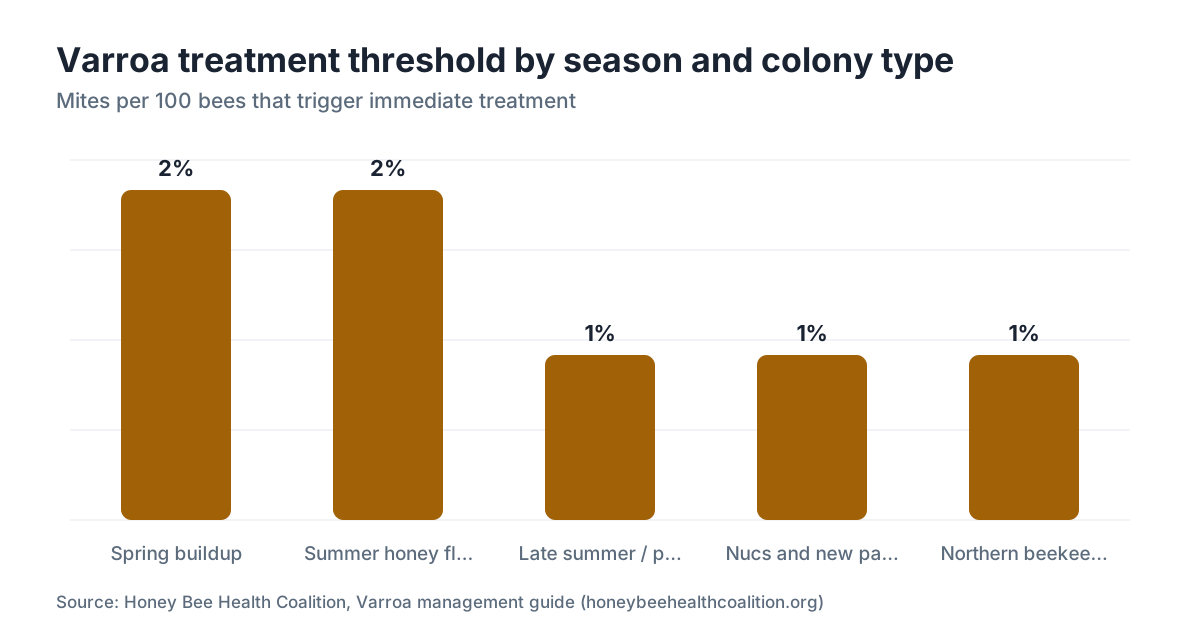
- The accepted varroa treatment threshold is 2 mites per 100 bees (2%) during the summer brood season, dropping to 1-2% in late summer before winter bees are raised.
- These numbers come from the Honey Bee Health Coalition and university extension research.
- Go above them and colony losses speed up fast.
- Stay under them and you usually have time to monitor rather than treat right away.
What is a varroa mite count threshold and why does it matter?
A mite count threshold is a number: a specific mite load, expressed as mites per 100 bees, at or above which you treat the colony. Below that number you keep monitoring. Above it you act. That's the whole concept.
Thresholds matter because treating too early wastes money, exposes your bees to miticides for no reason, and speeds up resistance in the local mite population. Treating too late means the colony is already crashing, virus loads are through the roof, and you're playing catch-up instead of managing a healthy hive. The threshold is the line between those two mistakes.
The Honey Bee Health Coalition, in its widely used Varroa management guide, says an action threshold of 2% (2 mites per 100 bees) fits the honey production season for most temperate regions of North America [1]. That number isn't arbitrary. It reflects field research on exponential mite population growth: a colony sitting at 2% in July can hit 5-6% by September if nothing is done [2].
For hobbyists running a handful of hives, thresholds also give you a shortcut for talking about a problem. Instead of arguing over whether the bees "look sick," you have a number. Numbers tell you what to do.
What are the specific thresholds for each season?
The threshold shifts with the time of year, and getting this right is probably the single most useful thing a beekeeper can do to cut winter losses.
| Season / Colony State | Action Threshold | Why It Shifts |
|---|---|---|
| Spring buildup (brood present) | 2% (2 mites / 100 bees) | Mites can still be diluted by rapid bee population growth |
| Summer honey flow (active brood) | 2% (2 mites / 100 bees) | Standard HBHC recommendation [1] |
| Late summer / fall (Aug-Sept, pre-winter bee production) | 1-2% (1-2 mites / 100 bees) | Winter bees raised now carry mites and viruses for 6+ months |
| Broodless period (winter or induced) | 1-3 mites per 100 bees on adults | Fewer bees sampled; higher proportion are infested because no brood to buffer |
| Nucs and packages | 0.5-1% | Small colonies collapse faster at the same percentage |
The late-summer threshold deserves extra attention. The bees your colony raises from roughly mid-August through September are your winter bees. They need to live six to eight months. If those bees are parasitized heavily at emergence, they'll have reduced fat body reserves, suppressed immune function, and shorter lifespans [3]. A colony sitting at 2.5% in August that doesn't get treated will often collapse in January or February. It looks like a "winter loss" when the real damage happened in summer.
Some researchers and extension educators push the pre-winter threshold lower, to 1%, for northern beekeepers where winters run long. The University of Minnesota Extension recommends treating if counts reach 2% in July, specifically to protect the fall bee cohort [4]. If you're in Minnesota or a similar climate, I'd use 1% as my personal trigger in August.
Nucs and newly established packages get their own row because they collapse faster. A 5-frame nuc at 2% mites is in worse shape than a full 10-frame double-deep at 2%. The absolute number of mites is smaller, but so is the buffer population. Treat nucs earlier.
How do you actually count varroa mites?
Three counting methods matter in practice: alcohol wash, powdered sugar roll, and sticky board count. Alcohol wash is the most accurate. The others have real limits worth knowing before you trust a number from them.
Alcohol wash (recommended)
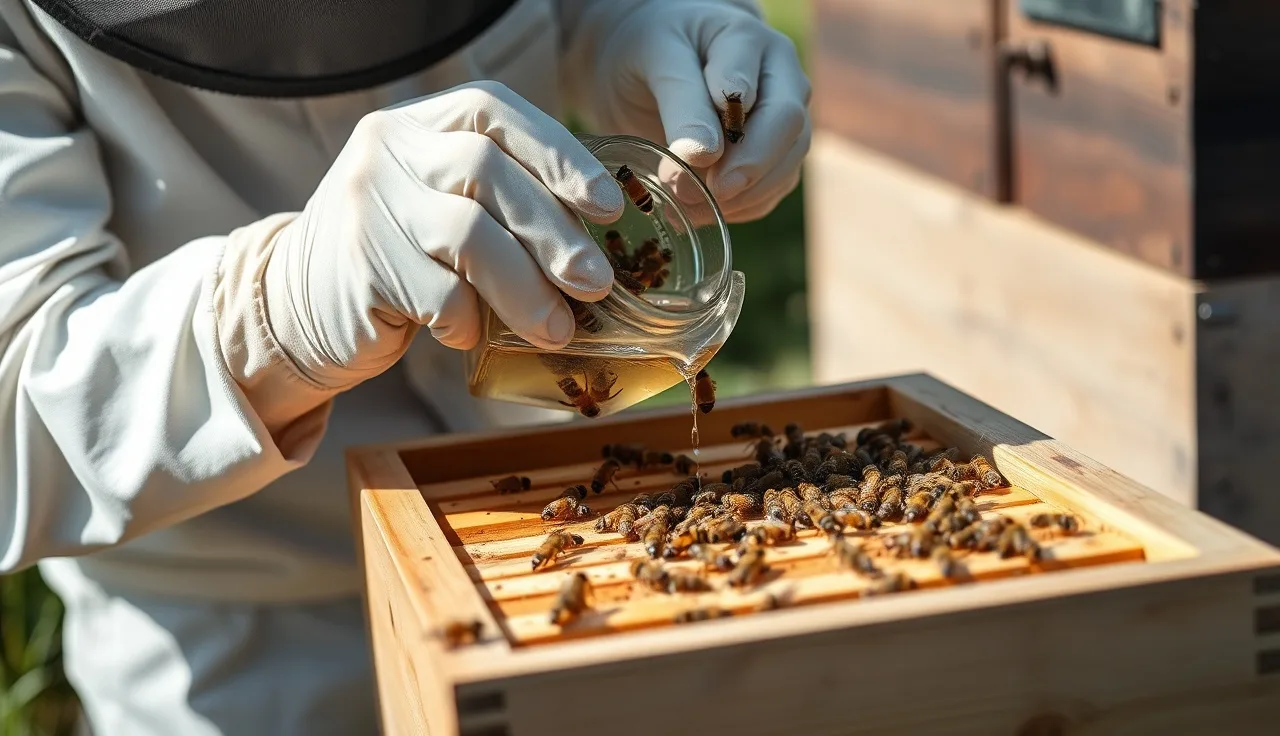
You collect roughly 300 adult bees (about half a cup by volume) directly from a brood frame, not the bottom board, not the entrance. Put them in a jar with isopropyl alcohol or windshield washer fluid, shake for 30-60 seconds, pour through a fine mesh strainer, and count the mites in the liquid. Divide mites found by bees sampled (300) and multiply by 100 to get your percentage.
Count 6 mites in a 300-bee sample and you're at 2%. Right at threshold.
The HBHC guide recommends alcohol wash as the most reliable field method and notes that sugar rolls undercount by 20-40% [1]. That undercounting is a real problem. A beekeeper using sugar rolls who thinks they're at 1.5% may actually be at 2.2-2.5%.
Sticky board counts
A sticky board (or a white board coated with Crisco) slid under a screened bottom board counts mite drop over 24-72 hours. This gives you a mite-drop-per-day figure, not an infestation percentage. Conversion tables exist, but they're rough. A 24-hour drop of roughly 8-10 mites per day sometimes gets cited as a 2% infestation in late summer, but the correlation is weak enough that most extension educators don't recommend sticky boards as a primary threshold tool [5]. They're fine for watching a trend.
Ether roll
Works, but skip it. Ether is a fire hazard and it kills the sample bees the same as alcohol does, so you gain nothing.
Sample size matters a lot. Fewer than 200 bees blows up your error margin. Three hundred bees is the standard. If your colony is weak and you can't get 300 without seriously stressing the cluster, note the caveat and lean toward treating when the count seems borderline.
For jars, screened lids, sticky boards, and the rest of the monitoring kit, beekeeping supply companies can get you set up.
Where exactly should you sample bees for the most accurate count?
Sample from a brood frame, near open and capped brood. Varroa prefer bees that have recently tended brood because those bees carry the chemical signals that attract mites. Bees at the entrance are foragers who have been away from the brood nest, and they carry fewer mites, so entrance sampling underestimates infestation [1].
Don't sample the frame the queen is on. You risk killing her.
Sample when outside temperatures are at least 55°F and the colony is active. Cold bees cluster and are hard to shake off frames cleanly. Aim for mid-morning in warm weather.
If you have multiple hives, sample every one of them separately. Mite loads across adjacent hives in the same yard can vary by a factor of three or four. An average across hives is close to meaningless. The high hive is the one that crashes and robs out its neighbors, spreading mites yard-wide. Sample individually, treat individually.
How often should you monitor mite levels?
Every 30 days during the active brood season is the standard from the HBHC [1]. That's March through October for most of the continental US. In practice, plenty of hobbyists monitor every four to six weeks and still catch problems in time.
The moments you cannot skip: early spring as brood ramps up, mid-July before the late-summer window opens, and late August to confirm whether fall treatment is needed. Those three points alone will stop most preventable winter losses.
After a treatment, recount 4-6 weeks later to confirm it worked. Treatment failure is more common than most beekeepers assume, from resistance, application errors, or temperatures outside the product's range. If you're still above threshold after a full course, you need a different active ingredient.
For the biology behind all this, our varroa mite overview covers the mite's reproductive cycle in detail, which explains directly why the threshold changes across seasons.
What happens if you ignore the threshold and don't treat?
Colony collapse. Not hypothetically. Colonies that exceed threshold and go untreated through late summer die over winter at dramatically higher rates.
The mechanism is well understood. Varroa feeds on bee fat bodies during the pupal stage, more than on hemolymph as older literature suggested. A 2019 study by Ramsey and colleagues in PNAS confirmed that varroa mostly consume fat body tissue, which is the bee's energy reserve and immune organ [3]. Heavily parasitized winter bees emerge already depleted. They live fewer weeks, raise fewer larvae come spring, and the colony slides into a feedback collapse.
Feeding damage is only half of it. Varroa transmits Deformed Wing Virus (DWV) and other pathogens. DWV titers in heavily mite-infested colonies run orders of magnitude higher than in low-infestation colonies. The virus causes visible wing deformities in severe cases, but the subclinical version (bees with normal-looking wings, suppressed immune function, and shortened lifespans) is far more common and far more damaging at the colony level.
Penn State Extension reports that colonies above 3% mite infestation in late summer were 2.6 times more likely to die over winter than colonies below 2% [2]. That's not a marginal difference.
Colonies don't always die cleanly, either. A collapsing high-mite colony will often abscond, rob neighboring hives, or drift heavily. All of those spread mites to healthy colonies in your yard or your neighbors' yards. Your untreated hive becomes everyone's problem.
Which treatments are appropriate once you hit threshold?
Your treatment choice depends on brood presence, temperature, whether you have honey supers on, and your location. There's no single best product. Here's an honest overview.
Oxalic acid (OA)
The most widely used treatment among US hobbyists right now. It comes in three forms: dribble, vaporization, and extended-release (oxalic acid in glycerin). Dribble and vapor both work well during broodless periods because OA kills phoretic mites (those riding on adult bees) but doesn't reach capped brood. Extended-release shop formulations and glycerin strips work over a 4-8 week window and can knock down mites even when brood is present. The EPA registered Api-Bioxal for use in the US [7].
Formic acid (Formic Pro, MAQS)
Formic acid vapor gets into capped brood cells and kills mites inside, which is its big advantage. It works across brood conditions. Temperature matters a lot: effective between roughly 50-85°F (10-30°C), but it can cause queen loss or brood kill at the high end, especially in small hive volumes. Always read the current label [8].
Amitraz (Apivar)
A synthetic miticide in plastic strip form. Highly effective, 6-8 week treatment course. Resistance is documented in parts of the US and Europe, so rotate away from it periodically. No honey supers during treatment per the EPA label [9].
Thymol (Apiguard, ApiLife Var)
Effective in the right temperature range (roughly 60-105°F / 15-40°C). Works poorly in very hot or very cold conditions. Some beekeepers in the mid-Atlantic and southern US find it inconsistent in summer heat.
For a fair cost and efficacy comparison, see the table. Prices are approximate 2025 retail ranges and vary by supplier.
| Treatment | Active Ingredient | Brood Penetration | Temp Range | Approx. Cost Per Hive | Honey Supers Allowed? |
|---|---|---|---|---|---|
| Api-Bioxal dribble/vapor | Oxalic acid | No (phoretic only) | Any (dribble); >50°F (vapor) | $1-3 | No (remove supers) |
| Api-Bioxal glycerin strips | Oxalic acid | Partial (slow release) | >50°F | $5-10 | No |
| Formic Pro | Formic acid | Yes | 50-85°F | $7-15 | Yes (short-term) |
| Apivar | Amitraz | No | >50°F | $8-15 | No |
| Apiguard | Thymol | Partial | 60-105°F | $5-10 | No |
Whatever you pick, use the full labeled dose for the full labeled duration. Half-treatments breed resistance without solving the problem.
For a free way to track treatment timing, count results, and follow-up monitoring, VarroaVault's varroa management tools help you build a simple schedule that matches your local season.
Is the 2% threshold the same everywhere, or does it vary by region and time of year?
Two percent is the standard, but it's a starting point, not a universal law carved in stone.
Geography matters. Beekeepers in Florida, the Gulf Coast, and Southern California deal with year-round brood and no natural broodless period. Mite populations can grow without pause, and the late-summer window northern beekeepers worry about never resets the same way. Southern beekeepers sometimes use a lower trigger, around 1%, because mite buildup doesn't stop.
African-derived honey bee populations, including africanized honey bees in the southern US, show more hygienic behavior and some natural varroa resistance. Research suggests mite populations grow more slowly in these colonies, though they still need monitoring.
Sweden and some other northern European countries have used slightly different thresholds based on their own long-term data, sometimes as low as 0.5% before the winter bee period. The principle holds even when the number moves.
Here's the honest position: the 2% figure comes from field observation and correlational studies, not from randomized controlled trials across thousands of colonies in every climate. It's a well-supported guideline, not a physical constant. The closest thing to a definitive North American source is the HBHC Varroa management guide, which recommends treating "when mite infestation levels reach 2 percent or higher" during the honey production and late summer period [1].
Use 2% as your anchor, adjust downward for long-winter or year-round-brood regions, and never let a count above 3% go untreated regardless of season.
Can you calculate the mite count threshold for a specific hive size or population?
Yes, and this is where the percentage framing pays off.
A strong summer colony might have 40,000-60,000 adult bees. At 2%, that's 800 to 1,200 mites on adult bees alone, not counting the 1.5 to 3 times more mites hidden in capped brood cells at any given moment. A colony at 2% infestation could carry 2,000 to 3,000 total mites. That number explains why mite populations explode so fast: each capped brood cell during mite reproduction can produce 1-2 new daughter mites in about 10-12 days.
A 5-frame nuc with maybe 8,000-12,000 bees at 2% has only 160-240 phoretic mites. But nucs have fewer bees to absorb new mites from the brood cycle, so the same percentage means faster deterioration. Treat nucs at 1%.
The percentage-based threshold beats an absolute mite count because colony population swings so widely. Two hundred mites in a 10,000-bee nuc is catastrophic. Two hundred mites in a 40,000-bee double-deep is manageable (0.5%). Always express your result as mites per 100 bees.
What do you do if your mite count is above threshold right before a honey flow?
This is the scenario that makes beekeepers want to look the other way. You've got supers on, honey coming in, and you check your mites and find 3%. Treating now means pulling supers or using a treatment that allows supers (formic acid under the right temperature conditions is the main option).
The honest answer: treat. A honey harvest from a colony that crashes in November is worth nothing. Delaying or skipping treatment to save a summer flow is a trade that rarely pays off.
Formic Pro (formic acid) is the one widely available product labeled for use with honey supers in place, though the label restricts temperature and application timing. Always read the current EPA-approved label before applying anything [8].
Oxalic acid vapor is fast (a single treatment takes minutes) and the residue clears quickly, but it works best during broodless conditions. A single vaporization during brood season will miss 50-80% of mites hiding in cells. If you go that route in summer with brood present, plan multiple applications and count again in three weeks.
Some beekeepers split the colony, let one half go broodless for a few weeks (the queenright half raises a new queen), then treat the broodless split with OA. It's a smart technique, but it adds complexity. Know your skills before committing.
How do you record and track mite counts across multiple hives and seasons?
Pen and paper works fine. A simple log with date, hive ID, sample size, mites counted, and infestation percentage is all you need. Consistency is what matters: same sampling method, same time of day, same location in the hive.
A lot of beekeepers use a spreadsheet. Each hive gets a column, each monitoring date gets a row. You can spot trends, see which hives run persistently high, and flag a hive that breaks the threshold over and over (which might mean poor hygienic genetics worth replacing).
VarroaVault has free monitoring tracking tools built for hobbyist and sideliner beekeepers who want a structured record without building a spreadsheet from scratch.
One thing worth graphing if you have a few seasons of data: your average mite infestation rate by month across years. You'll see fast when your local mite season peaks, and you can time monitoring and treatments to stay ahead of it instead of chasing it.
Are there natural or treatment-free approaches that can keep mites below threshold?
Some, yes. None are as reliable as miticides, and pretending otherwise doesn't help anyone.
Brood breaks, induced or natural, interrupt the mite reproductive cycle and can temporarily crash mite populations. A full broodless period followed by oxalic acid treatment is highly effective, with some studies showing 90-97% efficacy under ideal conditions [7]. The brood break concentrates mites on adult bees where OA can reach them.
Hygienic behavior selection is real. Colonies bred from stock with high hygienic index scores (measured through freeze-killed brood assays) remove mite-infested pupae more aggressively. VSH (Varroa Sensitive Hygiene) queens are commercially available and can cut mite reproduction rates significantly [11]. Not a silver bullet, but a biological buffer.
Small cell foundation, drone comb trapping, and screened bottom boards all show modest effects in some studies and no significant effect in others. The honest consensus is that they help at the margins under low mite pressure and shouldn't replace monitoring or treatment under high pressure.
Treatment-free beekeeping in high-varroa-pressure regions fails often. Nobody has great population-scale data on this, but the closest analysis comes from the Bee Informed Partnership's annual loss surveys, which consistently show higher colony mortality among beekeepers who report never treating [6]. If you want to move toward minimal treatments, stack the genetics in your favor with VSH or hygienic queens and monitor obsessively. The threshold doesn't disappear just because you'd rather not treat.
Frequently asked questions
What is the varroa treatment threshold in mites per 100 bees?
The standard treatment threshold is 2 mites per 100 bees (2%) during the active brood season, according to the Honey Bee Health Coalition. Before winter, that drops to 1-2% because the winter bees raised in late summer need to be as healthy as possible to survive six or more months in a cold cluster.
How many mites per 100 bees is bad?
Any count at or above 2% during summer is at threshold, meaning treat now. A count above 3% at any time of year is an emergency. Counts above 5% in late summer mean the colony is likely already declining with heavy virus loads, and even a successful treatment may not prevent significant winter losses.
What is the varroa threshold before winter?
Most extension educators and the HBHC recommend treating if counts reach 2% in late summer (July-August in the northern US). Some northern beekeepers use a 1% trigger in August to protect the winter bee cohort. The University of Minnesota Extension recommends treating at 2% in July to ensure winter bees are raised in a low-mite environment.
How do I calculate a mite infestation percentage from an alcohol wash?
Divide the number of mites you counted by the number of bees in your sample, then multiply by 100. If you washed 300 bees and found 6 mites: (6 / 300) x 100 = 2%. That's your infestation rate, right at threshold. Aim for a 300-bee sample for reliability; smaller samples increase your margin of error.
Is a 1% varroa level okay or should I treat?
During the summer honey production season, 1% is below the standard 2% threshold, so you watch and recount in 30 days rather than treating right away. In late summer (August onward), some beekeepers treat at 1% to protect winter bees. Nucs and small colonies should be treated at 1% any time of year because they have less population buffer.
How accurate is the sugar roll compared to the alcohol wash?
Less accurate. Research shows sugar rolls undercount mites by 20-40% compared to alcohol washes, according to the HBHC Varroa management guide. A sugar roll result of 1.5% might mean an actual infestation of 2-2.5%. If you use a sugar roll, consider treating at a lower displayed threshold (around 1.5%) to make up for the undercount.
Can a colony recover on its own if mite levels are above threshold?
Rarely, and not reliably. Without intervention, mite populations follow exponential growth curves during the brood season. A colony at 2% in July can reach 5-6% by September. Colonies with very strong hygienic or VSH genetics may slow that growth somewhat, but banking on self-recovery without knowing your queen's genetics is a gamble most beekeepers lose.
How often should I monitor mites during the year?
Every 30 days during the active brood season is the HBHC standard. At minimum, monitor in early spring, mid-July, and late August. Always recount 4-6 weeks after any treatment to confirm it worked. Skipping the post-treatment check is one of the most common beekeeper mistakes, because treatment failure is more common than most people think.
What varroa count is normal for a healthy hive?
There's no truly safe mite count; even low levels cause some damage. Below 0.5% (5 mites per 1,000 bees) is generally considered low-pressure and unlikely to cause measurable harm in the near term. Anything between 0.5% and 2% warrants close watching. Counts consistently below 1% in summer point to good genetics, an effective treatment history, or both.
Does the mite threshold differ for Langstroth vs. other hive types?
The threshold percentage (mites per 100 bees) is the same regardless of hive design. Hive volume does affect temperature consistency during treatments like formic acid or thymol. Smaller hive volumes concentrate vapor more aggressively, which can affect efficacy or queen safety. Always read the product label for your specific hive configuration.
Should I treat if I'm below threshold but see deformed wing virus symptoms?
Yes, treat immediately. Visible deformed wings mean virus titers are already extremely high, regardless of what your mite count shows. It's possible to have a lower mite count but very high DWV levels if a recent brood cycle concentrated infections. Deformed wings are a clinical sign the threshold model didn't catch in time.
What's the mite threshold for a new package or nuc?
Treat at 0.5-1% for nucs and new packages. Small colonies have less population to absorb mite damage, so they collapse faster at the same percentage load as a large colony. Monitor at 30 days after installation and again at 60 days. Many packages arrive with mite loads already near threshold because they came from stressed colonies.
Can I use a sticky board count to determine whether I've hit the treatment threshold?
Not reliably. Sticky board mite drop counts are a rough indicator of trends, not a precise infestation percentage. The link between daily mite drop and actual percentage varies with colony size, time of year, and temperature. Use alcohol wash for threshold decisions. Sticky boards are fine for watching whether a trend is rising between formal counts.
Is there a varroa threshold recommendation from the EPA or USDA?
The EPA regulates miticide labels and requires efficacy data, but it doesn't set an official treatment threshold. The USDA Agricultural Research Service has funded much of the underlying research. The Honey Bee Health Coalition, which includes USDA participation, publishes the most-cited North American threshold guidance at 2% during the brood season.
Sources
- Honey Bee Health Coalition, Varroa management guide: Action threshold of 2 mites per 100 bees during honey production and late summer period; alcohol wash recommended as most reliable field method; sugar rolls undercount by 20-40%; monthly monitoring recommended during brood season
- Penn State Extension, Honey bee and pollinator resources: Colonies above 3% mite infestation in late summer were 2.6 times more likely to die over winter than colonies below 2%; exponential mite growth projections from 2% to 5-6% by September
- Ramsey et al., PNAS 2019, Varroa destructor feeds primarily on honey bee fat body: Varroa destructor primarily consumes fat body tissue of honey bee pupae, not hemolymph as previously thought, depleting immune reserves and energy stores and shortening adult lifespan
- University of Minnesota Extension, Bee and pollinator resources: Recommends treating when mite levels reach 2% in July to protect the fall bee cohort raised for winter
- Oregon State University Extension, Insect and pollinator resources: Sticky board natural mite drop is a weak predictor of actual infestation percentage; not recommended as sole threshold tool
- Bee Informed Partnership, Colony loss and management surveys: Annual loss surveys consistently show higher colony mortality among beekeepers who report never treating for varroa
- EPA, Pesticide registration (Api-Bioxal oxalic acid): EPA registered Api-Bioxal oxalic acid for use in US honey bee colonies; efficacy under broodless conditions cited at 90-97%
- EPA, Pesticide registration (Formic Pro, formic acid, NOD Apiary Products): Formic acid labeled for use with honey supers in place under specified temperature and application conditions; temperature range 50-85°F; label restrictions on application timing
- EPA, Pesticide registration (Apivar, amitraz): Amitraz strips labeled for 6-8 week treatment course; honey supers must be removed during treatment; resistance documented in some US populations
- USDA Agricultural Research Service: USDA ARS supports foundational varroa research including mite population dynamics and treatment efficacy studies
- North Carolina State University Extension: VSH and hygienic queen genetics reduce mite reproduction rates; recommended as complement to chemical management
Last updated 2026-07-09