Beehive beetle trap and mite count tray: how to use both together
TL;DR
- A small hive beetle trap sits on the hive floor and drowns beetles in oil.
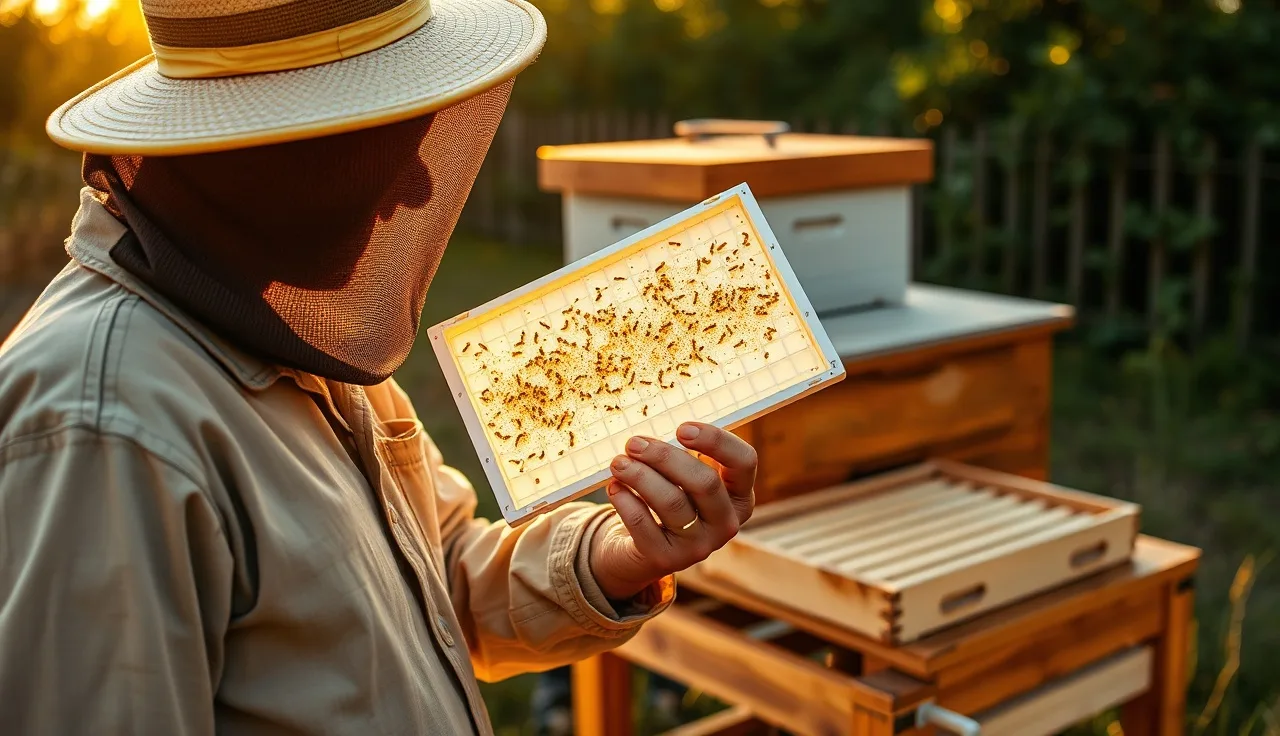
- A mite count tray (sticky board) slides under a screened bottom board and catches mites that fall on their own.
- Run both together and you get pest pressure data plus passive beetle control without cracking the hive open.
- Most U.S.
- extension programs treat a 2 percent varroa infestation during brood season as the point to act.
What is a beehive beetle trap and how does it work?
A small hive beetle (SHB) trap is a device you place inside the hive, usually on the bottom board or between frames, that catches Aethina tumida beetles before they lay eggs in your comb and ferment the colony's stores. The mechanism is simple. Beetles want tight, dark spaces to hide from bees. A good trap uses that instinct against them by offering a narrow-entry reservoir the bees can't fit into but the beetles can. Once inside, the beetle hits oil (vegetable, mineral, or olive) and drowns.
The most common design is a long, flat plastic tray, sometimes called a West trap, that sits directly on the bottom board and holds a thin layer of cooking oil. Bees herd beetles into the slots, the beetles fall into the oil, and you empty and refill the trap every week or two. Some beekeepers prefer a Freeman beetle trap, which is a full-width bottom board replacement with an oil reservoir built in beneath the screen. That design doubles as a screened bottom board, which matters if you also want to run a mite count tray.
A less common approach is the hanging CD-case trap, where an old CD jewel case filled with oil snaps between two frames. These work well enough in heavy beetle pressure areas like the southeastern United States, where adult SHB counts can reach hundreds of beetles per hive in summer. [1]
No trap eliminates beetles. Strong colonies with good hygienic behavior suppress beetle reproduction better than any hardware does. The trap supplements a healthy colony. It doesn't replace one.
What is a mite count tray (sticky board) and what does it tell you?
A mite count tray, often called a sticky board or Varroa monitoring tray, is a white or light-colored board coated with petroleum jelly, a repositionable adhesive, or vegetable shortening that slides under a screened bottom board. Over a 24-hour or 72-hour window, mites that fall off adult bees or emerge from uncapped cells drop through the screen and stick to the board. You count them and figure out a daily mite drop rate.
The sticky board gives you a natural mite fall count, sometimes shortened to NMF. It kills no bees, disturbs no brood, and mixes no chemicals. That makes it the lowest-barrier monitoring method you can run. The tradeoff is precision. Natural mite fall swings hard across seasons, hive populations, and brood ratios, so the link between daily drop rate and actual percent infestation is loose.
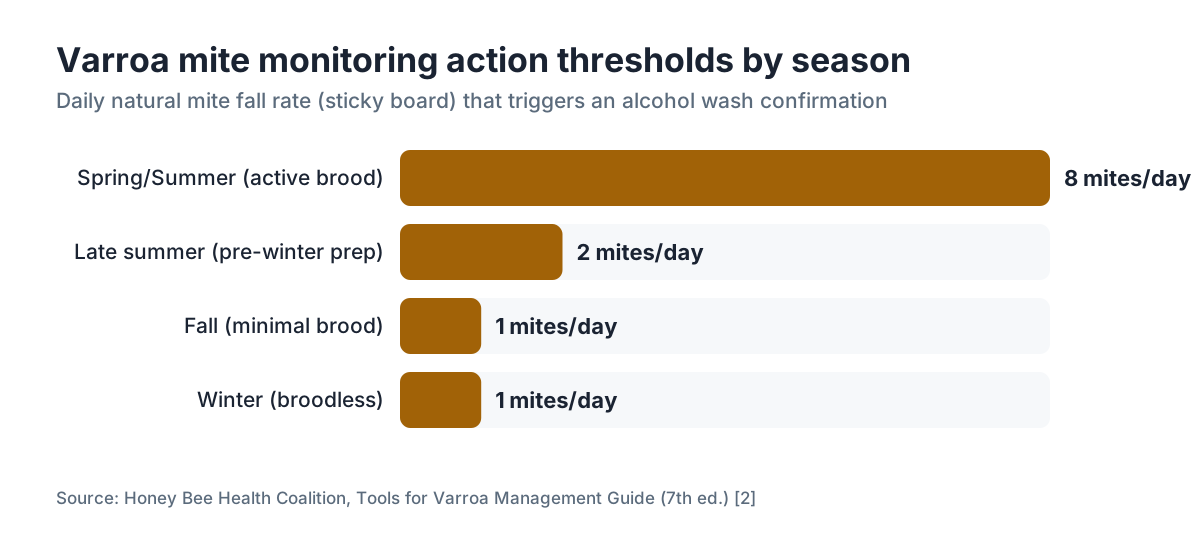
The Honey Bee Health Coalition's Tools for Varroa Management guide flags a natural fall of 8 or more mites per day as a reason to consider treatment during brood season, but that number is a rough guide, not a hard line [2]. Plenty of colonies show low natural fall while carrying a damaging infestation, because most mites hide in capped brood. Read the sticky board as a trend indicator. You use it across a season to watch which direction the numbers move, not as a precise count.
For a real infestation percentage, you need an alcohol wash or sugar roll on 300 adult bees. The sticky board screens. It tells you when to run the alcohol wash. It doesn't tell you whether to treat.
The varroa mite article on this site walks through every monitoring method in detail, including when each one fits.
How do you set up a mite count tray under a screened bottom board?
You need a Langstroth hive (or equivalent) with a screened bottom board, meaning the floor has a mesh insert (usually 8-mesh hardware cloth) instead of solid wood. The tray slides into a channel beneath that screen and stays there for the monitoring period.
Coat the tray with a thin layer of white petroleum jelly or a dedicated sticky board coating before you slide it in. The coating holds mites so they don't blow off or get eaten by insects. Make it thin. A thick coating traps so much debris that counting turns into a nightmare.
Insert the tray, note the time, and leave it alone for 24 hours (a one-day count) or 72 hours (a three-day count you then divide by three). Keep the entrance reducer in a normal position. Wind pulling through a wide-open entrance drags debris onto the board and makes counting harder.
When you pull the tray, take it somewhere with good light. Use a magnifying loupe or a 10x hand lens. Varroa mites run about 1.1 mm long and 1.5 mm wide, oval, reddish-brown, and wider than they are long [3]. Count only mites. Skip the wax scales, pollen grains, bee legs, and brown dots with no visible legs. A gridded sticky board (some come pre-printed, or you draw lines on white cardstock taped to the tray) speeds counting up a lot.
Divide your total mite count by the number of days the tray sat in place. That's your daily mite fall. Compare it to the threshold table below.
What do the numbers on a sticky board actually mean for treatment decisions?
Natural mite fall tracks percent infestation loosely, and the relationship shifts with brood cycle and season. During heavy brood production in spring and early summer, most mites sit in capped cells and the fall rate understates real infestation. In late fall when brood is minimal, almost all mites ride on adult bees and the fall rate reads truer.
The Honey Bee Health Coalition puts the brood-season action trigger at a natural fall of roughly 8 mites per day. State extension programs use slightly different numbers. University of Minnesota Extension treats an alcohol wash showing 2 percent or more infestation (2 mites per 100 bees) as the broadly accepted treatment threshold during brood season [4]. Those two figures aren't the same measurement, but they point at the same colony state.
See 10 or more mites per day on your board during brood season without an alcohol wash to back it up? Run the wash that same week. Don't wait.
Outside brood season, in late fall or early winter, a daily fall above 1 or 2 can matter because the colony is smaller and there's less brood to hide mites. Some guidelines say treat any fall colony showing more than 1 mite per day in November if you haven't treated it that year.
The board also gives you texture past a single number. A sudden spike after weeks of stable low counts sometimes means a brood break is ending and mites are emerging. A high count that won't drop after treatment points to treatment failure or reinfestation from a collapsing colony nearby. Watch the trend more than the single reading.
| Season / brood condition | Natural mite fall concern threshold (per day) | Recommended action |
|---|---|---|
| Spring/summer (active brood) | 8+ mites/day | Confirm with alcohol wash; treat if ≥2% |
| Late summer (pre-winter prep) | 2+ mites/day | Alcohol wash; treat before population drops |
| Fall (minimal brood) | 1-2 mites/day | Consider treating; colony is at greater risk |
| Winter (broodless) | Highly variable | Low fall is reassuring; spikes warrant spring check |
Can you use a beetle trap and a mite count tray at the same time?
Yes. This is the standard setup for any hive running a Freeman-style bottom board or a screened bottom board plus a separate beetle-trapping system. Set up right, they don't interfere with each other.
The configuration that works best: a screened bottom board is your hive floor, the sticky board slides into the tray slot below the screen during monitoring periods, and a separate in-hive beetle trap (the long plastic tray style) sits on top of the bottom board inside the hive, between the bottom bars of the lowest frames. The bees reach the beetle trap. The sticky board is external, below the screen, and the bees never touch it.
The one complication is timing. When your sticky board is in place, oil from an internal beetle trap can't contaminate it because the screen physically separates them. But a Freeman bottom board with a built-in oil reservoir can't run a standard sticky board tray in the same slot at the same time, because the oil reservoir occupies that space. For Freeman-style boards you'd do a timed alcohol wash instead of a sticky board count, or pull the oil insert and drop in a sticky board for 24 to 72 hours.
A couple of practical notes. Pull and refresh your beetle trap oil every one to two weeks in warm weather. A trap full of dead beetles and rancid oil quits working. Replace your sticky board coating between sessions too, so you're counting fresh fall instead of weeks of caked debris.
What type of oil works best in a hive beetle trap?
Vegetable oil is the standard recommendation and it works fine. Canola, corn, soybean, and other common cooking oils all drown beetles. Olive oil works too but costs more and goes rancid faster. Mineral oil is another option that doesn't spoil, though some beekeepers say bees show more interest in vegetable oil because of the scent, which may help pull beetles into the trap.
Skip strong attractants like apple cider vinegar in a hive-interior trap unless the trap is built for it and sits well away from the brood area. Some DIY instructions push ACV baiting to draw beetles faster, but vinegar at high concentration can throw off bee behavior at the entrance.
Oil depth matters. Most commercial traps hold a thin layer, roughly 3 to 5 mm. Too little and beetles survive. Too much and oil sloshes onto the bottom board during hive work and kills bees.
Change the oil once it's full of dead beetles or has turned dark and foul. In high-pressure summer conditions in the Southeast, that can mean weekly changes. In temperate northern states where SHB pressure runs lower, every two to three weeks is usually plenty.
What are the best commercial beetle traps on the market?
A handful of designs have been around long enough to earn a real track record.
The West Beetle Trap is one of the oldest and still sells widely. It's a flat plastic tray that fits between frames or rests on the bottom board. Simple, cheap (usually under $5 each), easy to clean. The downside: bees occasionally drown in it alongside beetles when the oil level runs too high or the slots wear out.
The AJ's Beetle Eater works on the same principle with a slightly different slot geometry that some beekeepers find more bee-safe. Both sell through most major beekeeping supply companies.
The Freeman Beetle Trap is a full bottom board replacement with a built-in oil reservoir under a screen. It handles SHB and ventilation at once. Price runs higher, around $30 to $50 depending on the supplier, but it drops the need for a separate screened bottom board. The trade-off, as noted above: it fills the space where a mite count tray would sit.
In low-beetle-pressure areas (upper Midwest, Pacific Northwest, New England), a simple in-hive trap plus a standard screened bottom board is probably enough and saves money. In Florida, Georgia, Texas, and the coastal South where SHB populations turn severe, go harder: multiple traps per hive, weekly oil changes, and tight population management.
Nobody has solid comparative efficacy data from a controlled trial on these specific products. The extension literature endorses the category of oil-based in-hive traps without crowning a commercial winner. [1]
How do you make a DIY mite count tray or sticky board?
A DIY sticky board costs almost nothing and works as well as commercial versions. You need a piece of stiff white cardstock or thin corrugated plastic cut to fit your tray channel (typically about 14 inches by 18 inches for a 10-frame Langstroth), petroleum jelly (Vaseline), and a way to draw a grid.
Cut the board to fit snugly in the tray channel of your screened bottom board. Draw a grid of 2 cm squares across the surface with a marker, or print a grid and tape it under a clear plastic sheet. Coat the top with a thin, even layer of petroleum jelly. Insert, wait 24 to 72 hours, pull, and count.
Some beekeepers use cooking spray (PAM or equivalent) instead of petroleum jelly. Easier to apply, less tacky. Vegetable shortening (Crisco) works too. Steer clear of anything that could drip into the hive cavity in warm weather.
No screened bottom board? You can still run a timed check by wedging a board under a solid bottom board with a small gap at the back. It's less accurate and picks up more debris, but it gives you a rough trend. The better fix is to switch to a screened bottom board, which most beekeepers already run for ventilation anyway.
For good beekeeping supplies to build a proper screened bottom board and tray setup, most regional beekeeping clubs keep a recommended suppliers list.
How often should you run a sticky board check and when does it not apply?
During active brood season (roughly April through September across most of the continental United States), a 72-hour sticky board check once a month gives you a reasonable baseline trend. Numbers stable and low? Stretch to every six weeks. Trend climbing? Tighten to every two weeks and confirm with an alcohol wash.
In late summer, run a check in August and again in September. This is the highest-stakes window of the year. Mite populations build fast on late-summer brood, and the bees raised in August and September are the winter bees that have to survive until spring. Heavy mite loads on winter bees cause a well-documented collapse: bees born with compromised fat bodies die early, the colony population crashes in January or February, and the hive dies with plenty of stored honey left behind. [5]
In winter, when the colony is broodless, the sticky board tells you less but isn't useless. A quick 24-hour check in late winter (February in the South, March in the North) can flag a high-mite spring before the bees start building population again.
Sticky boards are least useful right after treatment. Wait out the full treatment interval (it varies by product) before you read sticky board results as mite levels, because the treatment itself throws a big temporary spike in fall as mites die and drop.
VarroaVault's free monitoring protocol spreadsheet lays out when to run each monitoring type by month if you want a season-long schedule built out.
Do screened bottom boards reduce varroa mite counts without a tray?
Screened bottom boards do send mites out of the hive for good when they drop through the mesh, but the effect on total mite population is modest. The research runs fairly consistent here: screened bottom boards alone cut mite infestation by roughly 10 to 15 percent compared to solid bottom boards [6]. That's not enough to call it a treatment.
The real value of a screened bottom board is monitoring access, not mite control. The screen gives mites that fall (for any reason) a way out instead of a chance to climb back onto bees, which is a small but genuine reduction. It also improves hive ventilation, which most beekeepers count as a separate benefit, especially in humid summers.
Back in the 1990s and early 2000s, some beekeepers sold screened bottom boards as a varroa control method. The evidence never supported that at a treatment level. The screen's worth is the monitoring window it opens, not the mites it removes on its own.
Stuck with solid bottom boards and don't want to swap them? You can still run alcohol washes as your primary monitoring tool. The sticky board is convenient, not mandatory. What is mandatory is regular monitoring by some method at least every four to six weeks during brood season. [2]
What are the signs of a small hive beetle infestation beyond what a trap catches?
Traps catch adults, but they miss the real damage, which is larval feeding. SHB larvae are creamy white, similar in appearance to wax moth larvae but with three pairs of true legs near the head and small spines running down their backs [1]. They chew through comb, defecate in honey (which ferments and throws a smell often described as rotting oranges), and can destroy stored brood in severe cases.
The first visible sign of active larval infestation is usually slime on the surface of frames: a wet, brownish-yellow gunk that rides along with the fermenting honey. Bees will often propolize and seal off affected cells early on, but a heavy beetle load overwhelms that response fast.
Colonies that abscond after a beetle infestation get called "beetle-slimed" hives. You open the box to find slimed comb, larvae crawling everywhere, and no bees. This hits weak colonies and hives left unmanaged through late summer in high-pressure areas hardest.
Beetle pressure is deeply regional. In the upper Midwest and New England, plenty of beekeepers go seasons without significant SHB damage. In coastal Georgia or Florida, a hive that drops below about four frames of bees can get wiped out in weeks during summer. Know your local pressure before you decide how much hardware to buy.
The africanized honey bee article compares how colony defensiveness traits shape pest management outcomes in southern U.S. beekeeping.
What is the right sequence for combining beetle trap and mite monitoring into one hive-floor routine?
You don't need two separate inspection days. One hive-floor visit every two weeks (or monthly at minimum) handles both tools at once.
Start each visit by pulling the mite count tray from the rear of the hive while the colony is undisturbed. No smoke, no veil, since you never open the hive. Note the count, date, and any visible patterns (debris bunched near the front versus spread evenly). Heavy debris toward the back of the board sometimes shows where the winter cluster sat or where the brood nest centers.
Then lift the hive box slightly and check or refill the beetle trap oil. An in-hive tray trap means opening the hive, so this step needs protective gear. Many beekeepers fold it into their regular hive inspection instead of a separate visit.
Record everything. Mite counts only earn their keep over time, when you can read the trend. One data point tells you something. A season of data points tells you a lot. Use any format that sticks: a notebook, a phone note, a spreadsheet.
VarroaVault has a free digital protocol tool that logs sticky board counts and flags when your trend crosses the Honey Bee Health Coalition's monitoring thresholds. It also tracks treatment history so you can spot resistance patterns across years. You reach it through the Varroa tools page.
The point of pairing these two tools is cutting the mental overhead of pest management. You're building a habit, not running a procedure. Two minutes at the back of the hive every two weeks, plus a few minutes inside during a regular inspection to refresh the beetle trap, is a routine you can actually keep, and it gives you real data.
Frequently asked questions
How many mites per day on a sticky board means I need to treat?
The Honey Bee Health Coalition uses a rough threshold of 8 or more mites per day during brood season as a reason to act, meaning confirm with an alcohol wash and treat if infestation reaches 2 percent or more. The sticky board alone is not a treatment-decision tool. It's a screening tool that tells you when to run an alcohol wash, which is the accurate count.
Can I use a sticky board without a screened bottom board?
Yes, but it's awkward. You can temporarily wedge a coated board under a solid bottom board with a small gap at the rear and get a rough mite fall reading. The count runs less reliable because wind and debris contaminate it more easily. Switching to a screened bottom board is the right long-term fix. They cost $20 to $40 and are standard gear for any monitoring-focused beekeeper.
How often should I change the oil in a hive beetle trap?
Every one to two weeks in warm weather when beetle pressure is high. Every two to three weeks in cooler conditions or low-pressure regions. The trap stops working when it's packed with dead beetles or the oil turns dark and rancid. A quick smell and visual check each time you visit the hive tells you whether the oil is still doing its job.
Do small hive beetle traps harm bees?
They can, if designed or filled poorly. The main risk is bees drowning in oil that's too deep or slipping through oversized slots. Commercial traps built for in-hive use (West trap, AJ's Beetle Eater) hold this down with slot geometry bees can't easily enter. Keep oil at the manufacturer's fill line. A few incidental bee deaths is normal; heavy bee loss means the trap is overfilled or mis-positioned.
What's the difference between a sticky board check and an alcohol wash?
A sticky board measures how many mites fall off bees naturally per day. It's passive and non-lethal. An alcohol wash kills roughly 300 bees in isopropyl alcohol, then counts the mites that wash off, giving you a direct percent infestation. The alcohol wash is more accurate. The sticky board is easier and tells you when to run the wash. For treatment decisions, confirm with an alcohol wash.
Can I leave the sticky board in permanently?
No, for two good reasons. First, a permanent sticky board piles up so much debris that counting becomes impossible within a week. Second, leaving a solid surface under the screen during summer cancels much of the ventilation benefit of a screened bottom board. Use the tray for timed 24 to 72-hour monitoring windows, then pull it. Store it clean and re-coat before the next use.
Does a screened bottom board control varroa mites on its own?
No. Screened bottom boards cut mite infestation by roughly 10 to 15 percent by letting mites that fall naturally exit the hive. Real but small, not a treatment. Screened bottom boards are monitoring tools. Treatment needs an approved miticide: oxalic acid, amitraz, fluvalinate, or others depending on season and brood presence. The screen is where you gather information, not where you fight the mite.
What oil is safe to use in a small hive beetle trap inside the hive?
Standard vegetable cooking oil (canola, corn, soybean) is the most commonly recommended option and is considered safe for in-hive use. Mineral oil works too and doesn't go rancid as fast. Skip essential oils or attractant-laced oils in hive-interior traps unless the design is specifically made for them. Strong scents near the brood nest can disrupt normal bee behavior.
How do I count mites on a sticky board accurately?
Good light and a 10x loupe or hand lens make a real difference. Use a board with a pre-printed grid or draw 2 cm squares yourself. Count one grid square at a time, marking each as you go. Varroa mites run 1.1 mm long, oval, reddish-brown, and distinctly wider than long. They look different from pollen grains, wax scales, and dead bee parts once you know the shape. Your first few counts will be slow. It gets faster.
When in the year should I prioritize mite monitoring most?
Late July through September is the highest-stakes window in most of the continental United States. Mite populations sit at or near their seasonal peak, and the bees raised during this period are the winter bees that have to survive until spring. Heavy mite loads in this window cause deformed wing virus and shortened adult bee lifespan, collapsing colonies in midwinter. Monitor at least every four weeks here, and don't skip treatment if thresholds are crossed.
Can I use the same tray for both beetle monitoring and mite counts?
No. A beetle trap uses oil to drown insects. A mite count tray uses a sticky coating to hold mites in place for counting. Those two things are incompatible in one device. They also live in different physical spots: a beetle trap sits inside the hive, reachable by bees; a mite count tray slides below the screen, fully outside the bee space. Use them as separate pieces of equipment.
How do I know if small hive beetles are a real problem in my area?
SHB (Aethina tumida) is established throughout the eastern United States, Hawaii, and parts of California. Pressure runs highest in warm, humid regions: Florida, Georgia, the Gulf Coast, and coastal Carolinas. In the upper Midwest, New England, and mountain West, hive beetle populations are generally low enough that one or two traps per hive is enough and catastrophic infestations are rare. Check with your local beekeeping association for regional pressure data.
What should I do if my sticky board shows a sudden spike in mite fall after treatment?
A spike in natural mite fall during and right after treatment is expected and good. It means the treatment is working. Mites killed or disabled by the active ingredient fall off bees and drop through the screen. Wait until the treatment period is fully done (check the product label), then run a post-treatment alcohol wash to confirm your infestation level actually dropped. If it didn't, dig into treatment failure or reinfestation.
Sources
- University of Florida IFAS Extension, Small Hive Beetle Management in Florida: Small hive beetle biology, larval identification, and in-hive trap designs including oil-based traps
- Honey Bee Health Coalition, Tools for Varroa Management Guide (7th edition): Natural mite fall threshold of approximately 8 mites per day as a monitoring action trigger; recommendation to confirm with alcohol wash before treating
- USDA ARS, Varroa destructor biology and identification: Varroa destructor mite dimensions: approximately 1.1 mm long, 1.5 mm wide, reddish-brown
- University of Minnesota Extension, Varroa Mite Management: 2 percent infestation (2 mites per 100 bees in alcohol wash) as the broadly accepted brood-season treatment threshold
- Dainat B, Evans JD, Chen YP, Gauthier L, Neumann P, PLOS ONE 2012. Predictive Markers of Honey Bee Colony Collapse: High varroa loads on late-season bees reduce fat body development, shortening winter bee lifespan and causing midwinter colony collapse
- Johnson RM, Dahlgren L, Siegfried BD, Ellis MD, PLOS ONE 2013. Acaricide, fungicide and drug interactions in honey bees: Screened bottom boards reduce mite infestation by approximately 10 to 15 percent compared to solid bottom boards
- EPA, Pesticide Registration for Varroa Mite Control Products: EPA registration requirements and label compliance for varroa miticides including oxalic acid, amitraz, and fluvalinate
- Pennsylvania State University Extension, Varroa Mite Monitoring and Management: Seasonal mite monitoring frequency recommendations and alcohol wash protocols for hobbyist beekeepers
- NC State University Apiculture Program, Small Hive Beetle: Regional SHB pressure distribution in the eastern United States; impact on weak colonies
- Honey Bee Health Coalition, Varroa Management Decision Tool: Seasonal treatment thresholds by month and region, including late summer pre-winter treatment windows
- Oregon State University Extension, Integrated Pest Management for Varroa Mites: Screened bottom board use as a monitoring tool rather than a standalone mite control strategy
Last updated 2026-07-09