Mite count alcohol wash: how to do it and what the numbers mean
TL;DR
- An alcohol wash is the most accurate way to count varroa mites in a honey bee colony.
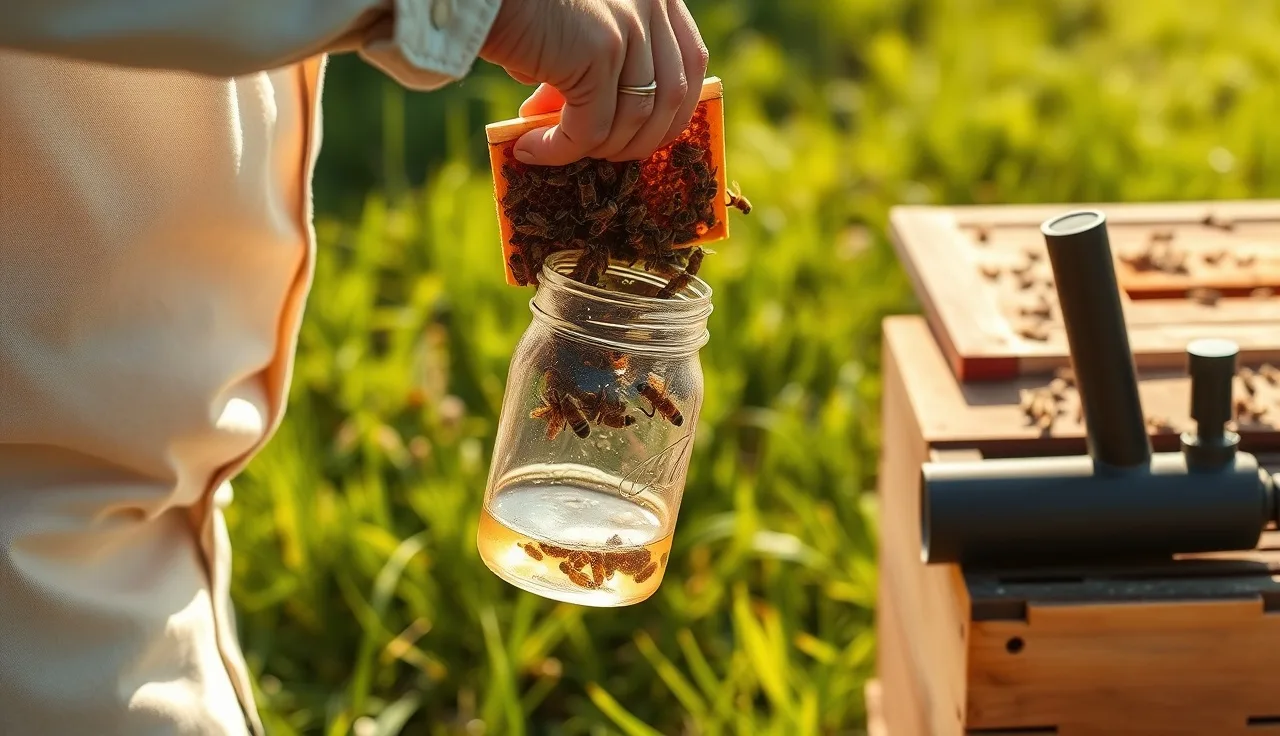
- You shake roughly 300 bees (about half a cup) into isopropyl alcohol, shake for 60 seconds, strain, and count the mites that fall out.
- A result of 2 or more mites per 100 bees is the accepted treatment threshold in most of North America.
What is an alcohol wash mite count?
An alcohol wash is the most reliable way a beekeeper can measure how many varroa mites live on the adult bees in a colony. You take a sample of bees, kill them in alcohol, and count the mites that wash off. The result, expressed as mites per 100 bees, tells you whether your load sits below or above the point where treatment makes sense.
The test sounds simple, and it mostly is. But the details decide whether the number means anything: which bees you sample, how many you get, how you count, and what you do with the result afterward. Done sloppily, you get a number that doesn't represent the colony. Done carefully, it's genuinely useful data.
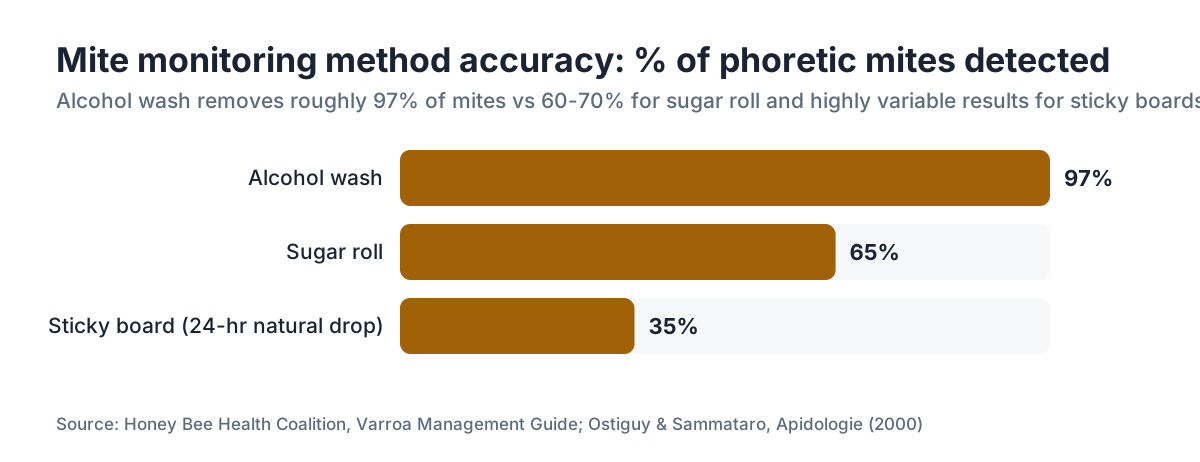
Be clear about what the wash tells you and what it doesn't. It measures phoretic mites, the ones riding on adult bees out in the open. Mites sealed inside brood cells are invisible to this test. That's a known limitation, not a flaw. Phoretic mite load tracks total colony mite population closely enough under normal conditions that the number is still a reliable signal. The Honey Bee Health Coalition's Varroa Management Guide calls the alcohol wash the "gold standard" for accuracy among the monitoring methods beekeepers can actually run at home. [1]
How does alcohol wash compare to other mite counting methods?
Three methods dominate: alcohol wash, powdered sugar roll, and sticky board counts. They are not interchangeable, and treating them as if they are gets colonies killed.
| Method | Accuracy | Kills bees | Time needed | Cost |
|---|---|---|---|---|
| Alcohol wash | High (~97% mite removal) | Yes (~300 bees) | 10-15 min | Under $5 in supplies |
| Powdered sugar roll | Lower (~60-70% mite removal) | No | 10-15 min | Under $2 |
| Sticky board (natural drop) | Low (highly variable) | No | 24-72 hrs | Free or $5 for board |
The sugar roll's appeal is obvious. You don't kill bees. But multiple studies put its recovery at around 60-70% of phoretic mites, against roughly 97% for the alcohol wash. [2] That gap is big enough to matter. If your true load sits right at threshold, a sugar roll can hand you a number that looks safe, and you skip treatment. That's how colonies die.
Sticky boards measure how many mites fall naturally over 24-72 hours. Temperature, brood cycle phase, colony population, and any chemical residue already in the hive all move that number around. The Honey Bee Health Coalition recommends against relying on sticky boards alone for treatment decisions for exactly those reasons. [1]
Want an honest answer? Use the alcohol wash. Losing 300 bees from a colony of 50,000-plus costs you almost nothing.
What supplies do you need to do an alcohol wash?
The list is short and cheap. You can buy a purpose-built mite counting jar from most beekeeping supply companies, or you can build one yourself for a few dollars.
You need:
- Two wide-mouth mason jars or purpose-built wash containers (one for washing, one for rinsing and counting)
- A fine mesh lid that lets alcohol through but holds bees and mites. Hardware cloth at 8 mesh works, or use a mason jar screw-band with a circle of fine window screen.
- At least 70% isopropyl alcohol. Higher (91%) works fine. Skip rubbing alcohol with additives like aloe, which make mites harder to see.
- A measuring cup or scoop calibrated to roughly half a cup (about 300 bees when the jar is packed with bees, not liquid)
- A white bowl or plastic container to pour the wash into for counting
- Good light
The whole setup runs under $10 if you improvise, or $15-25 for a pre-made kit. Some beekeepers keep a spray bottle of water to rinse the mesh and catch every last mite. Optional, but helpful if you're new to this.
How do you collect the right bees for an accurate sample?
Where you collect bees matters as much as how many you collect. Sample nurse bees from the brood nest. Nurse bees carry the highest phoretic mite load in the colony, because they work open brood cells constantly and varroa prefer to ride on them.
Find a frame in the middle of the brood nest with open brood on it. Look for bees covering that brood. Knock or shake the frame sharply so the bees drop into your collection jar. Repeat once or twice until you have roughly half a cup. You don't need to find the queen first, but glance at the frame before you shake so you don't sample her by accident.
Don't scoop bees off the bottom board or entrance. Don't sample foragers that just flew in. Those bees carry below-average mite loads and hand you a falsely low count.
A queenright hive with brood can be sampled any time the bees are flying, meaning roughly 50-55°F and up with active bees. In a queenless, broodless colony (after a split, or in late fall once the cluster tightens), mites spread more evenly across the adult bees, so sampling gets easier. The count is harder to read against your usual benchmarks, though, since there's no brood soaking up part of the mite population.
Aim for 300 bees. A half-cup measure packed with bees (no air pockets) gives you roughly that. The math runs about 1.5-1.7 bees per milliliter. [3] Fewer bees means a less precise count. More doesn't buy you much extra precision.
Step-by-step: how to run the alcohol wash
With your bees in the jar, the process takes about 10 minutes.
- Pour in enough alcohol to fully cover the bees. For a half-cup sample, 1-2 cups of isopropyl does it. Put the mesh lid on tight.
- Shake hard for 60 seconds. This knocks mites off the bees. Some beekeepers go 30 seconds, pause, then 30 more. Either way, don't cut the shaking short.
- Pour the alcohol through the mesh into your white counting bowl. Shake the jar so all the liquid comes through.
- Recommended: add a splash of fresh alcohol to the jar, shake 10-15 seconds, and pour that through too. This catches mites the first wash missed.
- Let the liquid settle a minute. Mites are small (about 1.1mm wide, reddish-brown, oval) but visible against white without magnification for most people with normal eyesight. A flashlight helps.
- Count every mite you see. If the bowl is crowded with bee debris, tilt it gently or spread the contents with a brush. You can also strain the liquid through a coffee filter and count the mites on the paper.
- Record the number. Calculate: (mites counted / bees in sample) x 100. Six mites from a 300-bee sample is 6/300 x 100 = 2.0 mites per 100 bees.
Dispose of the bee and alcohol slurry away from hive entrances. Dead bees can go in the compost.
What mite count is too high? Understanding the treatment threshold
The threshold used across North America is 2 mites per 100 bees during the brood-rearing season (roughly March through August, depending on your climate). The Honey Bee Health Coalition recommends treating when you reach or exceed 2% during this period. [1]
In late summer and fall, the threshold tightens. The mites alive in August and September are the ones that parasitize the long-lived winter bees your colony needs to reach spring. Those winter bees have to be healthy, meaning low viral load, because they live for months instead of weeks. So many experienced beekeepers and university extension programs recommend treating at 1 mite per 100 bees in late summer, roughly August, or whenever your region starts rearing the winter bee cohort. [4]
Treat the threshold as a calibrated risk signal, not a hard line. Three mites per 100 bees in July gives you weeks before serious damage sets in. Three mites per 100 bees in late September puts your colony in real danger heading into winter.
Below 1 mite per 100 bees in peak season: you're fine, monitor monthly.
At 1-2 mites per 100 bees: watch closely, treat if fall is approaching.
At 2 or more mites per 100 bees: treat. Now.
Delay costs you here. Varroa populations can double roughly every 3-4 weeks under good brood conditions. [5] What reads borderline today can be a disaster in a month.
How often should you do an alcohol wash?
Most extension programs and the Honey Bee Health Coalition recommend monitoring at least once a month during the active season (when brood is present), and more often in late summer when mite populations spike. [1] That's a floor, not a target.
A practical schedule for most temperate-climate beekeepers:
- April and May: one count a month, mostly to set your baseline for the year
- June through August: every 2-4 weeks, especially as you approach treatment windows
- September: at least twice, since getting ahead of mites now decides winter survival
- October onward (if broodless or near-broodless): once, to see whether a treatment is still possible and worthwhile given your local conditions and options
Just treated? Recount 4-6 weeks after the treatment finishes to confirm it worked. A failed treatment (resistance, poor application, or the wrong product for the season) is something you need to catch fast.
VarroaVault's free monitoring log maps your seasonal trend and flags drift toward dangerous territory across multiple colonies, so you can spot a hive climbing before it crosses the line.
For an apiary of 5-10 hives, an alcohol wash per hive takes about 15 minutes including setup. Over a season, that's a small price for the information.
What should you do after you get your mite count result?
Below threshold? Write it down with the date and move on. Your next test is in 2-4 weeks.
At or above threshold, you pick a treatment, and the right one hangs on three things: whether the hive has capped brood, the ambient temperature, and whether honey supers meant for people are still on.
The main approved treatment categories in the U.S.:
- Oxalic acid: EPA-registered for varroa control [6], highly effective when the colony is broodless (vaporized oxalic acid also works with brood present but needs repeated applications). Cheap, low residue concern in wax and honey.
- Amitraz (Apivar strips): synthetic miticide, very effective any time of year, including with brood present. Remove it after the treatment period. Never leave it in supers.
- Formic acid (Mite-Away Quick Strips, Formic Pro): kills mites under cappings, a real advantage. Temperature sensitive, applied in a specific range, typically 50-85°F depending on the product label. [7]
- Thymol-based products (Apiguard, ApiLifeVar): temperature sensitive, best above 60°F daytime temps.
Read the label. This is not a polite suggestion. EPA-registered miticides carry specific instructions on temperature, timing, and honey supers, and breaking those instructions can leave illegal residues in honey or hurt the colony. The label is the law. [6]
For a closer look at the varroa mite itself and how it breeds inside brood cells, that biology explains why timing treatments to broodless periods raises their effectiveness so much.
Why do alcohol wash results sometimes seem off or inconsistent?
Experienced beekeepers get results that surprise them: a count that reads too low given how the colony looks, or one that jumps hard from one test to the next. A few things cause this.
Sampling the wrong bees is the big one. Grab foragers, field bees returning with pollen, or bees from the edge of the cluster instead of the brood nest, and your count lands below the true load. This is the most common error by far.
Sample size is next. A 150-bee sample instead of 300 roughly doubles your margin of error. The math is simply shakier with fewer bees.
Queen status and brood cycle phase move the number too. Right after a swarm, after a queen is pulled to force a broodless window for treatment, or during a natural late-fall broodless stretch, mite distribution on adult bees shifts. In a broodless colony nearly all mites are phoretic, since they have nowhere to hide, so the wash reads closer to the total mite burden. In a colony heavy with capped brood, a big share of mites sits sequestered in cells and stays invisible to the wash. That isn't error. That's the biology of what the test measures.
Alcohol concentration matters last. Diluted or old alcohol (isopropyl degrades as it sits open to air) may not kill and release mites as well. Keep fresh 70% or higher on hand.
Nobody has strong published data on exact day-to-day variability from sampling error alone. The practical guidance from most extension sources is blunt: never make a treatment decision on a single borderline count. Get 1.8 mites per 100 bees in late July? Test again in a week before you decide you're safe. [4]
Can you do an alcohol wash on a package or nucleus colony?
Yes, and you should. New packages and nucleus colonies can arrive with mite loads that turn serious within a few brood cycles. Test at install, then again 4-6 weeks later when the new queen's first brood emerges, and you have a real baseline for the season.
The mechanics don't change. In a package with no brood yet, every mite is phoretic, so the wash is a near-complete census of the total mite population in that package, more than a phoretic sample. That makes it especially telling.
For nucs that arrive with brood, treat the test like any brood-right colony. You're measuring phoretic load, the brood-sequestered mites go uncounted, and you read the threshold the same way.
To learn more about the bee genetics you're working with and how they affect mite tolerance, the article on beekeeping species covers the relevant differences.
Is there any way to do a mite count without killing bees?
The sugar roll was built to answer beekeeper reluctance to sacrifice bees. The catch is the accuracy gap. At 60-70% mite removal, a sugar roll underestimates your true count every time. [2] Sit at 2 mites per 100 bees (treatment threshold) with a sugar roll catching 60% of mites, and you read 1.2 per 100 and figure you're safe. You aren't.
Commercial devices and optical systems are in research that could someday allow non-lethal automated counting, but none are reliable, affordable, and proven for hobbyist use as of mid-2026. The technology is promising. It isn't here yet.
For now, an accurate count costs 300 bees. In a healthy colony of 40,000-60,000, that's 0.5-0.75% of the population. The information is worth it. The colony won't notice.
Some beekeepers split the difference: alcohol wash for the annual or semi-annual decisions, sugar roll for quick informal checks in between. That works if you understand the sugar roll's limits and never use its numbers to talk yourself out of treating a borderline hive.
What does the research say about mite thresholds and colony survival?
The 2% threshold (2 mites per 100 bees) comes from research, not guesswork. Studies have found that colonies carrying mite loads above roughly 2-3% during the brood season die at significantly higher rates over the following months. [5] The Honey Bee Health Coalition's threshold recommendation cites this body of work and reflects the consensus of researchers and field practitioners as of its most recent guide update. [1]
The 1% fall threshold for late-season treatment has strong practical support even where the study evidence is less tidy, because it accounts for a simple arithmetic reality: mite populations grow while bee populations shrink heading into winter. A colony that hits October at 2% mites per bee will almost certainly reach damaging levels by February, if it survives that long.
The USDA Agricultural Research Service, which runs the Bee Research Laboratory in Beltsville, Maryland, has published widely on varroa population dynamics. Its work confirms that untreated infestations typically grow exponentially through the brood season, with doubling times often cited at 3-4 weeks under field conditions. [5]
VarroaVault's protocol templates are built around these thresholds and chart your count history across colonies, so you can catch a drifting hive before it hits the crisis zone.
Once you've decided to act, checking current beekeeping supplies sources helps you compare cost and availability of oxalic acid, amitraz strips, and formic acid products before you need them in a hurry.
Frequently asked questions
How many bees do I need for an accurate alcohol wash?
Aim for 300 bees, roughly half a cup when the jar is actually packed with bees (no big air gaps). That sample size gives a statistically reliable estimate of phoretic mite load. You can work with 200 bees if that's all you can get, but your margin of error grows. Fewer than 150 bees makes the count unreliable for treatment decisions.
Does the alcohol wash hurt the colony?
Yes, it kills the 300 bees you sample. In a colony of 40,000 to 60,000 bees, that's less than 1% of the population, replaced in a day or two during the active season. The information is worth the cost. Skipping monitoring because you don't want to sacrifice bees routinely leads to losing whole colonies to undetected mite loads.
Can I use rubbing alcohol from the drugstore for the mite wash?
Plain 70% or 91% isopropyl alcohol works fine. Avoid rubbing alcohol products with additives like aloe vera, skin softeners, or fragrances. Those can make mites harder to see, may affect how well mites detach from bees, and can stain your counting surface. Check the label before you buy. The plain stuff is cheaper anyway.
What do varroa mites look like in the alcohol wash?
Varroa mites are reddish-brown, oval, and about 1.1mm wide by 1.7mm long, flat and crab-like. In a white bowl with good light they're visible to the naked eye, though a flashlight helps. You'll see them as small reddish specks against the white surface. Bee body parts and pollen debris float in the wash too, so watch for the characteristic oval shape.
How do I calculate mites per 100 bees from my wash?
Divide your mite count by the number of bees in your sample, then multiply by 100. Five mites from 300 bees: (5 / 300) x 100 = 1.67 mites per 100 bees. Seven mites from 250 bees: (7 / 250) x 100 = 2.8 mites per 100 bees, above the treatment threshold. Round to one decimal place.
When is the worst time of year for varroa mite levels?
Late summer, roughly August through early September in most of North America, is when mite populations in untreated or undertreated colonies peak. Mites have built up since spring, and the bee population starts falling into autumn. That combination spikes the mite-to-bee ratio fast. This is why fall treatment timing decides winter survival.
Can I do an alcohol wash without a special kit?
Yes. You need two wide-mouth mason jars, a circle of fine window screen or 8-mesh hardware cloth cut to fit under one screw band, isopropyl alcohol, and a white bowl. That's it. The setup costs under $5 and takes 10 minutes to assemble. Commercial mite-wash kits are convenient but not necessary.
How long does it take to get results from an alcohol wash?
The whole test, from collecting bees to counting mites, takes about 10 to 15 minutes. No waiting period, no lab. Hands-on time is maybe 5 minutes of shaking and pouring; the rest is counting. You have your number before you close the hive.
Should I sample from every hive in my apiary?
Yes, if you can manage it. Mite levels vary a lot between colonies in the same apiary. Treating off one high-mite hive without testing the others means you may miss a colony that looks fine but is quietly collapsing. With practice, each hive takes about 15 minutes to sample. For 10 hives, that's an afternoon, not a week.
What if my mite count is zero?
A zero is good news, but don't read it as permanent protection. Keep monitoring monthly during the active season. Zero mites in May can become a crisis in August if a robbing event, drift, or package introduction brings mites into your apiary. A zero in October on a colony heading into a broodless winter cluster is genuinely reassuring.
Does brood affect my alcohol wash result?
Yes, indirectly. When a colony holds lots of capped brood, a big share of the total mite population sits inside cells, out of the wash's reach. The wash only counts phoretic mites on adult bees. So the same total mite population produces a lower wash count when brood is heavy. That's why wash counts during a broodless period give a more complete picture of total mite burden.
Is the alcohol wash approved or recommended by official sources?
Yes. The Honey Bee Health Coalition's Varroa Management Guide calls it the gold standard for hobbyist monitoring. USDA extension resources and most state apiculture programs recommend it as the primary monitoring method. It's the test most researchers use in published varroa studies because of its reproducibility compared to sugar roll or sticky board methods.
What is the treatment threshold for mite count in fall vs summer?
During the main brood season (roughly spring through midsummer), the accepted threshold is 2 mites per 100 bees. In late summer and fall, when colonies rear the long-lived winter bees, many programs recommend treating at 1 mite per 100 bees. The tighter fall threshold reflects how much those winter bees matter to colony survival through to spring.
Can I reuse the alcohol from the mite wash?
Technically yes, but it's a bad idea for counting. Used alcohol is cloudy with bee debris, which makes mites harder to see on the next count. Fresh alcohol also dislodges mites more effectively. Isopropyl is cheap enough that fresh alcohol per wash is worth it. Used wash can be strained and disposed of away from hives.
Sources
- Honey Bee Health Coalition, Varroa Management Guide: Alcohol wash is described as the gold standard monitoring method; 2% treatment threshold and monitoring frequency recommendations.
- Macedo et al., Journal of Economic Entomology, 2002; and Ostiguy & Sammataro, Apidologie, 2000 (sugar roll accuracy vs alcohol wash, approximately 60-70% mite removal for sugar roll): Powdered sugar roll removes approximately 60-70% of phoretic mites compared to roughly 97% for alcohol wash.
- University of Minnesota Extension, Varroa mite monitoring methods: Half-cup sample yields approximately 300 bees; sampling procedure from the brood nest for nurse bees.
- Penn State Extension, Varroa Mite Management: Late-summer threshold of 1 mite per 100 bees recommended to protect winter bee cohort; testing frequency guidance.
- USDA Agricultural Research Service, Bee Research Laboratory publications on varroa population dynamics: Varroa populations can double approximately every 3-4 weeks under conducive brood conditions; colonies above 2-3% mite load show elevated mortality rates.
- U.S. EPA, Pesticide product registration for oxalic acid (Reg. No. 84436-1) and amitraz-based miticides: Oxalic acid is EPA-registered for varroa control; label requirements are legally binding under FIFRA.
- NOD Apiary Products, Formic Pro label (EPA Reg. No. 84748-2): Formic acid (Formic Pro) approved temperature application range of 50-85°F; label instructions for brood-present use.
- North Carolina State University, Apiculture program, Varroa mite monitoring: Alcohol wash procedure details, including shaking duration and bee sample source guidance.
- University of California Agriculture and Natural Resources, Honey Bee Research: Seasonal monitoring schedule recommendations and interpretation of mite count results.
Last updated 2026-07-09