Ethanol vs isopropyl for alcohol mite wash: which to use
TL;DR
- Both 70% isopropyl alcohol and 70% ethanol (grain alcohol) kill varroa mites in a wash and give you an accurate count.
- The Honey Bee Health Coalition's Varroa Management Guide names 70% isopropyl as the standard.
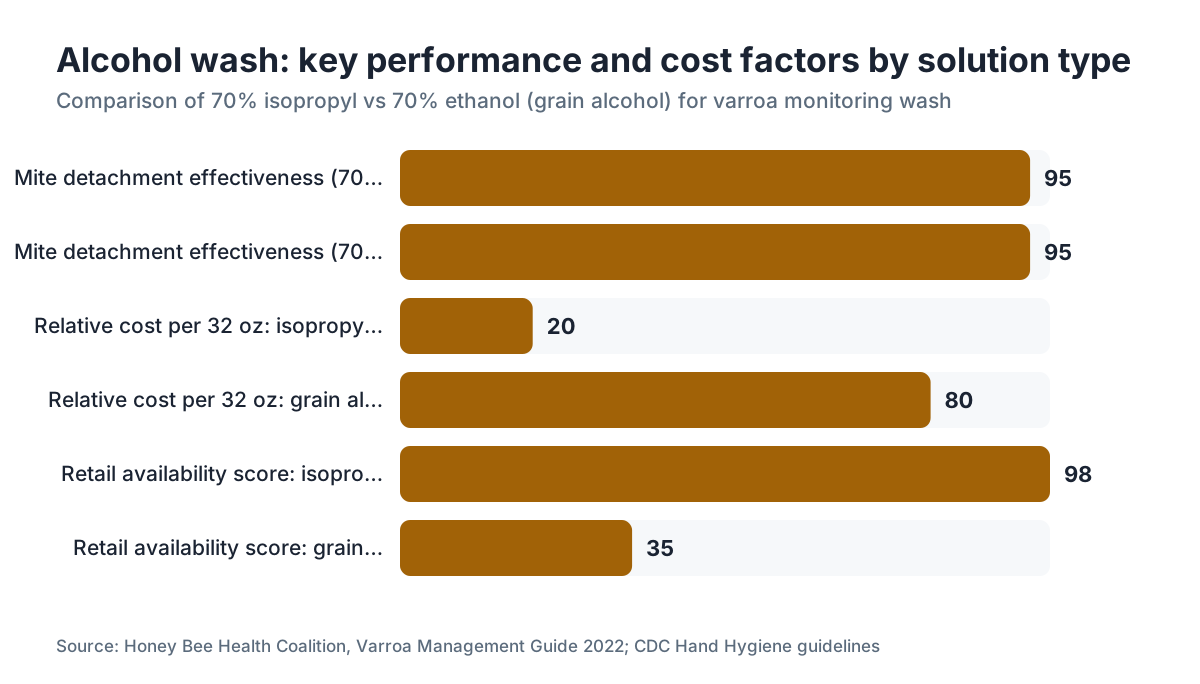
- Ethanol is equally effective and a little safer around bees, but it costs 5x more and is harder to find.
- For routine washing, grab 70% isopropyl from any pharmacy.
What is an alcohol mite wash and why does the alcohol type matter?
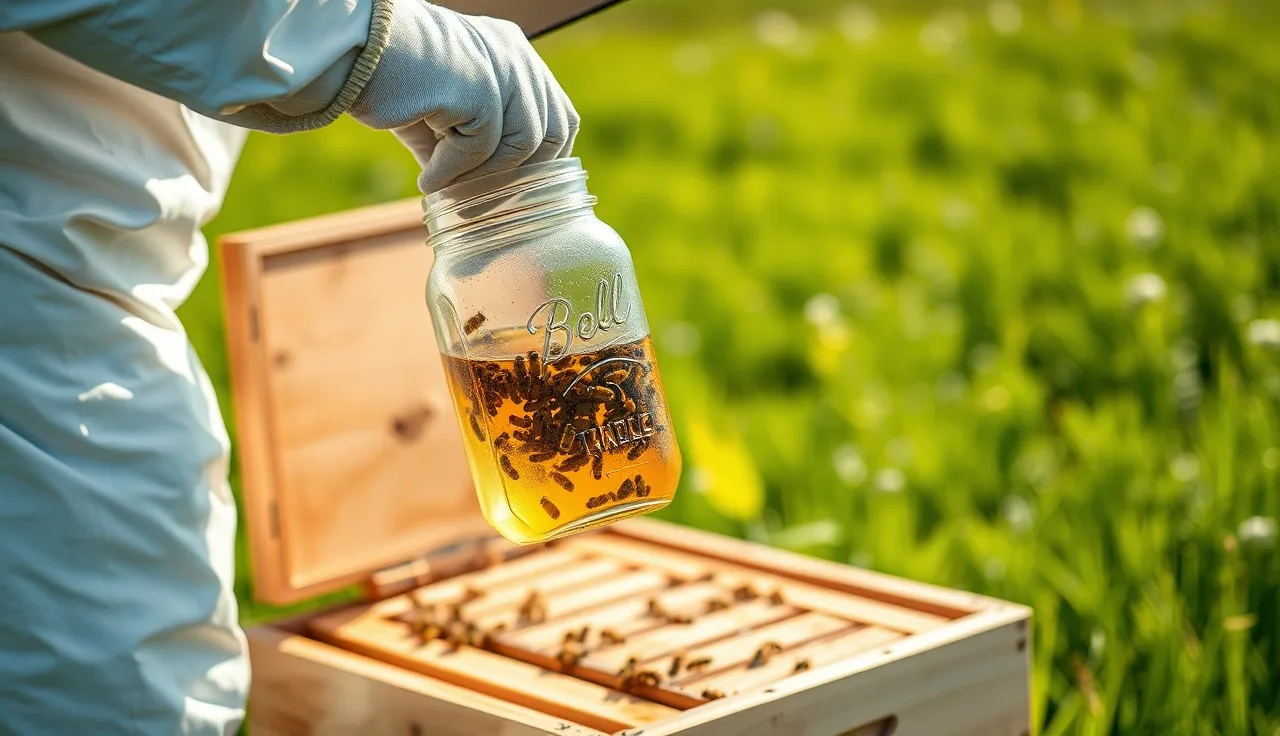
An alcohol mite wash is the most accurate way a beekeeper can count varroa on adult bees without shipping samples to a lab. You collect about 300 bees (roughly half a cup) into a jar, add alcohol, shake hard, then count the mites that fall off and settle at the bottom. That count gives you a mites-per-hundred-bees ratio you compare against treatment thresholds.
The alcohol type matters for two reasons. You want something that knocks every mite off the bees, because a weak or slow solution undercounts your infestation. You're also working next to an open hive, and any liquid that splashes onto bees outside the jar kills them. That's minor with one 300-bee sample. Run several washes back to back, or train a new beekeeper who spills, and the collateral adds up.
Both alcohols work. The choice comes down to availability, cost, and what you're comfortable handling near living bees. Neither option changes the bees you're monitoring, since those bees are sacrificed for the count regardless. See the varroa mite overview for why monitoring drives every treatment decision that follows.
What does the research say about which alcohol kills mites best?
The Honey Bee Health Coalition's Varroa Management Guide, last revised in 2022, names "70% isopropyl alcohol (rubbing alcohol)" as the wash solution for the standard protocol [1]. That guide is the de facto field standard for North American beekeepers, and nearly every extension publication on alcohol washing cites the same concentration.
No published study compares 70% isopropyl to 70% ethanol head to head for mite detachment rate, as of mid-2025. Nobody has clean comparative data on this narrow question. What the broader disinfection literature shows is that both alcohols at 60 to 80% denature proteins and dissolve lipids well. Varroa die and let go of bee hair in either solution inside the 30-second shake the protocol calls for [2].
The University of Minnesota Bee Lab and University of Florida IFAS Extension both describe the wash with 70% isopropyl and state no preference for ethanol [3][4]. I can't point to a single extension publication that recommends ethanol over isopropyl for this. The consensus, such as it is, defaults to isopropyl because it's cheap, everywhere, and the protocol was built around it.
How do ethanol and isopropyl actually differ as chemicals?
Ethanol (ethyl alcohol, grain alcohol) and isopropyl (isopropanol, rubbing alcohol) are both simple alcohols that kill arthropods and microbes by denaturing proteins. Their practical differences are real but small.
| Property | 70% Isopropyl | 70% Ethanol |
|---|---|---|
| Common source | Pharmacy rubbing alcohol | Everclear 151/190 proof, lab-grade |
| Typical cost (32 oz) | $2-$5 | $15-$30 (grain alcohol) |
| Availability | Every pharmacy, grocery, dollar store | Liquor stores, lab suppliers |
| Food-safe | No | Yes (if food-grade) |
| Fume strength | Higher | Lower |
| Bee toxicity if splashed | Lethal | Lethal |
| Effectiveness at 70% for mite wash | Excellent | Excellent |
The main chemical split: isopropyl is toxic if swallowed and throws a stronger, more irritating vapor. Ethanol is the alcohol in beverages, and at food-grade purity it carries a lower acute toxicity profile for humans. Standing over a hive on a still day, you'll notice the fume difference through a veil. It's not a safety crisis either way. Wear nitrile gloves, work with some airflow, and you're fine with either.
One real trap with ethanol. If you buy Everclear 190-proof (95% ethanol) to save money and dilute it yourself, you have to dilute it right. 95% ethanol is actually worse at killing organisms than 70%, because water helps the alcohol punch through cell membranes. To hit 70% from 190-proof, mix 74 parts Everclear with 26 parts water by volume [5]. Skipping that step and using near-pure grain alcohol is a common mistake that reads lower than it should.
Is 70% isopropyl actually accurate enough for mite counts?
Yes. The 70% isopropyl wash has been validated against the sugar roll, the CO2 method, and full dissection counts. A 2013 COLOSS BeeBook chapter on varroa methods (Dietemann et al., Journal of Apicultural Research) documents alcohol washing as the most reliable field method for detaching and counting mites from adult bee samples [6]. The tested solutions matched the 70% standard.
The accuracy floor isn't the alcohol you pick. It's your sample size. Collect fewer than 250 bees and your mites-per-hundred number gets shaky, because each mite you miss swings the result by half a point or more. The Honey Bee Health Coalition targets 300 bees (about half a cup) [1]. A 200-bee scoop from a 50,000-bee colony gives you a worse number than a proper 300-bee sample, no matter which alcohol filled the jar.
Can you use rubbing alcohol from the dollar store?
Mostly yes, with one label check. Generic rubbing alcohol at dollar stores and pharmacies is almost always 70% isopropyl. A smaller share sells as 91% isopropyl, which also works. Read the label before you pour.
Skip anything labeled "first aid antiseptic spray" that adds benzalkonium chloride, aloe, or fragrance. Those extras do nothing for the mite wash and can leave a film on a jar you reuse. You want plain 70% isopropyl with water as the only other ingredient.
91% isopropyl is fine too. There's no evidence it beats 70% for mite detachment in the 30-second shake, and it costs a little more. If 91% is what's in your cabinet, use it and move on.
What about using vodka or other spirits for an alcohol mite wash?
People reach for spirits when rubbing alcohol runs out. Vodka is usually 40% ethanol (80-proof), below the 60% line generally considered reliable for killing organisms by protein denaturation. It kills some mites, but detachment runs lower than with 70% alcohol, so your count reads short.
Everclear 151-proof (75.5% ethanol) sits right in the effective range. Everclear 190-proof (95%) works once you dilute it to 70%. Whiskey and beer are nowhere close to strong enough. Stuck in a pinch with only spirits? Use the highest proof you have and treat the count as a floor, not a ceiling.
For routine monitoring, keep a bottle of 70% isopropyl with your beekeeping supplies. It costs under $5 and takes the guesswork out.
How do you actually perform the alcohol mite wash?
The steps are identical regardless of which alcohol you choose.
- Find a brood frame with nurse bees. Shake or brush bees into an open container, then scoop about half a cup (300 bees) into your wash jar. Leave the queen behind.
- Pour in enough 70% alcohol to fully submerge the bees. A wide-mouth Mason jar with a mesh screen lid works well.
- Shake for 30 seconds. Some beekeepers run two 30-second shakes with a 30-second rest between.
- Invert the jar and drain the alcohol and mites through the mesh into a white tray or a second container. Mites are reddish-brown dots, roughly 1 to 2 mm across.
- Count the mites. Divide by the number of bees, multiply by 100. That's your mites per hundred bees (MPH).
The Honey Bee Health Coalition recommends treating when MPH reaches 2% or higher during the summer active season, and 1% or higher heading into winter cluster prep [1]. Those thresholds come from colony survival data, not a hunch.
VarroaVault's free monitoring tracker lets you log wash results over time so you can catch a climbing infestation before it crosses threshold. One data point tells you little. The trend tells you everything.
Does the alcohol harm your bees or leave residue in the hive?
The bees in the jar die. That's baked into the method, not the alcohol type. You're sacrificing roughly 300 bees from a colony that may hold 40,000 to 60,000 in summer. The trade holds up because accurate monitoring heads off the kind of mite crash that takes the whole colony down.
Dispose of the drowned bees and used alcohol away from the hive, never at the entrance. Dead and dying bees at the door rile up foragers. Dump spent wash down a utility sink or seal it in a bag for the trash.
A properly done wash leaves no honey or wax contamination, because the alcohol never touches the hive interior. EPA pesticide residue rules for hive products apply to treatments applied inside the hive, not to external monitoring tools [7]. You don't withhold honey after an alcohol wash.
Is there any reason to prefer ethanol over isopropyl for an alcohol wash?
A few reasons exist. None is strong enough to change my recommendation for most hobbyists.
If you have a documented sensitivity to isopropyl fumes, ethanol at the same concentration puts out less irritating vapor. That's a real difference, not marketing.
If you keep bees where the public is close, like an urban rooftop or a schoolyard, holding food-grade grain alcohol instead of a bottle stamped "poison" or "toxic" can smooth conversations with bystanders. Social, not technical.
Some beekeepers just like knowing the liquid in their hand is non-toxic if swallowed. With gloves and a sealed jar, that risk is tiny either way.
For most hobbyists and sideliners, none of that outweighs the 5x to 10x cost gap and the plain fact that 70% isopropyl is on a shelf at 10 p.m. on a Sunday at any gas station. Use isopropyl. If you already have grain alcohol at the right strength, use that.
What are the treatment thresholds you act on after a wash?
Your wash number only matters if you know what to do with it. The Honey Bee Health Coalition's published thresholds: treat at 2 mites per 100 bees during the summer brood-rearing season, and at 1 mite per 100 bees in late summer when you're raising the winter bees [1].
Those numbers come from field research tracking colony survival through winter. Colonies above threshold going into September survive at much lower rates. The exact breakpoint shifts some by climate. Beekeepers in the upper Midwest often need to act earlier than those in the deep south, because their window before winter cluster is shorter.
Timing matters as much as technique. Monthly washes from April through September give you trend data. A lone August wash tells you the current moment but hides whether you're climbing or falling. The varroa mite article here goes deeper on seasonal monitoring calendars and treatment timing by region.
Once you're over threshold, you have several EPA-registered options: oxalic acid (vapor or dribble), Apivar strips (amitraz), Apiguard or ApiLife Var (thymol), and Formic Pro or Mite-Away Quick Strips (formic acid). The right pick depends on whether brood is present, your local temperature, and your resistance management plan [8]. The alcohol wash is how you know which option you're actually choosing between instead of guessing.
Where can you find reliable protocols and tools for monitoring?
The Honey Bee Health Coalition's Varroa Management Guide is free to download and is the most cited monitoring resource in North America for protocols and treatment thresholds [1]. The University of Minnesota Bee Lab and University of Florida IFAS Extension both publish alcohol wash protocols with step-by-step photos [3][4]. Penn State Extension calls the alcohol wash the gold standard for monitoring and recommends the same 70% isopropyl [10].
For standardized gear, a commercial alcohol wash kit (jar, mesh lid, measuring cup) runs $15 to $30 from most beekeeping supply companies. You can build a DIY version from a Mason jar, a rubber band, and a scrap of window screen for under $2.
VarroaVault has a free mite count logging tool that tracks your MPH over time and flags you as you approach threshold. Because the data belongs to the monitoring protocol rather than any treatment brand, it's a neutral place to keep records across seasons.
Store your alcohol, your jar, and your log together. That's how checking becomes a habit instead of a project.
Frequently asked questions
Can I reuse the alcohol from an alcohol mite wash?
The alcohol still kills mites in a second wash, but it gets diluted with hemolymph and debris fast. Most beekeepers toss it after each wash. Monitoring several hives in one session? Use fresh alcohol per hive. It's cleaner and removes any doubt about your count. A bottle of 70% isopropyl costs a few dollars, so saving spent wash isn't worth the risk to your numbers.
How many bees should I put in the wash jar?
The Honey Bee Health Coalition recommends about 300 bees, roughly half a cup by volume. Fewer than 250 makes your mites-per-hundred math shaky, because each uncounted mite swings the result by half a point or more. Scoop from a nurse-bee frame, not from foragers at the entrance. Nurse bees carry higher mite loads and give you a more representative read on the colony.
Will an alcohol mite wash hurt my colony?
Losing 300 bees from a summer colony of 50,000 is a 0.6% cut. Researchers and extension programs agree that's an acceptable trade for accurate monitoring, and an undetected infestation above threshold does far more damage. The loss stings psychologically, but it's the right call. If your colony is genuinely small, say below 5,000 bees in early spring, collect fewer bees and adjust your denominator.
Is a sugar roll as accurate as an alcohol wash?
No. The 2013 COLOSS BeeBook varroa methods chapter documents the alcohol wash as more reliable than the sugar roll, especially at low mite loads under 2%. Sugar rolls miss mites that stay stuck to bees, because sugar doesn't coat them the way alcohol does. For threshold decisions, the alcohol wash wins. Beekeepers pick the sugar roll mainly when they want to release the sampled bees alive.
What concentration of isopropyl works for a mite wash?
70% isopropyl is the standard, matching the Honey Bee Health Coalition protocol. 91% isopropyl works too. You don't need to dilute 91% first, because both concentrations sit well inside the effective range for mite kill and detachment. Avoid going below 60%; efficacy drops off noticeably. 99% isopropyl is harder to find, costs more, and is actually slightly worse than 70% for biological applications.
Can I use hand sanitizer for a mite wash?
Most hand sanitizers are 60 to 70% ethanol or isopropyl plus gelling agents like carbomer. The gel makes it hard to strain cleanly through mesh and turns counting into a chore. In an emergency it will probably work, but you'll fight the gel during the pour. For planned monitoring, use straight liquid rubbing alcohol. It's cheaper and the process stays clean.
Do I need to wash my hands after handling the mite wash alcohol?
Yes. Both 70% isopropyl and ethanol dry out skin with repeated exposure. Nitrile gloves during the wash protect your skin and keep residue off your fingers before you handle bees on the next frame. When you're done, wash with soap and water. The volumes in a mite wash are small, so skin exposure is low risk, but habit beats dealing with cracked hands mid-inspection.
How often should I do an alcohol mite wash?
Monthly during the brood-rearing season is standard, roughly April through September in temperate North America. The Honey Bee Health Coalition suggests washing regularly through the season to catch a rising mite load before it crosses threshold. Once a week is overkill for most hobbyists. Once in spring and once in fall is too thin; you'll miss the midsummer buildup that sets up the late-season crash.
What is the treatment threshold after an alcohol mite wash?
The Honey Bee Health Coalition recommends treating at 2 mites per 100 bees in summer, and at 1 mite per 100 bees in late summer heading into winter prep. These come from colony survival research. Above 2% in August, winter survival drops sharply. Below 1% going into September, colonies show much better odds of reaching spring. The threshold marks the point where treatment costs clearly less than losing the colony.
Is there any risk of alcohol residue contaminating honey from a mite wash?
No. The alcohol never touches the hive interior. You collect bees into an external jar, add alcohol outside the hive, and dispose of the spent wash away from the entrance. EPA residue rules for honey apply to treatments applied inside the hive. An alcohol wash is a monitoring method, not a treatment, and it creates no honey or wax contamination risk.
Can I use 70% isopropyl for other varroa monitoring methods, like an oxalic acid vaporizer rinse?
Alcohol washing and oxalic acid vaporization are separate techniques. Standard protocols don't use alcohol to clean or calibrate a vaporizer. Alcohol washes exist specifically to count mites on adult bees. If you're cleaning vaporizer gear, follow the manufacturer's guidance, which usually means warm water and mechanical scrubbing, since alcohol can degrade some gasket and plastic components.
Where should I collect bees from for the most accurate mite count?
Shake or brush bees from a brood frame in the center of the nest, ideally frames with capped brood. The nurse bees on those frames carry the highest mite exposure and give the most representative count. Bees from honey frames, the entrance, or the top bars read lower, because they spend less time in the brood cells where mites reproduce. A low count from the wrong frame breeds false confidence going into winter.
Sources
- Honey Bee Health Coalition, Varroa Management Guide (2022 edition): 70% isopropyl alcohol is specified for the standard alcohol wash; treatment thresholds are 2% in summer and 1% in late summer/fall
- CDC, Hand Hygiene (Show Me the Science: How Hand Sanitizers Work): 60-80% alcohol concentration denatures proteins and kills organisms; efficacy drops below 60% and is not significantly improved above 80% for most applications
- University of Minnesota Bee Lab, Varroa mite monitoring and management: 70% isopropyl alcohol is recommended for the alcohol wash protocol by the University of Minnesota Bee Lab
- University of Florida IFAS Extension (EDIS), Varroa Mite Monitoring and Management: University of Florida IFAS Extension describes the alcohol wash protocol using 70% isopropyl alcohol
- Cornell University Office of Research, alcohol dilution calculations for laboratory use: To dilute 95% ethanol (190-proof) to 70%, mix 74 parts ethanol with 26 parts water by volume
- Dietemann et al. (2013), COLOSS BeeBook: standard methods for varroa research, Journal of Apicultural Research: Alcohol washing is documented as the most reliable field method for detaching and counting varroa mites from adult bee samples
- EPA, Pesticide Registration: EPA pesticide residue rules for hive products apply to treatments applied inside the hive; external monitoring methods do not trigger honey withholding requirements
- EPA, Pollinator Protection (approved varroa mite treatments): EPA-registered varroa treatments include oxalic acid, amitraz, thymol-based products, and formic acid
- USDA Agricultural Marketing Service, National Honey Report: Varroa destructor remains the leading cause of managed honeybee colony losses in the United States
- Penn State Extension, Varroa Mite Management in Honey Bee Colonies: Alcohol wash is described as the gold standard monitoring method; 70% isopropyl recommended
Last updated 2026-07-09