24-hour mite count: how to do it and what the numbers mean

TL;DR
- A 24-hour mite drop count measures how many varroa mites fall onto a sticky board under your hive in one day.
- During the brood season, 8 or more mites in 24 hours is the most widely cited treatment threshold for established colonies, though pre-winter cutoffs run lower.
- The count takes under 10 minutes of active work and costs almost nothing.
What is a 24-hour mite drop count and why does it matter?
A 24-hour mite drop count, also called a natural mite fall or sticky board count, is what it sounds like. You slide a board coated with something sticky under the screened bottom board of your hive, wait a day, then count the varroa that fell onto it. No bees die. No alcohol. No squeezing. You are counting mites that dropped off on their own during that window.
Varroa destructor is the single biggest driver of colony loss in managed honey bees worldwide [1]. The mite reproduces inside capped brood cells, feeds on bee fat bodies, and carries the deformed wing viruses that shorten bee lifespan and eventually collapse colonies. An early read on your mite load separates a treatment that works from a late scramble that mostly doesn't. The natural drop is one of three accepted monitoring methods, alongside the alcohol wash and the sugar roll, and it's the only one that kills nothing.
If you want the biology behind what you're counting, start with the varroa mite overview before your first count.
How do you set up a sticky board for a 24-hour count?
You can have a count running in under five minutes. Here's what you need:
- A screened bottom board (most modern Langstroth hives already have one)
- A corrugated plastic or cardboard insert that slides in below the screen
- Something sticky: petroleum jelly (Vaseline), cooking spray, or a commercial sticky trap grid
Slide the board in, smear or spray the sticky layer across it, and note your start time. Come back in exactly 24 hours. Pull the board out slowly so nothing rolls off, then count every varroa you find. Varroa are reddish-brown, oval, about 1.1 mm wide, roughly the size of a poppy seed but visibly crab-shaped. Wax, pollen, and debris fall through the screen too, so you'll sift through junk. A hand lens or loupe (10x is plenty) speeds the count up a lot.
Some beekeepers draw a 2-inch grid on white paper, slip it under the sticky board, and count square by square so nothing gets missed. Virginia Cooperative Extension recommends that method, and it works [2].
Run the count during normal colony activity. Not during a nectar dearth, not during a cold snap below about 50 F when bees are clustered, and not right after a treatment that already killed mites. Each of those skews the number.
What is the treatment threshold for a 24-hour mite drop?
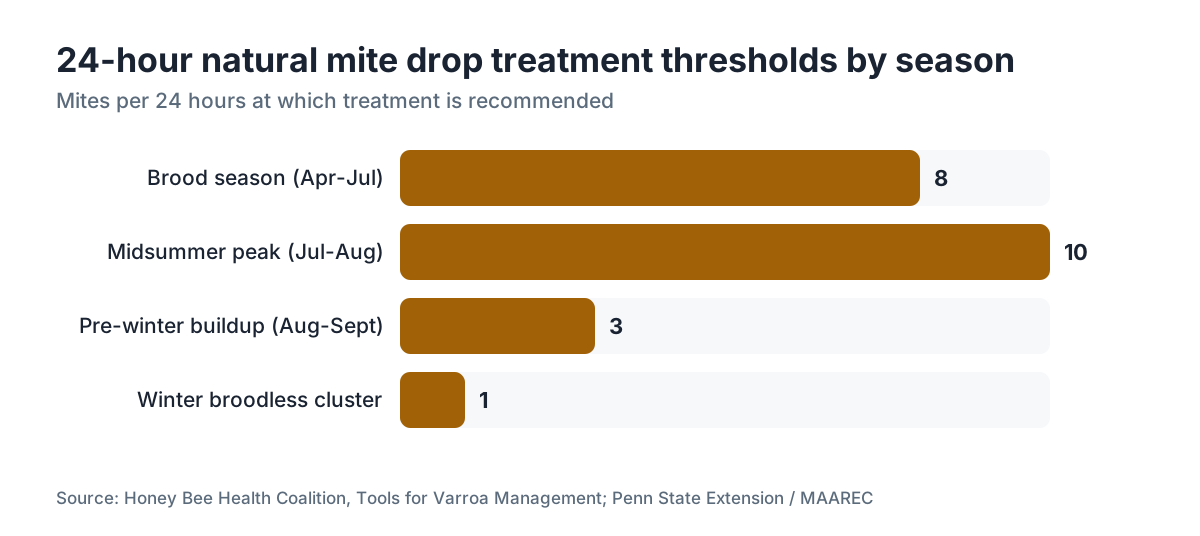
The most commonly published treatment threshold for natural mite drop is 8 to 10 mites per 24 hours during the active brood season, roughly April through September across most of North America [3]. The Honey Bee Health Coalition's varroa guide states that "an economic threshold of 2-3% infestation (about 8-10 mites on a 24-hour sticky board) is commonly used" as the point where treatment is warranted [3].
Thresholds are not one universal number, though. They shift with season, colony strength, and the method you're comparing against.
| Season / Condition | Natural Drop Threshold | Source |
|---|---|---|
| Brood season (spring/summer) | 8-10 mites/24 hr | Honey Bee Health Coalition [3] |
| Pre-winter buildup (Aug-Sept) | 2-4 mites/24 hr | MAAREC / Penn State [4] |
| Winter (broodless cluster) | 1-2 mites/24 hr | Some state extension guides |
| Weak colony or recent split | 2-3 mites/24 hr | General practitioner guidance |
The pre-winter threshold sits so low because every mite you send into winter shortens the life of the winter bees your colony leans on to reach spring. A count of 8 in July is bad but treatable. A count of 8 in late August, when you should already be raising winter bees, is close to an emergency.
Remember the natural drop is the least precise of the three methods. The alcohol wash and sugar roll give you an actual infestation percentage in the adult bee population, a more direct measure. The drop correlates with infestation rate, but the correlation is noisy. Mite fall changes with temperature, bee traffic, and grooming. Use the drop as a regular screen, then confirm with an alcohol wash when the numbers sit on the fence or something feels wrong in the colony.
How accurate is the natural mite drop compared to an alcohol wash?
Less accurate, and the research says so plainly. A 2016 study in the Journal of Economic Entomology found sticky board counts had weaker predictive power for actual infestation rates than alcohol washes, especially at low to moderate mite levels [5]. The board misses mites deep in capped brood, which can be 70-80% of the total mite population during the brood season [3]. A clean natural drop does not mean a clean hive.
Where the 24-hour drop earns its keep is as a low-effort, no-kill tool you run often. Plenty of experienced beekeepers run a sticky board monthly through the brood season as a quick screen, then pull a 300-bee alcohol wash whenever the drop climbs or something feels off. That pairing buys you the frequency of the easy method and the accuracy of the hard one.
The Honey Bee Health Coalition gives the same advice in its field guide: use multiple methods, and stay skeptical of a low natural drop during brood season [3].
Nobody has rock-solid data on exactly how often the drop misleads you relative to an alcohol wash across the seasons. The working consensus among practitioners is that the drop is fine for routine screening and the wash is the standard for treatment decisions.
How do you count the mites on a sticky board accurately?
Pull the board out slowly and set it on a flat surface in good light. Daylight is best because it shows the reddish-brown of mite bodies against debris. Lay plain white paper under the board if the board itself is dark.
Start in one corner and work a consistent pattern: across each row, or down each column. If you drew a grid, count each cell and write the tally before moving on. Varroa fool people as pollen granules at first, but once you've seen a few you'll catch the lopsided oval shape. When in doubt, use the loupe.
Count everything, including partial bodies. Dead mites groomed off bees still count. Live mites walking on the board definitely count.
After counting, divide the total by the number of days the board was in (usually 1, sometimes 3 for averaging) to get your daily drop. A 3-day count gets divided by 3.
Write the number down somewhere. A cheap notebook works. So does a phone note. VarroaVault has a free mite tracking tool if you want a running log with seasonal context, which helps you read trends across counts instead of reacting to a single data point.
Can you run a 24-hour count on a hive without a screened bottom board?
Technically yes, with extra effort. On a solid bottom board, you slide a piece of sticky corrugated plastic or cardboard through the entrance and position it under the cluster. It's awkward, and you'll disturb the bees more than you'd like. The count also catches fewer mites because some fall into corners you can't reach.
If you run solid bottom boards, the alcohol wash fits your setup better. It's more accurate anyway, and you're already doing the harder job just to run the supposedly easier method.
Screened bottom boards went standard partly because of mite monitoring. Most beekeeping supplies vendors sell screened bottom board kits as a direct retrofit, and the cost usually runs $20-40 for a 10-frame Langstroth setup. It's one of the few equipment upgrades that pays for itself in better data.
When during the year should you run a 24-hour mite count?
More often than you think, and above all at the transition points. That's the short answer.
The Honey Bee Health Coalition recommends monitoring at least monthly during the active season, and more often if counts are climbing [3]. The Mid-Atlantic Apiculture Research and Extension Consortium (MAAREC) at Penn State flags late summer, August through early September, as the single most important window, because that's when the colony raises the winter bees that must be healthy and long-lived [4].
A practical calendar:
- Early spring (as soon as bees fly regularly): baseline count
- Late spring (May-June): check whether the mite population is growing with brood
- Midsummer (July): often the highest natural drop of the year, treat if needed
- Late August: pre-winter threshold check, use the lower number
- After any treatment: recheck 4-6 weeks later to confirm it worked
- Mid-winter (December-January): optional, counts run very low and hard to read but can flag a problem
Don't skip late August. That one window causes more preventable colony loss than any other management lapse.
What do you do if your mite drop is above the threshold?
Treat. That's the whole point of monitoring.
The main registered varroa treatments in the United States sort into a few groups: oxalic acid (dribble, vapor, or extended-release), synthetic miticides such as amitraz strips (Apivar), and organic acids and essential oils like formic acid strips (Mite-Away Quick Strips) and hop beta acids (HopGuard) [6]. Each label specifies whether it can be used with brood present, the temperature range required, and the number of applications allowed per season. Those label requirements are federal law under FIFRA. You follow them.
Which treatment fits depends on whether there's brood in the hive, the temperatures during your window, and whether honey supers are on. The EPA pesticide label for each product is the governing document. The Honey Bee Health Coalition guide has a side-by-side comparison worth printing out [3].
After treatment, run another 24-hour count 4-6 weeks later to confirm it worked. A count that stays high or rebounds fast can mean the treatment failed, mites are developing resistance, or your colony is picking up mites from neighboring apiaries through robbing and drifting.
For sequencing treatments across multiple hives, VarroaVault's protocol tracker keeps your records straight, which matters most when you're running more than a few colonies.
How does a 24-hour mite count compare to an alcohol wash or sugar roll?
These three methods measure different things and carry different strengths.
| Method | What it measures | Accuracy | Bees harmed | Time required |
|---|---|---|---|---|
| 24-hour natural drop | Mites that fall off bees naturally | Lower (indirect) | None | ~5 min active, 24 hr wait |
| Alcohol wash | % mites on adult bees in a 300-bee sample | Highest | ~300 bees | 10-15 min |
| Powdered sugar roll | % mites on adult bees in a 300-bee sample | Lower than alcohol wash | None (bees released) | 10-15 min |
The sugar roll sounds humane and easy, but a 2016 Journal of Economic Entomology study found it consistently undercounts mites compared to the alcohol wash, sometimes by a wide margin [5]. Many extension programs stopped recommending it as a primary method for that reason. For a no-kill option, the 24-hour drop is more useful because its error runs consistent. It tends to show you less than is really there, so a high drop means a real problem.
For actual treatment decisions, an alcohol wash on 300 bees is what I'd do. The 24-hour drop is for keeping a regular eye on things between washes.
What affects the number of mites you'll count on a sticky board?
Several things push the count up or down without any real change in your infestation rate. Knowing them keeps you from over- or under-reacting.
Temperature matters a lot. In cold weather bees are less active, grooming drops, and fewer mites fall. A count taken during a cold snap looks better than the truth. Run counts during normal flight activity, ideally with daytime highs consistently above 55-60 F.
Colony strength matters. A large, active colony grooms harder and drops more mites than a weak one at the same infestation percentage. One more reason the drop is indirect.
Recent treatments inflate the count for a few days afterward. You're seeing treatment kills, not steady-state fall. Wait at least a week after treating before running a diagnostic count.
Season matters. During a broodless stretch, most mites ride on adult bees rather than sitting in cells, so the drop reflects total load better. During peak brood season, most mites are in cells and the drop understates the problem.
Robbing and drifting bring in mites from outside your apiary. In a dense beekeeping area, a sudden spike can be partly environmental rather than your own colony's reproduction.
How do you record and track 24-hour mite counts over time?
A single count is a snapshot. A series of counts is a trend, and trends keep you ahead of the problem.
At minimum, write down the date, the hive ID, the count, and any notes (temperature, recent treatment, nectar flow). With multiple hives, keep each hive's record separate. Mite loads vary enormously between colonies in the same yard, sometimes by a factor of 5 or 10, and treating on the worst hive's numbers while ignoring the rest is a common mistake.
Spreadsheets work fine. Some beekeepers use a dedicated app. What matters is that you can look back six months later and see whether this year's late-August count beat last year's, and whether last July's treatment actually held. That longitudinal record separates a beekeeper who's learning from one who's just reacting.
If you want something purpose-built, the free tools at VarroaVault include a count log and threshold alerts tied to the current month, which takes some of the guesswork out of which threshold applies.
Are there any limits to what a 24-hour mite count can tell you?
Yes, and owning them makes you a better beekeeper.
The natural drop tells you nothing about the mites hiding in capped brood. During peak brood season, that can be 70-80% of your total mite population [3]. You can have a low drop and a catastrophic infestation building in the brood nest at the same time.
It also can't tell you whether the mites in your hive carry dangerous viral loads. Two colonies can post identical counts and face wildly different virus pressure depending on the mite strains present. No field monitoring resolves that. It would take lab testing most beekeepers can't reach.
And it can't confirm a treatment worked. A post-treatment count that looks clean might just reflect the brood cycle, with mites tucked in cells that survived and haven't emerged yet. That's why the 4-6 week recheck is essential, not optional.
The 24-hour drop is a useful, cheap, run-it-often tool. It isn't a full varroa program by itself. Pair it with seasonal alcohol washes and a treatment plan tied to real thresholds, and you have something that actually works.
Frequently asked questions
How many mites on a sticky board is bad?
During the brood season, 8 or more mites in a 24-hour natural drop is the widely cited treatment threshold. Below 8, monitor closely and recheck in 2-4 weeks. Before winter the bar drops sharply: even 2-4 mites per day in August or September warrants treatment, because those mites damage the winter bee population your colony needs to survive.
Can I leave the sticky board in longer than 24 hours?
Yes. A 3-day count is common and smooths out daily variation. Divide the total by 3 to get your daily average. Don't leave the board in more than 3-5 days during warm weather, because debris builds up and makes counting harder. The longer the board sits, the more likely it draws pests.
Do I need a screened bottom board to do a 24-hour mite count?
A screened bottom board makes it easy: slide the sticky board in from the back, wait 24 hours, pull it out. On a solid bottom board you can improvise with a piece of sticky corrugated plastic pushed in through the entrance, but it's awkward and less reliable. If you run solid bottoms, an alcohol wash on 300 bees is a cleaner option.
What can I use as a sticky substance on the counting board?
Plain petroleum jelly (Vaseline) rubbed across the board works well and costs little. Cooking spray also works. Some beekeepers use white Crisco. Commercial sticky trap grids made for mite counting come pre-coated and are easier to use. Avoid anything with a strong scent that might change bee behavior near the bottom of the hive.
How do I tell varroa mites apart from other debris on the sticky board?
Varroa are reddish-brown, oval, and about 1.1 mm wide. They look like a tiny crab shell with a flat profile. In good light they're recognizable once you've seen a few. Pollen granules are round and usually yellow, orange, or white. Wax flakes are irregular and translucent. A 10x loupe helps beginners a lot. Photos in Virginia Cooperative Extension's monitoring guide are a good reference.
How does the 24-hour mite drop relate to actual infestation percentage?
The relationship is real but noisy. A drop around 8-10 mites per day roughly correlates with a 2-3% infestation rate in the adult bee population, the common treatment threshold. But the correlation shifts with colony size, season, and temperature. A high drop reliably signals a problem; a low drop doesn't reliably mean all is well. Confirm borderline results with an alcohol wash.
Should I run a mite count before and after treatment?
Yes, both. The pre-treatment count tells you how bad it is and confirms you need to treat. The post-treatment count, run 4-6 weeks after treatment ends, tells you whether it worked. A treatment that looked complete but left surviving mites rebuilds surprisingly fast. Skipping the post-treatment check is one of the most common monitoring mistakes.
Does natural mite drop monitoring work in winter?
It works, but the numbers read differently. In a broodless winter cluster, almost all mites ride on adult bees rather than in cells, so the drop reflects total load better than it does in summer. Even 1-2 mites per day can be meaningful in winter. The catch: if the cluster is tight and cold, bees are inactive and the drop stays very low regardless of mite load.
How often should I monitor for varroa using a sticky board?
The Honey Bee Health Coalition recommends monthly monitoring during the active brood season as a baseline. Check every 2 weeks if you had a high count, recently treated, or are heading into late summer. The one window most beekeepers miss is August, when the pre-winter threshold applies and late-season mite pressure can wreck the colony's winter bee cohort.
Why does my mite count spike after I add a honey super or do an inspection?
Inspections and manipulations disturb bees, which briefly increases grooming and knocks more mites off adults onto the board. That can cause a 1-2 day spike that doesn't reflect a true increase in infestation. For a clean baseline, avoid inspections for 2-3 days before you pull the board. If you couldn't, note it in your records and read the number cautiously.
Can a colony with a low mite drop still collapse from varroa?
Yes. The natural drop understates total mite load when most mites sit in capped brood, the normal situation during brood season. A colony can carry a dangerous infestation while showing a moderate drop because 70-80% of mites aren't falling at all. That's the strongest argument for periodically running an alcohol wash to check actual infestation percentage, even when your drop counts look fine.
What's the best way to record 24-hour mite counts across multiple hives?
Write down the date, hive ID, count, and conditions (temperature, recent treatment, nectar flow) for every count. Spreadsheets work well for multiple hives. Keep each hive's data separate, because mite loads vary enormously between adjacent colonies. A running log lets you catch a hive trending upward before it crosses the threshold, instead of reacting after the colony is already stressed.
Sources
- USDA Agricultural Research Service, Varroa destructor overview: Varroa destructor is the single most significant pest of managed honey bees worldwide, linked to widespread colony mortality
- Virginia Cooperative Extension, Varroa Mite Monitoring and Management: Drawing a grid on paper under the sticky board and counting square by square reduces missed mites; recommended monitoring protocol
- Honey Bee Health Coalition, Tools for Varroa Management: A Guide to Effective Varroa Sampling and Control: An economic threshold of 2-3% infestation (about 8-10 mites on a 24-hour sticky board) is commonly used; also that 70-80% of mites may be in capped brood during brood season
- Penn State Extension / MAAREC, Mid-Atlantic Apiculture Research and Extension Consortium Varroa Mite Management: Pre-winter threshold for mite drop is lower (2-4 mites/24 hr in August-September); late summer monitoring is the most critical window
- Journal of Economic Entomology, Comparison of Methods for Monitoring Varroa Mite Infestations (2016): Sticky board counts had weaker predictive power for actual infestation rates than alcohol washes; sugar roll consistently undercounts mites compared to alcohol wash
- U.S. EPA, Pesticides section: Registered varroa treatments in the United States include oxalic acid, amitraz strips, formic acid products, and hop beta acids; label requirements are federal law under FIFRA
- University of Minnesota Extension, Varroa Mite Monitoring: Alcohol wash on 300 bees is the most accurate field method for determining varroa infestation percentage
- Oregon State University Extension, Varroa Mite Management in Honey Bee Colonies: Regular monitoring intervals during brood season and post-treatment rechecks at 4-6 weeks are recommended practice
- North Carolina State University Extension, Sampling for Varroa Mites: Natural mite drop is an indirect measure; a low drop does not confirm a low infestation because mites inside capped brood do not fall
Last updated 2026-07-09