Sticky board mite count threshold for treatment: what the numbers mean
TL;DR
- A natural mite drop of roughly 8 to 10 mites per day on an uncovered sticky board is the widely cited threshold for treatment, though the Honey Bee Health Coalition and most university extensions emphasize that alcohol wash counts (3% per 100 bees) are more reliable.
- Sticky board numbers are directional, not diagnostic.
- Use them for trending, not as your sole trigger.
What is a sticky board mite count and how does it work?
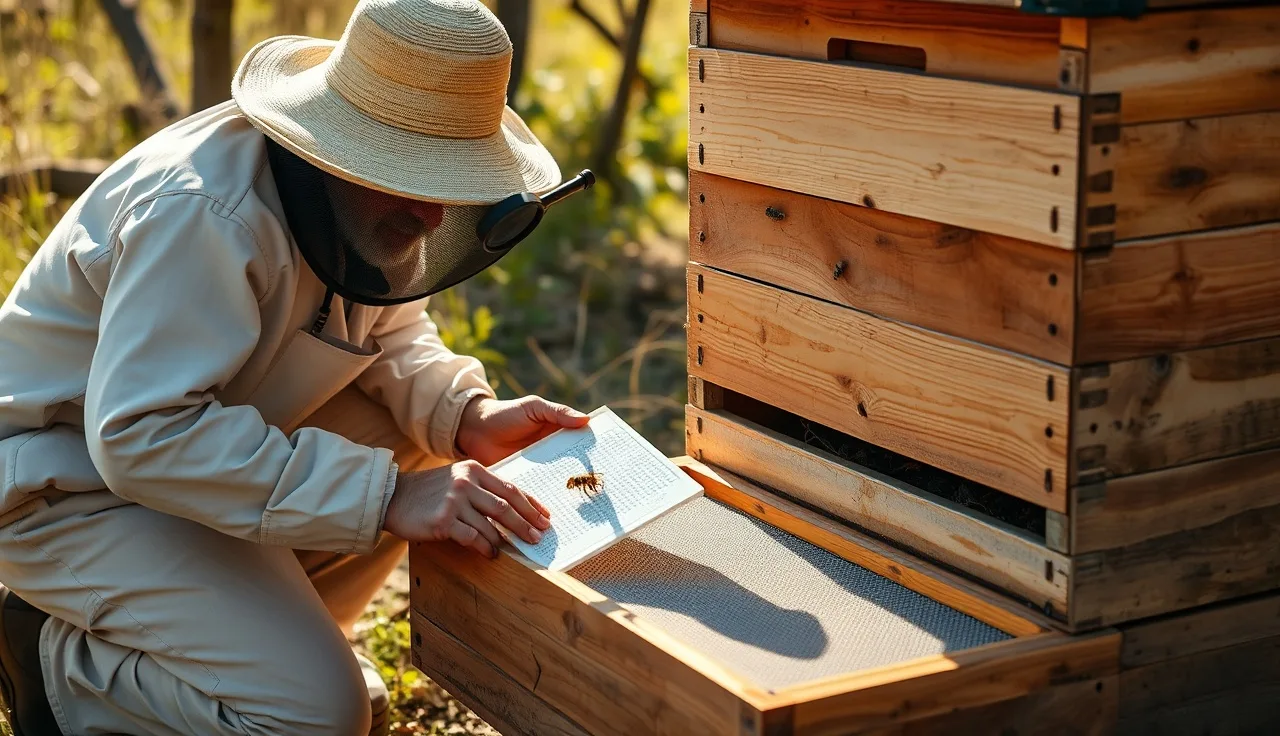
A sticky board, sometimes called a mite board or varroa screen insert, is a sheet of paper or cardboard coated with a sticky substance (petroleum jelly, cooking spray, or commercial adhesive) that slides under a screened bottom board. Mites that fall off bees and brood naturally land on the board and stick there. After a set period, usually 24 to 72 hours, you pull the board out, count the mites, and divide by the number of days to get a daily mite drop rate.
The key word in that description is "naturally." This is a passive count. You are not killing bees to get it, and you are not stressing the colony. That is its main appeal. Newer beekeepers often start here because there is no equipment to buy beyond the board itself and it does not require handling large numbers of bees.
The sticky board only captures mites in their phoretic phase: the ones riding adult bees that happen to fall or groom off. Mites reproducing inside capped brood cells are invisible to this method. That distinction matters enormously for interpreting results, and it is why most researchers now treat sticky board counts as a supplement rather than a primary diagnostic tool [1].
For a solid foundation on what varroa mites are and how they reproduce, the varroa mite overview is a good starting point before digging into count thresholds.
What sticky board mite drop number triggers treatment?
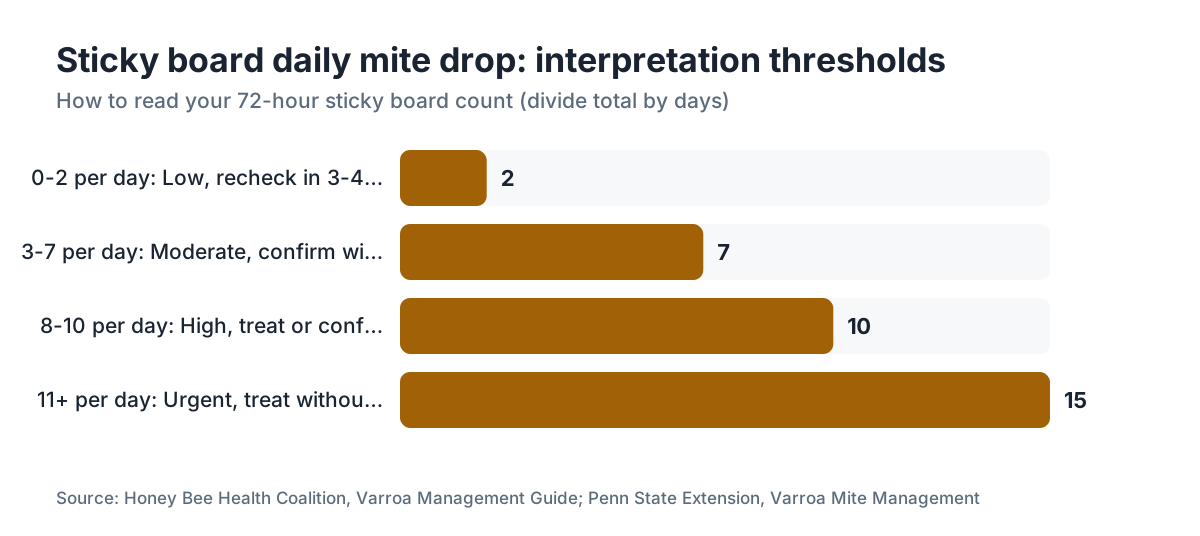
The number most commonly cited is 8 to 10 natural mite drops per day. That figure appears in older extension publications and was widely taught through the 2000s and 2010s. At 8 or more mites per day, most guidance says treat without waiting for further confirmation.
Below 8 per day, recommendations split. Many sources say monitor more frequently. Some say do an alcohol wash immediately to get an accurate infestation percentage before deciding.
Here is the problem with stopping at that single number: it ignores colony size. A drop of 8 mites per day in a small nucleus colony means something very different than 8 per day in a 60,000-bee production colony. The Honey Bee Health Coalition's Varroa management guide, the most referenced practitioner document in North American beekeeping, states that natural mite drop "is the least accurate" of the three main monitoring methods because it does not give you an infestation percentage [1]. The guide prioritizes alcohol wash (also called an ethanol wash or sugar roll wash) and recommends the 3% threshold: treat if 3 or more mites turn up per 100 bees.
Still, 8 to 10 drops per day is a useful rough rule. See 20 mites a day and you do not need an alcohol wash to know your hive is in trouble. See 2 per day in July and that is reassuring, but it is no reason to skip your next wash.
| Daily natural mite drop | Interpretation | Recommended next step |
|---|---|---|
| 0 to 2 | Low, likely acceptable | Re-check in 3 to 4 weeks |
| 3 to 7 | Moderate, trending upward possible | Do an alcohol wash to confirm |
| 8 to 10 | High, threshold zone | Treat or confirm with alcohol wash |
| 11 or more | Very high, urgent | Treat immediately [1][2] |
How accurate are sticky board counts compared to alcohol wash?
Not very accurate, if you are after an actual infestation rate. Multiple studies find that sticky board counts correlate poorly with infestation percentages from alcohol washes, especially when brood is present. A 2020 paper in PLOS ONE found that natural mite drop explained only about 30 to 40 percent of the variation in alcohol wash results across colonies, a weak predictive relationship for something driving treatment decisions [3].
The reason is straightforward biology. In summer, when a colony has lots of brood, roughly 80 to 90 percent of the mite population sits inside capped cells at any given moment. Those mites do not appear on a sticky board until they emerge. So a colony carrying 500 mites might drop only 20 to 50 per week during peak brood season. That same colony, if broodless (as in winter or after a queen removal), might drop 100 or more per week because every mite is phoretic.
This is not a trivial distinction. Sticky board counts in summer systematically underestimate the true mite load. Counts in late fall or winter, when brood is minimal, skew higher relative to the actual population, which can look alarming but may not require panic.
Alcohol wash, done correctly on 100 to 300 bees from the brood nest, gives you a direct percentage that does not depend on season in the same way. The Honey Bee Health Coalition's guide calls alcohol wash the gold standard for hobbyist monitoring [1]. If you can only do one monitoring method, do the wash.
Sticky boards keep one real advantage: they are passive. You leave the board in, walk away for 24 hours, come back, and count. For beekeepers checking hives weekly, a board under every hive gives you trend data across the season without cracking the lid each time.
How long should you leave a sticky board in before counting?
The standard is 24 to 72 hours. Most published protocols use a 72-hour (3-day) count, then divide by 3 for a daily average. The longer window smooths out random variation. Pull after 24 hours when a lot of mites happened to fall that morning from grooming or a temperature spike, and your number reads high for reasons that have nothing to do with your true infestation.
In practice, 48 to 72 hours beats 24, and anything past 72 hours gets messy. Debris, pollen, and dead bees pile up on the board and mites become hard to count. Wax and propolis also draw other insects that disturb the board.
Timing matters too. Do not pull the board right after a treatment application. Treatments cause elevated drop that reflects dying mites, not the baseline population. Wait at least 5 to 7 days post-treatment before using a sticky board to gauge infestation level. That elevated drop during treatment is actually good news. It means the treatment is working.
To count accurately, use a white or light-colored board and a magnifying glass or a 10x loupe. Varroa mites are reddish-brown, round to oval, and about 1.1 millimeters wide. Pollen grains, wax fragments, and small beetles share the board, so take your time. Many beekeepers draw a grid on the board before inserting it to make the count more systematic.
Does the threshold change by season?
Yes, a lot. The 8 to 10 mites per day rule was built for the summer brood season. The same number carries different meaning in spring versus fall.
Spring (March to May in most of the US): Colonies build fast, brood ramps up, and most mites head into cells. A drop of 5 per day in April can represent a higher actual infestation rate than a drop of 10 in December. See any meaningful drop in spring? Do an alcohol wash to check.
Summer (June to August): The ratio of phoretic to reproductive mites bottoms out here. The 8 to 10 per day threshold applies most directly, but still do not lean on it alone. The reproductive rate runs so high in summer that a colony can jump from 2% to 5% infestation in 4 to 6 weeks [2].
Fall (September to October): This is the monitoring window that decides whether your colony survives. The winter bees being raised now are the ones that carry the colony through to spring. The Honey Bee Health Coalition recommends treating before August 15 to September 1 in most climates to protect those winter bees [1]. A sticky board count of even 3 to 4 per day in September warrants serious thought about treatment, because an alcohol wash will often reveal an infestation above the 3% threshold.
Winter (November to February): Colonies with little or no brood show higher daily drop even at lower total mite populations. A count of 10 per day in January does not automatically mean trouble, though it does suggest your colony entered winter carrying a meaningful mite load. Treat before the colony goes broodless if you possibly can. Oxalic acid (OA) applied during a broodless period is highly effective and easy to do [4].
What is the 3% alcohol wash threshold and how does it compare to sticky board numbers?
The 3% threshold means this: if 3 or more mites turn up per 100 bees in an alcohol wash sample from the brood nest area, treat. That number comes from research correlating infestation rates with colony outcomes. Above 3%, colonies show significantly higher winter mortality and population decline [1][5].
Some university extensions use 2% in late summer and fall specifically because the consequences of going into winter with even a moderate mite load are so severe. Penn State Extension, for example, recommends treating if alcohol wash results reach 2% or above between July and September [5].
Can you convert a sticky board count to an approximate alcohol wash percentage? Loosely, yes, with heavy caveats. One rule of thumb going around the beekeeping community: divide your daily drop by 10 for a rough percentage. So 10 mites per day is roughly 1%, and 30 per day is roughly 3%. This is a crude conversion that swings with colony size, brood amount, and time of year. Treat it as a back-of-envelope guess, not a clinical equivalent.
The honest answer is that these two methods measure different things. Alcohol wash measures the phoretic infestation rate directly. Sticky board measures drop rate, a proxy that rides on colony-specific variables. Where they agree, feel confident. Where they diverge, trust the alcohol wash.
What factors cause sticky board counts to be misleading?
Several things inflate or deflate your count with no change in the actual mite load.
Screened bottom boards are required for sticky board use. On a solid bottom board, mites that fall off bees land in the debris and you cannot count them. Make sure the sticky board slides in below a mesh screen (typically 8x8 mesh or larger) so mites fall through onto the board.
Hive beetles and ants disturb mites on the board, carrying them off or piling debris on top. Find the board disrupted and your count is unreliable.
Formic acid treatments cause a spike in mite drop because the acid penetrates capped cells and kills reproductive mites, which then fall. A post-treatment board is not a baseline. It is a treatment efficacy indicator.
Outside factors matter too: cold snaps that pull clusters tight, high winds, or moving hives can temporarily push grooming activity and drop rate up or down.
Sticky material coverage on the board is the last trap. If part of the board dried out or was not coated evenly, mites landing on dry sections walk off uncounted. Check your board coating before each use.
None of this means you should stop using sticky boards. It means you need to understand what you are looking at. A single data point is weak. Three or four counts over a season, paired with at least one alcohol wash, give you a picture you can actually act on.
How often should you monitor with a sticky board?
The practical answer for most hobbyists: once a month during the active season (April through October), and at least once in late summer specifically to catch the fall buildup before it gets away from you.
Seeing elevated counts? Bump to every two weeks. Treated? Monitor 5 to 7 days post-treatment to verify efficacy, then again 4 to 6 weeks later to confirm the population has not rebounded.
The Honey Bee Health Coalition's guide recommends monthly monitoring as a minimum, with emphasis on the late-July to September window as the most critical [1]. That advice holds up. Most colony losses blamed on varroa trace back to a late-summer mite load that went unchecked.
Managing more than a handful of hives? A simple log (date, colony ID, daily drop count, any treatments applied) turns isolated numbers into a trend you can use. Free tracking tools, including the monitoring log at VarroaVault, let you record counts over time and see whether a colony is stable, building, or crashing against previous checks.
Which treatments are triggered at the sticky board threshold?
When your sticky board count hits the 8 to 10 per day threshold (or your alcohol wash confirms 3% infestation), you have several treatment options. The right choice depends on brood presence, temperature, whether honey supers are on, and your own preference.
Oxalic acid (OA) is EPA-registered as Api-Bioxal and several other products. It works best during broodless periods because it only kills phoretic mites. The label-approved methods are dribble, vaporization (sublimation), and extended-release gel pads [4]. Vaporization is the most common hobbyist method for broodless periods. During the brood season, repeated OA treatments or extended-release methods can knock down mite load, though not as dramatically.
Amitraz (Apivar strips) works during the brood season. Strips stay in the hive for 6 to 8 weeks and kill mites as they emerge from cells with bees. Amitraz is not approved for use with honey supers on [6].
Formic acid (Mite Away Quick Strips, Formic Pro) penetrates capped brood and kills reproductive mites. It works across a wide temperature range but carries label restrictions (temperature windows, super-free requirements) you must follow [7].
Hops beta acids (HopGuard 3) are an organic option with some brood-period activity, though efficacy data is thinner than for the options above.
Never treat without reading the current EPA-registered label for your specific product. Labels change, and treatment timing, dosage, and restrictions are legal requirements, not suggestions.
For sourcing treatments and equipment, checking reputable beekeeping supply companies that stock EPA-registered products makes sure you get what the label actually describes.
What do researchers say about sticky board thresholds?
The scientific literature on sticky board thresholds is older and thinner than most beekeepers realize. The 8 to 10 per day figure traces back mainly to work from the 1990s and early 2000s, much of it by researchers at the USDA Beltsville Bee Lab and European institutions studying Varroa destructor dynamics in temperate climates [8].
More recent work has shifted toward percentage-based thresholds (alcohol wash) because they predict colony outcomes better. A 2022 meta-analysis of varroa management studies published in Apidologie noted that natural mite drop thresholds have "variable predictive value depending on colony size and brood state" and recommended that extension guidelines move toward percentage-based monitoring as the primary trigger [9].
The Honey Bee Health Coalition, which convened a working group of researchers from USDA ARS, land-grant universities, and industry, concluded in its varroa guide that sticky board counts "should not be used as the sole basis for treatment decisions" [1].
Nobody has great prospective data pinning a specific daily drop number to a specific probability of colony death. The 8 to 10 figure is a useful rule of thumb with real-world backing, but it is not a clinical cutoff validated in a large randomized trial. Treat it accordingly.
How do you set up a sticky board correctly for the most accurate count?
Start with a clean, evenly coated board. Apply a thin layer of petroleum jelly (Vaseline) or cooking spray across the entire surface. Uneven coverage creates dead zones where mites walk off.
Slide the board all the way under the screened bottom board so it extends beneath the full cluster area. If the board covers only part of the hive footprint, you are missing mites.
Record the time and date you insert it. Pull it after exactly 24, 48, or 72 hours. Divide the total count by the number of days.
To count accurately, use a white board and good light. A 10x loupe or magnifying glass helps enormously. Varroa run about the size of a sesame seed, reddish-brown, and wider than they are long (1.1 mm wide, 1.6 mm long). Look for the flat, crab-like shape. Wax capping fragments and pollen pellets are common false positives. They tend to be more uniform in color and lack the segmentation you can see on a mite under magnification.
No screened bottom board, no sticky board. Solid bottom boards trap mites in debris where you cannot recover them. Screened bottom boards also give modest ventilation in summer, though the evidence that they cut mite loads on their own is weak [2].
VarroaVault's free downloadable sticky board grid template makes the count faster and cuts the chance of double-counting in dense drop areas. Print it on card stock, coat it, and reuse it all season.
Frequently asked questions
Can I use a sticky board count instead of an alcohol wash?
Not reliably. Sticky board counts measure mite drop rate, which correlates poorly with actual infestation percentage during the brood season because most mites sit inside capped cells. The Honey Bee Health Coalition calls alcohol wash the most accurate monitoring method for hobbyists. Use sticky boards for trends and as a supplement, but confirm with an alcohol wash before making a treatment decision if you have any doubt about the count.
What if my sticky board shows zero mites?
Zero or near-zero drops for 72 hours in spring or summer likely means your infestation is genuinely low, but do not skip your regular monitoring. Zero drop in a strong summer colony is reassuring. Zero drop in a weak colony that is rapidly shrinking might mean the bees are not healthy enough to carry mites onto the board in meaningful numbers. When in doubt, do an alcohol wash to confirm.
Does a screened bottom board alone reduce varroa?
Minimally. Research finds that screened bottom boards cause some mites to fall through and die, but the reduction runs only about 10 to 15 percent of the mite population, nowhere near enough to manage an infestation on its own. Their main value in varroa management is enabling sticky board monitoring. You still need to treat when thresholds are reached, screened or solid bottom board either way.
How many mites per day is normal or acceptable?
In early spring with a small colony, 1 to 2 mites per day is normal. In summer with a full-size colony, 0 to 5 per day is generally acceptable; 6 to 9 per day warrants close attention and an alcohol wash. At 10 or more per day, most extension guidance says treat. These are rough rules, not precise clinical cutoffs, and season and colony size both shape interpretation.
Should I treat if my mite drop is high but my alcohol wash is below 3%?
Generally, trust the alcohol wash result if it is done correctly on 100 or more bees from the brood nest area. A high sticky board count with a low wash percentage could mean the colony is large, so the mite percentage is diluted. Monitor closely, repeat the wash in two to three weeks, and treat if it climbs above 3%, or above 2% if you are in the late summer window when winter bees are being raised.
What is the mite treatment threshold in fall specifically?
Fall is the most consequential window. Most university extensions recommend a 2% alcohol wash threshold between July and September rather than the usual 3%, because winter bees being raised now carry the colony through to spring. The Honey Bee Health Coalition suggests treating before August 15 to September 1 in most US climates. On a sticky board, even 4 to 5 mites per day in September is worth taking seriously and confirming with a wash.
How do I know if my sticky board count went up because of a treatment or a real mite increase?
Post-treatment mite drop spikes are expected and positive. Formic acid, amitraz, and oxalic acid all cause elevated drop as they kill mites. Wait at least 5 to 7 days after a treatment ends before using a sticky board to assess baseline infestation. If you pull a board during treatment and see 50 mites per day, that reflects mites being killed by the treatment, not your baseline population.
Can sticky board counts detect a reinfestation after treatment?
Yes, and this is one of their best uses. After a successful treatment, mite drop typically falls to near zero or very low. If counts start climbing again 4 to 8 weeks later, especially in an apiary near other colonies or hives, that is an early sign of reinfestation from robbing or drifting bees carrying mites in. Catching this trend early is much easier than trying to recover a colony that has been reinfested and untreated for two months.
Does colony size affect how I interpret sticky board results?
Yes, significantly. A large colony of 60,000 bees with 8 mites per day has a much lower infestation rate than a nucleus of 10,000 bees with the same drop. That is exactly why percentage-based alcohol wash thresholds beat raw drop counts. If you know your colony is unusually small or large, adjust your read of the raw drop number and prioritize doing a wash.
What is the best time of year to start monitoring with sticky boards?
Start in early spring as the colony begins building, usually March to April depending on your climate. This gives you a baseline before mite populations begin their rapid summer increase. The most important monitoring windows run late July through September, when the fall mite buildup happens and when treatment timing has the greatest effect on winter survival.
How long does it take to count mites on a sticky board?
Five to fifteen minutes for most hives. Heavily infested colonies with lots of debris take longer. Using a gridded board (divide it into sections with a pencil before coating) and working section by section reduces errors and speeds counting. A 10x loupe makes identification faster and cuts down on false positives from wax debris and pollen.
Can sticky boards detect other pests besides varroa?
Yes. Small hive beetles and their larvae, wax moth scales, pollen mites, and sometimes Nosema spores (if you examine the board under high magnification) all show up. A board full of small hive beetle adults is its own signal worth noting. Sticky boards are a passive snapshot of whatever is moving inside and falling through your screened bottom board.
Is there a sticky board threshold for treatment during winter?
Winter is unusual because broodless colonies show higher phoretic drop rates even at moderate mite loads. The standard 8 to 10 per day threshold does not translate cleanly. If your colony is broodless or nearly so, a much higher drop is possible without representing a dangerous infestation percentage. The best winter strategy is to have treated in late summer before the colony went broodless, using oxalic acid during that broodless window if mites were still present.
Where can I find official guidance on varroa monitoring thresholds?
The Honey Bee Health Coalition's Varroa Management Guide is the most complete free resource and is updated periodically by a working group of researchers and extension specialists. Penn State Extension, University of Minnesota Extension, and the USDA ARS Bee Lab all publish state- and region-specific monitoring protocols. EPA product labels for registered treatments also carry monitoring guidance specific to each chemical class.
Sources
- Honey Bee Health Coalition, Varroa Management Guide (current edition): Natural mite drop is the least accurate of the three main monitoring methods; alcohol wash is the recommended gold standard; treat before August 15 to September 1 to protect winter bees
- University of Minnesota Extension, Bee Lab, Varroa Management: Screened bottom boards reduce mite population by roughly 10 to 15 percent and are not sufficient as a standalone control; summer mite populations can double in 4 to 6 weeks
- PLOS ONE, 2020, natural mite drop vs. alcohol wash correlation: Natural mite drop explained approximately 30 to 40 percent of variation in alcohol wash results across colonies
- EPA, Oxalic Acid (Api-Bioxal) registration and label requirements: Oxalic acid is EPA-registered for varroa control via dribble, vaporization, and extended-release methods; most effective during broodless periods
- Penn State Extension, Varroa Mite Management: Treat if alcohol wash reaches 2% or above between July and September; 3% threshold used outside peak fall risk window
- EPA, Amitraz (Apivar) label requirements: Amitraz strips must not be used with honey supers on the hive; treatment duration is 6 to 8 weeks
- EPA, Formic Acid (Formic Pro, Mite Away Quick Strips) label requirements: Formic acid products penetrate capped brood and kill reproductive mites; label restrictions include temperature windows and honey super removal
- USDA ARS Beltsville Bee Lab, varroa monitoring research publications: The 8 to 10 mite per day natural drop threshold traces to USDA and European research from the 1990s and early 2000s on Varroa destructor population dynamics
- Apidologie, 2022, meta-analysis of varroa management monitoring methods: Natural mite drop thresholds have variable predictive value depending on colony size and brood state; guidelines should move toward percentage-based monitoring as the primary trigger
- North Carolina State University Extension, Varroa Mite Monitoring and Management: Monthly monitoring recommended during the active season with emphasis on the late July to September window as the most critical for colony survival
Last updated 2026-07-09