How accurate is natural mite drop counting with a sticky board?
TL;DR
- Natural mite drop on a sticky board tracks loosely with infestation level, but it varies too much to set a treatment threshold on.
- The Honey Bee Health Coalition and university extension programs point you to alcohol wash or sugar roll for numbers you can act on.
- Use a sticky board to confirm mites are present or watch seasonal trends, not to decide when to treat.
What is the sticky board method for counting varroa mites?
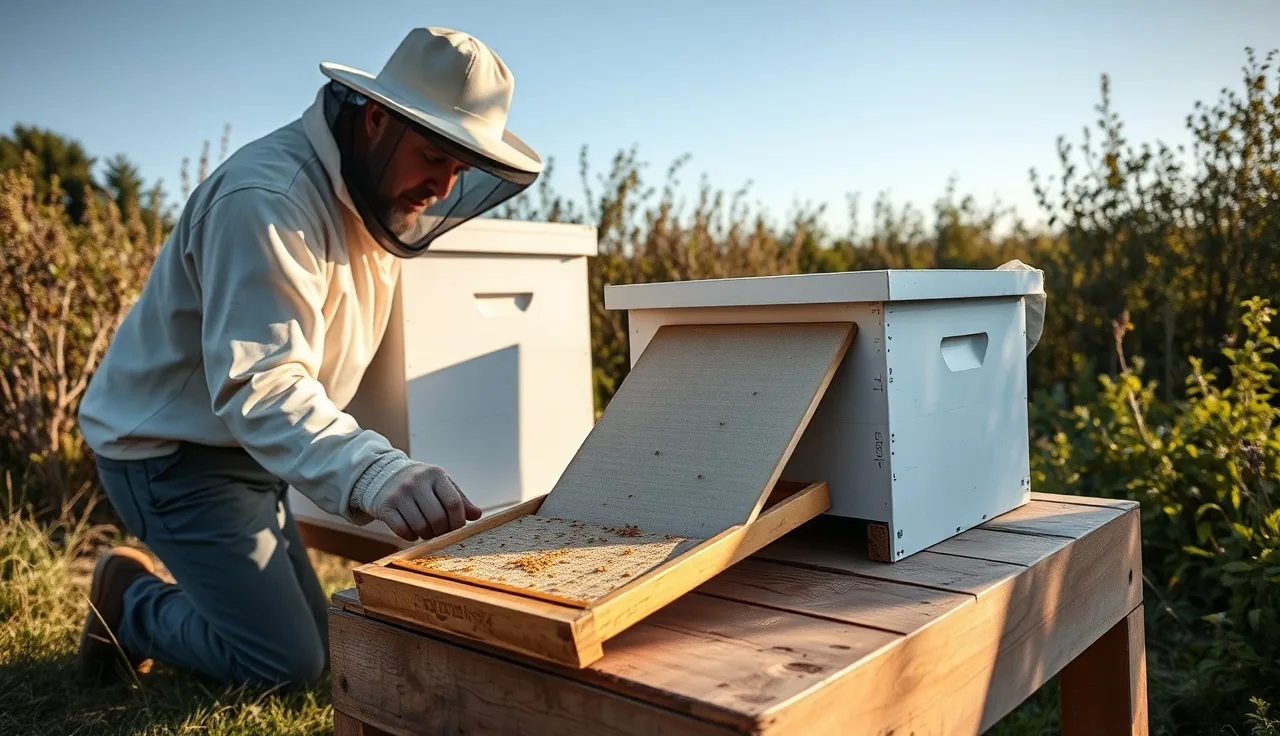
A sticky board is a sheet of cardboard or coroplast coated with petroleum jelly, vegetable shortening, or something similar sticky. You slide it under a screened bottom board for 24 to 72 hours, pull it out, and count the varroa mites that fell through the screen and stuck. Mites lose their grip on bees during normal colony activity and drop, and some fraction of those fallen mites land on the board.
The test costs almost nothing. A sticky board can be a piece of cardboard you smear with Crisco, or a commercial version sold by most beekeeping supply companies. You don't open the hive. You don't disturb a single bee. That convenience is real, and it matters, especially for newer beekeepers who aren't comfortable with heavy manipulation yet.
What you get from the board is the natural mite drop (NMD), sometimes called daily mite drop. Divide the total count by the number of days the board was in place, and you have a daily average. The question is what that number actually tells you, and whether it tells you enough to act on.
How does natural mite drop relate to the actual mite population in a hive?
The link between daily mite drop and the total mite load in a colony is real but noisy. A 2006 study by Branco and colleagues in the Journal of Apicultural Research found a significant correlation between natural mite drop and infestation rate, with coefficients landing around 0.6 to 0.7 depending on conditions [1]. Put plainly: a big chunk of the variation in mite drop comes from things that have nothing to do with how many mites are in the hive.
Several variables swing the number hard. Brood matters most. When a colony has a lot of capped brood, most mites are sealed inside cells and not dropping at all. A colony in a brood break, or one that is naturally broodless in winter, shows a much higher drop per mite than a colony at peak brood, simply because more mites are phoretic (riding on adult bees) and more likely to fall. Temperature shifts mite behavior. So does colony size, since a bigger colony has more bees grooming and jostling mites loose. None of those variables are controlled when you shove a board under the hive.
The Honey Bee Health Coalition's Varroa Management Guide states that natural mite drop "does not give an accurate count of the mite load in a colony" and recommends the alcohol wash as the preferred method for treatment decisions [2]. That's the most cited authority document in American beekeeping, and the statement is worth taking at face value.
Some older extension guides listed thresholds like "more than 50 to 60 mites per 24 hours means treat." Most of those have been quietly retired or rewritten. The variability makes any single drop threshold shaky.
What are the main sources of error in a sticky board count?
| Error source | Direction of effect | Magnitude |
|---|---|---|
| High brood-to-phoretic ratio | Underestimates mite load | Large |
| Colony brood break or winter | Overestimates relative load | Large |
| Small colony population | Underestimates absolute drop | Moderate |
| Ants, debris, or pollen clogging board | Obscures mite count | Moderate |
| Inconsistent board placement time | Distorts daily average | Small to moderate |
| Wind or rain drawing air through bottom | Changes drop pattern | Small |
| Wax moth larvae or hive beetles chewing board | Random | Small |
The brood ratio problem is the big one. In a healthy colony at peak summer population, somewhere between 70 and 85 percent of mites sit inside capped brood at any moment [3]. Those mites never touch your board. Two colonies with identical total mite burdens can throw drops that differ by a factor of three or four, purely on how much brood each one has.
Debris is a practical headache. During a pollen flow or right after you scrape propolis, boards fill with material that looks, under the wrong light, remarkably like a varroa mite. Mites are reddish-brown ovals, roughly 1.1 mm wide, with visible legs under a loupe. Pollen grains, wax flakes, and small debris fool people, especially without magnification. A 10x hand loupe is the floor. Plenty of experienced beekeepers use a 20x loupe or a cheap USB microscope.
Ants get overlooked. In warm climates they find sticky boards fast and carry mites off the surface before you retrieve the board. If ant pressure is heavy in your area and you leave the board past 24 hours, your count can run well below the real drop.
Is there a standard threshold for treating based on mite drop counts?
No. There is no widely accepted, evidence-based treatment threshold built on natural mite drop. Plenty of people tried to establish one. The correlation between drop rate and infestation percentage is just too inconsistent to hang a cutoff on.
Alcohol wash is a different story. The Honey Bee Health Coalition recommends treating if an alcohol wash of about 300 bees (roughly half a cup) shows 2 percent or more mites during the main honey flow, or 1 to 2 percent in late summer as mite populations climb toward winter [2]. Penn State Extension and others use similar figures [4].
Some older resources floated a daily drop threshold of 8 to 10 mites per 24 hours as a rough marker of moderate infestation. The University of Minnesota Bee Lab and others have backed away from specific sticky board thresholds, citing the same variability problems [5]. If you find these old tables in a beekeeping book, treat them as ballpark hints, not decision points.
Here's the honest version. If your sticky board shows any mites at all, you probably have a real mite population. If it shows dozens, you almost certainly have a problem. The exact number on the board still tells you far less than an alcohol wash would.
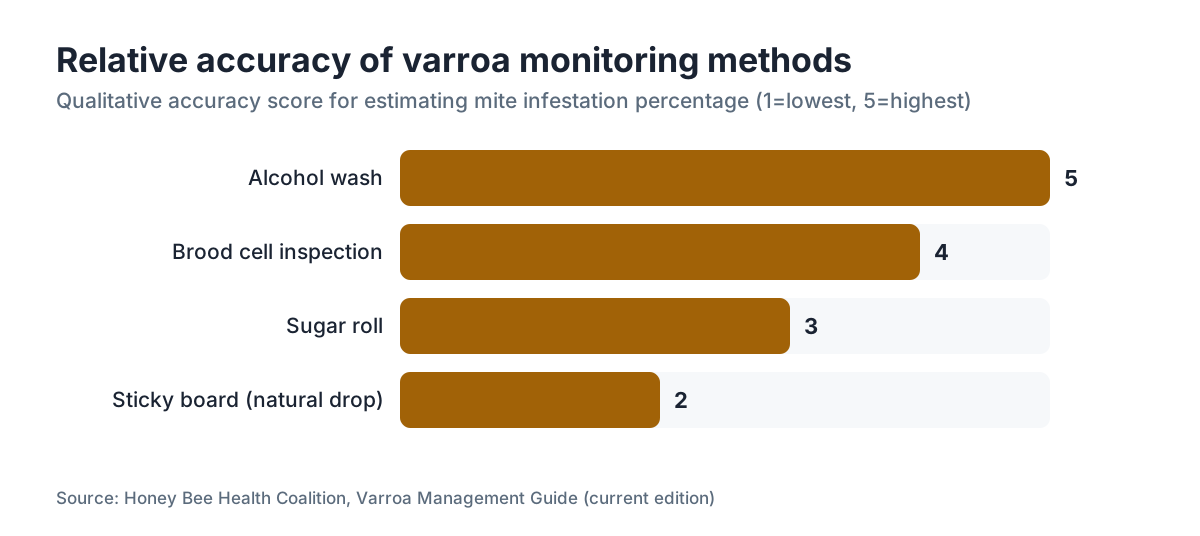
How does sticky board accuracy compare to alcohol wash and sugar roll?
| Method | Accuracy | Cost | Hive disturbance | Colony sample killed? | Detects brood mites? |
|---|---|---|---|---|---|
| Sticky board (natural drop) | Low to moderate | Near zero | None | No | Indirectly |
| Sugar roll | Moderate | Minimal | Low | No | No |
| Alcohol wash | High | Low (~$1/test) | Low | ~300 bees | No |
| Brood inspection (cell uncapping) | High for brood | Low | Moderate | No | Yes |
Alcohol wash is the gold standard for a reason. You collect about 300 bees in a jar with rubbing alcohol, shake hard, pour through a mesh, and count. Ten to fifteen minutes once you're practiced. Because you're physically stripping mites off a fixed sample, the result is a true percentage: mites per 100 bees. That number maps straight onto the treatment thresholds with confidence [4].
Sugar roll gets sold as gentler because no bees die, but the Coalition's own testing found it less accurate than alcohol wash, often undercounting because mites hold on better in powdered sugar than in alcohol [2]. NC State Extension puts the gap around 20 to 30 percent in mite recovery [11]. That gap matters when you're sitting near a threshold.
Sticky boards rank last for quantifying mite load and first for convenience and zero mortality. That tradeoff earns them a spot. They're genuinely useful for confirming mites are present, watching seasonal trends, and checking whether a treatment did anything without the labor of repeated washes. As a substitute for an actual count, they're weak.
For beekeepers who want a monitoring calendar and clear thresholds for each method, the free tools at VarroaVault include a protocol that ties sticky board checks to scheduled alcohol washes, so board observations sit in context instead of floating as loose numbers.
When should you use a sticky board instead of another monitoring method?
Sticky boards earn their keep in a few specific spots. Use one as a fast presence-or-absence check. If you're new to an apiary, don't know its mite history, and want to know whether varroa is around before committing to a bigger test, a 24-hour board is a reasonable first move. Even a handful of mites in 24 hours confirms an active population.
Use one as a treatment efficacy check. After oxalic acid or another miticide, counting mites over the first 72 hours gives you feedback. A pile of dead mites is reassuring. Almost none after oxalic acid might mean the colony was already broodless and the acid hammered the phoretic mites, or it might mean the application flopped. You still need a follow-up alcohol wash to know which.
Use one for tracking seasonal trends in your own apiary across years. Pull boards monthly, keep records, and patterns show up: this yard always spikes in August, that corner colony always runs hotter than the rest. Useful information, as long as you compare your data to itself and not to some universal threshold.
And use one if you physically cannot or flat-out will not do alcohol washes. Sugar roll is the compromise when killing bees is a hard no. A sticky board still beats nothing. Monitoring something imperfectly beats not monitoring at all.
How do you do a sticky board count correctly?
Start with a clean board. If you're making your own, use white cardboard or coroplast (white shows mites better than corrugated brown) and coat it with a thin, even layer of petroleum jelly or white vegetable shortening. A thick glob traps debris and buries your mites.
Slide the board under the screened bottom board. Confirm the screen sits above the board so bees can't reach it and pile on debris. Insert the board and note the exact time.
Leave it 24 to 72 hours. Most protocols run 72 and divide by three, because a single 24-hour window can get thrown off by one busy or quiet day. Pull the board at the same time of day you put it in.
Count under good light. Angled natural sunlight beats overhead artificial light for spotting mites against debris. A 10x loupe helps. Mites are oval, reddish-brown to dark brown, about 1 to 1.1 mm wide, with visible legs up close. Wax particles look irregular and lighter. Pollen grains are spherical or angular and usually yellow, orange, or brown, never oval with legs.
Record the count, the date, the duration, and the daily average. Note rough colony strength (strong, medium, weak) and brood status (normal, limited, none). Those notes make the count readable later. A bare number with no context is close to useless.
What do researchers actually say about sticky board reliability?
The research is consistent and a little deflating for anyone hoping the board is a decision tool. A 2012 study by De Guzman and colleagues in the Journal of Apicultural Research found that natural mite drop was significantly affected by season, temperature, and brood amount, and that its correlation with actual infestation rate varied a lot across colonies and timepoints [6]. The authors concluded mite drop "should be used with caution" as an infestation indicator.
Delaplane and Mayer, in their book Crop Pollination by Bees (CABI, 2000), noted that sticky board counts can underestimate total mite populations by as much as 50 percent during peak brood periods compared to direct sampling [7]. That figure has traveled widely and shows up in extension literature from several universities.
The blunt line comes from the Honey Bee Health Coalition, whose Varroa Management Guide calls natural mite drop "the least accurate method for estimating mite population levels" among the common approaches [2]. That's the working consensus.
Nobody says sticky boards are useless. The research says they're fine for detection and trending, poor for precise numbers. That distinction matters when you're trying to decide whether a colony reading 1.8 percent needs a treatment.
Does temperature or season affect how many mites drop naturally?
Yes, a lot. Mite drop climbs when colony temperatures swing, when bees are more active (spring and fall often beat midsummer heat), and when brood is limited. In a cold-climate winter, a broodless colony carrying a heavy mite load can throw a surprisingly high daily drop, because every mite is phoretic and getting knocked loose as the cluster shifts.
Summer flips it. A hot, productive colony with wall-to-wall brood can show a very low daily drop while sitting on a dangerous infestation, because most mites are locked in cells reproducing. This is where sticky boards fail worst. A beekeeper checks the board in July, sees 5 mites a day, figures all is well, and finds a mite-crashed colony in September.
The University of Minnesota Bee Lab warns directly that summer mite drops can read misleadingly low and shouldn't drive treatment decisions during the brood season [5]. A late-summer alcohol wash, roughly late July to mid-August in the northern U.S., catches the real mite buildup before it turns into an emergency.
Knowing which varroa mite lifecycle stage you're looking at is part of reading any count, board or otherwise. USDA Agricultural Research Service work puts the phoretic phase at only about 15 to 30 percent of the colony's total mite population during active brood season [10]. That single fact is the whole reason a low summer board can lie to you.
Can you use a sticky board to check if a varroa treatment worked?
This is one of the more legitimate uses, but it still needs reading between the lines. After an oxalic acid dribble or vaporization, a big mite drop over the first 48 to 72 hours is evidence the treatment killed phoretic mites. Vaporize a broodless colony, see hundreds of dead mites on the board in 72 hours, and you have solid qualitative proof the treatment connected.
The catch: a sticky board can't tell you your residual mite percentage after treatment. A dramatic drop might still leave the colony above 2 percent if the starting load was huge. A modest drop might be fine if you started low. To know the real before and after, you need a pre-treatment and post-treatment alcohol wash.
With treatments applied over brood, like Apivar (amitraz strips) or Mite Away Quick Strips (formic acid), much of the kill happens inside brood cells, and those mites never reach the board. Post-treatment drop from those products shows you only part of the picture. The EPA-registered labels for both recommend follow-up monitoring to confirm efficacy [8][9], and alcohol wash is the right tool for that follow-up.
How should sticky board monitoring fit into a full mite management plan?
Treat the sticky board as a low-effort first signal, never the final word. Here's how the pieces fit.
Run a sticky board check in early spring, before the first honey flow, to confirm mites are present and get a rough read on whether the colony overwintered light or heavy. If the board shows almost nothing after 72 hours and the colony is building well, you have a little more time before your first alcohol wash. If it shows a real drop, go straight to an alcohol wash.
Schedule formal alcohol washes: once in late April or May, once in late July or early August (this is the one that saves colonies), and once in September or October after any summer treatment. Timed to brood cycles and seasonal mite dynamics, these three catch problems while you can still fix them.
Use the sticky board opportunistically between scheduled washes, any time you're curious, treating the result as a qualitative flag. A sudden jump in daily drop is worth noting and chasing down. A near-zero board sitting between two clean alcohol washes is genuinely reassuring.
The Honey Bee Health Coalition's Varroa Management Guide, free to download and the most complete resource American beekeepers have, lays out this layered approach [2]. State apiculturists at most land-grant universities publish similar calendars tuned to regional brood and honey flow timing. Penn State Extension's materials are especially well-organized for it [4].
For beekeepers who want pre-built monitoring calendars and threshold calculators that fold sticky board observations into alcohol wash results, VarroaVault's free tools are built for this layered approach.
Frequently asked questions
How many mites per day on a sticky board is too many?
There is no reliable treatment threshold based on daily mite drop, and most authorities including the Honey Bee Health Coalition no longer publish one. Older guidelines suggested 8 to 10 mites per day as a warning level, but the variability in sticky board results makes any single cutoff misleading. If you're seeing double-digit daily drops, run an alcohol wash right away to get an actual mite percentage before deciding on treatment.
How long should you leave a sticky board in the hive?
Most protocols call for 24 to 72 hours. A 72-hour count averaged over three days beats a single 24-hour count, which can get skewed by one unusually active or quiet day. Pull the board at roughly the same time of day you inserted it, and note the exact hours in your records. Leaving a board in past 72 hours raises the risk of debris, ants, or hive beetle damage wrecking the count.
Do you need a screened bottom board to use a sticky board?
Yes, a screened bottom board is required. The screen lets falling mites drop through to the sticky surface while keeping bees off the board. If your hive has a solid bottom board, you cannot use the sticky board method. You would need to add a screened bottom board or switch entirely to alcohol wash or sugar roll for monitoring.
What do varroa mites look like on a sticky board?
Varroa mites are reddish-brown to dark brown ovals, roughly 1 to 1.1 mm wide and about 1.6 mm long. They're wider than they are long, so they look flattened and round rather than stretched out. Under a 10x loupe you can count eight legs. They read clearly different from wax flakes, which are irregular and lighter, and from pollen grains, which are round and usually yellow or orange. Angled light helps a lot.
Can you use a sticky board to monitor mites in winter?
Yes, and winter is one of the few times a board reads more cleanly, because a broodless colony has nearly all its mites in the phoretic phase. A drop of even a few mites per day in January or February confirms mites are present and gives a rough sense of burden. It won't replace a spring alcohol wash, but it tells you whether the colony entered winter carrying too many mites, before you even crack the lid.
Is a sticky board count good enough for a new beekeeper?
As a way to detect mite presence, yes. As a way to decide when to treat, no. New beekeepers are actually most at risk from leaning on sticky boards, because they're less likely to spot mite damage in the brood and may miss the seasonal patterns that make a board count readable. Learning alcohol wash early is a far better use of your energy than learning to count board drops accurately.
Why does my sticky board show almost no mites even though I know my colony is infested?
Almost certainly because most of your mites are reproducing inside capped brood cells. During peak brood season, 70 to 85 percent of a colony's mites sit in capped cells at any moment and never reach a sticky board. A low board count during a strong summer brood period can be deeply misleading. Run an alcohol wash to see the real picture.
How do you make a DIY sticky board?
Cut white corrugated plastic (coroplast) or stiff white cardboard to fit your screened bottom board. Coat the surface with a thin, even layer of petroleum jelly or white vegetable shortening, not thick enough to pool. White shortening on white plastic makes mites easy to spot. Slide it under the screen, making sure bees can't reach it from the entrance. Pull it in 24 to 72 hours. Total cost is under a dollar.
How accurate is a sugar roll compared to a sticky board?
Both trail alcohol wash, but sugar roll beats sticky board for estimating actual mite percentage. Sugar roll tests a defined sample of bees and gives you a percentage you can compare to treatment thresholds, unlike a board count, which gives you an absolute drop number with no reliable denominator. Still, the Honey Bee Health Coalition's own testing found sugar roll can undercount by 20 to 30 percent versus alcohol wash, so it's the second-best option, not an equal.
Do small hive beetles or debris make sticky board counts unreliable?
Yes. Wax scrapings, propolis, pollen, and small hive beetle activity can clutter the board and hide mites. Hive beetle larvae can physically chew a board left in too long. Ants in warm climates can strip mites off the sticky surface before you retrieve it. Pulling the board within 72 hours and using a hand loupe for careful identification cuts these errors down, but doesn't erase them.
How often should you run a sticky board check?
There's no consensus schedule for board checks, because they aren't the primary monitoring tool. Beekeepers who use them tend to check monthly during the active season, mainly to watch for trend changes rather than to make treatment calls. Some run one right after a treatment for quick feedback. The scheduled tests that matter are alcohol washes, at minimum twice a year: late spring and late summer.
Can sticky boards detect other hive pests besides varroa?
Sticky boards will catch small hive beetles, wax moth eggs, and assorted debris, but they aren't a reliable diagnostic for any pest other than varroa. Small hive beetle adults are much larger than mites and easy to tell apart. Wax moth frass and debris look irregular. Some beekeepers use boards to gauge rough hive beetle pressure, but that's informal observation, not a tested protocol.
Sources
- Branco et al., Journal of Apicultural Research, 2006, 'Use of sticky boards to estimate varroosis in honey bee colonies': Correlation between natural mite drop and infestation rate is significant but variable, with coefficients in the 0.6 to 0.7 range depending on season and brood conditions.
- Honey Bee Health Coalition, Varroa Management Guide (current edition): Natural mite drop is described as 'the least accurate method for estimating mite population levels' and alcohol wash is recommended for treatment decisions; treatment threshold is 2% during honey flow and 1-2% in late summer.
- Rosenkranz et al., Journal of Invertebrate Pathology, 2010, 'Biology and control of Varroa destructor': Roughly 70 to 85 percent of mites in a colony are in capped brood cells at any given time during brood season, explaining why phoretic mite drop underestimates total burden.
- Penn State Extension, Varroa Mite Monitoring and Treatment Guide: Alcohol wash of approximately 300 bees compared to a 2% threshold during honey flow season is the recommended monitoring protocol for treatment decisions.
- University of Minnesota Bee Lab, Varroa Mite Management: Summer mite drops can be misleadingly low; the university recommends against using sticky board counts alone during brood season for treatment decisions.
- De Guzman et al., Journal of Apicultural Research, 2012, 'Impacts of season and temperature on Varroa destructor drop rates': Natural mite drop is significantly affected by season, temperature, and brood amount, leading the authors to conclude mite drop should be used with caution as an infestation indicator.
- Delaplane and Mayer, Crop Pollination by Bees (CABI, 2000): Sticky board counts can underestimate total mite populations by as much as 50 percent during peak brood periods compared to direct sampling methods.
- EPA, Apivar (amitraz) registered label and product information: EPA-registered Apivar label recommends follow-up monitoring to confirm treatment efficacy after the treatment period.
- EPA, Mite Away Quick Strips (formic acid) registered label: Mite Away Quick Strips label recommends post-treatment monitoring; much of the efficacy occurs inside capped brood cells and does not appear on sticky boards.
- USDA Agricultural Research Service, Varroa Mite Research: Federal research supports phoretic mite phase accounting for approximately 15 to 30 percent of total colony mite population during active brood season.
- NC State Extension, Varroa Mite Management for Honey Bees: Sugar roll may undercount mites by 20 to 30 percent compared to alcohol wash due to mites adhering better in powdered sugar; alcohol wash is the preferred sampling method.
Last updated 2026-07-09