Sticky board mite count: how to read and act on your results
TL;DR
- Slide a sticky board under your screened bottom board for 24, 48, or 72 hours.
- Count every mite body, then divide by days to get a daily drop.
- Above 1-2 mites per day in spring, or 8-10 per day before winter, means treat, but confirm with an alcohol wash first.
- You need a grid, good light, and a loupe to count right.
What is a sticky board mite count and why does it matter?
A sticky board is a flat sheet of white cardboard or plastic coated with a thin film of petroleum jelly or vegetable shortening, sitting in the tray slot under a screened bottom board. Mites that fall off bees land on it and stay put. You pull the board after a set period, count the bodies, and do a little math to get a daily drop rate.
This is one of the oldest varroa monitoring methods there is, and it has real limits. But it's free, it disturbs the colony not at all, and it gives you a running picture of mite pressure over time. If you open your hives once a week, a board left in place between visits shows you trends you'd otherwise miss.
Here's the honest part. A sticky board count is a passive, indirect measurement. It tells you how many mites fell off bees or got groomed off. It does not tell you what percentage of your bees are infested, and that percentage is what treatment thresholds are actually built on. The Honey Bee Health Coalition's Tools for Varroa Management guide is blunt that alcohol wash or sugar roll is the preferred method for a treatment decision, because those give you an infestation rate. [1] The board is a screening tool and a trend tracker. It's not the thing you bet a treatment call on by itself.
Plenty of good beekeepers use the board as a first filter. Low drop, they hold off. Drop climbing fast or already high, they go straight to an alcohol wash to confirm, then treat. That workflow makes sense.
How do you set up a sticky board correctly?
You need three things: a screened bottom board, a tray that slides underneath it, and something sticky on that tray. Commercial boards come pre-coated and fit most Langstroth screened bottoms. To make your own, cut white cardboard to size, draw a 1-inch grid on it with a marker, then coat it with a thin layer of plain vegetable shortening. Draw the grid before you coat. The grid matters more than most people think, and I'll get to why.
Slide the board in sticky side up, flush under the screen. Check that no bees can reach it from the front entrance or through gaps at the sides. Bees that walk on it die stuck there, and their bodies bury your count.
Write down the exact time you put the board in. Pull it 24, 48, or 72 hours later and note that time too. The math only works if you're honest about elapsed hours.
When you pull the board, take it somewhere bright and still. Varroa mites are roughly 1.1 mm long and 1.6 mm wide [2], reddish-brown to dark brown, and oval. They look like tiny apple seeds. A heavy fall gives you dozens at a glance. A light spring drop can have you hunting ten minutes for four.
How do you count the mites accurately on a sticky board?
Accuracy is where most people blow it. A systematic grid count is the difference between a useful number and a guess.
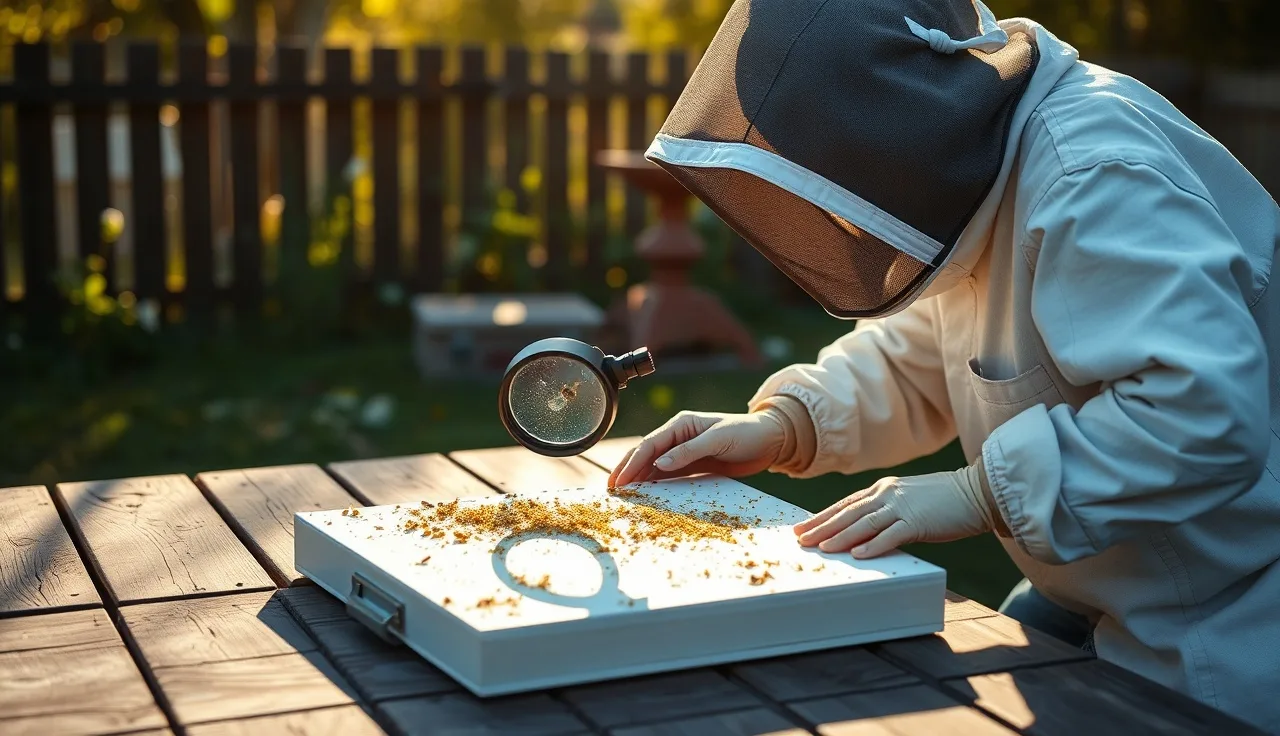
If your board has a grid, count one cell at a time and mark each cell as you finish it. A pencil checkmark per cell keeps you from double-counting an area. Use a 10x loupe or a magnifying glass. Angle a light low across the surface so the raking shadow makes mite bodies pop out from the debris.
The board also collects pollen, wax flakes, bee feces, and small hive beetle eggs. Mites are easy once you know the look: uniform oval shape, 8 tiny legs (usually folded and hard to spot), and that reddish-brown color. Dead mites sometimes curl or fade to pale tan, but the shape holds.
Count every mite body you find, whole or partial. If you see a loose leg cluster with no body, skip it. Count bodies only.
Nobody has clean data on how much counters disagree with each other on the same board. The closest useful figure comes from University of Minnesota extension work by Spivak and Reuter, which noted trained observers varying by roughly 10-15% on identical boards. [3] Treat your number as an estimate, not a lab reading. The trend across several counts beats any single number every time.
What daily mite drop number means you have a problem?
Divide your total count by the number of days the board sat. That's your daily natural mite drop. Simple.
Here's the catch with sticky board thresholds. No single number maps cleanly to infestation rate. The relationship between drop and infestation shifts with colony size, season, brood amount, and how much grooming is happening. The Honey Bee Health Coalition's 2022 guide says natural mite drop thresholds have been largely replaced by direct methods in professional recommendations, for exactly this reason. [1]
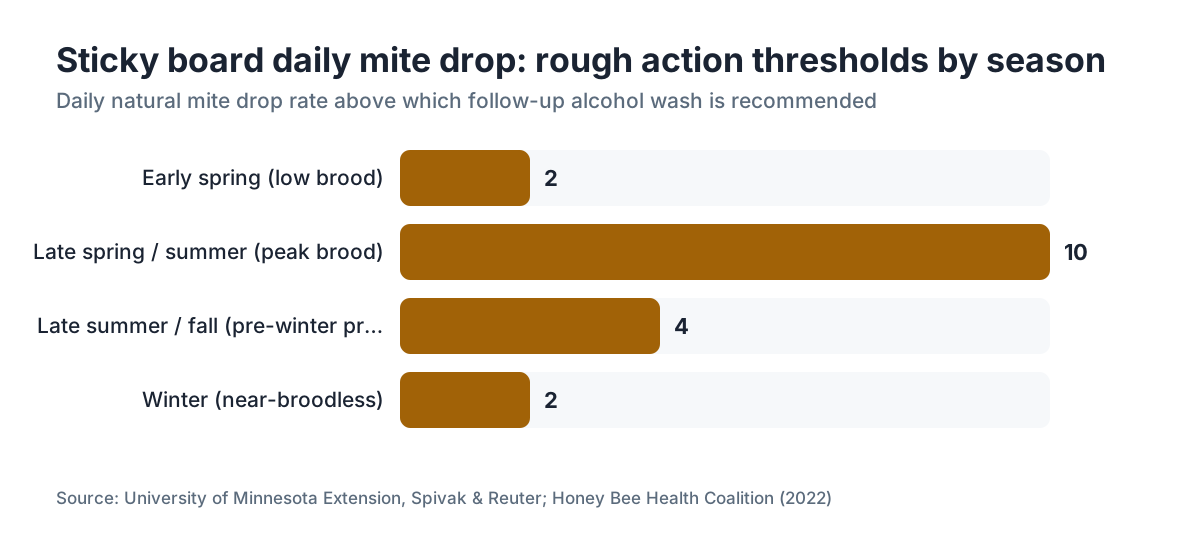
With that on the table, here are the rough thresholds that have circulated in extension literature for years, mostly from USDA ARS and university programs.
| Season | Daily drop suggesting action |
|---|---|
| Early spring (low brood) | 1-2 mites/day |
| Late spring / summer (peak brood) | 8-10 mites/day |
| Late summer / fall (pre-winter prep) | 2-4 mites/day |
| Winter (near-broodless) | 1-2 mites/day |
These come from older Marla Spivak and Gary Reuter extension work at the University of Minnesota, with similar ranges in Penn State Extension materials. [4][5] They aren't precise treatment triggers. They're early warnings. Hit one of these numbers and the next step is an alcohol wash to confirm infestation rate before you treat.
Read the table seasonally or it will fool you. A drop of 10 mites/day in July during a honey flow is alarming. The same 10 mites/day in February during a near-broodless cluster is an emergency, because almost every one of those mites is riding an adult bee with nowhere else to hide.
For a full picture of what varroa mites are, how they breed, and why brood timing drives all of this, start with the varroa mite overview.
How does sticky board count compare to alcohol wash or sugar roll?
Short version: alcohol wash is more accurate for treatment decisions, and the sticky board is better for low-disturbance trend tracking.
An alcohol wash samples about 300 adult bees (roughly half a cup), kills them in soapy water or alcohol, and counts the mites that wash off. You get a direct infestation rate: mites per 100 bees. Treatment thresholds from the Honey Bee Health Coalition, Virginia Cooperative Extension, and most state apiarist guidance sit at 2-3% infestation in spring and summer, dropping to 1-2% before winter. [1][6]
A sugar roll uses the same sample size but keeps the bees alive. It's less accurate, catching roughly 60-70% of mites versus around 90% or better for alcohol wash, based on comparisons in a 2012 Journal of Apicultural Research paper. [7]
The sticky board's edge is zero disturbance and the ability to run passively over several days. Its weakness is that the link between drop rate and true infestation is loose, bent by every variable above. A colony with strong grooming behavior can show a high drop at a low true infestation, for example.
So: screen and track with the board. Confirm and decide with the wash. That combination is about fifteen minutes of real work per hive and gives you data you can defend.
What else should you look for on the sticky board besides mites?
A sticky board catches everything falling out of the hive, and a trained eye reads more than mites off it.
Small hive beetle eggs and larvae show up as tiny white grains or worm-shaped bits. Wax moth frass looks like small pellets tangled with silk. Chalkbrood mummies fall through the screen as hard white or black capsules. Heavy pollen debris in winter, when bees shouldn't be foraging, can mean a cluster moving through stores or a ventilation problem.
None of these replace a real diagnosis, but they add context. A board with high mite counts and visible small hive beetle larvae is a colony fighting on two fronts. That shifts how you manage it.
Watch one trap: what looks like a mite might be a pollen grain, a chip of brown wax, or a mite off some wandering wasp or bee of another species. Varroa destructor has a very specific oval shape. When you're not sure, a 10x loupe settles it fast.
How often should you run a sticky board count?
Monthly monitoring is the Honey Bee Health Coalition's baseline. [1] Check more often at the turning points: coming out of winter, when a honey flow starts or ends, after you add a split or package, and in the six weeks before your winter cluster forms.
One count is a snapshot. Two or three counts over consecutive weeks give you a trend, and the trend is worth far more. A daily drop that went 3, then 7, then 15 over three weeks in August is a colony in trouble. A drop steady at 3 for six weeks buys you breathing room.
Managing five or more colonies? Rotating a single board between hives on a fixed schedule works well. Seven days per hive means you touch each one about once a month without a full inspection every time. The free protocol builder at VarroaVault can schedule these rotation windows so nothing slips.
Write the counts down. A number you remember wrong is worse than no number at all.
Does having a screened bottom board change your mite drop reading?
Yes, and it's a real difference.
A solid bottom board means fallen mites hit the floor and can climb back onto bees or get swept out. A screened bottom lets them drop through onto your sticky board, so you capture more of the natural fall. Research from the early 2000s suggested screened bottom boards alone could trim mite populations by around 10-15% versus solid bottoms, though later work walked that figure back somewhat. [8]
Running a solid bottom board? You can still do a sticky board count by sliding the tray under the entrance, but accept that you'll catch fewer mites. Your count is an underestimate of true drop. Read it that way: even moderate counts on a solid setup probably mean the real drop is higher.
Most modern Langstroth hives sold in the US now ship with screened bottom boards as standard. If you're buying equipment, screened is the better pick for ventilation and monitoring both. Check options at most beekeeping supply companies.
When should you treat after reading your sticky board results?
A sticky board count alone should not trigger treatment. Confirm with an alcohol wash. That's the honest answer, and I'm not going to soften it.
But if your drop is high and you can't wash immediately, urgency depends on the season. In July or August, a daily drop of 15 or more means treat within days, not weeks. Mite populations can double roughly every four to six weeks during peak brood season [1], and by the time you see collapse symptoms, the window is already gone.
Before winter is the highest-stakes treatment window of the year. Bees emerging in September and October need to be healthy enough to survive six months or more. A colony going into winter at 3% infestation has a poor chance of reaching spring. The Honey Bee Health Coalition's guide puts it plainly: "Treating colonies in late summer, before the winter bees are reared, is critical for colony survival." [1]
Once you've confirmed the infestation rate and decided to treat, your options hinge on temperature, brood state, and whether honey supers are on. Oxalic acid (drizzle or vaporization) is EPA-registered in the US and works best on broodless colonies. [9] Formic acid products like Mite-Away Quick Strips work at moderate temperatures and reach mites under capped brood. Apivar (amitraz strips) runs 6-10 weeks and works through the brood cycle. Every one has a labeled application window and requirements you have to follow by law.
Can cold weather or season affect your sticky board reading?
Absolutely, and this trips up more people than almost anything else.
In cold weather, bees cluster tight. Mite drop slows way down: less bee-to-bee contact, less brood turnover, less movement. A daily drop of 1-2 mites in January in Minnesota means almost nothing on its own. The same drop in June, when the colony has 60,000 bees and wall-to-wall brood during a strong nectar flow, means your infestation is probably fine.
Heat and humidity mess with the sticky film too. In hot weather, petroleum jelly can liquefy and mites sink in where you can't see them. In cold, it hardens and some mites bounce off instead of sticking. Vegetable shortening holds up across a wider temperature range than pure petroleum jelly.
Rain doesn't reach a board inside the hive, but condensation in late fall and early spring makes wax flakes clump and hide mite bodies. If the board comes out visibly damp, bring it indoors to dry before counting.
Mite pressure isn't flat across a season either. Mite populations track brood. They climb steeply from June through August while brood production runs high, then seem to fall as brood contracts in autumn, even while the share of infested bees rises because the total bee population is shrinking underneath them.
How do you record and track sticky board results over time?
A simple spreadsheet with four columns does the job: date pulled, days in place, total count, daily average. Add a column for colony ID and you can track a whole yard.
Plot your daily averages on a line graph across the season. The trend beats any single number for telling you what's happening. A colony sitting at 3 mites/day for two months is in a very different spot than a colony that was at 1 and is now at 3 and climbing.
Some beekeepers photograph the board before counting. That gives a permanent record of the debris pattern. Heavy mite concentrations in one area can hint at where the cluster is sitting, since most mites fall from zones of dense bee activity.
VarroaVault's free monitoring tools let you log sticky board counts alongside alcohol wash results and see your whole mite pressure history across colonies and seasons in one view. A record like that pays off when you're trying to work out whether some management choice actually made a difference.
For broader hive health signals and what healthy beehive pollen loads look like during monitoring, that context helps you read what you're seeing next to the mite counts.
What are the most common mistakes people make reading sticky board results?
Treating the number as more precise than it is. This is the big one. A sticky board count is a rough signal, and rounding to a whole number to compare against a threshold is false precision dressed up as science.
Skipping the grid. Without one, people over-count the dense middle and miss the corners. The grid forces complete coverage.
Pulling the board too soon or too late. A 4-hour count is nearly useless for trending. A 5-day count is hard to convert back to a daily rate if the colony's activity changed partway through. Stick to 24, 48, or 72 hours.
Ignoring season. A number that's fine in April is alarming in August. Always read your drop against the time of year and the brood state.
Using the board as the sole basis for a treatment call. Alcohol wash is the confirmation tool. The risk cuts both ways: you might treat when you didn't need to, or you might see a low drop and skip treatment right when you needed it.
And not monitoring at all. An imperfect sticky board count done monthly beats no monitoring by a mile. US managed colony losses have hovered near 40% annually in recent survey years [10], and the consistent finding is that untreated and under-monitored colonies drive most of those losses.
Frequently asked questions
How long should I leave a sticky board in the hive?
24, 48, or 72 hours gives reliable data for a daily drop rate. 24 hours is the most common choice because overnight through the next morning captures a full activity cycle. Longer periods smooth out day-to-day variation but are harder to time precisely. Don't go past 72 hours, since debris builds up and makes counting much harder.
What does 1 mite per day on a sticky board mean?
One mite per day is low and generally not cause for immediate action in spring or summer, when high brood levels and many bees dilute the infestation. In winter or early spring, when the colony is near-broodless, even 1-2 mites per day can represent a higher share of the adult bee population and warrants a follow-up alcohol wash.
Can I use a sticky board without a screened bottom board?
Yes, though your count runs lower than the true drop. Without a screen, slide a flat sticky tray under a solid bottom entrance or tape a sheet under the hive stand near the opening. You'll catch far fewer mites. It works as a rough presence check but not for reliable trend monitoring. If you're serious about monitoring, a screened bottom board is worth buying.
What's the difference between a natural mite drop and a post-treatment drop?
A natural (untreated) drop shows baseline mite fall from grooming and natural mite mortality. A post-treatment drop is often much higher as the treatment kills mites and they fall off bees. Don't use post-treatment sticky board counts to judge baseline infestation. Wait two to four weeks after treatment ends before a baseline count, or use an alcohol wash to confirm treatment efficacy sooner.
How do I make a DIY sticky board?
Cut white cardboard or foam board to fit your hive's bottom tray, usually about 14 x 16 inches for a 10-frame Langstroth. Draw a 1-inch grid with a permanent marker. Spread a thin, even layer of plain white vegetable shortening with a spatula. The shortening traps mites without hiding them. Make a fresh board for each period, since old ones accumulate debris that ruins the count.
Are sticky board mite counts useful in winter?
Yes, with careful reading. During a near-broodless winter cluster, almost all mites ride adult bees. A rising drop in January or February can flag mite pressure that will explode once brood rearing resumes. A very low or near-zero winter drop is reassuring. Even 5-10 mites per day on a January board in a cold climate suggests real mite load on a small cluster and makes spring monitoring a priority.
How do sticky board results compare to the 2% treatment threshold?
They don't map directly. The 2-3% infestation threshold used by the Honey Bee Health Coalition and most extension guidance comes from alcohol wash or sugar roll, which give a direct percentage of infested bees. Sticky board daily drop numbers don't convert cleanly to that percentage. A board tells you the trend is worsening; an alcohol wash tells you whether you've crossed the treatment line.
How many mites on a sticky board means my colony will die?
No single drop number predicts collapse on its own, because colony size, season, and brood state all matter. That said, a daily natural drop consistently above 50-100 mites in summer almost certainly means an infestation rate well above 5-10%, which is severe and points to a colony likely to collapse or abscond before winter without treatment. At that level, treat immediately and confirm with an alcohol wash.
Do sticky boards detect all varroa mites in the hive?
No. A sticky board only catches mites that fall off bees naturally or get groomed off. Most mites, especially those sealed in capped brood cells, stay invisible to this method. In a colony with 80% of mites in capped brood (typical), a board sees only a small fraction of total load. That's why sticky boards underestimate severity, especially during high-brood periods.
Is petroleum jelly or cooking oil better for a sticky board?
Vegetable shortening (solid cooking fat) is generally preferred because it holds up across a wider temperature range than petroleum jelly, doesn't liquefy in summer heat, and spreads evenly. Petroleum jelly works fine in moderate weather but can pool in heat and harden in cold, both of which cut capture reliability. Either works acceptably. Shortening is the more forgiving choice.
What does an uneven pattern of mites on the sticky board mean?
Mites cluster where bees cluster. A concentration of drop in the center of the board means the cluster or high-activity brood area sits directly above that zone. In winter this can confirm cluster position. Coverage across the whole board in summer points to a large, active colony. A completely empty section may mean that side sees less bee traffic, which can also flag a failing queen on one side.
Can I use sticky board results to evaluate whether my varroa treatment worked?
Partly. A very high mite drop right after treatment starts is a good sign the treatment is killing mites. But to confirm efficacy and check whether you're back below threshold, you need an alcohol wash two to four weeks after the treatment period ends. Post-treatment board counts tell you something is working. They don't tell you the job is done.
How do sticky boards fit into a full varroa monitoring schedule?
Most extension programs recommend monitoring at least monthly from March through November, with alcohol wash as the primary tool for treatment decisions. Sticky boards fit best as low-disturbance screening between formal washes, as a winter tool when you don't want to disturb the cluster, and as a quick trend check after adding equipment, splits, or packages. They supplement direct sampling; they don't replace it.
Sources
- Honey Bee Health Coalition, Tools for Varroa Management Guide (7th edition, 2022): Natural mite drop thresholds have largely been replaced by direct methods; seasonal treatment timing guidance; statement that treating before winter bees are reared is critical for colony survival.
- USDA ARS, Varroa destructor morphology description: Varroa destructor mites are approximately 1.1 mm long and 1.6 mm wide, reddish-brown, oval-shaped.
- University of Minnesota Extension, Varroa Mite Monitoring Methods (Spivak, Reuter): Inter-observer variation of roughly 10-15% noted in sticky board counting by trained observers.
- University of Minnesota Extension, Varroa Mite Management (Spivak, Reuter): Seasonal sticky board daily drop thresholds: 1-2 mites/day in spring, 8-10/day in summer, 2-4/day pre-winter.
- Penn State Extension, Varroa Mite Monitoring and Treatment: Similar sticky board threshold ranges cited alongside alcohol wash recommendations for treatment decisions.
- Virginia Cooperative Extension, Varroa Mite Management in Honey Bee Colonies: Action threshold of 2-3% infestation rate in spring/summer and 1-2% before winter, based on alcohol wash sampling.
- Journal of Apicultural Research, Comparison of sampling methods for Varroa destructor (2012): Sugar roll detects approximately 60-70% of mites compared to near 90%+ for alcohol wash in comparative sampling studies.
- USDA ARS, Screened Bottom Board Research Summary: Screened bottom boards reduce mite population by approximately 10-15% compared to solid bottom boards through increased natural fall.
- EPA, Oxalic Acid Registration for Varroa Control in Honey Bees: Oxalic acid is EPA-registered for varroa control in the US; most effective when applied to broodless colonies.
- USDA National Agricultural Statistics Service / Bee Informed Partnership, Annual Colony Loss Survey: Annual US managed honey bee colony losses have hovered near 40% in recent survey years, with varroa cited as a leading driver.
Last updated 2026-07-09