Reading sticky board results: what does your daily mite drop mean?

TL;DR
- Divide the total mites on a sticky board by the days it sat under the hive.
- That's your daily mite drop.
- A natural drop above 1-2 mites per day in late summer or fall is a warning; above 8-10 per day is a crisis by most extension guidelines.
- This number screens only.
- Confirm with an alcohol wash before you treat.
What is a sticky board daily mite drop average?
A sticky board (also called a monitoring board or debris board) slides under a screened bottom board and catches whatever falls through the mesh floor of the hive. Mites that fall off bees during grooming, mites emerging from cells, dead mites, and live ones that lose their grip all land on the sticky surface. You count the mites, divide by the days the board was in place, and get a number: mites per day. That's your natural mite drop average.
The math is simple. Leave the board in for 24, 48, or 72 hours, pull it, count the mites (a 10x hand lens helps), and divide the total by days. Three mites over 72 hours equals 1.0 per day. Sixty mites over three days equals 20 per day. The longer the board stays in, the more representative the average, because mite fall swings day to day with bee activity and temperature.
Here's the catch. Sticky board counts are not the same as the actual infestation rate in your colony. They measure mites that happen to fall, not the total mite population. The Honey Bee Health Coalition's Varroa Management Guide says natural mite drop is "less accurate than alcohol wash or sugar roll" and recommends it only as a first-pass screen rather than a treatment trigger on its own [1].
How do you set up and read a sticky board correctly?
Start with a clean board. If it has residue from a previous check, scrape it or flip to a fresh surface. A light coat of petroleum jelly or a commercial sticky spray keeps mites from crawling off before you count. Some boards come pre-coated. They work fine.
Slide the board under your screened bottom board so it covers the full footprint of the screen. Leave the entrance reducer at a normal setting. Do not apply any treatment during the monitoring period. Treatments knock mites loose and hand you an inflated number that reflects the treatment's knock-down, not the colony's background mite fall.
After you pull it, lay the board on a flat surface in good light. Varroa mites are brown-red ovals roughly 1.1 mm wide [2], much larger than pollen grains and clearly different from white wax flecks or the tiny elongated mites that live harmlessly in hive debris. Count everything you think might be a Varroa mite, then recount. New to this? Photograph the board and zoom in. A grid drawn on the back of the board before coating (visible through a clear substrate) helps you count systematically without losing your place.
Record the date placed, date removed, total count, and calculated daily average in a log or a monitoring app. Trends across several checks tell you more than any single number ever will.
What daily mite drop numbers indicate a problem?
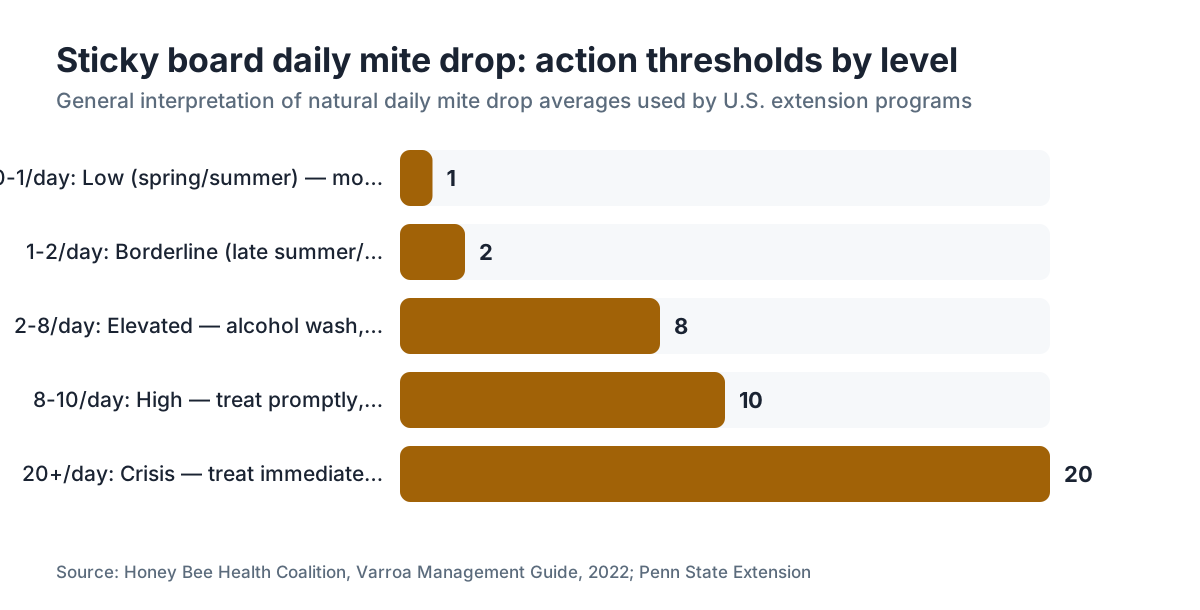
No single universal threshold exists for sticky board counts. The relationship between natural drop and actual infestation shifts with season, colony size, and brood cycle. Still, several U.S. university extension programs publish general guidance you can use as a starting point.
| Daily mite drop | General interpretation | Suggested action |
|---|---|---|
| 0-1 per day (spring/summer) | Low, monitor monthly | Continue monitoring |
| 1-2 per day (late summer/fall) | Borderline | Confirm with alcohol wash |
| 2-8 per day (any season) | Elevated, action likely needed | Confirm with alcohol wash, treat if ≥2% infestation |
| 8-10+ per day (any season) | High, treat soon | Treat promptly, recheck in 3-4 weeks |
| 20+ per day | Crisis level | Treat immediately |
Penn State Extension notes that "a sticky board count of 8-10 mites per day can be associated with a 2-3% mite infestation rate," while warning that the correlation is loose [3]. The Honey Bee Health Coalition puts the economic treatment threshold at 2% of adult bees infested (roughly 2 mites per 100 bees on an alcohol wash), regardless of what the sticky board shows [1].
Season changes the picture a lot. In late summer, brood is often peaking, more mites are reproducing inside cells, and fewer are riding adults where they can fall. A drop of 2 per day in August is more alarming than 2 per day in February. A broodless winter cluster dropping 2 mites daily has a huge fraction of its whole mite population out on adult bees, right where you can see it. Context is everything.
Why does sticky board count differ from alcohol wash results?
This trips up new beekeepers more than almost anything else. The sticky board measures passive mite fall, a small and shifting slice of the total population. The alcohol wash (or oxalic acid wash) kills and detaches every mite on a sample of bees and hands you a direct percentage. The two numbers measure different things.
Studies comparing the methods keep finding weak correlation. A 2018 paper in PLOS ONE examining mite monitoring methods found sticky board counts explained only a modest portion of the variance in infestation rates measured by alcohol wash, and the authors concluded sticky board alone should not drive treatment decisions [4]. The core problem: most mites hide inside capped brood, where they can't fall and no external method can count them short of uncapping cells.
Many extension apiarists use a rough rule of thumb. Multiply natural drop per day by something between 15 and 30 for a very rough estimate of total mite population. The range is so wide it's not a formula you can trust. Do an alcohol wash, find 2-3% infestation (2-3 mites per 100 bees), and that's your real number. Treat, no matter what the sticky board says.
Use the sticky board as a screening step. If the daily average clears your threshold, pull a 300-bee alcohol wash sample and get the real percentage. The varroa mite article on this site covers the full biology of why so many mites hide in brood and why that wrecks passive monitoring.
How long should you leave a sticky board in to get a reliable count?
Most extension recommendations call for 24 to 72 hours. Shorter than 24 hours and you're reading noise from hour-to-hour swings in bee traffic and temperature. Longer than 72 hours and debris piles up until the board is hard to read, and mites desiccate and fragment, which makes them harder to spot.
A 48-hour pull is a practical compromise. Enough time to smooth out daily variation, short enough that the board stays countable. Some beekeepers run a 72-hour check because it catches two full foraging days plus a rest day, which gives a slightly better average for a colony with a steady activity rhythm.
Skip pulling the board right after a rainstorm, a cold snap below about 50°F (10°C), or any day when bees flew far less than usual. Low-activity days suppress mite fall and make your average look lower than it really is. If the check period felt off, run a second 48-hour check before you decide anything about treatment.
One practical note. Leave the board out for the same duration every time so your records stay comparable. Comparing a 48-hour May check to a 24-hour August check works mathematically once you convert both to per-day. But if you're building a mental model of your hive's seasonal trend, a consistent duration makes patterns jump out.
Does a screened bottom board change your mite drop numbers?
Yes, and by a lot. A screened bottom board lets mites that fall off bees drop through to the ground instead of staying inside. Add a sticky board beneath the screen and you capture those falling mites, which is the whole point. A solid bottom board is different. Mites that fall land inside the hive, and bees often pick them up, groom them off again, and redeposit them on the floor over and over. A sticky board under a solid bottom catches some of those recycled mites, which can inflate your count.
Most monitoring runs a screened bottom with a sticky board underneath. That's the setup every threshold number in extension literature assumes. Using a solid bottom means your counts may not map onto the published thresholds. The University of Minnesota Bee Lab recommends screened bottom boards paired with sticky inserts for standardized monitoring [5].
Hive size matters too. A deep, populous colony with heavy bee-to-bee contact shows higher passive mite drop than a small split at the same percentage infestation, simply because more bees knock mites loose. A colony going into winter with 40,000 bees drops more mites passively than a 15,000-bee late-winter cluster at the same infestation rate. One more reason to express results as a percentage via alcohol wash when you're deciding whether to treat.
What time of year should you be monitoring most closely?
The highest-risk window for most colonies in the continental U.S. is late July through September. Varroa populations peak here because mite reproduction has been compounding all brood season, and this is exactly when the bees that carry the colony through winter are being raised. High mite loads in fall produce short-lived, immune-compromised winter bees. Colonies that crash in February usually lost the fight in August.
The Honey Bee Health Coalition recommends monitoring at least monthly from April through October, with checks every two weeks during August and September [1]. If your daily drop average is climbing fast between checks, that acceleration is its own warning. A colony at 3 per day in early August that hits 10 per day by Labor Day is in serious trouble.
Winter sticky board monitoring runs lower urgency but still helps in warmer climates or during warm spells up north, when the cluster loosens and bees turn active. A broodless colony in December dropping more than 1-2 per day has a high share of its mite load out on adult bees. That's actually the best moment to treat with oxalic acid vaporization, since it contacts phoretic mites directly [6].
Spring is a moment of false comfort. A small early-spring colony can show low drop numbers because the colony is small, not because it's clean. Do an alcohol wash before you assume you're safe.
Can you use sticky board results to decide when to treat?
Technically yes, if your counts are wildly high (20+ per day), that's a clear signal and you don't need more evidence. But for the middle ground, most experienced beekeepers and every major extension program say the same thing: don't base a treatment decision on sticky board counts alone. The accuracy isn't there.
Here's the protocol. Use the sticky board as a cheap, low-effort first screen. If it sits comfortably below your threshold, make a note and come back in a month. If it's at or above threshold, do an alcohol wash of 300 adult bees from the brood nest. If that wash shows 2% or more infestation, treat. Two steps give you the efficiency of passive monitoring plus the accuracy of a direct count when it counts.
Once you decide to act, the EPA registers several oxalic acid, formic acid, amitraz, and thymol-based products for varroa in the U.S., each with its own temperature ranges and application protocols on the label [7]. Your state's department of agriculture may add restrictions on certain treatments, so check local guidelines. The label is the law. Follow it exactly.
Want a step-by-step protocol that tells you when to check, what to do with the results, and which treatment fits your timing? VarroaVault's free monitoring tools walk that decision tree and store your records over time so you can watch seasonal trends build.
What else shows up on a sticky board besides varroa mites?
Plenty, and learning to tell it apart is part of the skill. Here's what you'll commonly find.
Wax scales: white, flat, hexagonal fragments from comb building. Much larger than mites and obviously not oval.
Pollen: dust-fine particles, usually yellow to orange, sometimes blue or white depending on your forage.
Hive debris mites: Tyrophagus and other grain-storage mites turn up on sticky boards. They're much smaller than Varroa, white or translucent, eight-legged like Varroa but with an elongated body instead of an oval one. They don't parasitize bees.
Varroa mites: brown to reddish-brown, wider than long (roughly 1.1 mm wide, 1.6 mm long), eight-legged, distinctly crab-like [2]. Under a loupe you can see the mouthparts on the front end.
Small hive beetle adults and larvae: much larger than mites, dark brown to black beetles with hard wing covers.
Bee body fragments: legs, antennae, wing parts from bees that died in the hive.
If you can't tell whether a speck is a Varroa mite, photograph it and compare against published images from USDA ARS or university extension sites. Most extension services keep close-up reference photos. Accuracy matters here. Counting Tyrophagus mites as Varroa sends you chasing a false alarm.
A proper set of monitoring supplies, sticky boards and an alcohol wash kit included, is foundational gear for any serious beekeeper. See beekeeping supplies for a rundown of what you actually need versus what's marketing fluff.
How do sticky board results change with treatments in progress?
Don't use sticky boards to monitor a treatment that's already running, at least not for calculating a baseline infestation. Apply oxalic acid, ApiLife Var, Mite Away Quick Strips, or Apivar and the product knocks mites loose, so you'll see an enormous spike in mite drop. Hundreds or thousands of mites may appear on the board in the first 24-48 hours. That spike means the treatment is working, not that your colony got worse.
Sticky boards do have a use during and after treatment. They confirm the treatment is having an effect (you should see elevated drop early), and a post-treatment check 3-4 weeks after the treatment period ends shows whether the infestation dropped. The post-treatment sticky board plus a post-treatment alcohol wash together tell you whether you need to retreat.
Apply a treatment and see almost no drop spike? That's worth investigating. Either mite levels were genuinely very low to begin with, the product went on wrong, temperatures sat outside the effective range (this matters most for formic acid and thymol products), or you have a product efficacy problem. The EPA label for each treatment names the temperature range in which it works [7].
On efficacy monitoring, the Honey Bee Health Coalition recommends an alcohol wash before and after any treatment cycle to document whether it worked [1]. Leaning only on a sticky board spike to declare victory is optimistic. Confirm with the wash.
Are there better alternatives to sticky boards for varroa monitoring?
For pure accuracy, yes. The alcohol wash is the gold standard for measuring infestation rate, recommended by the Honey Bee Health Coalition, USDA ARS, and most university extension programs as the basis for treatment decisions [1][8]. You sample 300 adult bees from the brood nest (not from the entrance or outer frames, and never the queen), submerge them in 70% isopropyl alcohol, shake for 60 seconds, strain the liquid through a sieve, and count the mites. Mites per 100 bees is your infestation rate.
The sugar roll is an older, non-lethal alternative with similar steps. You shake bees in powdered sugar, which coats the mites and makes them fall off. Studies find sugar roll undercounts mites versus alcohol wash by roughly 30-40%, so thresholds based on sugar roll results need adjusting accordingly [9].
Want a truly hands-off approach? Commercial mite monitoring kits with CO2 exist in some markets, and several universities are researching automated sticky board imaging that uses computer vision to count mites from a photo. None of the automated systems are widely validated or commercially mainstream as of 2025.
The sticky board's real edge is cost (a board runs a few dollars, or nothing if you DIY), ease (no bees harmed, no skill needed beyond counting), and repeatability over time. For a beginner building a feel for how a healthy colony's drop compares to a high-mite one, sticky boards teach you a lot. Just don't make them your only tool when lives are on the line.
VarroaVault's free varroa tracking tools let you log sticky board counts alongside alcohol wash results and treatment dates, so you can see how well passive monitoring matched your actual infestation data over time.
Frequently asked questions
How many mites per day on a sticky board is too many?
There's no perfectly clean cutoff, but most extension programs treat 8-10 mites per day as the zone where action is likely needed, and 20+ per day as a crisis. The Honey Bee Health Coalition uses an alcohol wash threshold of 2 mites per 100 bees (2% infestation) as the formal treatment trigger, so any sticky board count above your comfort threshold should be confirmed with an alcohol wash before you treat.
How long should I leave a sticky board in the hive?
48 to 72 hours is the practical sweet spot. Less than 24 hours introduces too much noise from daily bee activity variation. More than 72 hours and the board gets hard to read because of accumulated hive debris. Stick to the same duration every monitoring session so your records stay comparable across checks.
Can I use a sticky board without a screened bottom board?
You can slide a sticky board into a hive with a solid bottom, but the numbers won't match the thresholds published in extension guides, which assume a screened bottom. With a solid bottom, mites cycle around inside the hive and may be picked up and dropped multiple times before landing on the board, which can inflate your count.
What's the difference between a natural mite drop and a mite wash count?
Natural mite drop (sticky board) counts only mites that passively fall off bees during normal hive activity. An alcohol wash forces every mite off a known number of bees, giving you a direct infestation percentage. The two numbers are not directly interchangeable. Sticky board counts are screening tools; alcohol wash results are what you base treatment decisions on.
Do I need to coat the sticky board in petroleum jelly or oil?
Yes, or use a pre-coated commercial board. Without a sticky coating, live mites can crawl around or leave the board before you count. A thin, even coat of petroleum jelly works well. Some beekeepers use vegetable shortening. The goal is just enough stickiness to hold the mites in place.
Why is my sticky board count much higher right after I treated?
That's expected and actually good news: it means the treatment is working. Oxalic acid, formic acid, amitraz, and thymol all knock mites loose from adult bees. The spike you see in the 24-72 hours post-treatment is those mites falling. Do not count a post-treatment sticky board toward your monitoring baseline. Wait 3-4 weeks after the treatment ends and do a fresh check.
How do I tell varroa mites apart from other debris on the sticky board?
Varroa mites are reddish-brown, oval (wider than long), roughly 1.1 mm wide, and have eight legs. They look like tiny crabs. Common look-alikes include white wax flakes (flat, no legs), pollen grains (round, much smaller), and harmless Tyrophagus storage mites (translucent white, elongated body, much smaller than Varroa). A 10x hand lens makes identification easy once you've seen a few.
Is a daily mite drop of 0 always safe?
Not necessarily. Zero drop on a sticky board during a high-brood period mostly means mites are locked inside capped cells where they can't fall. A colony can have a dangerous 3-4% infestation rate and show very low passive drop during peak brood season. Zero drop is reassuring in a broodless winter colony; it means little during active brood rearing.
How often should I check the sticky board?
The Honey Bee Health Coalition recommends monthly monitoring from April through October, with checks every two weeks during the highest-risk late-summer window (August and September). If you're watching a borderline situation or just finished a treatment, check every two to three weeks until you're confident the colony is stable.
What varroa count is considered safe going into winter?
The generally accepted goal before winter is an alcohol wash result below 1-2% (1-2 mites per 100 bees). In sticky board terms, a natural daily drop well under 1-2 mites per day during the late fall broodless period is a reasonable sign. But confirm with an alcohol wash, more than the sticky board, before deciding you're safe for winter.
Do sticky board results vary by colony size?
Yes. Larger colonies have more bee-to-bee contact, which dislodges more mites passively, so a big colony at 2% infestation will typically show a higher raw daily drop than a small colony at the same infestation rate. This is one reason expressing results as a percentage from an alcohol wash is more reliable than relying on raw daily drop counts.
Can I use sticky board monitoring in combination with an alcohol wash?
That's exactly the recommended approach. Use the sticky board as a cheap, low-effort first screen each month. When the daily average hits your threshold, pull a 300-bee alcohol wash from the brood nest to get an accurate infestation percentage. Treat if the wash shows 2% or higher. The two methods together cost almost nothing extra and give you far better information than either alone.
Sources
- Honey Bee Health Coalition, Varroa Management Guide (2022): Natural mite drop is less accurate than alcohol wash or sugar roll and should be used as a screening tool; treatment threshold is 2 mites per 100 bees (2%)
- USDA ARS, Varroa Mite identification page: Varroa destructor is approximately 1.1 mm wide and 1.6 mm long, reddish-brown and oval
- Penn State Extension, Varroa Mite Management for Beekeepers: A sticky board count of 8-10 mites per day can be associated with a 2-3% mite infestation rate, with the caveat that correlation is loose
- Mondet et al., PLOS ONE (2018), Honey bee colony mite infestation monitoring: Sticky board counts explained only a modest portion of variance in infestation rates measured by alcohol wash; sticky board alone should not drive treatment decisions
- University of Minnesota Bee Lab, Varroa Monitoring Resources: Screened bottom boards paired with sticky inserts are the recommended setup for standardized natural mite drop monitoring
- EPA, Oxalic Acid Varroa Treatment Overview: Oxalic acid vaporization is registered for use in broodless colonies and contacts phoretic mites on adult bees
- EPA, Pesticide Product Label System (PPLS): EPA registers oxalic acid, formic acid, amitraz, and thymol-based products for varroa control; label specifies temperature ranges and application protocols and is legally binding
- USDA ARS Beltsville Bee Lab, Honey Bee Pests and Diseases: Alcohol wash is the recommended method for accurate infestation rate measurement by USDA ARS
- Macedo et al. / reviewed in Honey Bee Health Coalition Guide (2022): Sugar roll undercounts mites compared to alcohol wash by roughly 30-40%
- University of Florida IFAS Extension, Varroa Mite Monitoring and Treatment: Monthly monitoring from spring through fall is recommended, with more frequent checks in late summer
Last updated 2026-07-09