Sticky board count conversion to infestation percentage explained
TL;DR
- Divide your 24-hour natural mite drop by 10 to estimate infestation percentage in brood-right colonies during warm months.
- A drop of 20 mites per day signals roughly 2% infestation and warrants treatment.
- The formula is a rough estimate, not a lab test.
- But it's good enough to make a treatment call when you pair it with a visual check of capped brood.
What does a sticky board actually measure?
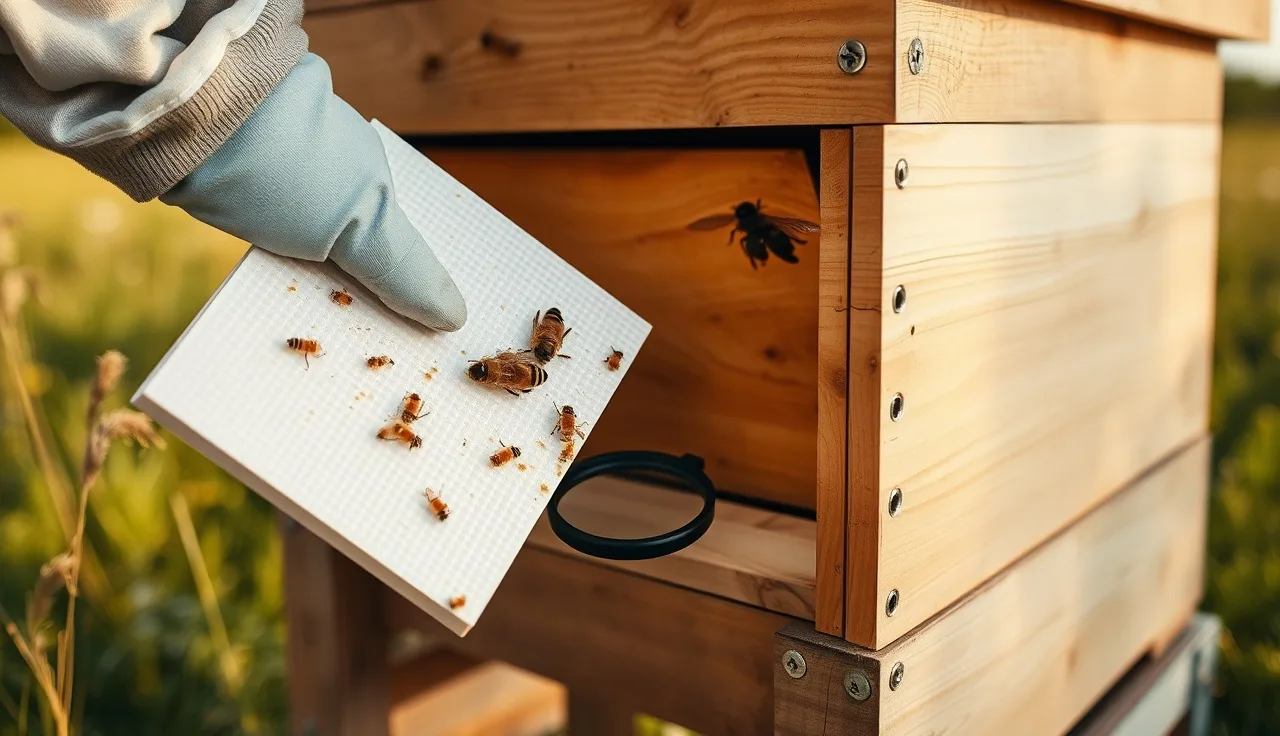
A sticky board catches mites that fall off bees on their own, through grooming, movement, and mite death. You slide a sticky or oil-coated board under a screened bottom board, leave it 24 to 72 hours, then count the mites. People also call it a varroa tray or bottom board insert.
That count is your natural mite fall. It doesn't tell you directly how many mites live in the colony. What it gives you is a proxy: a number that tracks the total mite population once you run it through a simple conversion. The relationship isn't perfect. But researchers at the USDA Beltsville bee lab and multiple university programs have checked it enough to make it useful for treatment decisions [1].
Here's the catch. The board sees mites from the whole colony, including phoretic mites riding adult bees and reproductive mites that tumble out of cells when nurse bees clean. About 80% of mites hide inside capped brood at any moment in a healthy colony, so the board only sees a slice of the real population on a given day [2].
Season shifts the whole picture. In summer, brood rearing peaks, more mites sit in cells, and fewer fall. In late fall, brood shrinks, more mites go phoretic, and fall rates jump relative to the true population. The divide-by-10 rule fits mid-season, brood-right colonies best.
What is the formula for converting mite drop to infestation percentage?
Divide the 24-hour natural mite drop by 10 to estimate the infestation percentage across capped brood and adult bees. That's the conversion taught in the Honey Bee Health Coalition's Varroa management guide [1].
The formula looks like this:
Infestation % ≈ (24-hour mite drop) / 10
Count 14 mites over 24 hours, and your estimated infestation is about 1.4%. Count 30, and you're near 3%.
Where does the divisor come from? The Coalition pulls it from a mix of university and USDA studies. The logic: in a typical mid-season colony, roughly 1% of the total mite population falls per day. Fold in the fraction of mites that are phoretic versus sealed in cells, and you land near divide-by-10 [1]. Some researchers have used divisors between 8 and 14 depending on colony size and brood coverage. That range tells you this is an estimate with real slop in it.
For a 48-hour count, add the two daily totals, divide by 2 to get a daily average, then divide by 10. Don't skip the averaging step. A full 72-hour run works the same way: average the daily fall over 3 days, then apply the divisor.
The board has to sit under a screened bottom board. A solid bottom board kills the method, because the mites can't drop through onto the tray.
What mite drop numbers should trigger treatment?
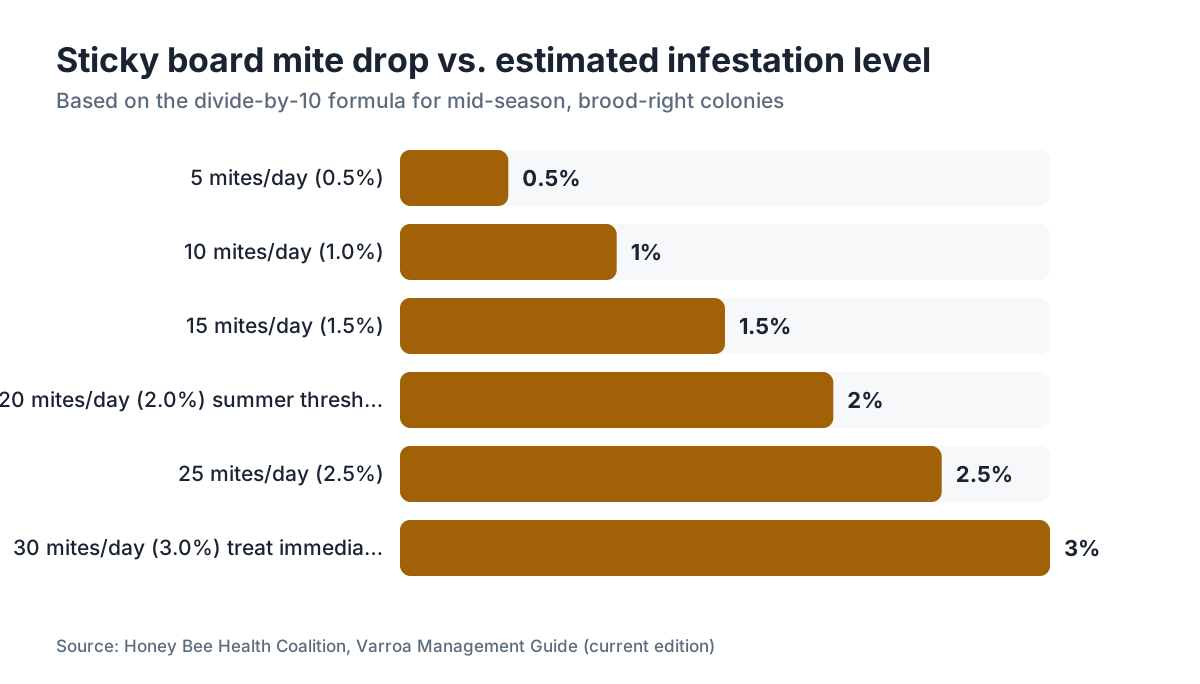
Treat at a natural drop of about 20 mites per 24 hours during brood season. That maps to the Honey Bee Health Coalition's 2% economic threshold [1]. Some extension programs set their summer action line a little lower.
Here is a practical reference table based on the divide-by-10 formula:
| 24-hr mite drop | Estimated infestation | Season guidance |
|---|---|---|
| Under 5 | Under 0.5% | Monitor monthly, no treatment needed |
| 5-9 | 0.5-0.9% | Watch closely, recount in 2-3 weeks |
| 10-19 | 1-1.9% | Consider treating; evaluate brood pattern and colony size |
| 20-29 | 2-2.9% | Treat. Above the standard summer threshold |
| 30+ | 3%+ | Treat immediately. Population can collapse fast at this level |
Those numbers assume mid-summer in a colony with a laying queen. In late summer (August and September in the northern hemisphere), the threshold flips. This is when your winter bees are being raised. Many extension programs and the Coalition recommend treating proactively at any drop above 8 to 10 during late summer, because the winter bee cohort that emerges damaged in October or November can't be replaced [3]. The Coalition sets the late-summer threshold near 1% infestation, or a daily drop around 10 mites [1].
Winter colonies with little or no brood behave differently again. Nearly all mites are phoretic on adult bees, so divide-by-10 doesn't apply. A winter drop of even 3 to 5 mites per day can flag a meaningful load when there's no brood soaking up mites.
How accurate is the sticky board method compared to alcohol wash or sugar roll?
Honest answer: it's the least precise of the three common methods. It reads trends well and diagnoses poorly.
An alcohol wash of a half-cup sample of bees gives you a direct infestation percentage with a margin of error around plus or minus 0.5% when you do it right [4]. The Honey Bee Health Coalition treats it as the gold standard for hobbyists. A sugar roll adds error because mites don't always detach. Sticky boards add the most error, because you're inferring from indirect data.
Delaplane and Hood, writing in the Journal of Apicultural Research (1999), found that natural mite fall can underestimate true infestation by as much as 50% during peak brood season, because so few mites are phoretic relative to the total population [5]. That doesn't make the board useless. It makes it a screening tool, not a diagnostic one.
The board earns its keep on trends. If your daily drop was 4 mites in June and 22 mites in August, you have a growing problem even without an exact percentage. The board is also non-lethal, needs zero bee handling, and costs almost nothing. For beekeepers who open their hives rarely, a board left in for several days paints a rough real-time picture without disturbing anyone.
So here's the rule I'd follow: confirm with an alcohol wash before you treat, especially on a borderline count (say, 12 to 18 mites). Use the board for routine monitoring in between. You can find an alcohol wash protocol through your varroa mite management resources or the Coalition guide.
Does brood volume change how you interpret the count?
Yes, a lot. The divide-by-10 rule assumes a typical mid-season colony with 6 to 8 frames of brood. Go queenless, watch the brood area shrink, and suddenly more mites go phoretic. The same daily drop of 15 mites might mean 3% infestation in a broodless colony and only 1.5% in a colony stuffed with capped brood.
That's why experienced beekeepers pair sticky board readings with a quick look at brood coverage. Estimate your frames of capped brood. If you're staring at a compact 4-frame nest, scale your read accordingly and think about an alcohol wash to calibrate.
Colony size matters too. A strong colony of 60,000 bees drops more mites at the same infestation percentage, simply because there are more bees for mites to fall off. A 2% infestation in a big colony might produce 25 to 30 mites per day. The same 2% in a 4-frame nuc might produce 8 to 10. Expressing the answer as a percentage helps, but it can't fully correct for the extremes [1][2].
How long should you run a sticky board to get a reliable count?
Twenty-four hours is the floor for a useful number. Longer reads better, because it smooths out variability from temperature swings, rain, inspection disturbance, and random fluctuations in mite fall.
Most extension programs recommend 48 to 72 hours. A 72-hour count is about as good as this method gets. Past 72 hours, debris piles up and hides mites, and your daily average gets shaky if colony conditions shifted mid-run.
Run the board when daytime temperatures clear 50°F (10°C), so bees are active and mites are actually moving. A board run during a cold snap in early spring can undercount badly, because chilled bees groom less. Summer heat can dry mites out and blow them off the board if the surface isn't sticky enough. Petroleum jelly spread thin across the board works as well as a commercial sticky board [2].
If your board has a printed grid, use it. Count one square at a time and cross off squares as you go. A 5x loupe helps you separate mite bodies (small, reddish-brown, oval) from pollen grains and wax debris. Varroa mites run about 1.1 mm across, wider than long [9].
What else shows up on the board and how do you tell mites apart from debris?
Sticky boards collect a lot of junk. Wax flakes, pollen grains, dead small hive beetles, bee legs and antennae, flower fragments, bits of comb capping. Mites stand out once you know the tells. This is the practical question nobody covers enough.
Varroa destructor is reddish-brown to brown, roughly oval, and wider than it is long. Fresh mites are about 1.1 mm wide. In good light you can see the legs. Pollen grains are round or triangular, often yellow or orange, and have no legs. Small hive beetle larvae are elongated and white. Wax flakes are translucent and shaped at random.
Two common mistakes: counting pollen masses as mites and overestimating, or missing brown mites camouflaged against brown debris and underestimating. A consistent light source, magnification, and a second look at anything suspicious cut both errors.
If you're genuinely unsure of your count, some university extension programs suggest placing a blank board in a healthy reference colony (one you've already tested at a known low level by alcohol wash) to calibrate your eye [4].
How does the conversion formula change in fall and winter?
The formula doesn't change on paper. It just becomes unreliable in predictable ways.
In fall, as the queen slows and the brood nest contracts, more mites go phoretic. The Honey Bee Health Coalition notes that natural mite fall can overestimate infestation percentage in broodless or near-broodless colonies, because you're seeing a bigger share of the total population on the board [1]. A daily drop of 20 mites in a broodless cluster is a smaller absolute infestation than 20 mites in a colony with 8 frames of brood, since the total mite population is smaller too.
In winter, full cluster, no brood, divide-by-10 is basically meaningless. Cluster temperatures run lower, bees move less, and mite fall drops hard even at high infestation. Some researchers suggest dividing by as little as 3 or 4 for broodless fall colonies, but that hasn't been validated with the rigor of the mid-season formula [5]. The honest move: run an alcohol wash in late August, before the colony goes broodless, instead of leaning on winter sticky board counts for treatment decisions.
Oxalic acid works well against phoretic mites in broodless colonies, which is exactly why winter treatment timing matters so much. Your October board count, imprecise as it is, can still tell you whether a treatment is urgent [3].
Can you use a sticky board count to decide which treatment to use?
Sort of. The board tells you the rough infestation level and the trend. The treatment choice depends on that, plus the presence of brood, the ambient temperature, and whether you're near a honey harvest.
A high load (above 3%, or 30 mites per day) during active brood rearing calls for something that reaches into capped cells. That means formic acid products (Formic Pro or Mite-Away Quick Strips), or oxalic acid by dribble or vapor, though oxalic acid only kills phoretic mites and needs repeat applications when brood is present [3]. Apivar (amitraz strips) works with brood present but takes 6 to 8 weeks to reach full effect [6].
A moderate reading (1 to 2%, or 10 to 20 mites per day) in an otherwise strong colony gives you room. You can match the treatment to the season's temperature window.
Want a structured protocol that ties the board count to a treatment decision tree? VarroaVault's free monitoring tools let you log board counts and see recommendations calibrated to your location and season. You can make the same call yourself with the thresholds here and the Coalition guide.
One note on supplies: if you're new to monitoring, a good beekeeping supply company will carry sticky boards, screened bottom board inserts, and oxalic acid applicators.
How often should you do a sticky board check during the season?
Monthly is the minimum for colonies you're actively managing. Every two weeks is better during high-risk stretches: late spring when the mite population starts to climb, and late summer when winter bees are being raised.
The USDA and university extension programs commonly recommend monitoring at least 4 times a year: early spring (set a baseline), late spring (catch the buildup), late summer (the pre-treatment window that matters most), and fall before the cluster forms [4]. That's the floor. Plenty of serious hobbyists check every inspection, which in summer often means every 10 to 14 days.
After treatment, the board becomes your feedback loop. A working oxalic acid vaporization produces a visible spike in mite fall in the first 24 to 48 hours, then a steady decline. If you treat and the count stays high two weeks later, something's off: the application, the temperature window, or reinfestation from robbing or drift next door. Both the Apivar label and the Formic Pro label spell out expected efficacy timelines [6][7].
What are the limits of this method that every beekeeper should know?
The sticky board is a blunt instrument. It points you in the right direction without giving you a precise number, and it's easy to over-read.
Four things throw the estimate off. Colony size (bigger colonies drop more mites at the same rate). Brood volume (more brood means fewer phoretic mites and lower fall). Temperature and bee activity during the count. And counting errors from mistaking debris for mites. Any one of these can move your estimate by 30 to 50% [5].
For a treatment decision in a borderline colony, confirm with an alcohol wash. The half-cup method (roughly 300 bees) gives you a direct, accurate count. The Honey Bee Health Coalition alcohol wash protocol is free and takes about 10 minutes in the field [1].
Keep a simple log. Board numbers, brood frames observed, colony strength score. Patterns across months beat any single reading.
And don't use a board count as your only reason to skip a treatment. If the board says 8 mites per day but it's mid-August and your colony is packed with brood, that's a borderline call. Do an alcohol wash and decide for real. Colonies can slide from manageable to collapsing fast in August and September. A treatment you didn't need costs a little. A treatment you skipped when you needed it costs the colony.
Frequently asked questions
What is a safe sticky board mite count per day?
Below 5 mites per 24 hours suggests an infestation under 0.5%, generally considered safe during brood-rearing season. The Honey Bee Health Coalition's summer treatment threshold is around 2%, or roughly 20 mites per day on the board. In late summer, when winter bees are being raised, some programs drop the action line to 10 mites per day, about 1% infestation.
Is the divide-by-10 formula always accurate?
No. It's a reasonable mid-season estimate for a colony with 6 to 8 frames of brood, but it can be off by 30 to 50% in colonies with very little brood, very large colonies, or during temperature extremes. Use it to decide whether to run a more precise test like an alcohol wash, not as a final diagnostic number.
Can I use a sticky board under a solid bottom board?
No. A sticky board only works under a screened bottom board. The screen lets mites that fall off bees drop through onto the tray below. With a solid bottom board, mites land on the hive floor and often climb back onto a bee. You'll need a screened bottom board insert to use this monitoring method.
How do I count the mites accurately without miscounting debris?
Use a loupe or hand lens at 5x with a consistent light source, ideally daylight. Varroa mites are reddish-brown, oval, wider than long, and about 1.1 mm across. Count grid square by grid square if your board has a grid, marking off each one as you finish. Compare suspicious objects: pollen is round, wax is translucent and irregular, and fresh mites show visible legs.
Does the mite drop number change after treatment?
Yes, and it's a useful signal. Effective treatment, especially oxalic acid vaporization, produces a spike in mite fall within 24 to 48 hours as phoretic mites die and drop. Fall should then decline over the following week or two. If your daily count stays high two weeks after treatment, check whether the application was correct, temperature was in range, or reinfestation from neighboring colonies is happening.
What's the difference between a sticky board count and an alcohol wash result?
An alcohol wash gives a direct measurement: you sample roughly 300 bees, wash them, and count mites for an exact phoretic percentage. A sticky board gives an indirect estimate of total infestation through the divide-by-10 formula. Alcohol wash is more accurate, especially in borderline cases. Sticky boards are non-lethal, cheaper, and good for trend monitoring between precise checks.
How does a queenless or broodless colony affect the sticky board reading?
A queenless or broodless colony has far more phoretic mites, because there are no capped cells to shelter them. So the daily drop runs high relative to the actual total mite population, and the divide-by-10 formula overestimates infestation percentage. In this situation, an alcohol wash beats the sticky board formula for setting a treatment threshold.
Can sticky board counts monitor the effectiveness of a treatment like Apivar or Formic Pro?
Yes, with caveats. A rise in mite fall shortly after applying Apivar or Formic Pro is a good sign the treatment is working. But the link between fall rate and remaining infestation is even shakier during active treatment than during baseline monitoring. After treatment ends, wait a week for the colony to stabilize, then run an alcohol wash to confirm the final infestation level.
Why do different sources give different thresholds for the same mite drop number?
Because the conversion formula has real biological variability baked in, and different programs weight seasonal timing differently. The Honey Bee Health Coalition, most land-grant university extension programs, and the USDA Agricultural Research Service use slightly different action thresholds, often ranging from 1% to 3% for summer. When numbers conflict, use the lower threshold and confirm with an alcohol wash.
How do I know if the mites on my board are from my colony or from drifting bees?
You can't tell from the board alone. Mites on drifting bees or robbers from a nearby high-load colony land on your board looking identical to your own. If you're seeing unusually high counts and your alcohol wash reads lower than expected, drift or robbing could be the reason. Reducing the entrance during robbing season is a practical step either way.
What materials do I need to make a sticky board at home?
A sheet of corrugated plastic or cardboard cut to fit your bottom board tray, coated with a thin layer of petroleum jelly, works well. Some beekeepers use vegetable oil on a white paper sheet. White or light backgrounds make mites easier to see against debris. Pre-printed grid sheets help you count systematically. Commercial sticky boards from suppliers work fine too and often ship with a grid.
At what infestation percentage does a colony typically collapse?
Research from the USDA and multiple university programs indicates colonies often show acute population decline when infestation passes 3 to 4% during brood-rearing season, matching a daily drop of roughly 30 to 40 mites on a board. At these levels, virus loads from mite-transmitted pathogens like Deformed Wing Virus can trigger rapid brood death and adult bee loss within 4 to 6 weeks.
Do I need to do a sticky board count before and after every treatment?
Before treatment, a board count gives you a baseline to decide whether to treat at all. After treatment, an alcohol wash beats a board count for confirming efficacy, because mite fall during treatment is artificially high with dying mites and doesn't reflect the true remaining infestation. Use the board for baseline monitoring and the alcohol wash to confirm post-treatment results.
Sources
- Honey Bee Health Coalition, Varroa Management Guide (current edition): Divide the 24-hour natural mite drop by 10 to estimate infestation percentage; treatment threshold is 2% during brood season and approximately 1% in late summer when winter bees are being raised.
- Penn State Extension, honey bee and pollinator resources: Approximately 80% of mites are in capped brood at any time in a healthy colony; sticky board captures phoretic fraction and debris.
- USDA Agricultural Research Service, Bee Research Laboratory: Oxalic acid is effective against phoretic mites in broodless colonies; late summer is the critical monitoring window for winter bee protection.
- University of Minnesota Bee Lab: Alcohol wash of a half-cup sample produces infestation percentage with margin of error around ±0.5%; recommended monitoring at least 4 times per year.
- Journal of Apicultural Research, Natural mite fall as an estimator of infestation level (Delaplane & Hood, 1999): Natural mite fall can underestimate true infestation by as much as 50% during peak brood season; divisors between 8 and 14 have been used depending on colony size and brood coverage.
- EPA, pesticide registration (Apivar / amitraz label): Apivar label specifies 6 to 8 week treatment duration; efficacy in presence of brood.
- EPA, pesticide registration (Formic Pro / formic acid label): Formic Pro label includes temperature application windows and expected efficacy timeline for brood-penetrating mite kill.
- North Carolina State University Extension: Alcohol wash protocol for hobbyists; action threshold guidance for summer and fall monitoring windows.
- University of Florida IFAS, Featured Creatures (Varroa mite): Varroa destructor body size approximately 1.1 mm wide; identification characteristics distinguishing mites from debris on sticky boards.
- Bee Informed Partnership, National Management Survey: Colony collapse risk increases substantially at infestation levels above 3 to 4% during brood season; Deformed Wing Virus load correlated with mite infestation level.
Last updated 2026-07-10