Natural mite fall counting: how accurate is it really?
TL;DR
- Natural mite fall, measured by counting mites on a sticky board over 24-72 hours, is the least reliable of the three main varroa monitoring methods.
- Counts swing with season, colony size, and brood cycle, so treatment thresholds are nearly impossible to set accurately.
- Alcohol wash or sugar roll gives you a real percentage.
- Use sticky boards only as a rough trend indicator, never as a sole treatment trigger.
What is natural mite fall and how is the count done?
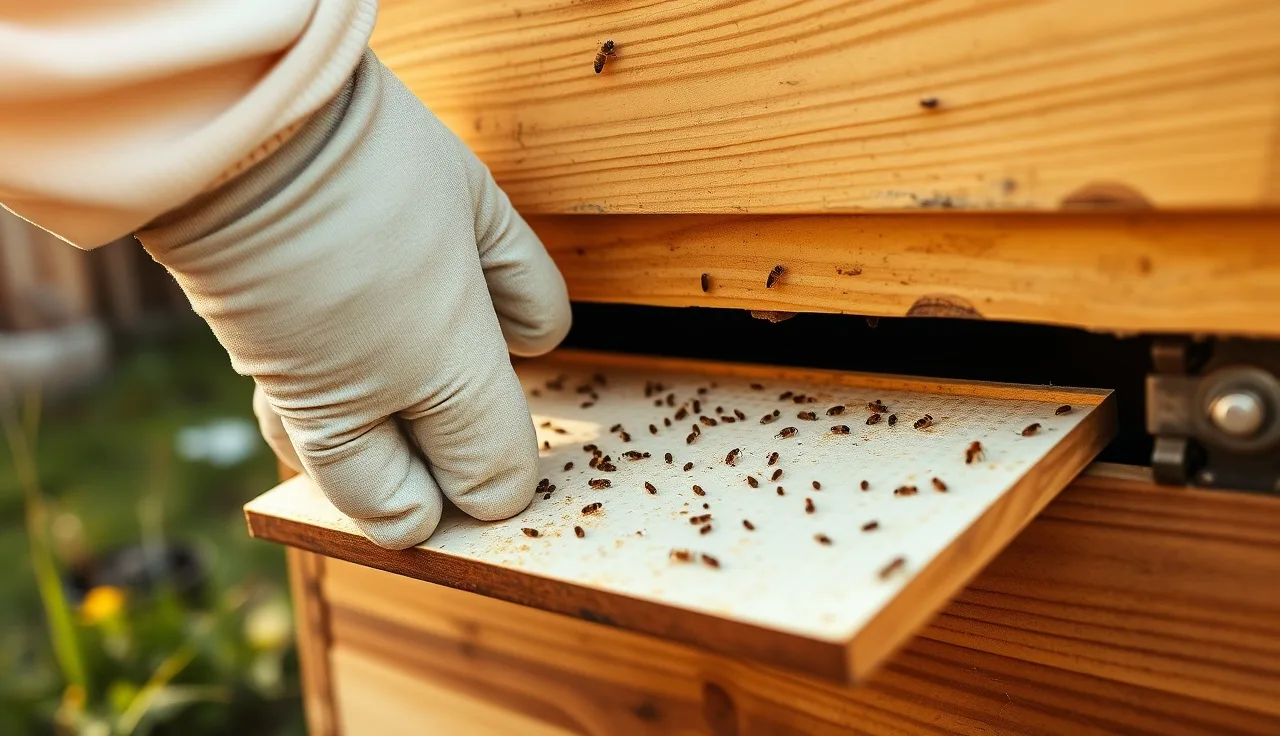
Natural mite fall is exactly what it sounds like: mites that drop off bees on their own and land on a board placed under the hive. You slide a sticky board (a sheet coated with petroleum jelly, Crisco, or a commercial adhesive) into the screened bottom board, leave it for 24, 48, or 72 hours, pull it out, and count every mite you can find. Divide by the number of days to get a daily mite drop rate.
The concept is simple and appealing. No bees die. No alcohol. No crushing. You just count the debris on a board. That low barrier to entry is why the method spread through the hobby world in the 1990s alongside screened bottom boards [1].
Understanding what a varroa mite actually is helps here. Varroa destructor is an external parasite that feeds on developing bees inside capped brood cells, and adult mites ride on adult bees between cells. Only phoretic mites (the ones riding adult bees) can fall onto a sticky board. Mites inside capped brood, which can make up 70-90% of the total mite population depending on the season [2], are invisible to this method entirely.
How accurate is natural mite fall compared to alcohol wash or sugar roll?
Bluntly: natural mite fall is the weakest of the three common monitoring methods by a wide margin. Several studies have compared sticky board counts against the alcohol wash, which is the closest thing beekeeping has to a gold standard for estimating mite load in a live colony.
A study in the Journal of Apicultural Research found that sticky board counts had low predictive value for actual infestation rates when compared with alcohol wash results, because daily drop numbers respond to too many variables outside the beekeeper's control [3]. The Honey Bee Health Coalition's Varroa Management Guide puts it plainly, stating the sticky board method "does not give an accurate count of the number of mites in a colony," and recommends alcohol wash or sugar roll for reliable infestation data [2].
Here's the practical problem. Sticky board counts give you a raw number of mites per day. Alcohol wash gives you mites per 100 bees, a true percentage. A colony with 60,000 bees dropping 30 mites a day is in very different shape than a colony with 8,000 bees dropping 30 mites a day, but the sticky board count reads identical. Without knowing the adult bee population, you cannot convert daily drop to an infestation rate with any confidence.
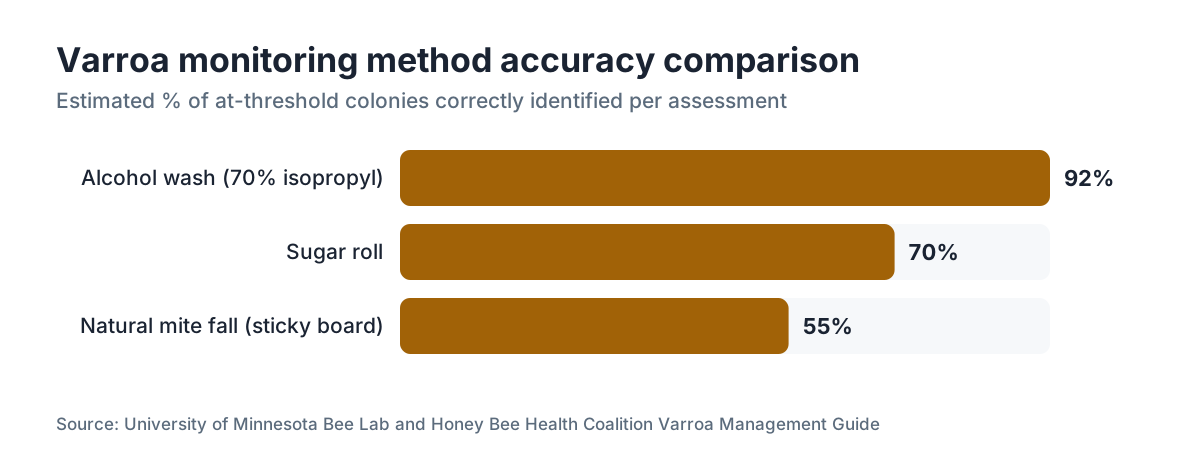
Sugar roll has its own accuracy problems. It tends to undercount relative to alcohol wash by 20-40% in some comparisons [4]. But it still gives you a percentage tied to a known sample size. Sticky board counts give you a number with no denominator. That's the accuracy gap in one sentence.
What factors make sticky board counts unreliable?
The list of confounding variables is long enough to make you skeptical every time you pull a board.
Colony size. Larger colonies carry more adult bees, which means more phoretic mites cycling off, even at a low infestation rate. A booming spring colony can look worse on a board than a stressed fall nucleus running twice the actual percentage load.
Brood cycle stage. When bees cap a big brood nest, mites rush into cells and daily drop plummets. A week later, when those cells emerge, mites pour back onto adult bees and drop rates spike. You can see a 3x swing in daily counts from the same colony within two weeks, purely from brood cycling, with no real change in total mite numbers [2].
Temperature and bee activity. Hot weather drives more movement, more grooming, more mite dislodging. Cold or rainy days suppress activity. A 48-hour count that spans a cold snap is not comparable to one taken during a nectar flow.
Drone brood. Varroa reproduces about 8x more successfully in drone brood than worker brood. Colonies raising lots of drones suppress mite drop temporarily as mites preferentially enter drone cells. When drone capping rates fall, the phoretic load spikes.
Debris on the board. Wax flakes, pollen, and dead bees hide mites. Counting accurately takes a magnifying lens and decent lighting. Studies suggest observer error alone introduces 15-25% variation in counts [3].
Season. In midsummer, even a low daily drop can mean a building problem, because the brood nest is large and most mites are capped. In late fall with a small or broodless colony, a low drop maps more directly to total mite burden. Same count, completely different meaning.
Is there any reliable treatment threshold based on natural mite fall?
Various thresholds have been published over the years, and you'll still find them in older extension guides. Common ones range from 50-60 mites per day in summer down to 10-20 mites per day in fall [1]. The trouble is that these numbers were built for average colony sizes in specific regions, and they can be wildly off for your actual hive.
The Honey Bee Health Coalition stopped recommending sticky board thresholds as primary treatment triggers in recent editions of its Varroa Management Guide [2]. The reason is straightforward: too many colonies get undertreated because their daily drop looks fine while their true infestation rate sits above 3%, the widely recommended treatment threshold for spring and summer.
Here's how the major monitoring methods stack up on threshold clarity:
| Method | What it measures | Treatment threshold available? | Sample size known? |
|---|---|---|---|
| Alcohol wash | % mites per 100 bees | Yes (2-3% spring/summer, 1-2% fall) | Yes (300 bees) |
| Sugar roll | % mites per ~300 bees | Yes (same thresholds, wider error) | Yes |
| Natural mite fall | Mites/day | Unreliable; population-dependent | No |
If you use a sticky board count at all, use it as a before/after comparison within the same colony, not as an absolute threshold tool. A board showing 5 mites/day before treatment and 50 mites/day four weeks later tells you something real, even when the number alone tells you nothing absolute.
When is natural mite fall counting actually useful?
The method isn't worthless. It earns a genuine role in a few spots, just not the one most beginners reach for.
Treatment efficacy confirmation is the best use. After an oxalic acid treatment on a broodless colony, you'll see a temporary spike in mite drop as mites die and fall off. Counting the board over 3-5 days post-treatment gives rough confirmation that something happened. A big spike means the treatment reached mites. A flat line on a colony you know is broodless suggests a problem with application or mite resistance, and that's worth chasing down with an alcohol wash [5].
Trend monitoring over time within one colony has value too. Check the same hive with a sticky board every two weeks and watch for steady doubling of daily counts. That trend is a real signal even when the absolute numbers stay hard to read. Mite populations roughly double every 4-6 weeks during the active brood season if untreated [2], so a board reading 5, 10, 22, 45 mites/day over eight weeks is a colony in serious trouble.
It's also a non-destructive option when you genuinely cannot do an alcohol wash. Maybe it's a queenright nucleus you don't want to disturb, or a beekeeper with a physical limitation that makes the wash difficult. In those cases, sticky board counts read with appropriate skepticism beat no monitoring at all.
For hobbyists running a handful of hives, I'd still say learn the alcohol wash first. It takes about 15 minutes once you're practiced, costs almost nothing beyond a jar and rubbing alcohol, and hands you a real number. Tools like those at VarroaVault help you track counts and decide when thresholds are crossed, whatever method you use.
How do you do a sticky board count correctly to maximize accuracy?
If you're going to use sticky boards, at least do them right. These steps won't fix the denominator problem, but they cut the observer error and confound variation that make results even noisier.
Use a 72-hour count rather than 24-hour. A three-day count smooths out daily variation from temperature swings and activity spikes. Divide the total by three for a daily average. Some extension programs use 24-hour counts but acknowledge 72-hour is more stable [1].
Count at the same time of day each time. Mite drop has a slight diurnal rhythm tied to bee activity, and consistent timing trims that variable.
Use a grid on the board. Print or draw a grid of 1-inch squares on a paper backing, then lay the sticky material over it. Working square by square prevents double-counting and missed mites in debris clusters. The Honey Bee Health Coalition's monitoring guide includes a printable grid template [2].
Always use a magnifying lens, ideally 5-10x. Mites run about 1.1 mm long and reddish-brown. On debris-heavy boards, they hide under wax flakes. Don't count without magnification.
Record the ambient temperature range during the counting period. When you compare counts across weeks, temperature context explains the outliers.
Never count boards after a nectar flow started or ended, after swarming, or after you've recently moved brood frames around. All of those events shift phoretic mite populations in ways that make a single count uninterpretable.
How does natural mite fall compare to alcohol wash accuracy in real numbers?
The most useful comparison data comes from studies that ran both methods on the same colonies at the same time.
A University of Minnesota Bee Lab comparison found that sticky board counts correctly identified colonies above the 2% treatment threshold only about 50-60% of the time, against alcohol wash results from the same hives on the same day [4]. On any given assessment, roughly one in three or four colonies that actually needed treatment would have been missed using sticky boards alone.
The alcohol wash itself has an estimated 90-95% recovery rate for mites in the sample when done correctly: full submersion, 30-second agitation in 70% isopropyl alcohol, then straining through a fine mesh lid [2]. Recovery drops if you skimp on agitation or use too small a sample.
Sugar roll recovers roughly 60-80% of mites in the sample. It's safer for queenright colonies you're reluctant to sacrifice bees from, but it consistently undercounts against alcohol wash [4].
The practical takeaway. If you monitor quarterly, use alcohol wash. If you check every two weeks and the small bee sacrifice adds up in a struggling colony, sugar roll is a fair compromise. Sticky boards are fine as a supplemental trend tool and should never be your sole basis for a treat/don't-treat call.
Can natural mite fall confirm whether a varroa treatment worked?
Yes, and this is one area where sticky boards earn their keep. Treatment efficacy checks are a genuinely good use of the method.
After an oxalic acid dribble or vaporization on a broodless colony, mite fall on a board placed immediately after treatment spikes for 3-7 days as treated mites die and drop [5]. Count this post-treatment fall, compare it to your pre-treatment baseline, and you get a rough kill-rate estimate. A colony that drops 200 mites in the 5 days after treatment when it was dropping 10 per day before suggests real mite mortality. One that drops 12 per day after treatment in a supposedly broodless colony is a warning sign worth a follow-up wash.
For amitraz strips (Apivar) or formic acid (Mite Away Quick Strips, FormicPro), interpretation gets messier, because those treatments work over weeks and brood is usually present [6]. A before-and-after wash gives more reliable efficacy data in those cases. A sticky board can still show you the general trend, especially in the first week of a long treatment when mites die off adult bees fast.
The EPA-registered varroa treatments, including oxalic acid products, amitraz strips, and formic acid products, all carry labels that specify application conditions and expected performance ranges [6]. None of them use sticky board counts as their efficacy metric in the label guidance. They reference infestation rate reductions measured by wash methods. That's a useful signal about which method regulators and researchers trust.
What does the Honey Bee Health Coalition actually say about sticky board accuracy?
The Honey Bee Health Coalition (HBHC) is the most widely cited collaborative authority on varroa management in the United States, bringing together universities, government agencies, beekeeping organizations, and industry. Its Varroa Management Guide, now in multiple editions, has become the standard reference for hobbyist and sideliner beekeepers.
On sticky boards, the HBHC guide states: "The sticky board (also called a mite count board or IPM board) method does not give an accurate count of the number of mites in a colony," and explains that the count "only represents the mites that have fallen off of adult bees, not those inside capped cells" [2]. The guide points you to alcohol wash or sugar roll for any decision about whether to treat.
The HBHC treatment thresholds (2-3% during brood-rearing season, 1-2% in late summer and fall going into winter) are built around wash-derived infestation percentages, not daily drop numbers [2]. Those thresholds line up with colony loss data across multiple seasons and get referenced by most university extension programs.
University extension programs echo this. Penn State Extension's apiculture resources and the University of Minnesota Bee Lab both recommend alcohol wash as the primary monitoring method and describe sticky boards as a supplemental or teaching tool [1][4].
Should you still use sticky boards at all, or skip them entirely?
My honest opinion: keep them as one tool of several, not your primary one.
For a beekeeper with 2-10 hives who checks colonies regularly, the alcohol wash is worth the small sacrifice of 300 bees per hive per check. It takes 15 minutes. It hands you a real percentage. The bees lost are a tiny fraction of a healthy colony. Do it four times a year minimum, more during high-risk summer and fall.
Sticky boards earn their spot in specific situations. You want to see mite fall after a treatment. You want a rough trend across a season in a colony you're not opening often. You have a physical limitation that makes the wash genuinely hard. In those cases, use a board, read the results conservatively, and don't let a low number talk you out of a wash when you have any other reason for concern.
The one thing I'd push back on firmly is the beekeeper who pulls a sticky board showing 20 mites per day in August and decides the colony is fine. August is exactly the high-risk window, when colonies carry heavy mite loads going into winter [2]. That 20-per-day count might mean 1% infestation or it might mean 5%. You cannot tell without a wash, and the cost of guessing wrong is a dead colony by February.
For tracking wash results across your apiary season to season, a structured monitoring log (VarroaVault's free tracking tools work well) removes the guesswork about when your last check was and what the trend looks like.
For sourcing sticky boards and wash jars, checking beekeeping supply companies is a reasonable place to start.
What are the real limitations of every varroa monitoring method?
No method is perfect. Knowing where each one breaks down makes you a more careful observer.
Alcohol wash limitations: it's destructive (300 bees per sample), a little intimidating to new beekeepers, and the 90-95% recovery rate still misses a small fraction of mites. Technique matters. Shaking the frame too gently to fill the jar collects disproportionately young bees who carry fewer mites, which underestimates the real load. Standard guidance is to sample nurse bees off a brood frame, not foragers from the entrance [2].
Sugar roll limitations: consistent undercounting against alcohol wash (some sources put it at 20-40% lower recovery [4]), and mites can escape the screen if the holes are too large or the sugar clumps in humid conditions. The method is gentler on bees, which is why some beekeepers prefer it, but for a real treatment decision the undercounting is a genuine risk.
Natural mite fall limitations: covered throughout this article, but the short version is no known denominator, high variability from outside factors, and no defensible treatment threshold.
All three share one limit: they only tell you about the moment of sampling, not what happens over the next four weeks. Mite populations double roughly every 4-6 weeks in active brood season [2], so a borderline result in late June is a serious problem by early August. Build that growth rate into your reading every time.
Frequently asked questions
How many mites per day on a sticky board means I should treat?
There is no reliably safe threshold for daily mite fall counts. Older guides suggested 50-60 mites/day in summer or 10-20 in fall, but those numbers depend on colony size and season in ways sticky boards can't account for. The Honey Bee Health Coalition recommends using an alcohol wash to get a real infestation percentage and treating when it exceeds 2-3% during brood season or 1-2% in late summer and fall.
Is a 72-hour sticky board count more accurate than a 24-hour count?
More stable, yes, but not fundamentally more accurate. A 72-hour count averages out day-to-day variation from temperature and bee activity, reducing noise in the daily drop rate. It doesn't fix the core problem, which is that you still have no denominator, no colony population figure to divide by. Use 72-hour counts when you use sticky boards at all, but don't mistake reduced variability for real accuracy.
Can I use a sticky board to check if my oxalic acid treatment worked?
Yes, this is one of the best uses for sticky boards. After oxalic acid treatment in a broodless colony, mite fall spikes over 3-7 days as treated mites die. Counting pre-treatment and post-treatment daily averages gives a rough kill-rate estimate. A large spike confirms mites were contacted. A flat post-treatment drop in a supposedly broodless colony is a warning sign worth following up with an alcohol wash.
Why do my sticky board counts vary so much week to week?
Because several forces drive daily mite drop independently of actual mite load. Brood capping and emerging cycles shift how many mites are phoretic versus capped. Temperature changes affect bee activity. Drone brood availability redirects mites into cells. A 3x swing in weekly counts from the same colony is normal and does not reliably signal a 3x change in total mites. That variability is one reason sticky boards are a poor standalone monitoring tool.
Do screened bottom boards affect natural mite fall counts?
Screened bottom boards are required for sticky board monitoring, since mites need to fall through the screen and land on the board below. Some research suggests screened bottom boards alone reduce mite loads by only about 2-10%, far less than early claims of 20-30%. The Honey Bee Health Coalition does not recommend screened bottoms as a primary mite control strategy, only as a monitoring platform.
How accurate is the sugar roll compared to natural mite fall?
Sugar roll is meaningfully more accurate than natural mite fall for a treatment decision, because it gives you a percentage tied to a known sample of roughly 300 bees. Its main limit is that it consistently undercounts mites relative to alcohol wash, typically by 20-40%. Still, a sugar roll result of 2% is actionable in a way a daily drop count of 30 mites just isn't, because you know the denominator.
What's the most accurate varroa monitoring method available to hobbyist beekeepers?
Alcohol wash is the most accurate method accessible to hobbyists, with roughly 90-95% mite recovery from a 300-bee sample when done correctly using 70% isopropyl alcohol and adequate agitation. The Honey Bee Health Coalition and most university extension programs recommend it as the primary monitoring method. It takes about 15 minutes, costs under $5 per check in materials, and gives you a real infestation percentage you can compare against established treatment thresholds.
Can I use sticky board counts during a nectar flow?
You can, but counts during active nectar flows are harder to read. Flows drive increased bee activity, which elevates mite drop, and they often coincide with population booms that change the phoretic-to-capped mite ratio. If you're using sticky boards for trend monitoring, take counts during consistent periods away from major flow starts and ends, and note the forage conditions in your records so you can contextualize changes later.
Does natural mite fall tell you anything about mites inside capped brood?
No. Sticky board counts only capture phoretic mites riding adult bees, the ones that fall off naturally. Mites inside capped brood cells, which can represent 70-90% of total mite population during peak brood season, are completely invisible to this method. This is the single biggest accuracy problem with natural mite fall: it misses most of what you need to know about where the population actually stands.
How do I convert a daily mite drop count to an infestation percentage?
You can't, reliably. There are published conversion formulas that try to estimate infestation rate from daily drop counts using assumed colony size, but the error ranges are too wide for a practical treatment decision. The colony population variable alone can swing a 2% infestation to look like 8% on the board, or the reverse. If you need a percentage, do an alcohol wash. It takes 15 minutes and tells you what the conversion formulas can only guess.
How often should I monitor for varroa mites?
University extension programs and the Honey Bee Health Coalition recommend monitoring at minimum four times per year: early spring before colonies build up, late spring as populations expand, midsummer around the solstice, and late summer (August) before the critical fall window. August monitoring matters most because mite loads peak as bee populations decline going into winter. More frequent monitoring, every 4-6 weeks, is better if you've had colony losses.
Are there situations where sticky board counting is the only option?
A few genuine edge cases exist. Some beekeepers with mobility limitations find the dexterity required for an alcohol wash difficult. Very small nucleus colonies, where sacrificing 300 bees is a meaningful percentage of the population, are another. If you truly cannot do a wash, a sticky board paired with conservative triggers, treating at lower daily counts than published thresholds suggest, beats no monitoring at all. But for most hobbyists, the wash is accessible.
What equipment do I need to do a sticky board count?
You need a screened bottom board on the hive, a sticky board (a sheet coated with petroleum jelly or a commercial adhesive like Tanglefoot), and a magnifying lens of at least 5x. A printed grid overlay helps with counting accuracy on debris-heavy boards. Total cost is under $10 for a DIY setup. Many commercial hive bottom boards come with a sliding sticky board insert included.
Sources
- Penn State Extension, Apiculture and Honey Bee resources: 72-hour sticky board counts used to derive daily mite drop averages; published seasonal thresholds for sticky boards and their limitations
- Honey Bee Health Coalition, Varroa Management Guide (latest edition): Sticky board is the least accurate monitoring method; 70-90% of mites are in capped brood; treatment thresholds of 2-3% spring/summer and 1-2% fall; mite populations double roughly every 4-6 weeks
- Journal of Apicultural Research (Taylor & Francis): Sticky board counts had low predictive value for actual infestation rates compared to alcohol wash; observer error can introduce 15-25% variation in sticky board counts
- University of Minnesota Bee Lab: Sticky board counts correctly identified colonies above 2% treatment threshold only about 50-60% of the time; sugar roll undercounts relative to alcohol wash by 20-40%
- USDA Agricultural Research Service: Post-treatment mite fall spikes for 3-7 days after oxalic acid application as treated mites die; useful for confirming treatment contact
- U.S. EPA, Pesticides program: EPA-registered varroa treatments including oxalic acid, amitraz strips, and formic acid products; product labels specify application conditions and do not use sticky board counts as efficacy metrics
- University of California Agriculture and Natural Resources: Screened bottom boards alone reduce mite loads by approximately 2-10%, far less than early estimates; not recommended as primary mite control
- Florida Department of Agriculture and Consumer Services, Apiary Inspection: Seasonal variation in mite drop counts and guidance on interpreting summer versus fall sticky board results
- NC State Extension: Nurse bees from brood frames recommended for alcohol wash sampling rather than foragers; sample collection technique affects mite recovery rate
Last updated 2026-07-09