Ether roll for varroa mite counting: the old method explained
TL;DR
- The ether roll was an early varroa diagnostic where about 300 bees were collected, hit with a burst of diethyl ether from car starter fluid, then rolled in a jar to knock mites loose.
- It worked.
- But ether is flammable, hard to source, and less accurate than the alcohol wash.
- Most extension services dropped it by the mid-2000s.
What was the ether roll and how did beekeepers use it?
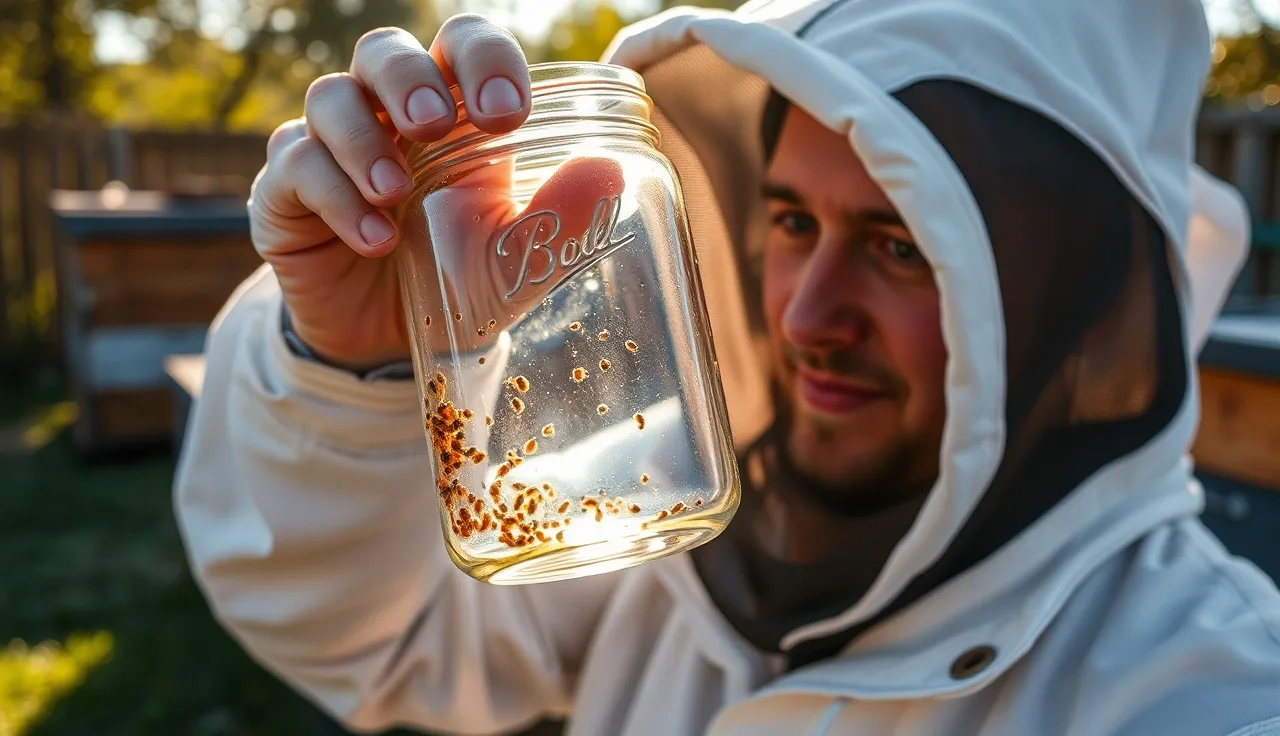
The ether roll was the first field method for counting varroa mites on adult bees. A beekeeper collected roughly 300 workers (about half a cup) off a brood frame into a wide-mouth jar, sprayed a short burst of diethyl ether starter fluid into the jar, capped it fast, then rolled the jar on its side for about 30 seconds. The rolling knocked mites loose. They stuck to the inside of the glass while the stunned bees stayed in a clump. You counted the mites on the wall, divided by the number of bees, multiplied by 100, and got an infestation percentage.
It was clever for its time. Varroa destructor showed up in the United States in the late 1980s [1], and beekeepers needed a fast way to gauge how bad an infestation was before anyone had even worked out treatment thresholds. The ether roll needed almost no gear: a jar, a lid with a small hole drilled in it, and a can of starter fluid. Cheap. Readable in under two minutes right at the hive.
The method spread fast through the 1990s and turned up in early extension bulletins alongside sticky board counts as the two main monitoring tools of that era. If you learned beekeeping before 2005, there's a decent chance an older mentor showed you this trick.
How accurate was the ether roll compared to other mite counting methods?
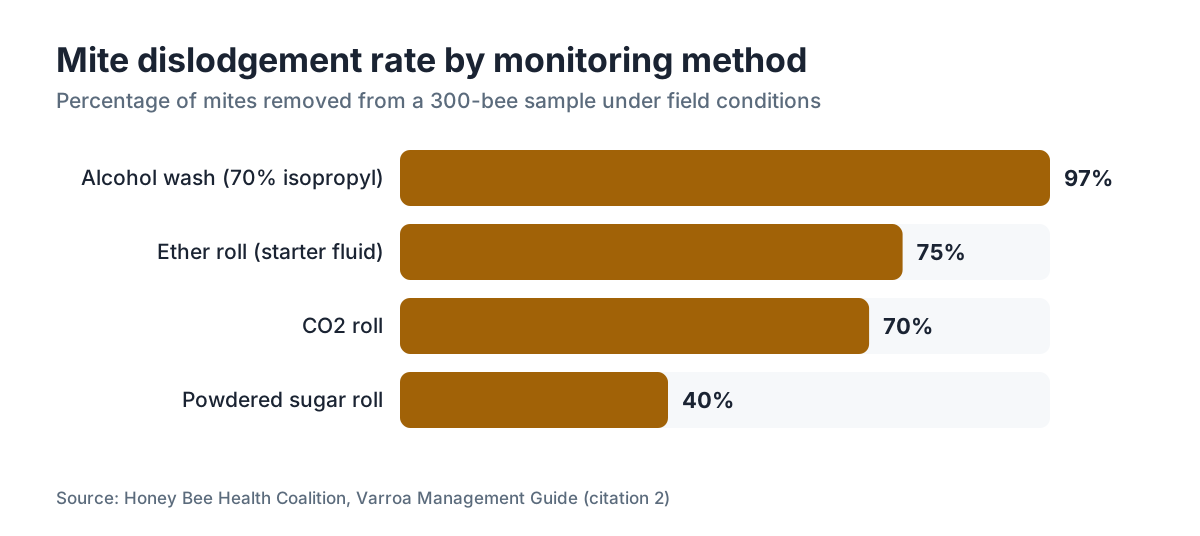
Reasonably accurate, but not the best. Comparisons of monitoring methods put the ether roll close to a 70% isopropyl alcohol wash, though often a bit lower, especially when mite loads are light. The mites have to physically detach and stick to the glass. If the rolling is uneven or the jar runs warm, some mites cling to the bees and get missed.
Work summarized by the Honey Bee Health Coalition puts the alcohol wash as the most reliable adult-bee monitoring method in use today [2]. Their field guide explains that alcohol wash and powdered sugar roll count mites from the same sample of bees, while ether and CO2 methods can undercount because dislodgement is less complete than full immersion.
Here's a rough comparison of the four main methods beekeepers have used:
| Method | Bees sampled | Bee mortality | Relative accuracy | Still recommended? |
|---|---|---|---|---|
| Ether roll | ~300 | Yes (all die) | Moderate | No |
| Alcohol wash | ~300 | Yes (all die) | High | Yes |
| Powdered sugar roll | ~300 | No (bees return) | Low to moderate | Limited |
| CO2 roll | ~300 | No (bees recover) | Moderate | Situational |
The alcohol wash beats the sugar roll and matches or beats ether, with none of the fire hazard. That's why it won.
Nobody has clean controlled data comparing all four methods under identical field conditions with verified mite loads. These rankings come from a mix of lab work and field observation, not one head-to-head trial. The honest read: ether was good enough to catch a heavy infestation but probably missed mites in lightly infested colonies.
What supplies did the ether roll require?
The shopping list was short. A wide-mouth mason jar (a pint jar with a lid does fine), a small drill for a quarter-inch hole in the lid, and a can of starting fluid containing diethyl ether. Brands like Prestone and Pyroil sold it at auto parts stores for a few dollars a can.
The ether concentration in those cans mattered. Most products ran around 25 to 35% diethyl ether cut with heptane and other propellants [3]. A one-second spray into the sealed jar usually did it. Some beekeepers marked a line on the side of the jar to eyeball the 300-bee sample by volume instead of counting individual bees.
For counting, a magnifying glass and good light helped. The mites are tiny (roughly 1.1 mm by 1.6 mm [4]) and show up as flat, reddish-brown dots on the glass. A black or white card held behind the jar improved the contrast.
Cost per test was basically zero once you had the jar and the can. One can ran dozens of tests. That low barrier is a big part of why the method spread before alcohol wash protocols got standardized.
If you're building a monitoring kit today, beekeeping supplies have moved on. Alcohol wash kits with mesh-lid mason jars are sold by most major suppliers now and cost under $15 complete.
Why did beekeepers stop using the ether roll?
Three reasons, and they stack.
First, diethyl ether is seriously flammable. Its flash point sits around negative 45 degrees Celsius, meaning it can ignite at almost any ambient temperature off a spark, a lit smoker, or a hot surface [3]. Using it near a lit smoker while wearing a veil is exactly the scenario nobody wants to rehearse. Incidents in beekeeping and in other farm settings made trainers and extension agents nervous about teaching a method with that risk.
Second, starter fluid with a high ether content got hard to find. Reformulations dropped the ether in many products, and some stores stopped stocking it. A monitoring method that hangs on a specific chemical you can't reliably buy is not a durable protocol.
Third, and the real reason, the alcohol wash got standardized. The Honey Bee Health Coalition put out a field guide that laid out the alcohol wash step by step: the correct sample size, the correct alcohol concentration, how to calculate and read the result [2]. Once that guidance was everywhere and agents could teach one clear standard, the ether roll lost its only edge, which was familiarity.
The EPA and USDA don't specifically ban the ether roll, but neither one includes it in current varroa monitoring guidance [5]. Land-grant extension programs like Penn State and the University of Minnesota have swapped all ether roll instructions for alcohol wash protocols in their published materials [6][7].
How do you do an alcohol wash instead?
The alcohol wash is the current standard. Here's the actual procedure.
Find a brood frame with open brood and nurse bees on it. Nurse bees carry the highest mite loads because mites prefer cells about to be capped. Shake or brush 300 bees into a collection container, roughly half a cup by volume.
Move the bees into a jar with a mesh lid or a purpose-built wash kit. Add 70% isopropyl alcohol (rubbing alcohol works, and the concentration matters, since higher proof evaporates too fast for a good wash). Use enough to fully submerge the cluster, usually about a cup. Shake hard for 30 seconds, then let it sit another 30 seconds.
Invert the jar and pour the alcohol-and-mite mix through the mesh into a white basin. The mites wash out. The bees stay behind the mesh. Swirl the liquid and count the mites as reddish-brown specks.
Divide the mite count by the number of bees (count them after the wash for an exact number, or use the 300-bee estimate from the half-cup) and multiply by 100 for the infestation percentage.
The Honey Bee Health Coalition's Varroa Management Guide states: "A wash with 70 percent isopropyl alcohol has been found to remove close to 100 percent of mites from the sampled bees" [2]. That's the accuracy edge over any rolling method.
At VarroaVault, the varroa mite tracking tools let you log wash counts over time and watch whether your infestation is climbing or holding, which matters more than any single count.
What mite count threshold should trigger treatment?
This is where the science actually moved over the past decade, and where the old ether-roll era set thresholds too high, partly because the counting was less precise.
The current consensus from the Honey Bee Health Coalition is 2% infestation (2 mites per 100 bees) during brood-rearing season, and some researchers now argue even that's too high [2]. In a broodless stretch or in late fall the threshold drops, because no capped brood is buffering the mite population and every mite is riding an adult bee.
The ether era ran thresholds like 5% or higher. Partly the community was still learning what mite levels actually predict colony death. Partly the treatments of the day (mostly Apistan fluvalinate strips) had their own problems, resistance included [8].
Here's how current guidance breaks down by season:
| Season / Colony state | Treat if count reaches... |
|---|---|
| Spring buildup | 2% (2 mites per 100 bees) |
| Summer brood-rearing | 2% |
| Late summer / before winter bees emerge | 2% (treat before September in most US regions) |
| Broodless period | 1-2 mites per 100 bees |
These figures come from the Honey Bee Health Coalition's updated guidelines and line up with University of Minnesota Extension recommendations [2][7]. Your state apiarist may tweak them for local mite pressure and winter length.
Was the ether roll ever endorsed by official sources?
Yes, briefly. Through the 1990s, early USDA extension materials and some state department of agriculture guides listed the ether roll as an acceptable monitoring method. It appeared in USDA Agricultural Research Service publications while Beltsville was actively building varroa management protocols [9].
By the early 2000s, the official mentions had mostly shifted to the alcohol wash and sticky boards. There was no formal retraction or condemnation in most cases. The ether roll just stopped showing up in new publications as better methods got standardized.
The EPA's regulatory materials for varroa miticides deal with approved treatments, not monitoring methods, so no EPA document specifically addresses the ether roll [5]. The Honey Bee Health Coalition, the closest thing US beekeeping has to a central guidance body, includes no ether roll instructions in any edition of the Varroa Management Guide [2].
Some beekeeping books from before 2005 still describe the ether roll as a valid option. If you're working from an older reference, this is one of the spots where the guidance has genuinely changed.
Can you still do an ether roll if you want to?
Technically yes. Nothing in federal or state pesticide law prohibits it. You're not applying a pesticide to a hive. You're applying a solvent to a sample of bees in a jar, outside the hive.
Doing it well now is harder than it sounds. Finding starting fluid with a meaningful ether concentration is genuinely tough. The product mix has shifted, and many cans sold as "starting fluid" run mostly naphtha or other hydrocarbons with little or no diethyl ether. That'll stun bees but won't dislodge mites nearly as well.
Got a reason to avoid killing bees? A small colony, a nucleus you can't spare 300 bees from, a valuable queen-right unit? The CO2 roll beats reviving the ether roll. CO2 knocks bees out for a bit, lets mites drop onto a sticky surface or into alcohol, and the bees come back around. It's not as accurate as the alcohol wash, but it's safer and doesn't need a flammable solvent.
For most hobbyists and sideliners running two to 50 colonies, the alcohol wash is the answer. The 300 bees you sacrifice out of a healthy colony of 20,000 to 60,000 adults is a rounding error, and the accuracy payoff is real.
How does mite counting fit into a full seasonal varroa protocol?
Counting mites matters only if you act on the number, and acting right depends on when in the season you find the problem.
Spring: count before the colony expands. A light load in April can climb fast as brood production scales up. If you hit 2% in April or May, treat right away with a product matched to the temperature (oxalic acid dribble works for smaller colonies; MAQS or Apivar for full-size ones).
Summer: count every 4 to 6 weeks through brood-rearing season. This is where a lot of hobbyist colonies die. The beekeeper counts once in June, sees 1.5%, and figures things are fine come August. They're usually not fine in August. Mite populations can double in 3 to 4 weeks under good conditions [10].
Late summer is the window that matters most. The bees raised in August and September are the winter bees that carry the colony to spring. Mite-damaged winter bees live shorter lives and have impaired fat bodies [11]. Treating in late July or August to knock the mite load down before those bees are raised is the single intervention with the biggest payoff for winter survival.
Fall broodless period: your best shot at an oxalic acid vaporization treatment, because mites have nowhere to hide in capped brood. One or two treatments in a broodless window can cut the overwintering mite population by 90% or more [12].
To track all of this, VarroaVault's free tools let you log counts by colony and flag when a hive crosses the threshold. That's especially handy once you're past a handful of hives.
Monitoring without a plan is just noise. The ether roll era taught beekeepers to count mites. The post-ether era is still teaching us what to do about the number.
What does the science say about why mite counting methods matter so much?
Counting accuracy drives treatment timing, and treatment timing drives colony survival. This isn't abstract.
Research by Seeley and Smith, published in Apidologie in 2015, links higher varroa loads to worse colony outcomes, and the broader literature ties late-summer infestation rates above 2 to 3% to elevated winter mortality compared with colonies kept below that line [10]. The mechanism is direct: varroa feeding on developing pupae introduces deformed wing virus and other pathogens that shorten bee lifespan and knock down immune function [4].
If your counting method undercounts by 30 to 40%, a colony that's really at 3% reads as 2%, and you wait. That delay during peak mite reproduction in summer can be the difference between a colony that winters fine and one that crashes before Christmas.
That's why the shift from ether roll to alcohol wash meant more than convenience. The Honey Bee Health Coalition's field guide states that alcohol wash "has been found to remove close to 100 percent of mites from the sampled bees" [2], while rolling methods that lean on physical dislodgement without full immersion miss a meaningful fraction. In a low-infestation colony where you're trying to tell 1.5% from 2.5%, that precision gap is the difference between treating and waiting.
The ether roll was good enough for spotting obvious, heavy infestations. For the threshold-based management that actually keeps colonies alive through winter, it wasn't precise enough.
Frequently asked questions
What is the ether roll mite test?
The ether roll is an older varroa monitoring technique where about 300 bees are collected into a jar, exposed to a short spray of diethyl ether from car starter fluid, and rolled to dislodge mites onto the glass wall. You count the mites, divide by the number of bees, and calculate an infestation percentage. The alcohol wash has replaced it because it's less accurate and diethyl ether is highly flammable.
Is the ether roll still used by beekeepers today?
Rarely. Most extension services and the Honey Bee Health Coalition no longer recommend it. Diethyl ether starting fluid has also gotten hard to find with consistent concentrations. A few older beekeepers still use it out of habit, but it has essentially no presence in current training or official monitoring guidance. The alcohol wash is the standard replacement.
How do you calculate mite infestation rate from a sample?
Divide the mite count by the number of bees in your sample, then multiply by 100. Count 6 mites from a sample of 300 bees and that's 2% infestation. The 300-bee sample is the standard because it's statistically reliable and equals roughly half a cup of bees. Smaller samples are less reliable and should be flagged when you record results.
What is a safe mite level in a beehive?
The Honey Bee Health Coalition recommends treating at 2% infestation or above during brood-rearing season. Below 2% is considered manageable, though some researchers argue even lower thresholds improve winter survival. During the broodless fall period the threshold drops to roughly 1-2 mites per 100 bees. There's no truly safe mite level. Lower is always better for colony health.
Why is the alcohol wash more accurate than the ether roll?
Full immersion in alcohol dislodges close to 100% of mites from the bees, per Honey Bee Health Coalition field research. Rolling methods like the ether roll rely on physical detachment from stunned bees, which is incomplete and swings with jar temperature, rolling consistency, and mite-bee adhesion. In low-infestation colonies where precision matters most, that difference can shift the apparent infestation rate enough to change your treatment decision.
Can I use powdered sugar instead of ether or alcohol?
You can, but the powdered sugar roll is a lot less accurate than the alcohol wash. Sugar coats the bees and knocks some mites loose, but the dislodgement rate is poor. Multiple field trials found it consistently undercounts. Some beekeepers use it because it doesn't kill the sample bees, but the Honey Bee Health Coalition rates it below the alcohol wash and no longer features it as a primary method.
How many bees do you need for an accurate mite count?
300 bees, collected from a brood frame with nurse bees present. That number gives a statistically meaningful sample without measurable harm to a healthy colony of 20,000 or more adults. Samples under 100 bees give unreliable results. Half a cup by volume is the practical field proxy for 300 bees, which is why most wash kit instructions reference a half-cup rather than counting individual bees.
When is the best time of year to count varroa mites?
Every 4 to 6 weeks during brood-rearing season, with the most important window running late July through August. Mites peak in late summer as the colony's bee population starts to drop but brood production is still high. A single spring count or a single fall count gives an incomplete picture. Late-summer counts predict winter survival better than any other single monitoring event.
Does the ether roll kill the bees in the sample?
Yes. Diethyl ether at the concentrations in starting fluid is lethal to bees at the exposures needed to dislodge mites. That's one reason some beekeepers lean toward the CO2 roll or powdered sugar roll, both of which let bees recover. But the accuracy penalty of those methods is real, and sacrificing 300 bees from a healthy colony has no measurable effect on performance.
What varroa treatments are available after a high mite count?
Approved US options include oxalic acid (dribble or vaporization), formic acid (MAQS or Formic Pro), thymol (Apiguard or ApiLifeVar), fluvalinate (Apistan), and coumaphos (Checkmite+). Choice depends on temperature, brood presence, and whether you want to avoid honey super exposure. Oxalic acid vaporization is highly effective during broodless periods. Resistance to synthetic pyrethroids like fluvalinate is widespread, so check local resistance data before defaulting to Apistan.
What is the difference between a mite wash and a mite roll?
A mite wash uses liquid (usually 70% isopropyl alcohol) to fully immerse and agitate the bee sample, producing near-complete mite dislodgement. A mite roll uses a dry or gas method (ether, CO2, or powdered sugar) to stun or coat bees so mites fall off when the jar rolls. Washes are more accurate because full immersion removes mites that clinging bees would otherwise hold through a rolling motion.
Is there a risk of harming the queen during mite sampling?
Only if you accidentally sample from her frame. Standard advice is to shake bees from a brood frame into your container, then watch to make sure the queen didn't come off with the crowd. If you spot her, set her aside or let her walk back onto the frame. Nurse bees from brood frames are what you want anyway. They carry the highest mite loads and give the most informative sample.
Where can I find current official guidance on varroa monitoring?
The Honey Bee Health Coalition's Varroa Management Guide is the most current and widely cited reference, free at honeybeehealthcoalition.org. University extension programs at Penn State, the University of Minnesota, and UC Davis publish updated monitoring protocols too. Your state apiarist's office is a good local resource, and many states run free diagnostic services for colony health assessments including mite counts.
Sources
- USDA Agricultural Research Service, Bee Research Laboratory: Varroa destructor arrived in the United States in the late 1980s and was first confirmed by USDA ARS researchers.
- Honey Bee Health Coalition, Varroa Management Guide: Alcohol wash removes close to 100% of mites from sampled bees; treatment threshold is 2% infestation during brood-rearing season; ether roll is not included in current monitoring recommendations.
- US National Library of Medicine, PubChem, Diethyl ether compound summary: Diethyl ether flash point is approximately -45 degrees Celsius, making it flammable at virtually all ambient temperatures; it is used as the active ingredient in many automotive starting fluid products.
- Rosenkranz P, Aumeier P, Ziegelmann B. Biology and control of Varroa destructor. Journal of Invertebrate Pathology, 2010: Varroa destructor adult female dimensions are approximately 1.1 mm by 1.6 mm; feeding on developing pupae introduces deformed wing virus and other pathogens.
- US EPA, Pollinator Protection: EPA regulatory materials for varroa miticides address approved treatments; the agency does not include ether roll instructions in current varroa monitoring guidance.
- Penn State Extension, Honey Bees and beekeeping resources: Penn State Extension replaced ether roll instructions with alcohol wash protocols in published varroa monitoring materials.
- University of Minnesota Extension, Honey Bee Health: University of Minnesota Extension recommends a 2% infestation threshold and alcohol wash monitoring; ether roll is not included in current guidance.
- Sammataro D, Untalan P, Guerrero F, Finley J. The prevalence of resistance to pyrethroid acaricides in Varroa destructor in the United States. International Journal of Acarology, 2005: Fluvalinate (Apistan) resistance in Varroa destructor is widespread in the United States, documented from the late 1990s onward.
- USDA Agricultural Research Service: Early USDA ARS extension materials during the 1990s included the ether roll as an acceptable varroa monitoring method alongside sticky boards.
- Seeley TD, Smith ML. Crowding honeybee colonies in apiaries can increase their vulnerability to the pathogen Nosema ceranae and the parasite Varroa destructor. Apidologie, 2015: Higher varroa loads are linked to worse colony outcomes; late-summer infestation above 2-3% is associated with elevated winter mortality, and mite populations can double in 3-4 weeks under favorable conditions.
- Dainat B, Evans JD, Chen YP, Gauthier L, Neumann P. Predictive markers of honey bee colony collapse. PLOS ONE, 2012: Mite-damaged winter bees have shortened lifespans and impaired fat bodies, reducing colony survival probability through winter.
- Gregorc A, Planinc I. The control of Varroa destructor in honey bee colonies using oxalic acid. Veterinarni Medicina, 2002: Oxalic acid treatment during a broodless period can reduce overwintering mite population by 90% or more.
Last updated 2026-07-09