CO2 roll for mite counting: how it works and when to use it
TL;DR
- A CO2 roll exposes about 300 bees to carbon dioxide gas, which makes varroa mites lose their grip and fall onto a white surface for counting.
- It takes 60 to 90 seconds and doesn't kill the bees.
- The result is comparable to an alcohol wash, though alcohol wash recovers slightly more mites at low loads and is still the accuracy standard.
What is a CO2 roll and what does it actually do to the mites?
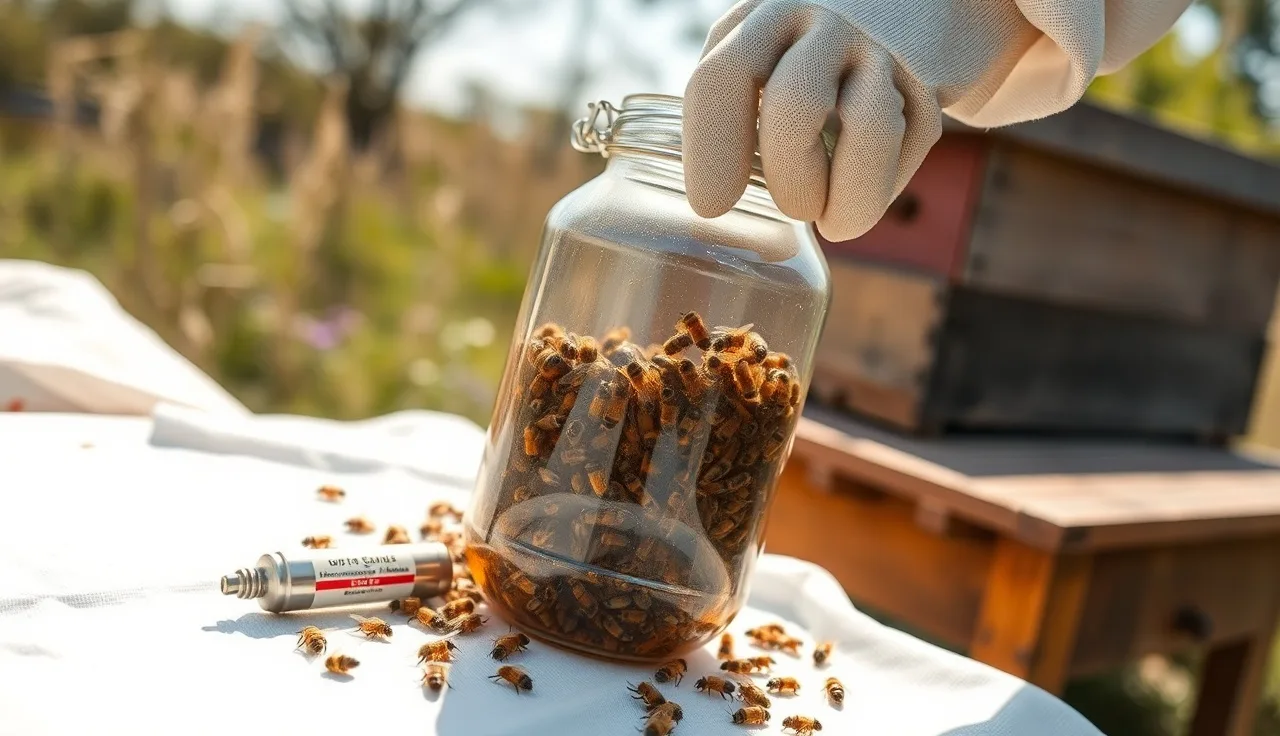
A CO2 roll gasses about 300 bees until the varroa mites riding them lose their grip and drop. The bees go limp, the mites fall off, you count them, and the bees wake up and go home. That's the whole mechanism.
Varroa attach to bees with specialized front legs and modified mouthparts called chelicerae. When CO2 concentration spikes around the cluster, the mites go limp before the bees do. A 60-second exposure at concentrations a standard CO2 cartridge produces will dislodge most phoretic mites, which are the ones riding adult bees between brood cells. Phoretic mites are exactly what alcohol wash and sugar roll measure too. The CO2 roll samples the same pool.
Bees recover within a minute or two of going back in the hive. No alcohol, no dish soap, nothing lethal touches the sample. That's the practical appeal: you dump the bees back and walk away without feeling like you sacrificed 300 workers for a data point.
One caveat matters more than any other. A CO2 roll does not detect mites inside capped brood cells, and no sample-based method does. If a colony has a heavy brood infestation that hasn't yet released a wave of emerging mites, the phoretic count will read low against your true colony burden [1].
What equipment do you need to do a CO2 mite roll?
You need four things: a sample jar, a CO2 source, a white surface to count on, and eyes good enough to spot small brown dots. A wide-mouth Mason jar with a mesh lid is the classic jar. That's the whole kit.
Most beekeepers use standard 12-gram CO2 cartridges, the kind sold for bike tire inflation or paintball, paired with a puncturing head that controls the flow. Some prefer a small aquarium CO2 canister with a needle valve for finer metering. A handful of dedicated products have appeared in the last several years, basically a purpose-built jar with a CO2 puncture port. The Varroa EasyCheck is the one you'll see most in North America. It has a measured-volume cup sized for 300 bees and a valve seat that fits standard cartridges, though you can copy the same idea on a DIY jar and spend almost nothing.
White paper or a white plastic sheet under the jar makes counting far easier. Mites are reddish-brown ovals about 1.1 mm wide, so a 10x loupe or reading glasses help if your eyes are past forty.
Some beekeepers invert the jar directly over a sticky board so the mites stick where they land and can't crawl away before you count. That works well outdoors on a calm day.
Stocking up? A working checklist runs to CO2 cartridges, the jar setup, a permanent marker for labeling samples by hive, and a notebook or the phone equivalent. Beekeeping supplies for mite monitoring are cheap next to the cost of losing a colony.
How do you collect the 300-bee sample correctly?
Sample collection is where most people make their one real mistake: they grab bees from the wrong frame.
You want nurse bees from a frame of open or capped brood. Nurse bees carry the highest phoretic mite load in the colony, because mites ride the bees about to enter a cell and get sealed in. Scoop from a honey frame near the edge and you'll collect foragers, which carry fewer mites and hand you an artificially low count [9].
Find a frame of brood without the queen on it. Tilt it about 45 degrees over your jar and shake or brush bees straight in. You're aiming for roughly 300 bees. That sounds hard to count on the fly, but 300 bees fill a standard half-cup (about 120 mL) measuring cup fairly reliably. The Honey Bee Health Coalition's Varroa management guide names roughly 300 bees as the minimum for statistical validity [1]. Drop to 200 bees and your margin of error widens enough to miss a borderline infestation.
Seal the jar once you have your sample. Some people chill it briefly in a cooler to calm the bees before gassing; others go straight to the CO2. Cooled bees are calmer and the mites drop a little more completely, but the gain is modest.
Don't sample on a cold day (below about 50°F / 10°C) when foragers are clustered inside. On a hot afternoon, foragers are out working, so a brood frame gives you a cleaner nurse-bee sample anyway. Spring and late summer are the two windows that matter most: spring before the population explodes, and late summer (August into early September across most of the northern hemisphere) when mite numbers peak [2].
Step-by-step: how to run the CO2 roll from start to finish
Here's exactly what I'd do, in order.
Step 1: Collect about 300 nurse bees from a brood frame into your jar and seal the lid. Mark the jar with the hive ID.
Step 2: Set the jar over your white surface or sticky board. If the lid has a CO2 port, keep the jar upright. If you're improvising, flip the jar upside down so bees fall away from the mesh lid, then push CO2 through the mesh.
Step 3: Inject CO2 for 60 to 90 seconds. Watch the bees slow and go lethargic. Don't push past 2 minutes. A long soak kills more bees than a quick burst.
Step 4: Roll the jar. Tilt it, spin it, turn it end over end a few times. The tumbling shakes loose mites off the bees and through the mesh onto your counting surface. Ten to fifteen seconds of active rolling does it.
Step 5: Count the mites. Get every reddish-brown oval before any of them crawl off the edge of your paper. A second short CO2 burst and roll recovers a few stragglers if you want to be thorough.
Step 6: Calculate the infestation rate. Divide mite count by bee count (estimated, or counted after the fact) and multiply by 100. Two mites per 100 bees is the treatment threshold cited across most management guides [1][2].
Step 7: Return the bees. Set the jar near the entrance and let them walk in, or open the lid over the brood nest. Most recover within a minute or two.
How accurate is CO2 roll compared to alcohol wash?
The honest answer: alcohol wash is more accurate, especially at low mite loads, but the gap is smaller than most people think.
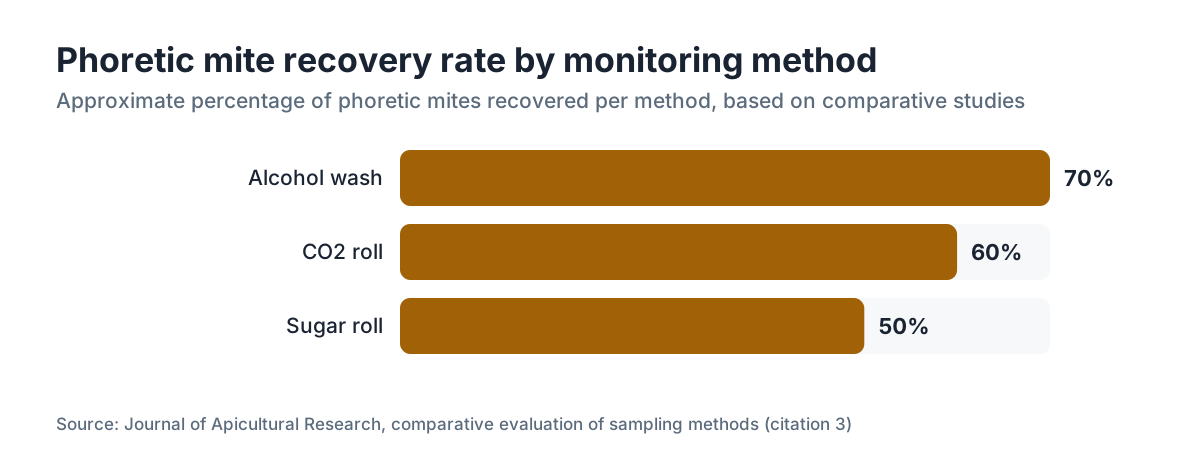
A study in the Journal of Apicultural Research compared CO2 roll, alcohol wash, and sugar roll against a full colony examination, the true gold standard. Alcohol wash recovered on average about 60 to 80% of phoretic mites, CO2 roll roughly 50 to 70%, and sugar roll 40 to 60% [3]. The ranges overlap because results shift with user technique, temperature, and colony condition. The Honey Bee Health Coalition's guide names alcohol wash as the most reliable method for hobbyist beekeepers while recognizing CO2 roll as a valid alternative when keeping bees alive matters [1].
Here's how that plays out. A CO2 roll reading 3 mites per 100 bees means treat. A reading of 0.5 means wait and retest. The gray zone sits at 1 to 2 mites per 100, where the lower sensitivity of CO2 roll could nudge you toward waiting when you should treat. On the fence in that range, repeat the test or switch to an alcohol wash to confirm.
Sugar roll is less accurate still, despite staying popular because it's cheap. Cornell's Pollinator Network has moved away from recommending sugar roll as a primary method for exactly that reason [4].
| Method | Approx. mite recovery rate | Kills bees? | Cost of supplies |
|---|---|---|---|
| Alcohol wash | 60-80% | Yes | $2-5/test |
| CO2 roll | 50-70% | No | $1-3/test (cartridge) |
| Sugar roll | 40-60% | No | <$1/test |
| Full colony exam | ~100% (destructive) | Many | High labor cost |
What does the mite count result mean, and when should you treat?
The number is mites per 100 bees, often written as a percent infestation. Here's how to read it.
Below 1%: Low load. Monitor again in 3 to 4 weeks, especially heading into winter.
1% to 2%: The warning zone. The decision turns on season. In early spring or late summer, I treat at 2%. In midsummer at peak population, you might watch one more test cycle. In August, the Honey Bee Health Coalition recommends treating at 2 mites per 100 bees without delay, because populations can double in a matter of weeks [1].
Above 2%: Treat now. A colony at 3% in August will very likely clear 5% by October, and 5% is where colony collapse and virus spread to neighboring hives accelerate [2].
Above 5%: Serious trouble. Treat immediately and look for deformed wing virus in newly emerged bees (shriveled wings, stunted abdomens). Colonies above 5% often seed mites into every hive within 2 to 3 km through drifting and robbing.
These thresholds come from the Honey Bee Health Coalition's Varroa Management Guide and line up with what most U.S. state apiarists recommend [1][2]. Reading this from Europe or elsewhere? Your national bee health authority may set slightly different cut-offs, but the 2% action threshold is broadly accepted internationally.
To track counts across hives and seasons, VarroaVault's free monitoring tools log CO2 roll results, flag treatment dates, and show trends over time without a spreadsheet.
Does CO2 roll harm the bees, and how many will die?
A clean CO2 roll kills very few bees. In tests, a 60-second exposure followed by returning bees to the hive produced mortality in the single-digit percentage range, often under 5% of the sample [3]. That's 10 to 15 bees out of 300, which a healthy colony replaces in hours.
Prolonged exposure (past 2 to 3 minutes) is where mortality climbs. If bees are still a dead-looking mass after 5 minutes in the jar, some of them won't come back. The fix is simple. Don't overdo the gas.
Alcohol wash kills 100% of the sample, so CO2 roll is plainly gentler. Whether that matters to hive productivity is debatable. Three hundred bees out of a summer colony of 40,000 to 60,000 is under 1% of the population. Killing them cleanly for an accurate count does no measurable harm to hive health. I say that not to talk you out of CO2 roll but to push back on the idea that alcohol wash is cruel. The bees an alcohol wash kills are outnumbered many times over by the bees you save when you catch an infestation early.
There is a real case for keeping the sample alive. Test a nucleus colony of only 5,000 to 8,000 bees and killing 300 in an alcohol wash is a bigger proportional hit. There, CO2 roll becomes the practical choice.
Can you reuse the same bees for a second CO2 roll to improve accuracy?
Yes, and some beekeepers do exactly this. A second 60-second burst after the bees are back in the jar, followed by another roll, recovers mites that were only partly dislodged the first time.
A two-round protocol pulls CO2 roll accuracy closer to a single alcohol wash. The cost is another cartridge burst and an extra minute. Bee mortality ticks up with repeated exposure, probably into the 10 to 15% range for a two-round test, so weigh that on a small colony.
For routine monitoring across an apiary, a single clean CO2 roll is good enough to make a treatment call in all but the most borderline cases. Save the two-round approach for confirmation when your first result lands right at the 2% threshold and you can't tell whether to treat.
How does CO2 roll fit into a seasonal mite management calendar?
Monitoring without a schedule is how you end up surprised in September. A basic annual rhythm for most of the U.S. runs like this.
Early spring (March to April): Test as soon as there's a capped brood frame. This tells you whether the colony wintered with a manageable load or is already headed for trouble.
Late spring to early summer (May to June): Test monthly if you didn't treat in spring. Mite numbers track bee numbers, so a growing colony can hide rising mites until it's too late.
Late summer (late July through August): The most important window of the year. Bees reared in August and September are the winter bees that have to survive to March. Mites wreck them. Treat by early August if you're at or above 2% [1][2].
Fall (September to October): Post-treatment check. If you treated in August, test again 4 to 6 weeks later to confirm the treatment worked. Miticide resistance often shows up here.
Winter (December to February): Little testing opportunity, but an oxalic acid dribble or vaporization during a broodless spell is both a treatment and a signal that mite pressure was high enough to bother.
CO2 roll fits every one of these checkpoints. It's fast enough to run on every hive in a 20-hive apiary in a single afternoon, which is why it appeals to sideliners managing more hives than they can alcohol-wash in a sensible amount of time.
For background on varroa mite biology and why these windows matter, the mite's reproductive cycle tied to brood capping is the thing to understand.
What are the common mistakes people make with CO2 mite rolls?
Wrong bee source. Sampling honey frames or frames of older foragers gives you a low count that doesn't reflect the whole colony. Always nurse bees, always from brood frames.
Too few bees. A 150-bee sample doubles your statistical uncertainty against 300. If you don't trust your half-cup estimate, count the bees after the test. It's tedious, but it calibrates your eye.
Not rolling enough. The tumbling is what deposits mites on the counting surface. A half-hearted wobble won't do it. Roll actively for at least 10 seconds.
Counting on a dark or wet surface. Mites vanish against it. Use bright white paper in good light.
Sampling late in the day. Foragers have come home and they'll be crowding your brood frame too. Forage-heavy samples skew low. Sample midday when foragers are out.
Ignoring temperature. Cold bees cluster and trap mites between bodies. If you must sample on a cold day, warm the jar slightly before rolling.
Mistaking pollen or debris for mites. Bees drop pollen granules in the jar. Mites are oval, reddish-brown, and flat. Pollen is round or lumpy and usually yellow, orange, or pale.
Not recording results. A single count tells you today's story. Three counts over a season tell you whether the colony is climbing. Write it down, every time.
Where can you buy CO2 cartridges and CO2 roll kits?
CO2 cartridges are not specialty beekeeping gear. Standard 12-gram threaded cartridges, the kind for bike tire inflation and soda makers, work perfectly and cost $0.50 to $1.50 each at bike shops, outdoor retailers, and online. A pack of 20 runs $10 to $25 depending on brand.
For a dedicated jar, options range from DIY (a Mason jar with a mesh lid and a drilled hole for a Schrader valve) to commercial tools like the Varroa EasyCheck (roughly $20 to $25), which has a precision-volume cup that takes the guesswork out of bee count. The EasyCheck is widely stocked at beekeeping supply companies, and many free shipping honey bee supply companies carry it too.
A 10x loupe or hand lens runs $5 to $15 and earns its keep on borderline counts. You can count mites with naked eyes, but you'll second-guess yourself less with magnification.
Total startup cost for a working CO2 roll setup lands between $15 (DIY jar, one pack of cartridges) and $45 (EasyCheck jar, cartridges, loupe). Set that against the cost of losing a colony, which USDA data puts at $150 to $300 or more per hive in replacement cost alone [5].
VarroaVault's free varroa calculator and monitoring logs pair with whatever kit you buy, so you're not locked to any single product to track results.
Is CO2 roll approved or recommended by any official bee health organizations?
Yes. The Honey Bee Health Coalition, which brings together USDA, EPA, university researchers, and major beekeeping groups, lists CO2 roll as a recognized monitoring method in its Varroa Management Guide, while naming alcohol wash as its top recommendation for reliability [1].
The USDA Agricultural Research Service has studied CO2 roll within broader evaluations of non-lethal mite monitoring tools [6]. Several U.S. state apiarists now include CO2 roll in their official monitoring guidance, often as the option for hobbyists who'd rather not destroy a bee sample.
The Bee Informed Partnership, which runs the annual national colony loss survey, uses alcohol wash as its monitoring standard for research data but does not discourage CO2 roll for management decisions by individual beekeepers [7].
No EPA registration is needed to run a CO2 mite roll. CO2 in this use is not a pesticide. The treatments you apply after testing (oxalic acid, formic acid, amitraz-based strips) do require label adherence, and the EPA labels for those products set the application rates and colony conditions under which they're legal to use [8].
So CO2 roll has solid backing from the beekeeping science and extension community. It isn't fringe and it isn't experimental. It's a well-established alternative to alcohol wash, trading slightly lower sensitivity for the benefit of returning your bees alive.
Frequently asked questions
How long does a CO2 roll take from opening the hive to having a mite count?
Start to finish, a CO2 roll takes about 5 to 8 minutes per hive: roughly 2 minutes to find a brood frame and collect bees, 60 to 90 seconds of CO2 exposure, 15 seconds of rolling, and a minute or two to count. That's fast enough to test a 15-hive apiary in an afternoon without rushing.
Can I use a CO2 roll to test a nucleus colony or package of bees?
Yes, and it often beats alcohol wash on small colonies. A 300-bee sample from a 5,000-bee nucleus removes 6% of the population if you alcohol-wash and lose them all. CO2 roll returns most of those bees alive, which matters more when the colony is small. Results stay valid as long as you sample nurse bees from brood frames.
What is the treatment threshold for varroa based on a CO2 roll?
The widely accepted threshold is 2 mites per 100 bees (2% infestation), per the Honey Bee Health Coalition. In late summer (July through August), some apiarists treat at 1% because winter bees are being reared and mite damage to those bees can't be undone. Above 3%, treat immediately regardless of season.
Does temperature affect CO2 roll accuracy?
Yes. Cold temperatures cause bees to cluster tightly, which traps mites between bodies and cuts how many drop during rolling. Testing when ambient temperature is above 55°F gives more reliable results. If you must test in cold weather, let the bee sample warm briefly before applying CO2. Hot weather is less of a concern.
Why do my CO2 roll counts seem lower than my neighbor's alcohol wash counts?
CO2 roll recovers roughly 50 to 70% of phoretic mites on average, while alcohol wash recovers 60 to 80%. If your neighbor gets consistently higher counts from the same colony, alcohol wash is likely giving the truer picture. If your counts are close, both methods are working well. The difference matters most near the 2% treatment threshold.
How many CO2 cartridges does one mite test use?
One standard 12-gram cartridge covers one or two tests. A 60 to 90 second burst for a single roll uses roughly half a cartridge. A two-round protocol (two bursts) uses a full one. At $0.50 to $1.50 per cartridge, this is one of the cheapest monitoring methods per test.
Can CO2 roll detect varroa in brood cells?
No. CO2 roll, like alcohol wash and sugar roll, only detects phoretic mites riding adult bees. Mites inside capped brood cells are out of reach for any sample-based method. That's why timing matters: testing after a brood break (swarm season, or after a split) gives phoretic counts that track total colony burden more closely.
Is sugar roll or CO2 roll better for hobbyist beekeepers?
CO2 roll is better. Sugar roll is cheaper but recovers only 40 to 60% of phoretic mites, against 50 to 70% for CO2 roll. Cornell's apiculture program has moved away from recommending sugar roll as a primary method because of its lower reliability. The cost difference is small enough that accuracy should decide it.
How do I convert a CO2 roll count into a decision if my sample was not exactly 300 bees?
Count your bees after the test, or estimate more carefully before. The formula is (mite count / bee count) x 100 = % infestation. If you had 250 bees and found 4 mites, that's 1.6%, below the 2% threshold but worth a retest in 2 to 3 weeks. Never assume 2% equals 6 mites; it only equals 6 mites if you had exactly 300 bees.
What do I do with the bees after a CO2 roll?
Return them to the hive as soon as you can. Open the jar near the entrance or over the brood nest and let them walk out. Most recover within 1 to 2 minutes of the CO2 ending. A small number (under 5% in a well-run test) won't recover. Shake out obviously dead bees before opening near the hive to avoid confusion.
How often should I run CO2 mite rolls during the season?
At minimum, test in early spring before the main nectar flow, once in midsummer, and again in late July or August before winter bee rearing begins. Monthly testing from April through September is better practice if you run more than 5 or 6 hives. Testing once a season means you'll miss infestations that build fast in July and August.
Can CO2 from a standard cartridge hurt me or cause problems outdoors?
No. A 12-gram cartridge holds a small amount of gas that disperses immediately in open air. The CO2 concentration needed to stun bees in a sealed jar is nowhere near harmful to humans outdoors. Use common sense: don't inject CO2 into a sealed container and then breathe from it, but normal outdoor testing is completely safe.
Does CO2 roll work for Africanized honey bee colonies?
The method works the same on Africanized bees as on European bees, but the safety math is different. Africanized colonies are more defensive, and opening a brood frame to collect a sample carries higher sting risk. Full protective gear and careful handling are essential. The mite biology is identical, and the 2% treatment threshold applies equally. For background on working with these bees, see our article on Africanized honey bees.
What's the cheapest way to start doing CO2 mite rolls if I already have a Mason jar?
Replace the lid with a piece of #8 hardware cloth (about 1/8 inch mesh) held on by a canning band. Drill a 1/4-inch hole in the center for a Schrader valve insert (from a bike shop, under $2). Use a standard threaded CO2 inflator head to puncture a cartridge through the valve. Total added cost: under $5. This DIY setup performs as well as commercial options.
Sources
- Honey Bee Health Coalition, Varroa Management Guide (latest edition): 300-bee minimum sample size, 2% treatment threshold, and alcohol wash as most reliable hobbyist method; CO2 roll recognized as valid alternative
- USDA Agricultural Research Service, Varroa Mite Management: Late summer (August) treatment window recommended before winter bee rearing; mite populations can double every few weeks
- Journal of Apicultural Research, Comparative evaluation of sampling methods for Varroa destructor: Alcohol wash recovers 60-80%, CO2 roll 50-70%, sugar roll 40-60% of phoretic mites; CO2 roll mortality under 5% with 60-second exposure
- Cornell University College of Agriculture and Life Sciences, Pollinator Network at Cornell: Cornell apiculture program moved away from recommending sugar roll as primary method due to lower reliability
- USDA National Agricultural Statistics Service, Cost of colony replacement estimates: Colony replacement cost estimated at $150 to $300 or more per hive
- USDA ARS Bee Research Laboratory, non-lethal mite monitoring tool evaluations: USDA ARS has studied CO2 roll as part of broader evaluations of non-lethal varroa monitoring tools
- Bee Informed Partnership, colony monitoring protocols: Bee Informed Partnership uses alcohol wash as monitoring standard for research data but does not discourage CO2 roll for management decisions
- EPA, pesticide registration and label compliance for oxalic acid, formic acid, and amitraz: Varroa treatments (oxalic acid, formic acid, amitraz) require EPA label adherence; CO2 monitoring does not require registration
- University of Minnesota Extension, Varroa mite management for Minnesota beekeepers: Nurse bees from brood frames carry higher phoretic mite loads than foragers; sampling from honey frames gives artificially low counts
- Penn State Extension, Honey bee mite monitoring and management: Monthly monitoring April through September recommended for apiaries with more than 5 to 6 hives
Last updated 2026-07-09