Mite resistant traits to look for when buying queens
TL;DR
- Three traits have real evidence behind them: Varroa Sensitive Hygiene (VSH), Suppressed Mite Reproduction (SMR), and general hygienic behavior.
- Queens bred for these traits can cut mite populations by 50 to 90% compared to unselected stock.
- Trait expression varies by environment and how the queen was mated.
- Buy from breeders who share actual mite wash data.
Why does the queen's genetics matter for varroa control?
Every worker bee in your hive is a daughter of your queen. Her genetics set the ceiling on every behavioral trait the colony can express, including the ones that slow varroa down. Carry strong alleles for hygienic behavior or Varroa Sensitive Hygiene, and her daughters uncap mite-infested cells and remove reproducing females before mite numbers compound. Skip those alleles, and no management scheme changes the baseline.
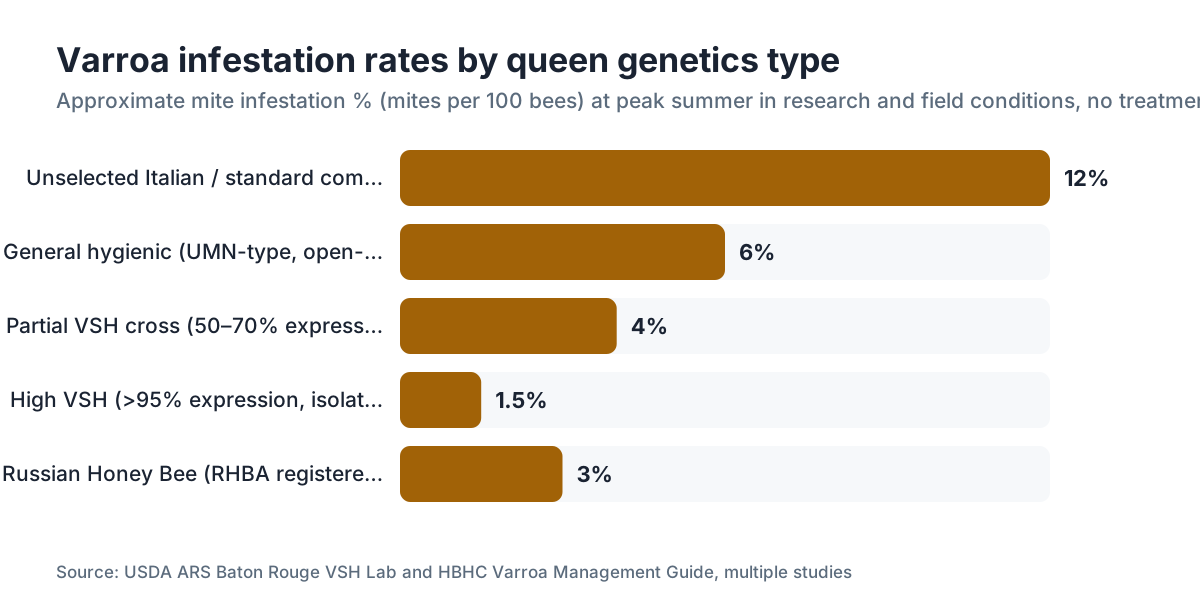
The effect is large. The USDA Baton Rouge Bee Lab, which developed VSH stock, found that colonies headed by VSH queens can hold mite levels below 1 to 2% infestation without chemical treatment in some environments [1]. Unselected colonies in the same apiaries often hit 10 to 15% by late summer, which is roughly the point where collapse becomes likely.
Buying the wrong queen is an expensive reset. A colony that reaches 3 to 4% infestation in July needs emergency treatment to survive winter, and across even 10 hives, that adds up in money and hours. Genetics is the highest-leverage decision you make each season.
See the varroa mite guide for a full breakdown of the mite life cycle and why genetic resistance works the way it does.
What is VSH and how is it different from general hygienic behavior?
VSH stands for Varroa Sensitive Hygiene. It's a specific behavioral trait where worker bees detect and remove varroa mites in the reproductive phase inside capped brood cells, before those mites make viable offspring [1]. Reproductive is the key word. VSH bees are tuned to the mite's signature during reproduction, more than to diseased or dead brood in general.
General hygienic behavior is broader. Hygienic bees detect and remove diseased or dead brood of any kind, including larvae infected with American Foulbrood or chalkbrood. Walter Rothenbuhler first documented the trait in the 1960s, and Marla Spivak later formalized it into a freeze-killed brood test at the University of Minnesota. A colony counts as hygienic if it removes 95% or more of freeze-killed brood within 48 hours [2].
VSH is a subset of hygienic behavior, and a sharp one for mite control. A colony can ace the freeze-killed brood test and still have mediocre VSH if it doesn't target mite-infested cells specifically. The USDA research line holds near-100% VSH expression by selecting for mite removal rather than general hygienic response.
Many commercial breeders sell queens labeled "hygienic" when they mean general hygienic behavior tested with the freeze assay. That's a real trait with real value. It just isn't the same as high-VSH stock, and the difference matters once you're trying to cut treatment frequency.
What is SMR and is it the same as VSH?
SMR stands for Suppressed Mite Reproduction. It describes colonies where mites that enter brood cells have reduced reproductive success, meaning fewer or no viable offspring. Mites in SMR colonies often lay eggs that fail to develop, or produce infertile males only.
SMR was the earlier name, used before researchers understood the mechanism. Once it became clear that worker bees were actively detecting and removing mites in reproductive phases, the USDA renamed the trait VSH to describe what was actually happening [1]. VSH and SMR are the same underlying genetic trait named at different research stages. You'll still see SMR on older breeding documents or from breeders who never updated their language, but it points to the same stock.
The confusion has teeth. Some sellers use "SMR" or "VSH" loosely, with no selection pressure or testing behind the label. Ask what percentage VSH expression the breeder selects for. The USDA research line targets 95%+ VSH. Many commercial crosses land at 50 to 70%, which gives partial benefits but won't keep colonies treatment-free under heavy mite pressure [3].
What other mite-resistant traits should you look for beyond VSH?
VSH and hygienic behavior get most of the attention. There are at least three other traits worth knowing.
Brood viability and recapping rate. Bees that quickly recap damaged or manipulated cells give mites fewer chances to finish reproduction. Some researchers track recapping as an indirect measure of brood surveillance. It isn't a standalone trait to select for, but breeders who measure it are doing deeper phenotyping than those who don't.
Grooming behavior. Bees that groom each other and knock mites off adults add to mite mortality. A 2010 study in Experimental and Applied Acarology found that grooming-selected colonies had significantly more mites with damaged legs than unselected controls [4]. The effect is real but modest next to VSH. Grooming alone won't keep a colony clean, but it stacks on top of cell-level hygiene.
Brood cycle length. Shorter brood cycles give mites less time to reproduce inside capped cells. Some naturally mite-tolerant populations, like Gotland Island bees documented by Swedish researchers, run brood cycles a day or two shorter than standard Italian lines. North American breeders don't commonly select for this yet, but it explains part of why Africanized bees, with their shorter development times, carry lower varroa loads in some studies. See the beekeeping species overview for more on the behavioral differences between bee types.
Multi-trait selection. The Honey Bee Health Coalition's Varroa Management Guide notes that combining VSH with hygienic behavior and mite-biting grooming produces more consistent results than single-trait selection [5]. The best breeders select on all of these at once.
How do you evaluate a queen breeder's claims about resistant traits?
This is where most hobbyists get burned. The phrase "mite-resistant stock" on a website means nothing without data behind it. Here's what to ask for and what to look for.
Ask whether the breeder tests colonies with alcohol wash or sugar roll mite counts before selecting breeders. Good breeders cull high-mite colonies from the program and rear queens only from consistently low-mite mothers. If a breeder can't name the mite thresholds they use for selection, they're probably selecting on temperament or honey production and hoping resistance tags along.
Ask about the freeze-killed brood test score. A legitimate hygienic claim comes with a number: "Our breeder colonies averaged 97% removal in 48 hours this season." Some breeders publish it; others will share it if you ask. If the question confuses them, that's your answer.
Understand queen mating. Even a queen from perfect VSH parents produces genetically diverse workers, because she mates with 10 to 20 drones on the wing [6]. If those drones come from unselected feral colonies, trait expression in your hive gets diluted. Breeders who use isolated mating yards, drone flooding (saturating an area with drones from selected fathers), or instrumental insemination hold much higher trait consistency. Ask where the queen was mated.
Check whether the breeder is enrolled in a formal program. The USDA-AMS honey bee germplasm program works with a network of VSH breeders [3]. The Honey Bee Health Coalition's Varroa Management Guide lists questions to ask breeders [5]. Real starting points, not marketing.
To track your colony's mite counts after you install a new queen, VarroaVault's free mite management tools include a seasonal monitoring protocol that tells you whether the new queen's colony is hitting expected thresholds for resistant stock or whether you need to treat.
Does mite-resistant genetics mean you never have to treat?
Honest answer: probably not, at least not in most North American environments. The USDA VSH line performs best under isolated mating, where trait expression holds high across generations. In open-mated commercial settings, dilution from wild drones drags performance down over time [3].
The Honey Bee Health Coalition puts it plainly in the Varroa Management Guide: "no currently available stock can be considered completely resistant to varroa under all conditions" [5]. That's a direct quote from the primary industry guidance, and it's accurate. What resistant genetics actually do is stretch the time before your mite load hits the treatment threshold, flatten the mite population's growth curve, and cut how many treatments you need per season.
A colony with a good VSH queen might need one oxalic acid treatment in late fall instead of two or three rounds of Apivar across summer and fall. That's a real difference in labor, cost, and chemical exposure for your bees, even if it isn't zero.
Buying queens to reduce chemical treatments? Resistant genetics plus a solid monitoring schedule is the right approach. Buying queens expecting to ignore mite counts entirely? You'll lose hives. The two work together, not as substitutes.
What queen lines or programs are backed by real research?
A handful of programs have published research or institutional backing behind them.
USDA Baton Rouge VSH line. John Harbo and Jeff Harris did the original VSH selection work at the USDA Honey Bee Breeding, Genetics, and Physiology Laboratory in Baton Rouge. Their papers are the foundational literature on the trait [1]. Some commercial breeders bought VSH stock from this lab and run breeding programs with it.
University of Minnesota Hygienic Bees. Marla Spivak's program at the University of Minnesota developed the freeze-killed brood test and ran hygienic selection lines for decades, training many commercial breeders in hygienic testing along the way [2].
Purdue Ankle Biter stock. Researchers at Purdue University, led by Greg Hunt, selected for bees that bite and mutilate mites on adults, cutting mite reproductive success. This trait is sometimes called "mite-biting" and has moved into some commercial lines [4].
Russian Honey Bees. The USDA imported these from the Primorsky region of Russia in the 1990s. Russian bees lived alongside varroa for decades before reaching North America. They show reduced mite reproduction and are maintained by the Russian Honey Bee Breeders Association, which runs a formal registration program. Research through the 2000s showed mite loads 2 to 4 times lower than Italian controls under similar conditions, though they can be harder to manage because of their spring buildup pattern [7].
Locally adapted survivor stock. Some small-scale breeders in high-feral-pressure areas have selected for survivor stock over many years without formal programs. Results are highly variable and tied to environment. These queens can be excellent or mediocre. The trick is finding breeders who track mite counts rigorously and share their data.
A comparison of the established resistant queen lines:
| Line / Program | Primary Trait | Formal Testing | Mating Control | Commercial Availability |
|---|---|---|---|---|
| USDA VSH | VSH / SMR | Yes (alcohol wash + brood assay) | Isolated yards / instrumental insemination | Through licensed breeders |
| UMN Hygienic | Hygienic behavior | Yes (freeze assay, 95% threshold) | Drone flooding | Through trained breeders |
| Purdue Ankle Biter | Grooming / mite-biting | Yes (mutilated mite counts) | Open-mated in selection program | Limited, some commercial crosses |
| Russian Honey Bee | Multiple (evolved) | Yes (RHBA registry) | Isolated mating yards preferred | RHBA member breeders |
| Local survivor stock | Variable | Varies widely | Usually open-mated | Local breeders |
[1][2][4][7]
How much more do mite-resistant queens cost, and is it worth it?
A standard Italian or Carniolan queen from a large producer runs roughly $30 to 50 in 2024. A queen from a breeder with documented VSH or hygienic selection typically runs $40 to 80, and some instrumental insemination or pedigree-verified queens reach $100 to 150 [8].
Whether the premium pays off depends on your situation. Run 5 hives and spend $60 to 80 on Apivar strips per hive per year (two treatments), and switching to resistant stock that cuts that to one treatment saves $30 to 40 per hive annually, before your time. Against a $70 queen versus a $40 standard queen, you break even in about a year if the trait holds.
The bigger value is colony survival. A hive that collapses from varroa costs you the bees, the winter stores, and the replacement package or split next spring, typically $150 to 200 in direct costs plus lost production. If resistant genetics cut your overwinter loss rate by even 10 to 15 percentage points, the math tips hard toward the better queen.
Still, I'd be skeptical of any queen priced over $120 from a seller who can't produce documented mite data. You're paying for genetics, not a brand. Ask for the numbers before you pay the premium.
What questions should you ask a queen breeder before buying?
Here's a list you can use on the phone or in an email to a breeder.
- What's the average mite wash result (alcohol wash or sugar roll) on your breeder colonies at the time of queen selection? What do you cull above?
- Do you run a freeze-killed brood hygiene test? What's your average score and your minimum threshold for keeping a breeder?
- Where are your queens mated? Isolated mating yard, drone flooding program, or open-mated in your area? Roughly how big is the feral bee population near your mating yard?
- Are you working with VSH, Russian, or another specific line, or selecting on phenotype from your own survivor colonies?
- How many generations have you selected for mite resistance, and can you share historical mite count data from the program?
- What's your replacement policy if the queen fails within 30 days?
Breeders who answer with actual numbers earn your money. Breeders who answer with general assurances about "naturally resistant" or "treatment-free stock" and no data aren't necessarily lying, but they aren't doing the work that produces consistent trait expression.
For the tools to test your queen's colony after installation, the beekeeping supply companies page rounds up vendors who carry alcohol wash kits and other monitoring gear.
How do you monitor whether your new resistant queen is actually working?
A mite-resistant queen is a hypothesis until your mite counts confirm it. Here's the monitoring schedule that makes sense after installing one.
Baseline wash at installation: do an alcohol wash on about 300 bees from the brood nest the week you introduce the queen. That sets your starting mite load.
First follow-up at 6 weeks: by now the queen's first full generation of workers has emerged and is on hive duty. Wash again. If VSH or hygienic traits are expressing strongly, the mite level should sit flat or fall, even if you started with some pressure.
Summer peak (July, August): varroa hits hardest here in most of North America, because big worker populations and heavy brood rearing hand mites maximum reproductive opportunity. Genuinely resistant stock should stay below 2% (2 mites per 100 bees) through this window with no treatment. At 2 to 3%, watch closely. Above 3%, treat regardless of your queen's genetics.
Pre-winter assessment (September, October): do a final wash before the population contracts for winter. The Honey Bee Health Coalition recommends treating if mite levels exceed 2% in fall [5]. Resistant-stock colonies may stay under it without treatment. Standard colonies almost always need treatment by this point in most US regions.
Alcohol wash is the accuracy standard. Sugar rolls work as a field method but tend to undercount by 20 to 40% compared to alcohol wash [9]. If you're using sugar roll results to judge whether a resistant queen is performing, use a conservative threshold.
VarroaVault's free seasonal monitoring protocol walks through exactly this schedule with threshold alerts built in, which helps if you're managing multiple hives with queens from different lines.
Are there any downsides or trade-offs with mite-resistant queens?
Yes, and any honest discussion of resistant stock has to cover them.
Temperament. VSH bees, especially first-generation VSH queens from the USDA research line, can be defensive. Breeders who cross VSH into Italian or Carniolan stock often improve temperament a lot, but some defensive streak persists in some lines. Manageable with proper gear and good hive technique, but real.
Productivity. There's a genuine trade-off debate in the literature about whether energy spent on hygienic behavior costs honey production. The evidence is mixed. Some studies find no significant difference; others find modest reductions of 5 to 15% in hygienic lines versus unselected Italian controls. Nobody has good data pointing to large production losses in well-bred commercial hygienic lines, but the honest answer is the trade-off exists at the genetic level even when it's hard to measure in the field.
Russian bees specifically build slowly in early spring, which differs from Italian bees and can complicate early-season splits or pollination contracts. Migratory operations or early almond pollination? This matters. Hobbyist with fixed hives and no pollination commitments? Much less of an issue.
Local adaptation. A queen from a VSH breeder in Louisiana may not express the same resistance in Michigan winters or high altitude in Colorado. Stock adapts to local conditions over generations. Buying from a breeder as geographically close to you as possible, or one with documented performance in a similar climate, is worth the effort.
What do Africanized bees have to do with mite resistance?
This comes up in the research because Africanized honey bees show lower varroa infestation than European honey bees in many studies. They have shorter brood development times, higher rates of hygienic behavior, and some evidence of active grooming. A 2004 study found Africanized colonies in Brazil had mite infestation rates roughly 10 times lower than European colonies in the same area [10].
That doesn't mean you should chase Africanized genetics. Africanized bees are genuinely dangerous to manage without extensive experience and specialized equipment, and they're regulated or prohibited in many US states. The resistance traits in Africanized populations are inseparable from the aggressive defense behaviors that make them hazardous around people.
What the Africanized research does is point researchers toward which traits matter. The shorter brood cycle observation drove interest in selecting for brood development time in European stock. The grooming data informed the Purdue Ankle Biter work. Africanized bees are a research model for understanding mechanisms, not a practical genetics source for most beekeepers. See the africanized honey bee article for more on their biology and management challenges.
The takeaway: mite resistance in European honey bees is achievable through selection, and researchers have been at that work for 30+ years. You don't need extreme genetics to get meaningful resistance.
Frequently asked questions
What does VSH mean on a queen breeder's website?
VSH stands for Varroa Sensitive Hygiene, a trait where worker bees detect and remove reproducing varroa mites from capped brood cells before those mites make viable offspring. The USDA Baton Rouge lab developed and named the trait. When a breeder claims VSH stock, ask what percentage VSH expression they select for and whether they test with mite washes. The research line targets 95%+ expression.
How long does mite resistance last after buying a resistant queen?
The queen's genetics persist as long as she's laying, typically 2 to 4 years. But trait expression in her worker daughters depends on the drones she mated with. Mated with unselected drones, her workers are hybrids with partial resistance. Queens replaced through supersedure or swarming mate with whatever drones are locally available, which can dilute resistance significantly within one generation.
Can I test whether my current colony is hygienic before buying a new queen?
Yes. The freeze-killed brood test kills a patch of capped brood with a liquid nitrogen-filled cap pressed against the comb for 30 to 60 seconds. Mark the patch, come back 48 hours later. If 95% or more of the freeze-killed brood is gone, the colony passes. Marla Spivak's lab at the University of Minnesota developed and validated this test, and it's reproducible in the field.
Are "treatment-free" breeders selling legitimately resistant queens?
Some are, some aren't. Treatment-free status alone tells you little, because apiaries vary enormously in mite pressure by location. A breeder in a low-feral-bee area with naturally low reinfestation might keep colonies without treatment and still have mediocre genetics. Ask for mite wash data from their breeder colonies. Selecting on documented low mite counts means the genetics are probably real. Selecting on survival alone, without counts, is weaker evidence.
What mite infestation rate should I expect from a colony with a good VSH queen?
A well-expressing VSH colony in an open-mated, managed setting should stay below 2% (2 mites per 100 bees on an alcohol wash) through peak mite season without treatment, per USDA research. Commercial hygienic crosses with partial VSH expression usually stay lower than unselected stock but may still reach 2 to 3% by late summer, which typically calls for at least one fall treatment.
Is Russian honey bee stock worth buying for varroa resistance?
Russian bees carry real, documented mite resistance from decades of co-evolution with varroa in Russia's Primorsky region. USDA studies through the 2000s showed 2 to 4 times lower mite loads than Italian controls. The trade-off is slow spring buildup and more complex overwintering behavior. For hobbyists in northern climates who don't depend on early-season production, they're a legitimate option. Buy from Russian Honey Bee Breeders Association members who maintain the registered stock.
How important is drone genetics for mite resistance in a purchased queen?
Very important, and often overlooked. A queen mates with 10 to 20 drones, and each drone fathers roughly 5 to 10% of the worker force. Mated in an area with unselected feral drones, her workers express VSH or hygienic behavior at a fraction of what her mothers showed. Breeders using isolated mating yards or drone flooding with selected fathers produce far more consistent trait expression than those relying on open mating near populated apiaries.
Can I raise my own mite-resistant queens from a purchased VSH mother?
Yes, and it's a reasonable strategy for hobbyists with 5 or more hives. Buy a high-quality VSH or hygienic queen, let her build a strong colony, then use standard queen-rearing methods (grafting or cell punching) to raise daughters. The daughters carry her genetics but mate with local drones, so trait expression dilutes compared to the mother. Over time, selecting daughters from low-mite colonies for your next generation adapts the line to your local conditions.
What certification or label tells me a queen is genuinely tested for mite resistance?
There's no government-issued certification for mite-resistant queens in the US as of 2024. The closest to a recognized standard is the Russian Honey Bee Breeders Association registry for Russian bees, plus informal peer recognition within the USDA VSH breeder network. The Honey Bee Health Coalition's Varroa Management Guide lists criteria to evaluate breeder claims but doesn't certify breeders. You're trusting the breeder's self-reported data, which is why asking for actual mite wash numbers matters.
Should I replace my current queen with a resistant one mid-season or wait?
If your colony has rising mite counts (above 2% in summer), requeening mid-season with a resistant queen is worthwhile, with a complication: the brood break during queen introduction actually helps reduce mites short-term. Then it takes 4 to 6 weeks before the new queen's daughters dominate the workforce. You may still need a treatment through that transition. Mid-season requeening for resistance works best paired with an oxalic acid vaporization during the broodless gap.
Does mite-resistant stock cost significantly more than standard queens?
Typically 20 to 60% more. Standard commercial queens run $30 to 50; documented hygienic or VSH queens run $40 to 80 for open-mated stock, and up to $100 to 150 for instrumentally inseminated or pedigree-verified queens. Whether that premium pays off depends on your treatment costs, colony loss rate, and hive count. For most hobbyists with 5 to 20 hives, the math favors the resistant queen within one to two seasons.
Are there mite-resistant trait differences between Italian, Carniolan, and other common bee races?
Within unselected populations, differences are modest and inconsistent. Italian bees are generally considered somewhat more susceptible to varroa, thanks to an extended brood-rearing season and larger brood nests. Carniolan bees rear brood more seasonally, which naturally limits mite reproduction windows. But both races can be selected for strong VSH or hygienic expression, and a well-selected Italian line beats an unselected Carniolan line on mite resistance every time. Race matters less than selection history.
Do mite-resistant queens affect anything other than varroa loads?
Yes, a few ways. Hygienic behavior also reduces American Foulbrood and chalkbrood incidence, a real secondary benefit. Some studies find slightly higher winter mortality in strong hygienic lines, possibly because aggressive brood removal can occasionally pull viable brood during stress events, but the data is inconsistent. Temperament is the most commonly reported practical trade-off, especially in first-generation VSH crosses. Most commercial hygienic lines have been selected for acceptable temperament alongside resistance.
Sources
- USDA Agricultural Research Service, Honey Bee Breeding, Genetics and Physiology Laboratory, Baton Rouge: VSH queens can maintain mite infestation levels below 1 to 2% even without chemical treatment in some environments; VSH was developed and named by John Harbo and Jeff Harris at this lab
- University of Minnesota Bee Lab (Marla Spivak), hygienic behavior research and freeze-killed brood test: A colony is considered hygienic if it removes 95% or more of freeze-killed brood within 48 hours; the freeze-killed brood test was developed and validated by Marla Spivak at the University of Minnesota
- USDA Agricultural Research Service, honey bee germplasm and VSH breeding program: Many commercial crosses maintain 50 to 70% VSH expression; the USDA works with a network of VSH breeders through its breeding program
- Honey Bee Health Coalition, Tools for Varroa Management (current edition): The HBHC states 'no currently available stock can be considered completely resistant to varroa under all conditions'; recommends treating if mite levels exceed 2% in fall; multi-trait selection produces more consistent results than single-trait selection
- Penn State Extension, honey bee biology and queen mating: Queen honey bees mate with 10 to 20 drones during mating flights, producing a genetically diverse worker force
- USDA Agricultural Research Service, Russian Honey Bee program: Russian bees imported from the Primorsky region in the 1990s showed mite loads 2 to 4 times lower than Italian controls in USDA studies through the 2000s
- American Beekeeping Federation, queen pricing and market reports: Standard commercial queens cost approximately $30 to 50; VSH or documented hygienic queens cost approximately $40 to 80 for open-mated stock and up to $100 to 150 for instrumentally inseminated or pedigree-verified queens
- US EPA, Pollinator Protection program (varroa monitoring and registered treatment products): Alcohol wash is the accuracy standard for varroa counting; sugar rolls tend to undercount mites by 20 to 40% compared to alcohol wash
- Apidologie (Pinto et al. 2004), Africanized honey bee varroa resistance study: Africanized colonies in Brazil had varroa infestation rates approximately 10 times lower than European honey bee colonies in the same study area
- North Carolina State University Extension, apiculture program: Mite monitoring protocols including alcohol wash thresholds and seasonal timing guidance for North American beekeepers
Last updated 2026-07-09