Post-treatment mite wash: when to retest and what counts as success
TL;DR
- Retest with an alcohol wash or sugar roll 3-5 days after a short-contact treatment like oxalic acid vaporization, or 42-48 days after a slow-release strip like Apivar.
- A colony is in the clear when post-treatment infestation sits below 2 mites per 100 bees.
- Above that, act again before the next brood cycle compounds the problem.
Why does the retest timing matter so much?
Skipping the post-treatment check is one of the most common hobbyist mistakes. You apply a treatment, assume it worked, and walk away. Then you open the hive two months later to a colony on the edge of collapse, carrying a mite load that would have been easy to catch in early fall.
Timing matters because treatments differ wildly in how fast they work, and because varroa breeding inside capped brood can hide a failing treatment completely. An alcohol wash the day after oxalic acid vaporization will look great, but that number reflects only phoretic mites, the ones riding on adult bees. The mites tucked into sealed cells are invisible to any wash. Oxalic acid can't penetrate capped brood, so those hidden mites emerge 12 to 21 days later and reload the colony.
So the timing of your retest has to match the biology of the treatment, not your calendar. Get it wrong in either direction and the number lies to you. Test too early and you count only the easy-to-kill phoretic mites while the brood-cell population stays hidden. Test too late after a short-contact treatment and you miss the rebound window when intervention is still cheap.
The Honey Bee Health Coalition's Varroa Management Guide, the most widely cited practical resource on this topic, states that "monitoring is the cornerstone of Varroa management," and recommends testing at least every 30 days during the active season with a specific retest after any treatment. [1]
When should you retest after oxalic acid treatment?
Retest 3 to 5 days after your final oxalic acid application, whether you vaporized or dribbled.
Oxalic acid kills phoretic mites within hours. After a single vaporization, many beekeepers watch a huge mite drop pile up on the sticky board in the first 24 to 48 hours. That's satisfying to see, but the sticky board count doesn't translate to an infestation rate you can act on. You need a proper alcohol wash or sugar roll for the per-100-bees number.
Wait at least 3 full days after the last vaporization so the mites that are going to die have died. The 5-day ceiling matters too. By day 6 or 7, mites that survived in recently emerged brood start showing up on nurse bees, and you want to catch your count before that skews it upward and panics you for no reason.
Running the extended oxalic acid protocol changes the math. This is the method sometimes called the Brood Break protocol, or the 7-treatments-over-42-days approach. Your retest window still opens about 3 to 5 days after the final vaporization, same rule, but now you're reading a colony that should have had nearly every brood cycle exposed. University of Montana research on the extended protocol found that repeated vaporizations across a brood-free or low-brood period can drop mite loads by more than 90 percent. [2] Your post-protocol wash should reflect that. If it doesn't, re-read your notes: did you actually hit the colony weekly, and was the queen laying continuously the whole time?
One more thing on oxalic acid. The EPA-registered label for Api-Bioxal, the most common registered oxalic acid product in the U.S., specifies application conditions including temperature minimums, and a treatment applied outside those conditions may have underperformed no matter how good your retest timing was. [3] Check label compliance before you blame the clock.
When should you retest after Apivar or other amitraz strips?
Retest 42 to 48 days after you installed the strips, not after you removed them.
Apivar (amitraz 3.3%) is a slow-release treatment. The active ingredient leaches off the strip over roughly 6 to 8 weeks, and the label window in most registered protocols runs a minimum of 42 days and a maximum of 56. [4] Mites emerging from sealed brood during that window get exposed once they become phoretic adults. That's the mechanism that lets Apivar reach the brood-cell population oxalic acid can't touch.
Test at day 10 or day 21 and you're reading the middle of a slow burn. The number often looks worse than pre-treatment, because the treatment hasn't had time to knock down mites emerging from the first and second brood cycles. Testing at 42 to 48 days shows you the actual steady state the treatment reaches.
After strip removal, one more test 2 weeks out is worth doing. Amitraz breaks down fast (its half-life in the hive is measured in days, not weeks), so there's no leftover chemical buffer once the strips come out. Any rebound in those two weeks tells you whether you have a resistance problem or a reinfestation problem from neighboring colonies.
Apivar resistance is real. It's documented in U.S. apiaries and is linked to specific mutations in the octopamine receptor gene of varroa. [5] If your post-treatment wash at day 42 to 48 still shows mites above 2 per 100 bees despite a properly timed and installed treatment, don't reinstall strips. Switch to a different active ingredient class for the next cycle.
When should you retest after MAQS or formic acid treatments?
Retest 3 to 7 days after the last pad removal.
Mite Away Quick Strips (MAQS) and Formic Pro both use formic acid. Formic acid is the one treatment that actually penetrates capped brood to some degree, a real advantage during heavy brood rearing. The U.S. label for MAQS calls for two 7-day treatments with a 7-day break between them, and the Formic Pro label is similar with some variation by region. [6]
Formic acid dissipates quickly. By the time you pull pads on day 7 or day 14, most of the active ingredient is already gone. So the 3 to 7 day post-removal window is really about letting any acutely stressed bees recover and giving surviving mites time to become phoretic and countable. Test much later than 7 days post-removal and you start picking up early reinfestation or new emergence, which muddies your read on efficacy.
Temperature matters more with formic acid than with anything else. Applications above 85 to 92 degrees Fahrenheit (label-dependent) can harm queens and brood. If you treated during a heat wave and your retest looks surprisingly poor, consider that your colony took damage the mite load alone doesn't explain.
What mite count after treatment counts as success?
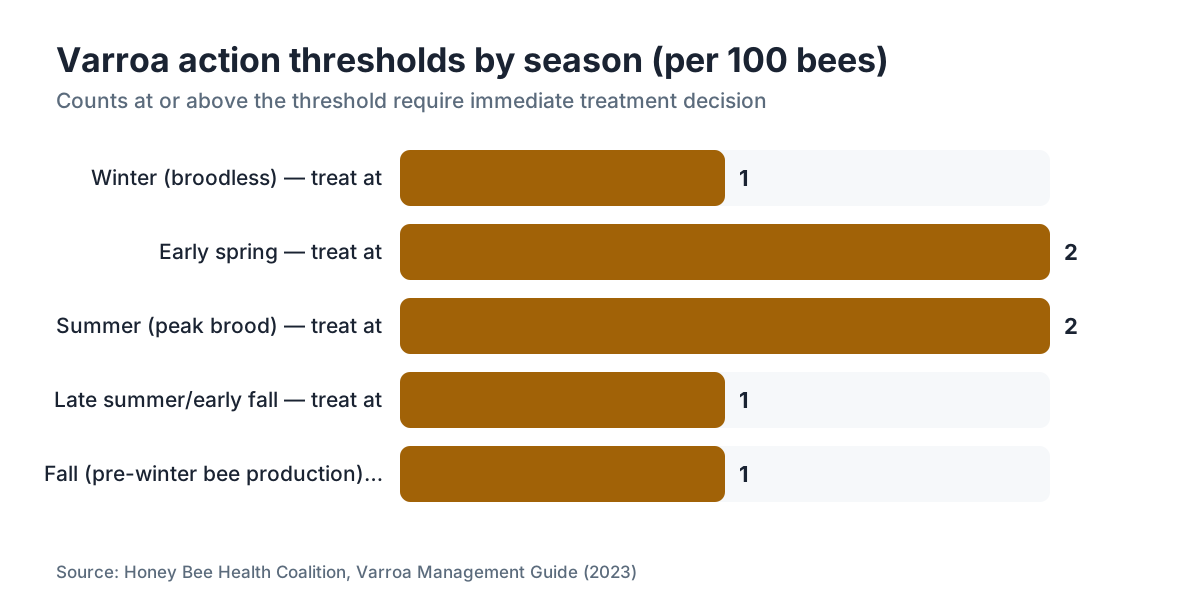
Two mites per 100 bees is the widely accepted action threshold for the active season. At or below that, most healthy colonies hold the balance between bee population and mite population without immediate crisis. Above 2 per 100, reproductive mites make new mites faster than the colony can compensate, and viral loads (deformed wing virus especially) start climbing.
The Honey Bee Health Coalition uses 2 per 100 bees as the economic injury equivalent for summer through early fall. In late summer and into fall, many researchers and extension services tighten that to 1 per 100, because the bees being made in August and September are the long-lived winter bees that need to survive until March. A heavily parasitized winter cohort is the most common proximate cause of spring deadouts. [1]
Here's a quick reference for what the numbers mean after treatment:
| Post-treatment mite count (per 100 bees) | Interpretation | Action |
|---|---|---|
| 0-1 | Treatment succeeded | Retest again in 30 days |
| 2 | Borderline, monitor closely | Retest in 2 weeks |
| 3-4 | Treatment underperformed | Consider retreatment or switch product |
| 5+ | Treatment failed or reinfestation | Treat immediately, investigate cause |
These thresholds assume an alcohol wash of at least 300 bees pulled from nurse-bee frames (frames with open or young brood, not honey frames). The sugar roll is easier on the bees but consistently undercounts mites. If you use it, mentally drop your threshold by about 20 to 30 percent, based on studies comparing the two methods side by side. [7]
How do you actually do a mite wash correctly for the retest?
Accuracy hinges on two things: pulling bees from the right frames, and using the right sample size. Plenty of hobbyists get numbers 30 to 50 percent too low because they scoop bees off a honey frame where older foragers hang out. Foragers carry far fewer mites than nurse bees.
Here's the protocol extension apiculturists recommend. Find a frame with open or recently capped brood and young larvae, because that's where nurse bees cluster. Shake or brush about 300 bees (roughly half a cup) into a container before the queen can fall in. Add about 200 ml of 70-percent isopropyl alcohol, seal the container, shake for 60 seconds, then pour the liquid through a fine mesh strainer into a white tray. Count the mites in the tray. Divide by the number of bees in the strainer and multiply by 100. [11]
The bee count is the step most people skip. They eyeball "about 300" and move on. Undercount your bees and you inflate the apparent infestation rate. Overcount and you deflate it. Neither is useful. Count the bees in the strainer or weigh them. About 300 worker bees weigh roughly 90 grams (about 3 oz), a handy calibration if you keep a kitchen scale in your bee bag. [12]
The Honey Bee Health Coalition's Varroa Management Guide includes a step-by-step wash method with photographs. It's free to download and worth printing out. [1]
If you want a consistent way to track results, VarroaVault has a free wash calculator and seasonal protocol tool that flags whether your post-treatment count is above or below the threshold for your region and month.
What if mite levels go up after treatment instead of down?
This happens, and it's almost never a sign that treatment made things worse.
The most common explanation is brood emergence. The treatment killed phoretic mites fast, but a big batch of brood was capping right as you treated. Three weeks later, all those brood-cell mites emerge as phoretic adults and your count spikes. This shows up often after a single mid-season oxalic acid vaporization with no brood break behind it.
The second explanation is drift or robbing. Varroa doesn't respect hive boundaries. A treated colony sitting near several untreated or undertreated hives can climb back to pre-treatment levels within 4 to 6 weeks just from mites hitching rides on returning foragers. A 2014 study in PLOS ONE found that varroa spreads between colonies through robbing and drifting at rates that make individual-colony treatment nearly pointless without at least some neighborhood coordination. [8]
The third explanation is genuine treatment failure. That could be resistance, application error (wrong temperature, weak dose, poor coverage), or an adulterated or expired product. Take this one most seriously. It's why switching active ingredient classes at the first sign of failure beats doubling down on the same product.
If your count goes up, don't panic, but do act. Figure out which explanation fits, correct for it, and retest 3 to 5 days after any follow-up intervention.
How does brood presence change the retest window?
A broodless colony is the easiest scenario, whether it got there naturally or you forced it. Almost all mites are phoretic, riding on adult bees and fully exposed to contact treatments. An alcohol wash 3 days after oxalic acid on a broodless colony gives you an accurate, essentially complete picture of infestation.
A colony full of brood is harder to read. The split between mites hidden in cells and mites riding on adults shifts hard. During peak brood season, roughly 70 to 80 percent of varroa sit in capped cells at any moment. [9] Your wash samples only the 20 to 30 percent that are phoretic. A count of 1 per 100 bees in a heavy-brood colony could mean an actual total of 3 to 5 per 100 once you account for the hidden fraction.
Some extension guidance, notably from Pennsylvania State University Extension, suggests a correction factor: multiply your wash result by 3 during heavy brood season for an estimated true infestation. [9] That's a rough approximation, not precise math, but it's a useful gut-check. If your corrected estimate lands above 6 per 100, the colony has a serious problem even when the raw wash looks borderline.
This is also why timing your big treatments to land on natural or manipulated brood breaks (late fall, splits, emergency requeen situations) buys you both better efficacy and more reliable retest numbers. A post-treatment wash during a brood break is close to a total mite census. During peak summer brood, it's a sample with a lot of hidden variance.
How long should you wait before the next treatment if retesting shows failure?
If your retest shows failure, don't wait. Switch products and retreat as soon as you can.
Guidance from the EPA and most state apiculture specialists makes retreatment product-specific. Oxalic acid labels in the U.S. (Api-Bioxal) allow up to three vaporization treatments per year. [3] Apivar labels set a minimum 14-week interval between strip applications in the same colony to slow resistance. [4] MAQS labels allow two applications per season with the prescribed break. [6]
Once you've used up an approved cycle (say you've maxed out Apivar for the season), you switch to a different active ingredient class rather than exceeding label limits. That's both a legal requirement and a practical one. Blowing past label limits doesn't improve efficacy and it speeds up resistance selection.
The class rotation logic is simple. Oxalic acid (an organic acid) sits in a completely different class from amitraz (Apivar) and from synthetic pyrethroids (Apistan; CheckMite+ targets small hive beetle more than mites now). Fluvalinate products carry documented widespread resistance and most extension apiculturists no longer recommend them first-line. If your mites survive a correctly applied, within-label amitraz treatment, your next move is formic acid (Formic Pro) or oxalic acid with a brood break, not more amitraz.
What records should you keep to track retest results over time?
A single mite count tells you very little. A string of counts across multiple seasons tells you almost everything.
At minimum, record the date of each wash, the mite count, the number of bees in the sample, the treatment applied, the dates treatment started and ended, and whatever you notice about brood pattern and colony strength at sampling. That's five or six data points per visit, and it takes two minutes to write down.
Many beekeepers use a plain notebook or spreadsheet. If you want something built for varroa tracking, VarroaVault's free protocol tools let you log counts, auto-calculate infestation rates, flag threshold crossings, and generate a seasonal treatment history you can share with another beekeeper or a local extension apiculturist for a second opinion.
Records earn their keep the first time a treatment seems to stop working. If you can pull up 18 months of wash data and show that counts after Apivar went from consistently below 1 per 100 in year one to consistently above 3 per 100 in year two despite correct application, that's a resistance signal worth taking seriously and worth reporting. Some state apiculture departments want to hear about suspected resistance. The USDA APHIS National Honey Bee Survey tracks colony health at a national scale, and local resistance data feeds that picture. [10]
If you're shopping for monitoring gear, our beekeeping supply companies guide covers vendors that carry reliable wash equipment, and our varroa mite reference article goes deep on the biology that makes monitoring non-negotiable.
Are there any cases where you can skip the post-treatment retest?
Honestly? Not really. But I understand the temptation.
Say you treated a broodless colony with oxalic acid in December in a cold climate, and you're running just two or three hives. A retest can feel redundant when the cluster is tight and barely accessible. In that narrow case, many experienced beekeepers skip the retest and do their first real check in late February when the cluster breaks. That's a reasonable judgment call, not a protocol violation.
Outside winter treatment of broodless colonies, skipping the retest costs you information you genuinely need. Scale changes the stakes. A sideliner with 50 hives who skips retests is flying blind across a real economic asset. A hobbyist with two hives takes a smaller risk per skipped test but loses the feedback loop that makes you a sharper beekeeper.
Beekeepers also cite "the sticky board looks clean." Sticky board counts point you in a direction, but they don't replace a wash. The correlation between a 24-hour sticky board drop and actual infestation rate is loose at best, and it swings with colony size, season, and which frames sit over the board. Never lean on a sticky board count as your only post-treatment efficacy measure. [1]
Do the wash. It takes 15 minutes, and it's the only honest data point you have on whether your colony is safe.
Frequently asked questions
How many days after oxalic acid vaporization should I do a mite wash?
Wait 3 to 5 days after your final vaporization. That window gives acutely killed phoretic mites time to fall and be counted, while keeping you early enough that newly emerged mites from residual capped brood haven't inflated your count. Testing the day after undercounts because not all mites have died yet. Testing after day 7 risks picking up emergence rebound.
What mite count after treatment is considered safe?
The standard threshold is 2 mites per 100 bees during the main active season, spring through mid-summer. In late summer and early fall, many extension apiculturists tighten it to 1 per 100, because those bees become the critical winter population. At or below threshold, retest in 30 days. Above threshold, treat again or switch products.
Can I use a sticky board count instead of an alcohol wash to check if treatment worked?
Not as your sole measure. Sticky boards give a directional sense of mite drop during treatment, which is satisfying to watch, but the daily drop number doesn't convert cleanly to a per-100-bees rate. It varies too much with colony size, season, and board placement. An alcohol wash is the only reliable post-treatment efficacy check.
Why did my mite count go up a few weeks after treatment?
Usually it's brood emergence, not treatment failure. Mites hiding in capped brood when you treated were invisible to your wash. As that brood emerges over 12 to 21 days, those mites become phoretic adults and appear in your counts. It can also be reinfestation from neighboring colonies through drifting and robbing. Check nearby hives and consider a second treatment round.
How long after Apivar strips are removed should I retest?
Test at 42 to 48 days from installation, which is around when strips come out. Then do a follow-up wash 14 days after removal. Amitraz degrades fast once strips are out, so any rebound in that two-week window tells you whether you have resistance or reinfestation from outside the colony. Don't rely on a single end-of-treatment check alone.
Does the time of year affect when to retest after treatment?
Yes, mostly because of brood levels. In late fall and winter, when brood is minimal or absent, your wash gives a near-complete census and the retest window is more forgiving. In summer with heavy brood, 70 to 80 percent of mites hide in cells, so timing and the correction factor matter more. Summer retests also need to happen faster because varroa reproduces at full speed.
How do I know if varroa resistance to Apivar is causing my treatment to fail?
Suspect resistance if your properly timed post-treatment wash (42 to 48 days, label-compliant application) still shows mites above 2 per 100, and you've confirmed the strips were fully seated and correctly spaced. Amitraz resistance is linked to specific octopamine receptor mutations and has been documented in U.S. apiaries. If you suspect it, switch to a different active ingredient class and consider reporting to your state apiculturist.
What is the minimum sample size for a reliable post-treatment alcohol wash?
Wash at least 300 bees collected from a nurse-bee frame with open or young capped brood. Smaller samples increase statistical error sharply. At 300 bees, finding 6 mites reads as 2 per 100. At 100 bees, the same 6 mites reads as 6 per 100. Always count or weigh your sample rather than estimating.
Can I retest with a sugar roll instead of an alcohol wash after treatment?
You can, but the sugar roll consistently undercounts mites compared to alcohol wash, typically by 20 to 30 percent based on side-by-side studies. Adjust your mental threshold down: a sugar roll result of 1.5 per 100 is probably closer to 2 per 100 actual. The sugar roll has the advantage of not killing bees, which matters when you're sampling a small, already-stressed colony.
How often should I test throughout the season, more than after treatment?
The Honey Bee Health Coalition recommends testing at least every 30 days during the active season, plus tests timed right before and after every treatment. In practice, most experienced beekeepers test in early spring (before treatment decisions), mid-summer (peak risk), late summer or early fall (winter-bee production), and after any treatment. That's a minimum of 4 to 6 washes per hive per year.
Is it okay to do a post-treatment mite wash on a very small colony?
Yes, but adjust your sample size. A 300-bee wash from a colony under 4 frames of bees removes a meaningful share of the population and adds stress. Sample 100 to 200 bees instead and account for the larger statistical margin. Some beekeepers use a sticky board only for very small or struggling colonies, accepting reduced precision as the lesser harm.
What do I do if my post-treatment count is borderline, say exactly 2 per 100?
Retest in 14 days. A single borderline reading could be sampling error (you grabbed slightly more foragers than nurse bees, or counted 270 bees as 300). A second wash two weeks out either confirms you're trending toward zero or shows mites climbing back. If the second wash comes in at 2 or above, treat.
Should I retest after a preventive oxalic acid treatment in a broodless winter colony?
It's optional if the colony is deeply clustered and barely accessible. Many experienced beekeepers skip the immediate winter retest and do their first spring wash in late February or early March when the cluster breaks. That said, if you can reach the hive during a warm spell above 50 degrees Fahrenheit, a wash before spring buildup gives you a useful baseline for the season ahead.
How do I account for reinfestation from nearby colonies when evaluating my retest result?
You largely can't, unless you know the mite loads of neighboring apiaries. Varroa spreads through drifting and robbing bees, and a treated colony within 1 to 3 km of heavily infested untreated hives can rebound to pre-treatment levels within 4 to 6 weeks. If your retest looks good but a 30-day follow-up shows a sharp spike with no brood emergence explanation, outside reinfestation is the likeliest cause.
Sources
- Honey Bee Health Coalition, Varroa Management Guide (2023 edition): The Coalition states that 'monitoring is the cornerstone of Varroa management' and sets 2 mites per 100 bees as the summer action threshold, tightening to 1 per 100 in late summer/fall.
- University of Montana, Bee Lab, oxalic acid extended vaporization research: Multiple oxalic acid vaporizations over a broodless or low-brood period can reduce varroa infestation by more than 90 percent.
- U.S. EPA, Api-Bioxal (oxalic acid) product registration and label: Api-Bioxal label specifies application temperature minimums and permits up to three vaporization treatments per year per colony.
- U.S. EPA, Apivar (amitraz 3.3%) product label via registrant: Apivar label requires a minimum 42-day and maximum 56-day treatment window, with a minimum 14-week interval between applications to the same colony.
- Journal of Economic Entomology, amitraz resistance mutations in Varroa destructor (2019): Amitraz resistance in varroa is associated with specific mutations in the octopamine receptor gene and has been documented in U.S. apiaries.
- U.S. EPA, MAQS (Mite Away Quick Strips) formic acid product label: MAQS label specifies two 7-day treatment strips with a prescribed inter-treatment break and cautions against application above 85-92°F to avoid queen and brood harm.
- Pennsylvania State University Extension, Varroa Monitoring Methods comparison: Sugar rolls consistently undercount varroa compared to alcohol wash by approximately 20-30 percent in side-by-side comparisons.
- PLOS ONE, Varroa destructor spread between honey bee colonies (2014): Varroa spreads between colonies through robbing and drifting at rates that can re-establish pre-treatment mite levels within 4-6 weeks, undermining individual-colony treatment strategies without neighborhood coordination.
- Pennsylvania State University Extension, Understanding Varroa Mite Biology: During peak brood season, roughly 70-80 percent of varroa mites are in capped cells at any given time, meaning an alcohol wash samples only 20-30 percent of the total population. PSU Extension suggests a 3x correction factor during heavy brood periods.
- University of Minnesota Extension, Varroa Mite Management in Honey Bee Colonies: Extension guidance recommends collecting nurse bees from frames with open or young capped brood for the most accurate alcohol wash infestation rate.
- NC State University Extension Apiculture, Alcohol Wash Protocol: 300 worker bees for an alcohol wash weigh approximately 90 grams; beekeepers can use weight as a calibration method to ensure accurate sample size.
Last updated 2026-07-09