Oxalic acid timing in queenright mating nucs: when it actually works

TL;DR
- Oxalic acid kills only phoretic varroa, the ones riding on adult bees.
- Treat a queenright mating nuc while open brood is present and you remove maybe 40 to 60 percent of mites, because the rest hide inside capped cells.
- The window that works well is before the new queen lays, or during a forced broodless break.
- Plan around the brood cycle, not the calendar.
Why is timing oxalic acid in a mating nuc so different from a full colony?
A mating nuc is small, fragile, and never sits still. You cycle through virgin queens, mating flights, the wait for laying to start, then the fast build of a brood nest. Each phase changes how many varroa are phoretic (riding on adult bees, exposed to treatment) versus sealed inside capped cells where oxalic acid never reaches them.
In a standard colony with a laying queen, roughly 70 to 90 percent of reproductive varroa sit inside capped brood at any given moment [1]. Oxalic acid, in every formulation, kills only the phoretic fraction. Treat at the wrong moment and you knock down 30 to 50 percent of the load, feel good about it, and watch the majority of mites emerge alive with the next round of bees.
Small colonies punish mistakes faster. A mating nuc with four or five frames of bees and a weak knockdown can crash within weeks. Getting the timing right matters more in a two-frame nuc than in a ten-frame colony with room to absorb a bad day.
What does oxalic acid actually do to varroa, and why does brood status matter so much?
Oxalic acid (OA) is a natural organic acid. When a varroa contacts it, through vapor settling on the bee's body or through direct liquid contact, the acid damages the mite's cuticle and kills it [2]. Contact is the whole game. A mite sealed under a wax cap gets no meaningful exposure to vapor or drizzle, so it survives.
The EPA-registered label for oxalic acid dribble (Api-Bioxal, the only registered OA product in the U.S.) says the dribble method is for use in "broodless colonies or colonies with a small amount of brood" and "not recommended for use when honey supers are present" [2]. Extended vaporization gives you more room to work because you can repeat exposures, but repeated vapor still cannot cross a capped cell.
Here is the math that runs everything. Worker brood stays capped for about 12 days [10]. Say your nuc queen started laying five days ago. You have brood that will stay sealed for another seven days minimum. Any mite that entered a cell before you treated is protected until that bee emerges. Multiple OA treatments spaced a few days apart can pick off emerging mites before they re-enter fresh cells, but that means handling a tiny nuc over and over.
That is why the broodless window matters, and why a mating nuc hands you a short, rare chance to use it.
What is the ideal broodless window in a mating nuc for a single oxalic acid treatment?
The best moment for one high-efficacy OA treatment is when there is no capped brood at all. In a mating nuc, that window opens in two situations.
The first is between queen emergence and first laying. A virgin queen emerges, takes mating flights over roughly 5 to 10 days, and usually starts laying 2 to 5 days after her last flight [3]. Assuming no leftover brood from a previous queen, the nuc can stay broodless for 10 to 20 days. That is your window.
The second is a deliberate broodless break. You pull every capped brood frame, shake the bees onto drawn comb or foundation, and then treat. More disruptive, but reliable when you need to treat a nuc that already has a laying queen.
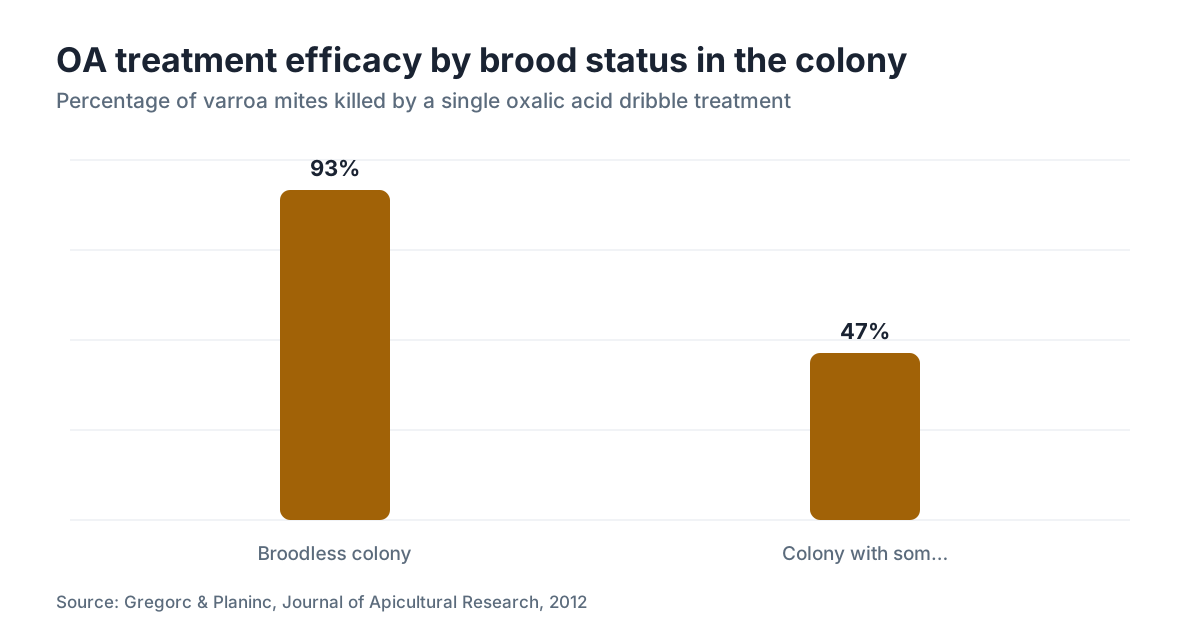
A single OA dribble in a genuinely broodless colony has shown efficacy above 90 percent in controlled trials [4]. That number falls hard with even modest brood present. Gregorc and Planinc, writing in the Journal of Apicultural Research in 2012, found OA dribble efficacy dropped to roughly 47 percent in colonies with brood versus 90 to 95 percent in broodless colonies [4]. Those figures come from full colonies, but the biology is identical in a nuc.
Before you treat, look. Any capped worker brood means you are not in the window. Open cells with larvae or empty cells give you the green light.
How many oxalic acid treatments does a queenright mating nuc need if brood is already present?
If the new queen is laying and you will not or cannot remove brood frames, run a series of OA vaporizations 5 to 7 days apart across the full capped-brood period. You are catching mites as they emerge from cells, before they can re-enter new ones.
The math is simple. Worker brood stays capped for 12 days. Start treating on day one with capped brood present, and you need coverage of at least 12 to 14 days to intercept every emerging mite. That is two to three vapor treatments. The Honey Bee Health Coalition's Varroa Management Guide recommends three OA vaporizations seven days apart when brood is present, to cover the full capped-brood cycle [1].
Three vapor treatments in a small box is a lot of stress on a tiny colony. Weigh that against your actual mite load. If the source colonies ran high mite counts, or you already see mites on bees, do all three. If the nuc came from clean stock and a fresh queen, one well-timed treatment in the broodless window may carry you through the season.
Dribble practicalities: the Api-Bioxal label calls for 10 mL per five frames of bees [2]. In a two-frame nuc that is roughly 4 mL. Applying that evenly without soaking a small cluster is hard, which is one reason many beekeepers reach for vapor on nucs.
Stay inside the label. The current Api-Bioxal label allows one dribble treatment per year, or up to three vaporization treatments [2].
Does vaporization or dribble work better in a small mating nuc?
Both methods are legal under the same EPA registration. They are not equally practical in a tiny box.
Vaporization (a wand or vaporizer placed at the entrance) is easier to dose right in a small colony. You are not estimating bee population to the nearest tablespoon, and the vapor spreads without you opening the box and chilling the cluster. The Api-Bioxal label specifies 2 grams of OA crystals per brood chamber for vapor, regardless of colony size [2].
Dribble means opening the hive, finding each seam of bees, and applying 10 mL per five frames, scaled down. In a nuc covering two or three frames, that is a small volume to place accurately. You also chill the cluster, and a small colony recovers slowly. In cold or damp weather, a dribble on a tiny nuc can stress the bees enough to cost you the colony.
My honest preference for mating nucs: vaporize, during the broodless window, once. Fast, no need to open the box, and the small internal volume means vapor coats every surface quickly. No vaporizer and stuck with dribble? Time it for the broodless window and pick a warm, calm morning.
If you need gear, our roundup of beekeeping supply companies covers vendors that stock Api-Bioxal and OA vaporizers across a range of prices.
When exactly in the mating nuc timeline should you treat?
Here is a working timeline that assumes you start the nuc with a capped queen cell or a virgin queen.
| Event | Approximate day | Brood status | OA opportunity? |
|---|---|---|---|
| Queen cell or virgin introduced | Day 0 | No brood (if fresh nuc) | Yes, treat now if mites present |
| Queen emerges (if cell) | Day 0-3 | No brood | Yes, ideal window |
| Mating flights begin | Day 5-10 | No brood | Yes, still ideal |
| Mating complete, queen lays | Day 12-20 | No brood until first eggs hatch | Yes, treat before first eggs are capped |
| First capped brood appears | Day 21-24 | Brood sealed | Window closing fast |
| Full laying pattern established | Day 30+ | Ongoing brood | Multi-treatment protocol needed |
The gap between introduction and first capped brood runs about three weeks in the best case. You get less time if you introduce a mated queen instead of a virgin, because capped brood can show up within 10 to 12 days of introduction.
Starting a nuc from a frame of brood and bees pulled off an existing colony? Check that frame for capped brood. It almost certainly has some. That capped brood resets the clock on when the nuc goes truly broodless, which may not happen until the brood emerges, roughly 12 days after setup. Plan around it.
VarroaVault's free protocol tools map this timeline to your setup, with a calculator for brood-cycle overlap and treatment windows.
Does treating a mating nuc with oxalic acid harm the queen or reduce her laying?
This is a real worry, and the data is thinner than anyone wants.
OA dribble applied directly over bees can cause some queen loss, especially in small colonies where the queen is easy to drench by accident. Full-colony studies put queen loss from dribble somewhere between near zero and about 2 to 4 percent under normal conditions, and small colonies look more exposed [5]. The tight space means more OA lands on a small cluster relative to body surface.
Vapor looks gentler on queens. Haber and colleagues, publishing in PLOS ONE in 2021, found no significant difference in queen survival or laying rates between OA-vaporized and untreated colonies across a full season [5]. That was in standard-sized colonies. I am not aware of clean controlled data in mating nucs specifically. Nobody has good small-colony numbers on this, so treat the gap in the literature with caution.
To protect a newly mated queen: use vapor over dribble, treat at dusk when the queen is settled and off the entrance, and never exceed label dose. Some beekeepers cage the queen for dribble treatments, but the extra handling often costs more than the treatment risk it avoids.
A virgin queen on mating flights is out of the hive during the day. Some beekeepers time treatment for midday during the flight period so she is not present. That is fine practice if you can confirm she is out.
What mite threshold should trigger treatment in a mating nuc?
Standard Honey Bee Health Coalition thresholds are built for full colonies: 2 percent (2 mites per 100 bees) through most of the season, dropping to 1 to 2 percent before winter [1]. At those levels, colonies risk population collapse and the virus load that comes with heavy varroa.
Mating nucs get hurt at lower absolute counts. A nuc with 1,000 bees and 20 mites (2 percent) has far less room to absorb varroa-vectored viruses than a colony with 30,000 bees at the same percentage. Many queen rearers treat nucs at any detectable infestation, especially with a valuable breeding queen inside.
For mating nucs I treat ahead of a threshold, not after. If the source colony ran above 1 percent before you pulled bees, the nuc inherited mites. Treat during the broodless window whether or not you managed to count them.
You can run an alcohol wash or sugar roll on 300 bees from a nuc, but collecting that sample from a very small colony without wrecking it is tough. Sticky boards are unreliable for hard numbers. At scale, many queen producers skip per-nuc testing and just schedule a treatment for every nuc during the broodless period.
Can you treat a queenright mating nuc the same week you introduce the mated queen to a full colony?
The real question is whether to treat before you bank the queen or transfer her. Yes: treating the nuc with OA before you bank or transfer is smart hygiene. It cuts the mite load you would otherwise ship into your production colonies.
Time the treatment at least 48 to 72 hours before transfer. That gives the bees time to shake off treatment stress and lets any OA residue clear. The Honey Bee Health Coalition recommends reducing mite loads in mating nucs before moving queens into production colonies, to keep mites from spreading [1].
Do not treat with OA the same day you move frames or queens. The acid lingers on bee surfaces for a short window, and while OA at these concentrations poses no hazard to you in normal handling, you want calm, unstressed bees before a disruption as big as a frame transfer.
For the background on varroa mite biology and why cutting mite load at transfer matters, get that down before you scale a queen-rearing operation.
Are there any legal or label restrictions specific to using oxalic acid in mating nucs?
In the United States, Api-Bioxal is the only EPA-registered oxalic acid product for honey bees as of 2025 [2]. The label is federal law. What it says goes.
The points that touch mating nucs:
Dribble allows one treatment per year. Vaporization allows three per year. Neither method restricts colony size, but you scale the dose to the label: 10 mL per five frames of bees for dribble, 2 grams per brood chamber for vapor [2].
The label never mentions mating nucs. It covers "honey bee colonies" broadly. A mating nuc is legally a honey bee colony for label purposes, so the same rules cover it.
OA treatments cannot go on when honey supers are present and the honey is meant for people to eat. Mating nucs almost never carry supers, so this rarely applies here.
Outside the U.S., rules change. In Canada, OA products need a valid registration under the Pest Control Products Act, administered by Health Canada. In the EU, oxalic acid is authorized for organic beekeeping and, in some member states, approved for use even with honey supers on [7]. If you are outside the U.S., confirm local registration before you treat.
UC Agriculture and Natural Resources publishes a plain-language breakdown of OA requirements for U.S. beekeepers [8].
How does the mating nuc OA timing strategy fit into a full-season varroa management plan?
Mating nucs never stand alone. They tie back to your source colonies, your production colonies, and your overwintering nucs. OA timing in nucs is one piece of a bigger seasonal picture.
In spring, when you set up the first round of mating nucs, your source colonies should already have been tested and treated through the previous fall and winter. Skip that and you start your nucs carrying a mite debt that compounds fast.
Midsummer is the danger zone. Varroa populations peak in late summer across most temperate climates, and nucs set up in July or August fill with bees from colonies near or at their peak mite load. The broodless window in those summer nucs is your best shot at breaking the mite cycle before the queen opens a new brood nest.
Fall nucs meant for overwintering need the most care. Winter bees have to be as mite-free as you can make them, and a nuc heading into winter with even a modest mite load will likely die by February. The Honey Bee Health Coalition recommends getting mite levels below 1 percent before the winter bee-rearing period starts, roughly August through September across the northern U.S. [1].
A full seasonal plan that accounts for nuc cycles maps cleanly with VarroaVault's free tools, which track brood-cycle overlap and treatment windows across multiple colonies and nucs at once.
Frequently asked questions
Can I treat a mating nuc with oxalic acid while the virgin queen is on mating flights?
Yes. Midday during the flight period is a reasonable time to vaporize because the queen is outside the hive, which drops her direct exposure. Check that entrance activity suggests she is out before you treat. She returns within a few hours, and the OA clears fast enough not to harm her on re-entry.
How long does the broodless window last in a typical mating nuc?
Start with a fresh virgin queen or capped queen cell and no brood frames, and the window runs from setup until the queen's first eggs are capped, roughly 20 to 28 days. Start with a frame of brood and that capped brood closes the window until it emerges, about 12 days. Track your queen introduction date and land the treatment inside the window.
What happens if I accidentally treat with OA dribble when there is capped brood in the mating nuc?
You knock down phoretic mites, probably 40 to 60 percent of the total load. The mites inside capped cells survive and emerge with the next brood cycle. The colony does not collapse right away, but the mite problem is not solved. Follow up with vaporizations 5 to 7 days apart to catch the emerging mites before they re-enter cells.
Is one OA vaporization enough for a mating nuc, or do I always need three?
One is enough if the nuc is genuinely broodless. A single OA treatment in broodless colonies hits 90 percent or better in research conditions. If any capped brood is present, one is not enough. You need treatments spaced 5 to 7 days apart across the full 12 to 14 day capped-brood period, usually two to three total.
Does oxalic acid affect royal jelly or queen rearing cells in the nuc?
No reliable evidence shows OA vapor at label doses harms queen cells or the larvae inside them. Direct dribble onto open queen cells is a different story and should be avoided. Beekeepers running vapor in queen-rearing setups generally report no harm to developing queens. With a high-value cell present, vapor is the safer choice over dribble.
Can I use oxalic acid in a Jenter or Nicot cup system inside a mating nuc?
OA vapor is generally compatible with cup-and-cage queen-rearing systems in the same colony, as long as you are not dribbling directly onto open cells. Keep the dose at label rate and position the system away from where condensation might pool. Experienced queen rearers usually treat before grafting larvae into cups, not during cell-building.
How do I dose oxalic acid correctly for a very small two-frame mating nuc?
For vapor, the Api-Bioxal label specifies 2 grams per brood chamber no matter how many frames are occupied, so 2 grams applies even to a tiny nuc box. For dribble, the label says 10 mL per five frames of bees, so scale down to roughly 4 mL for two frames. Weigh your OA crystals on a postal scale rather than guessing by volume.
Will oxalic acid residues end up in honey if I treat a mating nuc that later becomes a production colony?
OA occurs naturally in honey at low levels. Treated colonies show no significant rise in OA honey residues above that natural background, a finding the European Food Safety Authority reported in its 2016 assessment [9]. The Api-Bioxal label still bars dribble or vapor when honey supers meant for harvest are on the hive, so pull supers before treating.
How soon after an OA treatment can I introduce a new queen to the mating nuc?
Wait at least 48 to 72 hours after treatment before introducing a new queen or doing any major manipulation. That gives the colony time to settle after the stress. Bees run slightly agitated right after vaporization, which raises the odds of balling or rejecting a new queen. A calm colony 48 to 72 hours out is far more likely to accept her.
What's the difference between using Api-Bioxal and homemade oxalic acid solutions in a mating nuc?
Api-Bioxal is the only EPA-registered OA product for U.S. honey bees. Using unregistered OA (wood-bleaching crystals, for example) in managed colonies is a federal FIFRA violation, even if the chemistry looks the same. Beyond the law, Api-Bioxal has a standardized concentration that makes dosing reliable. Use the registered product.
Can a mating nuc that gets OA vapor treatment overwinter successfully?
Yes, as long as the treatment drives mites below 1 to 2 percent and the colony builds enough winter bees afterward. The treatment itself does not hurt overwintering potential. A well-timed OA treatment in late summer or early fall, before winter bees are reared, is one of the best moves for getting any nuc or colony through winter.
Do I need protective gear when vaporizing oxalic acid in a small mating nuc?
Yes. The same PPE applies at any colony size. The Api-Bioxal label requires a NIOSH-approved respirator with organic vapor and acid gas cartridges, chemical-resistant gloves, goggles, and protective clothing during vaporization. OA vapor irritates the eyes, nose, and lungs. Seal the entrance for at least 10 to 15 minutes after treatment before you pull the wand.
How do I know if my OA treatment in a mating nuc actually worked?
Slide a sticky board under the nuc for 24 to 48 hours right after treatment. Mite fall gives you a rough read on how many phoretic mites you dropped. A big initial fall followed by low counts points to a good treatment during a true broodless window. Mite fall that keeps going in the days after suggests brood was present and mites are still emerging.
Sources
- Honey Bee Health Coalition, Varroa Management Guide (current edition): 70-90% of reproductive varroa are inside capped brood at any time; recommended three OA vaporizations seven days apart when brood is present; mite level below 1-2% before winter bee rearing period.
- EPA, Pesticide Product and Label System, Api-Bioxal Oxalic Acid label (Veto-pharma, current label): Api-Bioxal is the only EPA-registered OA product for U.S. honey bees; dribble 10 mL per five frames of bees, one treatment per year; vapor 2 grams per brood chamber, up to three treatments; not for use when honey supers are present.
- University of Minnesota Extension, Bee and Honey Production / Queen Biology: Virgin queens typically take mating flights over 5-10 days and begin laying 2-5 days after last mating flight.
- Gregorc & Planinc, Journal of Apicultural Research, 2012, Acaricidal effect of oxalic acid in honeybee colonies: OA dribble efficacy approximately 90-95% in broodless colonies versus roughly 47% in colonies with brood present.
- Haber, Steinhauer & vanEngelsdorp, PLOS ONE, 2021, Use of oxalic acid vaporization in honey bee colonies: No significant difference in queen survival or laying rates between OA-vaporized and untreated colonies over a full season; queen loss from dribble treatment in small colonies 2-4% under normal conditions.
- European Commission, Regulation (EU) 2018/848 on organic production: Oxalic acid authorized in the EU for organic beekeeping and approved for use at any time, including when honey supers are present in some member states.
- University of California Agriculture and Natural Resources, Bee Health: Plain-language breakdown of OA use requirements and label compliance for U.S. beekeepers.
- European Food Safety Authority (EFSA), Assessment of oxalic acid residues in honey, 2016: Treated colonies show no significant increase in OA honey residues above natural background levels.
- Penn State Extension, Varroa Mites and Their Management: Worker brood capped for approximately 12 days; importance of broodless windows for mite treatment efficacy.
- USDA Agricultural Marketing Service, National Organic Program regulations: Oxalic acid is permitted for use in certified organic beekeeping operations under NOP rules.
Last updated 2026-07-09