Powdered sugar test for varroa mites: what it can and can't do
TL;DR
- The powdered sugar roll coats bees so mites fall off into a jar, then you count mites per 100 bees.
- It's gentler than an alcohol wash but misses 20 to 60% of mites, which makes it shaky for treatment calls.
- Alcohol wash or CO2 methods count more accurately.
- Use the sugar roll only when you need live bees back and you know its limits.
What is the powdered sugar test for varroa mites?
The powdered sugar roll is a sampling method. You shake roughly 300 bees into a jar with a mesh lid, add about two tablespoons of powdered sugar, roll the jar to coat the bees, then shake the sugar and any dislodged mites onto a white surface or through a second screen. You count the mites, divide by the number of bees in the sample, and express the result as mites per 100 bees. A count of 3 mites per 100 bees (3%) is the number most sources cite as the point where treatment becomes necessary during the brood-rearing season [1].
The test has been around for decades. It got popular for one reason: it returns live bees. For beekeepers who couldn't stomach killing even a small sample, it felt kinder. That appeal is real. But the gentleness has a price. The sugar roll consistently undercounts mites against an alcohol wash, sometimes by a lot.
How does powdered sugar actually affect varroa mites?
Powdered sugar does not kill varroa mites. Full stop.
The test is purely physical. Fine sugar particles coat a bee's body and legs, and in theory that makes it harder for a mite to grip the exoskeleton with its front leg pads (ambulacra). Mites use those sticky pads to hold onto their host. A heavy sugar coating is supposed to break that grip enough that mites let go and drop when you roll the jar.
Mites grip hard, though. Phoretic mites (the ones riding adult bees between brood cycles) are the easiest to knock off, and even they don't all fall. Mites tucked in the cuticle folds near the abdomen stay put. So do the ones with a strong hold. And mites inside capped brood cells, which can be 70 to 80% of the total population at peak brood season [9], never enter the sample at all.
As a treatment, powdered sugar does close to nothing. Several controlled studies found no meaningful drop in mite loads from dusting hives. The Honey Bee Health Coalition's Varroa management guide calls powdered sugar "not an effective treatment" for varroa [1]. The idea that sugar triggers bees to groom each other harder and knock off mites hasn't held up in repeated trials. Don't spend money or time on powdered sugar as a treatment. Keep it for the occasional monitoring roll.
How accurate is the powdered sugar roll compared to alcohol wash?
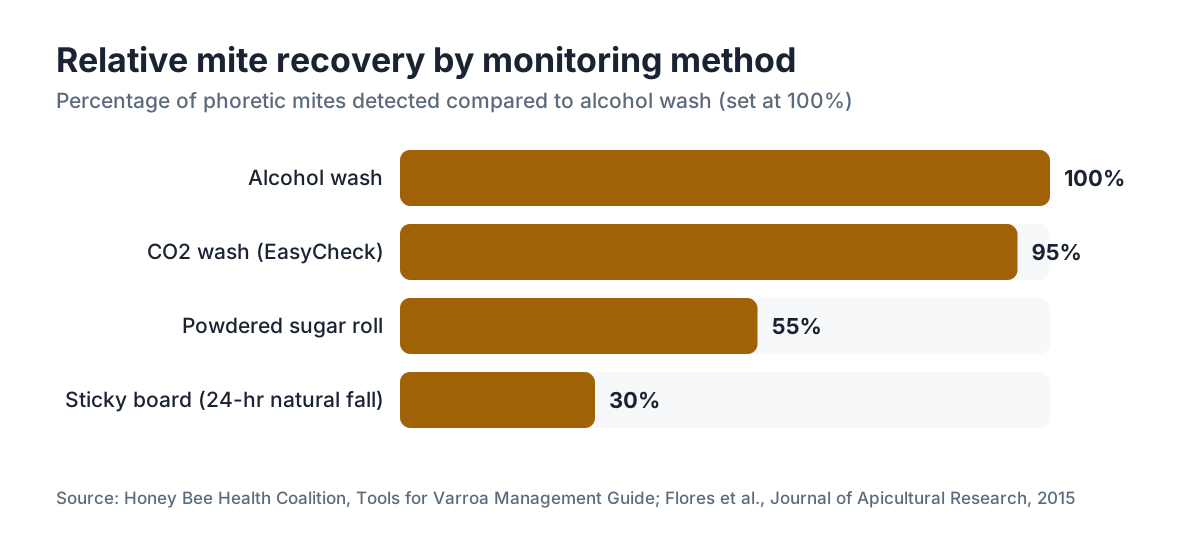
Here's the honest accounting. Work published in peer-reviewed apiculture journals, including Flores et al. in the Journal of Apicultural Research (2015), found that alcohol wash recovers significantly more mites per sample than the sugar roll from the same hives. The sugar roll misses somewhere between 20% and 60% of phoretic mites depending on conditions, technique, and the mite load in the hive [2].
Say an alcohol wash would give you 3 mites per 100 bees, right at the treatment threshold. A sugar roll on the same hive might hand you 1.5 to 2.4, and you'd walk away thinking you're fine. You're not fine. That false-low reading can push your treatment weeks past when it should have happened. A varroa population doubling time near 2 to 3 weeks during the summer brood season means those weeks cost you.
The Honey Bee Health Coalition's Varroa management guide recommends alcohol wash or the CO2 method (using a Varroa EasyCheck or similar device) as the preferred monitoring methods and flags the sugar roll's lower accuracy [1]. University extension programs in several states say the same. For a treatment decision, alcohol wash is the standard.
| Method | Bees returned alive | Relative mite recovery | Best use |
|---|---|---|---|
| Alcohol wash | No | Highest (reference standard) | Treatment decisions |
| CO2 wash (EasyCheck) | Yes | High (comparable to alcohol) | Treatment decisions, bee-safe |
| Powdered sugar roll | Yes | Low (misses 20 to 60%) | Rough screening only |
| Sticky board | Yes (no bees used) | Highly variable | Trend detection only |
How do you do the powdered sugar roll correctly, step by step?
If you're going to use it, do it right. Sloppy technique makes the miss rate worse.
First, collect your sample. Open the hive, find a frame with nurse bees, and keep the queen out of it. Shake or brush roughly 300 adult bees into a collection jar. A dedicated half-pint mason jar with a 1/8-inch hardware cloth lid screened into the band works well. So do purpose-made mite-counting kits. For rough estimates, 300 bees fill about a half-cup by volume.
Add powdered sugar. Two tablespoons (about 30 mL) is standard. Confectioner's sugar is fine. Plain powdered sugar with no corn starch is ideal, but the corn starch in most grocery store sugar hasn't been shown to harm bees over the brief exposure of a monitoring roll.
Roll and wait. Put the lid on and roll the jar gently for 60 seconds to coat every bee. Let it sit for 2 minutes. That rest matters. It gives the sugar time to work into the joints where mites hide.
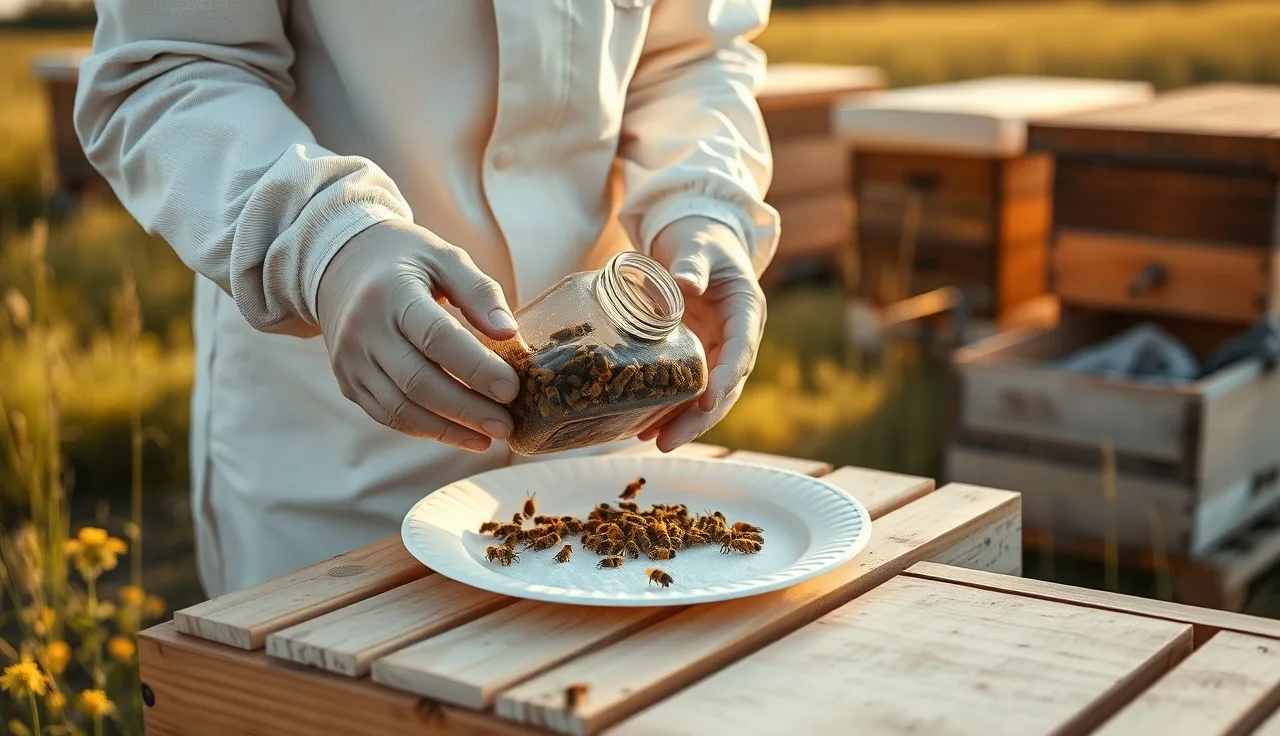
Shake out the sugar. Hold the jar upside down over a white surface (a paper plate, a pale bucket lid, a sheet of white cardboard) and shake hard for about a minute. Sugar and any loose mites fall through the mesh. A light mist of water on the white surface makes mites pop as dark specks against the white sugar.
Count and return. Count the reddish-brown oval mites. Then count or estimate the bees in the jar, or weigh them (300 bees run about 30 to 35 grams depending on the season). Return the sugared bees to the hive entrance. Most survive. The math: mites counted divided by bees in sample, times 100, gives mites per 100 bees.
Temperature and timing matter more than most people think. Run the test when it's warm, ideally mid-morning after foragers have left, so your sample skews toward younger nurse bees that carry more phoretic mites. Cold bees clump and won't roll. Hot days above 35 degrees C stress the sample bees badly.
What mite count is too high? How to read your results
The thresholds in wide use come from the Honey Bee Health Coalition and various university extension programs. For the brood-rearing season (roughly April through August in temperate North America), the common action threshold is 2 to 3 mites per 100 bees [1]. Some programs use 2%, some use 3%. The HBHC Varroa management guide uses 3% for summer treatment and recommends treating at any detectable level in late summer or early fall, before the colony raises its winter cluster.
A sugar roll count of 2 per 100 bees is borderline. Remember the 20 to 60% miss rate. A 2 on a sugar roll could easily be 3 or more on an alcohol wash. Here's my own approach. If a sugar roll shows anything above 1.5 mites per 100 bees during brood season, I follow up with an alcohol wash before I decide anything. Don't treat on a falsely low sugar-roll number, and don't wait once an alcohol wash confirms you're at or above threshold.
The late summer and early fall window (August through September across most of the U.S.) is where the stakes climb. Bees raised in September and October carry the colony through winter. Varroa-damaged winter bees mean dead hives by February. If any monitoring method shows mites above zero in August, most experienced beekeepers treat.
When does the powdered sugar roll make sense?
It's not a useless test. A few situations call for it.
You're doing a quick pass across many hives and need live bees back. Running 30 colonies and want a fast flag on which ones need a closer look? A sugar roll screens quickly. Flag anything above 1.5% for an alcohol wash follow-up. You've cut your alcohol wash workload sharply.
You're teaching new beekeepers. The sugar roll is visually dramatic and non-lethal, which makes it a better classroom tool. Beginners will actually run a test they don't feel guilty about.
You're monitoring the same colonies very often for research or demonstration. Repeated alcohol washes kill a small number of bees each time. Repeated sugar rolls don't. For tracking a trend rather than making a precise treatment call, the roll earns its place.
For the actual treatment decision, use alcohol wash. The Honey Bee Health Coalition's guide [1], Penn State Extension's mite-monitoring protocols [3], and the UC ANR honey bee resources [4] all point to alcohol wash as the primary method. They're right.
Does powdered sugar treatment for varroa mites actually work?
No. This gets its own section because the myth won't die and beekeepers keep asking.
The claim that dusting hives with powdered sugar controls varroa has circulated since at least the early 2000s. The theory: sugar either disables mites directly or triggers heavy mutual grooming that removes them. Both mechanisms sound plausible. Neither survived testing.
Rademacher and Harz, publishing in Apidologie (2006), compared sugar-dusted hives to undusted controls and found no statistically significant reduction in mite loads [5]. The Honey Bee Health Coalition's guide states that powdered sugar treatment "has not been shown to reduce mite populations" [1]. The Ontario Ministry of Agriculture's varroa resources land in the same place [6].
Why doesn't it work? Most mites sit in capped brood cells where sugar can't reach them. Phoretic mites that do get dusted often re-attach once the sugar dissolves or is groomed off. And natural grooming, which does remove some mites, isn't strong enough in Apis mellifera ligustica (Italian bees, the most common commercial stock) to drive real population decline. VSH (Varroa Sensitive Hygiene) and Africanized stock groom harder, but that's genetics, not something sugar switches on.
If someone sells you a "powdered sugar treatment" kit, keep your money. The treatments with proven efficacy are the ones registered with the EPA or allowed under USDA Organic rules: oxalic acid, thymol-based products (Apiguard, ApiLife VAR), amitraz (Apivar), formic acid (Formic Pro, MAQS), and the hop-derived beta acids (Hopguard 3) [7].
How often should you monitor for varroa?
Monthly monitoring during the active season is the floor, not the ceiling. The Honey Bee Health Coalition recommends testing every 30 days from spring buildup through the fall mite wash [1]. Plenty of experienced beekeepers test every 2 weeks in July and August, when mite populations climb fastest relative to the bee population.
Here's the costly mistake: test once in spring, treat, and assume the hive is set for the year. Mite loads that sat below threshold in May can hit crisis by August. The colony raises fewer bees as summer dearth shrinks the brood area, while mite reproduction keeps rolling. The mites-per-bee ratio jumps. Test again.
The varroa mite page here covers the mite's life cycle and why the brood-phase population is so much harder to count and treat. That background explains why the sugar roll's blindness to brood-cell mites is such a real limit.
What tools and supplies do you need for varroa monitoring?
For a sugar roll, the kit is short and cheap. A half-pint mason jar with a hardware-cloth lid, a tablespoon, powdered sugar, and a white surface for counting. Improvise and it costs under $5. Or buy a purpose-made mite-counting kit from most beekeeping supply companies for $10 to $20 [8].
For an alcohol wash, add a bottle of 70% isopropyl alcohol and a second jar, or a purpose-made device like the Varroa EasyCheck. The EasyCheck (roughly $15 to $25) lets you run a CO2 wash or alcohol wash in the same device and count through the clear base. It's one of the better small tool buys for a small operation.
VarroaVault has a free printable monitoring log and treatment protocol calendar in its varroa tools section. It won't replace your alcohol wash jar. But a tracking system is the difference between managing mites and reacting to dead colonies in February.
A few more useful items: a small kitchen scale (300 bees weigh about 30 to 35 grams, which beats eyeball counting), a squeeze bottle for misting your counting surface, and a hand magnifier or loupe if your eyes aren't what they used to be. Varroa mites run about 1.1 mm long, visible to the naked eye on a white surface, but a magnifier makes counting far easier [9].
What's the best alternative to the powdered sugar test?
Alcohol wash is the reference standard for monitoring phoretic mites, and it's what you should use for any treatment decision. The technique is almost identical to the sugar roll. Collect 300 bees into a jar, add 70% isopropyl alcohol (windshield washer fluid works too), shake for a minute, pour through a fine screen or the EasyCheck base, and count mites on the white surface below.
The bees die. That's the trade. Three hundred bees is a tiny slice of a healthy colony (60,000 to 80,000 bees in summer), and the accuracy you gain is large. A small operational discomfort buys a much better number.
CO2 wash with a device like the Varroa EasyCheck is the closest thing to accuracy plus live bees. CO2 knocks out the bees, mites release their grip once the bees stop moving, you roll the device to collect mites on the base, read the count, then let the bees go. Several extension programs and the HBHC now list this as a viable alternative to alcohol for beekeepers who want live bees back without the sugar roll's accuracy penalty [1].
Sticky boards sit below the screened bottom board and catch mites that fall naturally. They're useful for confirming varroa is present at all and for watching trends. They're not reliable for threshold-based treatment decisions, because natural mite fall swings wildly with hive conditions, temperature, and season. Use them as a supplement, never a substitute.
What effective varroa treatments should you use instead of powdered sugar?
Once monitoring confirms you're at or above the treatment threshold, you have several registered options. The right one depends on your temperatures, whether there's brood, and whether you lean organic or synthetic.
Oxalic acid (OA) is highly effective against phoretic mites and is the only treatment with real efficacy in broodless conditions (mid-winter or during a broodbreak). Extended-release methods can work during brood-rearing season too, though they take longer [7]. The EPA registers oxalic acid for honey bees through label approvals, and the Api-Bioxal label spells out specific application methods and rates [10].
Apivar (amitraz strips) works well during brood-rearing season because amitraz kills mites on contact as they transfer between bees. It needs a 6 to 8 week exposure. Resistance to amitraz has been documented in some U.S. populations, so rotating modes of action matters [7].
Formic acid (Formic Pro or MAQS) is the one treatment that penetrates capped brood cells and kills mites alongside the developing bee. It's temperature-sensitive (best between 10 and 29 degrees C), and reaching mites in the brood is its main edge over other options. Read the label closely. It has specific ventilation requirements.
Thymol-based products (Apiguard, ApiLife VAR) work well in the late summer window when nights stay above 15 degrees C. They're allowed in organic operations under the National Organic Program with the right documentation.
For more on the full range of beekeeping supplies, including monitoring gear and treatment applicators, the supply-company comparison page covers what's worth buying.
Common mistakes beekeepers make with the powdered sugar roll
The most common error is treating a sugar roll result like an alcohol wash result and deciding on the lower number. If your sugar roll says 1.8 mites per 100 bees, the true count is likely 2.5 to 3.5 or higher. You're probably already at threshold. Don't let a gentle method hand you false confidence.
Second most common: rolling too briefly or counting too fast. The 60-second roll, 2-minute rest, and 1-minute shakeout is a minimum. Thirty seconds of rolling gives you a worse number. Be methodical.
Third: sampling the wrong bees. Foragers carry fewer phoretic mites than nurse bees because they spend less time in the brood nest. Always sample from frames with brood, not the entrance or the outer honey frames. That's where the nurse bees cluster.
Fourth: testing too rarely and treating late. One test in May with no follow-up is how a colony that looked fine in spring ends up dead in November. Test monthly. More in August.
Fifth: making treatment decisions off sticky board counts. Sticky board numbers don't translate cleanly to infestation rates. The HBHC explicitly cautions against using them as the primary decision tool [1].
Frequently asked questions
Does powdered sugar kill varroa mites?
No. Powdered sugar does not kill varroa mites. It only briefly disrupts their grip on bees, which is why it works (imperfectly) as a monitoring tool when you shake mites loose into a jar. Applied to whole hives as a treatment, multiple controlled studies found no significant mite reduction. The Honey Bee Health Coalition confirms powdered sugar is not an effective varroa treatment.
How accurate is the powdered sugar roll for counting varroa?
The sugar roll misses roughly 20 to 60% of phoretic mites compared to alcohol wash, the reference standard. That means a reading of 2 mites per 100 bees on a sugar roll could represent 3 or more on an accurate count. Treat sugar roll results as conservative estimates and follow up with an alcohol wash before any treatment decision.
How many bees do you need for a sugar roll sample?
About 300 bees, which fills roughly a half-cup by volume and weighs 30 to 35 grams on a kitchen scale. This is the same sample size used for alcohol wash and gives a meaningful mite-per-bee ratio. Smaller samples make the percentage less reliable. Always sample from brood frames to capture nurse bees, which carry more phoretic mites than foragers.
What mite count means you need to treat your bees?
The standard treatment threshold during brood-rearing season is 3 mites per 100 bees (3%), based on Honey Bee Health Coalition guidance. Some programs use 2%. In late summer (August onward), most experienced beekeepers treat at any count above zero to protect the winter bee population. Confirm a threshold reading with alcohol wash or CO2 wash, not a sugar roll.
Can bees survive after a powdered sugar roll?
Yes. The vast majority of bees survive a sugar roll and can go back to the hive entrance. That's the main practical argument for the method. Returned bees groom off the powder quickly and rejoin the colony without major losses. Avoid the roll in cold weather or full sun on very hot days, since temperature stress is harder on bees than the sugar itself.
How often should I do a varroa mite test?
At minimum, once a month from spring buildup through fall. The Honey Bee Health Coalition recommends monthly testing throughout the active season. Many experienced beekeepers test every two weeks in July and August, when mite populations climb fastest relative to the bee population. Test after treating too: check at 4 to 6 weeks post-treatment to confirm the load dropped to an acceptable level.
What is the best varroa monitoring method for a hobbyist?
Alcohol wash is the most accurate and widely recommended method for hobbyists making treatment decisions. CO2 wash (using a Varroa EasyCheck or similar) is nearly as accurate and returns bees alive, which makes it a good choice if live bee return matters to you. The powdered sugar roll is the least accurate of the three and belongs in rough screening, not threshold calls.
What time of year is varroa worst?
Late summer, typically August through September in temperate North America, is the most dangerous window. The bee population declines after the summer peak while the mite population keeps growing, so the mites-per-bee ratio rises fast. This is also when the bees that carry the colony through winter are being raised, and varroa-damaged winter bees mean colony death by late winter or early spring.
Does the powdered sugar in grocery stores work for mite testing?
Yes, standard grocery store confectioner's sugar works fine. Most contains a little corn starch as an anti-caking agent. The brief exposure during a monitoring roll (a few minutes) hasn't been shown to harm bees. Use it fresh and dry. Clumped or humid sugar won't coat bees well, which worsens your already imperfect mite recovery.
Is there a varroa mite test that doesn't kill bees?
Yes. CO2 wash with a device like the Varroa EasyCheck anesthetizes bees, dislodges mites for counting, then lets you release the bees unharmed. Its accuracy is comparable to alcohol wash and much better than the powdered sugar roll. It costs roughly $15 to $25 for the device plus a CO2 source. This is the best live-bee option for beekeepers who need accurate counts.
How do I know if my varroa treatment worked?
Test again 4 to 6 weeks after treatment ends using alcohol wash or CO2 wash. A successful treatment should bring your count below 1 to 2 per 100 bees. If it's still at or above 3%, either the treatment was applied wrong, resistance is present, or mites reinfested from neighboring colonies. Reinfestation is common in areas with many colonies within a 3-mile radius.
Can I use a sticky board instead of a sugar roll for varroa monitoring?
Sticky boards detect mite presence and show trends, but they can't give a reliable mite-per-bee percentage for treatment decisions. Natural mite fall varies too much with temperature, colony size, and hive conditions. The Honey Bee Health Coalition explicitly recommends against using sticky board counts as the primary monitoring tool for treatment thresholds. Use them to watch direction, not to make the call.
How do varroa mites spread between hives?
Mainly through drifting and robbing. Worker bees from high-mite colonies drift into neighboring hives carrying phoretic mites. Robbing events, where strong colonies rob weaker ones of honey, move mites fast and efficiently. Swarms from infested colonies carry mites too. That's why your load can rebound even after a clean treatment if your neighbors don't monitor.
What is a phoretic varroa mite?
A phoretic mite rides on an adult bee instead of reproducing inside a capped brood cell. These mites feed on the bee's fat body, and they're the ones sugar roll and alcohol wash tests actually capture. During brood season, only about 15 to 30% of total mites are phoretic at any given time. The rest sit in capped cells, which is why broodless treatments like oxalic acid dribble are so effective.
Sources
- Honey Bee Health Coalition, Tools for Varroa Management Guide (current edition): 3% mites per 100 bees action threshold during brood season; sugar roll has lower accuracy than alcohol wash; powdered sugar is not an effective treatment; alcohol wash is the recommended monitoring method
- Flores et al., Journal of Apicultural Research, 2015 - comparison of varroa sampling methods: Alcohol wash recovers significantly more mites per sample than sugar roll; sugar roll misses 20 to 60% of phoretic mites
- Penn State Extension, Honey Bee Varroa Mite Monitoring resources: Alcohol wash recommended as the primary monitoring protocol for treatment decisions; monthly monitoring during the active season
- University of California Agriculture and Natural Resources, Honey Bee Research Program: Alcohol wash is the preferred monitoring standard for phoretic varroa mites
- Rademacher & Harz, Apidologie, 2006 - oxalic acid and sugar dusting efficacy: Sugar dusting did not produce statistically significant reductions in mite loads in controlled trials
- USDA Agricultural Research Service, Bee Research Laboratory - Varroa Treatments Overview: Registered effective varroa treatments include oxalic acid, amitraz, formic acid, thymol, and hop beta acids; rotation of modes of action recommended to address resistance
- Mann Lake Beekeeping Supplies - Mite Management Equipment: Purpose-made mite-counting kits available from beekeeping suppliers for $10 to $20
- Rosenkranz et al., Journal of Invertebrate Pathology, 2010 - Varroa destructor biology: Varroa destructor adult female measures approximately 1.1 mm in length; 70 to 80% of mite population typically in capped brood during peak brood season
- U.S. EPA - Api-Bioxal (oxalic acid) pesticide registration: Oxalic acid (Api-Bioxal) is EPA-registered for varroa mite control in honey bee colonies; specific application methods and rates required per label
Last updated 2026-07-09