Reusing equipment from a varroa-collapsed hive: what's actually safe
TL;DR
- Equipment from a varroa-collapsed hive can hold live mites for days, American foulbrood spores for decades, and pesticide residues indefinitely.
- Most woodenware is reusable after a specific clean, freeze, and scorch routine.
- Combs showing disease signs get destroyed.
- Rushing reuse without a diagnosis is the fastest way to kill your next colony.
What actually kills a hive during a varroa collapse?
Varroa destructor rarely kills a colony directly. High mite loads open the door to a run of viral infections, mainly Deformed Wing Virus (DWV) and Acute Bee Paralysis Virus, that shorten adult bee lifespan, deform emerging workers, and eventually leave the colony too weak to hold its population. [1] By the time you find the deadout, the colony has usually crashed over three to six weeks. What's left in the box is a mix of dead bees, partly capped brood, honey, pollen, and wax, and all of it can hold live mites and pathogens.
The Honey Bee Health Coalition's Varroa Management Guide describes the late-stage pattern plainly: a hive that was 'booming in summer can crash by fall when varroa and associated viruses suppress winter bee production.' [2] That's the biology that makes deadout gear dangerous. The colony didn't just die. It died sick, and the gear soaked up that sickness.
What killed the hive shapes every decision you make about the equipment. A clean starvation death with no disease signs is a different animal from a DWV-wrecked, mite-saturated collapse. Don't treat them the same.
How long do varroa mites survive in an empty hive?
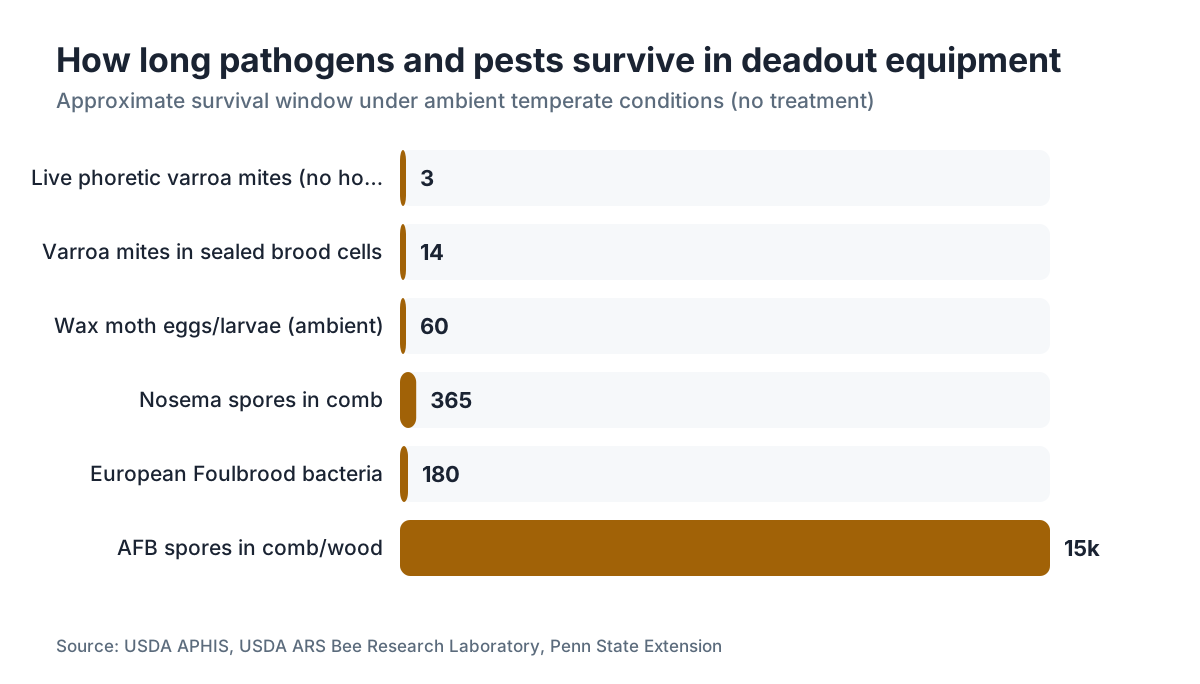
Beekeepers underestimate this one badly. Live phoretic mites (the ones riding adult bees) die within hours to a few days once the host is gone, because they run on bee body heat and hemolymph. [3] Reproductive mites sealed inside brood cells last longer. They can hang on for several days inside cells even after the adult bee has died, especially if the cell stays somewhat capped and the temperature is mild.
Crack open a deadout in January in Minnesota and most mites are dead. Work a deadout in September when it's still 70°F and you should assume live mites are present. The USDA ARS Bee Research Lab notes that mites in capped cells are the hardest to kill with anything short of heat or cold. [3]
Here's the rule I use. Don't move combs from a recent collapse into a new colony without treatment. The line is fuzzy, but any deadout under two weeks old in warm weather gets treated as if live mites are there. Freeze the combs at 0°F (-18°C) for at least 24 hours and you'll kill anything left. [4] Simplest, cheapest fix on the list, and it costs you nothing but freezer time.
The varroa mite life cycle explains why cells shelter mites longer than open surfaces do, and that background helps here.
What diseases can survive in deadout equipment and for how long?
This is where the real long-term risk lives. Several bee pathogens outlast varroa mites by a wide margin.
American Foulbrood (AFB). Paenibacillus larvae spores are the nightmare. They stay viable in wax and wood for 40 years or more. [5] The USDA states that 'spores can remain viable for more than 35 years in old combs and equipment.' [5] If your collapsed hive had AFB, the combs get destroyed, usually by burning, and the boxes get scorched with a propane torch until the interior wood is uniformly brown. Rules vary by state: many require AFB-positive equipment to be reported to the state apiarist and destroyed under their guidance. Check your state department of agriculture's apiary program before you decide anything.
European Foulbrood (EFB). Melissococcus plutonius is less stubborn than AFB spores but can survive in equipment for months. Scorching and thorough cleaning handle it. EFB-positive gear is generally lower risk than AFB after proper sanitation.
Nosema. Nosema ceranae and N. apis spores can survive in drawn comb for months to years. Glacial acetic acid fumes (not vinegar) are the standard treatment for Nosema-contaminated combs in storage and are approved for this use in many countries, though U.S. options are more limited. [6] Fumigation followed by thorough airing is common practice.
Chalkbrood. Ascosphaera apis makes tough spores that hang around in comb. Strong colonies often clear it, but starting a new colony on heavily infected comb puts it on the back foot from day one.
Sacbrood and viral loads. Viruses like DWV break down faster in the environment than bacterial spores do. Weeks of sun and drying cut viral load a lot, though nobody has clean public data on exactly how long each bee virus stays infective in stored comb.
The short version: AFB is the only disease that forces you to consider burning everything. The rest can be managed with freezing, scorching, and pitching the worst combs.
What's the risk from pesticide residues in old comb?
Pesticide buildup in beeswax is real and underappreciated. Wax is lipophilic, so fat-soluble compounds bind to it and stay. Studies of commercial and hobbyist comb have found a long list of miticides and farm pesticides embedded in wax, including fluvalinate, coumaphos, and chlorothalonil. [7]
A 2010 study in PLOS ONE by Mullin et al. found 'more than 120 different pesticides and metabolites' in samples of wax, pollen, and bees from U.S. hives, with coumaphos and fluvalinate present in almost every wax sample tested. [7] If the previous beekeeper leaned on Apistan or CheckMite+ hard over the years, the comb carries that chemical load straight into your next colony.
High coumaphos levels in wax have been tied to queen reproductive problems and reduced drone viability. [7] That's not theoretical. Inherit gear from someone who treated heavily for years and the oldest, darkest combs hold the heaviest residue. Cycle them out regardless of any disease question.
There's no practical home test for pesticide residue. The only real fix is retiring old comb on a schedule (many experienced beekeepers replace about a third of their comb each year) and never handing a new package or split the worst, oldest equipment to start on.
Which equipment can be safely reused and which should you discard?
Here's the honest breakdown. Most woodenware comes back. Most very old, dark comb isn't worth keeping.
| Equipment | Reuse decision | Protocol |
|---|---|---|
| Wooden boxes (no AFB) | Yes | Scrape clean, scorch interior with propane torch |
| Wooden boxes (AFB confirmed) | State-dependent | Scorch or burn per state rules |
| Frames (wood, no disease) | Yes | Scrape, freeze 24h, or replace comb |
| Drawn comb, light color, no disease | Yes with caution | Freeze 24h at 0°F minimum |
| Drawn comb, very dark, old | No | Render for wax or discard |
| Comb with visible AFB scale | No | Burn with frames |
| Comb with chalkbrood mummies | Judgment call | Freeze, let strong colony clean |
| Plastic foundation | Yes | Scrape, wash with bleach solution, rinse |
| Feeders, bottom boards, covers | Yes | Scrape, wash, dry completely |
| Used miticide strips (Apivar, MAQS, etc.) | No | Dispose per label instructions |
The one item almost always worth replacing: old black comb from a collapsed hive. It's loaded with wax moth cocoons, pesticide residue, and possibly several pathogen loads at once. Any honey it holds isn't worth the risk it poses to your next colony. Render it for wax or toss it.
Metal parts like queen excluders and bottom board hardware are fine after a scrub in hot soapy water and a full rinse. Corrosion is the bigger worry there, not pathogen transfer.
How do you properly clean and treat salvageable equipment?
Cleaning isn't optional and it isn't hard. Here's a step-by-step that handles the realistic threats.
Step 1: Full inspection. Before you touch anything, glove up and go through every frame. Look for the ropy, brown, foul-smelling scale of AFB. Look for sunken, greasy cappings. Take photos. If you're not sure what you're seeing, contact your state apiarist. Most state apiary programs offer free inspections for exactly this.
Step 2: Remove dead bees and debris. Scrape down every interior surface with a hive tool. Get propolis, wax, and gunk off the wood. Physical scraping drops the microbial load a lot before any heat or chemical step.
Step 3: Freeze combs you plan to reuse. A chest freezer at 0°F (-18°C) for 24 to 48 hours kills varroa mites, wax moth eggs and larvae, and small hive beetle eggs. [4] That's a floor, not a ceiling. Some beekeepers run 72 hours. Longer does no harm. Let combs warm to room temperature slowly, ideally inside a sealed bag, so condensation doesn't soak them.
Step 4: Scorch wooden boxes. Run a propane torch over every interior surface until the wood turns uniformly brown (not black, not charred through). This kills most bacteria and fungal spores. It's standard AFB-prevention practice and adds maybe five minutes per box. Don't skip it.
Step 5: Bleach wash for non-porous surfaces. A 1:9 bleach-to-water solution (about half a cup of bleach per gallon of water) works on plastic components, feeders, and metal parts. Soak 10 minutes, rinse completely, air-dry. Chlorine residue is toxic to bees, so the rinse and dry step matters.
Step 6: Storage. Store cleaned gear somewhere with airflow, off the ground, away from wax moths. Moth crystals (paradichlorobenzene, not naphthalene) placed above the frames in stacked boxes, not touching the comb, protect stored comb from wax moths. Follow the label for amounts. [8]
If you want a checklist to track which equipment has been through which step, VarroaVault's free hive management tools include a deadout equipment assessment worksheet that runs alongside your broader varroa protocol.
Can honey from a collapsed hive be extracted and used?
Honey from a varroa-collapsed hive is generally safe for people, as long as the colony wasn't treated with antibiotics in the honey super and in-hive treatments didn't contaminate the honey frames. [9] Varroa mites don't infect honey. The viruses they carry don't affect humans.
Feeding that honey back to bees is another matter. Honey can carry AFB spores. If there's any chance the colony died with AFB, do not feed that honey to any bee colony, yours or anyone else's. The spores survive in honey essentially forever, and a small amount can start an AFB infection in a healthy hive. The USDA is blunt about it: never feed honey from an unknown source to bees. [5]
Honey from a disease-free varroa collapse can be extracted and used normally. Harvest it, process it, eat it. If you're not sure about disease status, err toward not feeding it back.
One more thing. Honey left in frames more than a few weeks after the colony dies will ferment if it's high moisture or set up hard if it's low moisture. Neither hurts a human, but crystallized comb honey is a pain to extract and fermented honey tastes off. Move on it.
What are the legal requirements when a hive collapses from disease?
This varies by state and it matters. American foulbrood is a reportable disease in most U.S. states, so if you confirm or suspect AFB in a deadout, you're legally required to notify your state department of agriculture's apiary program. Skip it and you risk fines, plus you miss free professional guidance and inspection.
Many states spell out exactly how AFB-positive equipment gets disposed of. Burning on-site, hauling gear to a licensed disposal facility, or scorching the wood for reuse all carry state-specific rules. California, for one, requires AFB-infected equipment to be burned or buried under an inspector's supervision. [10] Florida, Texas, and most other major beekeeping states have similar statutes.
For non-disease collapses there's usually no reporting requirement, but it's still smart to call your local bee inspector or extension apiculturist. They can confirm what killed the hive and give you region-specific guidance on what's circulating nearby.
The National Honey Bee Survey and state apiary inspection programs are the front line for disease surveillance. Using them is free and fast, and it gives you documentation that pays off later if you're in an inspector's network.
How do you diagnose what actually killed the hive before reusing anything?
Don't skip this. The reuse decision hangs entirely on what killed the hive, and the diagnosis is usually doable without a lab.
Varroa collapse (primary cause). Look for the pattern: a small cluster of dead or dying bees, a patchy, spotty brood pattern in the final frames, lots of empty cells, and maybe deformed-wing bees near the entrance or on the bottom board. Alcohol wash or sticky board counts before death would have shown high mite loads. After collapse you can sometimes still find mites on dead bees under magnification.
AFB. The smell test is reliable: AFB smells like rotting garbage, a sharp, putrid odor you won't forget once you've met it. The ropy string test is the classic field check. Insert a small stick into a suspicious cell and pull it out. If the contents string more than an inch before breaking, treat it as AFB until an inspector says otherwise. [5]
Starvation. Dead bees head-down in cells, facing in. No honey stores. This happens with or without varroa and changes the equipment risk a lot. Starvation deadouts with no disease signs are the lowest-risk gear to reuse.
Small hive beetle damage. Slime, a fermented honey smell, beetle larvae in the comb. SHB-wrecked equipment is unpleasant but not a pathogen risk after cleaning.
Pesticide kill. A sudden, large pile of dead bees at the entrance or on the bottom board, often with dead foragers in the grass nearby. Gear from pesticide kills is generally safe after normal cleaning.
When you're stuck, the most useful resource in the U.S. is the USDA Bee Research Laboratory in Beltsville, Maryland, which supports apiary diagnostics for state inspectors and beekeepers. [11]
Should you ever just start fresh with new equipment instead?
Honestly, sometimes yes. If you're staring at a deadout with several boxes of very old black comb, confirmed AFB signs, and no time or certainty to run the full protocol, buying new frames and foundation is the right call. New foundation and frames cost roughly $3 to $6 per frame depending on material and supplier, and a new deep box with ten frames runs $40 to $80 at most beekeeping supply companies. [12]
Compare that to losing another $200 nuc or $150 package to a disease you passed along by accident. The math isn't hard.
Clean wooden boxes, though, are worth keeping. A well-built deep super that's been scraped and scorched can last 20-plus years. The boxes aren't where the risk lives. The comb is. Keep the wood, replace the comb, and you've done the part that counts.
This is also the moment to ask why the hive collapsed and whether your varroa monitoring needs work. A hive that crashed from varroa in fall almost certainly had a mite problem you missed by midsummer. VarroaVault's free protocol resources are built around structuring that monitoring, including timing and threshold guides.
What's the safest way to introduce bees back into treated deadout equipment?
Timing and colony strength both matter. Don't drop a small nuc into a full double-deep. Give bees a space they can actually defend and keep clean. A three-pound package or a five-frame nuc should start in a single deep with no more than eight frames. Let them build into extra space.
A few practices cut risk when you reintroduce bees.
Run an alcohol wash or sugar roll baseline mite count within the first week of installation. [2] You need your starting mite load before anything goes sideways. A new package going into old equipment might pick up mites from leftover debris faster than you'd guess, though the scientific consensus is that the risk from equipment surfaces (versus live bee-to-bee spread) is low once the bees are gone. Know your numbers anyway.
Feed syrup to push fast comb drawing if you replaced foundation. Bees drawing comb are building a clean start, and the faster they cover or replace surfaces in the box, the lower the long-term exposure.
Watch how the bees behave. Bees can detect pathogen cues in comb. A colony that's slow to move into a box, keeps propolizing over one spot, or acts strangely around certain frames is telling you something worth a closer look.
Frequently asked questions
Can live varroa mites still be in a hive weeks after the colony died?
Phoretic mites on adult bees die within a few days of losing their host. Mites inside sealed brood cells last a bit longer but rarely more than one to two weeks in warm conditions. A hive dead more than two weeks in cool weather carries minimal live-mite risk. For any recent collapse in warm weather, freeze combs at 0°F for 24 hours to be safe.
Is it safe to give honey from a dead-out hive to another colony?
Only if you're certain the hive did not have American foulbrood. AFB spores survive indefinitely in honey, and a tiny amount can infect a healthy hive. If you have any doubt about disease status, extract the honey for people or discard it. Never feed honey from an unknown-status hive to bees. This is one of the most common ways AFB spreads between colonies.
Do I need to report a varroa-collapsed hive to my state apiarist?
Pure varroa collapse without confirmed disease is generally not reportable, but American foulbrood is reportable in most U.S. states. If you see AFB signs (ropy pull test, putrid smell), contact your state department of agriculture's apiary inspection program. They provide free diagnosis, guidance on legal disposal, and help document disease spread in your area.
How do I know if my deadout hive had American foulbrood before I reuse the equipment?
The field test is the ropy string test: insert a stick into a suspicious cell with dark, sunken cappings and pull it back. If the contents string more than about an inch before breaking, suspect AFB. The smell is distinctive too, like rotting garbage. When in doubt, have a state apiarist inspect before you clean or move anything.
Can I reuse drawn comb from a varroa-collapsed hive for a new package?
Yes, with conditions. Freeze it at 0°F for 24 to 48 hours to kill remaining mites and wax moth eggs. Check it carefully for disease signs. Skip very old, dark comb with heavy pesticide buildup. Light to medium comb with no disease signs and no foul odor is reasonable to reuse after freezing.
What does scorching wooden hive boxes with a propane torch actually accomplish?
Scorching kills most bacteria, fungal spores, and mite eggs on wood surfaces. Run the torch over interior surfaces until the wood turns uniformly brown, not charred or black. It takes about five minutes per box. It's the most cost-effective sanitization step for woodenware and is strongly recommended before reusing boxes from any disease-suspect colony.
How long do AFB spores survive in old beekeeping equipment?
The USDA states that Paenibacillus larvae spores can remain viable in old combs and equipment for more than 35 years. Burning is the only truly reliable way to clear AFB from heavily infected equipment. Scorching may not reach deep spore contamination in badly infected wood, which is why many state regulations require burning confirmed AFB-positive equipment.
Is bleach effective for cleaning beehive equipment after a collapse?
Bleach (sodium hypochlorite) at a 1:9 dilution in water works against many bacteria and fungi on non-porous surfaces like plastic feeders, plastic foundation, and metal hardware. It doesn't penetrate wood well and it doesn't destroy AFB spores reliably. After bleach treatment, rinse all parts thoroughly and let them dry completely before exposing bees to them.
Can wax moths contaminating a deadout hive spread varroa to other colonies?
No. Wax moths don't carry or transmit varroa mites. Wax moth larvae wreck comb and can ruin stored equipment, but they aren't a vector for varroa or foulbrood. Freezing stored comb kills wax moth eggs and larvae. The main risk from wax moth-damaged comb is structural, not pathogenic, though the damaged cells should be replaced.
Should I quarantine deadout equipment before reusing it near other hives?
Yes, as a precaution. Store it away from active hives to prevent robbing, which can spread disease if the comb holds AFB-positive honey. A minimum of two weeks in a sealed or covered space away from live hives also lets any surviving mites die off and gives you time to assess and treat the equipment before it goes back in service.
What's the risk from pesticide residues in old comb from a collapsed hive?
Real and underappreciated. Wax absorbs fat-soluble pesticides including miticides like fluvalinate and coumaphos, which build up over years of treatment. High coumaphos levels have been linked to reduced drone fertility and queen reproductive problems. There's no home test for residues. The practical answer is to retire old, dark comb and never hand new colonies your worst equipment.
Can I reuse frames with foundation from a hive that collapsed due to varroa if the comb looks normal?
Yes. Normal-colored comb with no disease signs, no foul odor, and no visible AFB scale is generally safe to reuse after a 24 to 48 hour freeze at 0°F. Inspect each frame under good light. If the comb is more than two or three years old and very dark, replace it anyway, since older comb carries higher pesticide and pathogen loads.
Sources
- USDA ARS Bee Research Laboratory, 'Varroa destructor and associated bee viruses': High varroa mite loads enable Deformed Wing Virus and other viruses that collapse colony populations
- Honey Bee Health Coalition, 'Tools for Varroa Management Guide' (7th edition): A hive booming in summer can crash by fall when varroa and associated viruses suppress winter bee production; baseline mite count protocols recommended
- USDA ARS Bee Research Laboratory, Varroa mite biology and survival: Phoretic mites die within hours to days off a bee host; mites in capped cells survive longer than those on open surfaces
- University of Minnesota Bee Lab, comb storage and freezing guidance: Freezing comb at 0°F for 24 hours kills varroa mites, wax moth eggs and larvae, and small hive beetle eggs
- Penn State Extension, 'Nosema Disease of Honey Bees': Acetic acid fumigation is a recognized treatment for Nosema-contaminated comb in storage
- Mullin et al. (2010), 'High Levels of Miticides and Agrochemicals in North American Apiaries', PLOS ONE: More than 120 different pesticides and metabolites found in U.S. hive wax, pollen, and bee samples; coumaphos and fluvalinate present in nearly every wax sample; high coumaphos linked to reduced drone viability
- EPA, Pesticide product label requirements: Paradichlorobenzene (not naphthalene) moth crystals approved for wax moth control in stored comb per label instructions
- FDA, Honey guidance for industry: Honey is safe for human consumption absent disallowed drug or chemical residues
- California Department of Food and Agriculture, Apiary Inspection Program: California requires AFB-infected equipment to be burned or buried under inspector supervision
- USDA ARS Bee Research Laboratory, Beltsville, Maryland, diagnostic services: USDA Bee Research Laboratory in Beltsville supports apiary diagnostics for state inspectors and beekeepers
- Mann Lake Ltd., Beekeeping Equipment Price Reference: New wooden frames with foundation cost approximately $3-6 per frame; a new deep super with ten frames runs $40-80
Last updated 2026-07-10