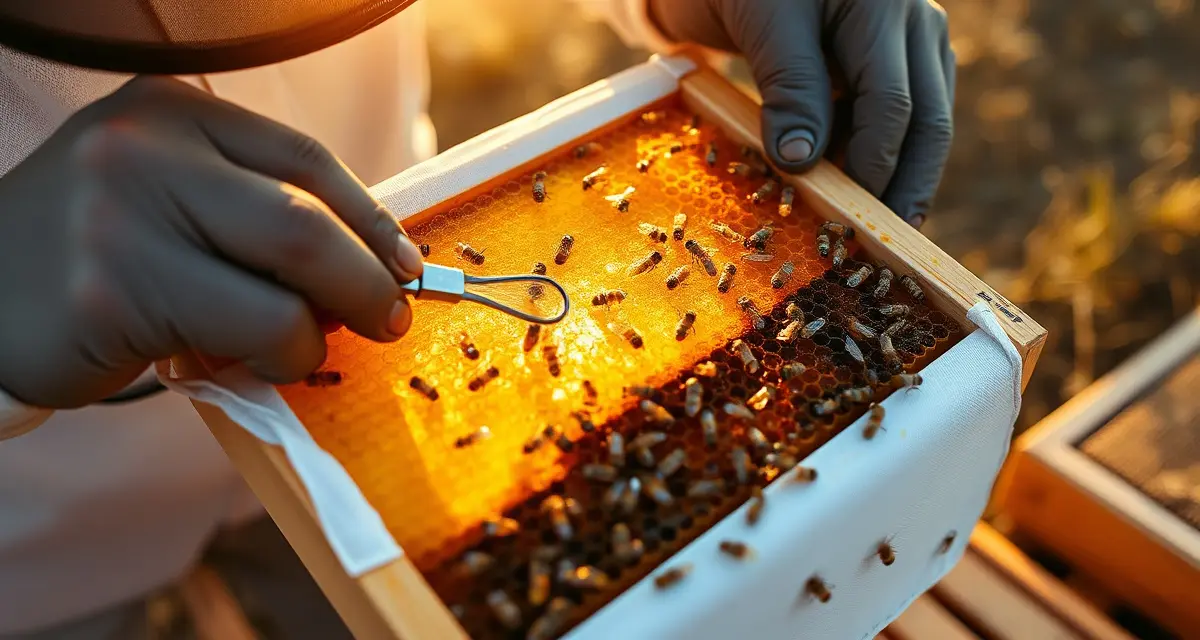
Spring Buildup Mite Checks: Monitoring During Early Colony Growth
Colonies raising first spring brood with even 0.5% infestation can reach threshold by early May. That's a fast trajectory for a colony that's already under stress from winter. The spring buildup mite check is your first real look at where you stand, and your first chance to intervene before the problem compounds.
This guide covers exactly when to do your first spring count, what threshold applies during early buildup, and how to set a baseline in VarroaVault that gives you trend data all season.
TL;DR
- Spring mite counts can be deceptively low because small winter populations have not had time to grow yet
- Mite populations can double every 4-6 weeks during the spring buildup period
- The spring treatment decision should be based on a mite count, not on calendar date alone
- A spring count of 1% or above warrants treatment before the population grows into summer
- Formic acid and oxalic acid extended vaporization are the primary spring options that avoid PHI issues
- VarroaVault's spring monitoring reminders fire at the right time based on your region's buildup calendar
Why the First Spring Count Matters More Than Most
Your winter treatment, whether it was a fall OA vaporization protocol or a broodless-colony dribble, worked to some degree. But how well it worked is something you only find out when you count in spring.
A spring count serves as verification. Did your fall treatment achieve 90%+ mite reduction? Did the winter itself create stress that allowed mites to gain ground? Did robbing or drifting bring mites from other colonies before or after your fall treatment?
If your spring count comes back high (above 2% in a small building colony), you're already at threshold before the season begins. You need to treat immediately and investigate why the fall treatment underperformed.
If your count comes back low (below 1%), you have a real advantage. You can watch more and treat later, which means less chemical stress on the colony during its most vulnerable spring-buildup phase.
Step 1: Know When Your Colony Has Broken Cluster
You can't do a meaningful mite count while the bees are still clustered in a tight winter ball. But you don't need to wait for warm weather either.
Watch for these signs that brood rearing has resumed:
- Bees are flying on warm afternoons (above 50°F) and returning with pollen
- You can hear active movement inside the hive without opening it
- A quick inspection shows brood frames with eggs and young larvae
In most of the US, this happens between late February (Gulf Coast) and late April (upper Midwest, New England, mountain states). Don't go by calendar date. Watch your colonies.
Step 2: Choose a Good Testing Day
Spring counts should be done on a warm afternoon, ideally above 55°F, when foragers are out flying. This concentrates nurse bees in the brood area, which is where you want your sample.
Avoid counting on cold mornings, during rain, or on days when bees are clustered due to cold. The distribution of mites across the colony changes with temperature and activity levels, and your count will be less representative.
Step 3: Locate the Brood Nest and Sample Correctly
In early spring, the brood nest may be confined to just 2-3 frames. This matters: if you sample from the wrong part of the hive, you'll get an inaccurate mite count.
Remove a frame from the edge of the brood nest where nurse bees are densest. Shake or brush approximately 300 bees into your washing container. Don't include the queen. Watch for her on the sample frame and set her aside.
If your colony is very small (fewer than 5 frames of bees), a 200-bee sample is acceptable. Adjust your calculation: divide mites counted by 2 instead of 3 to get your per-100-bee infestation rate.
Step 4: Perform the Alcohol Wash
- Place your bees in a wide-mouth jar with a mesh lid
- Add enough 70% isopropyl alcohol or windshield washer fluid to submerge the bees
- Shake vigorously for 60 seconds
- Pour the liquid through the mesh into a white container, retaining the bees on top
- Count the mites in the liquid. They'll appear as small reddish-brown dots
- Divide mites counted by bees in sample, multiply by 100
If you counted 300 bees and found 6 mites: 6 ÷ 300 × 100 = 2% infestation.
Step 5: Log and Set Your Baseline in VarroaVault
Open VarroaVault immediately after counting. Log the mite count, sample size, hive ID, and date. If this is your first count of the season, the app auto-sets it as your seasonal baseline.
This baseline matters more than it might seem. Every count you do for the rest of the season will be compared against this first reading. A gradual rise from 0.4% to 0.8% to 1.3% tells a very different story than jumping from 0.4% to 2.1% in a single interval. The trend line is often more informative than any single number.
The spring mite management guide covers treatment decisions in more detail. For the count itself, your focus right now is accuracy and consistency.
Step 6: Decide Based on What the Count Shows
Use these early spring thresholds during the buildup phase:
| Colony Condition | Infestation Rate | Action |
|---|---|---|
| Strong spring cluster | Below 2% | Monitor monthly |
| Strong spring cluster | 2% or above | Treat now |
| Small/weak cluster | Below 1% | Monitor every 3 weeks |
| Small/weak cluster | 1% or above | Treat; colony is under stress |
| Any colony with supers going on soon | Below 1% | Good; proceed with flow preparation |
| Any colony with supers going on soon | 1%+ | Treat before adding supers |
The mite count tracking app will prompt your next monitoring date based on your current count and colony status. For a strong colony below 1%, it'll suggest 4 weeks. For a marginal colony at 1.4%, it'll push a 2-3 week recheck.
Common Mistakes in Spring Mite Checks
Sampling too early. If the colony is still loosely clustered and brood rearing has barely started, your sample won't represent the true mite distribution. Wait for active brood rearing on at least 2-3 frames.
Sampling from the wrong location. Bees on the periphery of the hive have lower mite loads than nurse bees in the brood nest. Always sample from the edge of the brood nest.
Using too small a sample. A 100-bee sample has much higher statistical error than a 300-bee sample. At low infestation rates (0.5-1%), a small sample can easily read zero when the real rate isn't zero. Use at least 200-300 bees.
Not logging the count immediately. Memory is unreliable. Log the count before you leave the apiary or before you move to the next hive. VarroaVault's mobile interface is designed for field use.
Related Articles
- How to Use a Sticky Board for Varroa Mite Monitoring
- Mite Counts by Hive Strength: How Colony Size Affects Your Results
FAQ
When should I do my first spring mite check?
Do your first spring mite check when your colony breaks cluster and begins active brood rearing. The reliable indicator is bees returning with pollen and daytime temperatures consistently above 55°F. Don't go by calendar date; watch your specific colonies. In the Deep South this can be late February. In Minnesota or Maine, it might be late April. The goal is to get a count as soon as the colony is actively raising brood, before the mite population has time to build on the new brood cycle.
What threshold should I use in early spring?
The standard threshold is 2% for spring colonies. But for small or weak spring colonies, many experienced beekeepers treat at 1% because a small colony with even moderate mite pressure is under proportionally more stress than a large summer colony at the same percentage. If your colony is heading into the nectar flow season and you're planning to add supers, getting below 1% before supers go on is the cleaner approach.
How do I set a baseline count in VarroaVault?
Log your first mite count of the season as a standard alcohol wash entry. VarroaVault automatically identifies this as your first count of the year and sets it as your seasonal baseline. All subsequent counts are displayed with a trend line relative to this baseline. You can also manually set any count as a baseline in the hive record settings, which is useful if you want to reset after a treatment cycle and track the new trajectory from a clean starting point.
How do I know if my varroa treatment is working?
Run a mite count 2-4 weeks after the treatment ends and compare it to your pre-treatment count. The efficacy formula is: ((pre-count - post-count) / pre-count) x 100. A result above 90% indicates effective treatment. Results below 80% should trigger investigation for possible resistance, application error, or reinfestation. Log both counts in VarroaVault to track efficacy trends across treatment cycles.
How often should I check mite levels in my hives?
At minimum, once per month (every 3-4 weeks) during the active season. Increase to every 2 weeks when counts are near threshold or after a treatment to verify it worked. In fall, monitoring frequency matters most because the window to treat before winter bees are raised is narrow. VarroaVault's monitoring reminders can be set to your preferred interval for each apiary.
What records should I keep for varroa management?
Each record should include: date of count or treatment, hive identifier, monitoring method used, number of bees sampled, mites counted, infestation percentage, treatment product name and EPA registration number, dose applied, treatment start and end dates, and PHI end date. State apiarists typically expect this level of detail during inspections. VarroaVault captures all of these fields in a single log entry.
What is Spring Buildup Mite Checks: Monitoring During Early Colony Growth?
Spring Buildup Mite Checks: Monitoring During Early Colony Growth is a beekeeping guide focused on varroa mite monitoring during the critical early spring period when colonies begin raising their first brood. It explains when to conduct your first mite count, what infestation thresholds apply during buildup, which treatments are appropriate in spring, and how to use VarroaVault to track mite trends throughout the season before populations compound into a summer problem.
How much does Spring Buildup Mite Checks: Monitoring During Early Colony Growth cost?
Spring Buildup Mite Checks: Monitoring During Early Colony Growth is free content available on VarroaVault. The monitoring reminders, regional buildup calendar alerts, and trend tracking features referenced in the article are part of the VarroaVault platform, which offers tools to help beekeepers time their mite checks and treatment decisions accurately throughout the season.
Sources
- American Beekeeping Federation (ABF)
- USDA ARS Bee Research Laboratory
- Honey Bee Health Coalition
- Penn State Extension Apiculture Program
- Project Apis m.
Start the Season Right
The spring buildup mite check takes 15 minutes. It tells you whether your winter program worked, whether you need to act now, and what trajectory you're starting from for the rest of the season.
Skip it, and you're managing by guesswork from March forward. Do it right, with the correct location, correct sample size, and logged immediately, and you've got the first data point in a full season's worth of trend information.
Count now. Log it. Let the data tell you what to do next.
Get Started with VarroaVault
The information in this guide is most useful when you have your own mite count data to apply it to. VarroaVault stores every count, flags threshold crossings automatically, and builds the treatment history you need for state inspections and effective management decisions. See pricing and free tools at varroavault.com.