Spring checklist for varroa monitoring and treatment

TL;DR
- Test every colony for varroa in early spring, before the mite population runs away from you.
- If an alcohol wash or sugar roll hits 2 mites per 100 bees (2%), treat now.
- Oxalic acid vapor, Apivar, and Mite-Away Quick Strips are the main spring options.
- Timing beats product choice.
- Early action is the biggest factor in surviving the season.
Why does spring varroa management matter so much?
Spring is when varroa problems compound fastest. A colony that enters the season carrying even a moderate mite load is building bees on infested brood right now, and every round of capped brood multiplies the mites. By midsummer, a colony that tested at 2% in April can sit at 5 to 8% or worse. At that point you are chasing a fire that already spread. [1]
The bees raised in March and April also matter more than most. They rear the summer foragers. If they incubate high mite loads and the viruses riding along, especially Deformed Wing Virus, the whole forager population peaks at lower quality. [11] That shows up as less honey, weaker fall cluster prep, and worse winter odds.
Nobody argues about this anymore. The Honey Bee Health Coalition's "Tools for Varroa Management" guide states plainly that "the number of mites in a colony is the single most important factor affecting colony health and survival." [1]
Spring is your cheap window. One well-timed treatment can get you ahead of the curve. Wait until July and you usually need two.
When exactly should you do your first spring varroa check?
Do it as soon as the cluster has broken and bees are flying freely on warm days, which usually means daytime temps consistently at or above 55°F. Across the continental US that lands somewhere between late February and early April depending on your latitude. [9]
The real trigger is your first true inspection. When you can open the hive, see eggs, and confirm the queen is laying, you have brood, and varroa are reproducing inside it. That is your starting gun.
Treated with an oxalic acid dribble or vapor over winter while the colony was broodless? Good. Do not skip the spring test because of it. Broodless winter treatments knock down phoretic mites well, but any capped brood present at treatment time sheltered mites that walked away clean. The colony is not automatically empty. Test within 4 to 6 weeks of that last broodless OA treatment to confirm you are still under threshold. [1]
Deep South beekeepers face a harder version of this. Colonies there rarely go fully broodless, so there is no clean reset. Spring testing matters even more because the mite population never took a break.
What is the best way to test for varroa in spring?
The alcohol wash is the most accurate test you can run in a bee yard. Collect about 300 bees (roughly half a cup) from a brood frame, drop them in 70% isopropyl alcohol, shake for 30 to 60 seconds, and count the mites that fall out. Divide mites by bees, multiply by 100. Six mites from 300 bees equals 2%. [1]
The sugar roll is the non-lethal version, but it undercounts by 20 to 30% compared to the alcohol wash in side-by-side tests. [8] A sugar roll reading of 1.5% could be a real 2% infestation. If you plan to act on the number, use the test that gives you a true one.
Sticky boards (counting boards under a screened bottom board for 24 to 72 hours) tell you mites are falling but not how many bees live above them, so you cannot get a percentage. Fine for watching a trend. Not a substitute for a wash when a treatment decision hangs on the number.
Sample from the right spot. Pull bees from a capped brood frame near the center of the nest. Nurse bees on brood carry the most mites. Foragers near the entrance give you a falsely low read. [1]
For the biology behind the mite itself, see our guide to the varroa mite.
| Test Method | Accuracy | Bees Killed | Equipment Cost | Best For |
|---|---|---|---|---|
| Alcohol wash | High | ~300 per test | $10-20 (jar + alcohol) | Treatment decisions |
| Sugar roll | Moderate (undercounts 20-30%) | None | $5-10 | Monitoring trends |
| Sticky board | Low (no % possible) | None | $0-5 | Trend watching only |
| CO2 roll | Moderate-high | None | $50-150 (device) | Non-lethal accuracy |
What mite count triggers treatment in spring?
Treat when your alcohol wash hits 2 mites per 100 bees (2%) during the brood-rearing season, which spring squarely is. That is the Honey Bee Health Coalition's action threshold. [1] It has broad backing from university extension programs, including Penn State Extension and the University of Minnesota Bee Lab. [2][3]
Some researchers and seasoned beekeepers push for treating at 1% during spring buildup, because the colony is growing fast and a 2% count in April can hit 5% by June before a slow treatment finishes working. That is a fair call, especially in high-pressure areas or if you lost colonies the previous fall.
The 2% threshold is a decision line, not a cliff. A colony at 1.8% is not safe. A colony at 2.1% is not doomed. It is a tool for making a call. If you are on the fence, treat.
Here is the part people miss: the threshold applies to an adult bee sample, not to mites hiding in capped cells. Your wash only counts phoretic mites on adult bees. Roughly 70 to 80% of the mite population in a colony with brood sits sealed inside cells and never shows up. [1] Your 2% wash is the tip. The iceberg is bigger.
Which varroa treatments actually work in spring?
One fact complicates spring treatment: most colonies have brood, which rules out or limits several options. Here is what you actually have.
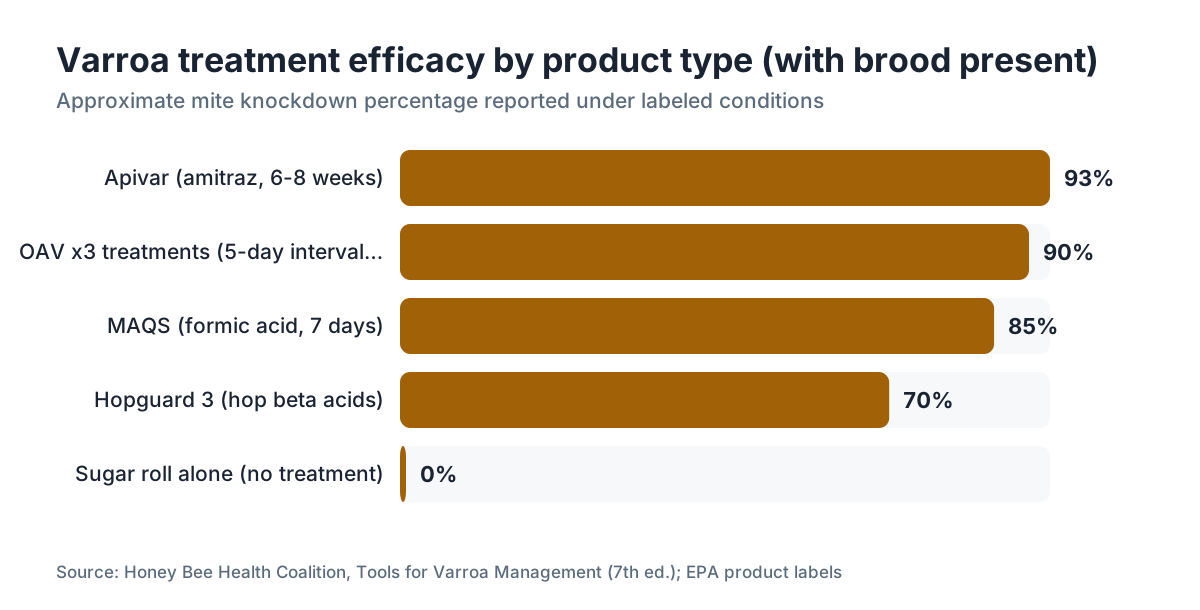
Oxalic acid vapor (OAV) is the most flexible spring tool right now. Vaporized oxalic acid kills phoretic mites on adult bees but does not reach into capped cells. With brood present you need repeat rounds, usually 3 treatments spaced 5 days apart, to catch mites as they emerge and become phoretic. The EPA-registered product (Api-Bioxal is the main labeled one) sets the rate at 2.2 grams of oxalic acid dihydrate per brood box per treatment. [4] Three properly spaced rounds get many beekeepers to 90% or better knockdown over a full brood cycle.
Apivar (amitraz strips) releases amitraz slowly over 6 to 8 weeks. It works with brood present because it stays in the hive long enough to catch mites emerging across multiple brood cycles. Studies report over 90% efficacy in colonies with normal brood patterns. [5] Leave strips in the full 6 to 8 weeks. Pulling them early is how resistance breeds. Never run Apivar with a honey super on the hive that you will harvest for people. Pull supers first or wait until they are off.
Mite-Away Quick Strips (MAQS, formic acid) can be used with honey supers on, which is the main reason people reach for them. One application, two strips per colony, seven days. The catch is temperature. The label calls for daytime highs between 50°F and 85°F across the 7-day window. [6] Above 85°F you risk queen loss and brood damage. In a mild spring, MAQS is a real option. In a warm snap, it is a gamble. The label carries a queen loss warning. Nobody has clean data on how often it actually happens, but the warning is there for a reason.
Hopguard 3 (hop beta acids) is newer and can be used with supers on. Efficacy data is thinner than for amitraz or formic acid, and it does best in low-brood conditions. A reasonable backup if your other options are off the table or resistance worries you.
Oxalic acid dribble shines when there is no brood, which means it is mostly not a spring tool for colonies already laying. One exception: a newly caught swarm with no capped brood yet takes a dribble well.
What I would actually do: In most springs I run OAV on a 3-round schedule or reach for Apivar as first-line. If supers are going on soon and I cannot pull them, MAQS in a mild temperature window. Apivar is the easiest to apply correctly and the least likely to fail when temperatures swing.
How do you build a spring varroa checklist that actually gets done?
A checklist only helps if it maps to real hive visits. Here is a sequence that survives contact with a busy spring.
Visit 1 (first warm inspection, late Feb to early April by region):
- Confirm cluster survival, queen presence, eggs
- Note brood pattern (spotty can flag mite or disease pressure)
- Run an alcohol wash from a brood frame
- Record the count in a hive journal or app
- Decide: above 2%, treat now. Below 2%, mark the calendar to retest in 3 to 4 weeks.
If treating at Visit 1:
- Pick the treatment by temperature forecast and super status
- Log treatment type, start date, and dose on your hive record
- Set a reminder for a follow-up test 4 weeks after treatment ends
Visit 2 (3 to 4 weeks later):
- Assess buildup and queen performance
- Run a post-treatment alcohol wash
- Still above threshold? Decide whether to retreat or switch products
- Note: retreating with the same chemical class raises resistance risk
Visit 3 (May to early June, before first nectar flow):
- Final pre-flow varroa check
- Under 1%? You enter the flow in good shape
- Add supers, make splits if planned
- Mark the calendar for the next test (midsummer)
VarroaVault's free protocol tools let you set treatment calendars and threshold alerts by colony, which helps a lot once you are past a handful of hives.
Sourcing gear for spring inspections? Compare beekeeping supply companies for alcohol wash jars, mite counting sheets, and OAV vaporizers before the spring rush empties the shelves.
Should you split colonies in spring and how does it affect varroa?
Spring splits are one of the most underused varroa tools going. When you split, the half that ends up queenless drops into a broodless stretch while a new queen develops and starts laying, usually 3 to 4 weeks. During that gap every mite is phoretic and fully exposed to an oxalic acid dribble or vapor. A single OAV round in that window can clear 95% or more of the mites in the queenless split. [1]
The split also slows mite growth in the original queenright half by cutting total brood area for a while.
The catch: you have to plan the split for varroa, not only for queen rearing or swarm control. Make the split when your mite count is already moderate (1 to 2%), treat the queenless half during the broodless gap, then unite back or grow both. You come out with lower mite loads across the board. [9]
This is a strong move in spring if you want to avoid chemicals or cut chemical load. It costs management time. It costs nothing in treatment dollars.
What mistakes do beekeepers make with spring varroa management?
The most common one: treating without testing, or testing wrong. A few mites on a sticky board and people panic and treat. A clean board and they assume they are fine. Neither is a real count. Do the wash.
Second mistake: stopping treatment early. Apivar strips need 6 to 8 weeks. Pulling them at 4 weeks because the colony looks healthy is exactly how you select for amitraz-resistant mites and leave survivors to breed. The label exists for a reason.
Third mistake: treat once and forget. A single spring treatment does not carry you through summer. Varroa populations roughly double every 4 to 6 weeks under normal brood-rearing conditions. [7] Retest after every treatment, and again at midsummer.
Fourth mistake: recording nothing. If you do not write down what you treated with, when, and your counts before and after, you cannot make a smart call next year or catch resistance early. A spreadsheet is enough. A notes app is enough.
Fifth mistake: same product, every hive, every year. Rotating chemical classes (oxalic acid to amitraz to formic acid and back) is the main way to slow resistance. [1] Some beekeepers have run Apivar and nothing else for 8 to 10 years. That is a bet that eventually loses.
How does spring weather affect which varroa treatment you can use?
Temperature is the main constraint, and each product carries a viable range on its EPA label. That label is federal law, not a suggestion.
Oxalic acid vapor: no meaningful temperature limit on efficacy, though very cold slows bee movement and can affect how well mites get exposed. Practical floor is roughly above 40°F.
Apivar (amitraz): the label calls for use when temperatures will exceed 50°F. Release rate slows in the cold, which can drag efficacy. Applied in a cold snap, the strips still work but may need the full 8 weeks to deliver a full dose. [5]
MAQS (formic acid): the strictest limits of the bunch. The label requires sustained temperatures between 50°F and 85°F across the 7-day window. [6] A warm spring that spikes above 85°F mid-treatment is a real problem. Read the 10-day forecast before you apply.
Upper Midwest, northern New England, Canada: early spring often runs too cold for MAQS and marginal for Apivar. OAV is usually the practical first choice until temperatures settle.
Southeast, California, Texas: spring warms fast. MAQS may have only a short window before highs pass 85°F regularly. [10] Apivar or OAV are usually the safer picks.
What records should you keep after each spring varroa test?
Minimum record per hive, per visit:
- Date of the alcohol wash
- Number of bees in the sample (count them, or use a standardized cup and calibrate it once)
- Number of mites counted
- The calculated percentage
- Treatment applied (product name, EPA registration number if it is unfamiliar, dose, start date, end date)
- Post-treatment wash date and result
Why this pays off past this season: when treatment failures show up, your records tell you which kind. Resistance (applied correctly, mites survived), misapplication (wrong dose, too short), or reinfestation (low counts after treatment that climbed fast from drifting or robbing).
Reinfestation is real and underrated in spring. Colonies within a half-mile trade mites through drifting foragers and robbing. If your neighbors keep untreated high-mite colonies, you can reload within weeks of a clean treatment. In an apiary with several hives, treat all of them at once for exactly this reason. [3]
Are there any natural or organic spring varroa options?
Oxalic acid is OMRI listed for organic use when applied to the Api-Bioxal label. [4] For a certified organic operation, OAV is your main spring tool, paired with mechanical methods like brood interruption and splits.
Formic acid (MAQS and Formic Pro) counts as organic-compatible in many certification programs, though confirm with your certifier before you rely on it.
Thymol-based products (Apiguard, ApiLifeVar) are another organic route, but they carry their own temperature demands (above 60°F, below 105°F) and run over a longer 4 to 6 week course. They work less reliably in spring when nights are still cold.
Drone comb removal is a mechanical method worth layering in. Varroa infest drone brood at roughly 8 to 10 times the rate of worker brood. [1] Slot in a drone comb frame, let the drones cap, then pull and freeze it. You remove a lopsided share of the mites. It will not solve the problem alone, but it cuts pressure.
The honest version: for an organic operation with brood present in spring, a 3-round OAV protocol plus aggressive splits during queenless gaps is your strongest combo. No single organic treatment matches Apivar's knockdown in a colony carrying heavy brood.
How do spring varroa protocols differ for new packages versus overwintered colonies?
New packages are actually easier in one specific way. A package installed in April or May usually has no capped brood for the first week or two. If you know the source mite level, you can test and, if needed, run an oxalic acid dribble during that broodless window for a very clean knockdown.
The problem is that packaged bees in the US often come out of the South with mite loads that vary widely and rarely get disclosed. Test the package after installation, wait for the first sealed brood, then test again. A clean dribble within the first week of installation is a reasonable precaution regardless of count, as long as you follow the Api-Bioxal label.
Overwintered colonies are less predictable. Some carry almost no mites if you treated well in fall. Others rebuilt from a few survivors over winter. You cannot assume. Test every colony on its own, your strongest included. Strong colonies often hide high mite loads, because more brood means more cells for mites to raid.
One more point on overwintered colonies. The bees present in early spring are old. They survived the winter. The new bees on those frames right now are the colony's future, and any virus load those old bees carried passes into the larvae. Spring mite management protects the next generation more than the current one.
Frequently asked questions
How early in spring should I check my hives for varroa mites?
Check as soon as your hive is open enough to pull a brood frame, generally when daytime temperatures hold consistently above 55°F. In most of the continental US that runs late February through early April. Do not wait for warm weather to feel settled. An early alcohol wash costs 300 bees and can save the whole colony if counts come back high.
What mite count percentage is too high in spring?
The Honey Bee Health Coalition sets the treatment threshold at 2 mites per 100 bees (2%) during the brood-rearing season. Some beekeepers treat at 1% in spring given how fast populations grow. A 2% reading in April can become 5 to 8% by June without intervention. If you are close to 2%, treat rather than wait for the next test.
Can I use oxalic acid vapor in spring when there is brood in the hive?
Yes, but you need repeat applications. OAV kills phoretic mites on adult bees and does not penetrate capped cells. With brood present, apply 3 treatments spaced 5 days apart to catch mites as they emerge. Follow the Api-Bioxal label: 2.2 grams per brood box per treatment. Three properly spaced OAV rounds can reach 90% or better knockdown over a full brood cycle.
Is Apivar safe to use in spring with honey supers?
No. The Apivar label prohibits use when honey supers intended for human consumption are on the colony. Apply Apivar before supers go on in spring, or after you remove them. Leave strips in the full 6 to 8 weeks as the label requires. If your nectar flow starts soon and supers are imminent, MAQS or OAV are your alternatives.
How do spring splits help with varroa control?
When you make a split, the queenless half enters a broodless period while a new queen develops, usually 3 to 4 weeks. All mites are phoretic during that window and fully exposed to oxalic acid dribble or vapor. A single OAV treatment in that broodless gap can remove 95% or more of the mites in the split, giving you a nearly clean colony to grow from.
What is the difference between alcohol wash and sugar roll for varroa testing?
Both collect about 300 bees and dislodge mites for counting, but accuracy differs. The alcohol wash kills the bees and consistently gives accurate counts. The sugar roll undercounts mite loads by 20 to 30% compared to the alcohol wash in side-by-side studies. For a treatment decision, use the alcohol wash. Sacrificing 300 bees per hive is worth the accurate number.
Can I treat all my hives with the same varroa product every spring?
You can, but rotating chemical classes is strongly recommended to slow resistance. Using amitraz (Apivar) year after year selects for mites that survive it. Alternate oxalic acid, formic acid, and amitraz across successive seasons. If post-treatment counts stop dropping the way they should, resistance may already be in play in your yard.
How long does it take for varroa treatment to work in spring?
Timing varies by product. Apivar needs 6 to 8 weeks of continuous exposure to fully knock down mites in a colony with brood. MAQS works in 7 days but demands careful temperature management. A 3-treatment OAV protocol spaced 5 days apart runs about 10 to 14 days total. Plan a follow-up alcohol wash 4 weeks after treatment ends to confirm it worked.
What temperature do I need for formic acid (MAQS) varroa treatment in spring?
The MAQS label requires sustained temperatures between 50°F and 85°F for the 7-day window. Applying MAQS when temperatures exceed 85°F risks queen loss and brood damage. Check a 10-day forecast before applying in spring. In warm-climate states, the viable MAQS window may be narrow or already closed by late April or May.
Should I treat new packages for varroa in spring?
Test first, then decide. Packages vary widely in mite load depending on source. If you can test within the first week while the colony is still broodless or nearly so, a clean oxalic acid dribble is a low-risk, high-value precaution. Once brood is capped, switch to an extended treatment like OAV vapor or Apivar if counts warrant it.
How often should I test for varroa during the spring season?
At minimum: once at first inspection, once 4 weeks after treatment ends, and once in late May or early June before nectar flow peaks. Three tests across spring is a reasonable baseline. If your counts run borderline or you are in a high-pressure area, testing every 3 to 4 weeks gives you earlier warning of a rising population.
What records should I keep after spring varroa treatment?
Record the test date, number of bees sampled, mite count, calculated percentage, product name and dose, treatment start and end dates, and your post-treatment result. These records help you spot failures, tell resistance from reinfestation, and make smarter product choices the next year. A basic spreadsheet is enough to see patterns across seasons.
Can varroa mites reinfest a treated hive in spring?
Yes, and it happens more than many beekeepers realize. Mites move between colonies through drifting foragers and robbing. If neighboring hives, including your own untreated ones, carry high mite loads, your treated colony can rebuild to dangerous levels within weeks. Treat all colonies in your apiary at the same time, and coordinate with nearby beekeepers when you can.
Is drone brood removal an effective spring varroa control method?
It helps but cannot carry the load alone. Varroa prefer drone brood at roughly 8 to 10 times the rate of worker brood, so slotting in a drone comb, letting it cap, then pulling and freezing it removes an outsized share of the mite population. As a supplement to chemical or OAV treatments, drone brood removal earns its place. As a standalone with high counts, it falls short.
Sources
- Honey Bee Health Coalition, Tools for Varroa Management Guide (7th edition): 2% alcohol wash threshold as action trigger during brood season; 70-80% of mites hidden in capped brood; varroa as single most important factor in colony health; drone brood preferred at 8-10x rate of worker brood; OAV 95%+ efficacy during broodless window
- Penn State Extension, Varroa Mite Management: Spring testing timing guidance and 2% treatment threshold support
- University of Minnesota Bee Lab, Varroa Management: 2% treatment threshold; reinfestation risk from neighboring colonies
- EPA, Api-Bioxal (oxalic acid) pesticide registration and label: Api-Bioxal labeled at 2.2 grams oxalic acid dihydrate per brood box per vaporization treatment; OMRI listed for organic use
- EPA, Apivar (amitraz) pesticide registration and label: Apivar requires 6-8 week treatment period; use when temperatures exceed 50°F; do not use with honey supers; 90%+ efficacy reported in labeled conditions
- EPA, Mite-Away Quick Strips (formic acid) pesticide label: MAQS label requires temperatures between 50°F and 85°F during 7-day treatment window; queen loss warning included on label
- USDA Agricultural Research Service, Varroa destructor biology and management: Varroa population doubling roughly every 4-6 weeks under normal brood-rearing conditions
- Oregon State University Extension, Integrated Pest Management for Varroa Mites: Sugar roll undercounts mite loads by 20-30% compared to alcohol wash in controlled comparisons
- North Carolina State University Apiculture, Spring Varroa Management Fact Sheet: Timing of first spring inspection and testing protocol guidance; split-based broodless treatment strategy
- University of California Cooperative Extension, Varroa Mite Control in Honey Bees: Temperature constraints for spring treatment product selection by climate region
- Journal of Economic Entomology, Deformed Wing Virus and Varroa interaction studies: Deformed Wing Virus transmission through varroa infestation of brood; quality of bees raised under mite pressure
Last updated 2026-07-09