Spring varroa treatment timing before the population explosion
TL;DR
- Treat varroa in early spring once the queen is laying but before the first big brood cycle finishes capping.
- Mite counts can double every 4 to 6 weeks once capped brood is abundant.
- Aim for an infestation under 2% before the spring build-up peaks.
- Miss this window and your colony pays the bill in July.
Why does spring varroa timing matter so much?
Varroa destructor breeds inside capped brood cells. Its lifecycle locks onto the bee's: a female mite slips into a cell just before capping, lays eggs, and her daughters emerge already mated when the bee does [1]. In a growing spring colony, capped brood expands fast. More brood means more places for mites to reproduce. More reproductive sites means the mite population climbs exponentially, not in a straight line. That single difference decides your whole season.
A colony with 1,000 mites in early April can carry 3,000 by late May under the right conditions. The bees hatching during that surge are the ones raising your summer foragers, your queen attendants, and your winter bees down the line. Mites don't only feed on adults. They suppress immune function and shorten the life of every bee they parasitize during development [2]. A spring mite spike echoes for months.
Miss the spring window and you don't just have more mites in April. You corrupt the entire cohort of bees your colony leans on through the summer dearth and into fall. Beekeepers call it the debt you pay in August for what you ignored in April.
When exactly should you treat in spring?
The window is narrow. Treat after the cluster breaks up and the queen resumes laying, but before that first big spring brood cycle finishes capping and hands the mites a fresh nursery to multiply in.
In practice, that means treating when daytime temperatures hold consistently above 50°F (10°C) and you can see eggs and young larvae in the brood nest. For most of the northern U.S., that's late February through mid-April depending on latitude. In the South, it can be January. In the northern tier or Canada, it might be late April.
The Honey Bee Health Coalition's Varroa Management Guide recommends monitoring at least once a month during the active season and treating any time counts exceed 2 to 3 mites per 100 bees (2 to 3%) during spring build-up [3]. Skip the calendar. Watch your counts.
A colony that came through winter with a 1% wash in February is usually fine to monitor for another three or four weeks. A colony showing 4% in early March needs treatment now, before that load doubles again. The calendar is a rough guide. Your alcohol wash is the answer.
For more on the mite itself and its lifecycle, see our overview of the varroa mite.
What is the action threshold for spring treatment?
The widely cited spring action threshold is 2%, or roughly 2 mites per 100 bees on an alcohol wash [3]. Some university extension programs use a stricter 1% threshold in spring because the colony is small and each mite carries a proportionally larger share of the reproductive burden [4].
Here's why 2% bites harder in spring than in summer. A colony in March may hold 10,000 to 15,000 bees, not the 40,000 to 60,000 of a summer peak. A 2% load on 12,000 bees is 240 mites. Those 240 breed inside the same capped brood that produces your spring build-up. A 2% load on 50,000 summer bees is 1,000 mites, but that colony has far more bees per mite and far more time to recover before winter.
The Honey Bee Health Coalition states colonies "should be treated if mite levels reach 2 percent or higher during spring build-up" [3]. Engrave that number.
Counting is simple. Take a half-cup (roughly 300 bees) from the brood nest frames. An alcohol wash beats a sugar roll for accuracy. Shake, wait 60 seconds, count the mites on the mesh lid, divide by 3 for mites per 100 [3]. Do it every two to four weeks from your first late-winter inspection through July.
Which spring varroa treatments actually work?
Your options in spring hinge on two things: whether the colony has capped brood, and what your daytime temperatures are doing. Some treatments need brood-free conditions. Others need a specific temperature band to work at all.
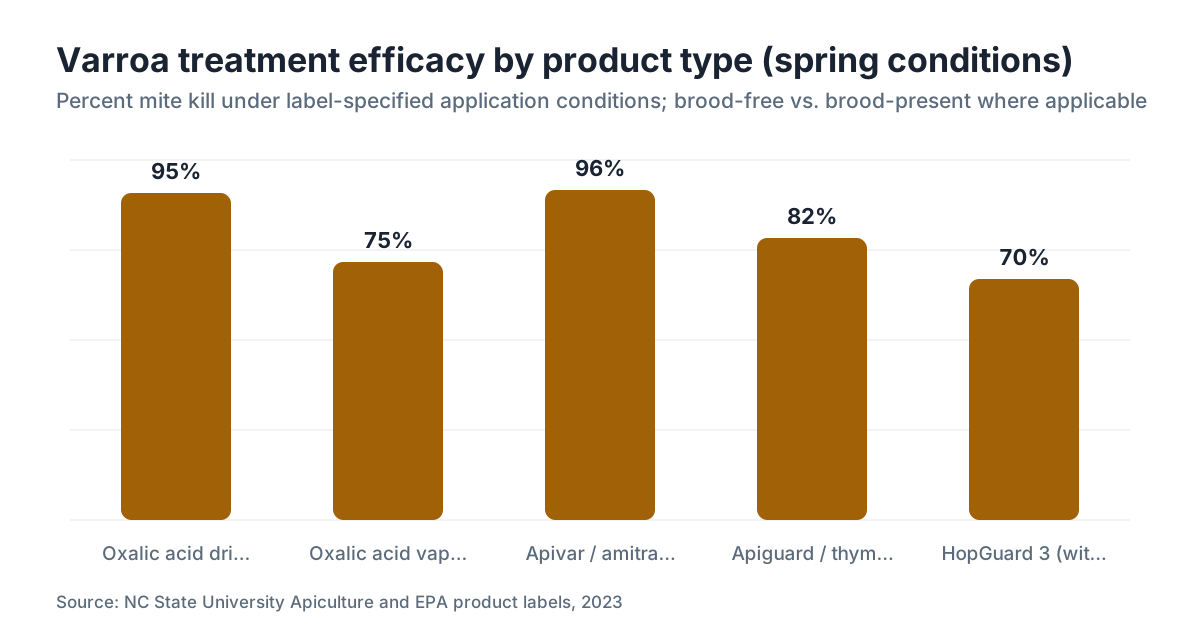
| Treatment | Brood tolerant? | Temp range | Efficacy (%) | Duration |
|---|---|---|---|---|
| Oxalic acid dribble | No (brood-free only) | 40-60°F | 90-99% brood-free | One application |
| Oxalic acid vaporization | Partial (reduced brood) | Above 32°F | 60-90% with brood | 3 treatments, 5 days apart |
| Api-Life VAR (thymol) | Yes | 60-105°F | 85-95% | 2-3 strips, 6-8 weeks |
| Apivar (amitraz) | Yes | 50-105°F | 93-99% | 6-8 weeks, 2 strips |
| Apiguard (thymol gel) | Yes | 60-105°F | 74-90% | 4-6 weeks |
| HopGuard 3 (hop beta acids) | Yes | No restriction | 60-80% | 3 treatments, 7 days apart |
Efficacy figures come from label studies and peer-reviewed evaluations [5][6][8].
In early spring, with a small cluster and cold nights, oxalic acid dribble is the most accessible option if the colony is brood-free or close to it. One dribble at the right moment, applied at roughly 5 mL per seam of bees (50 mL total per colony maximum), kills mites on adult bees with no honey super waiting period in winter or early spring [5].
Once daytime temperatures hold at 60°F and the brood nest is expanding, Apivar strips or a thymol product become practical. Apivar is the most effective option with brood present, but you have to pull the strips before honey supers go on, and you should never run it more than once a year in the same hive. Amitraz resistance is real and spreading in some populations [6].
Stocking up for the season? See our beekeeping supplies overview and our comparison of beekeeping supply companies.
Can you treat in early spring if there's still brood?
Yes, but your choices shrink. Oxalic acid dribble applied with brood present drops from 90%-plus efficacy to roughly 50 to 60% because it only kills mites riding on adult bees, not the ones sealed inside capped cells [5]. Still better than nothing if you're over threshold and it's too cold for a thymol product.
Oxalic acid vaporization done several times (three treatments five days apart is a common protocol) reaches more mites during the brood cycle by hitting newly emerged bees before mites can re-enter cells [5]. The EPA registered oxalic acid for use with brood present via vaporization in 2015, with re-treatment allowed up to three times per treatment event [5]. Use a vaporizer rated for the job and wear proper respiratory protection. OA vapor irritates the lungs.
Apivar with brood is easy. Slide two strips between frames of bees, leave them 6 to 8 weeks. Amitraz resistance is documented in some U.S. populations [6], so if your counts aren't dropping after four weeks, plan a different mode of action for the next cycle.
VarroaVault's free protocol tools map which treatment fits your brood status and temperatures across the season, so you don't have to hold it all in your head.
What happens if you treat too late in spring?
You lose the compounding advantage.
Mites double roughly every 4 to 6 weeks during build-up. A colony that should have been treated in late March but waits until late May enters summer with four to eight times the mites it would have carried otherwise. That's not a gap you claw back easily. Bees raised during those 6 to 8 weeks of high mite load live shorter lives, run weaker immune systems, and are more likely to carry deformed wing virus [2]. Deformed wing virus (DWV), spread by varroa feeding, is the main driver of colony collapse tied to mite infestation.
A 2012 study in PLOS ONE found that colonies with high varroa infestation through spring and summer died over winter at a much higher rate than managed colonies, with the August mite load the single strongest predictor of winter mortality [7]. That August load is built in spring. The clock starts now.
Treating late also collides with honey supers. Most varroa treatments carry a super-off period or a harvest restriction. Scramble to treat in May as your first super goes on and you either skip treatment (bad) or pull the super (annoying and sometimes costly). Treat in early spring and that conflict never happens.
How do you monitor varroa counts in early spring?
The alcohol wash is the gold standard. Sugar rolls are easier to run but consistently undercount mites by 20 to 30% [3][8], which matters at low counts when you're on the fence about treating.
Here's the wash in early spring. Pull a frame from the center of the brood nest where bees cluster. Brush or shake bees into a container. Scoop about 300 bees (half a cup) into your wash jar. Seal, shake 60 seconds, drain through the mesh lid, count the mites on the lid, divide by 3 for percent infestation [3].
Very early spring makes this tricky, because the cluster stays tight. Work on a warm day above 50°F so the bees loosen up enough for a representative sample. Pull from bee-covered brood frames, not the outside frames where mite density runs lower.
Sticky boards (counting natural mite fall) get used in winter when you can't open the hive. A drop above 1 to 2 mites per day in late winter is a rough signal the colony is heading into spring carrying a real load, and it earns an early wash once weather allows. The Honey Bee Health Coalition treats sticky board counts as a relative indicator only, not a way to calculate percent infestation [3].
Write your counts down. A count without a date is nearly useless for reading the trend that matters.
Does spring treatment affect your honey crop?
It depends on which product you use and when. Plan by the month and the two rarely collide.
Oxalic acid applied in early spring, before supers go on, leaves no residue concern for the honey. The EPA label for oxalic acid products (such as Api-Bioxal) prohibits application when honey supers are present [5]. Apply in March or early April, put supers on in May. Clean.
Apivar (amitraz strips) has to come out at least 2 weeks before honey supers go on, per the label [6]. Insert strips in late February, pull them by late April, and you're clear for a May super. That math works in most climates. Don't leave strips in past 8 weeks no matter what. Long exposure raises resistance pressure.
Thymol products (Apiguard, Api-Life VAR) need temperatures above 60°F to volatilize right, which often means April or May in cooler climates. They can't be used with honey supers on. They're natural compounds and leave no synthetic residue, but the temperature constraint is real.
HopGuard 3 is the only currently registered product with no temperature restriction and no ban on use with honey supers present, which makes it handy in some spring scenarios, though its efficacy trails the others [6].
Treat early enough that you finish before any realistic super date for your region. Spring treatment and a spring honey crop coexist fine when you plan a month ahead instead of a week.
Should you treat before or after the first spring inspection?
After. Always after. Get a mite count before you open a bag of anything.
A colony that wintered under 1% doesn't automatically need a spring treatment. Every treatment has a cost: stress on the colony, time with the hive open in cool weather, and with some products, a risk of queen loss or brood damage if you apply it wrong or at the wrong temperature.
Run your first inspection and alcohol wash as early as weather allows. Under 2%, monitor again in three or four weeks. Between 2 and 3%, treat now. Above 3%, treat now and rethink whether your winter strategy needs adjusting.
University of Minnesota Extension recommends at least four monitoring events per active season: early spring, late spring, midsummer, and late summer or early fall [4]. Basing your spring decision on an actual count instead of a date is the single biggest habit that separates beekeepers who keep their colonies alive from the ones who lose colonies they never saw coming.
What about treatment resistance and rotation?
Varroa resistance to synthetic miticides is not theoretical. Resistance to fluvalinate (Apistan, used everywhere in the 1990s) is now essentially universal in the U.S. Resistance to coumaphos (CheckMite+) is widespread. Amitraz (Apivar) resistance is documented in multiple U.S. states and several European countries [6].
Rotate chemical class each treatment cycle. That's the standard advice. Used Apivar in fall? Reach for oxalic acid or a thymol product in spring, or the reverse. Used oxalic acid over winter while brood-free? Apivar in spring with brood is a reasonable rotation.
Organic acids (oxalic acid, formic acid) and essential-oil treatments (thymol) don't build resistance the way synthetics do, because they hit multiple physiological systems instead of a single receptor. That's why oxalic acid still works decades after it appeared. Even so, the application method, temperature, and repeat schedule have to follow the label for full efficacy [5].
Keeping bees where africanized honey bees are present? The management dynamics shift a bit. See our overview of the africanized honey bee for context.
What's the spring varroa treatment plan for a new beekeeper?
Keep it simple. You don't need to master every product your first year.
Buy an alcohol wash kit (a mason jar and a mesh lid do the job) and learn the wash before anything else. Set a reminder to inspect every four weeks from late February through September. When the count hits 2%, treat.
A new package or nuc will show low mite levels at first, because the population is small and the queen hasn't built much brood yet. Don't skip that first wash at four weeks. Packages from some commercial suppliers arrive with detectable mite loads, and that small colony is about to take off. Catching 2% on 5,000 bees beats chasing 4% on 40,000 bees two months later.
A practical first-year spring protocol:
- Alcohol wash within 30 days of setting up the hive.
- Over 2%? Apply oxalic acid dribble (brood-free) or Apivar if brood is present.
- Re-wash 4 weeks after treatment to confirm it worked.
- Keep monitoring monthly through the season.
The Honey Bee Health Coalition publishes a free Varroa Management Guide with downloadable decision trees and treatment calendars that genuinely help beginners [3]. Print it. Keep it with your hive tool.
Frequently asked questions
What is the best time of year to treat varroa in spring?
The best window is after the queen resumes laying but before the first major brood cycle finishes capping, typically late February through mid-April in the northern U.S. depending on latitude. Use your mite count, not the calendar: treat any time your alcohol wash reads 2% or higher during spring build-up. Waiting for a date without monitoring is how colonies spiral past easy recovery.
How do I know if my colony needs a spring varroa treatment?
Do an alcohol wash. Take about 300 bees (half a cup) from brood nest frames, wash with alcohol for 60 seconds, count mites on the mesh lid, and divide by 3 for percent infestation. At 2% or higher, treat. Under 2%, re-test in three or four weeks and watch the trend. A sticky board drop above 1 to 2 mites per day in late winter is a warning sign to test early.
Can I use oxalic acid in spring if there's brood in the hive?
Yes, with caveats. Oxalic acid dribble only kills mites on adult bees, so it misses the ones inside capped cells; efficacy drops to around 50 to 60% with brood present. Vaporized oxalic acid applied in three treatments five days apart works partially with brood because it catches mites on newly emerged bees between applications. The EPA allows brood-present vaporization. Neither method matches a single dribble during a brood-free period.
Will spring varroa treatment hurt my honey crop?
It doesn't have to. Oxalic acid applied in early spring before supers go on leaves no harvest concern. Apivar strips must come out at least 2 weeks before supers go on, but strips inserted in late February and pulled by late April clear the timeline in most climates. Thymol products can't be used with supers on. Finish treatment before your first super date and there's no conflict.
How fast do varroa mite populations grow in spring?
Mite populations can roughly double every 4 to 6 weeks during active brood rearing in spring and summer, depending on colony size and brood volume. A colony carrying 500 mites in early April can reach 2,000 or more by late May under favorable conditions. This exponential growth is why a small delay costs so much downstream. Bees produced during a high-mite spring carry the damage into summer and fall.
What varroa treatment is safe to use in spring when temperatures are still low?
Oxalic acid dribble works down to 40°F and is the best choice in cold early spring if the colony is brood-free or nearly so. Vaporized oxalic acid can be applied above 32°F. Thymol products (Apiguard, Api-Life VAR) need daytime temperatures above 60°F to volatilize correctly. Apivar works from 50°F up. In late February or early March, oxalic acid is almost always the practical answer.
Should I treat a new package or nuc for varroa in spring?
Yes, but check first. Do an alcohol wash three or four weeks after installation. Packages from commercial suppliers can arrive with mites, and that small colony grows fast. Over 2%? Treat immediately. New packages that start with even a moderate mite load and go untreated can crash by late summer, which confuses new beekeepers because the colony looked like it was thriving right up until it wasn't.
How many times should I monitor for varroa in spring?
At minimum, monitor at your first spring inspection (late winter or early spring), again four weeks later, and again four weeks after that. University of Minnesota Extension recommends at least four monitoring events across the active season, with the first two in spring. If you treat, always wash four weeks afterward to confirm it worked. Efficacy below 90% after treatment can signal resistance and the need to switch products.
What's the difference between sugar roll and alcohol wash for spring monitoring?
Alcohol wash is more accurate. Sugar rolls consistently undercount mites by 20 to 30% compared to alcohol wash, according to the Honey Bee Health Coalition. At the 2% action threshold, a 20 to 30% undercount can leave you sitting on your hands when you should be treating. Sugar rolls are gentler on bees (no kill), but the inaccuracy is a real trade-off. For spring decisions, use the alcohol wash.
Does varroa treatment in spring prevent summer colony collapse?
It cuts the risk sharply. Research in PLOS ONE found that mite levels in August are the strongest single predictor of winter colony mortality, and August loads are built by exponential spring growth. Knocking populations down in early spring interrupts that compounding. It doesn't guarantee survival; other stressors exist. But well-timed spring treatment plus continued monitoring is the clearest intervention with the strongest evidence behind it.
How do I rotate varroa treatments to avoid resistance?
Alternate chemical class each treatment cycle. Used amitraz (Apivar) in fall? Use oxalic acid or a thymol product in spring. Treated with oxalic acid over winter? Apivar in spring with brood is reasonable. Resistance to fluvalinate (Apistan) and coumaphos (CheckMite+) is already widespread in U.S. populations. Amitraz resistance is documented and growing. Organic acids and thymol don't build resistance the same way and can be used more freely in a rotation.
Is there a spring varroa treatment protocol I can follow as a guide?
Yes. The Honey Bee Health Coalition publishes a free downloadable Varroa Management Guide with seasonal treatment calendars and decision trees. Extension programs from Minnesota, Penn State, and others publish regional guides too. A basic spring protocol: inspect and wash in late winter, treat if over 2%, re-wash four weeks after treatment, monitor every four weeks through the season. Matching treatment to temperature range and brood status is the personalization step that matters.
What happens to my bees if I skip spring varroa treatment?
Mite populations grow exponentially through the spring brood cycle. Bees raised under high mite loads live shorter lives and carry deformed wing virus at higher rates. The colony may look strong in June while quietly carrying compromised bees. The crash often lands in August or September and looks sudden. Beekeepers who skip spring treatment and then blame fall conditions are usually looking at a problem that was locked in by May.
Sources
- USDA Agricultural Research Service, Varroa destructor lifecycle overview: Varroa mites enter brood cells just before capping and reproduce during the capped pupal stage, with daughters emerging already mated.
- PLOS ONE, Nazzi et al. (2012), Synergistic Parasite-Pathogen Interactions Mediated by Host Immunity Can Drive the Collapse of Honeybee Colonies: Varroa infestation suppresses immune function and is the primary vector for deformed wing virus, shortening bee lifespan and colony cohort quality.
- Honey Bee Health Coalition, Varroa Management Guide (2023): The Honey Bee Health Coalition recommends treating when mite levels reach 2 percent or higher during spring build-up, using alcohol wash as the preferred monitoring method.
- University of Minnesota Extension, Varroa Mite Management: Minnesota Extension recommends at least four monitoring events per active season, with 1% as a conservative spring action threshold for smaller colonies.
- EPA, Api-Bioxal Oxalic Acid Product Label (Reg. No. 69070-1): The EPA-registered oxalic acid label specifies application rates of approximately 5 mL per seam of bees, a 50 mL maximum per colony, and prohibits use when honey supers are present; vaporization with brood is allowed in up to three treatments per event.
- EPA, Apivar (Amitraz) Product Label and Resistance Documentation: Apivar strips must be removed at least 2 weeks before super installation; amitraz resistance has been documented in multiple U.S. states and European countries; fluvalinate and coumaphos resistance is considered widespread.
- PLOS ONE, van Dooremalen et al. (2012), Winter Survival of Individual Honey Bees and Honey Bee Colonies Depends on Level of Varroa destructor Infestation: Mite infestation level in August was the strongest single predictor of overwintering colony mortality in a multi-year European study.
- Penn State Extension, Varroa Mite Monitoring and Treatment: Penn State Extension confirms alcohol wash accuracy advantage over sugar roll, which can undercount mites by 20-30%; recommends alcohol wash for spring treatment decisions.
- North Carolina State University Apiculture, Varroa Mite Treatment Efficacy Summary: Efficacy figures for registered varroa treatments in the presence and absence of brood, including oxalic acid (90-99% brood-free), Apivar (93-99%), and thymol products (74-95%).
Last updated 2026-07-09