Varroa mite lifecycle and why it matters for treatment timing
TL;DR
- Varroa destructor lives in two phases: a short phoretic phase riding adult bees where treatments can reach it, and a longer reproductive phase locked inside capped brood where most treatments can't.
- Roughly 70% of mites in a brooding colony sit inside capped cells at any moment.
- That single fact makes broodless or low-brood timing the biggest lever you have.
What is the varroa mite lifecycle, start to finish?
Varroa destructor is an external parasite that reproduces only inside honey bee brood cells. The lifecycle splits into two phases, and every treatment decision you'll ever make traces back to understanding both.
The phoretic phase is the exposed one. A mated female mite (called a foundress) rides on an adult bee and feeds on the bee's fat body tissue. She's visible, mobile, and reachable. This phase runs anywhere from a few days to several weeks depending on the season and how much brood the colony has. In summer, with brood everywhere, a mite usually spends only 4 to 11 days phoretic before slipping into a cell [1]. In late fall and winter, when a colony carries no brood, those same mites can ride the bees for months.
The reproductive phase starts when the foundress enters a brood cell in the roughly 20-hour window before nurse bees cap it. She hides under the larval food at the bottom of the cell. Once the cell is sealed she begins feeding on the pupa and lays her first egg about 60 to 70 hours after capping [1]. That first egg is always a male. Every egg after it (laid roughly every 30 hours) is female. The male mates with his sisters inside the sealed cell, and they all emerge together with the young bee.
A worker cell stays capped for about 12 days. In that window a founding mite typically produces one to two daughters that survive to leave the cell [1]. Drone cells stay capped longer, around 14 to 15 days, which buys more reproduction time and yields roughly 2 to 3 daughters per mother mite. That extra runway is why mites pick drone brood at a rate about 8 times higher than worker brood [2].
The male dies in the cell. The mated daughters ride out on the emerging bee, go phoretic, and the loop restarts. Generation time in summer runs about 25 to 28 days from egg to reproductive adult. Fast enough for a mite population to double in three to five weeks when conditions favor it [1].
What percentage of varroa mites are in capped brood vs. on adult bees?
In an actively brooding summer colony, roughly 70 to 80% of all mites sit inside capped brood cells at any moment, out of reach of contact treatments and mostly shielded even from fumigant-style treatments like oxalic acid vapor [3]. This one number should steer your whole strategy.
The other 20 to 30% are phoretic, riding the adult bees. Those are the mites that oxalic acid dribble, oxalic acid vapor, amitraz strips, and formic acid pads actually reach.
Run the math and it gets stark. Say your colony carries 3,000 mites (a moderate to heavy load). A single oxalic acid treatment with a strong 90% kill of phoretic mites wipes out 90% of the 900 phoretic mites (about 810), but touches almost none of the 2,100 mites in brood. Three weeks later those 2,100 survivors have emerged, reproduced, and refilled the colony. Lots of effort, little lasting effect.
That's why experienced beekeepers treat a broodless colony as a completely different game from an in-season one. In-season treatments aren't useless. The brood-to-phoretic ratio just means you're always fighting with one hand behind your back while brood is present [4].
The comparison table below shows how mite distribution shifts with brood status.
How fast does a varroa population grow, and why does timing matter so much?
Mite populations grow exponentially, not in a straight line. That difference decides how much your timing matters.
A single mated female entering a colony in spring can, under good conditions, spin up thousands of mites by late summer. The Honey Bee Health Coalition's Varroa Management Guide puts the reproductive rate at roughly 25 to 30 new mites per foundress per season when nothing checks them [4]. The University of Minnesota Bee Lab has modeled this growth and found that colonies starting spring with even low mite loads (1 to 2% infestation) can hit damaging thresholds (3% or higher) by midsummer with no intervention [5].
Most beekeepers miss the same window: late summer, after the main honey flow ends and before the queen slows her laying for winter. In temperate North America that's usually July through August. A high mite load right then hammers the winter bees being raised. Winter bees live 4 to 6 months. Parasitize them heavily as pupae and their fat bodies are compromised, their immune function drops, and the colony's odds of surviving winter fall off a cliff [4].
Treat too late, say October or November, and that cohort of winter bees is already lost. You can still kill the mites, but the damage is done. Treat in August and you protect the exact bees that carry the colony through the cold.
Here's the lesson the lifecycle hands you: summer mite control is winter survival prep, not a summer problem.
Which varroa treatments work during brood, and which require a broodless period?
Treatments split into two camps based on whether they can reach mites inside capped brood.
Treatments that need a broodless (or near-broodless) period:
Oxalic acid dribble (Api-Bioxal) kills phoretic mites hard, often 90% or better, but does almost nothing to mites in capped brood. The EPA-approved label allows one dribble application per year, and the recommended timing is when brood is absent, usually midwinter [6]. Dribble a colony full of brood and you'll see a dramatic mite drop while the brood-phase mites survive and refill the colony within weeks.
Treatments that work with brood present (with lower efficacy than broodless conditions):
Oxalic acid vapor (also Api-Bioxal, vaporized with an approved wand) spreads through the hive atmosphere and reaches some mites in brood, but efficacy on capped brood is low and argued over. The real payoff from repeated vaporization is catching newly phoretic mites as they emerge across several treatments (typically every 5 days for 3 to 5 rounds). That cycling mimics a broodless treatment by covering a full brood period [6].
Formic acid (Mite Away Quick Strips or Formic Pro) does penetrate capped brood to a degree. Studies report 60 to 90% efficacy in brood, though results swing hard with temperature, colony size, and strip placement [7]. Formic has a usable temperature range (roughly 50 to 85 degrees F for MAQS; 50 to 79 degrees F for Formic Pro) that pins its use to spring and fall in many climates.
Amitraz strips (Apivar) work by sustained contact with adult bees across a 6 to 10 week treatment. Mites emerge from brood and pick up the strips over that window. Efficacy runs high (often 93 to 99% in label studies), but it's slow, and the strips have to stay in long enough for the brood to cycle all the way through [8].
Thymol products (ApiLife VAR, Apiguard) are vapor-phase treatments with efficacy anywhere from 40 to 90% depending on temperature. They need temperatures above 59 to 65 degrees F to volatilize well, which boxes them into spring and fall [4].
If you have one shot and want maximum kill, a broodless period plus oxalic acid dribble or vapor is the most efficient combination you can get. For in-season control, Apivar or repeated formic acid are your realistic picks.
What is the phoretic phase and how long does it last?
The phoretic phase is the mite's downtime between reproductive cycles, spent riding adult bees. She feeds by piercing the bee's cuticle and eating fat body tissue (long described as hemolymph feeding, until Samuel Ramsey's lab pinned the fat body as the real feeding site) [9]. Its length depends almost entirely on how much brood is available.
When brood is thick in summer, foundresses cycle back into cells fast and phoretic time stays short, often under two weeks. When brood is scarce or gone, as in winter or right after a split, mites stay phoretic for weeks or months. That extended stretch is the opening you exploit when you treat a broodless colony.
Freshly emerged mites can't reproduce yet. They need a short maturation of a few days on adult bees before they'll invade a cell and breed successfully. That's a small but real weak point, and rapid sequential oxalic acid vapor treatments target it by hitting newly phoretic mites before they can reinvade brood.
The mites you count in a natural drop on a sticky board or in an alcohol wash are all phoretic. Keep that front of mind for monitoring: your count reflects only the 20 to 30% of mites currently on bees. A 2% wash result (2 mites per 100 bees) likely maps to a total infestation several times larger in raw numbers [3].
How does drone brood affect varroa mite reproduction?
Drone brood is a varroa mite's favorite nursery, and it's not close. The longer capping period (14 to 15 days versus 12 for workers) and the bigger cell allow more reproductive cycles, producing 2 to 3 viable daughters per foundress instead of the 1 to 2 typical in worker cells [2].
Mites hunt out drone cells behaviorally too, entering them at rates 8 to 10 times higher than worker cells when both are on offer [2]. The chemical cues that pull foundress mites toward pre-capped cells are only partly understood, and they seem to differ between drone and worker larvae.
That preference opens a tactic: drone brood trapping. You add a frame of drone foundation (or a brood frame with open space at the bottom that bees draw into drone comb), let the mites pack into it, then pull and freeze the capped drone comb before it emerges. You remove a lopsided share of mites for the amount of brood you sacrifice. It's free, it uses no chemicals, and it works, with one catch: it eats labor and demands precise timing. Miss the window and let the drone brood emerge, and you've just dumped a batch of newly mated mites back into the colony. On its own, drone trapping usually cuts mite loads 30 to 50%, not enough to hold a colony below threshold [4].
For low-chemical management it earns a spot in a wider program. It doesn't replace organic acid or chemical treatments.
When should you actually treat, based on the lifecycle?
The Honey Bee Health Coalition's Varroa Management Guide, the closest thing to a consensus document in North American beekeeping, names three main treatment windows, and lifecycle logic drives all three [4].
Early spring, before the population explosion. Treat while the colony is still small and the mite-to-bee ratio runs high. Test first regardless. If you're at or above the 2% threshold (2 mites per 100 bees by alcohol wash), treat. Some beekeepers treat preventively in early spring before populations build. That's defensible, but you may be treating colonies that didn't need it.
Late summer, the window that matters most. This is the treatment that saves your winter bees. Aim to treat 6 to 8 weeks before your last real nectar flow ends, roughly by early to mid-August across most of the northern US. You want winter bees raised after the mite load crashes, not during the peak. Apivar (6 to 8 weeks) or Formic Pro (two 10-day treatments) fit this window well.
Winter broodless period. A single oxalic acid dribble when the colony is broodless (usually late December through January in temperate climates) kills phoretic mites with high efficiency and low toxicity to the bees. It won't rescue a colony that went into winter loaded with mites, but it trims the mite load carried into spring and gives an overwintered colony a cleaner start. In warm climates where colonies never fully stop brooding, you'll need vaporization with multiple treatments instead.
The Honey Bee Health Coalition sets the monitoring threshold at 2% or higher during the active season (spring through summer), and 1% or higher before winter prep begins [4]. These aren't guesses. They come from colony-level data across multiple years of field research.
If you want a structured way to map these windows to your climate and colony status, the free tools at VarroaVault build a season-specific treatment calendar from your region and hive data.
How do you monitor mite levels to know when the lifecycle has put you at risk?
Monitoring isn't optional. The lifecycle math means a colony can go from below threshold to threatened in four to six weeks during peak season, and you can't read that from outside the hive.
The alcohol wash (sometimes called the ether roll, though alcohol is the standard now) is the most accurate practical method. Collect about 300 adult bees (roughly half a cup) from the brood nest, drop them in 70% isopropyl alcohol, shake 30 to 60 seconds, and count the mites that fall out. Divide mites by bees and multiply by 100 for your percentage. The Honey Bee Health Coalition recommends this over sticky boards for accuracy [4].
Sticky boards (a screened bottom board with a greased insert below) count mite fall over 24 to 72 hours. Less precise than an alcohol wash, but useful for trending and for beekeepers who'd rather not sacrifice bees. Rough rule of thumb: a 24-hour natural drop of 8 to 10 or more mites points to a threshold-level infestation, but that shifts with colony size and season [4].
Powdered sugar rolls have fallen out of favor with most extension apiculturists and the Honey Bee Health Coalition. The research keeps showing they undercount, often missing 50% or more of the mites present.
Frequency counts as much as method. The Honey Bee Health Coalition recommends testing every 30 days through the active season. At a bare minimum: test before any treatment (to confirm you're at threshold), three to five weeks after (to confirm it worked), and again in late summer before winter prep.
Does the varroa lifecycle differ in Africanized honey bee colonies?
More beekeepers in the southern US should be asking this. Africanized honey bees (AHB), the hybrid population descended from African subspecies brought to Brazil in 1957, show measurably lower varroa reproductive success than European honey bees. African-derived bees carry stronger hygienic behavior, including the knack for detecting and pulling varroa-infested pupae from cells, which breaks the mite's reproductive cycle.
Studies across Latin America found varroa populations in AHB colonies stay suppressed in many regions with no treatment at all, while European colonies in the same areas need active management [4]. The mechanism looks like a mix of faster brood development, higher recapping rates (which physically throws off the mite's reproductive timing), and sharper hygienic detection.
None of this means AHB colonies are mite-free or that keepers can skip monitoring. Mites are still there and still reproduce. The reproductive success rate is simply lower, and colony populations hold below damaging thresholds more reliably. Breeding programs chasing Varroa Sensitive Hygiene (VSH) and hygienic behavior in European bees are trying to capture the same resistance without the defensive temperament that makes AHB dangerous to manage.
What happens to bees that are parasitized during the pupal stage?
A bee raised in a cell with one or more reproductive mites emerges damaged. The mite feeds on the pupa's fat body, the organ that handles energy storage and immune function. Parasitized bees come out with less fat body mass, lower protein stores, shorter lives, reduced learning ability, weaker immune function, and sometimes physical deformities like a shortened abdomen or malformed wings [9].
Deformed wing virus (DWV) makes it worse. Varroa mites are the main vector for DWV, one of the most damaging bee viruses known. Feeding on a pupa, the mite injects virus straight into the bee's tissues. Colonies with high mite loads almost always run high DWV titers, and it's frequently the virus, spread at scale by the mites, that kills the colony rather than the feeding itself [4].
That's the whole case for the late-summer treatment window. The bees raised in August and September are the ones that have to survive until April or May. If they emerge from virus-loaded, mite-fed cells, the winter cluster is already broken before the first frost. You might open the hive in November and see a solid ball of bees, but you can't see the shortened lifespans and immune gaps baked into that cohort.
How does a broodless period change treatment efficacy, and how do you create one artificially?
A broodless period, natural (midwinter, swarm season) or artificial, flips the phoretic-to-brood ratio from roughly 25:75 to nearly 100:0. Now an oxalic acid treatment that kills 95% of phoretic mites kills 95% of every mite in the colony, not 95% of a quarter of them. The math changes completely.
Natural broodless periods hit most temperate climates in midwinter, usually late December through January, when the queen stops laying in response to short days and cold. Some colonies in the southern US or through mild winters never fully quit brooding, which complicates winter treatment. Beekeepers in Florida, Texas, and California deal with this every year.
You can also engineer a broodless period. Caging the queen for 24 to 25 days (one full brood cycle) lets all existing brood emerge while no new brood gets capped. By day 24 or 25 the colony is fully broodless. Release the queen, wait 24 hours for her to start laying, then treat with oxalic acid before the new brood is capped. It's real work, but in a high-mite summer where you can't wait for winter, it's a legitimate tool.
Splitting the colony makes a temporary broodless condition in the queenless half while the bees raise emergency queen cells. That queenless split is a good candidate for an oxalic acid treatment while the new queen mates and starts laying.
Shaker swarms and walk-away splits are simpler versions of the same idea. None are quick fixes. But they all point at one principle: understand the lifecycle and you can bend colony conditions to make your treatments far more effective.
What are realistic treatment efficacy numbers, and where do they come from?
Be careful with the efficacy numbers you repeat. Label figures come from controlled trials built to show the product at its best. Real-world results wander.
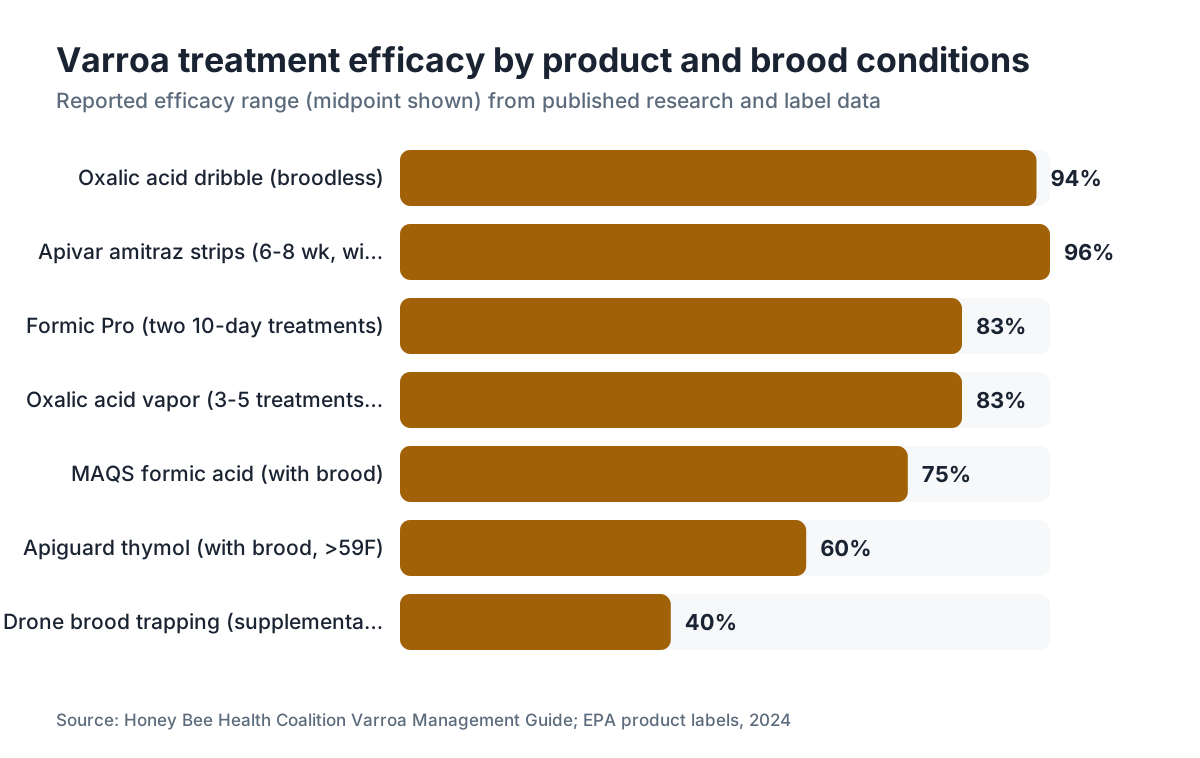
Here's a summary of representative efficacy ranges from published research and label data:
| Treatment | Conditions | Reported efficacy range | Source |
|---|---|---|---|
| Oxalic acid dribble (Api-Bioxal) | Broodless colony | 90-97% | EPA label; Honey Bee Health Coalition [4][6] |
| Oxalic acid vapor (repeated, 3-5 treatments) | With brood | 75-90% | Published field trials; varies by protocol [4] |
| Apivar (amitraz strips, 6-8 weeks) | With brood | 93-99% | EPA/label registration data [8] |
| Formic Pro (two 10-day treatments) | With brood | 76-90% | Registered efficacy studies [7] |
| MAQS (formic acid) | With brood | 60-90% | Varies with temperature and placement [4] |
| Apiguard (thymol) | With brood, >59F | 40-80% | Multiple field trials, highly variable [4] |
| Drone brood trapping | Supplemental | 30-50% reduction | Research synthesis [4] |
The spread inside each product is real. Temperature, colony size, applicator technique, and mite resistance all move the outcome. The COLOSS BeeBook research network and the Honey Bee Health Coalition guide are the most reliable aggregated sources for North American beekeepers [4].
A word on resistance. Amitraz resistance in varroa has been documented in multiple US states and European countries. The mechanism is a point mutation in the mite's octopamine receptor gene. If your Apivar results are poor despite correct application and timing, resistance is worth suspecting, though it isn't universal yet [4]. Rotating modes of action between treatment seasons is sound practice.
Frequently asked questions
How long does varroa take to complete one reproductive cycle?
A foundress mite enters a cell just before capping, lays her first egg about 60 to 70 hours after capping, and finishes her cycle when the adult bee emerges 12 days later (worker) or 14 to 15 days later (drone). Total time from one phoretic mite to new phoretic daughters runs about 25 to 28 days in summer. That fast turnover is why untreated mite populations can double in three to five weeks.
Why do mites prefer drone brood over worker brood?
Drone cells stay capped 14 to 15 days instead of 12, giving mites more time for multiple reproductive cycles. A foundress in a drone cell typically produces 2 to 3 viable daughters versus 1 to 2 in a worker cell. Mites also seem to read chemical cues from drone larvae that make those cells more attractive. The result is a preference rate roughly 8 to 10 times higher for drone cells when both are available.
Can varroa mites survive without bees?
No. Varroa destructor is an obligate parasite and can't reproduce or survive apart from honey bee colonies. Off a host bee, a mite lasts only a few hours to a couple of days at most, depending on temperature and humidity. That dependency means mites spread almost entirely through bee-to-bee contact: drifting bees, robbing, beekeeper equipment transfers, and swarms moving into new cavities.
What is the varroa mite treatment threshold?
The Honey Bee Health Coalition recommends treating when an alcohol wash shows 2% or more infestation (2 mites per 100 bees) during the active season from spring through midsummer. The threshold tightens to 1% or higher before fall winter prep begins, because even moderate mite loads at that point damage the long-lived winter bees your colony depends on to survive.
Does oxalic acid kill varroa mites in capped brood?
As a dribble, oxalic acid has essentially no effect on mites in capped brood. As vapor (using an approved vaporizer) it reaches some mites in brood, but efficacy is low and inconsistent. The standard way to use oxalic acid with brood present is repeated vaporization every 5 days for 3 to 5 treatments, timed to catch newly phoretic mites as successive rounds of brood emerge.
How do I know if my colony is broodless enough to treat with oxalic acid dribble?
Open the hive and inspect frames in the brood nest. You want no capped brood at all, just empty cells, eggs, or open larvae at most. Even a small patch of capped brood shields part of your mite population. If you see any capped brood and still want to treat, switch to vapor with multiple treatments or wait until the broodless period is complete. In winter, inspect on a mild day above 50 degrees F.
What happens if you treat for varroa too late in the fall?
The bees raised in late summer and early fall are your winter bees. They live 4 to 6 months and need to emerge in good shape. If varroa infestation is high while they're pupae, they come out with damaged fat bodies, weak immune systems, and high viral loads from mite-transmitted deformed wing virus. Treating in October or November kills mites, but the winter cohort is already compromised. The colony may not survive, or may limp into spring too weak to build.
How does varroa spread between colonies?
Mite spread runs on bee movement. Forager drift and robbing are the two biggest routes. A bee from a high-mite colony drifts into a low-mite one and brings its phoretic mites along. During robbing, common when a weak colony collapses, thousands of mites can move fast to neighboring hives. Swarms carry their founding population's mite load. Beekeepers spread mites too, by moving frames of brood between hives without monitoring first.
Can brood breaks alone control varroa without chemicals?
Brood breaks, natural (winter) or artificial (queen caging, splitting), cut mite populations and make oxalic acid treatment far more effective. But a brood break alone, with no treatment applied during it, won't eliminate mites. Phoretic mites on the adult bees survive the broodless stretch and start reproducing again the moment brood returns. The brood break is the setup. The treatment is the action that actually drops the count.
What monitoring method is most accurate for detecting varroa?
The alcohol wash is the most accurate practical field method and is recommended by the Honey Bee Health Coalition and most university extension programs. Collect about 300 bees (half a cup) from the brood nest, wash in 70% isopropyl alcohol, count mites. Sticky board counts help for trending but run less precise. Powdered sugar rolls consistently undercount and are no longer recommended by most apiculture researchers.
How does varroa affect bee immunity, specifically?
Varroa mites feed mainly on the fat body of developing pupae, the organ behind protein storage, immune function, and vitellogenin production. Samuel Ramsey's group identified fat body tissue rather than hemolymph as the primary feeding site. Bees from parasitized cells emerge with measurably lower fat body mass, reduced immune gene expression, and weaker ability to fight infection. That leaves them more open to bacteria, fungi, and viruses including deformed wing virus, which the mites also vector directly.
Are there varroa-resistant bee stocks I can buy?
Yes, though availability and consistency vary. Varroa Sensitive Hygiene (VSH) bees, developed through USDA-ARS research, show much lower mite reproduction because the bees detect and remove infested brood. Mite-biter (recapping) traits have also been bred for. Minnesota Hygienic and several commercial VSH-derived lines are on the market. Resistant stock helps but rarely erases the need for monitoring and occasional treatment, especially where mite pressure from neighboring colonies runs high.
How many varroa mites will kill a colony?
There's no single mite number that does it. What matters is the infestation rate relative to bee population, the time of year, and the virus load. A 3% infestation rate (3 mites per 100 bees) in midsummer is damaging. The same rate in August, during winter bee production, can be fatal to overwintering. Colonies have collapsed with as few as 2,000 to 3,000 total mites in a small late-season cluster, while a strong summer colony of 50,000 bees might tolerate similar absolute numbers for a while.
Sources
- Martin, S.J. (1994). Ontogenesis of the mite Varroa jacobsoni Oud. in worker brood of the honeybee Apis mellifera L. under natural conditions. Experimental and Applied Acarology: Varroa foundress lays first egg 60-70 hours after capping; male is first; worker cells capped 12 days; drone cells 14-15 days; 1-2 viable daughters per worker cell
- Fuchs, S. (1990). Preference for drone brood cells by Varroa jacobsoni Oud. in colonies of Apis mellifera carnica. Apidologie: Varroa mites enter drone cells at a rate 8-10 times higher than worker cells; 2-3 daughters per foundress in drone brood
- Caron, D.M. and Connor, L.J. (2013). Honey Bee Biology and Beekeeping. Wicwas Press: Approximately 70-80% of mites in an actively brooding colony are in capped brood at any given time
- Honey Bee Health Coalition, Varroa Management Guide (current edition): 2% threshold for treatment during active season; 1% before winter prep; broodless oxalic acid efficacy 90-97%; drone trapping reduces mites 30-50%; recommends alcohol wash over sugar roll; deformed wing virus vectored by varroa
- University of Minnesota Bee Lab, Varroa Mite Management resources: Colonies starting spring at 1-2% infestation can reach 3%+ by midsummer without treatment; mite population modeling
- EPA, Api-Bioxal (oxalic acid) product registration and label: Api-Bioxal approved for one dribble application per year when brood is absent; vapor applications permitted; active ingredient oxalic acid dihydrate
- Giovenazzo, P. and Dubreuil, P. (2011). Evaluation of autumn treatments against Varroa destructor in honey bee colonies. Experimental and Applied Acarology: Formic acid treatments achieve 76-90% efficacy in brood-present conditions depending on temperature and application method
- EPA, Apivar (amitraz) product registration and label: Apivar registered efficacy 93-99% over 6-8 week treatment period; active ingredient amitraz
- Ramsey, S.D. et al. (2019). Varroa destructor feeds primarily on honey bee fat body tissue and not hemolymph. PNAS: Varroa feeds on fat body tissue rather than hemolymph; parasitized bees show reduced fat body mass and immune function
- USDA Agricultural Research Service, Bee Research Laboratory: VSH (Varroa Sensitive Hygiene) bees developed through USDA-ARS breeding program; show significantly reduced mite reproductive success
- Pennsylvania State University Extension, Varroa Mite Management in Honey Bee Colonies: Late summer treatment protects winter bee cohort; mite damage to pupae during August-September reduces colony winter survival odds
Last updated 2026-07-09