Thymol treatment temperature window for effectiveness
TL;DR
- Thymol-based varroa treatments (Apiguard, ApiLife Var) work between roughly 59°F (15°C) and 105°F (40°C).
- Below 59°F thymol barely turns to vapor and mite kill collapses.
- Above 105°F the vapor gets strong enough to kill bees and queens.
- The range most labels call best is 65°F to 85°F (18°C to 29°C) held across the whole treatment period, nights included.
What is the temperature window for thymol varroa treatments?
Thymol works between 59°F and 105°F (15°C to 40°C), and it works best between 65°F and 85°F (18°C to 29°C) held across the entire treatment period. That's the labeled range for the two big products. [1][2]
The range isn't arbitrary. Thymol is a crystalline phenol that sublimates, meaning it goes straight from solid to vapor. Temperature drives how fast that happens. Too cold and you get almost no vapor, so mites sit in cells unbothered. Too hot and vapor spikes to a level that stresses or kills bees before it kills every mite. Both failures are common, because beekeepers misjudge how much temperatures swing over a two-week stretch.
The Apiguard label, one of the most widely used thymol gels in the U.S., sets a minimum of 59°F (15°C) and states that optimum efficacy comes at 59°F to 77°F (15°C to 25°C). [1] ApiLife Var, the thymol tablet product, carries the same 59°F floor with an upper caution near 105°F. [2]
Beekeepers in the northern U.S. and Canada usually find the fall window closes faster than they expect. One cool week in September drops nights below 59°F even when the afternoons stay warm. Thymol needs sustained heat, more than a nice high at 3 p.m.
Why does temperature affect how well thymol works?
Thymol kills varroa by fumigation. The mites breathe the vapor and it wrecks their nervous system. So efficacy tracks vapor concentration inside the hive, and vapor concentration tracks temperature almost one to one. [3][11]
At 59°F, thymol makes just enough vapor to register a mite-killing effect over a long exposure, which is why labels allow it as the floor. Push to 77°F and the vapor pressure roughly doubles against 59°F, which is why that midrange gives the steadiest kill without poisoning bees. A 2002 Apidologie study by Imdorf and colleagues found thymol efficacy against varroa dropped sharply once average temperatures fell below 15°C across the treatment period. [3]
Heat is the other trap. Above roughly 90°F to 95°F (32°C to 35°C), thymol volatilizes so hard it can shut down queen laying and drive bees to abscond. Above 105°F it turns acutely toxic. Beekeepers in the South and in Mediterranean climates sometimes lose queens or watch colonies beard heavily off the bottom board during late-summer thymol runs. That's the temperature ceiling talking. [4]
The Honey Bee Health Coalition's Varroa Management Guide puts it plainly: thymol-based products "are temperature sensitive and should not be applied when temperatures are expected to exceed 105°F or fall below 59°F during the treatment period." [5]
There's a brood catch too. Thymol vapor doesn't cross cappings well, so it hits phoretic mites riding adult bees and almost nothing else. A full cycle (two to four weeks depending on product) has to outlast the worker brood cycle, about 21 days, to catch mites as they emerge. Cut that window short with a cold snap and mites sealed in cells before the drop may never meet an effective vapor dose.
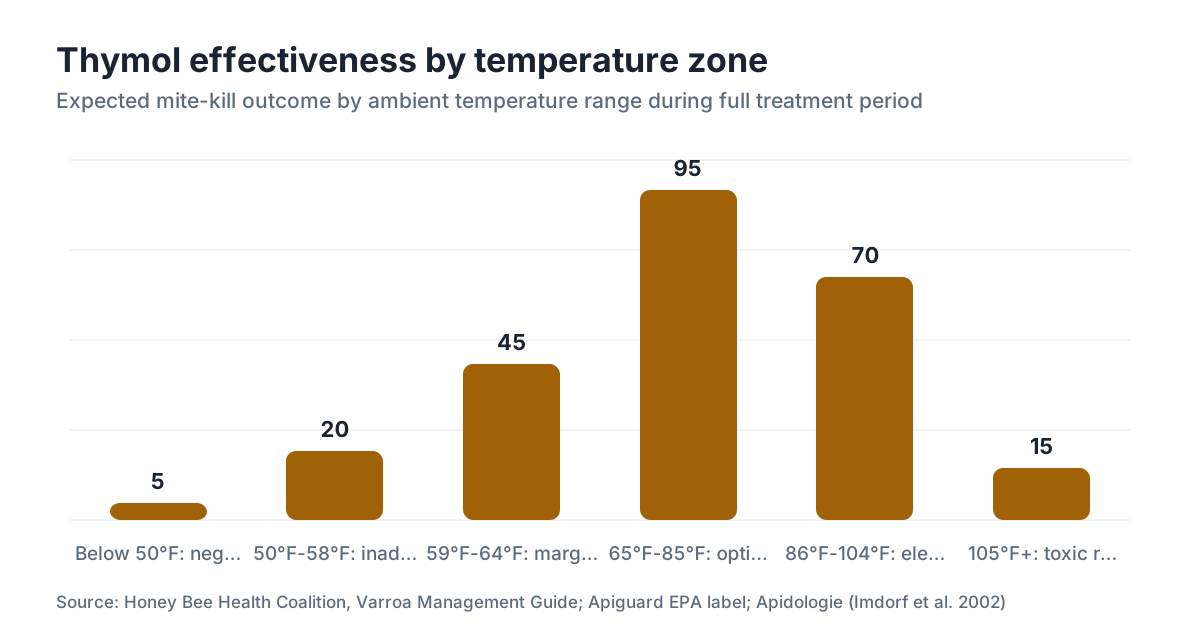
What is the temperature range chart for thymol effectiveness?
Here's how the temperature zones map to thymol performance, pulled from published label guidance and peer-reviewed research.
| Temperature Range | Thymol Behavior | Expected Outcome |
|---|---|---|
| Below 50°F (10°C) | Almost no sublimation | Negligible mite kill |
| 50°F to 58°F (10°C to 14°C) | Very slow vapor release | Likely inadequate, not labeled |
| 59°F to 64°F (15°C to 18°C) | Minimum labeled range | Marginal, treat only if daytime highs run well above |
| 65°F to 85°F (18°C to 29°C) | Optimal vapor production | Best mite kill, lowest bee risk |
| 86°F to 104°F (30°C to 40°C) | Elevated vapor, borderline | Watch for queen issues, bees may beard |
| 105°F+ (40°C+) | Excessive sublimation | Bee and queen toxicity, not recommended |
These ranges come from EPA-registered product labels and match what the Honey Bee Health Coalition publishes. [1][2][5] A few beekeepers report luck at the 59°F floor in warm climates where nights recover fast by mid-morning. Treating at or below that threshold is a real efficacy gamble, more than a regulatory footnote.
How do you time a thymol treatment around seasonal temperatures?
Time it by the 10-day forecast, not the calendar, and read the lows as hard as the highs. Most hobbyists get burned here because the date on the wall and the number on the thermometer disagree.
Across most of the continental U.S., the spring thymol window opens once average daily temperatures hold above 65°F, often May into early June up north. Fall is the tricky one. You want to treat after the honey harvest but before mites explode heading into winter. In the upper Midwest and New England that means late July through mid-September, stretching into October in the South. [6]
Check a 10-day forecast before you place any thymol product. You need sustained warmth, not one warm placement day. If a cool front is set to drop you below 59°F in the first week, hold off. Starting a treatment and losing vapor halfway through is arguably worse than not treating, because you've disrupted the colony without landing enough kill to matter.
Plenty of experienced beekeepers set a min-max thermometer in a spare hive body near the apiary for a week before treating. Hive interiors run several degrees warmer than ambient thanks to cluster heat, but the product sits above or near the cluster where ambient air temperature predicts actual vapor concentration better. [4]
Night lows are the binding constraint in spring and fall. A day that touches 75°F can still average below 59°F if the overnight low sinks to 42°F. Thymol pads and gels are barely working at 2 a.m. when it's cold, and those hours count toward total exposure. The Honey Bee Health Coalition's guide tells you to check forecasted highs and lows for the whole treatment period before you start. [5]
Does the specific thymol product change the temperature rules?
Mostly no. The 59°F floor and 105°F ceiling hold across both major products. But a few practical differences matter.
Apiguard is a slow-release thymol gel. Its maker, Vita Bee Health, and the EPA label set a 59°F minimum and tell you to replace any tray that hasn't been consumed after two weeks with a fresh one. In cooler weather the gel evaporates slower and bees are less likely to haul it out, which can stretch the treatment duration. That doesn't reliably make up for low vapor concentration. [1]
ApiLife Var runs thymol as the main active but adds eucalyptus oil, levomenthol, and camphor. Its labeled window is similar: 59°F floor, cautions above 95°F to 100°F. Some beekeepers find it a touch less fussy about temperature swings because the other volatiles chip in some mite kill when thymol vapor runs low. That's field observation, not a published controlled comparison. [2]
Apivar gets confused with Apiguard in conversation, but Apivar contains amitraz, not thymol, and has a completely different temperature profile. They are not interchangeable. [7]
DIY thymol crystals in mesh bags or on cardboard carry no EPA registration and no label temperature guidance. They may act like the commercial products, but the dose and vapor rate are genuinely unpredictable. The registered products exist partly because someone did the dosing and safety testing to set those ranges.
Comparing thymol against other miticides before you commit? The varroa mite hub covers the full menu of registered treatments and their windows.
Can you use thymol during a honey flow or when supers are on?
No. Pull every honey super meant for human consumption before you treat. This is a separate restriction from the temperature question, but it shows up in the same seasonal timing talk every time.
Both Apiguard and ApiLife Var require supers off before treatment. Thymol taints honey with a medicinal flavor and pushes residues up, and both EPA-registered labels state this outright. [1][2] The Honey Bee Health Coalition's guide backs it: don't apply thymol with honey supers present. [5]
Because of that, most beekeepers treat right after pulling the last super in late summer or early fall, which often lands in the best remaining temperature window. Great when it works out. It creates a scheduling jam in years when the flow runs late or the temperatures drop early.
One workaround is treating in early spring, before supers go on, if mite loads justify it. Spring temperatures across most of the U.S. hit the acceptable range by late April or May. The catch: spring treatment does nothing about the mite load that will build through summer. Most advisors say don't lean on spring treatment alone to carry a colony through the year. [5][6]
What happens if you apply thymol outside the temperature window?
Below the window, the treatment fails and mite loads keep climbing. The colony heads into winter loaded with varroa and carries the loss risk that comes with it. A miss like this is expensive, and the wasted weeks in late fall can cost you the whole colony.
Above the window, you can lose your queen. Heavy thymol vapor repels bees and fouls larval acceptance. Queens exposed to high vapor during laying can quit laying or get superseded. Absconding, the whole colony walking out, is a real risk above 105°F and has been reported at sustained temperatures above 95°F with some products. [4]
There's a residue angle at the top end too. When thymol volatilizes faster than bees can ventilate, more of it soaks into wax and honey stores. The registered products stay within accepted residue tolerances inside the labeled window, but nobody has run residue testing at temperatures well above the ceiling, so treating there is flying blind. [8]
Some beekeepers try to fight hot weather by placing thymol farther from the cluster, behind a divider, or partway outside the entrance. That's off-label and its efficacy isn't established. The safer move is to wait for a cooler stretch or switch treatment class (oxalic acid, amitraz) when the heat makes thymol impractical.
How does temperature affect thymol residues in honey and wax?
Higher treatment temperatures push more thymol into your wax. Thymol occurs naturally in honey at low levels, and trace treatment residues are generally considered acceptable when the product is used as directed. [8] Published studies have found thymol in beeswax ranging from a few parts per million to over 100 ppm depending on application rate, temperature, and whether supers were present.
A study in the Journal of Agricultural and Food Chemistry found thymol residues in wax ran higher when treatments happened at elevated temperatures, which fits the faster sublimation and greater wax absorption. [8] So treating above the labeled range doesn't just risk bee toxicity. It loads more residue into your wax, and that builds up across treatment seasons.
This matters more if you sell comb honey or run foundationless hives where wax gets eaten with the honey, and less if you use drawn plastic foundation you swap out on a schedule.
How do you monitor whether a thymol treatment is actually working?
Count mites before and after with a sticky board or an alcohol wash. That's the whole check.
Slide a sticky board under a screened bottom board for 24 to 72 hours before you start and count the natural drop. After the treatment period ends (about 28 days for two Apiguard applications, 6 to 8 weeks for two ApiLife Var rounds), run another 72-hour sticky board or an alcohol wash on a 300-bee sample. [5]
If the post-treatment load still sits at or above 2 to 3 mites per 100 bees on a wash, the treatment underperformed. Temperature failure is one reason. Heavy incoming pressure from nearby collapsing colonies is another. A third is a treatment window too short to catch mites that were capped when you started.
The Honey Bee Health Coalition sets an action threshold of 2 mites per 100 adult bees (2%), the point where treatment is warranted, based on the best available research tying mite loads to winter survival. [5] Sit at or above that after a thymol round and the right call is usually to retreat with a different class, not another thymol tray.
Logging counts before and after each treatment shows you patterns across seasons. VarroaVault's free protocol tools can build that season-long tracking for you so you don't have to design it from scratch.
Are there alternatives to thymol when temperatures are out of range?
Yes, and that's one of the best reasons to know the thymol window cold: it tells you exactly when to grab a different tool.
Oxalic acid dribble and vaporization work at lower temperatures and are the standard late-fall and winter treatments, because they don't hinge on vapor concentration the way thymol does. OA vaporization is EPA-registered under Api-Bioxal and effective in broodless or low-brood periods. [9] Extended-release OA on a sponge carrier has been used across a wider temperature band than thymol.
Amitraz (Apivar strips) is another path with its own temperature profile. It works down to about 50°F and doesn't carry thymol's upper-limit bee toxicity. The tradeoffs are a withdrawal consideration and the standing risk of mite resistance if you don't rotate it with other classes. [7]
HopGuard 3 (hop beta acids) starts at a 50°F floor and can go on with supers in some states, though label conditions vary by state. [10]
The seasonal logic most advisors follow: thymol for late summer when temperatures cooperate, oxalic acid for late fall and winter, amitraz as a fallback when neither fits. Nobody should ride a single class year after year anyway. Resistance pressure builds, and each tool has seasonal and temperature limits that make rotation a practical necessity. [5][6]
Need a place to source these? The beekeeping supply companies guide has a current roundup of vendors stocking registered miticides.
What do beekeepers commonly get wrong about thymol temperature guidance?
The biggest miss is treating off daytime highs alone. Think in average temperature over the full period, nights included. A week of 78°F days paired with 48°F nights averages around 63°F, marginal at best, which means thymol is barely working through the cold hours.
The second miss is pulling a treatment early because the bees don't seem to be eating the gel. In cool weather, bees sometimes cap over the Apiguard tray instead of hauling it out. That looks like rejection but actually traps some vapor in the hive. The label says remove unconsumed gel after two weeks and add a fresh tray. Follow the label instead of reading bee behavior as failure.
Third miss: double-dosing to fight the cold. Two Apiguard trays at once doesn't reliably make up for low vapor pressure, but it does raise the odds of queen problems and absconding at the warm end of the range. The products are dosed to deliver a set vapor concentration over time, and the directions account for that.
Last one. Some beekeepers assume that because thymol is natural, it's automatically safer than synthetics at any dose or temperature. Wrong. The EPA classifies thymol as a biopesticide and registers it under a specific label for a reason. The temperature and dosing limits exist because the safety and efficacy data were gathered inside those parameters, not because the compound is harmless outside them.
Frequently asked questions
What is the minimum temperature for thymol varroa treatment?
The labeled minimum for both Apiguard and ApiLife Var is 59°F (15°C). Below that, thymol sublimates too slowly to build vapor concentrations that reliably kill varroa. Treating below 59°F usually means a failed treatment even if the product sits in the hive for the full labeled duration.
What is the maximum safe temperature for thymol bee treatments?
Most thymol labels warn against use above 105°F (40°C). Between roughly 90°F and 105°F you get elevated risk of queen loss, reduced laying, and bearding or absconding. The safe, effective range is 65°F to 85°F. Above 95°F, watch colonies closely for stress.
Can I use Apiguard in spring?
Yes, if temperatures hold consistently above 59°F and honey supers aren't on yet. Spring treatment can knock down overwintered mites before the main brood buildup. The catch is that spring treatment alone won't control the mite explosion during summer brood rearing, so you'll still need a late-summer or fall round.
Does thymol work when there's capped brood in the hive?
Thymol vapor doesn't cross wax cappings well, so it only kills phoretic mites on adult bees. That's why a full cycle has to run at least as long as the worker brood cycle (about 21 days) to catch mites as they emerge. A full two-tray Apiguard regimen runs 28 days for exactly this reason.
How long does a thymol varroa treatment take?
Apiguard uses two trays, each left in for two weeks, for 28 days total. ApiLife Var involves replacing the tablet pieces every 7 to 10 days across three to four applications, roughly 28 to 42 days. The exact schedule is on each product's EPA-registered label, which is the authoritative source.
Can I use thymol with honey supers on the hive?
No. Both Apiguard and ApiLife Var require all honey supers meant for human consumption to come off before treatment. Thymol can taint honey with medicinal off-flavors and leave residues above acceptable levels when supers are present. This restriction is on the EPA-registered labels for both products.
Why are my bees clustering around the hive entrance during thymol treatment?
Heavy bearding during a thymol treatment usually means the hive is too hot, temperatures near or above 95°F, and the vapor inside is irritating the bees. Open the entrance reducer fully if you haven't. If temperatures stay above 95°F, pull the treatment and switch miticides. This behavior is a real warning sign for queen loss.
Does thymol kill varroa mites in capped cells?
No. Thymol vapor doesn't reach concentrations inside capped cells high enough to kill sealed mites. It acts almost entirely on phoretic mites on adult bees. That's why thymol treatments run the full labeled duration spanning a complete brood cycle, so mites sealed in cells at the start get exposed once they emerge.
What should I do if a cold front hits during a thymol treatment?
Leave the treatment in place if you're mid-cycle and temperatures are expected back above 59°F within a few days. Removing and replacing mid-treatment wastes product and drags out the disruption. If temperatures are forecast to stay below 59°F for more than a week of your window, the treatment is likely failing and you should switch to oxalic acid once weather permits.
Is thymol safe for bees compared to synthetic miticides?
The EPA classifies thymol as a biopesticide, and it has a lower residue concern profile than some synthetics, but it isn't harmless. At high temperatures or overdose it can suppress queen laying, cause absconding, and load more residue into wax. Used inside the labeled temperature window and dose, it has a good safety record and no documented varroa resistance.
How do I know if my thymol treatment worked?
Run an alcohol wash on a 300-bee sample (about half a cup of bees) at the end of the treatment period. Below 2 mites per 100 bees (2%) means it worked. Above that, switch treatment classes rather than repeating thymol. A sticky board count before and after shows the trend, but the alcohol wash gives a more reliable infestation rate.
Can varroa mites develop resistance to thymol?
No documented cases of varroa resistance to thymol exist in current published research, in contrast to documented resistance to coumaphos and tau-fluvalinate. That's one of thymol's advantages in a resistance management program. Rotating treatment classes is still best practice to limit exposure to any single mode of action.
What temperature is best for thymol treatment in fall?
The ideal fall window has daytime highs consistently above 70°F and nightly lows that don't drop below 59°F. In most of the northern U.S., that runs from late July through mid-September. Check a 10-day forecast for both highs and lows before placing treatments. A single cold week mid-treatment can cut your total mite kill hard.
Can I use thymol and oxalic acid at the same time?
There's no published data showing a direct harmful interaction, but using both at once isn't part of any EPA-registered label protocol and isn't recommended. The standard approach is to finish the thymol treatment during warm fall conditions, then follow with oxalic acid vaporization later in fall or winter when the colony is broodless or nearly so.
Sources
- Vita Bee Health, Apiguard EPA-registered product label: Apiguard minimum application temperature is 59°F (15°C); optimum efficacy at 59°F to 77°F (15°C to 25°C)
- California Department of Pesticide Regulation, ApiLife Var (Chemicals Laif) registered product label: ApiLife Var labeled temperature minimum 59°F; cautions against use above approximately 95°F to 105°F
- Apidologie, Imdorf et al. 2002, thymol efficacy and temperature correlation study: Thymol efficacy against varroa dropped significantly when average treatment temperatures fell below 15°C
- Pennsylvania State University Extension, varroa treatment guidance: Thymol treatments at elevated temperatures above 90°F to 95°F associated with queen loss and absconding behavior in colonies
- Honey Bee Health Coalition, Varroa Management Guide (latest edition): Thymol-based products should not be applied when temperatures are expected to exceed 105°F or fall below 59°F; action threshold of 2 mites per 100 bees cited
- University of Minnesota Extension, Bee Lab varroa treatment timing recommendations: Late July through mid-September cited as primary fall thymol treatment window for upper Midwest beekeepers
- EPA, Apivar (amitraz) product registration: Apivar (amitraz) contains no thymol and has a different temperature profile, effective down to approximately 50°F
- Journal of Agricultural and Food Chemistry, thymol residues in beeswax study: Thymol residues in beeswax were higher at elevated treatment temperatures, consistent with increased sublimation rate
- EPA, Api-Bioxal (oxalic acid) registration and label: Oxalic acid vaporization is EPA-registered for varroa control and effective at lower temperatures than thymol, standard for late-fall and winter treatment
- EPA, HopGuard 3 (hop beta acids) registered label: HopGuard 3 (hop beta acids) has a labeled lower temperature bound starting at 50°F
- Cornell University College of Agriculture and Life Sciences, Department of Entomology bee health resources: Thymol acts via fumigation targeting phoretic mites; cappings prevent vapor penetration to reproductive mites in cells
Last updated 2026-07-09