Home made thymol varroa treatment: does it actually work?
TL;DR
- You can make a thymol varroa treatment at home from food-grade thymol crystals dissolved in alcohol or vegetable glycerin, applied on a sponge or shop-cloth pad.
- Knockdown runs 74 to 93% between 60 and 105 degrees F.
- It costs less than ApiLife Var or Apiguard, but the risks are real: overdose, queen loss, and no EPA registration.
What is thymol and why does it kill varroa mites?
Thymol is a monoterpene phenol. It is the compound that gives thyme and oregano their smell, and it is the active ingredient in two EPA-registered miticides: ApiLife Var and Apiguard. At treatment concentrations, thymol vapor scrambles the mite's nervous system and disrupts its breathing. Bees shrug it off at the right temperatures. Mites do not.
The compound works by turning slowly from a solid or gel into vapor that fills the hive air. That vapor lands on mites riding adult bees, and, to a much weaker degree, on mites sealed inside capped brood cells. Because it barely reaches mites under cappings, thymol loses to oxalic acid on a broodless colony. During an active brood season, though, it is far more practical.
Researchers describe thymol's toxicity as targeting octopaminergic receptors in arthropods, which mammals lack, and that selectivity is why honey bees survive a dose that kills mites [1]. The EPA lists thymol as a minimum-risk pesticide under FIFRA section 25(b) in certain formulations, which is part of how the commercial products reached the market, but that exemption does not cover every homemade batch [2].
For the mite biology behind all of this, the varroa mite overview covers the life cycle in detail.
Is making your own thymol varroa treatment legal in the US?
Here is the part most tutorials skip. In the US, any pesticide you apply to a hive has to either follow the label of an EPA-registered product or fall under an exemption. Thymol sits on the EPA's FIFRA section 25(b) minimum-risk list [2], which means a formulation meeting specific criteria (approved inert ingredients, no pesticidal claims beyond the allowed label, and so on) can be sold without registration. That exemption was written for manufacturers, not for a beekeeper mixing pads in the garage.
In practice, the EPA has not gone after individual beekeepers making small batches of thymol pads for their own hives, and several state extension services describe DIY methods with no warning of legal trouble [3]. That does not make it clearly legal. It makes it a gray area nobody has taken to court. A commercial operation or a sideliner selling nucs and honey carries a different risk than a hobbyist with five hives.
Some states go further than federal law. California runs its own pesticide regulation layer, for example. Check with your state department of agriculture before you mix anything. The honest answer for a hobbyist treating their own hives: nobody is coming to your apiary. For anyone moving bees commercially or selling product, use registered labels.
Canada is different again. Health Canada's Pest Management Regulatory Agency handles thymol products, ApiLife Var holds a registration there, and DIY formulations occupy the same gray area they do in the US.
Use a registered product if you want certainty. If you go homemade, understand the tradeoffs and stay at or below the doses the registered products use.
What are the real DIY thymol recipes beekeepers use?
Three approaches show up again and again across extension publications and beekeeper forums. Each has a different release rate and a different tradeoff.
Sponge pad method (the common one)
Dissolve 15 to 25 grams of food-grade thymol crystals into 100 mL of 70% isopropyl or ethyl alcohol until the crystals are fully gone. Soak a cellulose sponge or a folded terrycloth square in the solution, then let it dry until it is damp but not dripping. Set the pad on the top bars of the brood nest, under the inner cover. Replace every 7 to 10 days for 2 to 3 rounds. This copies the dosing schedule of ApiLife Var, which runs roughly 74.1% thymol on a vermiculite carrier [5].
Vegetable glycerin method
Thymol dissolves in glycerin slower than in alcohol, so the release is slower and steadier. A common ratio is 1 part thymol crystals to 4 parts food-grade vegetable glycerin by weight, warmed gently to mix. Apply 25 to 30 mL per round on a cellulose sponge. Glycerin holds the material together in hot weather, which some beekeepers like in midsummer. Others find it drags in cool fall conditions.
Oil carrier method
A smaller group dissolves thymol in a carrier oil on grooved wooden strips laid across the top bars. The oil slows volatilization even more. Nobody has published controlled data on this exact method. The evidence is anecdotal.
A note on the crystals
Food-grade thymol comes from chemical supply companies. Prices run roughly $15 to $30 per 100 grams (2025 market), enough for many rounds across several hives. ApiLife Var runs about $3 to $4 per treatment per hive at retail. Over a full season with more than a few hives, the DIY savings are real.
When you buy supplies, get the rest of your beekeeping supplies sorted too, because timing your treatment window matters as much as the formula.
What temperature range does thymol treatment actually require?
Temperature is the single biggest lever on thymol efficacy. Too cold and the crystals barely volatilize, so neither bees nor mites get much exposure. Too hot and you burn off the full dose in two or three days, hit the bees with concentrations that repel or injure them, and risk losing the queen.
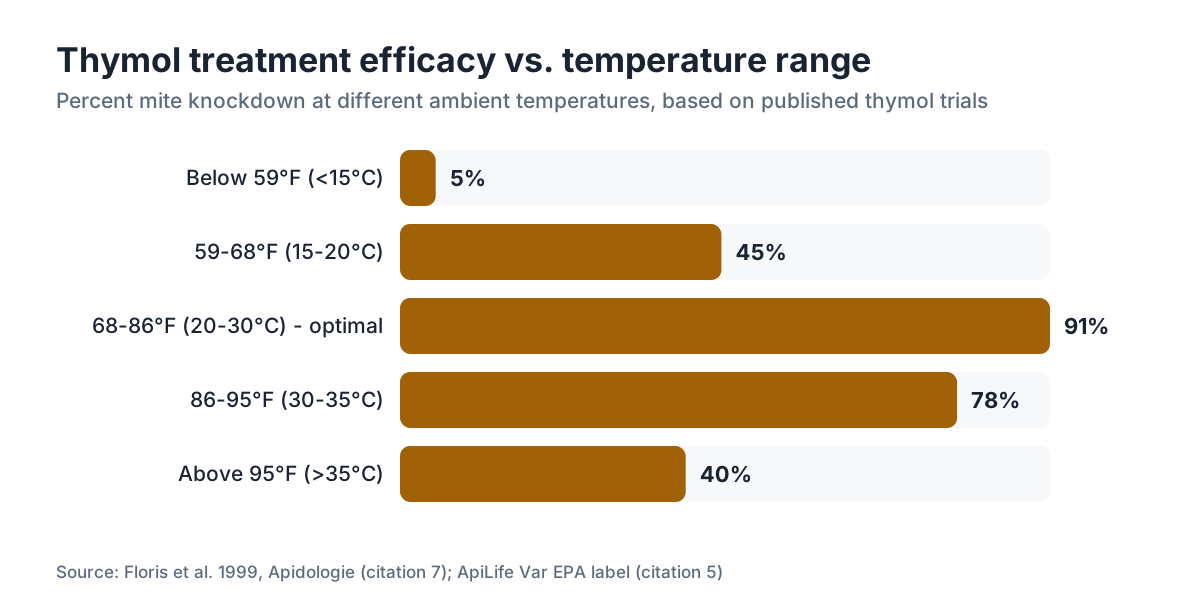
The documented effective range is 60 to 105 degrees F (15 to 40 degrees C) ambient during treatment [3][5]. The sweet spot most practitioners and the Honey Bee Health Coalition point to is 60 to 85 degrees F, for the best balance of knockdown and bee safety [6]. ApiLife Var's label says not to apply when daytime temperatures top 105 degrees F, and that limit is worth following for any thymol formulation.
Below 60 degrees F, published efficacy falls off a cliff. A 1999 study by Floris and colleagues found essentially no effect under 59 degrees F (15 degrees C), against 90%+ knockdown at 68 to 86 degrees F (20 to 30 degrees C) [7]. This is what makes fall timing tricky up north. You want the brood nest shrinking so fewer mites hide under cappings, but you still need warm daytime temperatures to vaporize the thymol.
The best windows land in late summer, roughly late July through mid-September across most of the US. Temperatures still run warm, the honey supers are off, and there is no risk of tainting cured honey. Spring works too, but watch the thermometer closely.
How effective is homemade thymol compared to commercial products?
Honest answer: when conditions are right, very close. When conditions are off, meaningfully worse.
ApiLife Var trials in European conditions showed 74 to 93% mite knockdown across studies [5]. Apiguard (25% thymol gel) landed in the same range, with a frequently cited Italian trial reporting 91% under optimal conditions [8]. Homemade sponge pads that copy the ApiLife Var dose and timing have posted comparable numbers in beekeeper-reported trials, though peer-reviewed data on DIY formulations specifically is thin.
The Honey Bee Health Coalition's Varroa management guide, widely treated as the best US practitioner reference, backs commercial thymol products and notes that treatment efficacy "is highly dependent on temperature and proper dosing" [6]. That caution hits homemade versions even harder, because dose consistency is tougher to control at home.
Here is where DIY gives up ground. Commercial products use a standardized carrier that governs the release rate. Your sponge varies in porosity. Your alcohol evaporates at a rate that shifts with the day's humidity. Your crystals may vary in purity if you skip pharmaceutical or food grade. None of that sinks the method. It adds variance.
For a hobbyist who is comfortable with uncertainty and willing to check the outcome with sticky boards or alcohol washes, DIY thymol is a fair tool. For anyone who wants reliability on paper, buy a registered product.
Here is how the thymol options stack up.
| Treatment | Thymol % | Typical efficacy | Approx. cost/colony/treatment | EPA registered? |
|---|---|---|---|---|
| ApiLife Var | 74.1% | 74-93% [5] | $3-4 | Yes |
| Apiguard | 25% | 74-91% [8] | $3-5 | Yes |
| DIY sponge pad (15-25g) | variable | 70-90% (beekeeper reports) | $0.50-1.50 | No |
| DIY glycerin blend | variable | Unknown (no peer data) | $0.75-2.00 | No |
What mite count thresholds should trigger a thymol treatment?
Treating on a calendar without monitoring is how you treat when you do not need to, or skip treatment when you badly do. The Honey Bee Health Coalition puts the action threshold at 2% infestation (2 mites per 100 bees) from spring through midsummer, dropping to 1% in late summer when the colony is raising the winter bees that have to survive [6].
Alcohol wash is the most accurate field method [11]. Sample about 300 adult bees from the brood nest area, wash them in a jar with 70% alcohol, and count the mites in the wash. Divide mites by bees, multiply by 100, and you have your percent infestation. Three mites out of 300 bees is 1%. Run it every 30 days through the active season.
Sticky board counts (natural mite drop over 24 to 48 hours) are less precise but give you a direction. A 24-hour drop above 8 to 10 mites is often cited as a rough trigger in a full-size colony. The method has more noise, and I would not lean on it alone.
At or above threshold, thymol is a reasonable pick from spring through early fall. In late fall, with the colony broodless or nearly so, oxalic acid dribble or vaporization beats thymol, because it reaches every phoretic mite with no capped brood left to hide in.
How do you apply a DIY thymol treatment step by step?
Getting the application right is the difference between a treatment that works and one that drives your bees out of the box.
- Pull honey supers at least 3 to 4 days before treatment and leave them off until at least 2 weeks after the last round. Thymol taint in honey is real and unpleasant.
- Read the 10-day forecast. You want daytime highs steady between 60 and 85 degrees F. If a spike over 95 degrees F is coming in the next 3 days, wait.
- Mix the solution. For the sponge pad method, dissolve 15 grams of thymol crystals in 100 mL of 70% ethyl alcohol (isopropyl works, but ethyl is gentler). Wear nitrile gloves and work outside or with ventilation. Thymol vapor stings eyes and mucous membranes.
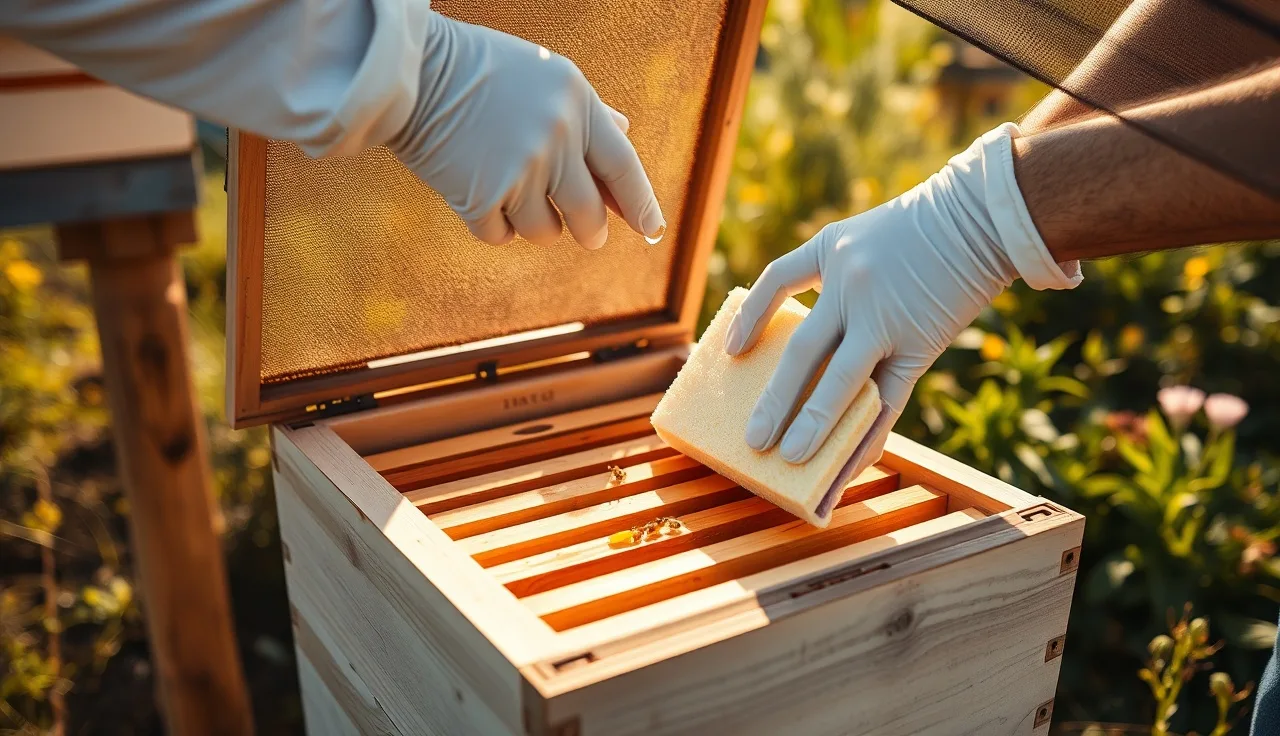
- Saturate a cellulose sponge (roughly 4 by 4 by 1 inch, or a folded shop cloth), then let it drain 30 seconds so it is damp, not dripping.
- Open the hive and lay the pad flat on the top bars of the brood nest, close to where the bees cluster. Do not jam it into the frames.
- Add a spacer rim (or a medium or shallow super with no frames) between the top brood box and the inner cover, so the vapor has room to spread. An empty shim works fine.
- Close up. Come back in 7 to 10 days. Swap in a fresh sponge. Repeat for 3 cycles, roughly 21 to 30 days total.
- After the last round, do an alcohol wash 3 to 5 days later to confirm knockdown. If mites are still above threshold, figure out whether temperature or timing was the problem before running another round.
VarroaVault has a free treatment timing calculator that maps this schedule against your local forecast, which helps when you are juggling several hives.
What are the risks of homemade thymol treatments to bees and queens?
The two big risks are overdose toxicity and queen loss. Both are real. Both track with the dose.
At high concentrations, thymol pushes bees to abscond or cluster at the entrance in a bearding pattern. That is a stress response, not colony collapse, and it usually eases within a day or two once temperatures fall. If the bearding is severe and stays that way, you have overdosed. Pull the pad now.
Queen loss worries beekeepers most, and rightly so. There is documented evidence that thymol at high concentrations or in hot weather can stop a queen from laying, or, less often, get her superseded or killed [5][8]. Commercial products cut this risk with a standardized dose and set temperature windows. With homemade formulations, you manage that risk yourself. Warning signs are a spotty brood pattern, workers building emergency queen cells, or a sudden laying pause. Check the colony 7 to 10 days into treatment if the recipe is new to you.
Brood damage is a smaller worry at normal doses. Push the dose high, especially in heat where volatilization runs fast, and you can get spotty brood.
For a hobbyist running 15 to 25 grams per round in normal temperatures, these risks stay manageable. Go past 30 grams per round, or treat above 85 degrees F, and you are in territory where I would pull the treatment and reassess.
One thing that gets overlooked: thymol builds up in wax at low levels. A 2001 study found thymol residues in wax after ApiLife Var and Apiguard treatment, at concentrations well under any known toxicity threshold for bees or humans [8]. Wax you render from treated combs carries some residue. Not a reason to panic, but worth knowing.
How does DIY thymol fit into a full-season varroa management plan?
No single treatment carries a whole season. Thymol fits one slot best: the midsummer round after the honey supers come off and before the colony starts raising winter bees in earnest. Across most of the US, that is roughly August through mid-September.
A practical plan for a northern beekeeper runs like this. Start monthly alcohol washes in April. If mites hit 2% or higher before the honey flow ends and supers come off, use oxalic acid vaporization if you can open a broodless window (by splitting or caging the queen), or wait for supers to come off if the count is not catastrophic. Once supers are off in July or August, run thymol (commercial or DIY) for 3 to 4 weeks. Do a wash in September. If mites still sit above 1%, follow with oxalic acid dribble or vaporization in late fall, when the colony is broodless or close to it.
The Honey Bee Health Coalition's Varroa management guide frames this as integrated pest management rather than single-treatment reliance, and that framing is right [6]. Thymol alone will not carry a colony through a season if you start with a heavy mite load or apply it in the wrong temperatures.
The resistance angle matters too. Thymol resistance in varroa is not documented the way pyrethroid resistance is with fluvalinate, but that is no reason to stop rotating. Alternating thymol and oxalic acid (different modes of action) is a sensible precaution.
How does thymol treatment compare to other organic varroa options?
Beekeepers working without synthetic acaricides have three main organic tools: thymol, oxalic acid, and formic acid. Each fills a different slot.
Oxalic acid is the standard for broodless colonies. It reaches every phoretic mite when there is no capped brood to hide in, and studies show 90 to 97% knockdown in broodless colonies [9]. It does not move through cappings, so it fades when brood is present. The EPA registered Api-Bioxal for US use in 2015 [9], and it is the treatment I reach for first in a fall or winter broodless window.
Formic acid (sold as Mite-Away Quick Strips or mixed from concentrated acid) penetrates brood cappings better than thymol and kills mites inside cells, more than the phoretic ones. It runs across a wider temperature range than thymol (50 to 85 degrees F for most protocols) and earns its keep in the late summer and fall window. The tradeoff is a higher queen loss risk and more bee mortality if you apply it above the label's upper limit [10].
Thymol's edge is cost (especially DIY), availability, and a cleaner safety profile for the beekeeper than corrosive formic acid. Its weaknesses are the narrow temperature window and weak penetration of capped brood.
For most hobbyists, thymol (commercial or DIY) plus oxalic acid vaporization in a fall broodless window is a solid, affordable, fully organic setup. If you want a treatment that hits mites under cappings in late summer, add a formic acid product.
Still sorting out where to buy? The beekeeping supply companies guide covers sourcing without overpaying.
What do you actually need to buy to make thymol varroa treatments?
The shopping list is short.
Thymol crystals: food-grade or pharmaceutical-grade, 99% purity. Available from chemical suppliers like Sigma-Aldrich or Spectrum Chemical, and from some beekeeping retailers. Expect $15 to $30 per 100g (2025 pricing). That 100g covers 4 to 6 full cycles on a single hive at the 15 to 25 gram per round rate.
Carrier: 70% isopropyl or ethyl alcohol (drugstore stuff) for the sponge pad method, or food-grade vegetable glycerin if you want slower release. Alcohol is fine. Glycerin costs a bit more but keeps longer on the shelf.
Applicator: cellulose kitchen sponges, terrycloth shop cloths cut to about 4 by 4 inches, or wooden strips. Nothing exotic.
Spacer shim: a 3/4-inch or 1-inch rim to give vapor room above the pad. No shim? An empty medium super with no frames works.
Protective gear: nitrile gloves (thymol is a skin sensitizer with repeated exposure), safety glasses, and a ventilated workspace or the outdoors. This part is not optional.
Scale: a small kitchen scale accurate to 1 gram. Eyeballing the dose is how you overdose a colony.
The first-time DIY outlay runs roughly $40 to $60, dropping to $15 to $25 a season once you own the carrier and gear. Against commercial ApiLife Var at $3 to $4 per colony per cycle across 3 cycles, you break even fast if you run more than 3 or 4 hives.
Most of this sits alongside your other beekeeping supplies at a full-service apiary supplier.
What are the most common mistakes beekeepers make with DIY thymol?
Watch colony-loss threads across extension publications and beekeeper forums long enough and the same errors keep surfacing.
Treating in heat. Laying thymol pads when daytime highs run above 85 to 90 degrees F is the fastest route to queen loss and absconding. In the South in August, you may have to treat at dawn and pull pads in the heat of the day, or wait for a cooler week. The commercial label caps out at 105 degrees F, but I would not push a DIY formula past 90 degrees F, where dosing is already less precise.
Leaving supers on. Thymol taints honey. Even at low concentrations it lends an herbal, medicinal off-flavor you can catch in a blind tasting. Pull supers at least 3 to 4 days before treatment, and leave them off until 2 weeks after the last cycle ends.
Using impure or industrial-grade thymol. Food-grade or pharmaceutical-grade at 99%+ purity is the target. Industrial thymol can carry solvents or other contaminants. Do not buy from a source you cannot verify.
Skipping post-treatment monitoring. You put the treatment in. Now you need to know if it worked. An alcohol wash 5 to 7 days after the last cycle tells you whether the knockdown was enough. Still at 2%+? You need another tool, not another round of thymol in the wrong conditions.
Leaning on thymol alone. Treat once, skip monitoring until spring, and you will often open a dead box. Thymol is one piece of a plan, not the plan.
If you track mite counts across your apiary and line them up against treatment timing, VarroaVault's free mite log sheets keep that data organized and comparable across seasons.
Frequently asked questions
Can I use thymol to treat varroa in the fall?
Yes, but the window is narrow. Fall thymol works only while daytime temperatures stay above 60 degrees F. In most northern states that means late August through mid-September. After that, switch to oxalic acid, which needs no warmth to volatilize and works best in a broodless or near-broodless colony. If your fall runs warm, a thymol cycle followed by oxalic acid vaporization gives you two modes of coverage.
How much thymol should I use per hive?
The range used in commercial formulations and the most cited DIY protocols is 15 to 25 grams of thymol crystals per hive per round, applied every 7 to 10 days for 3 cycles. ApiLife Var holds 74.1% thymol in a 21-gram tablet, so the thymol per round is roughly 15 to 16 grams. Staying in that range for DIY keeps you in a documented-efficacy zone without risking overdose.
Will thymol treatment hurt my honey?
Yes, if supers are on during treatment. Thymol is volatile enough to move into uncured and curing honey, and even small amounts give a noticeable herbal off-flavor. Always pull honey supers at least 3 to 4 days before placing any thymol treatment. Leave supers off until at least 2 weeks after the final cycle. Wax holds trace residues, but at levels well below any documented safety concern.
Is food-grade thymol the same as thymol for bees?
The molecule is identical. Food-grade or pharmaceutical-grade thymol at 99%+ purity is exactly what you want for varroa treatment. Purity is what matters: industrial-grade thymol may carry residual solvents or other compounds. Buy from a reputable chemical supplier and check the certificate of analysis for purity. Thymol labeled for beekeeping from apiculture suppliers is the easiest route to verified purity.
How do I know if my thymol treatment worked?
Do an alcohol wash 5 to 7 days after the final cycle. Sample 300 bees from the brood nest frames, wash in 70% alcohol, count the mites. If your infestation rate sits below 1 to 2%, the treatment worked. A sticky board also shows a drop in mite fall after treatment, though those counts are less precise. Do not skip this. Assuming a treatment worked without measuring is how colonies die over winter.
Can I use thymol in a Langstroth and also a top bar or Warré hive?
Thymol works in any hive style as long as you can set the pad near the brood cluster and leave some vapor space above it. Top bar and Warré hives do better with a piece of cardboard or foil loosely placed above the pad to slow the vapor escaping upward. The dose per colony stays the same across hive styles. What changes is pad placement. Watch for heavy bearding, which can mean the vapor is concentrating more than it would in a Langstroth.
Does thymol work on mites inside capped brood?
Weakly. Thymol vapor diffuses through cappings at a much lower rate than it reaches phoretic mites on adult bees. Studies show most of thymol's knockdown lands on phoretic mites. That is why thymol efficacy tops out around 90 to 93% rather than the 95%+ you can hit with oxalic acid in a fully broodless colony. In colonies with heavy brood, the mites under cappings rebound after treatment unless you follow up.
Can I combine thymol with oxalic acid in the same treatment window?
There is no toxicological reason you cannot run a thymol cycle in August and then vaporize oxalic acid in October when the colony is broodless. Using them at the same time or in tight succession is not a standard protocol and is not backed by published data. Sequential use across a season, though, is exactly the integrated approach the Honey Bee Health Coalition recommends. Different modes of action, different timing, works well.
What is the difference between ApiLife Var and Apiguard, and does DIY thymol match either?
ApiLife Var uses a vermiculite carrier at 74.1% thymol, applied in broken pieces on the top bars, replaced every 7 to 10 days for 3 applications. Apiguard is a slow-release gel at 25% thymol, applied as a 50g scoop in a tray for 2 to 4 weeks per application. DIY sponge pads at 15 to 25 grams most closely copy the ApiLife Var approach. Apiguard's gel gives a steadier low-level release that is hard to replicate at home without emulsifiers.
How often can I use thymol on the same colony in one season?
The standard is one full course per season: 3 applications 7 to 10 days apart, roughly 3 to 4 weeks total. Running a second course right after the first on the same colony in the same season is not standard and raises the risk of wax buildup and chronic bee stress. If mites rebound fast after a first course, that usually signals either treatment failure from poor conditions or a very high starting infestation that needs a different tool.
Is homemade thymol treatment safe for the beekeeper?
With basic precautions, yes. Thymol is a skin and mucous membrane irritant. Wear nitrile gloves when you mix and handle pads. Mix outdoors or with ventilation. Keep crystals and solution out of your eyes. Thymol is not classified as a carcinogen and has a long history of food and pharmaceutical use at low doses, but high-concentration exposure while mixing is unpleasant and mildly hazardous. Normal beekeeper gear plus gloves covers it.
Where can I buy thymol crystals for varroa treatment?
Food-grade or pharmaceutical-grade thymol crystals come from chemical suppliers such as Spectrum Chemical or Sigma-Aldrich, and from some beekeeping retailers. Prices in 2025 run roughly $15 to $30 per 100 grams. Some beekeeping supply companies stock it labeled for apiculture use, which settles the purity question. Avoid any source that cannot provide a certificate of analysis showing 99%+ purity.
Can I use essential oil thyme extract instead of pure thymol crystals?
No, not reliably. Thyme essential oil contains thymol, but also carvacrol, cymene, and other compounds at variable concentrations depending on the plant and the extraction method. The thymol content in thyme oil swings from roughly 20 to 60% by brand and batch. You cannot dose accurately without knowing the exact thymol content, and other compounds in the oil may affect bees or wax in ways nobody has measured. Pure food-grade thymol crystals are the only reliable starting material.
What is the success rate of DIY thymol treatments compared to buying ApiLife Var?
Under good conditions (60 to 85 degrees F, correct dose, 3 full cycles, no honey supers), DIY sponge pads reach knockdown broadly comparable to ApiLife Var's published 74 to 93% range. The gap opens in poor conditions, where a standardized commercial carrier volatilizes more consistently than a hand-soaked sponge. For hobbyists willing to monitor and repeat if needed, the efficacy difference is small. For beekeepers who want predictability without monitoring, the commercial product earns its price.
Sources
- National Center for Biotechnology Information, PubMed: Imdorf et al. 1999, Apidologie - thymol mode of action in Varroa: Thymol acts as a toxicant via octopaminergic receptor disruption in arthropods, providing selective toxicity to mites over bees
- EPA, FIFRA Section 25(b) Minimum Risk Pesticides: Thymol is listed as a minimum-risk active ingredient under FIFRA section 25(b), allowing certain formulations to be sold without full EPA registration
- Penn State Extension, Varroa mite management for honey bees: Effective temperature range for thymol varroa treatment is 60-105 degrees F; extension describes DIY application methods
- EPA, ApiLife Var pesticide label and registration document: ApiLife Var contains 74.1% thymol on a vermiculite carrier; registered efficacy range is 74-93% mite knockdown; label specifies not applying above 105 degrees F
- Honey Bee Health Coalition, Varroa Management Guide (latest edition): Action threshold is 2% mite infestation spring through midsummer, dropping to 1% in late summer; treatment efficacy is highly dependent on temperature and proper dosing; integrated pest management approach recommended
- Floris et al. 1999, Apidologie - temperature dependence of thymol efficacy against Varroa: Efficacy of thymol drops to near zero below 59 degrees F (15 degrees C), reaching 90%+ knockdown at 68-86 degrees F (20-30 degrees C)
- Gregorc & Planinc 2001, Apidologie - Apiguard efficacy and thymol residues in wax: Apiguard (25% thymol gel) showed 91% efficacy under optimal conditions; thymol residues found in beeswax post-treatment at concentrations below toxicity thresholds for bees and humans; queen loss risk documented at elevated concentrations or temperatures
- EPA, Api-Bioxal (oxalic acid) registration for honey bee varroa treatment: Api-Bioxal received EPA registration in 2015; oxalic acid achieves 90-97% mite knockdown in broodless colonies
- USDA ARS, Formic acid (Mite-Away Quick Strips) efficacy and application guidance: Formic acid penetrates brood cappings and kills mites inside cells; effective temperature range is 50-85 degrees F; queen loss and bee mortality risk increases above label temperature limits
- University of Minnesota Extension, Bee Lab - Varroa mite monitoring and management: Alcohol wash is the most accurate field method for mite infestation monitoring; sampling 300 bees and dividing mite count by bee count gives percent infestation
Last updated 2026-07-09