Thymol treatment for varroa mites: how it works and when to use it
TL;DR
- Thymol is a naturally derived, EPA-registered miticide made from thyme oil.
- Applied as gel pads (ApiGuard) or vermiculite wafers (Api-Life VAR), it kills varroa mites by vapor contact with 90 to 95% efficacy when temperatures stay between 60°F and 105°F.
- It leaves no residue in honey at label rates and is safe for bees when used correctly.
- Timing and temperature are everything.
What is thymol and how does it kill varroa mites?
Thymol is a phenolic compound extracted from thyme (Thymus vulgaris) and other plants in the mint family. It's one of four organic acids and essential-oil treatments the EPA approves for varroa control in the United States, alongside oxalic acid, formic acid, and hop-derived beta acids. [1]
The killing mechanism is vapor-phase toxicity. Thymol sublimates slowly at hive temperatures, filling the air inside the hive with a concentration lethal to Varroa destructor but tolerable to adult bees at label doses. Research published in Apidologie found that thymol disrupts mite neurological function and respiration, and mites cannot develop meaningful resistance because the mode of action is physical rather than a single receptor target. [2]
One thing thymol does not do is penetrate sealed brood cells in meaningful concentrations. That's the treatment's biggest limitation. Mites hiding under capped brood are largely protected, which is why a full thymol course runs 6 to 8 weeks and is timed to coincide with periods of low or no brood. Get the timing wrong and you'll under-treat.
Thymol also has a threshold problem. Below about 60°F (15°C), vapor production drops too low to be effective. Above roughly 105°F (40°C), the product releases too fast, may harm brood, and bees may abscond. This temperature window is the single most discussed limitation in university extension literature. [3]
Which products contain thymol and what are the registered options in the US?
Two thymol-based products carry EPA registration for varroa control in the United States as of 2025. Both work by slow vapor release, and both are gentle on queens at label rates.
ApiGuard (Vita Europe / Vita Bee Health): a thymol gel in an aluminum tray. Each tray holds 50 g of 25% thymol in a gel matrix. The label calls for two trays applied three weeks apart, placed directly on top of the brood frames. [1]
Api-Life VAR (Chemicals LAIF): thymol crystals (74.09% thymol) embedded in a vermiculite wafer. One wafer is broken into three pieces and placed on the top bars of frames. Treatment is three applications at 7 to 10 day intervals. [1]
Both products sell through beekeeping supply companies. Prices move around, but in 2024 to 2025 a full course for a single hive ran roughly $8 to $14 per colony. That's competitive with amitraz strip costs and cheaper than formic acid gel pads per application in many markets.
A third product, Apicure, is registered in Canada and parts of Europe but not currently registered in the US for honey bee varroa treatment.
If you're sourcing supplies and want to compare options, beekeeping supply companies carry both ApiGuard and Api-Life VAR, and several offer quantity pricing for sideliners managing more than 10 colonies.
Neither product is labeled for use when honey supers are on the hive. Remove supers before treatment, full stop. The EPA label is a legal document. Ignoring it puts your honey marketability at risk and violates federal pesticide law. [1]
What efficacy should you realistically expect from thymol?
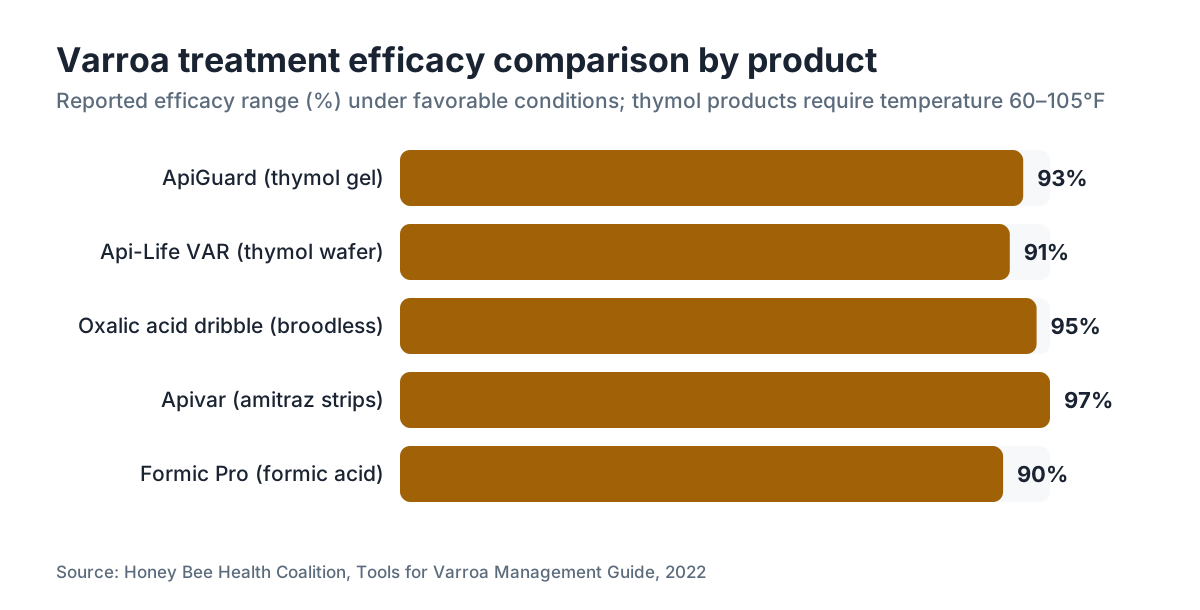
Under good temperature conditions, thymol products consistently hit 90 to 95% mite kill in controlled trials. A 2021 review by the Honey Bee Health Coalition cited field studies showing ApiGuard achieving 93% efficacy when ambient temperatures stayed within range and brood levels were low. [4]
Real-world performance is messier. A Pennsylvania State University extension study found on-farm efficacy ranged from 74% to 97% depending on application timing, hive strength, and how well beekeepers followed label instructions. [3] The low end of that range is not acceptable if your baseline mite load is already high.
| Product | Active ingredient (%) | Application schedule | Reported efficacy range | Temp window |
|---|---|---|---|---|
| ApiGuard | 25% thymol gel | 2 trays, 3 weeks apart | 90 to 95% | 60 to 105°F |
| Api-Life VAR | 74% thymol wafer | 3 apps, 7 to 10 days apart | 87 to 94% | 65 to 105°F |
| Oxalic acid (dribble) | 3.2% OA solution | Single treatment, broodless | 90 to 99% | 40°F+ |
| Amitraz strips (Apivar) | 3.3% amitraz | 6 to 8 weeks | 93 to 99% | 50°F+ |
That comparison isn't an argument against thymol. It's context. If you're in a region with stable summer temperatures in the 70 to 85°F range and you can time treatment to late summer when brood is contracting, thymol is an excellent choice with minimal residue concerns and no resistance issues documented in U.S. populations. [4]
If you're in the Deep South in July and your hive interiors routinely hit 106°F during the day, thymol is the wrong tool. Use formic acid or wait for cooler weather and switch to oxalic acid when the colony goes broodless.
When is the best time of year to apply thymol treatment?
Late summer to early fall is the window most university extensions recommend, and for good reason. In most of North America that means roughly late July through September. [3][5]
Here's the logic. Varroa populations peak in late summer because the colony has raised brood all season and mites have compounded. Honey supers are typically off or can come off. Daytime temperatures are warm enough (above 60°F) to drive thymol vaporization but not so extreme that you're risking overdose. And treating in late summer protects the long-lived winter bees being raised in August and September, because those bees have to survive 5 to 7 months to carry the colony into spring. [9]
Spring treatments are possible but trickier. Colonies often have a brood break in late winter or early spring in colder climates, which is ideal for oxalic acid. By the time temperatures consistently hit 60°F, the colony is usually ramping brood production back up, which shrinks thymol's reach.
The Honey Bee Health Coalition's Varroa management guide puts it plainly: treat based on mite counts, not the calendar. If your alcohol wash or sticky board count shows more than 2 mites per 100 bees, treat regardless of the season, then pick the product that fits your current temperature conditions. [4]
Monitoring is non-negotiable. You cannot guess at mite levels. Alcohol wash is more accurate than sticky boards. A half-cup (roughly 300 bees) is the standard sample size. Aim for a count below 1 mite per 100 bees going into winter.
How do you apply ApiGuard correctly?
ApiGuard is the most commonly used thymol product in the US, partly because the gel matrix releases thymol at a slower, more controlled rate than the wafer formulations.
Step-by-step for a single colony:
- Remove all honey supers. The label forbids use when supers are present. [1]
- Confirm ambient temperature will stay between 60°F and 105°F for the duration of treatment.
- Open the foil seal on one 50g tray. Place the tray gel-side up (or gel-side down, depending on the version, so read your specific label) directly on top of the brood frames, under the inner cover.
- Add a spacer (an empty medium super or eke) above the treatment frames to give bees room to circulate around the tray without being forced through a tight space that raises their exposure.
- Leave for 10 to 14 days, then replace with the second tray.
- Remove the second tray after 10 to 14 days.
Total treatment time is roughly 3 to 4 weeks. The most common mistake I see is forgetting to add a spacer, which crowds the bees and can push the queen to slow laying or the colony to try absconding. Don't skip it.
Keep a record of application dates, your pre-treatment mite count, and a post-treatment count taken 3 to 5 days after the last tray comes out. [8] If efficacy looks low (mite load drops less than 80%), figure out whether temperatures went out of range or brood levels ran higher than you expected.
How do you apply Api-Life VAR correctly?
Api-Life VAR is popular in Europe and among US beekeepers who prefer a shorter treatment interval per application. The wafer releases thymol faster than the gel, which means the temperature sensitivity is a bit higher on the upper end.
Step-by-step:
- Remove honey supers.
- Break one wafer into three roughly equal pieces.
- Place the three pieces on the top bars in three corners of the brood box, away from the center of the brood nest.
- Close the hive and leave for 7 to 10 days.
- Replace with a fresh wafer (broken into thirds again) for a second application.
- Repeat for a third application, for a total of three treatments over 21 to 30 days.
The corner placement matters. Concentrating all the vapor near the center of the brood nest can stress the queen and slow laying. Spreading the pieces distributes vapor more evenly.
Api-Life VAR tends to evaporate faster on very warm days, and some beekeepers report bee rejection of the wafer pieces (bees propolis them over or drag them out). If you see this happening, try placing pieces in small matchbox-sized containers with perforations to slow the release rate. That's a field adaptation I've heard from experienced sideliners, not a label instruction, so take it for what it is.
If you're running multiple hives and tracking treatment timing alongside mite counts, the free protocol resources at VarroaVault can help you log applications and get reminders on second and third treatments without losing track.
Is thymol safe for bees, queens, and brood?
At label rates and temperatures, adult bees tolerate thymol well. Studies have not found meaningful worker mortality at recommended doses. [2]
Queens are more sensitive. High thymol concentrations, from placing too many wafers, applying without a spacer, or treating during a heat wave, can push queens to slow egg laying or stop for a stretch. This usually reverses within a week or two of treatment completion, but a full laying shutdown during a fall buildup period can hurt your winter numbers. The practical fix is to keep thermal exposure away from the queen area by using a spacer and placing vapor sources away from the center cluster.
Brood mortality at label rates is low in most studies, but there's an important nuance. Open larvae are more sensitive than capped pupae to vapor exposure, and the patch of open brood sits right in the path of rising vapor. A 2019 University of Florida extension report noted that some beekeepers see spotty brood patterns during thymol treatment, particularly when temperatures top 90°F. [5] This typically clears up after treatment ends.
The bottom line: if temperatures are in range, you add a spacer, and you follow the label, the safety record is solid. Push the temperature limits or stack doses and you create real risk.
Thymol has some documented secondary benefits too. It's antifungal (relevant for chalkbrood suppression) and it repels small hive beetles, though neither effect is strong enough to treat it as a primary SHB control. [2]
Does thymol leave residue in honey or beeswax?
This is the question that separates thymol from synthetic miticides in most beekeepers' minds, and the answer is favorable but not zero.
At label rates with supers removed, thymol residues in comb wax are detectable but low. A widely cited German study found wax residues after two ApiGuard treatments averaged around 1.0 to 1.5 mg/kg, compared to background levels of 0.2 to 0.5 mg/kg in untreated hives (thymol is naturally present in small amounts in honey because bees forage on thyme). [6] The EU's maximum residue limit (MRL) for thymol in honey is 800 μg/kg (0.8 mg/kg). US EPA registration relies on the determination that thymol is Generally Recognized as Safe (GRAS) as a food additive at these levels. [1]
The practical takeaway: treat with supers off, wait at least two weeks after treatment ends before adding supers back, and you land well within safe residue limits. Treating while supers are present is a label violation and a real food safety risk.
Thymol does not build up in wax the way synthetic acaricides do. Coumaphos wax residues have been documented above 100 mg/kg in heavily treated hives. Thymol wax contamination at label rates is orders of magnitude lower and does not appear to impair queen rearing from that wax the way synthetic residue buildup can. [6]
For a fuller look at the varroa mite problem and how thymol fits into a full management rotation, that resource covers the parasite biology in detail.
Can mites develop resistance to thymol?
As of 2025, there is no documented field resistance to thymol in Varroa destructor populations. That's a meaningful advantage over amitraz and coumaphos, both of which have documented resistance in some US and European populations. [4]
Resistance is unlikely (though not impossible) because thymol's toxicity isn't mediated by a single receptor or enzyme pathway that a point mutation can defeat. It acts through multi-target membrane disruption. Evolving resistance would take multiple simultaneous genetic changes, which is a much steeper evolutionary hill.
That said, "no documented resistance" is not the same as "resistance is impossible." Rotate treatment classes anyway. The Honey Bee Health Coalition recommends treating with two different modes of action per year, for example thymol in late summer and oxalic acid in a broodless winter window, to reduce selection pressure on either compound. [4]
The Honey Bee Health Coalition's 2022 Varroa management guide states: "Rotate among different modes of action across treatment events to slow the development of resistance." [10] That guidance applies to every miticide, organic and synthetic.
How does thymol compare to other varroa treatments?
No single treatment is best for every beekeeper, every climate, and every time of year. Here's an honest comparison.
Thymol vs. oxalic acid: Oxalic acid is more effective per treatment event when colonies are broodless (90 to 99% kill on phoretic mites in a single application) but needs a broodless window that may not exist in warm climates. Thymol works on colonies with brood, giving it a broader seasonal window. [4]
Thymol vs. formic acid (MAQS, Formic Pro): Formic acid penetrates capped brood cells and kills mites under the cap, which thymol does not. That makes formic acid more powerful in high-brood situations. But formic acid has a narrower temperature window (50 to 85°F for most products) and higher queen loss risk, particularly in smaller colonies. Thymol is gentler on queens at label rates.
Thymol vs. amitraz (Apivar): Amitraz is the most effective single treatment available, with field efficacy above 95% across many conditions. It works at lower temperatures, does not require brood reduction, and lasts 6 to 8 weeks in the hive as a slow-release strip. The trade-offs are synthetic origin, documented resistance in some populations, and longer residue persistence in wax. If your mite levels are dangerously high going into fall, Apivar is probably the right rescue treatment. Thymol is a better fit for planned summer maintenance treatments.
Thymol is not the most powerful tool in the box. It's a well-matched tool for late-summer treatment in temperate climates when mite loads are moderate and you want to keep synthetic residue out of your wax.
For a broader look at sourcing the gear you'll need for any treatment approach, beekeeping supplies covers equipment including hive tools, protective gear, and treatment applicators.
What do extension services and the Honey Bee Health Coalition say about thymol?
The Honey Bee Health Coalition (HBHC), which includes the USDA, university researchers, and industry stakeholders, lists thymol products as one of four recommended organic treatment options in their Varroa management guide. They rate it as effective for moderate mite loads when temperature conditions are met, and note it as preferable to synthetic options for beekeepers who market honey as residue-free. [4]
The Penn State Extension Apiculture program, one of the most-cited US university sources on varroa, recommends ApiGuard and Api-Life VAR for late-summer treatments and provides specific dosing guidance aligned with EPA labels. Their materials note that "temperature management is the most critical factor in thymol treatment success." [3]
The University of Florida's bee lab has published extension materials noting that thymol performs best in the mid-Atlantic and northeastern states where late-summer temperatures are moderate, and that Florida beekeepers often need to wait until September or October for temperatures to drop into the effective range. [5]
The EPA's product registration for ApiGuard (Registration No. 92967-2) and Api-Life VAR (Registration No. 73049-20) classifies both as biochemical pesticides derived from naturally occurring substances, which is why they carry simpler registration requirements than synthetic miticides. [1]
None of these sources suggest thymol as the only tool you need. Every major guidance document treats it as one part of an integrated mite management rotation, not a standalone solution.
What are the most common mistakes beekeepers make with thymol treatments?
The same errors come up again and again in beekeeper forums, state apiarist reports, and extension Q&A sessions.
Treating at the wrong temperature. This is number one. A hive interior can hit 95 to 100°F on a hot summer day even when the ambient shade temperature reads 85°F. If you're in a region with hot summers, monitor hive interior temperatures before you apply. A cheap data logger (under $20) inside a hive body tells you more than a weather app.
Leaving honey supers on. The label is explicit. No supers. Beekeepers who treat with supers on risk residue in their honey crop and a label violation. Remove supers at least 24 hours before applying, and don't put them back on for at least two weeks after the last tray or wafer comes out.
Skipping the spacer on ApiGuard. Without a spacer, the gel tray sits right below the inner cover and bees push through a vapor cloud. Add an empty medium super or a purpose-built eke between the brood box and the inner cover.
Not monitoring before and after. Treating without a pre-treatment mite count means you don't know if treatment was necessary or if it worked. Do an alcohol wash before and 3 to 5 days after the treatment ends.
Treating once and calling it done. A single ApiGuard tray is not a complete treatment. The label requires two trays. Beekeepers who stop after one tray consistently see incomplete mite knockdown.
Ignoring brood levels. Treating a colony with a large brood nest in midsummer using thymol alone is a recipe for disappointment. If brood levels are high, consider formic acid instead, or wait until brood levels naturally contract in late summer.
Frequently asked questions
Can I use thymol treatment when honey supers are on?
No. Both ApiGuard and Api-Life VAR label instructions explicitly prohibit use when honey supers are present. Thymol vapors can push honey residues above acceptable limits. Remove supers before applying and wait at least two weeks after the final treatment before adding them back. Treating with supers on violates the EPA label, which is a federal pesticide law violation.
What temperature range is needed for thymol to work on varroa?
Thymol needs ambient temperatures between 60°F and 105°F to work effectively. Below 60°F, vapor production drops too low to reach lethal mite concentrations. Above 105°F, the product releases too fast and can harm brood or trigger absconding. Hive interior temperatures can run 5 to 10°F above ambient, so check actual hive temps on hot days before applying.
How long does thymol treatment take and how many applications are needed?
ApiGuard requires two trays applied three weeks apart, for a total treatment period of about 4 weeks. Api-Life VAR requires three wafer applications at 7 to 10 day intervals, spanning 21 to 30 days. A single application of either product is not a complete treatment. Follow the full course to reach the 90 to 95% efficacy reported in trials.
Does thymol kill varroa mites under capped brood?
No. Thymol vapor does not penetrate capped brood cells at concentrations high enough to kill mites. This is the treatment's main limitation. Mites reproducing under cappings are largely protected. The multi-week course is designed to catch newly emerged phoretic mites over several brood cycles, but it does not match formic acid's ability to reach mites inside sealed cells.
Will thymol treatment hurt my queen?
At label rates with a spacer added, most queens tolerate thymol treatment without permanent harm. Some queens temporarily slow laying during treatment, which usually resolves after the trays or wafers come out. Risk climbs if temperatures top 90°F, if you skip the spacer on ApiGuard, or if you use higher-than-labeled doses. Treat in cooler morning hours when you can and watch for laying disruption.
How effective is thymol against varroa compared to Apivar?
Amitraz strips (Apivar) generally achieve 93 to 99% efficacy across many conditions and brood levels. Thymol products achieve 90 to 95% when temperature conditions are met and brood is low. For planned late-summer maintenance treatments in temperate climates, the gap is small. For high mite loads or rescue treatments in tough conditions, amitraz is more reliable. Thymol wins on residue profile and resistance risk.
Can varroa mites develop resistance to thymol?
No documented field resistance to thymol has been reported as of 2025. Thymol acts through multi-target membrane disruption rather than a single enzyme pathway, making it harder for mites to evolve resistance through a simple mutation. Even so, rotating treatment classes (such as thymol in summer and oxalic acid in a broodless window) stays best practice to avoid selection pressure on a single compound.
What is the difference between ApiGuard and Api-Life VAR?
Both are thymol-based EPA-registered varroa treatments, but the formulations differ. ApiGuard is a 25% thymol gel in an aluminum tray, applied twice over four weeks. Api-Life VAR is a 74% thymol vermiculite wafer broken into pieces, applied three times over three to four weeks. ApiGuard releases vapor more slowly. Api-Life VAR has a higher concentration but a shorter per-application window. Both hit similar efficacy targets when used correctly.
How do I know if my thymol treatment worked?
Do an alcohol wash (300 bee sample) before treatment and again 3 to 5 days after the final tray or wafer comes out. A successful treatment should cut mite counts by 90% or more. If you started at, say, 5 mites per 100 bees and post-treatment counts show more than 1 per 100, look at whether temperatures went out of range, brood levels were high, or you missed a full application.
Is thymol treatment organic or natural?
Thymol is derived from thyme oil, a naturally occurring substance, and carries GRAS (Generally Recognized as Safe) status as a food additive with the FDA. The EPA classifies ApiGuard and Api-Life VAR as biochemical pesticides. They are permitted in certified organic beekeeping operations in the US under National Organic Program rules, provided honey supers are managed per label. Verify current NOP status with your certifier.
Can I use thymol in hot climates like Florida or Texas?
Thymol is challenging in climates with long stretches above 95°F. In Florida, University of Florida extension recommends waiting until September or October when temperatures moderate. In Texas, the treatment window may be limited to fall and spring. If your region rarely drops into the 60 to 85°F sweet spot during mite peak season, formic acid or oxalic acid may be more reliable, and your state apiarist can advise on local timing.
Do I need to monitor mite levels before deciding to use thymol?
Yes. The Honey Bee Health Coalition recommends treating when mite loads top 2 mites per 100 bees (1 to 2% infestation). Treating below that threshold wastes money and product. Treating above 3 to 4% means you may need a faster-acting option first. Alcohol wash is the most accurate monitoring method. Sample at least 300 bees from the brood area, count mites, and calculate percentage before choosing any treatment.
How much does thymol treatment cost per hive?
A full ApiGuard treatment (two trays) costs roughly $10 to $14 per hive in 2024 to 2025 pricing from major US beekeeping suppliers. Api-Life VAR is typically $8 to $12 for a three-application course. Prices vary by retailer and order quantity. Sideliners buying in 10-colony quantities often get modest bulk discounts. This is generally cheaper per colony than a full Apivar course and competitive with formic acid pads.
What is the tobe varroa mite treatment connection to thymol?
"Tobe varroa mite treatment" shows up in searches referring to approaches popularized in certain beekeeper communities that use thymol as the primary summer treatment tool. It is not a separate branded product. In context, it typically means thymol-first protocols for summer mite control, often paired with oxalic acid in broodless periods, aligning with Honey Bee Health Coalition rotation guidance.
Sources
- EPA - Pesticides program (biopesticide registration, thymol products ApiGuard and Api-Life VAR): ApiGuard (Reg. No. 92967-2) and Api-Life VAR (Reg. No. 73049-20) are EPA-registered biochemical pesticides for varroa control; labels prohibit use when honey supers are present
- Apidologie (Springer) - research on thymol as a varroa acaricide: mode of action and residues: Thymol kills Varroa destructor through vapor-phase multi-target membrane disruption; no single receptor target that enables simple resistance mutation
- Penn State Extension - Apiculture and honey bee program: Temperature management is the most critical factor in thymol treatment success; field efficacy ranged 74 to 97% depending on conditions and beekeeper compliance
- Honey Bee Health Coalition - Tools for Varroa Management Guide (6th edition): ApiGuard achieves 93% efficacy under good temperature conditions; HBHC recommends rotating among different modes of action across treatment events; treat when loads exceed 2 mites per 100 bees
- University of Florida IFAS Extension - EDIS publications on varroa mite control: Thymol performs best in mid-Atlantic and northeastern states; Florida beekeepers may need to wait until September or October; some beekeepers see spotty brood patterns during thymol treatment above 90°F
- Journal of Apicultural Research (Taylor & Francis) - thymol residues in beeswax and honey after ApiGuard treatment: Wax residues after two ApiGuard treatments averaged 1.0 to 1.5 mg/kg vs background 0.2 to 0.5 mg/kg; EU MRL for thymol in honey is 800 μg/kg; thymol does not accumulate in wax to the degree synthetic acaricides do
- USDA AMS National Organic Program - Organic rules and regulations: Thymol is permitted in certified organic beekeeping operations under National Organic Program rules
- Penn State Extension - Apiculture program (mite monitoring and alcohol wash guidance): Alcohol wash using a half-cup (approximately 300 bees) sample from the brood area is the recommended mite monitoring method; post-treatment counts should be taken 3 to 5 days after treatment ends
- University of Minnesota Extension - Bee and pollinator program: Thymol effective for late-summer treatment when brood is contracting; protecting winter bees raised in August and September is the primary goal of late-summer varroa treatment
- Honey Bee Health Coalition - Tools for Varroa Management Guide, resistance guidance: "Rotate among different modes of action across treatment events to slow the development of resistance" - direct guidance quote from HBHC guide
Last updated 2026-07-10