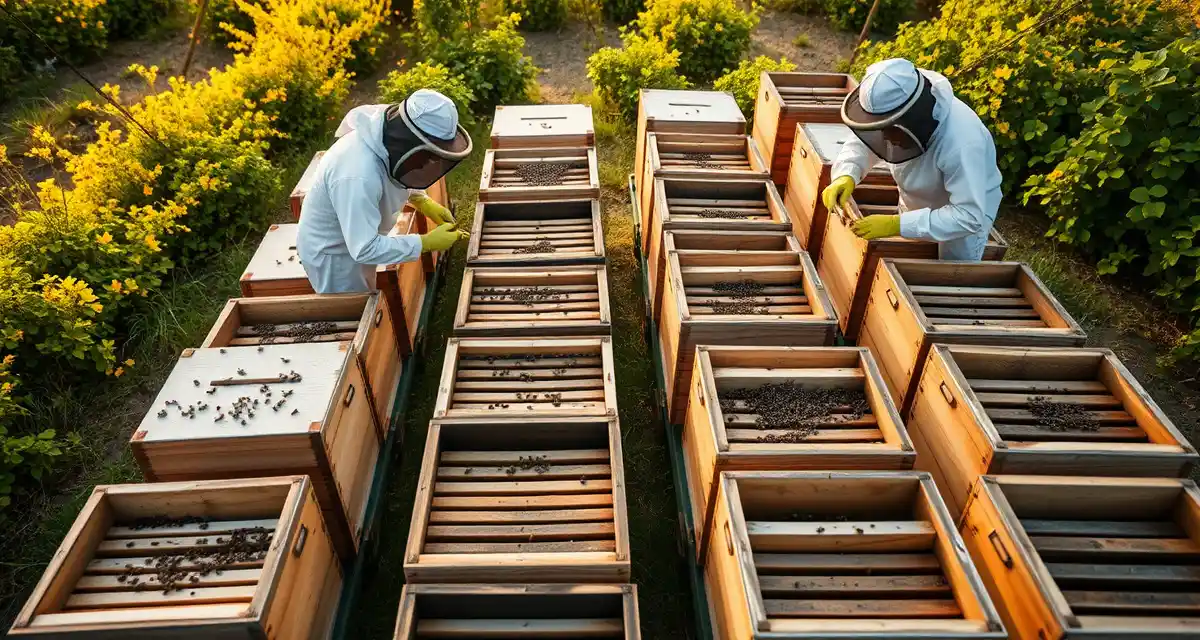
Varroa Management for Community Garden and Shared Apiaries
A single untreated hive in a community apiary is a varroa reservoir for all neighboring hives. This is the central varroa management challenge of shared beekeeping spaces, and it's one that individual beekeepers cannot fully solve on their own. If you're managing your hives diligently but your neighbor's colony at the far end of the garden is untreated and at 8% infestation, your post-treatment counts are going to rebound faster than they should.
Community and shared apiaries need a coordination layer that most individual beekeeping software simply doesn't provide.
TL;DR
- This guide covers key aspects of varroa management for community garden and shared apiaries
- Mite monitoring should happen at minimum every 3-4 weeks during active season
- The 2% threshold in spring/summer and 1% in fall are standard action points based on HBHC guidelines
- Always run a pre-treatment and post-treatment mite count to calculate efficacy
- Treatment records including product name, EPA number, dates, and counts are required for state inspection compliance
- VarroaVault stores all monitoring and treatment data with automatic threshold comparison and state export formatting
How Shared Apiaries Create Varroa Risk
In any apiary with multiple colonies in close proximity, mites move between hives through:
Robbing: When a weak colony is robbed by stronger neighbors, the robbing bees carry mites home with them. A collapsing high-mite colony can infest multiple neighbors simultaneously through a single robbing event.
Drift: Bees regularly enter the wrong hive, especially when hives face the same direction or are placed in rows. Drifting bees carry mites with them.
Swarm residue: If a colony in the shared apiary swarms and the swarm is collected by another beekeeper, the swarm carries mites from the parent colony into a new location. The parent colony's reduced population is also more vulnerable to SHB and wax moth.
In a community apiary with 6 beekeepers and 12 hives, each individual beekeeper's colony is exposed to mite pressure from all 12 hives through these mechanisms. If any one of those 12 hives is poorly managed, it affects everyone.
The Case for Community Varroa Policies
Many community apiaries have policies about hive placement, feeding, and inspection schedules. Far fewer have explicit varroa management policies. This is a gap worth addressing.
A minimal community varroa policy might include:
- Required mite counts a minimum of twice per year (spring and summer)
- A trigger threshold for required treatment (for example, any colony above 2% in summer)
- Required treatment notification for other apiary members when a colony is above threshold
- A timeline for completing treatment after a threshold breach
- A consequence for beekeepers whose colonies consistently exceed threshold without treatment
Community apiaries that adopt policies like this see lower average mite counts across all colonies because the "free rider" problem, where one member's untreated colony benefits from everyone else's management, is removed.
VarroaVault's shared apiary mode lets multiple beekeepers log counts and coordinate treatments in one location. Each beekeeper manages their own hive records, but the apiary dashboard shows aggregate mite status across all hives in the shared space. When one member's count is above threshold, other members can see it.
How to Coordinate Treatment in a Shared Apiary
Timing: Coordinating treatment timing so all hives in a shared apiary are treated simultaneously dramatically reduces reinfestation risk. If all 12 hives in a community garden apiary treat in the same week, the neighborhood mite reservoir drops together. If treatments are staggered over six weeks, early-treated colonies are being reinvested from the still-untreated colonies throughout the window.
Communication: A shared apiary group chat or monthly check-in meeting where members report their mite counts creates accountability. When beekeepers know others will see their counts, monitoring compliance improves.
Policy enforcement: This is the difficult part. Community apiaries need some mechanism for addressing non-compliance. Options include a formal agreement beekeepers sign when joining the apiary, an apiary coordinator with authority to require action for high-count colonies, or in the most serious cases, removal of unmanaged colonies from the shared space.
Setting Up VarroaVault for a Shared Apiary
Create a shared apiary location in VarroaVault and invite each participating beekeeper to link their hives to the shared location. Each beekeeper has their own account and controls their own records. The apiary dashboard shows aggregate health data across all linked hives without exposing individual beekeeper data to others unless they choose to share it.
The varroa reinfestation from drifting and robbing guide covers the science of how mites move between colonies, which is directly relevant to understanding why community coordination matters. For urban-specific varroa dynamics in shared spaces, the varroa management for urban beekeeping guide covers reinfestation risk in dense environments.
Frequently Asked Questions
How do I coordinate varroa treatment in a shared apiary?
Start with communication: share mite count results with fellow apiary members at least twice per year. Propose a coordinated treatment schedule where all beekeepers treat during the same window, reducing reinfestation risk for everyone. Use VarroaVault's shared apiary mode to give everyone visibility into the apiary's aggregate mite status without requiring individual records to be shared.
Should community apiaries have a varroa treatment policy?
Yes. A policy that sets minimum monitoring requirements and treatment thresholds protects all members of the shared apiary from the consequences of one member's unmanaged colony. Community apiaries with explicit policies have lower average mite counts than those relying on individual good faith. The policy doesn't need to be punitive, but it does need to be clear.
What happens if one beekeeper in a shared apiary doesn't treat?
Their colony becomes a mite reservoir that continuously reinvests the treated colonies of their neighbors. Post-treatment counts for other members will rebound faster than expected. Over time, the untreated colony typically crashes, which then causes a robbing event that distributes mites from the collapsing colony throughout the shared apiary in a sudden spike. The impact of one neglected colony in a shared space extends far beyond that single beekeeper's hives.
How do I know if my varroa treatment is working?
Run a mite count 2-4 weeks after the treatment ends and compare it to your pre-treatment count. The efficacy formula is: ((pre-count - post-count) / pre-count) x 100. A result above 90% indicates effective treatment. Results below 80% should trigger investigation for possible resistance, application error, or reinfestation. Log both counts in VarroaVault to track efficacy trends across treatment cycles.
How often should I check mite levels in my hives?
At minimum, once per month (every 3-4 weeks) during the active season. Increase to every 2 weeks when counts are near threshold or after a treatment to verify it worked. In fall, monitoring frequency matters most because the window to treat before winter bees are raised is narrow. VarroaVault's monitoring reminders can be set to your preferred interval for each apiary.
What records should I keep for varroa management?
Each record should include: date of count or treatment, hive identifier, monitoring method used, number of bees sampled, mites counted, infestation percentage, treatment product name and EPA registration number, dose applied, treatment start and end dates, and PHI end date. State apiarists typically expect this level of detail during inspections. VarroaVault captures all of these fields in a single log entry.
What is Varroa Management for Community Garden and Shared Apiaries?
Varroa management for community garden and shared apiaries refers to the coordinated monitoring and treatment of varroa mite infestations across multiple colonies managed by different beekeepers in a shared space. Because mites spread between nearby hives through drifting and robbing, a single untreated colony can reinfest treated neighbors. Effective management requires synchronized monitoring schedules, shared treatment protocols, and collective recordkeeping rather than relying on each individual beekeeper to act independently.
How much does Varroa Management for Community Garden and Shared Apiaries cost?
Varroa management itself relies on approved treatments that vary in cost — oxalic acid vaporizers, formic acid strips, and synthetic miticides range from a few dollars to $30+ per application. Coordination tools like VarroaVault offer structured recordkeeping and threshold tracking to reduce wasted treatments from premature or mistimed applications. The real cost of poor management is colony loss, which far exceeds any treatment expense, making shared apiary coordination a sound investment.
How does Varroa Management for Community Garden and Shared Apiaries work?
Shared apiary varroa management works by establishing a common monitoring schedule — typically every 3–4 weeks during active season — where all beekeepers conduct alcohol wash or sugar roll counts. Results are compared against action thresholds (2% in spring/summer, 1% in fall). When any hive exceeds a threshold, coordinated treatment is triggered across the apiary to prevent reinfestation. Pre- and post-treatment counts confirm efficacy, and all data is logged for state inspection compliance.
What are the benefits of Varroa Management for Community Garden and Shared Apiaries?
The primary benefit is breaking the reinfestation cycle that undermines individual treatment efforts. When all hives are monitored and treated together, mite populations across the apiary stay suppressed simultaneously. This means treatments last longer, colonies remain healthier through winter, and overall colony losses decrease. A coordinated approach also simplifies compliance with state inspection requirements, since shared recordkeeping tools can generate formatted reports with product names, EPA registration numbers, application dates, and mite counts.
Who needs Varroa Management for Community Garden and Shared Apiaries?
Anyone keeping bees in a shared space needs coordinated varroa management — community garden apiaries, beekeeping club demonstration hives, educational apiaries, and urban rooftop setups with multiple keepers. New beekeepers especially benefit, since a coordinated system provides structure and accountability. Even experienced beekeepers managing their own hives diligently are exposed to risk if neighboring colonies are untreated. Shared apiary varroa management is essential wherever hive-to-hive mite transfer is possible due to proximity.
Related Articles
- Backyard Beekeeper Varroa Program: A Simple 4-Step Plan for 1-5 Hives
- Bee Yard Biosecurity: Preventing Varroa Spread Between Apiaries
Sources
- American Beekeeping Federation (ABF)
- USDA ARS Bee Research Laboratory
- Honey Bee Health Coalition
- Penn State Extension Apiculture Program
- Project Apis m.
Get Started with VarroaVault
The information in this guide is most useful when you have your own mite count data to apply it to. VarroaVault stores every count, flags threshold crossings automatically, and builds the treatment history you need for state inspections and effective management decisions. See pricing and free tools at varroavault.com.