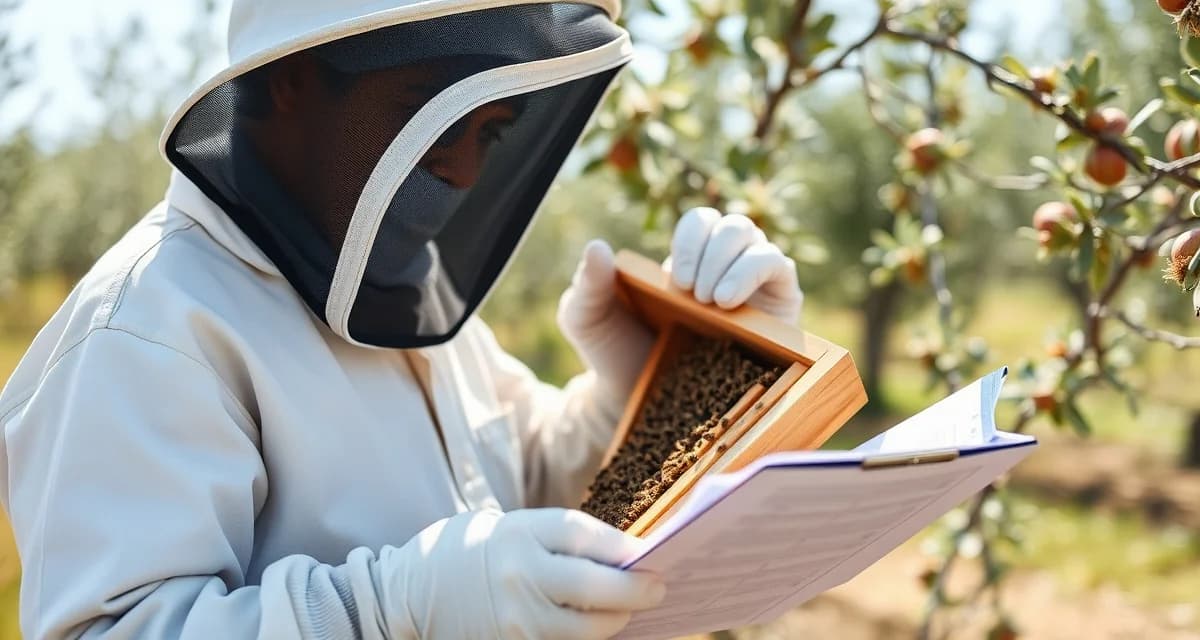
Varroa Management for Pollination Contract Compliance
California almond pollination contracts now commonly require colony health records including varroa treatment history for the prior 90 days. If you provide commercial pollination services and can't produce those records, you risk losing your contract, facing payment disputes, or being turned away at the delivery gate.
This guide covers what pollination contracts require, how to build a documentation system, and how VarroaVault generates contract-ready records.
TL;DR
- This guide covers key aspects of varroa management for pollination contract compliance
- Mite monitoring should happen at minimum every 3-4 weeks during active season
- The 2% threshold in spring/summer and 1% in fall are standard action points based on HBHC guidelines
- Always run a pre-treatment and post-treatment mite count to calculate efficacy
- Treatment records including product name, EPA number, dates, and counts are required for state inspection compliance
- VarroaVault stores all monitoring and treatment data with automatic threshold comparison and state export formatting
How Pollination Contract Requirements Have Changed
Ten years ago, a handshake and a truck full of strong colonies was sufficient for most pollination contracts. Today, especially in California almonds, the largest and most lucrative pollination market in the US, the documentation requirements have formalized significantly.
The change was driven by growers experiencing pollination failures from undersized, mite-stressed colonies, combined with increased regulatory attention to agricultural pesticide use. Growers and brokers started requiring verification that the colonies arriving at their orchards were actually healthy.
Current contract requirements typically include:
Colony strength standards:
- Minimum 6-8 frames of bees per hive (expressed as "8-frame equivalent" or "6-frame equivalent" depending on the contract)
- Minimum number of frames of capped brood
- Active, laying queen confirmed or documented
Health documentation:
- Varroa treatment history for the 90 days prior to delivery
- Treatment records showing product name, application dates, and method
- Current mite count (within 14-30 days of delivery)
- PHI compliance confirmation: confirmation that any treatments applied before delivery complied with pre-harvest intervals for the crop being pollinated
State health certificate:
- Interstate movement permit with state apiarist inspection for colonies crossing state lines
- Health certificate typically valid for 30 days from issue
Pesticide residue disclosure:
- Some contracts require disclosure of any pesticide treatments applied in the prior 30-90 days
- Premium contracts may require residue testing for specific acaricides
What a Pollination Contract Audit Looks Like
When colonies arrive at a pollination site, the broker or grower may conduct a receiving audit:
- Physical inspection: Frame counts per hive, bee population assessment
- Record review: Request to see treatment records and health certificates
- Spot mite counts: Some high-value contracts have inspectors perform spot-check mite counts at delivery
Colonies that fail to meet contract strength standards may be rejected or downgraded. In the almond industry, downgraded colonies receive reduced payment (e.g., 75% of the contract price for colonies that meet minimum but not premium standards).
Colonies that arrive without health documentation create a payment dispute that takes time and money to resolve. With documentation in hand, the conversation is straightforward.
Building Your Pollination Documentation System
Step 1: Know your contract requirements.
Read the colony strength and health documentation requirements in each contract you sign. Requirements vary by broker, grower, and crop. California almonds are the most demanding; other contracts may have simpler requirements.
Step 2: Start a treatment log for all pollination colonies 90 days before delivery.
If your almond delivery is February 1, your 90-day treatment record window opens November 1. Any treatment applied from November 1 forward needs to be in your documentation. Treatments before that window typically don't need to be documented.
Step 3: Confirm PHI compliance for the pollination crop.
Honey bees pollinating almonds aren't producing honey for human consumption during this period, but if your colonies will later be used for honey production or if the orchard has any food safety concerns, confirm that your treatments cleared PHI before delivery.
Step 4: Schedule a pre-delivery mite count.
A mite count 14-30 days before delivery documents current colony health. The count should be from a representative sample of your pollination colonies, not just your best ones.
Step 5: Generate your pollination compliance report.
VarroaVault's pollination compliance report generates per-hive strength and treatment records formatted for contract review. Select the hives in your pollination set, specify the 90-day reporting window, and export as PDF.
What VarroaVault Generates for Pollination Contracts
The pollination compliance report in VarroaVault includes:
Per-hive section:
- Hive ID/name
- Colony strength assessment (from your inspection log: frames of bees, frames of brood)
- Varroa count history for the reporting window
- Treatment history: product, date, EPA registration number, applicator
- PHI clearance status for each treatment
Apiary summary:
- Average mite count across the pollination set
- Count of colonies above/below contract strength standards
- Any colonies with outstanding treatment or count overdue alerts
Documentation statement:
- Summary confirming all treatments in the window used registered products
- PHI compliance statement
- Inspector name and date of most recent inspection if applicable
This format matches what most California brokers and growers accept for documentation review. Some premium contracts may require additional certifications; verify with your specific broker what additional documentation they require.
Communicating With Growers and Brokers About Varroa Management
Increasingly, growers and brokers appreciate beekeepers who proactively share their management documentation. Being the pollinator who arrives with a clean, organized health record is a competitive differentiator in a market where documentation is becoming standard.
Consider:
- Sharing a preliminary compliance report with your broker 2 weeks before delivery so they can review and flag any questions before colonies arrive
- Documenting any mite treatment done specifically to prepare colonies for pollination placement
- Keeping records of your response to any disease or mite findings discovered at pollination sites (some contracts require this)
Special Considerations for Multi-State Movement
If you're moving colonies across state lines for pollination (e.g., California almonds, Michigan blueberries, Maine cranberries), you need an interstate movement permit and a health certificate from your state apiarist. The state apiarist will inspect colonies before issuing the certificate.
Your VarroaVault treatment records support the state apiarist inspection: inspectors want to see that you've been managing varroa appropriately and that your treatment history is complete. Organized digital records make this inspection faster and more straightforward.
Frequently Asked Questions
What varroa records do pollination contracts require?
Most commercial pollination contracts, particularly California almond contracts, require 90-day treatment records showing product names, application dates, and EPA registration numbers; current mite count within 14-30 days of delivery; PHI compliance confirmation; and colony strength documentation (frames of bees and brood). Interstate movement also requires a current state health certificate.
How do I generate pollination contract documentation in VarroaVault?
Use VarroaVault's pollination compliance report: select the hives in your pollination set, specify the 90-day reporting window, and export. The report generates a per-hive PDF showing treatment history, mite count records, colony strength assessments, and PHI compliance status for each hive in the format most brokers and growers accept.
Are VarroaVault records accepted by major pollination brokers?
VarroaVault's compliance export is formatted to match the documentation requirements of major California almond brokers and other major pollination markets. If a broker has a specific format requirement, VarroaVault's export data can be reorganized into their template. Contact your broker to confirm their specific format if you have concerns.
How do I know if my varroa treatment is working?
Run a mite count 2-4 weeks after the treatment ends and compare it to your pre-treatment count. The efficacy formula is: ((pre-count - post-count) / pre-count) x 100. A result above 90% indicates effective treatment. Results below 80% should trigger investigation for possible resistance, application error, or reinfestation. Log both counts in VarroaVault to track efficacy trends across treatment cycles.
How often should I check mite levels in my hives?
At minimum, once per month (every 3-4 weeks) during the active season. Increase to every 2 weeks when counts are near threshold or after a treatment to verify it worked. In fall, monitoring frequency matters most because the window to treat before winter bees are raised is narrow. VarroaVault's monitoring reminders can be set to your preferred interval for each apiary.
What records should I keep for varroa management?
Each record should include: date of count or treatment, hive identifier, monitoring method used, number of bees sampled, mites counted, infestation percentage, treatment product name and EPA registration number, dose applied, treatment start and end dates, and PHI end date. State apiarists typically expect this level of detail during inspections. VarroaVault captures all of these fields in a single log entry.
What is Varroa Management for Pollination Contract Compliance?
Varroa management for pollination contract compliance refers to the systematic monitoring, treatment, and documentation of varroa mite levels in honey bee colonies to meet the health record requirements now standard in commercial pollination contracts. California almond contracts, for example, commonly require verified mite counts and treatment history for the prior 90 days before colonies are accepted at the delivery gate.
How much does Varroa Management for Pollination Contract Compliance cost?
Varroa management itself isn't a paid service — it's an operational requirement for commercial beekeepers. The real cost is non-compliance: lost contracts, payment disputes, or being turned away at delivery. Tools like VarroaVault provide low-cost record-keeping and reporting infrastructure, which is far less expensive than losing a single pollination contract over missing documentation.
How does Varroa Management for Pollination Contract Compliance work?
Effective varroa management for contract compliance involves mite monitoring every 3–4 weeks using alcohol wash or sugar roll methods, applying approved treatments when counts exceed 2% in spring/summer or 1% in fall, and documenting every step. Records must include product name, EPA registration number, application dates, and pre/post mite counts. Platforms like VarroaVault automate threshold alerts and generate state-ready export reports.
What are the benefits of Varroa Management for Pollination Contract Compliance?
Maintaining documented varroa management practices protects your pollination contracts, reduces colony losses before high-value placements, and demonstrates professionalism to growers. Verified treatment records also satisfy state inspector requirements and position your operation competitively as documentation standards tighten industry-wide. Post-treatment efficacy tracking ensures treatments are actually working, not just recorded.
Who needs Varroa Management for Pollination Contract Compliance?
Commercial beekeepers providing pollination services — especially for California almonds, Pacific Northwest blueberries, or other crops with evolving contract standards — need formal varroa management documentation. Operations with 50+ colonies, those working with corporate growers or co-ops, and any beekeeper facing state inspections will benefit most. Smaller operations planning to scale into pollination contracts should build these systems early.
Related Articles
- Beekeeping Grants for Varroa Management: USDA and State Programs
- Beekeeping Software for Alabama Beekeepers: Varroa Tracking and PHI Compliance
- Beekeeping Software for Alaska Beekeepers: Short Season Varroa Management
Sources
- American Beekeeping Federation (ABF)
- USDA ARS Bee Research Laboratory
- Honey Bee Health Coalition
- Penn State Extension Apiculture Program
- Project Apis m.
Get Started with VarroaVault
The information in this guide is most useful when you have your own mite count data to apply it to. VarroaVault stores every count, flags threshold crossings automatically, and builds the treatment history you need for state inspections and effective management decisions. See pricing and free tools at varroavault.com.