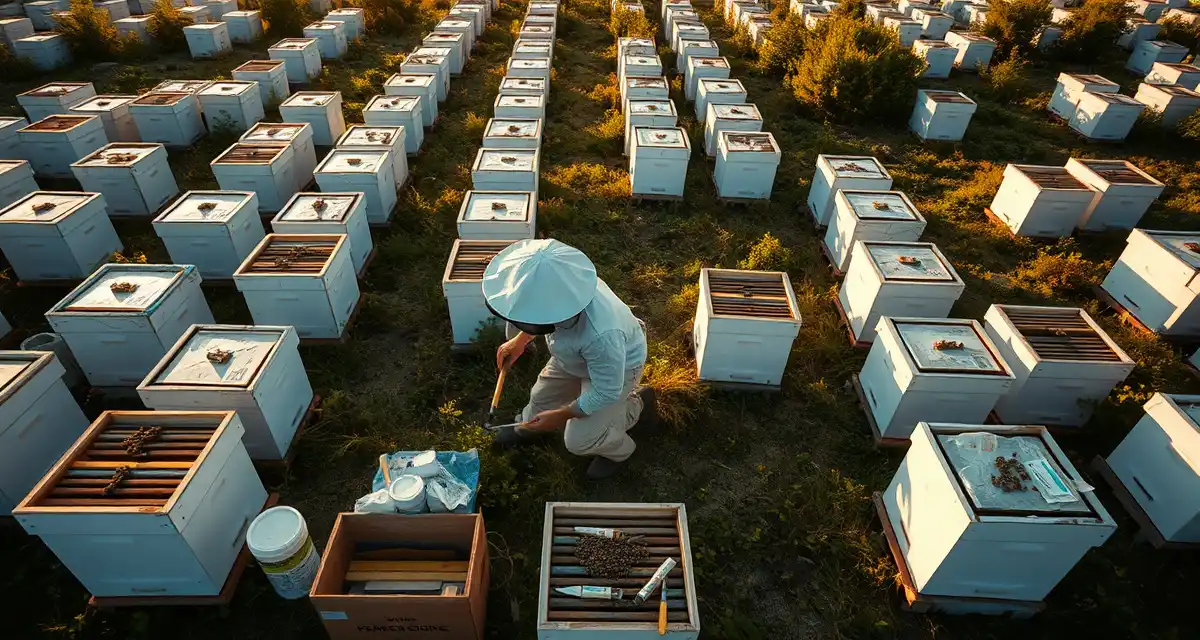
The Economics of Commercial Beekeeping and Varroa: ROI at Scale
The financial case for structured varroa management looks compelling at 5 hives. At 300 hives, it becomes overwhelming. The 2025 average replacement nucleus colony price of $280 means VarroaVault's commercial ROI break-even is 2.5 saved colonies per year -- an almost trivially small threshold for any operation managing three-digit hive counts.
But the economics of commercial varroa management go deeper than the simple replacement cost calculation. Let's look at the full picture.
TL;DR
- Commercial operations managing 50+ hives cannot rely on per-hive manual records without significant time investment
- Treatment efficacy must be tracked across yards, not just individual hives, to detect resistance patterns
- USDA APHIS and state apiarists increasingly request documented treatment protocols for commercial inspections
- PHI compliance across multiple apiaries and multiple treatments requires a systematic tracking system
- VarroaVault's commercial tier supports multi-yard management with yard-level reporting and bulk data entry
- Generating a treatment history report for all apiaries takes under 60 seconds in VarroaVault
The Real Cost of Varroa at Commercial Scale
Colony replacement. At $280 per nuc, losing 30 colonies out of 300 -- a 10% loss rate, below the national average -- costs $8,400 in replacement stock alone. A well-managed operation at 5-8% winter loss saves $4,200-7,000 per year compared to the national average 37% loss rate. An operation at 37% loss rate on 300 hives replaces 111 colonies at a cost of $31,080 annually in replacement stock.
Reduced honey production. A poorly managed colony that limps through winter doesn't produce efficiently in spring. Varroa-stressed colonies show reduced foraging efficiency, shorter worker lifespan, and depressed honey production throughout the season. At a conservative estimate, a varroa-stressed colony produces 30-40% less honey than a healthy one. Across a 300-hive operation, even a 20% production improvement from better mite management adds up to substantial additional revenue.
Pollination service reliability. If your operation provides pollination services, colony quality directly affects your contract reliability. Almond pollination contracts in California specify minimum colony strength requirements. Colonies that fail to meet those requirements -- often because late-season varroa damage has reduced population going into spring buildup -- either can't fill contracts or require emergency supplemental bees. Contract penalties and last-minute replacement costs are significant.
Labor efficiency. Emergency varroa management is expensive. Diagnosing dying colonies, sourcing emergency treatments, managing treatment logistics under pressure -- all of this costs more than planned management. Operations that treat varroa reactively spend 40-60% more labor time on varroa management than those with structured programs. At commercial scale, that's meaningful money.
The VarroaVault Professional ROI Model
The ROI model for commercial beekeepers calculates break-even at 12 preserved colonies per year -- but that's the full professional plan cost at $708/year ($59/month). At the actual replacement cost of $280 per nuc, you need to prevent just 2.5 colony losses to cover the subscription cost.
For a 300-hive operation, here's a realistic scenario:
Current state (national average 37% loss rate): 111 colonies lost annually at $280 each = $31,080 in replacement stock.
Improved management (15% loss rate achievable with structured protocols): 45 colonies lost annually = $12,600 in replacement stock.
Annual savings from the improvement: $18,480.
VarroaVault Professional cost: $708/year.
Net ROI: $17,772 per year.
Even a modest improvement from 37% to 25% loss rates would save $33,600 - $22,680 = $10,920 annually net of the subscription cost. The subscription pays for itself before you finish calculating whether it's worth it.
What Commercial-Scale Varroa Management Actually Looks Like
At 300 hives, individual hive monitoring is impractical if applied equally to every colony. Commercial operations use several approaches to make monitoring manageable:
Sentinel hive programs. Designate 10-15% of hives in each apiary as sentinel hives -- monitored monthly while the broader flock is monitored quarterly. Sentinel hives give you early warning of apiary-level mite pressure changes without requiring 300 individual monthly counts.
Representative sampling. Statistical sampling of 10-15% of hives per apiary, selected at random, provides 90%+ confidence in the apiary-level mite status. This approach has a scientific basis and is documented in the commercial beekeeper operations guide.
Batch treatment scheduling. Treating an entire apiary on the same day, rather than individual colonies at different times, is the only practical approach at scale. This requires planning your treatment windows by apiary and scheduling treatment days on a calendar.
Crew logging. At 300+ hives, you need treatment logs that multiple people can enter data into. VarroaVault's professional plan supports crew access with individual user accounts, so every treatment event is logged by the person who performed it, with their credentials attached to the record.
Compliance Cost at Commercial Scale
state inspection requirements become a serious time cost at commercial scale. Preparing records for an inspection on a 300-hive operation using paper logs can take 8-16 hours. With VarroaVault's compliance export features -- pre-formatted for 27 state apiarists -- that preparation takes minutes.
Commercial beekeepers managing 500+ hives report that compliance documentation takes more time than the physical treatment itself when records are paper-based. State inspection failure rates for operations with disorganized records are 3x higher than for those with organized digital records. Beyond the cost of failed inspections, some state programs require treatment interventions for operations out of compliance, adding both cost and management burden.
The commercial beekeeper management software section of VarroaVault's professional plan documentation details all compliance and crew management features.
Treatment Costs vs. Management Costs
Commercial beekeepers often focus on minimizing treatment supply costs, but treatment costs are a small fraction of total varroa management costs. For 300 hives:
- Apivar strips (6 strips per colony at ~$2/strip): $3,600/year for two fall/spring treatments
- Api-Bioxal for broodless period dribble on all hives: ~$500/year in material
- Total treatment material costs: ~$4,100/year
Management labor and record-keeping at 2 hours per treatment event per apiary (assuming 10 apiaries) at $18-25/hour adds another $3,600-5,000 per year just for treatment days, not counting monitoring.
The cost of not managing effectively -- in replacement colonies, in lost production, in compliance risk -- dwarfs both of these figures. The economics of varroa management at commercial scale are clear: the investment in structured systems always returns more than it costs.
Frequently Asked Questions
What is the financial ROI of VarroaVault for commercial beekeepers?
At the national average winter loss rate of 37%, a 300-hive operation loses roughly 111 colonies annually, costing $31,080 in replacement stock at $280 per nuc. Operations using structured varroa management programs typically achieve 10-15% loss rates, saving $18,000-25,000 annually in replacement costs alone. VarroaVault Professional at $708/year generates a break-even at just 2.5 prevented colony losses. The typical commercial operation sees a net return well in excess of 10:1 on the subscription cost.
How many hive losses does VarroaVault need to prevent at 300 hives to pay for itself?
VarroaVault Professional costs $708/year. At a replacement cost of $280 per nucleus colony, you need to prevent 2.5 colony losses to break even on the annual subscription. For a 300-hive operation, that's less than 1% of your hive count -- a threshold that any structured monitoring and treatment program will exceed in its first year. The more meaningful ROI comparison is what improving your annual loss rate from the national average to well-managed levels saves in replacement stock over 5 years.
Can I see case study data on commercial VarroaVault ROI?
The treatment program case study page includes documented outcomes from commercial operations using VarroaVault Professional. Case studies cover winter survival improvement, compliance time savings, and pollination contract reliability for operations ranging from 100 to 2,000 hives. The ROI calculator in the professional plan allows you to input your own operation size and current loss rate to generate a custom projection.
How do I know if my varroa treatment is working?
Run a mite count 2-4 weeks after the treatment ends and compare it to your pre-treatment count. The efficacy formula is: ((pre-count - post-count) / pre-count) x 100. A result above 90% indicates effective treatment. Results below 80% should trigger investigation for possible resistance, application error, or reinfestation. Log both counts in VarroaVault to track efficacy trends across treatment cycles.
How often should I check mite levels in my hives?
At minimum, once per month (every 3-4 weeks) during the active season. Increase to every 2 weeks when counts are near threshold or after a treatment to verify it worked. In fall, monitoring frequency matters most because the window to treat before winter bees are raised is narrow. VarroaVault's monitoring reminders can be set to your preferred interval for each apiary.
What records should I keep for varroa management?
Each record should include: date of count or treatment, hive identifier, monitoring method used, number of bees sampled, mites counted, infestation percentage, treatment product name and EPA registration number, dose applied, treatment start and end dates, and PHI end date. State apiarists typically expect this level of detail during inspections. VarroaVault captures all of these fields in a single log entry.
What is The Economics of Commercial Beekeeping and Varroa: ROI at Scale?
Commercial beekeeping varroa economics examines the full financial impact of varroa mite infestations on operations managing 50 or more hives. At scale, losses compound rapidly—replacement nucleus colonies average $280 each in 2025, and unmanaged varroa can devastate entire yards. Structured tracking tools like VarroaVault reach ROI break-even by saving just 2.5 colonies per year, making the financial case straightforward for any three-digit hive operation.
How much does The Economics of Commercial Beekeeping and Varroa: ROI at Scale cost?
VarroaVault's commercial tier pricing is designed to break even after saving fewer than three colonies annually—a threshold easily met at scale. Compared to the $280 average replacement cost per nucleus colony in 2025, plus lost honey production and pollination revenue, the cost of systematic varroa tracking software is negligible. The greater cost of inaction—colony losses, resistance patterns going undetected, and compliance failures—far exceeds any subscription fee.
How does The Economics of Commercial Beekeeping and Varroa: ROI at Scale work?
At commercial scale, varroa management works by tracking mite loads across entire yards rather than individual hives, identifying resistance patterns early, and maintaining PHI-compliant treatment records across multiple apiaries. VarroaVault enables bulk data entry, yard-level reporting, and generates complete treatment history reports in under 60 seconds—replacing manual per-hive record keeping that becomes unmanageable beyond 50 hives.
What are the benefits of The Economics of Commercial Beekeeping and Varroa: ROI at Scale?
Systematic varroa management at scale reduces colony replacement costs, improves treatment efficacy by detecting resistance patterns across yards, and ensures compliance with USDA APHIS and state apiarist documentation requirements. Operations with documented treatment protocols are better positioned during commercial inspections. Multi-yard visibility also enables smarter resource allocation—targeting treatments where mite pressure is highest rather than applying blanket protocols across all apiaries.
Who needs The Economics of Commercial Beekeeping and Varroa: ROI at Scale?
Any beekeeping operation managing 50 or more hives needs structured varroa economics tracking. At this scale, manual per-hive records become a significant time burden, PHI compliance across multiple treatments and apiaries requires systematic documentation, and undetected resistance patterns can trigger cascading colony losses. Commercial beekeepers supplying pollination services face additional pressure, since colony health directly impacts contract fulfillment and reputation with growers.
Sources
- American Beekeeping Federation (ABF)
- USDA ARS Bee Research Laboratory
- Honey Bee Health Coalition
- Penn State Extension Apiculture Program
- Project Apis m.
Get Started with VarroaVault
Commercial beekeeping operations need a varroa management system that scales across yards, generates compliance-ready reports, and flags resistance before it costs you colonies. VarroaVault was built for exactly this kind of multi-apiary operation. Start your free trial at varroavault.com and see how it fits your operation.