Varroa mite size: how big they actually are and why it matters
TL;DR
- A Varroa destructor female is about 1.1 to 1.8 mm wide and 1.0 to 1.1 mm long, roughly the size of a sesame seed.
- That makes her visible to the naked eye as a reddish-brown oval on a bee's body.
- Her size decides which monitoring methods catch her and which treatments reach her.
How big is a varroa mite exactly?
Varroa destructor is a flat, oval outside parasite. Adult females measure about 1.1 to 1.8 mm wide and 1.0 to 1.1 mm long [1]. That footprint is wider than it is long, which sets varroa apart from most mites you'll meet anywhere else. Males are much smaller, around 0.8 mm, and they die inside the cell after mating. You'll never see one in a wash sample.
Picture a sesame seed, maybe a touch smaller. A trained eye spots her clinging to a bee's abdomen, especially against the pale membrane between the abdominal plates. Not microscopic. Not easy to miss once you know the shape.
The body is also strikingly flat, around 0.75 mm deep [1]. That flatness lets her slide under a bee's abdominal plates and feed while the bee grooms, staying half-hidden the whole time. It's a body built for this exact job.
Can you see varroa mites without a microscope?
Yes, easily. The 1.1 to 1.8 mm width sits right at the edge of comfortable unaided vision for most adults. You don't need magnification to see a mite on a bee. A 10x hand lens earns its keep during brood inspections, when you're hunting for mites inside open cells.
On adult bees, varroa shows up as a reddish-brown to dark mahogany oval, usually tucked in the groove between abdominal segments on the bee's top side. She sits crosswise to the bee's body axis, a detail a hand lens helps confirm.
Capped brood hides everything. Nothing shows on the outside of a sealed cell. That's the whole reason alcohol wash and sugar roll methods exist: they knock mites off adult bees so you can count them in solution. A drone brood uncapping tool lets you pull pupae straight out and eyeball the mites inside, which get obvious fast once you're past the capping.
The first time a new beekeeper sees a real mite on a real bee's back, something clicks. Photos never quite land the way it does in person. A brick-red mite against a yellow-and-black abdomen is louder than any picture suggests.
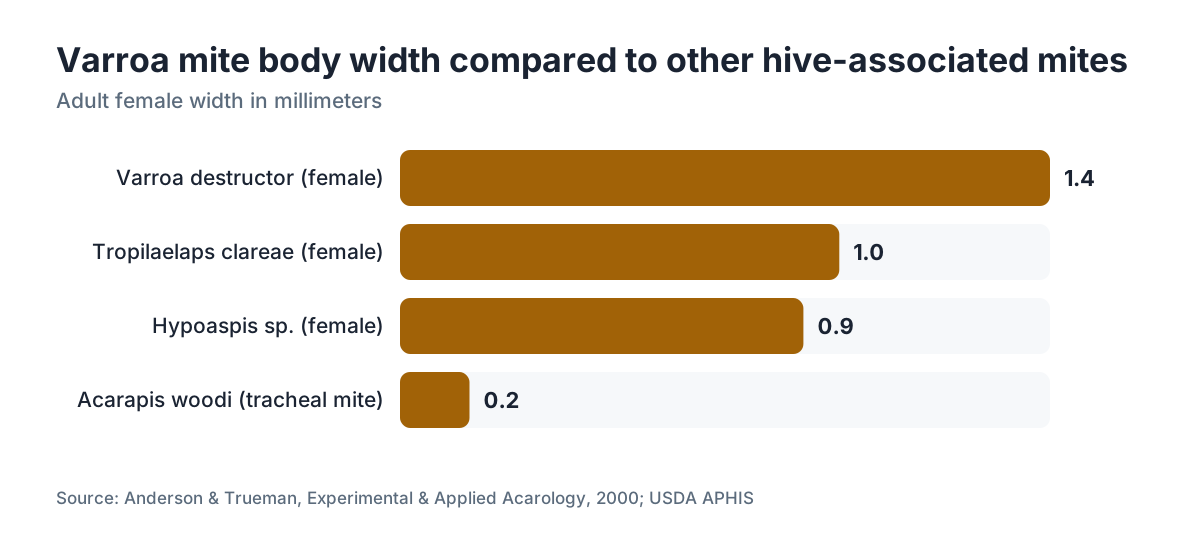
How does varroa mite size compare to other common hive mites?
Not every mite in a hive is varroa. Knowing the size gaps keeps you from panicking over the wrong bug.
| Mite species | Width (mm) | Length (mm) | Color | Pest status |
|---|---|---|---|---|
| Varroa destructor (female) | 1.1 to 1.8 | 1.0 to 1.1 | Reddish-brown | Major honey bee pest |
| Tropilaelaps clareae (female) | 0.95 to 1.0 | 0.96 to 1.0 | Pale brown | Serious pest, not in US |
| Acarapis woodi (tracheal mite) | 0.14 to 0.17 | 0.13 to 0.15 | Translucent | Minor concern, US present |
| Hypoaspis (Stratiolaelaps) sp. | 0.8 to 1.0 | 0.6 to 0.8 | Tan to brown | Soil predator, not a pest |
The comparison people ask about most is varroa versus Tropilaelaps. Tropilaelaps mites (not established in the US or Europe) are a bit smaller overall and longer than they are wide, and they scurry fast across bees instead of sitting still [2]. If you ever import bees or travel through Southeast Asia, that long, quick-moving shape is the warning sign.
Tracheal mites (Acarapis woodi) live in a different size world entirely: about 0.15 mm, invisible without a dissecting microscope, and they hide inside the bee's trachea rather than riding on the surface. Anything you see on a bee's back is not a tracheal mite.
Hypoaspis species turn up in hive debris on sticky boards now and then. They're helpful predators, a little smaller than varroa, with a rounder and less flattened outline. They do bees no harm.
Why does the mite's body size matter for detection accuracy?
Here's the practical part: varroa is just big enough that a standard alcohol wash or sugar roll reliably knocks loose and counts most phoretic mites on adult bees. The Honey Bee Health Coalition's "Tools for Varroa Management" guide calls the alcohol wash the most accurate field method for exactly this reason. A 300-bee wash catches infestations at or above the 1 to 2% treatment trigger [3].
Mite width against sticky-board mesh matters too. Standard monitoring boards run an 8-mesh screen (apertures around 3.2 mm) up top, which blocks bees but lets mites drop onto the sticky surface below. A 1.1 to 1.8 mm mite falls through that mesh cleanly [4]. Building a board from scratch or sizing up a product? Check that mesh spec first.
Size shapes oxalic acid vaporizer results as well. Vaporized oxalic acid coats surfaces across the hive, including the mite's cuticle. A 1.1 mm mite has a large surface area for its mass compared to a bee, so it takes a bigger dose per gram of body, which is part of why oxalic acid stays selective at the right concentration [5].
Want a clean way to track counts against action thresholds? VarroaVault has free monitoring worksheets that log wash results over time.
How big are varroa mite eggs and larvae compared to the adult?
The adult female in your wash is only half the story. All reproduction happens inside capped brood, and the young stages run much smaller.
The first egg in a worker cell is an unfertilized haploid egg that becomes a male. The eggs after it (three to five in a worker cell, up to six in a drone cell) are fertilized diploid eggs that become females [6]. The egg itself is about 0.3 to 0.4 mm long, pale white, and barely visible against dark wax. The protonymph and deutonymph stages that follow run from about 0.4 to 0.9 mm, growing through each moult.
This progression has teeth. Only adult females, whether phoretic or freshly matured foundresses, are open to oxalic acid. Eggs and nymphs inside sealed cells sit behind the wax capping, protected by the mite's own developmental biology. That's the whole case for broodless oxalic acid treatments: you hit every mite in its exposed phase instead of letting 70 to 85% of the population ride out the treatment under wax [5].
Formic acid and amitraz both reach into capped cells to some degree, a real edge during stretches of heavy brood.
How does varroa's size relate to its ability to spread between colonies?
Varroa's size cuts both ways for dispersal. At 1.1 to 1.8 mm, the mite can't last long off a bee. It doesn't fly. It doesn't jump. It moves colony to colony by hitchhiking on bees during drift, robbing, and swarms.
A phoretic female grips a bee with four pairs of legs tipped in adhesive pads, and her flat body sits low enough that grooming bees often fail to pry her off even when they try. Research on hygienic behavior shows that even the best colonies remove only about 20 to 30% of varroa from adult bees through mutual grooming, nowhere near enough to control the mite on its own [7].
The mite's fair size also means one hard drift event or robbing episode can move dozens of mites in an afternoon. In field observations tied to University of Minnesota Extension work, when a strong colony robs out a collapsing mite-heavy colony, mite levels in nearby hives climb within a few weeks [9]. That fast redistribution is why your neighbors' colonies (and your own weakest boxes) matter even when your best hives test clean.
For the full biology and life cycle of this parasite, the varroa mite overview covers it in depth.
Does varroa mite size vary between drone brood and worker brood?
The mite doesn't grow larger in drone cells. It reproduces better there, and that success is tied to cell size in a roundabout way.
Drone pupal cells run bigger than worker cells (about 6.4 mm across versus 5.4 mm) and stay capped longer: 14 to 15 days for drones against 12 for workers [6]. That extra capped time gives the foundress room to lay more eggs and lets more offspring finish maturing. Reproductive rate in drone brood is roughly 2.2 to 2.6 mature daughters per foundress, against 1.3 to 1.45 in worker brood [6].
For monitoring, drone brood sampling reads high relative to whole-colony infestation. A 1-in-3 or 1-in-4 ratio of mites in drone pupae versus worker pupae lines up loosely with a wash figure, but the scatter is wide enough that the Honey Bee Health Coalition tells beekeepers not to lean on drone uncapping as their main quantitative method [3]. Treat it as a quick gut check, a reason to run a full alcohol wash if you turn up mites.
The bigger drone cell also shows mites more clearly during uncapping. More room, better contrast against a pale pupa.
What does varroa mite size look like under a microscope?
Under even a modest 40x stereoscope, varroa stops being a red oval blob and turns into something with parts. You can pick out the four pairs of legs, the forward gnathosoma (mouthparts, about 0.2 to 0.3 mm long), and the flat idiosoma that makes up most of the body.
The cuticle shows fine setae (hairs) and hardened plates. The gnathosoma points forward and down, built to pierce the soft cuticle of bee pupae and adults and feed on fat body tissue, not hemolymph as everyone assumed for decades. A 2019 study by Ramsey and colleagues in PNAS showed varroa feeds mainly on bee fat body cells, overturning the long-held hemolymph idea [8]. The mite's feeding tube fits that lipid-rich tissue well.
For extension teaching or plain curiosity, a $40 to $80 USB digital microscope (30x to 60x) handles mites recovered from an alcohol wash. Dry the mites on a paper towel, drop one on a glass slide, and the whole body plan reads clearly. It's a fast way to confirm you're looking at varroa and not a Hypoaspis or some other hitchhiker.
How does knowing varroa's size help you choose a monitoring method?
Monitoring method follows from mite size more than most guides admit. The three field options sort themselves out once you think about how a 1.1 to 1.8 mm mite behaves.
Alcohol wash is accurate because mites that size shake loose from bee bodies fast when agitated in fluid. Comparison work summarized in the Honey Bee Health Coalition guide found alcohol wash slightly more accurate than sugar roll for recovering mites, since sugar rolls let some mites hang on through the shaking [3]. The Mason jar method with isopropyl alcohol (at least 70%) is the standard: 300 bees (about half a cup) in solution, shake 60 seconds, count the mites in the strained fluid.
Sticky board counts read looser for population estimates because mite fall rate shifts with colony size, brood area, and temperature. The upside is they're easy and kill no bees. As a rough guide, University of Minnesota Extension points to a natural daily drop around 8 to 10 mites per day in summer, though this trails a wash result for reliability [9].
Visual inspection catches only about 20 to 30% of mites at low infestation, so it isn't a monitoring method at all. Seeing mites on bees without hunting for them means you already have a serious problem.
Get the monitoring right and everything downstream gets easier. Treatment calls cascade from accurate counts. VarroaVault's free protocol tools walk threshold-based decision trees by region and season.
What treatment methods are effective given varroa's body structure and size?
Varroa's small-but-not-microscopic body, its spot on the outside of bees, and its permeable cuticle all steer what works.
Oxalic acid (OA) works by direct contact. The mite's cuticle takes up oxalic acid more readily than the bee's exoskeleton, and the mite's small size relative to the application space means it picks up a heavy dose. The EPA label for Api-Bioxal, the only registered OA product in the US, allows three methods: dribble, sprinkle, and vaporization [5]. Vaporization usually wins in broodless conditions because it reaches mites across the hive without cracking every super.
Formic acid (Mite Away Quick Strips, Formic Pro) works partly by pushing through cell cappings, since formic acid turns volatile at hive temperatures. That penetration counts because 70 to 85% of mites hide inside sealed brood during the active season. Formic acid strips carry a firm temperature window on the label, typically 50 to 85 degrees F (10 to 29 degrees C) ambient [10].
Amitraz strips (Apivar) work by contact too: bees walk over the strips, pick up amitraz, and pass it around through colony contact. The chemical is lipophilic and moves through the mite's cuticle easily. Given varroa's flat body pressed against its host, that transfer runs efficiently.
Hop beta acids (HopGuard 3) need direct contact with mites and fall off in effect when brood is present, again a size-and-access problem. Label dose scales to colony weight and brood coverage.
For beekeeping supplies and beekeeping supply companies that carry these treatments, confirm current EPA registration before you buy, because new products and formulations keep arriving.
Does varroa size change with geographic location or bee species?
Varroa destructor shows some shape variation across populations, but the 1.1 to 1.8 mm width range covers almost everything you'll meet anywhere Apis mellifera is kept.
Two main haplotypes ride European honey bees worldwide: the Korea haplotype and the Japan haplotype. The Korea haplotype drives essentially every varroa infestation in the Western world. Morphometric work found small differences in setal arrangement and leg length between the two, but nothing a beekeeper would ever notice or act on [11].
Varroa first evolved on Apis cerana, the Asian honey bee, and it's a far milder parasite there because A. cerana colonies are smaller, cap brood for less time, and groom hard, including targeted removal of mites from drone cells. The mite is the same size on A. cerana. Its reproductive success per cell is just far lower.
African and Africanized honey bees (see: africanized honey bee) show somewhat lower varroa reproduction, tied to shorter post-capping periods and busier hygienic behavior, not to any change in the mite itself.
Small-cell foundation, sold on the claim that it cuts varroa reproduction, has been tested and found not to work. The mite's body fits standard cells with room to spare, and shrinking cell diameter doesn't disrupt reproduction in controlled trials [12].
What are the economic and management thresholds based on mite counts?
The two most-used treatment thresholds in North America come from the Honey Bee Health Coalition and university extension services. Both are built around a 300-bee alcohol wash.
Across most of the active season (spring through late summer), the threshold is a 2% mite load, meaning 2 mites per 100 bees in a wash [3]. The Honey Bee Health Coalition's Tools for Varroa Management guide, free to download, puts the number plainly: it recommends treating at a 2% threshold, which works out to 6 mites in a 300-bee sample, for most of the season.
In late summer and fall, as colonies rear the long-lived winter bees, many extension specialists drop the threshold to 1%, because varroa-vectored viruses hit winter bees hardest, and those bees have to last five to six months. University of Minnesota Extension recommends treating in late August or early September if levels reach 1 to 2%, ahead of the winter-bee peak [9].
The table below lays out the published thresholds:
| Season | Wash threshold (mites per 100 bees) | Source |
|---|---|---|
| Spring (buildup) | 2% | Honey Bee Health Coalition [3] |
| Summer (active) | 2% | Honey Bee Health Coalition [3] |
| Late summer/fall | 1 to 2% | UMN Extension [9] |
| Pre-winter cluster | 1% | Various university extensions |
All of these assume a 300-bee sample (about half a cup of bees). Six mites in 300 bees is 2%. Simple math, easy to blow if your sample size drifts. Standardize to 300 bees or adjust your percentage to match.
Frequently asked questions
How big is a varroa mite in millimeters?
Adult female varroa mites measure 1.1 to 1.8 mm wide and 1.0 to 1.1 mm long. They're wider than they are long, which gives them that oval, almost circular shape. The male is smaller, around 0.8 mm, and never leaves the brood cell. You can see a female with the naked eye. She looks like a reddish-brown sesame seed on the bee's back.
Can you see varroa mites with the naked eye?
Yes. At 1.1 to 1.8 mm wide, a varroa female is clearly visible without magnification against a bee's abdomen, showing as a reddish-brown oval. You won't see her when she's tucked under an abdominal plate, which is often. A 10x hand lens helps during brood inspections. Eggs and nymphs inside cells run much smaller and need at least a hand lens to spot.
What color are varroa mites?
Adult female varroa mites are reddish-brown to dark mahogany. The shade varies a little with age and feeding, but the color stays distinct from the bee's yellow and black. Males are lighter, a whitish tan. Nymphs inside brood cells are pale and nearly translucent when young, darkening as they mature.
How does varroa mite size compare to a bee egg?
A honey bee egg is about 1.7 mm long and roughly 0.4 mm across, so it's longer than a varroa mite but far narrower. The varroa female is 1.1 to 1.8 mm wide, much wider than a bee egg. In practice, a varroa adult is easier to see with the naked eye than a bee egg, which needs good light and a magnifier for most beekeepers.
Do varroa mite sizes vary by season or colony type?
The adult female's dimensions don't change with the season. What shifts is the split between mites in the phoretic (adult bee) phase and the reproductive (brood) phase. During heavy brood seasons, 70 to 85% of mites sit inside cells. During broodless periods, nearly 100% are phoretic and open to contact treatments like oxalic acid.
How small is a varroa mite egg compared to the adult?
A varroa egg is about 0.3 to 0.4 mm long, roughly a quarter of the adult female's width. You can't see it with the naked eye in normal hive conditions. Nymphs (protonymph and deutonymph stages) run 0.4 to about 0.9 mm as they develop inside the sealed cell. Only once a female reaches adult size, around 1.1 mm, does she become visible without magnification.
What mesh size do sticky boards use to catch varroa mites?
Standard varroa monitoring boards use an 8-mesh screen on top, with apertures around 3.2 mm. That opening is wide enough for a 1.1 to 1.8 mm varroa mite to fall through onto the sticky board below, while adult bees can't fit. If you build your own board, keep the mesh aperture at least 2 mm so mites don't bounce off the screen.
Why do varroa mites prefer drone brood?
Drone cells are larger (6.4 mm versus 5.4 mm across for worker cells) and stay capped about two days longer. That extra time lets a foundress lay more eggs and lets more offspring finish maturing before the cell opens. Reproductive success per foundress runs 2.2 to 2.6 daughters in drone cells against 1.3 to 1.45 in worker cells, which makes drone brood a lopsided driver of population growth.
Is varroa mite size related to how well treatments work?
Yes, indirectly. Oxalic acid depends on contact with the mite's cuticle, and the mite's large surface area for its mass helps ensure a strong dose at hive concentrations. Sticky board mesh, shaker jar mesh, and formic acid label dosing all calibrate around the known size and weight of adult mites. Size also explains why lab-effective treatments underperform in full colonies with capped brood hiding most of the population.
Can varroa mite size help me tell it apart from other hive pests?
Mostly yes. Tracheal mites are 0.15 mm and invisible to the naked eye. Tropilaelaps mites are a bit smaller than varroa and run fast across bees instead of sitting still, but they aren't established in the US or Europe. Hypoaspis soil mites sometimes appear on sticky boards; they're tan, rounder, and smaller than varroa females. When in doubt, a 40x stereoscope or USB microscope settles it fast.
How many varroa mites fit on a single honey bee?
There's no fixed ceiling, but studies of heavily infested bees usually find two to five phoretic mites on one adult bee in collapsing colonies. In healthy colonies below the 2% threshold, most bees carry zero mites and a few carry one. Finding several mites on individual bees in a normal-looking colony means the infestation is already well past the treatment threshold.
What alcohol wash count tells me I need to treat?
Six mites or more in a 300-bee sample equals 2%, the widely used treatment threshold for most of the active season. In late summer, as winter bees are reared, some extension services recommend treating at three mites per 300 bees (1%). Always wash a full 300-bee sample so the count means something; smaller samples throw off the count badly. The Honey Bee Health Coalition's free guide has a step-by-step wash protocol.
Does small-cell foundation reduce varroa mite reproduction?
No. Multiple controlled studies tested the idea and found no meaningful drop in varroa reproduction or infestation levels on small-cell foundation. The mite's 1.1 to 1.8 mm body fits both standard and small-cell brood easily, and the slight cut in cell diameter doesn't shorten capping enough to break the mite's reproductive cycle. This is one idea testing has repeatedly failed to support.
Sources
- Anderson DL & Trueman JWH, Experimental & Applied Acarology, 2000, Varroa jacobsoni morphometric description: Adult female Varroa destructor measures 1.1 to 1.8 mm wide and 1.0 to 1.1 mm long; males approximately 0.8 mm; depth approximately 0.75 mm
- Honey Bee Health Coalition, Tools for Varroa Management Guide (current edition): Alcohol wash recommended as most accurate field monitoring method; 2% mite load (6 mites per 300 bees) is the standard treatment threshold for most of the active season; alcohol wash slightly more accurate than sugar roll
- Honey Bee Health Coalition, Tools for Varroa Management Guide (sticky board / screened bottom board section): Standard monitoring boards use an 8-mesh screen (apertures approximately 3.2 mm) that blocks bees but lets varroa mites fall through onto the sticky surface
- EPA, Pesticide registration and Api-Bioxal (oxalic acid) product label: Api-Bioxal is the only EPA-registered oxalic acid product in the US; three approved application methods (dribble, sprinkle, vaporization); oxalic acid works by contact with mite cuticle; broodless treatments most effective
- Fuchs S & Langenbach K, Experimental & Applied Acarology, 1989, Varroa reproductive biology in drone vs worker brood: Reproductive success per foundress: 2.2 to 2.6 daughters in drone brood vs 1.3 to 1.45 in worker brood; drone cells capped 14 to 15 days, worker cells 12 days; cell diameters 6.4 mm vs 5.4 mm
- Boecking O & Spivak M, Apidologie, 1999, Hygienic behavior and varroa removal: Even highly hygienic honey bee colonies remove roughly 20 to 30% of varroa from adult bees through grooming; insufficient for control alone
- Ramsey SD et al., PNAS, 2019, Varroa destructor feeds on honey bee fat body tissue: Varroa destructor primarily feeds on bee fat body cells, not hemolymph as previously assumed; this revises the understanding of mite feeding anatomy
- University of Minnesota Bee Lab / Extension, Varroa mite management: Threshold of 1 to 2% mite load recommended in late summer/fall before winter bee rearing; natural daily mite drop of 8 to 10 per day used as rough summer threshold on sticky boards; robbing of collapsing colonies redistributes mites to nearby hives within weeks
- EPA, Pesticide registration and Mite Away Quick Strips (formic acid) product label: Formic acid strips approved for use in 50°F, 85°F (10°C, 29°C) ambient temperature range; penetrates cell cappings to reach mites in brood
- Anderson DL & Trueman JWH, Experimental & Applied Acarology, 2000, Varroa haplotype morphometrics: Korea and Japan haplotypes show subtle morphometric differences (setal arrangement, leg length) but not practically significant size differences; Korea haplotype responsible for all Western world infestations
- Maggi M et al., Apidologie, 2010, Small-cell foundation and Varroa reproduction controlled study: Small-cell foundation shows no meaningful reduction in varroa reproductive success or colony infestation levels in controlled trials
Last updated 2026-07-09