Varroa treatment scheduling software: what works and what doesn't

TL;DR
- Varroa treatment scheduling software and online calculators help beekeepers time oxalic acid, ApiLife VAR, Apivar, and other treatments to the colony's brood cycle, local temperature windows, and reinfestation risk.
- The best tools sync mite-wash results to a treatment calendar, flag when counts hit the 2-3% threshold, and account for queen status.
- Most are free browser tools or spreadsheet templates.
Why does timing matter more than the treatment you pick?
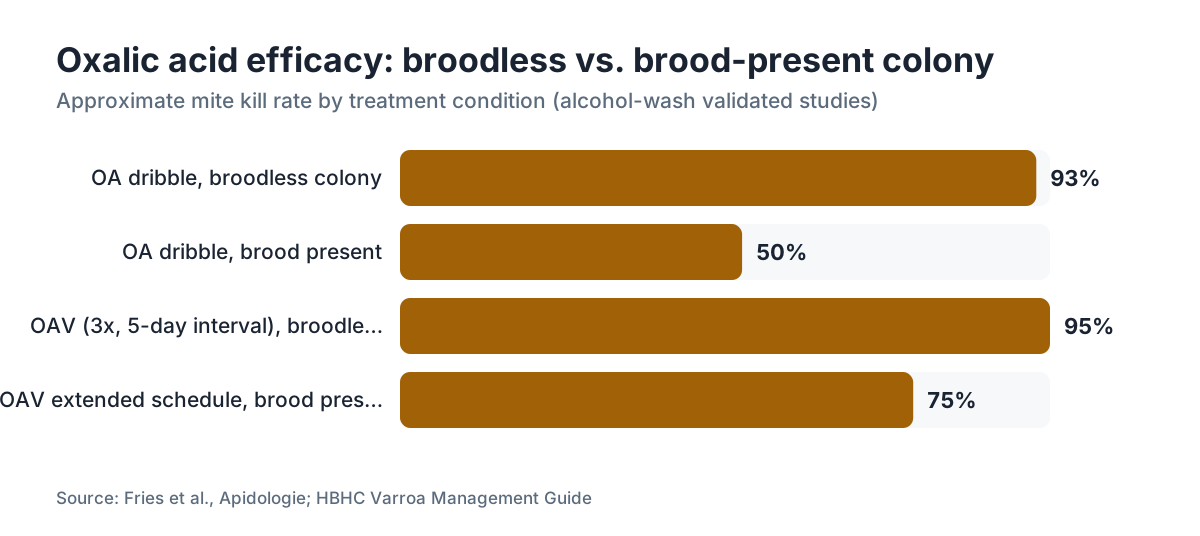
The mite that kills your colony is almost never the mite you can see. About 70-80% of varroa in a healthy colony at any given moment are sealed inside brood cells, invisible to alcohol washes and unreachable by most treatments [1]. The window between those mites emerging and the queen laying again is the only time an oxalic acid dribble or vaporization wipes out nearly everything. Miss that window by two weeks and you might drop your mite load 50% instead of 95%.
That gap between "I know I need to treat" and "I actually treated at the right moment" is exactly what scheduling software tries to close. It forces you to track what you measured, when the queen was last seen, how hot or cold it's been, and when your treatment option is legal and effective in your climate.
The Honey Bee Health Coalition's Varroa management guide states that "the goal of monitoring is to provide the beekeeper with a mite count that can guide management decisions" and that treatment thresholds are only useful if tied to an action plan [1]. Software gives that plan a calendar instead of a sticky note.
Timing is also a resistance issue. Apivar (amitraz strips) used outside the labeled exposure window, or pulled early because the beekeeper forgot the start date, selects hard for resistant mites. A scheduler that remembers your strip-in date and pings you at day 42 does something simple but genuinely valuable.
What do varroa treatment scheduling tools actually do?
At minimum, a scheduling tool takes a mite count, a date, and a colony identifier, and outputs a recommended action with a calendar deadline. The better ones do more.
Here's what separates the useful tools from the ones you open once and forget:
Mite load tracking over time. A single 2% wash tells you less than seeing that you were at 0.8% in April, 1.9% in June, and 3.4% in August. Trend matters. A tool that graphs counts by hive gives you that.
Threshold alerts by season. The Honey Bee Health Coalition recommends a 2% threshold (2 mites per 100 bees) as a general action point, but drops that to 1% or lower during the fall population buildup before winter [1]. A scheduler that doesn't know what month it is can't apply the right threshold.
Brood-break detection. Oxalic acid's efficacy against phoretic mites is roughly 90-95% in a broodless colony versus roughly 40-60% when brood is present [2]. If you log a swarm, a queen removal, or a confirmed broodless inspection, the scheduler should flag that as a high-value treatment window right away.
Temperature gate for contact treatments. Formic acid products (Mite-Away Quick Strips, FormicPro) carry label restrictions: MAQS requires ambient temperatures between 50°F and 85°F during treatment [3]. ApiLife VAR (thymol) works best above 59°F and below 105°F [4]. A scheduler that pulls local weather or lets you enter your forecast can block out days the treatment won't perform.
Treatment history log. Rotating between oxalic acid, amitraz, and formic acid slows resistance. A log shows you what you used last cycle so you don't default to Apivar every single time.
Most free tools cover the first two or three of these. Paid apiary management platforms like Hive Tracks or ApiaryBook cover most of them, though they bundle scheduling inside a broader hive-record system that some beekeepers find more than they need.
What are the main free varroa scheduling tools available right now?
This landscape shifts faster than any article can track, so read this as a category description rather than a ranked list.
Honey Bee Health Coalition mite management calculator. The HBHC hosts a straightforward online tool that takes your mite count, colony size estimate, and time of year, then recommends whether to treat, retest, or hold. It links directly to their treatment options table, which covers label-registered products in the United States. It won't track multiple hives or store your history, but for a single-hive decision it's honest and well-sourced [1].
Penn State Extension's Varroa Calculator. Penn State's apiculture team built a spreadsheet-based tool that estimates total mite population (more than phoretic alone) from an alcohol wash result. It uses a fixed brood-to-adult ratio model. The math behind it comes from published colony modeling research. It's a spreadsheet download, not a live app, which means you own your data but have to manage it yourself [5].
VarroaVault's scheduling tools. VarroaVault offers a free browser-based protocol OS that links mite-wash entries to a treatment calendar, flags threshold crossings, and lets you log brood status and treatment products. It's built for hobbyist and sideliner scale, where you might manage 5-30 hives across a couple of yards rather than running a commercial operation on dedicated apiary software.
BeePlus and Beekeeper Pro (mobile apps). These are general hive management apps with varroa modules. Beekeeper Pro includes mite count logging and some threshold flagging. Neither was built primarily as a treatment scheduler, and both have paid features that have nothing to do with mite management. Worth a look if you already want digital hive notes, less compelling if you just want the mite calendar.
DIY spreadsheet templates. Honestly, for a beekeeper with fewer than 10 hives, a well-built Google Sheet with mite count, treatment log, and date columns might beat any app because you control it completely. The University of Minnesota Extension has shared template structures in their apiculture resources [6]. The weakness is you have to remember to open it.
How does the 2% mite threshold get built into a scheduler?
The 2% threshold means 2 mites per 100 bees in an alcohol wash or sugar roll. It's not magic. It comes from research on colony collapse timelines and from experience with how fast mite populations double in late summer. The Honey Bee Health Coalition's guide explains the seasonal variation: "A 2% threshold is appropriate for the active season, but a 1% threshold may be more appropriate in late summer or early fall when winter bees are being produced" [1].
A scheduler needs two things to apply this correctly: your mite count and the date. Most tools use a static seasonal calendar rather than tracking actual brood phenology, which is an honest limitation. Your local nectar flow, your queen's laying rate, and whether you've had a recent split all shift the real mite-to-bee ratio in ways a calendar can't see.
The better tools handle this by letting you log inspection events alongside mite counts. If you note "queen not seen, no open brood" on the same date as a mite wash, the tool can flag that as a broodless window and apply a lower effective threshold, because your window of opportunity is also your window of vulnerability.
One number worth keeping in mind: mite populations can double roughly every 17-25 days in a colony with a laying queen during peak summer [7]. At that doubling rate, a count of 1.5% in early August is almost certainly above 2% by Labor Day. A scheduler that projects forward from your last count, even roughly, does something a standalone threshold lookup can't.
Which treatment products have time-sensitive label requirements that a scheduler must track?
Every registered varroa treatment in the United States is an EPA-registered pesticide with a label that is the law. The scheduler's job, in part, is to keep you inside that label.
| Product | Active ingredient | Min temp | Max temp | Min exposure | Max exposure | Brood restriction |
|---|---|---|---|---|---|---|
| Apivar strips | Amitraz | None stated | None stated | 42 days | 56 days | None |
| Mite-Away Quick Strips | Formic acid | 50°F | 85°F | 7 days | 7 days (remove) | Safe with brood |
| FormicPro | Formic acid | 50°F | 85°F | 14-20 days | 20 days | Safe with brood |
| Oxalic acid dribble (Api-Bioxal) | Oxalic acid | 5°C (41°F) | No stated max | Single treatment | Single treatment | Broodless only for full efficacy |
| OAV (Api-Bioxal vaporization) | Oxalic acid | No stated min | No stated max | 3 treatments, 5 days apart (broodless) or extended schedule | Varies | Broodless for one-time; extended for brood present |
| ApiLife VAR | Thymol + other EOs | 59°F | 105°F | 3 treatments, 7 days apart | 28 days total | Reduced efficacy with brood |
| Apiguard | Thymol gel | 59°F | None stated | 2 treatments, 10-14 days apart | 28 days | Reduced efficacy with brood |
Sources: EPA-registered product labels for each product listed above [3][4][8][9][11][12].
Apivar trips people up most often. The minimum 42-day exposure exists because amitraz efficacy is contact-dependent and cumulative. Beekeepers who pull strips at 28 days because the colony "looks fine" are both violating the label and potentially selecting for resistance. A scheduler with a strip-in date and an automated 42-day reminder closes that gap entirely.
Oxalic acid by vaporization is the other complex case. Api-Bioxal's label allows extended treatment schedules when brood is present: typically 3 vaporizations spaced 5 days apart, repeated over the capped brood cycle. Some beekeepers run weekly vaporizations for the full capped brood period (roughly 12-15 days for worker brood plus buffer). The label permits this; the scheduler should track how many treatments you've done and when the next is due [9].
How should a scheduler handle multiple hives with different mite levels?
This is where most casual tools fall short. When you have 12 hives and half of them are above threshold on different schedules, a single "treat all" recommendation is too blunt. Robbing, drifting, and migratory mites mean a low-count hive next to a high-count hive is likely to reinvest quickly anyway, but that's still no reason to treat indiscriminately if you care about rotation and residue management.
A multi-hive scheduler should give you a per-hive dashboard, not an apiary average. The average is fine for a quick risk scan. The decision to treat is always made hive by hive, because a queen-right hive at 1.8% in September is a different animal from a hive that threw a swarm last week and has no sealed brood.
The practical workflow for a 10-20 hive sideliner:
- Sample all hives within a 2-week window in late July or early August.
- Log each count right away into whatever tool you use.
- Let the tool sort hives into treat-now, retest-in-3-weeks, and monitor categories.
- For the treat-now group, choose a product based on the current temperature forecast and last treatment used.
- Set a strip-in date or treatment-start date in the scheduler for each hive you treat.
- Schedule follow-up washes 3-4 weeks after treatment ends to confirm efficacy.
The follow-up wash is the step most beekeepers skip, and it's the one that catches resistant-mite situations before they turn into a winter kill.
Can a scheduler predict mite population growth between counts?
Sort of, and with heavy caveats. Mite population models exist in published research, most notably work from USDA-ARS and European apiculture institutes, and some tools use a simplified version [7]. The basic model takes your last known mite load, an assumed reproductive rate (roughly 1.4-1.6 daughter mites per reproductive cycle under ideal conditions), and the proportion of the colony's time spent in sealed brood.
The trouble is that the inputs are fragile. A queenless period, a cold snap that slows brood rearing, a nectar dearth that shrinks the colony, or a recent treatment all pull the real curve away from the model's prediction. Nobody has great data on how much individual colony variation matters here. The closest studies use population averages and find wide confidence intervals even in controlled apiaries.
Projection is genuinely useful for one thing: setting urgency. If a tool tells you "based on your July 20th count of 1.6%, projected load crosses 3% around August 12th," that gives you a deadline that feels real rather than abstract. Whether the actual crossing lands on August 10th or August 16th matters less than having a date to work backward from when you plan your next inspection.
Use projections as a planning guide. Never use them as a substitute for a real mite wash.
What data should you enter into a varroa scheduler to get useful output?
The recommendation is only as good as the data you feed it. Here's the minimum set that makes a scheduler actually useful:
Hive identifier. Obvious, but make it consistent. "Blue hive" and "Hive 3" as two entries for the same colony will give you garbage trend data.
Mite count and sample date. Record the raw count (number of mites in your wash) and the sample size (number of bees). Let the software calculate the percentage. Don't round to "about 2%" before entering.
Sample method. Alcohol wash and sugar roll give different results. Alcohol wash is more accurate, and the HBHC recommends it over sugar roll for threshold decisions [1]. Log which you used.
Queen status. Laying, missing, capped queen cell, or confirmed broodless. This single field changes the treatment recommendation more than almost anything else.
Current treatment and start date. If Apivar went in on June 5th, log June 5th. Not "sometime in early June."
Geographic location or climate zone. Some tools use this to apply seasonal thresholds correctly and to flag temperature windows for formic acid products.
Colony strength estimate. Frames of bees, rough population, or a simple strong/medium/weak scale. It affects how urgently a given mite percentage translates to actual mite load.
That's it. More fields are nice. Those seven are the ones that change the output in a meaningful way.
How do university extension programs recommend using these tools?
Extension apiculture programs have stayed cautious about endorsing specific software, for obvious reasons. What they do consistently is recommend a structured monitoring-and-response cycle that maps directly onto what scheduling software automates.
The University of Minnesota's Bee Lab, one of the most cited research groups on varroa management in North America, recommends monitoring colonies at least every 30 days during the active season, earlier treatment response in late summer, and keeping written records [6]. Their published materials use paper-based templates as examples, but they note plainly that digital tracking serves the same function.
Penn State Extension's varroa resources stress that the treatment decision should come from data, not calendar date alone, and that a mite-count-to-population-estimate calculator helps beekeepers see that "a 2% wash result in a strong colony represents a much larger absolute mite population than the same percentage in a small colony" [5].
The Honey Bee Health Coalition's guide is the most widely cited practical reference in American beekeeping and forms the backbone of what most serious scheduling tools implement. It's a free PDF download and covers monitoring methods, thresholds, and product selection in detail [1].
For beekeepers who want the biology underneath, the USDA-ARS Beltsville Bee Lab has published research on mite population dynamics and treatment efficacy that supplies the numbers most tools use [7]. Knowing the source data helps you tell when to trust the tool's output and when your situation sits outside the model's assumptions.
What are the real limitations of varroa scheduling software?
Be direct about this, because software can create a false sense of control.
It only knows what you tell it. Skip a July wash because the bees looked calm, and the scheduler has no idea your mite load doubled. It will hand you a confident-looking recommendation built on stale data. The tool is as disciplined as you are.
Reinfestation from nearby colonies is invisible to the model. Research from the University of Guelph and others has documented that robbing and drifting can import hundreds of mites per day into a treated colony from failing neighbors [10]. A scheduler tracking your hive in isolation can't see that. A dramatically failed post-treatment wash is often this, not treatment failure or resistance.
Resistance is not detectable by the software. If your colony has amitraz-resistant mites, Apivar at the right temperature for the right duration will still fail. The only way the scheduler flags this is if you log a follow-up mite wash after treatment and the count didn't drop. That's why the follow-up wash is non-negotiable.
Label updates lag in software. The EPA can revise product labels. Api-Bioxal's label has changed more than once since its initial registration. If a tool was built in 2019 and hasn't been updated, its protocol for OAV extended treatments might not match the current label. Cross-check the current label before treating [9].
It can't replace your eyes. A scheduler can tell you it's time for a mite wash. It can't tell you the colony has laying-worker syndrome, or that European foulbrood is present and you should hold off on formic acid stress until you've resolved the disease. Inspection data and judgment still live with the beekeeper.
How do you build a year-round varroa protocol around a scheduling tool?
Here's a practical annual framework for a temperate-climate beekeeper in USDA hardiness zones 5-7 (roughly the northern two-thirds of the contiguous US). Shift the months for your latitude.
March/April (post-winter assessment). First mite wash of the year as soon as brood is present. Colonies coming out of winter with brood already have mites reproducing. Log the count. Threshold is 2%. Treat if needed, usually with OAV if temperatures are marginal or Apivar if you want extended protection through the buildup.
June (pre-flow peak). Second wash, especially if you didn't treat in spring. This is often the low point of the mite season, because colony population is high and the mite-per-bee ratio looks manageable. The absolute mite count, though, may already be high. Log it.
Late July/early August (critical window). The most important wash of the year. The winter bees that carry the colony through to next March are being produced right now, starting around mid-August in most northern climates. A mite-infested winter bee is a shorter-lived, immunocompromised bee. Treat anything above 1% here, not 2%. Log the treatment start date.
September (post-treatment check). Wash 3-4 weeks after treatment ends to verify efficacy. If counts are still above 1%, either the treatment didn't work (suspect resistance or a label violation), reinfestation is happening, or you treated with brood present and need a follow-up. Log the result and act.
November/December (broodless OAV window). In cold-winter climates, the colony goes broodless for 4-8 weeks. A single OAV treatment, or the standard 3-treatment broodless protocol during this window, is the highest-efficacy treatment of the year. Some beekeepers skip it if fall counts were well below 1%. I wouldn't. The cost is minimal and the margin of safety for spring is large.
A scheduler tied to this framework should auto-populate the next recommended wash date after each entry and flag the late-summer window specifically. If you're evaluating tools, ask whether they treat the August window as distinct from general summer. If they don't, they're missing the most important timing signal in temperate beekeeping.
How do you choose between spreadsheet tools, apps, and full apiary management software?
The right answer depends almost entirely on your hive count and how you actually work.
For 1-5 hives, a paper log plus the HBHC online calculator handles 90% of what you need. A mite count on a notecard stapled to your hive journal is not inferior to an app if you actually do it consistently. The tool that gets used beats the tool that's theoretically better.
For 6-25 hives, a dedicated scheduling tool or a well-organized spreadsheet starts pulling real weight. You can no longer hold every hive's history in your head. You need to know at a glance which hives got treated in June, which have the new queens, and which are overdue for a wash. This is where something like the Penn State spreadsheet template or a free apiary management app crosses from nice-to-have to genuinely useful. Picking up supplies from beekeeping supply companies as you scale up and reading resources on the varroa mite biology behind treatment windows will help you get more out of any tool you choose.
For 25+ hives (sideliner territory), you probably need multi-apiary support, the ability to export data for your own records, and ideally a bulk-entry option for days when you're washing 15 hives in a row. Full platforms like Hive Tracks or ApiaryBook are worth a look here, with the caveat that you're paying for a lot of features beyond mite management.
The feature I'd weight most heavily in any tool: does it separate the "when to wash" reminder from the "how to treat" decision? Those are two different questions, and tools that conflate them tend to push you toward treatment when you might really just need more data.
Frequently asked questions
Is there a free varroa treatment scheduler I can use online?
Yes. The Honey Bee Health Coalition hosts a free online mite management calculator at honeybeehealthcoalition.org. Penn State Extension offers a free downloadable spreadsheet tool. VarroaVault offers a free browser-based protocol scheduler that tracks mite counts by hive and generates treatment calendars. None of these require an account to get basic recommendations, though hive-level history tracking usually requires logging in.
What mite count triggers a treatment recommendation in most scheduling tools?
The standard threshold most tools use is 2 mites per 100 bees (2%) during the active brood-rearing season, dropping to 1% in late summer (typically August and September in temperate climates) when winter bees are being produced. The Honey Bee Health Coalition recommends these thresholds in their Varroa management guide. Some tools let you customize the threshold for your specific situation.
Can scheduling software tell me when to use oxalic acid vs. Apivar?
A good scheduler can narrow it down but can't make the final call for you. It can flag that you're in a broodless window (favoring OAV for maximum efficacy), that temperatures are below formic acid's effective range (ruling out MAQS or FormicPro), or that you last used amitraz (suggesting a rotation to oxalic acid). The final product choice also depends on honey supers, your rotation history, and label compliance.
How does a varroa scheduler account for broodless periods?
The better tools let you log a broodless event (swarm, queen loss, deliberate split, or winter dormancy) and immediately flag that window as a high-priority oxalic acid treatment opportunity. Oxalic acid dribble or vaporization in a broodless colony reaches roughly 90-95% efficacy against phoretic mites versus 40-60% when brood is present. Without logging queen status, the scheduler has no way to know.
Do varroa scheduling tools work outside the United States?
Most tools built on Honey Bee Health Coalition guidance are US-centric. Product names, label regulations, and registration status differ in Canada, the EU, and Australia. Canadian beekeepers should cross-check against PMRA-registered products. European beekeepers have different approved products (Oxuvar, Apivar in most EU states, Apistan in some). Some tools let you set your own thresholds and product list to work around this.
How often should I enter data into a varroa scheduler to keep it useful?
At minimum, log a mite count every 30 days during the active season (roughly April through October in temperate climates) and after every treatment ends. The University of Minnesota Bee Lab recommends monthly monitoring as the baseline. Logging treatment start and end dates matters as much as mite counts, because the tool needs both to calculate strip-removal reminders and follow-up wash dates.
Can I use a varroa scheduler to manage multiple apiaries in different locations?
Some tools support multiple apiary locations; many do not. If temperature-gating for formic acid products matters to you (it should), the tool needs to apply the right local temperature to each yard, not a single average. Browser-based platforms with user accounts tend to handle multi-apiary setups better than standalone spreadsheets. Check whether the tool lets you filter the dashboard by yard before committing.
How does scheduling software handle Apivar strip timing?
Apivar's label requires strips to remain in the hive for a minimum of 42 days and no longer than 56 days. A scheduler should let you log the date strips went in, then send a reminder at day 42 (or your target removal date) with a flag if day 56 is approaching. This is one of the clearest benefits of any digital tool over a sticky note: you log it once and the deadline tracks itself.
Is sugar roll or alcohol wash data more reliable for scheduler inputs?
Alcohol wash. The Honey Bee Health Coalition recommends alcohol wash over sugar roll for threshold-based treatment decisions because sugar roll consistently undercounts mites by roughly 30-40% compared to alcohol wash on the same sample. Entering a sugar roll result into a tool calibrated on alcohol wash data will make your mite load look lower than it is. If your scheduler asks for method, always log it accurately.
What happens if I miss a scheduled mite wash in my tracker?
Most tools flag the missed date and fall back on your last known count for any projection or recommendation, which gets less reliable the longer it's been. The practical answer is to do the wash as soon as you can and log it as the actual date you sampled, not the date the app wanted you to. Backdating a wash you didn't do is worse than a gap; it feeds bad data into future projections.
Can scheduling software help me avoid varroa treatment resistance?
Indirectly, yes. A treatment history log shows you which products you've used in recent cycles so you can rotate active ingredients (oxalic acid, amitraz, thymol, formic acid) rather than defaulting to the same product every time. It also catches label violations that select for resistance, like pulling Apivar strips too early or treating outside the effective temperature range for thymol products.
Do any scheduling tools integrate with weather data for temperature-sensitive treatments?
A small number do. Some browser-based tools let you enter your zip code or coordinates and pull forecast data to flag whether the next 7-14 days suit formic acid or thymol treatments. This is genuinely useful given how narrow the effective temperature window is for MAQS (50-85°F) and ApiLife VAR (59-105°F). Most spreadsheet-based tools don't have this feature; you'd check the forecast manually.
What's the best varroa scheduling approach for a new beekeeper with one hive?
Start with the HBHC online calculator and a simple paper log. Learn the alcohol wash technique first; data quality matters more than the tool. Once you're consistently washing monthly and logging results, you'll quickly outgrow a paper log and feel the value of a digital scheduler. Adding a second or third hive is usually the moment most beekeepers switch to a digital tool.
Sources
- Honey Bee Health Coalition, Varroa Management Guide: 70-80% of mites are in sealed brood; 2% treatment threshold with 1% threshold in late summer; alcohol wash recommended over sugar roll for threshold decisions
- Fries I. et al., Apidologie, oxalic acid efficacy in broodless vs. brood-present colonies: Oxalic acid dribble efficacy roughly 90-95% in broodless colony vs. 40-60% when brood is present
- EPA, Mite-Away Quick Strips (MAQS) product label via National Pesticide Information Retrieval System: MAQS requires ambient temperatures between 50°F and 85°F during treatment; 7-day single application
- EPA, ApiLife VAR product label: ApiLife VAR (thymol-based) effective between 59°F and 105°F; three treatments 7 days apart
- Penn State Extension, Varroa Mite Management resources and population calculator: Same percentage mite load in a strong vs. small colony represents very different absolute mite populations; spreadsheet tool available
- University of Minnesota Bee Lab, Varroa management recommendations: Monthly monitoring recommended during active season; digital and paper record-keeping both appropriate
- USDA Agricultural Research Service, Beltsville Bee Lab, mite population dynamics research: Mite populations can double roughly every 17-25 days in a colony with a laying queen during peak summer
- EPA, Apivar (amitraz) product label: Apivar strips minimum exposure 42 days, maximum 56 days; no stated temperature restriction
- EPA, Api-Bioxal (oxalic acid) product label: Api-Bioxal label permits extended vaporization schedules when brood is present; dribble is single-treatment, broodless for full efficacy; label has been updated multiple times since initial registration
- University of Guelph, Honey Bee Research Centre, mite reinfestation via robbing and drifting: Robbing and drifting can import hundreds of mites per day into a treated colony from failing neighboring colonies
- EPA, FormicPro product label: FormicPro (formic acid) requires ambient temperatures between 50°F and 85°F; 14-20 day treatment duration depending on colony size
- EPA, Apiguard (thymol gel) product label: Apiguard effective above 59°F; two treatments 10-14 days apart; reduced efficacy with brood present
Last updated 2026-07-09