What happens to a colony if varroa treatment is delayed in fall
TL;DR
- Skip or delay fall varroa treatment past late August or early September in most of the U.S., and mite populations can double every 4-6 weeks inside capped brood.
- The winter bees raised in September and October emerge damaged, short-lived, and loaded with virus.
- Colonies that look fine in October often crash by January or February, a pattern beekeepers call "spring dwindle" or winter loss.
Why does fall timing matter more than any other treatment window?
Fall is the one treatment window you cannot get back. The bees your colony raises in late August, September, and early October are the ones that have to survive five to seven months until spring buildup. Beekeepers call them "winter bees" and they're physiologically distinct from summer bees. They carry more fat body reserves, live three to five times longer, and are the only reason a colony survives a northern winter.
Varroa mites don't read the calendar. They keep reproducing as long as capped worker brood is present, and reproduction inside those capped cells amplifies their numbers fast. The Honey Bee Health Coalition notes that a single mite entering a cell can produce one to two reproductive daughters in one brood cycle [1]. A colony carrying even a 2-3% mite wash in early August can pass 5-6% by mid-September with no intervention, well past the point where Deformed Wing Virus (DWV) becomes epidemic.
The window matters because once those September and October winter bees have already developed inside infested cells, the damage is done. Treating in November kills mites on adult bees, but it can't undo the viral load baked into bees that already emerged. You're always treating to protect future bees. Delay long enough and there are no healthy future bees left to protect.
How fast do mite populations actually grow when treatment is delayed?
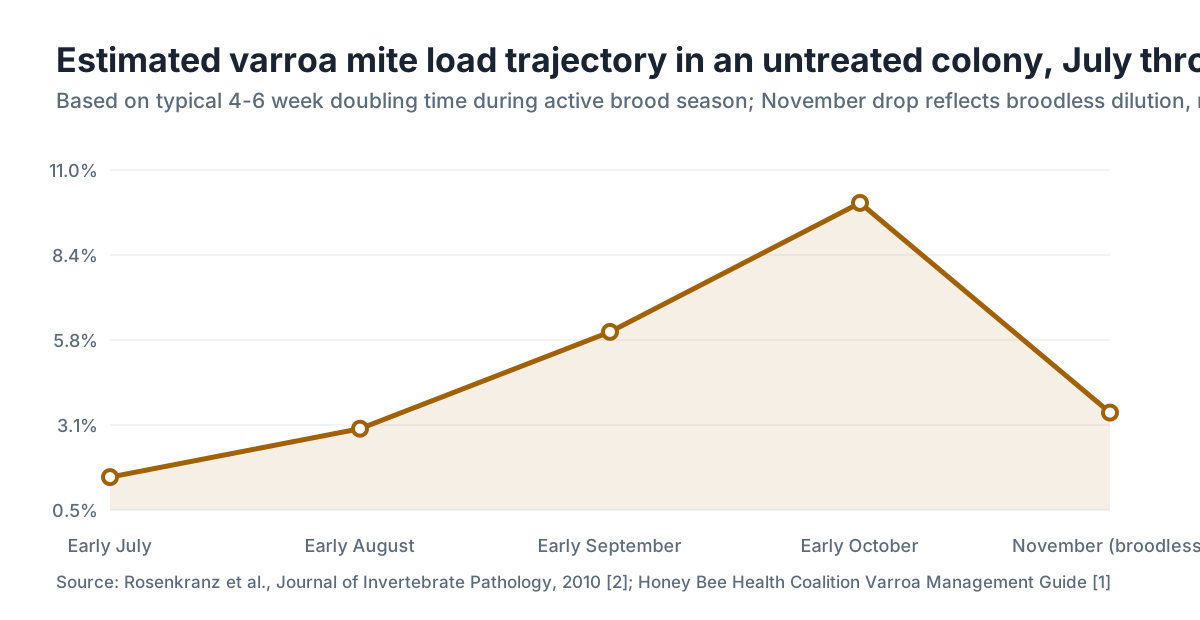
The math gets ugly fast. Varroa populations grow exponentially in a colony with capped brood. The commonly cited doubling time is roughly every 4-6 weeks during peak brood season, though it varies by colony size, queen laying rate, and local conditions [2]. A mite infestation sitting at 1% in July can realistically reach 4-6% by early September untreated.
Here's a rough picture of what untreated populations look like across a season:
| Sample Date | Approx. Mite Wash (% per 100 bees) | Risk Level |
|---|---|---|
| Early July | 1-2% | Low to moderate |
| Early August | 2-4% | Moderate to high |
| Early September | 4-8% | High, winter bees at risk |
| Early October | 6-12%+ | Critical, colony likely failing |
| November | 2-5% (apparent drop) | Misleading: no brood dilutes count |
That November drop tricks a lot of people. When brood rearing stops, all the mites are riding adult bees, so a wash still shows a load, but there's no brood left to amplify it. The colony looks like it made it. Then it crashes in January. Penn State Extension calls this the "mite bomb" effect, where colonies with high summer and fall mite loads export infested bees and viruses to neighboring hives before they collapse [3].
For context on what these mites look like and how they reproduce, see our overview of the varroa mite.
What is deformed wing virus and why does fall delay make it catastrophic?
Deformed Wing Virus is the real killer. Varroa doesn't destroy colonies just by feeding on hemolymph and fat body. It's a vector, essentially a flying hypodermic needle that inoculates each developing bee with DWV and other pathogens as it feeds. A 2016 study in Science found that Varroa-vectored DWV strains have largely replaced the milder wild-type virus in managed colonies worldwide, and the vectored strains cause far more severe pathology [4].
DWV-infected winter bees don't just have crumpled wings. They have reduced fat body mass, weakened immune function, shorter lifespans, and impaired learning. A winter bee that should live 4-6 months may live 4-6 weeks instead. When a cluster made of short-lived, immune-compromised bees tries to hold 93-95°F, they burn through stores faster, generate less heat, and die off faster than they're replaced. By January the cluster is too small to thermoregulate. The colony starves or freezes even with plenty of honey overhead.
That's why the Honey Bee Health Coalition's Varroa management guide recommends treating before the winter bee production period, which it puts at roughly August 1 through October 1 depending on latitude [1]. Miss that window and a high mite count is the least of your problems. You're stuck with a colony of sick bees that can't survive winter no matter what you do in November.
What does a delayed-treatment colony actually look like inside the hive?
Open a hive in late October or November where fall treatment got skipped or done too late, and this is what you see.
The adult bee population looks smaller than it should for the season. The cluster is loose, sometimes scattered across three or four frames instead of tightly packed. You may spot bees with crumpled or stunted wings crawling on the bottom board or near the entrance. That's advanced DWV disease, and by the time crawlers show up in numbers, the colony has been at critical mite load for weeks.
Comb inspection often shows a shotgun brood pattern even in fall, with many cells uncapped and recapped (a sign of mite activity) and scattered empty cells mixed with capped brood. Brood that does emerge often looks undersized. The bees that should be filling winter cluster frames simply aren't there.
Here's the most telling check. Open the cluster and look for mites on adult bees without a sticky board or wash. At high loads you can see reddish-brown mites on bee abdomens with the naked eye. If you can spot them without tools, you're probably above 8-10%. That colony has a very poor prognosis even with immediate treatment.
Can treating in October or November still save a colony?
Honest answer: sometimes yes, often no. The outcome depends almost entirely on whether enough healthy bees remain to form a viable winter cluster.
Treat in early October and you can still kill a big share of mites on adult bees and cut viral transmission going forward. Oxalic acid vaporization (OAV) is the standout for late-season use because it works on broodless or nearly broodless colonies without harming bees, with no residue waiting period in honey. The EPA registered oxalic acid for this use, and the Api-Bioxal label specifies treatment of broodless colonies for maximum efficacy [5]. A broodless colony treated with OAV in late fall can see mite drops above 95% in some studies [6].
Here's what the mite kill cannot do. It can't restore fat bodies to already-damaged bees, it can't clear virus from infected individuals, and it can't replace winter bees that died or never developed properly. If the colony going into October already has 8%+ mite loads and a visibly weak population, oxalic acid may drop the mite burden but the winter prospects stay poor. You're reducing suffering, not reversing damage.
The practical call in late October is often whether to treat and combine: treat down the varroa load in a weak colony, then merge it with a stronger treated colony instead of gambling on an overwintering compromised hive alone.
What treatment options are available for fall, and do they differ in effectiveness?
Fall has several approved options, but they're not interchangeable, and the window matters differently for each.
Oxalic acid (Api-Bioxal): Most effective when brood is absent or minimal, typically November onward in most U.S. climates. Vaporization reaches mites on adult bees only. Three consecutive treatments spaced 5 days apart during broodlessness gives the best results. EPA has registered oxalic acid per the Api-Bioxal label [5].
Amitraz (Apivar strips): Must stay in the hive 6-8 weeks. Works with brood present, which makes it useful in August and September when brood is still heavy. Requires removal before spring honey supers. Penn State Extension lists Apivar as a core fall option when mite loads are high and brood is still present [3].
Formic acid (Formic Pro, MAQS): Kills mites inside capped brood, which makes it uniquely useful in late summer when brood rearing is still active. It's temperature-dependent though: the Formic Pro label restricts the 14-day formulation to temperatures between 50°F and 79°F, which limits it to early fall in most climates [7]. Above 85°F it can cause queen loss.
Thymol (Apilife VAR, Apiguard): Also temperature-dependent, effective between 59°F and 105°F, but efficacy drops sharply in cooler fall weather. This is a late summer option, not a true late-fall one.
A comparison table:
| Treatment | Brood Penetration | Fall Temperature Window | Weeks in Hive |
|---|---|---|---|
| Oxalic acid vaporization | No | Any (broodless preferred) | 1-3 applications |
| Apivar (amitraz) | Partial (repeated exposure) | No restriction | 6-8 weeks |
| Formic Pro | Yes | 50-79°F | 14 days |
| Apiguard (thymol) | No | 59-105°F | 3-4 weeks |
If you need a structured protocol to choose between these based on your mite count and current date, the free tools at VarroaVault walk you through that decision.
How do you know if your fall mite levels are already too high?
You count mites. You don't guess. There's no reliable way to read varroa load by looking at bees or watching hive behavior until the colony is already in crisis. The two standard methods are the alcohol wash and the sugar roll, and the alcohol wash is consistently more accurate [1].
The Honey Bee Health Coalition recommends treating when a mite wash hits 2% (2 mites per 100 bees) during the period when winter bees are being produced, roughly August through October [1]. That threshold sits lower than the summer threshold of 2-3% because the stakes for that particular cohort of bees are so much higher.
Do a wash in mid-August and get 3%? Treat immediately. Don't wait for your next scheduled inspection. Don't wait for the bloom to end. The bees raised in the next four weeks are your winter cluster.
Test in late September and get 5%+? Treat immediately with whatever is label-appropriate for your temperature and brood situation, and plan for the possibility that the colony may not survive even with treatment. Start thinking about combining or emergency feeding to give the cluster its best shot.
Test in November and get 2-3% in a broodless colony? That's an encouraging sign. Treat with oxalic acid, feed if stores are low, and you have a reasonable chance of overwintering. That colony dodged the worst of the fall mite bomb.
Why do so many colonies die in January and February even when they looked fine in November?
This is one of the most frustrating experiences in beekeeping, and it has a clear explanation once you understand varroa biology.
A colony in November with a moderately high mite load may still look adequate. There might be 10,000 or 12,000 bees covering several frames, honey stores look good, the queen is present. Everything reads survivable. But a big chunk of those bees are winter bees that developed inside heavily infested cells and carry DWV. Their fat bodies are depleted. Their lifespan is 4-6 weeks instead of 4-6 months.
As December passes and January arrives, the die-off rate of these damaged bees outruns the winter replacement rate (which is minimal in a cold cluster). By late January the cluster has shrunk to where it can't hold cluster temperature. Bees on the outer edge freeze. The cluster contracts, isolates itself from honey stores, and the survivors starve in a box full of capped honey. This is cluster isolation starvation, the death beekeepers find in February postmortems: frames of honey, a small dead cluster with heads buried in cells, no obvious disease.
National surveys of U.S. winter colony losses have consistently found losses of 30-40% annually for managed colonies, with varroa named the primary contributing factor in most loss surveys [8]. The USDA NASS honey bee colonies report has tracked total colony counts and losses for years, and the link between poor fall mite management and high winter loss is well-documented in the extension literature [9].
Does delaying fall treatment affect neighboring hives too?
Yes, and this is what turns a high-mite colony into a community problem rather than a personal one.
When a colony passes a mite load of 6-8%, it starts producing heavily DWV-infected foragers and drifting bees. Those bees carry mites physically and spread viruses by contact. Robbing behavior intensifies in late summer and fall as nectar dearths develop, moving mites fast from a collapsing high-mite colony into neighboring healthy ones. A 2014 study in PLOS ONE found significant mite transfer between colonies through robbing and drifting, with collapsing colonies acting as "mite bombs" that redistribute mites to surrounding hives [10].
Keep bees in an apiary with other beekeepers, or near feral colonies, and an untreated collapsing hive can raise mite loads in every colony within a kilometer or more. That's why many bee inspectors and extension programs encourage treating all colonies in an apiary at once, not only the ones that test high. A neighbor's abandoned hive is often the source of unexplained mid-fall mite spikes in otherwise well-managed colonies.
It also means that even a perfectly timed fall treatment can be partly undone if an untreated collapsing colony gets robbed out nearby. Monitoring after treatment matters as much as the treatment itself.
What should the fall varroa management calendar actually look like?
Here's a practical timeline that reflects the research and extension consensus. Dates shift north or south with your latitude, but the logic holds everywhere.
Late July / early August: Do an alcohol wash. At or above 2 mites per 100 bees, treat now. Below 2%, plan to test again in two weeks. This is your first decision point for the fall.
August: If you didn't treat in late July, treat by mid-August at the latest using a product that penetrates brood (Formic Pro or Apivar). This captures the bulk of winter bee production. University of Minnesota Extension recommends treatment no later than August 15 as a general guideline for northern climates [11].
September: Do a post-treatment wash to confirm efficacy. Counts still above 2% mean a second treatment or a different product. Below 1-2%, monitor monthly.
October: Haven't treated yet? Treat now with whatever is label-appropriate for your temperature. Accept that some winter bee damage has happened. Evaluate colony strength honestly. Combine weak colonies instead of betting on them alone.
November onward: Treat broodless colonies with oxalic acid if mite loads ran high in fall. Consolidate food stores, reduce entrances, and stop disturbing the cluster.
For tools to track mite counts and generate treatment decisions tied to your specific dates, VarroaVault's free protocol tools are built around exactly this calendar logic.
When sourcing approved treatments, reliable beekeeping supply companies carry all the EPA-registered options mentioned here.
Are some colonies or beekeeping setups more vulnerable to fall treatment delays?
Yes. Several factors push certain situations into the danger zone.
Newly installed packages or nucs from spring: These colonies spent the summer building population and often get less monitoring because beekeepers assume they're still establishing. A package installed in April has had a full summer to build mite load. By August it may be just as infested as a second-year colony, with less buffer population to absorb the damage.
High-production colonies: The biggest, most productive colonies are often the ones with the highest mite loads going into fall. A queen laying heavily all summer produces more brood cells for mites to breed in. Strong colonies mask high loads because the large adult population dilutes the per-bee count in a wash, but the total mite population can still be enormous.
Beekeepers in longer-brood climates: In the southeastern U.S. or California, colonies may rear brood nearly year-round, so there's almost never a natural broodless window for easy oxalic treatment and mites have more time to build. Georgia and Florida beekeepers often treat two or three times in fall rather than once.
Apiaries near feral populations: As noted above, robbing and drifting from collapsing feral or unmanaged colonies can reinfest a treated hive within weeks. If established feral swarms live in your area, treat, test post-treatment, and treat again if counts rebound.
Frequently asked questions
What is the latest date I can treat for varroa in fall and still save my colony?
There's no hard universal date, but the practical deadline for protecting winter bees is mid-September in most northern U.S. states and early October in southern states. After that, you're treating bees that have already emerged and likely already carry DWV damage. Treatment in late October or November can still cut mite loads and improve survival odds, but it cannot undo damage to already-developed winter bees. Earlier is always better.
Can a colony recover on its own from high fall mite loads without treatment?
Almost never. There are genetic lines selected for hygienic behavior and varroa-sensitive hygiene (VSH) that show some mite suppression, but even VSH colonies in research settings rarely hold mite loads below damaging levels without treatment when starting from a high baseline. An untreated colony with 5%+ mite loads in September has very poor winter prospects in any managed apiary. Don't count on self-recovery.
How do I tell the difference between winter starvation and varroa collapse in a dead-out?
Both often look alike: a small cluster dead with honey nearby. Varroa collapse clues include crawlers on the bottom board before death, deformed-wing bees visible in the dead cluster, and a population that shrank faster than expected. Starvation looks like a cluster that simply ran out of food. In practice, most winter dead-outs involve both: mite-damaged bees that consumed stores faster than a healthy colony would. A mite wash on the live colony before winter is the only way to know in advance.
Is oxalic acid safe to use in fall on a colony that still has some brood?
Oxalic acid only kills mites on adult bees, not mites inside capped brood. With brood still present in fall, oxalic acid gives incomplete control. The Api-Bioxal label recommends use during the broodless period for best results. If you must treat in early fall with brood present, Apivar or Formic Pro (temperature permitting) are better options because they reach brood. Some beekeepers use OAV in multiple applications 5 days apart to catch emerging mites, but efficacy is lower than in a broodless colony.
How do I measure mite levels accurately in fall to know if I need to treat?
Use an alcohol wash: collect about 300 bees (roughly half a cup) from a brood frame, submerge in 70% isopropyl alcohol, shake for 60 seconds, and count mites. Divide mite count by bee count and multiply by 100 for percentage. The Honey Bee Health Coalition recommends treating at or above 2 mites per 100 bees during the late summer and fall window when winter bees are being produced. Sugar rolls are less accurate; use alcohol for fall counts.
What happens to the queen if varroa loads get very high in fall?
The queen is not immune to varroa. Mites can reproduce in queen cells and ride on the queen herself. More commonly, high fall mite loads drive a population collapse that leaves the queen without enough workers to hold the cluster or feed her. Queens can also be superseded in stressed, mite-damaged colonies. A surviving queen in a spring exam may lay poorly not because she's old but because winter conditions were so degraded that she's nutritionally stressed.
Does fall feeding affect varroa management or mite counts?
Heavy sugar syrup feeding in fall can stimulate brood rearing, which extends the period when mites can reproduce. It's a trade-off: you want bees to have adequate stores, but stimulative feeding in August or September can push brood rearing deeper into fall and hand mites more reproductive time. Many beekeepers treat first, then feed, to avoid extending the brood window during peak mite reproduction. Pollen substitute in fall has the same effect. Time it carefully.
How many mite treatments does a colony typically need in fall?
Most colonies need one well-timed fall treatment if it's done early enough (August) with a brood-penetrating product like Formic Pro or Apivar. If the August count was high and treatment slipped into September or October, a two-step approach often works better: one Apivar treatment in September or October while brood is still present, then an oxalic acid vaporization in November or December once broodless. Always test after treatment to confirm efficacy before assuming you're done.
Why do beekeepers say fall is the most important treatment window?
Because the bees produced in the fall window, roughly August through October, are the only cohort that must survive until spring. Every other seasonal generation lives 4-6 weeks and gets replaced quickly. Winter bees must live 4-6 months. Varroa-damaged winter bees can't do that, and there's no way to raise a fresh batch of healthy ones mid-winter. The fall window is your one shot each year to protect the exact generation your colony's survival depends on.
Can I use Apivar strips in late October if I missed the August window?
Yes, Apivar can go in during October, and it's often the best remaining option if brood is still present and temperatures are above freezing. The strips need 6-8 weeks in the hive to work. Install them in late October in a cold climate and cluster movement may slow, reducing contact with the strips. Place them high and close to the cluster. They won't match an August treatment, but they beat skipping fall treatment entirely.
Do I need to treat for varroa in fall if I run VSH or mite-resistant queens?
VSH and hygienic queens reduce mite reproduction rates but rarely remove the need for monitoring and occasional treatment. Research from the USDA Baton Rouge lab and others shows VSH colonies can hold lower mite levels, but performance varies with how well the VSH trait has been maintained through breeding and whether the queen mated with VSH drones. Test your VSH colonies the same as any other. Don't skip fall monitoring because of the queen source.
What should I do in spring if I find a dead colony that clearly died from varroa?
Assess equipment before reuse. Varroa mites on dead bees die within days without a live host, so equipment is generally safe to reuse after a few weeks. The bigger concern is leftover comb that may hold virus-infected bee material and, separately, American foulbrood spores (AFB is unrelated to varroa). Freeze combs for 24 hours to kill wax moths and their eggs, inspect for disease, and start the new colony in that equipment with a full monitoring and treatment protocol from day one.
Is fall varroa treatment different for first-year beekeepers with their first colony?
The biology is identical but the psychology is different. New beekeepers often hesitate to open hives frequently or to add chemical treatments to a colony they worked hard to establish. The hard truth: first-year colonies can and do build high mite loads over their first summer, and they die over their first winter at rates similar to or higher than established colonies when untreated. Test in July, test in August, and treat promptly at 2%. Don't wait for the colony to get stronger first.
Sources
- Honey Bee Health Coalition, Varroa Management Guide (Tools for Varroa Management): Mite reproduction rates, the 2% treatment threshold during winter bee production, and recommended monitoring methods including alcohol wash
- Rosenkranz P, Aumeier P, Ziegelmann B. Biology and control of Varroa destructor. Journal of Invertebrate Pathology, 2010: Varroa population doubling time of roughly 4-6 weeks during active brood season
- Penn State Extension, Varroa Mite Management in Honey Bee Colonies: Mite bomb effect from collapsing colonies and Apivar as a recommended fall treatment option
- Wilfert L et al. Deformed wing virus is a recent global epidemic in honeybees driven by Varroa mites. Science, 2016: Varroa-vectored DWV strains have largely displaced mild wild-type strains globally and cause far more severe pathology in managed colonies
- EPA, Api-Bioxal (oxalic acid) product registration and label: Oxalic acid registered for use in broodless colonies; Api-Bioxal label specifies broodless treatment for maximum efficacy
- Gregorc A, Planinc I. Acaricidal effect of oxalic acid in honeybee colonies. Veterinary Record, 2001: Oxalic acid treatment of broodless colonies can achieve mite drops exceeding 95% efficacy
- EPA, Formic Pro (formic acid) product label: Formic Pro 14-day formulation restricted to temperatures between 50°F and 79°F; queen loss risk above 85°F
- Bee Informed Partnership, Annual Colony Loss Survey: U.S. winter colony losses consistently at 30-40% annually; varroa identified as primary contributing factor in loss surveys
- USDA NASS, Honey Bee Colonies Report: USDA tracks total colony counts and seasonal loss rates; data supports correlation between poor varroa management and elevated winter losses
- Frey E, Rosenkranz P. Autumn invasion rates of Varroa destructor into honey bee colonies. PLOS ONE, 2014: Significant mite transfer between colonies via robbing and drifting; collapsing colonies act as mite sources distributing mites to surrounding hives
- University of Minnesota Extension, Varroa Mite Management: Treatment by August 15 recommended as general guideline for northern U.S. climates to protect winter bee production
Last updated 2026-07-09