What mite count level requires immediate treatment in a hive
TL;DR
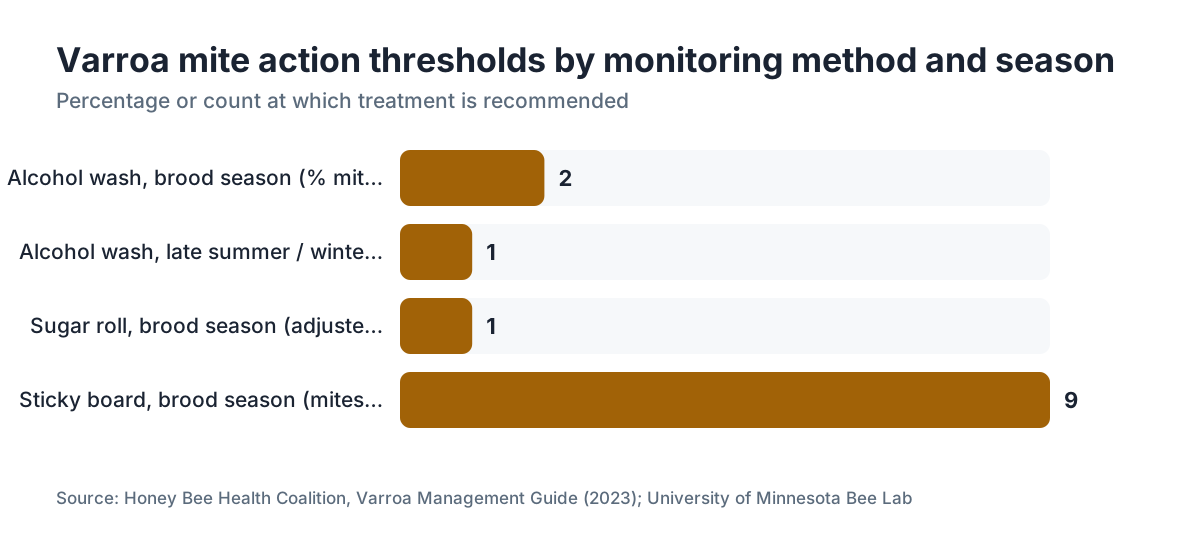
- Treat right away when an alcohol wash reads 2% or higher (2 mites per 100 bees) during the brood season.
- That number comes from the Honey Bee Health Coalition and is echoed by Penn State and University of Minnesota extension.
- In late summer, some programs tighten the trigger to 1% to protect winter bees.
- Sticky board drop above 8-9 mites per 24 hours signals the same urgency.
What is the action threshold for varroa mites?
Treat now if your alcohol wash reads 2% or higher during the active brood season. That 2% figure comes from the Honey Bee Health Coalition's Varroa Management Guide, the most widely cited consensus document in U.S. beekeeping, which pulls together data from university trials and field programs across North America [1]. Penn State Extension and the University of Minnesota Bee Lab repeat the same number [2][3].
Two percent means 2 mites per 100 bees in your half-cup alcohol wash sample. Count 4 mites out of 100 and you're at 4%, well past the line. Count 1 mite and you're at 1%, low enough to monitor closely and probably hold off, depending on the season.
The threshold is not a biological cliff. Colonies have survived at higher counts and crashed below it. What the number really marks is the infestation level where research keeps showing colony performance drop and winter survival fall off, which is why extension entomologists settled on it as a practical trigger.
One thing worth knowing: the line drops in late summer. The Honey Bee Health Coalition recommends treating at or above 2% from spring through midsummer, but several programs flag late July through August as a window where even 1% is cause for worry, because those mites ride the bees that will overwinter the colony [1].
How do alcohol wash, sugar roll, and sticky board counts compare?
The method matters, because each tool has a different accuracy and a different threshold tied to it. Here's how the three main ones stack up:
| Method | Sample size | Accuracy vs. true infestation | Action threshold |
|---|---|---|---|
| Alcohol wash | ~300 bees (~1/2 cup) | ~95% mite recovery [1] | 2% (brood season), 1% (late summer) |
| Sugar roll | ~300 bees (~1/2 cup) | ~60-70% mite recovery [1] | 2% adjusted, but results undercount |
| Sticky board (natural drop) | 24-hr or 48-hr count | Indirect; highly variable | 8-9 mites/24 hrs (brood season) [3] |
Alcohol wash is the gold standard. You lose the bees, but you get a count you can trust. Sugar roll is gentler on the bees and notoriously low, because powdered sugar doesn't knock every mite loose. If you sugar-roll and get 1.5%, your real infestation is likely higher. I'd treat at 1% on a sugar roll during brood season for that reason.
Sticky boards are the least reliable for setting a precise threshold. Natural mite drop swings with ambient temperature, colony population, and whether you've recently applied oxalic acid. The old rule of thumb was 8-9 mites per 24 hours as a trigger during the brood season [3], but that number assumes roughly 40,000 bees. A small nucleus colony dropping mites at the same rate is in far deeper trouble.
Want accurate data? Use alcohol wash. Everything else is a rough screen.
Does the threshold change by season?
Yes, and this trips up a lot of beekeepers. A 2% count in May is a problem, but a manageable one. The same count in August can cost you the colony going into winter.
Here's why late summer carries so much weight. Varroa reproduce inside capped brood cells, and the bees raised in July and August form your winter cluster. Researchers call them winter bees because they're physiologically different, with larger fat bodies that carry the colony through months without brood. Mite-parasitized bees have depleted fat bodies and higher viral loads, especially deformed wing virus [4]. A colony heading into October with those compromised bees frequently does not survive February.
Several programs now recommend an August treatment regardless of count, timed to protect the winter bee cohort. The Honey Bee Health Coalition guide identifies the period before winter bees are raised as the single most important treatment window of the year [1].
In spring, the threshold is still 2%, but a borderline count costs less because the colony has a full season ahead. The math flips hard in late summer.
Winter monitoring is its own conversation. Colonies in a broodless period are easier to treat with oxalic acid, and even a 1-2% count on a broodless winter colony may warrant treatment, because mites sit entirely on adult bees with nowhere to hide [1].
How do you actually do an alcohol wash to check mite levels?
You need a half-cup measure, a jar with a mesh lid (purpose-made mite wash jars are sold at most suppliers, or make one from a mason jar and window screen), isopropyl alcohol at 70% or higher, and water to dilute your sample for counting.
Step one: find a frame with open brood and nurse bees. Nurse bees attending brood carry the highest mite loads and give the most representative count. Don't sample from the entrance or a honey frame.
Step two: shake or brush about 300 bees (a half-cup measure) into a container, then tip them into your jar with alcohol. The bees die immediately. Shake the jar hard for 30 to 60 seconds.
Step three: pour the wash through the mesh lid into a white tray or bowl. The mites fall through and the bees stay behind. Count the brown dots in the liquid. Count the bees in the jar, or use the half-cup approximation of 300.
Step four: divide mites by bees and multiply by 100. Six mites from 300 bees is 2%. Twelve mites from 300 bees is 4%.
Sample size matters. A half-cup of bees is about 300 workers. Smaller samples make the percentage shaky. Wash only 100 bees and find 1 mite, and that's 1%, but a single mite either way swings you by a full point.
The University of Minnesota Bee Lab has a step-by-step alcohol wash guide with photos that's worth bookmarking [3].
What happens if you don't treat when mites hit threshold?
The colony rarely dies right away. Varroa damage stacks up over weeks, and it shows most in the months after the infestation peak.
Here's the usual trajectory. Mite populations in untreated colonies double roughly every 4 to 6 weeks during the active brood season [4]. A 2% count in late June can hit 8-10% by September. At those levels deformed wing virus goes widespread, you see bees with crumpled wings crawling at the entrance, brood turns spotty, and the population drops hard going into fall. Most untreated colonies collapse by late winter or early spring.
The neighboring beekeeper problem is real too. A collapsing colony releases a wave of mite-laden bees, and nearby colonies rob them out and carry the mites home. Researchers have documented this drift and robbing as a major route of mite spread between apiaries [4]. Skipping treatment is more than a risk to your own hive.
Already at 4% or higher? The window for a soft intervention is closing. Reach for the fastest effective treatment your conditions allow, not a slow-burn option.
Which treatments work at high mite counts and how fast do they act?
Not every treatment moves at the same speed. That matters when counts are high, because you want mite load dropping before more brood emerges and hands the surviving mites fresh cells to breed in.
Oxalic acid vaporization is the fastest option in broodless conditions. With no capped brood, a single session reaches nearly every mite on the adult bees. Efficacy in broodless colonies runs 90-99% in controlled trials [5]. The EPA-registered product in the U.S. is Api-Oxal (oxalic acid dihydrate), and the label is the legal document that governs rates and intervals [5].
During the brood season, a single oxalic acid vapor treatment is far weaker because mites inside capped cells are protected. Extended-release oxalic acid (glycerin-soaked cellulose strips, sold as OA extended release strips) reaches mites over 3 to 4 weeks as bees chew the pads, and it's gaining traction, though the data is still maturing next to older options.
Amitraz strips (Apivar) are one of the most reliable brood-season treatments. Active for 6 to 8 weeks, long enough for every mite reproductive cycle to finish. Studies report 93-95% efficacy when strips stay in for the full labeled duration [6]. Resistance shows up in some U.S. apiaries, so rotating with other modes of action matters.
Formic acid (Mite-Away Quick Strips, sold as MAQS) penetrates capped brood, which is its main edge. It reaches mites under the cappings that amitraz leaves untouched. Temperature has to sit between 50 and 85 degrees Fahrenheit during treatment; outside that range you lose efficacy and stress the colony [7].
Thymol-based products (ApiLife Var, Apiguard) need sustained temperatures above 60 degrees F and act slowly. They work in spring and early fall but are the wrong tool for an August emergency.
Count came back at 6%? Use amitraz strips or formic acid. Don't mess around with thymol in a crisis.
Is the 2% threshold the same for all colony types and sizes?
Mostly, with some honest caveats.
The 2% threshold assumes a typical Langstroth colony in the active brood season with a normal population. Nucleus colonies (nucs) are more vulnerable at lower counts because fewer adult bees are there to absorb the losses. Some researchers suggest treating nucs at 1% during brood season [2].
Package bees installed in spring are a different picture. A newly installed package has no brood for the first week or two, so mites sit entirely on adults, and an oxalic acid dribble or vaporization right after installation can slash your starting mite load. This is a standard practice, not an emergency move.
High-density apiaries see faster reinfestation from neighboring colonies. Keep bees near many other hives or other beekeepers, and hitting threshold then treating buys you less time before mites move back in. Some commercial operations in dense settings treat on a calendar schedule rather than waiting for counts, precisely because reinfestation is so predictable.
Colonies with a brood break, from a requeening or a swarm, can take a more aggressive oxalic acid treatment during that window even below 2%, as a strategic reset. It's an opportunity, not a requirement.
For most hobbyists with standard Langstroth colonies, 2% is the right line. The nuance lives in timing and treatment choice, not in wildly different threshold numbers.
How often should you monitor mite levels?
More often than most hobbyists actually do it.
The Honey Bee Health Coalition recommends monitoring at least monthly during the active season, with extra attention on late winter/early spring, midsummer, and late summer before fall [1]. In most of the continental U.S. that means roughly March, June, August, and October, as a floor.
Here's the practical logic. Mite populations can go from sub-threshold to dangerous in 4 to 6 weeks. Check in May, skip until September, and you may have missed the window where a single treatment cycle would have carried the colony safely through winter. Monthly monitoring closes that gap.
For a two-hive hobbyist, each alcohol wash takes about 15 minutes per colony. Monthly monitoring is roughly four hours of work per season across two hives. That's a cheap hedge against colony loss, and a replacement nucleus colony runs $150-250 in most markets in 2024-2025 [8].
If you want to track counts across the season and set reminders for treatment windows, VarroaVault's free monitoring tools let you log alcohol wash results over time and flag threshold crossings, which makes trends easier to spot than reacting to a single snapshot.
Keep records. One count tells you where you are today. A series of counts tells you whether the population is rising or falling, which is usually the more useful information.
What do official guidelines say about mite thresholds?
The clearest official U.S. guidance comes from three places: the Honey Bee Health Coalition, university extension programs, and EPA product labels.
The Honey Bee Health Coalition's Varroa Management Guide states that a 2% threshold (2 mites per 100 bees) is recommended during the brood season, and it flags late summer as a period when beekeepers should consider treating at even lower levels to protect the winter bee population [1]. The guide was developed with input from USDA, university researchers, and commercial beekeepers, and it's the closest thing to a national consensus document the industry has.
Penn State Extension recommends the same 2% threshold and states that mite levels above it call for prompt action [2]. The University of Minnesota Bee Lab reinforces this with its own monitoring guide and adds that sticky board counts of 8-9 mites per 24 hours correspond roughly to a 2% alcohol wash infestation in a full-sized colony [3].
EPA-registered treatment labels are legal documents. The Apivar label, for example, sets application timing and duration, and using the product outside label directions is a federal violation under FIFRA, the Federal Insecticide, Fungicide, and Rodenticide Act, 7 U.S.C. § 136 et seq. [9]. That matters because some beekeepers cut treatment cycles short to save money, which both drops efficacy and speeds up resistance.
No single federal regulation mandates a treatment threshold for hobby beekeepers. The guidance is advisory. But the agreement among the Coalition, extension programs, and decades of field data is strong enough that 2% is effectively the industry standard.
Can mite-resistant bees change the treatment threshold?
This one is genuinely unsettled, and anyone who hands you a confident number is overstating what we know.
Breeders working on varroa-sensitive hygiene (VSH) and other hygienic traits report that colonies from high-VSH stock tolerate higher mite loads without the performance declines standard stock shows. The USDA Baton Rouge Bee Lab, which leads much of the U.S. VSH work, has documented that VSH bees keep below-threshold mite levels naturally through mite-removal behavior [10]. But "can" carries a lot of weight in that sentence. Field results with commercial "mite-resistant" genetics vary widely, and few hobbyists get access to rigorously tested VSH stock.
The practical advice from most extension specialists: even with mite-tolerant genetics, keep the same monitoring intervals and the same threshold. If your resistant stock stays well below 2% without treatment, that's good data, and you can adjust over time. Until your own history with that stock says otherwise, assume 2%.
Small-cell beekeeping, which some advocate as a natural control, hasn't held up in controlled research. A study comparing small-cell and standard-cell comb found no significant difference in mite infestation [11]. I wouldn't lean on it as a substitute for monitoring.
Mite-resistant bees are a real, developing tool. They're not a reason to stop counting mites.
What's the right next step after you find you're over threshold?
First, confirm the count. One alcohol wash can carry sampling error. At 2.5-3%, run a second wash from a different part of the brood nest before committing, especially if you treated recently and are trying to judge efficacy. At 5% or higher, don't wait. Treat.
Second, pick the right treatment for your conditions. Temperature, brood status, and honey supers all constrain your options. Oxalic acid can't be applied while honey supers meant for human consumption sit on the hive, per the Api-Oxal label [5]. Amitraz strips have to come out before you install supers. Know your label before you open the treatment kit.
Third, re-wash 4 to 6 weeks after treatment to confirm it worked. A treatment that isn't working is worse than none, because it burns your timing window. If post-treatment counts stay above 1%, suspect resistance, poor application, or a shortened treatment duration.
Ordering supplies or comparing treatment options? Beekeeping supply companies can help you find current pricing and availability for registered products in your region.
Fourth, set the next monitoring date before you close the hive. Mite management is a season-long rhythm, not a one-off. Write the date on your hive record before you leave the apiary. VarroaVault's protocol tools help you set that schedule and track efficacy across treatment cycles, which pays off most if you're running more than two or three colonies.
For the varroa reproductive cycle and why the mite's biology makes timing so consequential, the varroa mite overview covers the foundational science.
Frequently asked questions
What mite count is considered normal and safe?
Below 1% (1 mite per 100 bees on an alcohol wash) during the active brood season is generally low and manageable. Monitor monthly to keep it there. In late summer, even 1% deserves close attention, because the bees being raised then are your winter bees. There is no truly 'safe' mite level, only a level below which treatment is not yet urgent.
Is a 3% mite count an emergency?
Yes, treat now. Three percent sits above the 2% action threshold used by the Honey Bee Health Coalition and most U.S. extension programs. At 3%, mite populations keep growing and colony performance drops. Pick an EPA-registered treatment that fits your current temperature and brood conditions, and follow the full label duration for the best result.
How many mites per day on a sticky board requires treatment?
The commonly cited sticky board threshold during the brood season is 8-9 mites per 24 hours, which corresponds roughly to a 2% alcohol wash infestation in a full-sized colony. Sticky boards are less accurate than alcohol wash, and the count shifts with colony size, temperature, and recent treatments. Use the board as a screen, not a verdict, and confirm with an alcohol wash if you're close to threshold.
What's the varroa treatment threshold in fall versus spring?
In spring and early summer, treat at 2% or above. In late summer (July through August in most of the U.S.), treat at 1-2%, because those mites parasitize the winter bees the colony needs to survive. Some programs recommend a late-summer treatment regardless of count. Going into winter, even low counts in a broodless colony may warrant oxalic acid, since every mite is accessible on adult bees.
Can I use a sugar roll instead of an alcohol wash to check the threshold?
You can, but sugar rolls undercount real mite levels by roughly 30-40% next to alcohol wash. If you use a sugar roll, treat at 1% rather than 2% to account for that gap. An alcohol wash costs you a small cup of bees but gives you a count you can trust. For any threshold call that drives a treatment choice, alcohol wash is the better tool.
How do I know if my varroa treatment worked?
Run an alcohol wash 4 to 6 weeks after treatment starts (or after it ends, for contact strips). Below 1% means the treatment worked. Still at or above 2% means the treatment may have been incomplete, applied outside labeled temperatures, or you're facing resistance. Contact your state apiarist or extension specialist if a re-treatment doesn't bring counts down.
What is the varroa treatment threshold for a new package or nucleus colony?
Treat nucleus colonies at 1% during brood season rather than waiting for 2%, because nucs are more vulnerable with smaller populations. For newly installed packages with no brood, an oxalic acid dribble or vaporization right at installation is widely recommended as a baseline reset regardless of mite count. It's a low-cost move that cuts your starting infestation before the colony builds up brood.
Does the mite count threshold differ for commercial versus hobbyist beekeepers?
The biological threshold is the same. Commercial operations sometimes treat on a calendar schedule rather than monitoring to threshold, because washing thousands of hives makes count-based triggers impractical. For hobbyists running a few to a dozen colonies, monthly alcohol washes are doable, and threshold-based treatment is the more targeted approach, cutting unnecessary chemical exposure and resistance pressure.
How do varroa mite counts relate to colony collapse or winter death?
Studies have consistently found that colonies entering winter with mite counts above 2-3% have much higher overwintering mortality. Varroa transmits deformed wing virus to developing bees, and winter bees with compromised fat bodies and high viral loads fail to sustain the cluster through cold months. The relationship isn't perfectly linear, but high late-summer mite loads are among the strongest predictors of spring deadouts.
Are there any states or countries with different official mite thresholds?
Most North American extension programs have converged on the 2% alcohol wash threshold, though some Canadian provincial guidelines and European programs use slightly different reference points based on local research. The UK's BeeBase program, for instance, uses a natural mite drop calculation tied to colony size rather than a strict percentage. In practice, 2% is the number most working beekeepers in the U.S. and Canada use as their trigger.
What happens if I treat when mite counts are below threshold?
You're unlikely to harm the bees, but you're adding unnecessary chemical exposure and speeding up resistance in the local mite population. Every application of amitraz or formic acid without cause puts selection pressure on mites. Unnecessary treatment also costs money and may force honey super removal. Stick to threshold-based treatment; it's better for your bees and for resistance management across your region.
Can I treat for varroa while honey supers are on the hive?
It depends on the product. Oxalic acid (Api-Oxal) can't be applied when honey supers meant for human consumption are present, per the EPA label. Amitraz strips (Apivar) likewise must come out before you add supers. Formic acid (MAQS) has a different label provision but still needs careful temperature management. Always read the current product label before treating. Labels are the legal document, and extension summaries can lag behind label revisions.
How long after crossing threshold do I have before my colony is in serious danger?
There's no clean answer, and it turns on the time of year. A colony at 2.5% in May has several weeks of margin. A colony at 2.5% in August has much less, because every day of brood rearing produces more mite-parasitized winter bees. The general guidance: once you're at threshold, treat within a few days, not a few weeks. A 3-week delay in August can mean a deadout by March.
Sources
- Honey Bee Health Coalition, Varroa Management Guide (latest edition): Action threshold of 2% mites per 100 bees during brood season; late summer threshold may be lower to protect winter bees; monthly monitoring recommendation.
- Penn State Extension, Honey Bee Health and Varroa Mite Management: Recommends 2% alcohol wash threshold; mite levels above threshold call for prompt action; nucs more vulnerable at lower counts.
- University of Minnesota Extension, Bee Lab, Varroa Monitoring Methods: Alcohol wash is gold standard; sticky board threshold of 8-9 mites per 24 hours corresponds to approximately 2% infestation in a full colony.
- Nazzi F, Brown SP, et al. (2012), PLOS Pathogens, 'Synergistic Parasite-Pathogen Interactions Mediated by Host Immunity Can Drive the Collapse of Honeybee Colonies': Varroa-parasitized bees carry higher deformed wing virus loads and have compromised fat bodies; mite populations can double every 4-6 weeks during active brood season; mite spread via robbing documented.
- U.S. EPA, Pesticide Registration (Api-Oxal / oxalic acid dihydrate label): Oxalic acid dihydrate registered for Varroa treatment; cannot be applied with honey supers intended for human consumption present; 90-99% efficacy in broodless conditions cited in registration materials.
- Elzen PJ, Baxter JR, et al. (2000), Apidologie, 'Control of Varroa jacobsoni Oud. resistant to fluvalinate and amitraz using coumaphos': Amitraz strip (Apivar) efficacy of 93-95% when used for full labeled duration in brood-present colonies.
- U.S. EPA, Pesticide Registration (Mite-Away Quick Strips / formic acid label): Formic acid (MAQS) application requires temperatures between 50 and 85 degrees Fahrenheit; penetrates capped brood cells.
- USDA National Agricultural Statistics Service, Honey and Cost of Pollination reports: Replacement nucleus colony pricing context of $150-250 in most U.S. markets, 2024-2025.
- U.S. EPA, Summary of the Federal Insecticide, Fungicide, and Rodenticide Act (FIFRA), 7 U.S.C. § 136 et seq.: Using EPA-registered pesticide products (including varroa treatments) outside label directions is a federal violation under FIFRA.
- USDA Agricultural Research Service, Honey Bee Breeding, Genetics, and Physiology Laboratory (Baton Rouge): VSH (varroa-sensitive hygiene) bees maintain below-threshold mite levels naturally through mite-removal behavior.
- Ellis AM, Hayes GW, Ellis JD (2009), Experimental and Applied Acarology, 'The efficacy of small cell foundation as a varroa mite control': Small-cell comb showed no significant difference in varroa infestation levels compared to standard cell comb in controlled studies.
- University of California Agriculture and Natural Resources, Statewide Integrated Pest Management Program, Honey Bees: Monitoring frequency recommendations; threshold-based treatment reduces unnecessary chemical exposure and resistance pressure.
Last updated 2026-07-10