Why forager bees give lower mite count results than house bees
TL;DR
- Forager bees spend most of their time outside the hive, away from capped brood where varroa reproduce.
- Mites prefer young nurse bees, which stay close to brood cells.
- Sample foragers instead of nurse bees and your mite count can read 60-80% lower than the true infestation, so you skip treatments the colony badly needs.
What makes forager bees different from nurse bees for mite sampling?
Honey bee colonies split their work by age. Newly emerged bees start as nurses, feeding larvae and tending brood for the first two to three weeks of their lives. After that they graduate to foraging, flying out for pollen and nectar. [1]
That age split matters enormously for sampling, because mites do not spread themselves evenly across the colony. Varroa destructor reproduces only inside capped brood cells, and the female mites spend most of their adult lives riding nurse bees while they wait to enter the next cell. Foragers almost never touch capped brood. A forager leaves the hive before most mites have any reason to be on her.
The practical result: nurse bees carry the bulk of phoretic (free-riding) mites, and foragers carry almost none. Studies comparing mite loads on age-grouped bees have found phoretic prevalence on nurse bees running two to five times higher than on foragers from the same colony at the same moment. [2]
So the bees you grab matter more than almost any other variable in your protocol.
How much lower can a forager sample read compared to a nurse bee sample?
Much lower, and the gap widens as infestation climbs. Research in Experimental and Applied Acarology found that sampling from the hive entrance (where foragers return) produced mite counts 60-80% lower than samples from brood frames with nurse bees. [2] That is not a rounding error. A colony sitting at a true 3% infestation might read 0.6-1.2% if you scoop a cup of foragers off the landing board.
The Honey Bee Health Coalition's Varroa Management Guide says it plainly: sample nurse bees from brood frames, and treat samples from anywhere else as unreliable. [3] This is one of the most commonly broken rules in backyard beekeeping, and it kills colonies quietly every fall.
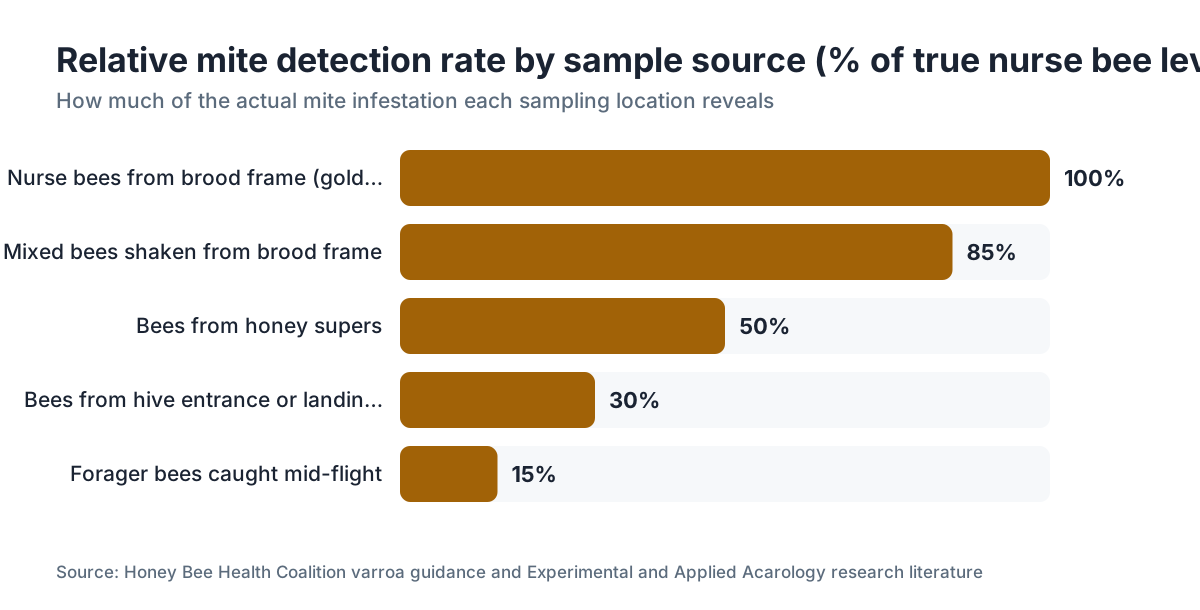
The table below sums up what the research and extension guidance say about how mite readings shift with collection point.
| Sample source | Relative mite load | Reliability for treatment decisions |
|---|---|---|
| Nurse bees from brood frame (gold standard) | Baseline (100%) | High |
| Mixed bees shaken from brood frame | ~80-90% of baseline | Acceptable |
| Bees from honey supers | ~40-60% of baseline | Poor |
| Bees from hive entrance or landing board | ~20-40% of baseline | Very poor |
| Forager bees caught mid-flight | ~10-20% of baseline | Essentially useless |
These are order-of-magnitude estimates drawn from the research literature [2] and extension guidance [4], not a single controlled trial. Colonies vary. But the direction holds across every study that has looked at the question.
Why do mites prefer nurse bees in the first place?
Varroa mites are not passive hitchhikers. They hunt for nurse bees because a nurse bee is the mite's ticket into the brood cell, the only place a mite can reproduce. [5]
The mite reads chemical signals, mainly brood pheromones and the cuticular hydrocarbons of young bees, that tell her she is close to a host who will soon enter a cell. Nurse bees are soaked in those cues. A forager, after days of flying through open air and visiting flowers, carries a very different chemical profile, and mites show little interest in her.
Think of it from the mite's side. Riding a forager is a dead end. The forager is not going back into a brood cell. She is going to a flower and then to a honey storage area. A mite that lands on a forager is stranded. A mite on a nurse bee has a good shot at entering a capped cell within hours or days.
This preference is documented in Rosenkranz, Aumeier, and Ziegelmann (2010), a review of varroa biology that is still the standard reference. [5] Mites cluster where reproduction is possible. They do not scatter at random.
Does the time of day affect whether you accidentally sample foragers?
Yes, and it matters. In the morning, most foragers are still inside and mixed with nurses on the brood frames. By midday on a warm day, a big share of the forager population is out flying, and the bees left on the brood frames skew younger. [1]
So the best time to sample is midday on a good foraging day, when foragers are out and the bees clustered on your brood frame are most likely the young nurses you want. Shake or scoop bees from a brood frame at 7 a.m. before flight has started and you may pull in more foragers than you meant to.
Midday sampling also spares you the morning rush, when opening the hive triggers a bigger defensive response. A calmer, thinner in-hive population is just easier to work.
Penn State Extension recommends midday sampling specifically to cut forager contamination of nurse bee samples. [4]
How do you make sure you're actually collecting nurse bees and not foragers?
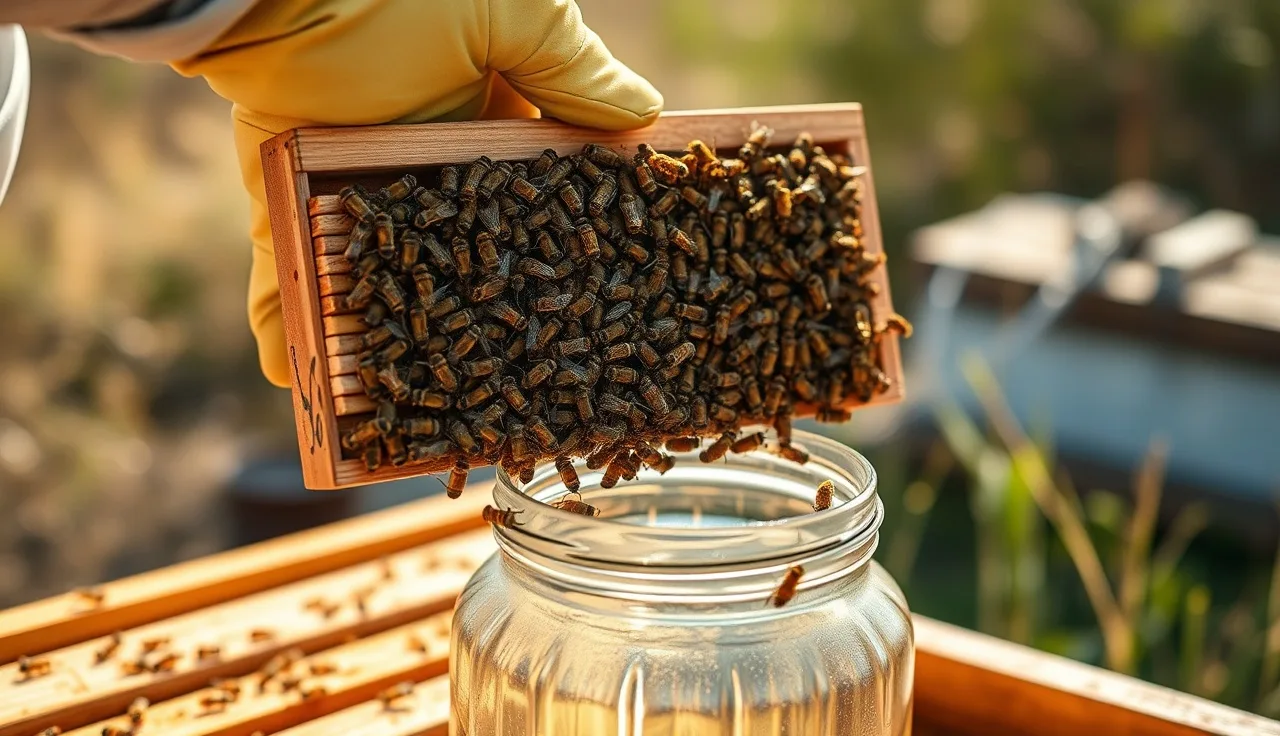
Shake directly from a brood frame. Not the entrance, not a honey super, not by catching bees at the hive opening. That is the method that consistently hands you nurse bees.
Here is the reliable process:
- Pull a frame from the center of the brood nest, one with capped brood on both sides.
- Confirm the queen is not on the frame before you shake.
- Hold the frame over your jar or alcohol wash container and give it a sharp downward shake. The bees that drop are mostly nurses.
- Collect roughly 300 bees (about half a cup) for an alcohol wash or a sugar roll.
Now check your work. Look at what fell. Nurse bees are soft-looking, slightly fuzzy, and slow. Foragers are worn, sometimes with frayed wings, and quick. If your sample is mostly worn, fast-moving bees, your frame selection went wrong.
Never use the landing board, the screened bottom board, or the hive entrance as a collection point. The varroa mite biology page on this site walks through the mite life cycle if you want the background on why brood-frame sampling is the right target.
What is the recommended threshold for treatment, and how does a forager sampling error change that decision?
The Honey Bee Health Coalition recommends treating when mite levels reach 2% infestation (2 mites per 100 bees) in spring and summer, and 1-2% in late summer or early fall when winter bees are being raised. [3] The economic injury threshold behind those numbers assumes your sample reflects the nurse bee population.
Sample foragers and get a 1% result, and you might call the colony fine. But if forager samples run 60-80% low, that 1% reading could mean a true nurse bee level of 2.5-5%. That is a colony that needs treatment now, not a pat on the back.
This is how beekeepers lose colonies while believing they monitored diligently. The monitoring happened. The sample was wrong.
EPA requires varroa treatment products to carry labels specifying when and how to use them, and those labels reference infestation thresholds built on nurse bee sampling. [6] Reading a forager-based count against a nurse-bee-based threshold compares two different things.
For a way to track counts across the season and flag when you are near threshold, the free tracking tools at VarroaVault let you log your alcohol wash or sugar roll results and watch the trend.
Does broodless period sampling behave differently?
Broodless periods change the math, and for once the change works in your favor.
With no capped brood, there are no cells for mites to enter. Every phoretic mite is riding an adult bee, and the nurse-versus-forager split matters much less because the whole mite population is out in the open with nowhere else to go. [5]
During a broodless stretch (natural in winter in cold climates, or induced by caging the queen), a sample of adult bees gives a truer picture of total mite load. It is one of the more accurate times to count, because close to 100% of mites are detectable on adult bees rather than the 20-40% that are phoretic during active brood rearing.
Here is the catch to remember. A broodless count often looks alarming next to a mid-summer count from the same colony, even when the actual mite population barely moved. The colony did not get worse. All the mites are simply visible now. Read the number with that context.
Do sugar roll and alcohol wash methods differ in how they're affected by forager contamination?
The method (sugar roll vs. alcohol wash) is not the main variable here. The source is. Load either one with foragers and you get an inaccurate low count.
That said, alcohol wash beats sugar roll for accuracy in general, because it captures close to 100% of the mites on the sampled bees. Sugar roll efficiency runs around 60-80% in controlled comparisons, so even a well-collected nurse bee sample can read lower than an alcohol wash from the same colony. [10]
Run a sugar roll on a forager sample and you stack two undercounts on top of each other: wrong bees and a less efficient detection method. The reading can end up a fraction of the true infestation.
The Honey Bee Health Coalition and most university extension programs recommend alcohol wash for its accuracy. [3] [4] The downside is that it kills the bees in the sample. Sugar roll is non-lethal and fine for tracking trends, as long as you stay disciplined about sampling from the right place.
Can drone brood sampling compensate for the forager problem?
Drone brood sampling sidesteps the adult-bee problem entirely, but it comes with its own limits.
Varroa prefers drone brood at roughly 8-10 times the rate it prefers worker brood, because drone cells stay capped longer (about 14 days for drones vs. 12 for workers, with the longer total development giving mites more reproduction time). [5] Uncapping drone brood gives you a high-signal count of reproducing mites, but it tells you nothing about phoretic loads on adult bees.
Drone brood sampling can help early in the season, when drone brood is abundant and before the adult mite population has built up. It is not a substitute for an adult bee alcohol wash, and drone brood results cannot be compared to the 2% treatment threshold, which is based on adult bee sampling. Extension guidance treats drone brood inspection as a supplementary diagnostic, not the main monitoring method. [4]
Drone brood sampling tells you mites are present and reproducing. An alcohol wash on nurse bees tells you the actual percentage, which is what a treatment decision needs.
How does forager sampling error interact with seasonal mite population dynamics?
Mite population growth tracks brood cycles, not calendar months. In a strong colony with continuous brood, varroa can double its population every four to six weeks. [5] During peak summer brood rearing, a high fraction of mites sit inside cells, not on adult bees at all, so phoretic rates drop. Forager sampling during this stretch is at its least accurate.
In late summer, as colonies raise winter bees and brood volume drops, the phoretic fraction climbs. That is when a forager sample gets slightly more representative, though still not reliable.
Here is the worst case. A beekeeper samples the entrance in July, sees 0.8%, calls the colony fine, and skips the late-summer oxalic acid or Apivar treatment. By October the colony sits at 5-8%. The winter bees raised in August and September emerged heavily parasitized, with shortened lifespans and thin fat body reserves, and the colony dies by January or February.
This is not hypothetical. It is the most common pattern of varroa-related winter loss in temperate climates, and bad sampling is one of the main drivers.
What do researchers and extension programs say about sampling location best practices?
The consensus across university extension programs and the Honey Bee Health Coalition is clear and consistent: collect from the brood nest.
The Honey Bee Health Coalition Varroa Management Guide directs beekeepers to collect bees from brood frames rather than honey supers or the entrance to get an accurate mite count. [3] Penn State Extension specifies samples from frames with open and capped brood, collected at midday. [4] The University of Minnesota Bee Lab likewise recommends shaking bees from brood frames and notes that entrance sampling is not reliable. [7]
The USDA Beltsville Bee Lab has produced training materials for state apiarists that treat nurse bee brood-frame sampling as the standard against which other methods are measured. [8]
Nobody in the research or extension community recommends entrance or forager sampling for routine monitoring. If you have seen advice suggesting otherwise, it was wrong. This is a rare case where the guidance leaves no room for argument.
Is there any situation where a forager sample is actually useful?
One narrow case. If you are trying to detect whether varroa is present in a feral or inaccessible colony you cannot open, catching foragers at the entrance and washing them can tell you whether mites exist at all. It cannot tell you the percentage with any accuracy, but present-or-absent is sometimes all you need.
Inspectors screening swarms or package bees at a state border sometimes use entrance sampling for presence-absence detection rather than a quantitative count. [8]
For any management decision, treat or don't treat, entrance sampling does not work. The numbers it produces cannot be plugged into the standard thresholds.
If you are shopping for beekeeping supplies and eyeing entrance-mount monitors that claim to count mites from returning foragers automatically, stay skeptical. The biology limits what those devices can see.
Frequently asked questions
Why does sampling bees from the landing board give such a low mite count?
The landing board is where foragers return from the field. Foragers carry almost no mites because mites actively avoid bees unlikely to enter brood cells, which is where mites reproduce. A landing board sample can read 60-80% lower than the true infestation in the brood nest, which makes it useless for treatment decisions.
How do I tell nurse bees from foragers when I collect a sample?
Nurse bees are fuzzier, softer-looking, and slower than foragers. Foragers often show wing wear and move quickly and deliberately. The reliable method is to shake bees directly from a frame with capped brood on both sides, taken from the center of the brood nest at midday. Bees from that spot are overwhelmingly nurses.
Can I use a screened bottom board mite drop count instead of sampling nurse bees?
Natural mite drop on a sticky board correlates poorly with infestation percentage, especially during active brood season when most mites are inside cells. The Honey Bee Health Coalition no longer recommends sticky board counts as a primary monitoring method. Alcohol wash or sugar roll from nurse bees is the standard. Sticky boards may confirm mite presence but cannot replace a wash.
What is the best time of year to do an alcohol wash mite count?
Late summer, typically late July through August in temperate climates, is the most critical window. Brood rearing is still active enough that nurse bee mite loads are meaningful, but it is early enough to treat before winter bees are raised. Sampling in May and again in late July covers the season. A broodless winter count is also very accurate but rarely actionable.
How many bees do I need in an alcohol wash sample for an accurate count?
300 bees is the standard recommended by the Honey Bee Health Coalition and most extension programs, roughly half a cup by volume. Smaller samples carry wider uncertainty: 100 bees with 2 mites could read anywhere from 1-3% once you account for confidence intervals, while 300 bees narrows that range a lot. Do not expect precision from 100 bees.
Does sugar roll undercount mites compared to alcohol wash even with nurse bees?
Yes. Sugar roll efficiency runs roughly 60-80% in controlled comparisons, so it misses some mites a parallel alcohol wash would catch. If your sugar roll reads 1.5% on a proper nurse bee sample, the true level may be closer to 2-2.5%. Alcohol wash is more accurate. Sugar roll is fine for trend tracking if you stay consistent, but alcohol wash is better for threshold calls.
Can varroa mites fall off forager bees during flight and re-infest other colonies?
Mites are not known to transfer between colonies through foraging flights in any meaningful way. The bigger inter-colony route is robbing and drifting, where bees and their mites physically enter a foreign hive. Foragers returning to their own hive carry so few mites that flight-based transfer between colonies is considered negligible next to bee-to-bee contact during robbing.
Does a broodless period mean all mites are on adult bees?
Yes. With no capped brood, mites have nowhere to reproduce and every phoretic mite rides an adult bee. A count during a true broodless period reflects total mite population better than a midsummer count, when 70-80% of mites can be hidden inside capped cells. Broodless counts often look higher than summer counts from the same colony, which reflects better detection, not a sudden surge.
Why do some online beekeeping forums recommend entrance sampling? Is that advice wrong?
It is wrong for quantitative monitoring. Entrance sampling can work as a quick presence-absence screen, and it is easy, which is why people suggest it. But the biology is settled: foragers carry a small fraction of the colony's mite load. Using entrance counts for treatment decisions leads to systematic undercounting and missed treatment windows. The research and extension consensus is unambiguous.
How does capped drone brood sampling compare to adult bee alcohol wash for accuracy?
They measure different things. Drone brood sampling counts reproducing mites inside cells and is sensitive for detecting presence early in the season. Adult bee alcohol wash counts phoretic mites and gives a percentage you can compare to treatment thresholds. Drone brood numbers cannot be compared directly to the 2% threshold used in colony management. Use alcohol wash on nurse bees for treatment decisions.
Does the size of the colony affect whether a nurse bee sample is accurate?
Somewhat. A 300-bee sample from a 40,000-bee colony is a small fraction with real statistical variance. A colony under 10,000 bees (late winter or a struggling colony) may have fewer nurses on brood frames, so the sample can pick up older bees. The method is still the best available, but reading a 2.1% result from a weak colony as different from 1.8% overstates the precision.
What happens if I treat based on a forager sample that reads below threshold?
You skip a treatment you probably needed. The colony keeps carrying the real mite load, which compounds over weeks. By the time symptoms show, damaged brood or deformed wing virus in adults, the mite population is often 5% or higher and hard to knock down before winter. Colonies lost to varroa in January or February were usually under-treated the previous August.
Are there any automated or passive monitoring tools that accurately replace nurse bee alcohol wash?
Not yet, not reliably. Several commercial and research devices claim to count mites on returning foragers or on bees inside the hive, but none have shown accuracy equal to alcohol wash on nurse bees across different colony conditions and seasons. They may work as supplemental trend indicators. For a treatment threshold decision, alcohol wash on nurse bees from a brood frame is still the standard.
Sources
- USDA Agricultural Research Service, Bee Research Laboratory (Beltsville): Honey bee labor division by age: nurse bees spend first 2-3 weeks tending brood before transitioning to foraging
- Experimental and Applied Acarology (journal): phoretic mite loads on nurse vs. forager bees: Entrance-based samples produce mite counts 60-80% lower than nurse bee samples from the same colony at the same time
- Honey Bee Health Coalition, Tools for Varroa Management guide: Sample nurse bees from brood frames; treatment threshold is 2% infestation in spring/summer, 1-2% in late summer; alcohol wash preferred over sugar roll
- Penn State Extension, honey bee and varroa monitoring guidance: Samples should come from frames with open and capped brood, collected at midday to minimize forager contamination
- Rosenkranz, Aumeier, Ziegelmann (2010), Biology and control of Varroa destructor, Journal of Invertebrate Pathology: Varroa mites actively seek nurse bees via brood pheromones and cuticular hydrocarbons; mites prefer drone brood at 8-10x the rate of worker brood; mite population can double every 4-6 weeks
- EPA, Pesticide Labels (Pesticide Product and Label System): EPA-registered varroa treatment labels reference colony infestation thresholds established using nurse bee sampling protocols
- University of Minnesota Bee Lab: Recommends shaking bees from brood frames for sampling; entrance sampling is not reliable for quantitative mite monitoring
- Oregon State University Extension: Broodless period counts reflect total mite population because all phoretic mites are on adult bees with no cells available
- University of Florida IFAS Extension (EDIS): Sugar roll efficiency approximately 60-80% compared to alcohol wash as reference standard on same sample of nurse bees
Last updated 2026-07-09