How to do a mite count on bees (and what the numbers mean)
TL;DR
- A mite count tells you how many varroa mites ride your adult bees, expressed as mites per 100 bees.
- The alcohol wash is the gold standard at roughly 96% accuracy.
- A count at or above 2 mites per 100 bees in summer is the widely accepted treatment threshold.
- Test every 30 days during the active season.
What is a mite count and why does it matter?
A mite count (also called a mite wash or mite load test) is a quick sample test that gives you the infestation rate of varroa destructor in your colony, expressed as mites per 100 adult bees. That single number is the most useful piece of data a beekeeper can hold. It tells you whether to treat now, wait and recheck, or relax for the month.
Varroa mites kill colonies. Not sometimes. Not only under bad conditions. The Honey Bee Health Coalition's Varroa Management Guide states flatly that "without management, varroa will eventually kill a honey bee colony, usually within one to three years." [1] That timeline compresses badly in autumn, when mite numbers spike on a shrinking bee population.
The number from a mite count doesn't tell you how many mites live in the whole hive. It estimates the phoretic mite load, meaning the mites riding on adult bees right now. Some mites are always hidden in capped brood cells where no wash can reach. But the phoretic rate tracks total colony infestation closely enough to work as a management trigger, and it's the number every published threshold is built on. [1]
Skipping mite counts is the most common mistake hobbyist beekeepers make. A colony can look busy and healthy while carrying a mite load that crashes it in six to eight weeks.
What are the two main methods for counting varroa mites?
Two methods dominate: the alcohol wash and the sugar roll. A third option, the sticky board count, exists but has real limits worth treating separately.
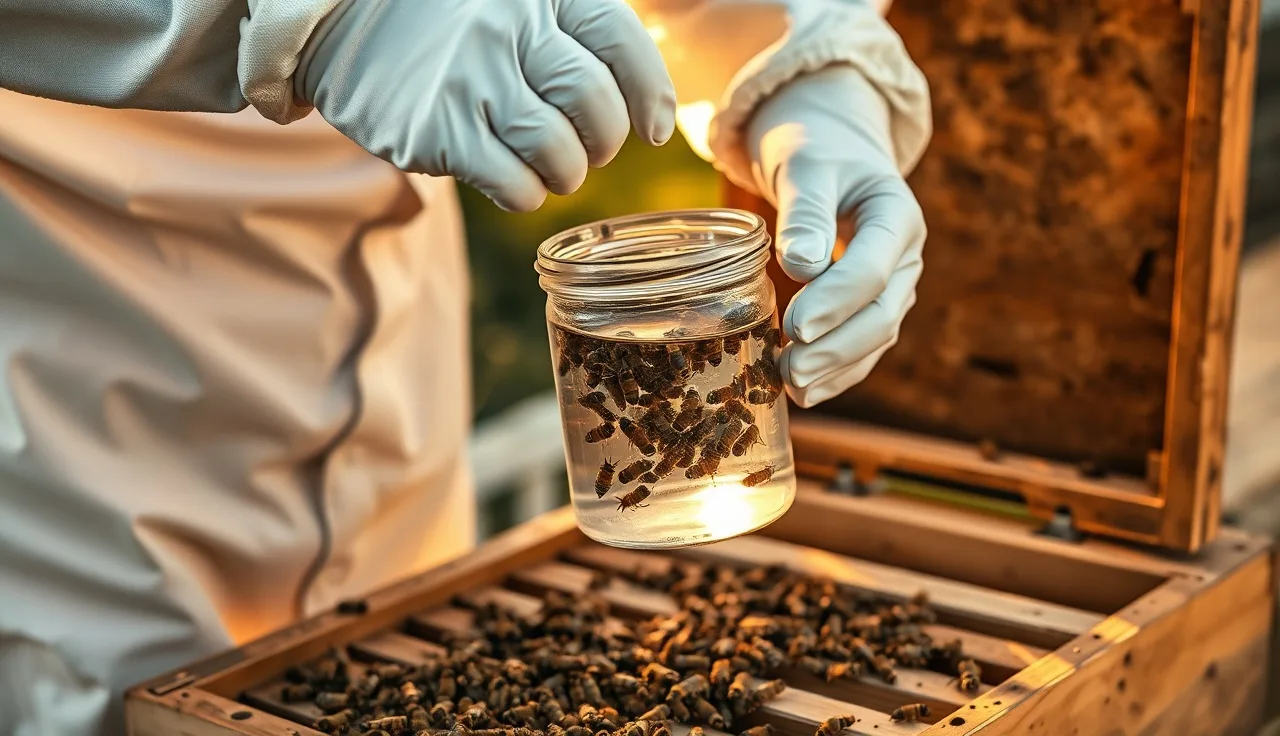
Alcohol wash takes about 300 adult bees (roughly half a cup), submerges them in 70% isopropyl alcohol, shakes for 60 seconds, and strains the liquid through a mesh lid into a white container. You count the mites that fall through. The bees die. Accuracy runs about 96% in controlled comparisons, which makes the alcohol wash the most reliable method a hobbyist can run. [2]
Sugar roll uses the same 300-bee sample, coats the bees in powdered sugar, and rolls them in a jar for 60 seconds. The sugar clogs the mites' grip pads and knocks them loose. You sift the sugar through a mesh lid and count. The bees live and go back in the hive, which matters emotionally but not statistically. Accuracy in peer-reviewed testing runs around 60 to 70%, well under the alcohol wash. [2] That gap is real. On a borderline count, the sugar roll can hand you a false sense of security.
The Honey Bee Health Coalition and most university extension programs name the alcohol wash as the standard method for exactly this reason. [1][3]
Sticky boards (placed under a screened bottom board for 24 to 72 hours) count mites that naturally fall off bees. They're non-lethal and need no sample collection. The trouble is reading them. Daily natural mite fall swings wildly with colony size, season, brood pattern, and temperature. The formulas that convert sticky board counts to infestation rate are rough guesses. Most extension specialists today say sticky boards can tell you mites are present but shouldn't drive a precise treatment decision. [3]
A short comparison:
| Method | Bees killed | Accuracy | Time to result | Best use |
|---|---|---|---|---|
| Alcohol wash | ~300 | ~96% | 10 minutes | Treatment decisions |
| Sugar roll | 0 | ~60-70% | 10-15 minutes | Rough screening only |
| Sticky board | 0 | Low/variable | 24-72 hours | Mite presence detection |
How do you do an alcohol wash step by step?
You need a half-cup measuring cup or a purpose-built mite wash kit, a jar with a screen or mesh lid, 70% isopropyl alcohol (rubbing alcohol from any drugstore works), and a white or light-colored container to pour the wash into.
Step one: find a frame with the heaviest concentration of young nurse bees. These bees carry the most phoretic mites because they spend the most time in contact with open brood cells. A frame of open brood ringed by nurse bees is ideal. Never use the frame the queen is on.
Step two: shake or brush roughly 300 bees into your collection container. Half a cup is about 300 bees, though the exact number matters less than you'd think. The math still holds at 250 or 350. Precision here is a common over-worry. What matters more is that you pulled from the right frame.
Step three: add enough alcohol to fully submerge the bees, seal the lid, and shake hard for 60 seconds.
Step four: invert the jar over your white container and strain the alcohol through the mesh. Shake and tap to force every mite out. Add a second splash of alcohol and shake again to lift stragglers.
Step five: count every dark speck in the white container. Mites are reddish-brown to dark brown, roughly 1 to 2mm long, and oval. After a couple of washes, they're unmistakable.
Step six: do the math. Six mites from a 300-bee sample is 6/300 x 100 = 2 mites per 100 bees (2%). Write it down with the date and hive ID. One number without a trend is far less useful than a run of them.
You can buy pre-made mite wash kits from most beekeeping supply companies, or build your own with a mason jar and a piece of hardware cloth cut to fit the lid.
What is the treatment threshold for mite counts?
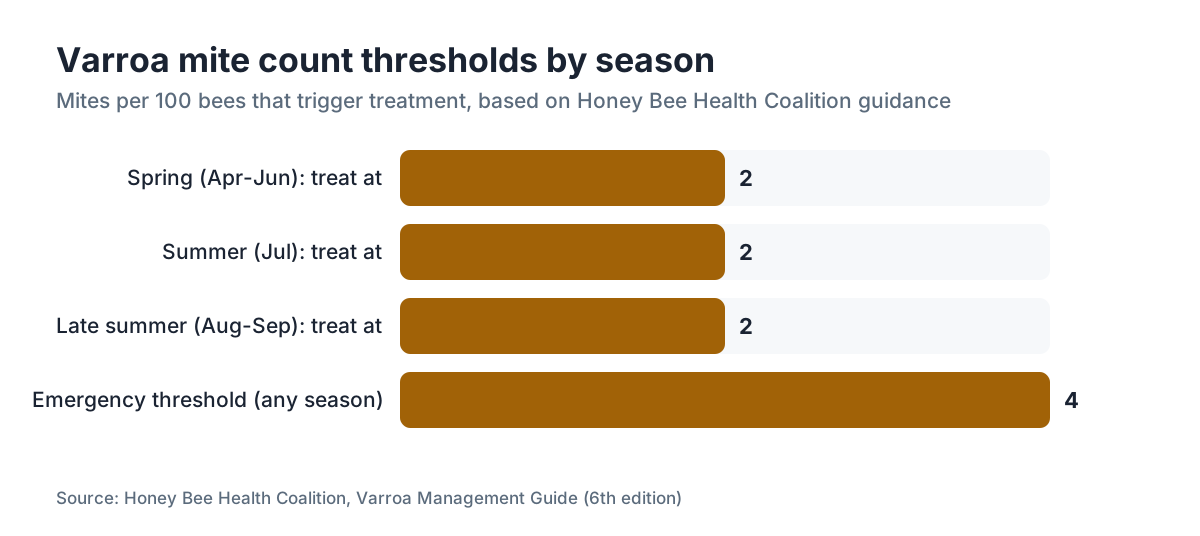
The most widely cited threshold in North America is 2 mites per 100 bees (2%) during the summer brood-rearing season. At or above that number, treat. Below it, recheck in 30 days. [1]
Thresholds aren't one-size-fits-all, though, and the Honey Bee Health Coalition's guide lays out season-based nuance: [1]
- Late summer to early fall (August-September in most of the US): Some programs drop the trigger to 1.5% because the colony is raising the winter bees that need to survive five or six months. A mite load a summer colony might shrug off turns deadly when it lands on a smaller, aging population raising the bees that must overwinter.
- Spring through midsummer: The 2% threshold holds, though some experienced beekeepers use 3% when colonies build fast and dilute the mite rate with waves of newly emerged bees.
- Winter: Counting in true winter is impractical in cold climates. If you treated well in late summer and fall, your winter load should stay manageable. Some beekeepers add an oxalic acid dribble on a broodless winter cluster as a knockdown.
One number gets less attention but matters a lot. See 4% or higher at any point in the active season and treat that as an emergency. Treat immediately. Don't wait for the "ideal" window or cooler weather. A colony at 4% is already in trouble, and the mite population doubles roughly every four to five weeks. [1]
If you want a free tool for tracking counts and cross-referencing treatment windows against local weather and your colony calendar, VarroaVault's varroa management tools let you log results and get threshold alerts with no math on your end.
Before you interpret any count, it helps to understand the varroa mite itself, its life cycle, and how treatments work at the biological level.
When during the season should you test your bees for mites?
Test at least every 30 days from the time bees forage actively in spring until you finish your final fall treatment. That's roughly April through September across most of the continental US, though the window shifts with climate.
Four moments matter most:
Early spring. Before colonies build up. A high count in March or April means mites overwintered in bigger numbers than you expected, maybe because your fall treatment underperformed or landed at the wrong time.
Late spring through early summer. The colony expands fast. Mite reproduction accelerates right alongside it. This is when a count that looked fine can jump inside a single 30-day gap.
Late July through August. The most important testing window of the year. Winter bee production is coming, and you need enough runway to finish a full treatment course (often 6 to 8 weeks for many miticides) before those winter bees are capped. Miss this window and colonies die over winter even when the beekeeper swears they treated.
After treatment. Always recheck 4 to 6 weeks after you finish. A count that doesn't drop tells you something broke: a resistant mite population, a temperature outside the product's range, or an application error.
Nobody has clean data on exactly how often testing catches problems that inspection alone misses, but the closest population studies suggest mite loads can double in four to five weeks during peak brood season. [4] Monthly testing gives you at least one data point per doubling cycle.
How many bees do you need for a reliable mite count sample?
The standard sample is about 300 adult bees, which comes to roughly half a cup (120 mL) by volume. That's enough to give statistically meaningful results across the infestation rates that drive treatment decisions, 1 to 5%. [1][8]
Smaller samples add variance. Sample 100 bees, find 2 mites, and you can call it 2%, but with far wider error bars than a 300-bee sample. On the border between treat and wait, a small sample can push your decision the wrong way.
You don't need to count bees one by one. Experienced beekeepers know what half a cup of bees looks like by feel. The first time or two, do a dry run: shake bees into a measuring cup to calibrate your eye, then release them. After a few seasons, collection gets fast and consistent.
Don't sample from the honey supers. Foragers up in the supers carry far fewer mites than nurse bees in the brood nest. Sample the wrong place and you undercount your load.
What do you do if your mite count is high?
A count at or above the threshold means you treat. The treatment you pick depends on season, hive configuration, and the local temperature at the time.
The main registered varroa treatments in the US fall into a few groups:
Organic acids: Oxalic acid (OA) hits phoretic mites hard but barely touches mites in capped brood. It works best on broodless colonies in winter or right after a brood break. Formic acid (MAQS, Formic Pro) volatilizes and penetrates capped brood, so you can use it during the brood-rearing season at temperatures between roughly 50 and 85F depending on the product label. [5][6]
Synthetic miticides: Amitraz (Apivar strips) is a long-established treatment with high efficacy across the brood-rearing season. Tau-fluvalinate (Apistan) and coumaphos exist, but resistance to both is documented in US mite populations, which limits their usefulness in many regions. [7]
Thymol: Api-Life Var and Thymovar use thymol and work through volatilization. They're temperature-sensitive (ideally 60 to 80F) and effective when conditions cooperate.
Follow the label exactly. The EPA registers these products with specific application rates, temperatures, and honey super removal rules. Going off-label can leave residues in honey, hurt the queen, or blow the treatment entirely. [7]
After any treatment, run a mite count 4 to 6 weeks later to confirm the number dropped. If it didn't drop much, don't just repeat the same product. Call your state apiarist or local extension specialist about resistance testing options.
Can a mite count be wrong, and what causes errors?
Yes. Every count carries some error, and knowing where the error comes from helps you read borderline results.
The biggest source of error in an alcohol wash isn't the method. It's where you sample. Bees from a honey super or from outside the brood nest carry fewer mites. Sample the wrong spot and get a 1% count when the true brood-nest rate is 3%, and that's a meaningful miss with real consequences.
Season matters too. During heavy drone brood, varroa pile into drone cells by preference. More mites hide in brood, fewer ride the adults, and your wash count underestimates the true colony infestation. That's part of why some beekeepers use drone brood removal as a management tool, and why spring counts (when drone brood is heavy) need extra context.
Sample size errors compound with location errors. Pull a small sample from the wrong frame and you can land a count that's off by a factor of two.
Mites clump on the jar or lid if you don't shake thoroughly. After straining, add a second small pour of alcohol, re-shake, and re-strain. The extra mite yield on the second wash often runs 5 to 10% of the first count.
Temperature affects the sugar roll (cold sugar doesn't coat well) but has no meaningful effect on the alcohol wash. Live somewhere cold and choose to sugar roll in early spring, and accuracy suffers.
How does a mite count change over the season?
Varroa populations follow a predictable seasonal curve in temperate climates, and your counts should trace it.
In early spring, mite loads often sit at their annual low because the colony ran broodless or low-brood through winter. Treat well the previous fall and a spring count under 1% is typical.
Through late spring and early summer, mite numbers grow with the colony. Colonies expanding fast through May and June dilute the mite rate with huge waves of new bees, so your percentage can stay low even as the raw mite count climbs.
The crunch hits in July and August. Mite reproduction runs flat out while the worker population plateaus or starts to fall. The percentage climbs fast. A colony at 1.5% in July can reach 3.5% by late August with no treatment.
By September and October, if you haven't treated, counts above 5% are common and pre-winter collapse is likely. The mites left in the hive concentrate entirely on the winter bees, shortening their lives and stunting their fat body development. Research from the USDA Beltsville lab has found that mite-parasitized bees show measurably shorter lifespans and weaker immune function. [4]
Track your counts on a simple spreadsheet or log. One count is a snapshot. Three or four across the season form a trend line, and the trend usually tells you whether your management is actually working.
Are there mite count tools or kits that make this easier?
Yes, and they genuinely help, especially for beekeepers new to the process.
Purpose-built mite wash kits (a jar with a screen-mesh lid and a collection cup) sell through most major beekeeping supply companies and beat improvised setups on ease of use. They run $15 to $25 and last for years. [8] You can also build a serviceable kit with a pint mason jar, a circle of 1/8-inch hardware cloth, and a jar band for under $3.
The Varroa EasyCheck device from Veto-Pharma standardizes the sample volume and simplifies the wash and count. Extension programs have picked it up for field demonstrations because it cuts the main sources of user error.
For logging and interpretation, VarroaVault offers free varroa management tools that record counts, track trends, and compare your results against published thresholds. Run more than a handful of hives and a structured log makes it far easier to catch a colony trending up before it crosses the threshold.
The most useful thing you can do, past buying a kit, is run your first wash alongside an experienced beekeeper or at a club demonstration. Reading about it and doing it are different experiences. Watching someone collect the sample and count the mites strips out the uncertainty.
What does research say about mite counts and colony survival?
The evidence linking mite load to colony death is some of the strongest in applied bee research.
The Honey Bee Health Coalition's Varroa Management Guide, drawing on multiple peer-reviewed studies and USDA data, states that untreated colonies "usually die within one to three years" and that the speed of collapse depends heavily on the starting mite load at the end of summer. [1]
A national colony loss survey published in PLOS ONE (Kulhanek et al., 2017) tied high late-season mite loads to higher winter mortality, with varroa named among the top drivers of loss reported by beekeepers. [4] The 2% treatment threshold isn't arbitrary. It comes from survival data like this.
The mechanism runs deeper than direct mite feeding. Varroa vectors deformed wing virus (DWV) and a range of other bee pathogens. High mite loads mean high virus transmission, and DWV in particular produces bees that emerge with crumpled wings and short lives. Colonies heading into autumn with high mite loads often show elevated DWV in the nurse bees, and those are the bees that have to survive winter. [4]
For scale on how varroa stacks against other stressors, the USDA's colony loss data has tracked annual losses well above 40% in many years, with varroa named as a leading cause by beekeepers reporting losses. [9]
How do mite counts fit into a full varroa management protocol?
A mite count is a diagnostic, not a treatment. It tells you where you are. Your protocol tells you what to do next.
A practical seasonal protocol runs like this: test in early spring for a baseline, test monthly through the active season, treat any time a count hits the threshold for that time of year, recheck after every treatment, and time a late-summer treatment so the winter bees emerge into a low-mite hive. [1]
The mite count is the decision engine for all of it. Without counting, you're guessing, and the price of guessing wrong is a dead colony by February.
Some beekeepers treat on a calendar rather than a count. That's a reasonable strategy in climates and apiaries where counts reliably hit the threshold at predictable times each year. But calendar treatment with no counting at all means you never learn whether your treatments work, and you can miss a year when mites build unusually fast.
The best approach uses both: a roughly predictable schedule anchored by real counts that confirm you're on track or warn you to move sooner. The Honey Bee Health Coalition recommends this combined approach and includes a seasonal calendar in the Varroa Management Guide that's worth rereading before each season. [1]
If you're just starting out, a solid set of beekeeping supplies with a mite wash kit should be one of your first buys, ahead of any treatments you may not even need yet.
Frequently asked questions
How often should I do a mite count on my beehives?
Every 30 days during the active brood-rearing season, which across most of the continental US runs from roughly April through September. Always recheck 4 to 6 weeks after any treatment to confirm it worked. In winter, testing is usually impractical in cold climates, but a late-fall post-treatment count before temperatures drop confirms you're heading into winter in decent shape.
What is the normal mite count for healthy bees?
A phoretic mite rate below 1% (fewer than 1 mite per 100 bees) is a healthy summer result. Between 1 and 2% is a caution zone worth watching monthly. At 2% or above during the main brood season, treat. In late summer and fall, some programs lower the trigger to 1.5% because the winter bee population is more vulnerable to mite damage.
Is an alcohol wash harmful to the colony?
An alcohol wash kills the roughly 300 bees sampled, but a healthy colony holds 20,000 to 60,000 workers. The loss is biologically trivial. The real harm comes from skipping the test and missing an infestation that kills the whole colony. Every extension program and the Honey Bee Health Coalition names the alcohol wash as the standard method despite the sample mortality.
Can I use a sugar roll instead of an alcohol wash?
You can, but sugar rolls run about 60 to 70% accurate against roughly 96% for the alcohol wash. If your count sits well below threshold (say 0.5%) or well above (say 4%), the sugar roll is reliable enough to act on. Right at the 2% line, the sugar roll's lower accuracy makes it a poor choice for a borderline decision. Use the alcohol wash for any count that matters.
Where do I collect the bee sample for a mite count?
Always sample from a brood-nest frame with visible nurse bees, ideally one with open brood. Nurse bees carry the highest phoretic mite loads because they spend time in and around brood cells. Avoid honey super frames and frames far from the brood. Sampling the wrong location is the most common reason a beekeeper gets a falsely low count.
What is a high mite count and when should I panic?
A count of 2% at any point in the main season should trigger treatment, not panic. A count of 4% or above at any time is serious and warrants immediate treatment. Counts above 5% in August or September, with winter closing in on a shrinking bee population, mean a colony genuinely at risk of dying before spring. Treat immediately and recheck within a month.
Do mite counts work the same way in all bee species?
Varroa destructor parasitizes Apis mellifera (the European honey bee) and Apis cerana (the Asian honey bee). If you keep Apis mellifera, standard mite count methods apply. Some Africanized honey bee populations show hygienic behaviors that suppress mite loads naturally, but they still need monitoring. The alcohol wash method and thresholds are calibrated for A. mellifera colonies.
How do I count mites accurately when there are very few?
With a low count (0 to 3 mites in a 300-bee sample), accuracy hinges on a thorough wash and a clean white background. After straining, add a second small pour of fresh alcohol, re-shake, and re-strain. Photograph the strained liquid with your phone for a record. Count everything dark and oval before any of the liquid evaporates.
What is the mite count threshold for treating in the fall?
Most extension programs and the Honey Bee Health Coalition set the fall trigger at 2 mites per 100 bees, with some programs using 1.5% in September and October because mite damage to winter bees has an outsized effect on spring survival. Timing matters as much as the threshold: finish treatment before most of the winter bees are capped as pupae.
How long does a mite count take?
The alcohol wash takes about 10 to 15 minutes per hive once you're comfortable: 2 to 3 minutes to collect bees, 1 minute shaking, 5 minutes draining and counting, 2 minutes recording. Your first few will run longer. A sugar roll adds a few minutes because you wait for the sugar to coat and then release the bees.
Can I do a mite count in winter?
In cold climates, don't open the cluster to collect a nurse bee sample. If your colony is genuinely broodless, an oxalic acid treatment is both safe and appropriate without a formal count. In mild-winter climates where bees cluster loosely and brood stays present year-round, the standard alcohol wash works fine and winter counts are advisable.
What mite count level causes visible bee damage like deformed wings?
Deformed wing virus (DWV), which varroa vectors, produces visible wing deformities at elevated mite loads, typically counts above 2 to 3% sustained across multiple brood cycles. But DWV can hit high titers before any visible symptoms appear. Seeing bees with crumpled wings means you're already well into a problem. Regular counts let you act before that clinical stage shows up.
Sources
- Honey Bee Health Coalition, Varroa Management Guide (6th edition): Treatment threshold of 2 mites per 100 bees; alcohol wash as standard method; untreated varroa kills colonies within one to three years
- Macedo et al., Journal of Apicultural Research, 2002 (alcohol wash vs sugar roll accuracy comparison): Alcohol wash accuracy approximately 96%; sugar roll accuracy approximately 60-70% in controlled comparison
- University of Minnesota Extension, Varroa Mite Identification and Management: Sticky boards useful for presence detection but unreliable for precise treatment-threshold decisions
- Kulhanek et al., PLOS ONE, 2017, A national survey of managed honey bee colony losses in the USA: High late-season mite loads linked to higher winter mortality; varroa named among top reported drivers of colony loss
- EPA, Formic Pro pesticide registration label: Formic acid (Formic Pro) label temperature range and brood-penetration efficacy requirements
- EPA, Oxalic acid (Api-Bioxal) pesticide registration label: Oxalic acid registered for varroa control; most effective on broodless colonies
- EPA, Apivar (amitraz) pesticide registration label: Amitraz (Apivar) application rates, honey super removal requirements, and registered use for varroa
- Penn State Extension, Varroa Mite Management in Honey Bee Colonies: Sample size of 300 bees (approximately half a cup) as standard for alcohol wash
- USDA National Agricultural Statistics Service, Honey Bee Colony Loss Reports: Annual US colony losses tracked well above 40% in many years; varroa named as a leading cause by beekeepers reporting losses
- NC State University Apiculture, Varroa Mite Monitoring Methods: Alcohol wash as recommended standard method; nurse bee sampling location guidance
- University of California Cooperative Extension, Bee Health: Varroa Monitoring: Monthly monitoring frequency recommended during active season; fall threshold timing guidance
Last updated 2026-07-10