After 7-day MAQS you counted 40 mites: what it means and what to do
TL;DR
- A 40-mite drop after a 7-day MAQS strip treatment sounds alarming, but the number alone tells you almost nothing without context.
- Run an alcohol wash on a 300-bee sample, get your mites-per-100-bees percentage, and compare it to the 2% honey-flow threshold or 1% late-summer threshold.
- Below it, you likely succeeded.
- Above it, treat again or switch products fast.
What does a mite drop of 40 after MAQS actually mean?
A sticky board drop and an infestation rate are two different animals. Forty mites on a board after seven days of Mite-Away Quick Strips tells you the treatment knocked some mites loose. It does not tell you whether your colony is safe.
The number that decides things is the percentage of mites per 100 bees, measured by an alcohol wash or sugar roll on a 300-bee sample. Forty dead mites on a board could be great news in a 60,000-bee colony that started at 3%, or it could mean you barely dented a collapsing 15,000-bee colony sitting at 5% or higher.
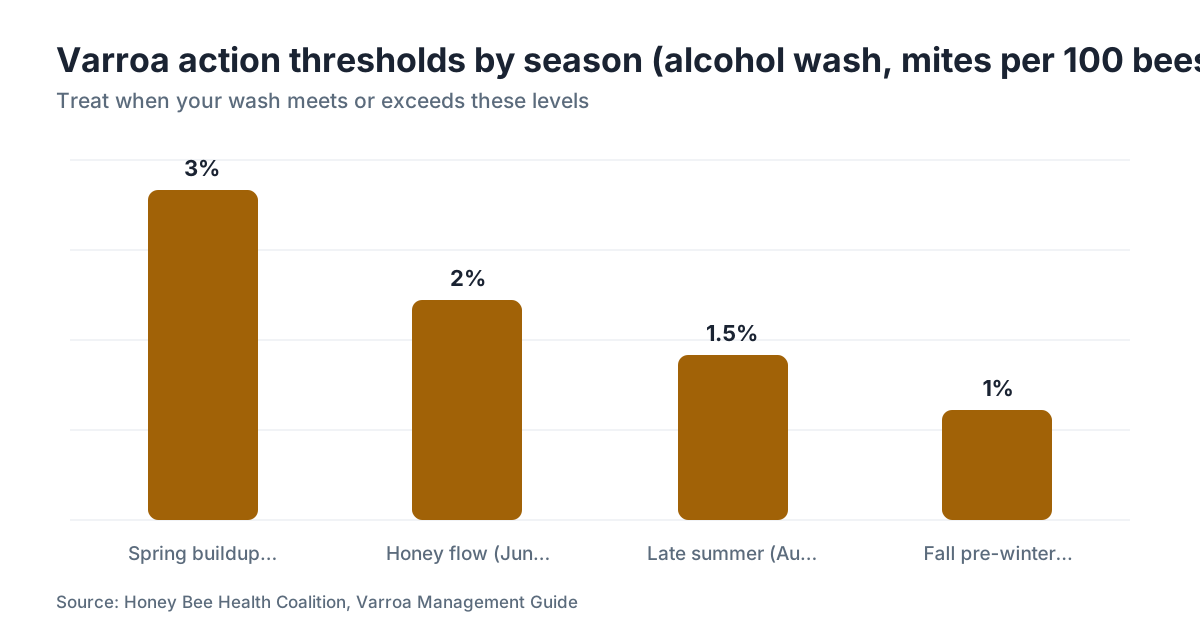
The Honey Bee Health Coalition's Varroa management guide sets action thresholds that shift by season: treat when a wash reaches 2% (2 mites per 100 bees) during honey flow, and 1% in late summer when mite populations climb fastest relative to bee populations [1]. Still above those thresholds after MAQS? The treatment did not get you where you need to be.
So the honest first move is simple. Do an alcohol wash right now, within a day or two of pulling the strips.
How effective is MAQS supposed to be, and why does it sometimes fall short?
MAQS (formic acid gel strips, registered by NOD Apiary Products) is EPA-registered for varroa control in honey bee colonies, and it carries a label claim most other organic acids can't match: it penetrates capped brood cells [2]. That's the real advantage. It kills phoretic mites and mites reproducing under cappings at the same time.
In university trials, MAQS efficacy runs from roughly 54% to over 90% in a single 7-day application, depending on conditions. Penn State Extension notes that formic acid efficacy drops meaningfully when ambient temperatures fall outside the labeled range or when hive ventilation is poor [3]. Temperature matters more than most beekeepers realize.
Here's why MAQS underperforms in real hives:
- Temperatures ran outside the labeled range (50 to 85 degrees F for the 7-day strip) during part of the treatment window.
- The colony had a huge brood nest with many capped cells, which dilutes exposure because the vapor competes with a lot of surface area.
- Strips got placed flat instead of on edge, cutting vapor release.
- A queen laying heavily added fresh capped brood mid-treatment, sheltering mites that emerged after strip removal.
- The starting infestation was so high that even 70% efficacy left a dangerous residual load.
None of those are exactly your fault, but they explain why 40 mites on the board doesn't close the case. MAQS is a good tool with real limits. Formic acid chemistry is genuinely touchy about field conditions in ways oxalic acid is not.
How do you calculate whether 40 mites dropped is good or bad for your hive?
You can't judge a sticky board count without a follow-up alcohol wash. Here's the math that actually decides.
After pulling your MAQS strips, wait 48 to 72 hours, then take a 300-bee sample from the brood frames (not the entrance, not a cluster frame with no brood nearby). Count the mites washed off. Divide by 3 to get mites per 100 bees.
Example: 9 mites in a 300-bee sample equals 3%. That's above the 2% threshold, and it means you need another round before the honey flow ends or before winter bees start developing in mid-to-late summer [1].
A natural mite drop on a board gives you a rough relative trend over time, nothing more. The board catches only a fraction of falling mites, and that fraction swings with hive setup, season, and how hard the bees are grooming. Track daily drop if you like watching trends, but for a go/no-go treatment decision, the wash is the standard [4].
Wash comes back at 1% or below after MAQS? Those 40 mites may be real success. Comes back at 3% or 4%? You have a problem that needs a plan inside the next week or two, not next month.
Mite count thresholds by season: a reference table
The right threshold in May is not the right threshold in August. Mite populations grow exponentially as bee populations shrink in late summer. The table below shows the treatment thresholds most commonly cited by university extension programs and the Honey Bee Health Coalition [1][4].
| Season / Period | Action Threshold (alcohol wash) | Why it changes |
|---|---|---|
| Spring buildup (March, May) | 2 to 3% | Large bee population buffers mite growth |
| Honey flow (June, July) | 2% | Keep below threshold before supers go on |
| Late summer (Aug, Sept) | 1 to 2% | Winter bee production starts; damage is lasting |
| Fall pre-winter (Oct) | 1% | Mite-damaged winter bees don't recover |
| Winter (cluster, broodless) | 1 to 2% | Oxalic acid works well here; do not use MAQS |
A 40-mite drop in August or September is a bigger worry than the same drop in June, because the clock on winter bee development is already running. Varroa-parasitized bees in late summer emerge with reduced fat bodies and suppressed immune function, and those are the exact bees that decide whether the colony sees April [5].
If your drop happened in July or August and your wash is still above 1.5%, treat again promptly. Don't wait to see if the colony recovers on its own. It won't.
Can you do a second round of MAQS right after the first?
Yes, with conditions. The MAQS label allows a second 7-day treatment, but you have to wait at least 12 days between applications [2]. That window matters. Applying strips back-to-back concentrates formic acid in the hive to levels that stress queens and sometimes kill them.
Queen loss is the most common complaint with MAQS, and it's dose-dependent. The label itself warns of temporary increases in bee mortality and possible queen loss at higher temperatures [2]. A second treatment too soon compounds that risk. If you already saw unusual bee die-off at the entrance during the first treatment, switch products for the follow-up.
The 12-day wait also buys you time to assess. Pull your strips, wash in 48 to 72 hours, read the result. At 1.5% and falling, the first treatment may have done enough and you can monitor instead of re-treat. At 3% or higher, a second MAQS round or a pivot to a different product is the call.
Never apply MAQS when temperatures are forecast to top 85 degrees F during the 7-day window. The label prohibits it, and the risk of queen loss climbs sharply above that mark [2].
What are your options if MAQS did not work well enough?
If a post-treatment wash still reads 2% or higher, you have several real options. Which one fits depends on the season, whether honey supers are on, and how fast you need to act.
Oxalic acid vaporization is the most practical follow-up for most beekeepers. It's highly effective against phoretic mites (the ones not in capped cells), EPA-registered in the U.S., and gentle on queens compared to formic acid [6]. The catch: it doesn't touch capped brood. If your colony has a big brood nest, you need repeat treatments (typically every 5 days for 3 to 4 rounds to catch mites as brood emerges) or you wait for a broodless stretch. The Api-Bioxal label is the controlling document for approved use in the U.S. [6].
Apivar (amitraz strips) is a synthetic option that works over 6 to 8 weeks and hits both phoretic mites and mites in brood through continuous contact. Efficacy in U.S. trials usually runs 90% or above when used correctly [7]. Apivar can't be used while honey supers are on. If you've pulled supers, this is a strong fall choice.
HopGuard 3 (hop beta acids) is another organic option you can use with supers on, though its efficacy data is more variable than oxalic or formic acid at the tested concentrations. Some beekeepers run it as a bridge treatment.
Rotation matters over the long haul. Varroa resistance to synthetic acaricides, especially pyrethroids like the older Apistan (still sold, heavily resisted across most U.S. populations), is well documented [8]. Alternating modes of action (organic acids one cycle, amitraz another) eases selection pressure. If MAQS is your only tool every single season, rethink that.
For mapping your treatment schedule and wash results across hives, the free protocol tools at VarroaVault help you time things so a second treatment doesn't land outside the safe window.
Could the 40-mite drop mean the treatment worked perfectly?
Possibly. Forty mites killed is not trivial, and in a small colony it might be a big slice of the whole mite population.
Here's a case where 40 is good news. Your colony holds about 25,000 bees. Your pre-treatment wash showed 1.8% (roughly 450 total mites estimated in the colony), and your post-treatment wash reads 0.6% (roughly 150 mites). The strips killed something near 300 mites total, and maybe 40 of those landed on the board. That's a successful treatment. You're below threshold, and the colony is in good shape heading into fall.
That scenario is entirely plausible. But you only know it's your scenario by doing the wash. Forty mites on a board, all by itself, is not enough to decide anything.
So assume the treatment worked, then verify. If the wash confirms you're below the seasonal threshold, write it down and set a monitoring date 30 days out. If the wash says otherwise, move fast.
How do you do an alcohol wash correctly after MAQS?
The alcohol wash is the standard for varroa infestation measurement in the U.S. Here's how to run one cleanly.
You need a half-pint mason jar with a screened lid (8-mesh hardware cloth), isopropyl alcohol at 70% or higher, and a second jar to pour into. A commercial wash kit from any beekeeping supply company comes with the screened lid.
Step by step:
- Find a frame with open brood to confirm the queen is nearby. Do not sample the queen herself.
- Scoop or shake about 300 bees (roughly half a cup) from a brood frame into the jar. The count doesn't need to be exact; 250 to 350 bees works.
- Fill the jar halfway with isopropyl alcohol.
- Seal the screened lid and shake hard for 60 seconds.
- Pour the alcohol through the screen into the second jar. Mites wash through; bees stay behind.
- Add more alcohol to the original jar, shake again, pour again.
- Count the mites in the collected liquid. A white background helps.
- Divide the mite count by the number of bee scoops you estimate (assume 1 standard half-cup scoop equals about 100 bees, or count a sample once to calibrate).
The University of Minnesota Extension describes this method in detail and recommends sampling from brood frames, not the entrance, because nurse bees on brood carry a higher share of phoretic mites and give you a more accurate read [4].
Run the wash within 48 to 72 hours of pulling the MAQS strips. Any longer and the colony starts rebuilding its mite load from emerging brood, and you lose the clearest post-treatment signal.
What does queen loss after MAQS look like, and should you be worried?
Queen loss is the fair knock on MAQS. It happens more often than the marketing suggests, especially in hot weather and in colonies with older queens.
Watch for these signs starting 10 to 14 days after treatment: a missing or dead queen, multiple eggs per cell (laying workers), no brood, or emergency queen cells scattered through the nest. A healthy colony with a working queen should show a normal brood pattern within two weeks of strip removal.
The EPA label for MAQS states: "Queen loss has been reported by some beekeepers. Queen loss may increase at higher ambient temperatures" [2]. NOD recommends checking for a laying queen 14 to 21 days after treatment.
If you lost the queen, that jumps ahead of the mite count as your most urgent problem. A queenless colony in midsummer can't build winter bees and will collapse before fall. Introduce a mated queen or a frame of young eggs from another hive as fast as you can. Then deal with the mite load in whatever situation you end up with.
The queen-loss risk is one reason some beekeepers prefer the 14-day MAQS strip over the 7-day (MAQS comes in both): the lower peak formic acid concentration is easier on queens, and total efficacy is similar. Check current label guidance, since product registrations and strip configurations have changed over time [2].
How do you prevent this situation next time: treating earlier and tracking better
A 40-mite drop after MAQS is usually a symptom of a monitoring gap. Colonies rarely need rescue treatment in midsummer if they got timely treatment in early spring and the beekeeper washed regularly through May and June.
Most extension programs recommend a wash every 30 days from April through October, and every 60 days through winter [1][4]. That sounds like a lot. Each wash takes about 15 minutes per hive once the motion is in your hands.
Treat before the mite population spikes, not after. Varroa populations double roughly every 4 to 6 weeks under summer brood-rearing conditions [5]. A 1% wash in June can be a 4% wash by late July if you sit on it. The summer treatment threshold is 2%, so the window between "fine" and "emergency" is narrow.
For tracking washes across hives, a simple spreadsheet or a dedicated tool like the free hive tracking protocols at VarroaVault shows you which colonies are trending up before they hit the danger zone. Trend beats any single number.
To keep a wash kit in every apiary, see our guide to beekeeping supplies and what actually belongs in a field kit.
And learn the varroa mite biology if you haven't. The mite reproduces only in capped brood and produces one reproductive daughter per cell. That single fact explains why brood breaks are so powerful and why phoretic-only treatments like an oxalic acid dribble fall short when brood is present.
A note on record-keeping and reporting: does this data have value beyond your apiary?
Forty mites after MAQS is a data point. Record it with context (ambient temperature during treatment, colony size estimate, pre-treatment wash, post-treatment wash, strip placement, and whether you saw increased bee mortality) and you're building a local efficacy picture that informs every future decision.
The Honey Bee Health Coalition and several university extension programs actively ask beekeepers to contribute monitoring data through programs like the Bee Informed Partnership, which has tracked colony losses and treatment outcomes in U.S. apiaries since 2010 [9]. Its annual loss surveys show that colonies left untreated for varroa, or treated late, take a disproportionate share of winter losses.
Bee Informed Partnership data from the 2022-2023 survey year showed a 48.2% managed colony loss rate for respondents who reported no varroa treatment, against a 28.4% loss rate among those who treated on a schedule [9]. Those are real numbers from real beekeepers' records. Your data matters, and keeping it carefully makes you a sharper beekeeper year over year.
Frequently asked questions
Is a 40-mite sticky board drop after MAQS a sign the treatment worked?
Not necessarily. A board drop tells you mites died, but it doesn't tell you whether your infestation rate is below the safe threshold. Run an alcohol wash 48 to 72 hours after pulling the strips to get your actual mites-per-100-bees count. A 40-mite drop could be success in a large, lightly infested colony or ongoing danger in a small, heavily infested one.
What should my mite count be after MAQS treatment to consider it successful?
Your post-treatment alcohol wash should read 2% or below during honey flow, and 1% or below in late summer (August through September). The board drop alone can't answer this. If your wash is still above 2% within a week of removing the strips, plan a follow-up treatment. The Honey Bee Health Coalition's Varroa management guide is the primary reference for these thresholds.
How long after removing MAQS strips should I do an alcohol wash?
Do the wash 48 to 72 hours after pulling the strips. That window gives the colony time to settle after the treatment disturbance while still giving you a clean read before mites from emerging brood start repopulating. Wait more than a week and the picture blurs, because new mites emerge and your post-treatment baseline creeps back upward.
Can I apply a second MAQS treatment right away?
No. The MAQS label requires at least a 12-day break between applications to avoid stressing the queen and raising bee mortality. Back-to-back treatments without that gap can cause queen loss. If your post-treatment wash is still high, use the 12-day window to decide whether a second MAQS round makes sense or whether a different product, such as oxalic acid or Apivar, fits better.
Why might MAQS have not killed all the mites?
Several factors cut MAQS efficacy. Temperatures outside the 50 to 85 degrees F window during treatment are the most common culprit. A very large brood nest dilutes the formic acid vapor. Poor ventilation, or strips placed flat instead of on edge, also drag performance down. A queen laying heavily during treatment adds capped brood that may not get full exposure. No treatment hits 100%.
Does MAQS kill mites under capped brood?
Yes, and that's the main advantage over oxalic acid. Formic acid vapor penetrates beeswax cappings and reaches mites reproducing inside brood cells. University trials confirm this, though efficacy in brood is more variable than against phoretic mites and depends heavily on temperature and vapor concentration during treatment. The brood-penetration claim is written into the EPA registration.
What should I do if I suspect my queen was lost after MAQS?
Inspect 14 to 21 days after strip removal. Signs of queen loss include no eggs, scattered emergency queen cells, or multiple eggs per cell from laying workers. If the queen is gone, that outranks the mite count: a queenless summer colony can't build winter bees. Introduce a mated queen or a frame of young eggs from a healthy hive as fast as possible, then address the mites from there.
How do I know if my colony's mite load is dangerously high right now?
Do an alcohol wash. Take a 300-bee sample from a brood frame, wash in 70% isopropyl alcohol for 60 seconds, and count the mites that come off. Divide by 3 for mites per 100 bees. Above 2% during honey flow, or above 1% in late summer, means treat immediately. Eyeballing the bees or brood won't reliably catch a dangerous load before serious damage sets in.
What treatment should I use after MAQS if mite levels are still high?
Oxalic acid vaporization is the usual follow-up. It's gentle on queens and highly effective against phoretic mites, though it needs repeat treatments if brood is present. Apivar (amitraz strips) is a strong synthetic option with 90%-plus efficacy in trials, run over 6 to 8 weeks, but it can't go on with honey supers in place. The right pick depends on season, super status, and how fast you need results.
Can I treat with MAQS while honey supers are on?
Yes. That's a real advantage over synthetic options like Apivar. The EPA registration allows application with honey supers in place because formic acid occurs naturally in honey and dissipates. The label does recommend removing supers when no flow is on, to avoid any risk of elevated formic acid residues in harvested honey. Always read the current label before treating.
How does the time of year affect whether 40 mites after MAQS is a serious problem?
Timing is everything. A 40-mite drop in June after a treatment that brings you below 2% is manageable. The same drop in August, when winter bee development starts and thresholds fall to 1%, could mean the colony is already in trouble for winter. Late summer mite spikes make short-lived, nutritionally depleted bees that can't sustain a cluster, so the urgency is genuinely higher in August.
How often should I be monitoring for varroa even when I'm not treating?
Once a month from April through October, and every 60 days through winter if the colony is broodless. Monthly washes give you enough lead time to treat before mite populations cross the action threshold. Most varroa-tied losses happen when beekeepers monitor only once or twice a season and miss the exponential buildup in July and August, when brood is everywhere and mites reproduce fast.
What is the Honey Bee Health Coalition's recommendation on varroa treatment timing?
The HBHC Varroa management guide, the most widely cited reference in U.S. apiculture, recommends monitoring at least monthly, treating when washes exceed the seasonal threshold (2% in summer, 1% in late summer), and finishing fall treatments early enough that treated bees can raise the winter cluster. It also recommends rotating between organic and synthetic treatments to reduce resistance selection.
Sources
- Honey Bee Health Coalition, Varroa management guide (Tools for Varroa Management): Action thresholds for varroa: 2% during honey flow, 1-2% in late summer; monthly monitoring recommended
- EPA / NOD Apiary Products, MAQS (Mite-Away Quick Strips) federal pesticide label: MAQS label permits use with supers on, allows two 7-day treatments 12 days apart, warns of queen loss at higher temperatures, and specifies 50-85F application window
- Penn State Extension, Varroa mite treatments and application: Formic acid efficacy drops meaningfully when ambient temperatures are outside the labeled range or when hive ventilation is poor
- University of Minnesota Extension, Varroa mite monitoring methods: Alcohol wash from brood frames is the recommended standard for infestation measurement; sticky board counts are not a substitute for wash-based thresholds
- Genersch et al., Journal of Invertebrate Pathology (2010), Varroa destructor impact on honey bee health: Varroa-parasitized bees in late summer emerge with reduced fat bodies and suppressed immune function; mite populations double roughly every 4-6 weeks under summer brood-rearing conditions
- EPA, Api-Bioxal (oxalic acid dihydrate) label and registration: Oxalic acid (Api-Bioxal) is EPA-registered for varroa control in the U.S.; effective against phoretic mites; does not penetrate capped brood cells
- USDA AMS National Organic Program / Apivar label via EPA registration: Amitraz strips (Apivar) efficacy in U.S. trials typically 90% or above when used correctly over 6-8 weeks; cannot be used with honey supers
- Sammataro et al., Annual Review of Entomology (2000), Parasitic mites of honey bees: Varroa resistance to synthetic acaricides including pyrethroids is well documented across U.S. populations
- Bee Informed Partnership, 2022-2023 Colony Loss Survey: 48.2% managed colony loss rate for beekeepers reporting no varroa treatment vs 28.4% for those treating on a schedule in the 2022-2023 survey year
- Honey Bee Health Coalition, Tools for Varroa Management (treatment product comparison): HBHC recommends rotating between organic and synthetic treatments to reduce resistance selection pressure
Last updated 2026-07-10