ApiLife Var varroa treatment: how it works and when to use it

TL;DR
- ApiLife Var is an EPA-registered organic varroa treatment made from thymol, eucalyptol, menthol, and camphor.
- Applied as a wafer on the top bars, it knocks down 74-95% of mites over six to eight weeks.
- It works best between 59°F and 69°F ambient temperature, needs three applications spaced 7-10 days apart, and cannot go on during a honey flow.
What is ApiLife Var and how does it work against varroa mites?
ApiLife Var is a soft-chemical, organic varroa treatment built around thymol, combined with eucalyptol, menthol, and camphor. It comes as a porous vermiculite wafer that releases vapors slowly through the hive. Those vapors contact mites riding on adult bees and disrupt the mite's nervous and respiratory function. Mites drop off or die in the cells, and the bees haul out the debris.
Thymol is a plant compound from thyme oil. The EPA classifies it as a minimum-risk pesticide ingredient, and it qualifies as an organic input under the National Organic Program when used per the label [1][12]. ApiLife Var itself carries EPA Reg. No. 66916-1, which means it passed federal review for use on managed colonies in the United States [2].
The action is fumigant-style. Oxalic acid kills mites only on adult bees and does nothing inside capped brood cells. ApiLife Var vapor reaches some cells and cuts mite reproduction over several weeks of repeated dosing. It is not a full broodicide, though. Its reach into capped brood is partial, which is exactly why the label wants three applications spaced a week or two apart instead of one hit.
Want the biology behind the target? The varroa mite overview walks through the mite's life cycle, and that cycle is the whole reason timing decides whether any treatment works.
What is the active ingredient in ApiLife Var?
Thymol is the lead active, about 74.1% of the wafer by weight in the original European formulation. Eucalyptol, menthol, and camphor make up the rest of the active fraction [3]. Each wafer weighs roughly 25 grams.
Thymol has well-documented contact and vapor toxicity to Varroa destructor. At treatment concentrations it is far harder on mites than on bees. But heat flips that math. When hive interior temperatures climb above roughly 105°F, thymol can kill queens and spike bee mortality. That is why the label temperature range is a hard limit, not a suggestion.
The eucalyptol, menthol, and camphor add some acaricidal punch of their own and may help spread the vapors more evenly. Whether they meaningfully beat thymol alone is still argued in the literature. The combination is what got tested and registered, so the combination is what the label covers.
How effective is ApiLife Var at killing varroa mites?
Published efficacy for ApiLife Var runs from about 74% to 95% mite mortality depending on conditions [4]. That spread is real, and it drives planning. The three big variables are ambient temperature, how much brood is in the box, and whether you actually follow the three-application schedule.
A 2018 review in the journal Insects that pooled thymol-based treatment studies reported mean efficacy around 85-90% under good temperature conditions [4]. Hobbyist results tend to land on the low end, because backyard hives don't sit at ideal temperatures and treatment timing slips in the real world.
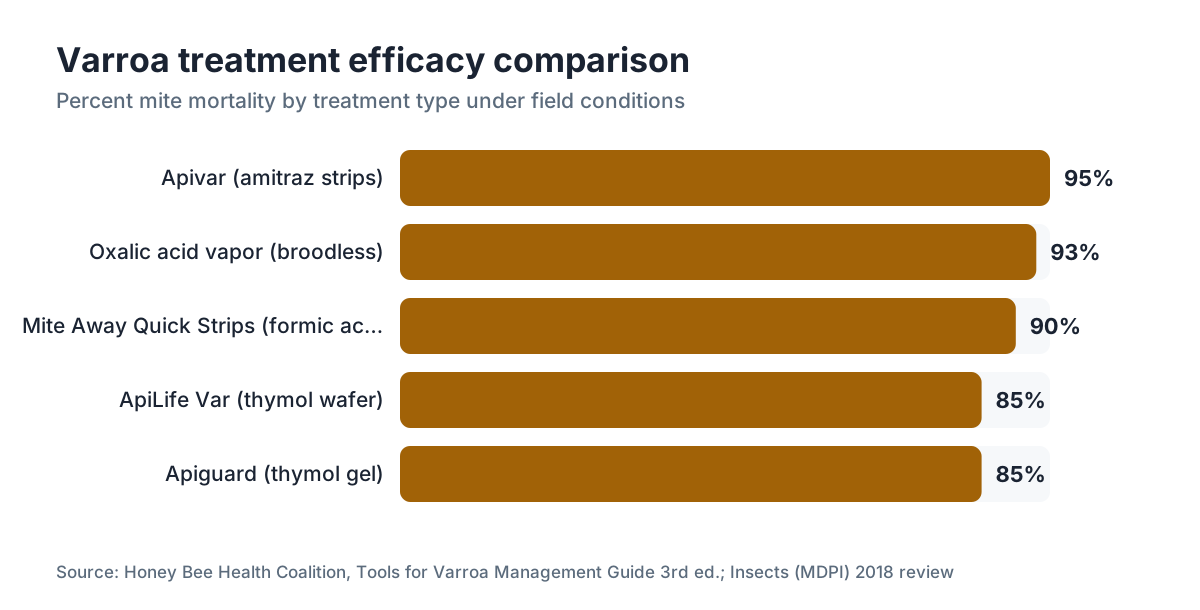
Here is the honest comparison. Oxalic acid vaporized on a broodless colony clears over 93% consistently, and Apivar (amitraz strips) regularly tops 90% even with brood present [5]. ApiLife Var sits in the middle. It beats a single oxalic dribble on a colony full of brood, but it is not as dependable as Apivar when mite loads are very high. The Honey Bee Health Coalition's Varroa guide is blunt about this: thymol products fit best as maintenance or moderate-load treatments, not as a rescue for a colony already crashing [5].
| Treatment | Efficacy range | Works with brood? | Temperature sensitivity |
|---|---|---|---|
| ApiLife Var (thymol) | 74-95% | Partial | High (59-69°F ideal) |
| Apivar (amitraz strips) | 90-99% | Yes | Low |
| Oxalic acid (vaporized, broodless) | >93% | No (broodless only) | Low |
| Mite Away Quick Strips (formic acid) | 85-96% | Yes | Moderate (50-85°F) |
Sources: Honey Bee Health Coalition Varroa Guide 3rd edition [5]; Insects review, 2018 [4].
What is the correct ApiLife Var dosage and application method?
The EPA label is the legal document, and it calls for three applications, one wafer each, for a single 10-frame Langstroth hive body [2]. Break each wafer into two or three pieces and set them on the top bars at the corners of the brood nest. Keep them off the center, where bees will strip them out fast.
Space the applications 7-10 days apart. Three treatments run about six weeks. Pull the old wafer remnants before the next piece goes in. You do not stack wafers. The label says plainly: do not exceed three applications per treatment period.
For a strong colony or a double-deep, some beekeepers and extension resources place pieces in both boxes. Check your current state label first, because registered uses vary by state [6]. Texas A&M's apiculture extension notes that hive configuration changes vapor distribution and that strong colonies may need pieces at both the front and back of the brood area [6].
Wear nitrile gloves. Thymol soaks through skin and the smell sticks around. Wash your hands after.
What temperature range does ApiLife Var require?
The label sets 59°F to 69°F (15°C to 21°C) ambient daytime temperature for the whole treatment [2]. This is the single biggest operational limit on ApiLife Var, and it is why the product does not fit every beekeeper's calendar.
Below 59°F, thymol vaporizes too slowly and not enough active reaches the mites. Above about 70°F, volatilization runs past the safe threshold for bees. Push it to a hive interior above 100-105°F and you risk killing the queen and gutting the colony. Beekeepers have reported queen losses during summer heat waves, which lines up with what the label warns against.
That leaves two useful windows. Spring, after buildup but before the main flow. And fall, after the honey harvest and before it gets too cold. In the South and Southwest, August highs routinely blow past 90°F, so the fall window might not open until late September or October. Up north, fall slams shut fast once nights drop below 50°F. Neither end forgives sloppy timing. Do your mite counts and map the calendar before you order, not after.
When is the best time of year to apply ApiLife Var?
Early fall is the single best window for most U.S. beekeepers, usually late August through October depending on where you keep bees. The supers are off by then (the label bans use during a flow), temperatures are cooling into range, and you still have six weeks before the colony tightens into its winter cluster.
Spring is the backup, usually late April or May in temperate climates. The catch: spring buildup means heavy brood, which shrinks the share of mites exposed on adult bees. Mite loads also sit lower in spring, so if your count is under 1-2 mites per 100 bees you may be treating for nothing.
Do a mite wash or sugar roll before you commit. The Honey Bee Health Coalition recommends treating when counts pass 2 mites per 100 bees (2%) in summer, or 1% in fall heading into winter prep [5]. Run the math. ApiLife Var at 85% efficacy on a colony at 3% leaves you near 0.45% after treatment, which is fine. The same treatment on a colony at 6% leaves roughly 0.9% under ideal conditions, and that may be too high for winter.
The VarroaVault protocol tracker lets you log mite counts next to treatment dates so the timing math sits in front of you. Actual records matter more than most beekeepers admit.
Can you use ApiLife Var during a honey flow or with honey supers on?
No. The EPA label flatly prohibits use when honey supers are on the hive or a nectar flow is running [2]. Thymol and the other essential oils move into honey and wax and change the flavor. Honey from treated hives shows elevated thymol during treatment, though most studies find concentrations fall back to near-background within several weeks after the wafers come out [7].
The working rule is simple. Supers off, treatment in, supers back only after the full three-application course finishes and at least a week passes. If you are trying to squeeze treatment in right before a fall goldenrod or aster flow, be honest about whether that flow beats your finish date. A surprise nectar flow mid-treatment is a real risk in a lot of regions.
Wax residue is a separate issue from honey. Thymol builds up in comb at low levels. It is generally considered safe there, but rotating brood comb on a schedule is good practice no matter which treatments you run.
How does ApiLife Var compare to other varroa treatments?
The real choice between ApiLife Var and the alternatives comes down to three things: your current mite load, your local temperature, and whether you want to stay in the organic soft-chemical category.
Against Apivar (amitraz), ApiLife Var loses on raw efficacy. But amitraz is a synthetic acaricide, and plenty of beekeepers avoid it, especially in certified-organic operations. Apivar also needs 6-8 weeks of strip contact and carries resistance concerns in mite populations with long amitraz exposure [5].
Against oxalic acid, brood decides it. In a broodless colony, natural or induced, oxalic acid vaporization beats ApiLife Var on speed, efficacy, and temperature freedom. With brood present, oxalic acid can't touch mites in capped cells, so ApiLife Var's slow fumigant reach gives it an edge during the brood season even though its overall numbers are lower.
Mite Away Quick Strips (formic acid) share ApiLife Var's temperature-constrained space, but the window is a bit wider (50-85°F) and formic penetrates capped cells better. Many sideliners keep formic and oxalic products on the shelf alongside thymol, rotating to manage resistance and match the tool to the season.
For sourcing, beekeeping supply companies with cold-chain shipping matter for heat-sensitive products like formic acid strips.
ApiLife Var fits best when temperatures are in range, mite counts are moderate rather than crisis-level, you prefer organic options, and you have six weeks to run the course.
Does varroa develop resistance to ApiLife Var?
Resistance to thymol has been studied, and the consensus so far is that it is far less likely than resistance to synthetic acaricides like amitraz or pyrethroids. A 2020 paper in PLOS ONE examining mite populations in Italy, where thymol has been in use for over two decades, found no meaningful drop in thymol sensitivity compared to naive populations [8]. That is genuinely reassuring, and it is one biological reason organic treatments keep showing up in rotation plans.
The leading explanation: resistance to a volatile organic compound would likely require several genetic changes at once, while resistance to a single synthetic molecule is a straighter selective path. Nobody claims resistance is impossible. But after 25-plus years of field use in Europe, there is still no confirmed resistant population on record.
Rotating treatment modes across the season is still smart mite management, resistance concern or not. Apiaries that lean on thymol year-round are probably leaving efficacy on the table versus a rotation that adds oxalic acid during broodless windows.
Is ApiLife Var safe for bees, queens, and brood?
At label-compliant temperatures, ApiLife Var has an acceptable safety profile for adult bees and brood. The main documented risk is to queens. University of Minnesota's Bee Lab and reports from beekeepers describe elevated queen loss when thymol treatments run during hot weather or in tightly confined hives where vapor concentrations spike [9]. This is not a rare edge case. It is a known risk, and the label tries to head it off through the temperature limits.
Brood usually tolerates label doses fine, but eggs and first-instar larvae are more sensitive than older brood. Do not set wafer pieces directly over open brood. The corners of the top bars are the spot.
Some adult bee mortality comes with any varroa treatment. Watch for abnormal die-off at the entrance or a jump in crawling bees outside. If you see that in the first 48 hours and temperatures are on the high end, pull the wafer and reassess. A colony survives a temporary mite bump far better than it survives losing its queen in midsummer.
Queens in nucs or mating nucs nearby can also catch vapor drift when hives sit close together. Keep that in mind at a crowded apiary.
Where can you buy ApiLife Var and what does it cost?
ApiLife Var sells through most major U.S. beekeeping retailers. As of 2024-2025, a pack of 10 wafers (enough for roughly three to four complete hive treatments) runs about $20-$30 depending on the seller [10]. That puts it below Apivar strips, which run $25-$40 for a 10-strip pack that treats five hives.
ApiLife Var is a registered pesticide, so it should ship with an intact EPA label and never be sold for uses off that label. Buying from a legitimate beekeeping supply company gets you a properly labeled, fresh product. Thymol degrades over time, and heat during shipping or storage speeds that up. Store spare wafers cool, sealed, and out of direct sun.
Shelf life is usually 2-3 years from manufacture if you store it right. Wafers that have partly gassed off in storage (noticeably lighter or crumbly) deliver a weaker dose and cut efficacy. Buy fresh each season if you are not sure how old your stock is.
For the broader retailer picture, the beekeeping supplies guide has comparisons worth a look.
How do you monitor for varroa after an ApiLife Var treatment?
Monitoring is not optional. Treat on counts, not the calendar, and always verify the treatment worked.
Before treatment, do an alcohol wash or sugar roll to set your baseline. The Honey Bee Health Coalition publishes step-by-step alcohol-wash instructions, and the alcohol wash is the more accurate of the two methods [5]. Sample at least 300 bees (about half a cup) from the brood nest.
After all three applications finish, wait 2-3 days, then run a sticky board for 24-48 hours and repeat the alcohol wash. If your post-treatment count still sits above 2% in summer or above 1% heading into fall, you have a problem. Your options are to re-treat with a different mode of action (oxalic acid if you can force a broodless window, or amitraz if you will go synthetic) or accept the risk. Do not re-apply ApiLife Var past the three-application label limit in one cycle.
Natural mite drop on the board spikes in the first week or two as the vapors work. Dozens of mites per day falling early is a good sign, not a scare. The number should fall as the treatable mite population shrinks.
VarroaVault has a free mite count tracker for logging pre- and post-treatment washes next to the treatment type. Over a few seasons it makes clear whether a given product actually works in your specific apiary.
Frequently asked questions
How many ApiLife Var wafers do I need per hive?
One wafer per application, broken into pieces and set at the corners of the top bars. You apply three wafers total per hive per treatment cycle, spaced 7-10 days apart. A pack of 10 wafers covers roughly three full hive treatments. For a double-deep hive, some extension resources suggest distributing pieces across both boxes, but check the current label for your state first.
Can I use ApiLife Var in winter?
No. Winter temperatures fall below the 59°F minimum thymol needs to volatilize adequately, so the treatment would not work. Winter is the time for oxalic acid dribble or vaporization on the overwintering cluster, which works regardless of temperature. ApiLife Var is a warm-weather shoulder-season treatment only.
Does ApiLife Var kill varroa in capped brood cells?
Partially. Thymol vapor penetrates capped cells to a degree, which is one advantage over oxalic acid during brood season. But efficacy against mites inside capped cells is lower than against phoretic mites on adult bees. That is why the multi-week schedule exists: repeated vapor exposure as new mites emerge and turn phoretic improves overall knockdown across the treatment period.
What happens if I apply ApiLife Var when temperatures are too high?
Above roughly 70°F ambient (or higher hive interior temperatures), thymol vaporizes faster than the label intends. Excess vapor can cause queen loss, higher adult bee mortality, and brood damage. If a heat wave hits mid-treatment and daytime highs stay above 70°F, remove the wafer and wait for cooler weather before resuming. Queen loss mid-treatment is the single most reported problem with ApiLife Var misuse.
Is ApiLife Var approved for certified-organic honey production?
Thymol is on the National Organic Program's allowed substances list for organic bee production when used according to label directions. Your specific certifying agent still has the final say on approved inputs, so confirm before use. The EPA registration number for ApiLife Var is 66916-1, and you should present the label to your certifier for review.
Can ApiLife Var cause queen loss?
Yes, this is a documented risk. Queen loss is most likely when temperatures top the labeled range, when wafer pieces sit too close to the cluster center, or in small colonies where vapor concentration runs high relative to hive volume. Following the temperature limits strictly and placing pieces at the corners rather than over the cluster reduces the risk but does not erase it.
How long after ApiLife Var treatment can I put honey supers back on?
The label prohibits supers during treatment. After all three applications finish and the final wafer remnants come out, most label guidance and extension recommendations suggest waiting at least 1-2 weeks before adding supers. That lets residual thymol off-gas from the hive. Some beekeepers wait longer. Nobody has great data on the exact clearance time under field conditions.
What is the difference between ApiLife Var and Apiguard?
Both use thymol as the primary active. Apiguard delivers thymol in a slow-release gel tray, while ApiLife Var uses a vermiculite wafer that also carries eucalyptol, menthol, and camphor. Efficacy in head-to-head trials is similar, generally 85-95% under good conditions. Apiguard needs two applications 2-4 weeks apart; ApiLife Var needs three applications 7-10 days apart. Temperature windows are similar for both.
Can I use ApiLife Var in a top-bar hive or Warré hive?
The EPA label is written for standard Langstroth equipment. Use in top-bar, Warré, or log hives is technically off-label. The same vapor-exposure principles apply, and placing wafer pieces near the brood cluster is the logical approach in any hive. The key variables stay the same: temperature, vapor containment, and no supers during treatment. Check with your state department of agriculture for state-specific label restrictions.
How do I dispose of used ApiLife Var wafer pieces?
Used remnants can generally go in household trash once they have finished volatilizing. Do not compost them near the apiary in a way that might expose bees or other pollinators to concentrated residue. Some beekeepers bury small amounts in the garden. Follow your local pesticide disposal guidelines; the EPA label may include specific disposal language, so read that section before discarding.
What mite count should prompt me to use ApiLife Var vs. a stronger treatment?
The Honey Bee Health Coalition sets the summer treatment threshold at 2 mites per 100 bees (2%). ApiLife Var at 85% efficacy can bring a 3-4% infestation down to an acceptable post-treatment level. If your pre-treatment count tops 5-6%, a faster or more efficacious treatment (Apivar or oxalic acid with a broodbreak) is the better call. ApiLife Var is not the right rescue tool for a colony in varroa crisis.
Does ApiLife Var affect other hive pests or diseases?
Thymol has shown some activity against Nosema spores and small hive beetle larvae in lab conditions, but ApiLife Var is labeled and studied only as a varroa treatment. Any off-label benefit against other pests is not supported by the registration, and you should not rely on it for those purposes. It has no meaningful effect on American foulbrood or other bacterial diseases.
Sources
- EPA, Minimum Risk Pesticides under FIFRA Section 25(b): Thymol is classified by the EPA as a minimum-risk pesticide ingredient.
- EPA, ApiLife Var product registration (EPA Reg. No. 66916-1) via EPA pesticide registration program: ApiLife Var EPA registration number 66916-1; label prohibits use during honey flow; specifies 59-69°F temperature range and three-application protocol.
- Insects (MDPI), review of thymol-based products against Varroa destructor, 2018: Mean efficacy of thymol-based varroa treatments approximately 85-90% under optimal temperature conditions; range 74-95% across field studies.
- Honey Bee Health Coalition, Tools for Varroa Management Guide, 3rd edition: Treatment threshold 2 mites per 100 bees in summer, 1% in fall; thymol products appropriate for moderate mite loads; Apivar efficacy 90-99%; oxalic acid vaporization >93% efficacy in broodless colonies.
- Texas A&M AgriLife Extension, Apiculture Program: Strong colonies may need ApiLife Var wafer pieces distributed front and back of brood area; hive configuration affects vapor distribution.
- Journal of Apicultural Research (Taylor & Francis): Thymol residue levels in honey elevated during treatment; decrease to near-background concentrations within several weeks after treatment removal.
- PLOS ONE, study of thymol sensitivity in Italian Varroa destructor populations, 2020: No significant reduction in thymol sensitivity found in Italian Varroa destructor populations after more than two decades of thymol-based treatment use.
- University of Minnesota Bee Lab, Varroa Management: Elevated queen loss documented when thymol treatments applied above label temperature range or in confined hives where vapor concentration spikes.
- Penn State Extension, Varroa Mite Management in Honey Bee Colonies: ApiLife Var retail price approximately $20-$30 per pack of 10 wafers as of 2024-2025; cost-effectiveness comparison with other varroa treatments.
- USDA Agricultural Research Service, Honey Bee Health: Varroa destructor is the single most damaging parasite of managed honey bee colonies worldwide.
- USDA National Organic Program, Allowed and Prohibited Substances: Thymol is on the National Organic Program allowed substances list for use in organic bee production.
Last updated 2026-07-10