Apivar easy rip strip: how it works, how to use it right
TL;DR
- Apivar Easy Rip strips are amitraz polymer strips you hang between brood frames to kill varroa over a 6-to-10-week window.
- Each strip holds 500 mg amitraz.
- A 10-frame colony gets two strips.
- The scored design tears in half by hand for nucs, no scissors.
- Amitraz is EPA-registered for honey bee colonies (Reg.
- No.
- 81310-1-81824) and sold over the counter in the U.S.
What is the Apivar Easy Rip strip and how does it differ from the original Apivar?
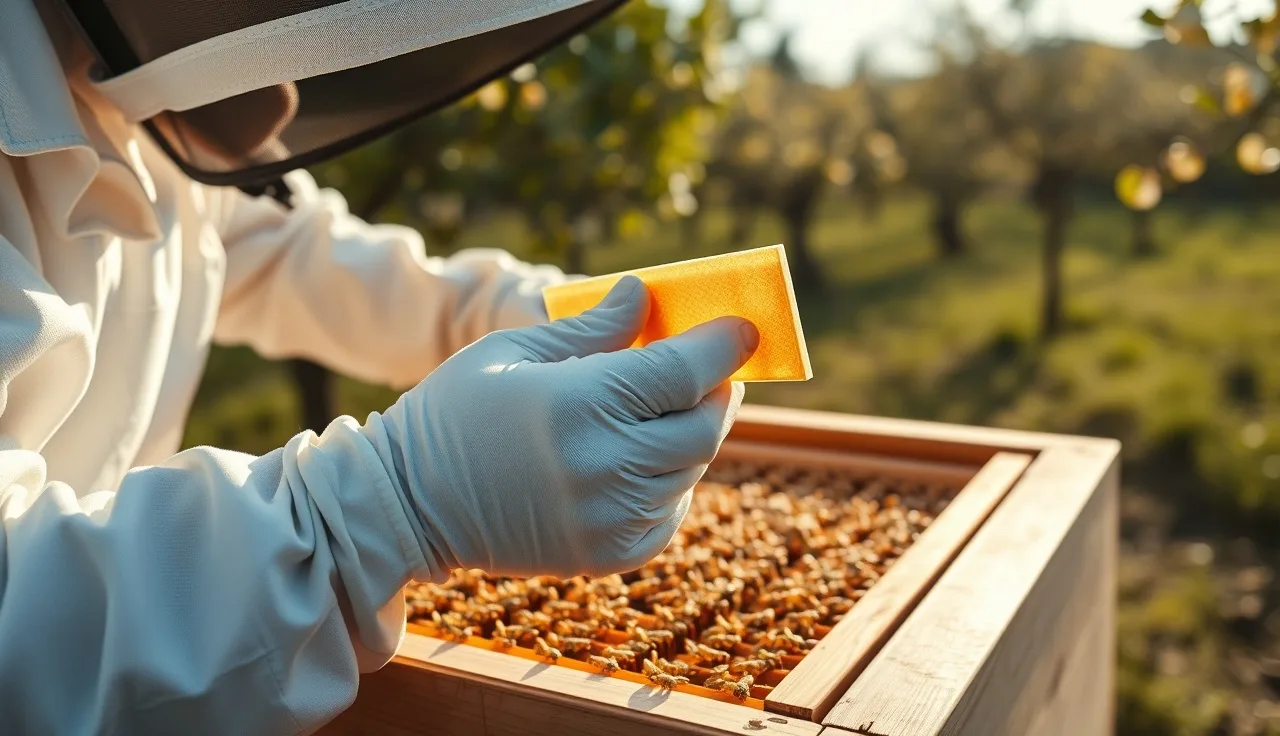
Apivar is an amitraz miticide made by Veto-Pharma. Each strip is a slow-release polymer matrix holding 500 mg of amitraz. Bees walk across it and chew on it, pick up amitraz on their bodies, and spread it through the colony by contact. That contact transfer is the whole reason the treatment works over weeks instead of hours.
The Easy Rip version adds one perforated score line down the center. Fold, pull, done. You get two clean 250 mg half-strips by hand. Before this change, splitting strips for nucs meant scissors and a guess at where to cut.
Everything else is the same. Same active ingredient, same concentration, same EPA registration. The current label mentions the easy-rip feature by name, so if your box is old and says nothing about it, you're probably holding older stock. [1]
Worth saying plainly: Apivar needs a veterinary prescription in some countries, but in the United States it sells over the counter. No vet relationship required. That could change as antimicrobial stewardship rules shift, but as of mid-2026 any beekeeper can order it from beekeeping supply companies directly.
How does amitraz actually kill varroa mites?
Amitraz is a formamidine acaricide. It acts as an octopamine agonist, binding octopamine receptors in the mite's nervous system. Octopamine is a neurotransmitter invertebrates lean on heavily and mammals barely use, which is part of why amitraz has a decent mammalian safety margin at label doses.
Overstimulate those receptors and the mite loses coordination, lets go of its host bee, and dies. It drops to the hive floor. Slide a sticky board under a screened bottom and you can count the daily drop, watch it spike in the first two weeks, then taper. That count is your cheapest read on whether the treatment is doing its job.
Amitraz doesn't get into capped brood cells. That single fact is why the label wants a full 6-to-10-week window instead of a one-day knockdown like oxalic acid vapor. The colony has to cycle through at least one full brood cycle (about 21 days for workers) with strips in place, so mites emerging from sealed cells hit exposure before they can breed. [2]
Resistance is real and documented. The Honey Bee Health Coalition's varroa guide notes resistance in some U.S. populations and treats field efficacy below 85% as a warning sign. Rotate amitraz with treatments that kill by a different mechanism (oxalic acid, formic acid) across seasons. That's the standard move to slow resistance, and it works. [3]
How do you place Apivar Easy Rip strips correctly?
The EPA-registered label calls for two strips per colony of 10 frames of bees, one strip per five frames. Fewer frames of bees, less product. A five-frame nuc gets one strip. This is where the score line earns its keep: fold, pull, hang the half-strip. [1]
Placement matters more than most beekeepers think. Strips hang between frames in the brood nest, never out in empty honey storage. You want maximum bee-to-strip contact. In a double-deep 10-frame hive running two strips, spread them across the brood nest rather than jamming both in the middle.
Hang them vertically using the notch at the top. Don't lay them flat on the top bars. Don't leave them bundled together. Bees need to walk both faces.
A few label prohibitions people skip: no strips in supers, no honey supers on the hive during treatment, and pull the strips when the window ends. Leaving strips past 10 weeks just builds wax residue and kills no extra mites. [1]
If you want the biology behind the enemy first, read up on varroa mites before your first treatment. Knowing the life cycle makes the timing rules make sense.
When is the right time of year to use Apivar strips?
Apivar works best with brood in the colony. It's registered for active brood-rearing, spring buildup through fall. You can run it during a broodless stretch, but you lose the product's main strength: catching new mites as they crawl out of cells.
Spring treatment fits colonies that went into winter with borderline loads or built mites up over the cold months. Put strips in once the cluster has broken, brood is steady, and daytime temps let bees fly and work frames.
Fall matters more. The bees raised in August and September are your winter bees, the ones that have to live four to six months and start spring brood-rearing. Parasitize those bees as larvae and they emerge with shrunken fat bodies and short lives. The Honey Bee Health Coalition recommends treating in late summer or early fall so your last winter-bee rounds grow up in a low-mite hive. [3]
Temperature moves the needle a little. Amitraz volatilizes faster when it's warm, which helps it spread. The label sets no hard minimum the way formic acid does, but treating below about 50 degrees F (10 C) with the colony in a tight cluster gets you nowhere. At that point an oxalic acid treatment during a broodless window is the right tool.
What does a complete Apivar treatment protocol look like?
Here's the sequence I'd run, start to finish.
Assess before you treat. Alcohol wash or sugar roll on a 300-bee sample. Below 1 mite per 100 bees (1%) outside fall, you have some time. At 2% or higher during the brood season, treat. At 2% or higher heading into fall, treat now. [3]
Remove honey supers. You can't run Apivar with supers on. Amitraz migrates into wax and honey at detectable levels, and the label flatly prohibits supers during treatment. Time your treatment around your honey flow calendar.
Install the strips. Wear nitrile gloves (you're avoiding prolonged skin contact, not defusing a bomb). Hang two strips per 10 frames of bees in the brood nest. Write the install date on a hive tag or in your records.
Leave them alone. Six weeks minimum, ten weeks maximum. Don't peek and pull early. The first two weeks knock down phoretic mites. Weeks three through eight catch mites emerging as cells uncap.
Wash again at week 8 or at removal to confirm efficacy. If your post-treatment count still sits above 1%, you have a problem: reinfestation from a neighbor's bees, or a resistance signal worth reporting to your state apiarist.
Remove and dispose of used strips. Never reuse them. Spent strips still carry some amitraz and go out according to the label (usually household waste, not burned). [1]
To track install dates, mite counts, and colony notes across seasons, VarroaVault's free varroa management tools hold your hive records so nothing gets lost between spring and fall.
How many strips does a colony actually need?
The label is plain: two strips per colony with 10 frames of bees, one strip per five frames. The score line finally makes the half-strip dose easy without a pair of scissors.
People go wrong treating the dose as a suggestion. Under-dosing is probably the single most common field error with Apivar. A weak colony with three frames of bees gets a full strip anyway in practice (you can't cleanly cut 60% of a strip), but a colony carrying eight frames of bees needs two strips, not one to save a few dollars.
Over-dosing buys you nothing. More strips do not mean faster or fuller kill. Four strips in a 10-frame colony is worse than two, not better, because you're loading the wax with residue for no gain. [1]
Nucs are where the design pays off. A four or five-frame nuc gets one half-strip. Before the scored strip, beekeepers either skipped nucs (letting them turn into mite bombs that reinfest treated hives), cut strips unevenly, or overdosed a small population with a full strip. Half-strips done right close a real hole in a mite program.
What are the most common mistakes beekeepers make with Apivar?
Leaving honey supers on is the big one. The label prohibits it, and bees move substances around the hive no matter where you set the strips.
Pulling strips too early. Six weeks is the floor. Some folks pull at four because the colony looks fine and the drop slowed down. It isn't done. The matrix is still releasing, and the brood cycle hasn't finished turning over.
Skipping nucs and splits. Every untreated colony in your yard is a mite reservoir. Splits and nucs run brood-heavy with young bees, so mites build fast, and those mites ride back to your treated hives through drifting and robbing.
Skipping the before-and-after mite count. Without numbers you can't tell a reinfestation from a placement error from early resistance. The wash takes ten minutes. Do it.
Running Apivar every single cycle with no rotation. Amitraz resistance is real. The Honey Bee Health Coalition recommends rotating active ingredients across treatment events to slow it. Spring Apivar, fall oxalic acid on a brood break: that's a rotation plenty of sideliners run.
Reusing old strips from last season. Used strips are depleted. The 500 mg drops hard across the window. Reinserting spent strips hands you a false sense of safety while mites keep breeding. [3]
Is Apivar safe for bees, queens, and brood?
At label doses, honey bees tolerate amitraz well. Adult bees and brood aren't meaningfully harmed by what the strips release over the window. That said, "not meaningfully harmed" carries some nuance you should know.
Peer-reviewed work shows sub-lethal amitraz can affect bee learning and foraging. A 2018 Scientific Reports study found field-realistic amitraz exposure altered olfactory learning in honey bees. [4] That doesn't make Apivar dangerous at label doses. It does mean chronic, repeated amitraz across many cycles isn't free of consequences for bee cognition.
Queens generally come through fine. Label-dose Apivar doesn't typically cause queen loss in healthy colonies. Beekeepers often blame a queen loss on the treatment they just applied, but the timing is usually coincidence, or the queen was already failing. Lose a queen right after treatment? Wash the dead colony for mites. High pre-treatment loads are the more likely killer.
Amitraz residue does build up in wax over repeated use. A Cornell University study detected amitraz and its breakdown product DMPF in commercial beeswax samples. [5] That's the reason for the no-supers rule, and it's why rotating out old brood comb is good hygiene regardless of which treatment you run.
How does Apivar compare to other varroa treatments?
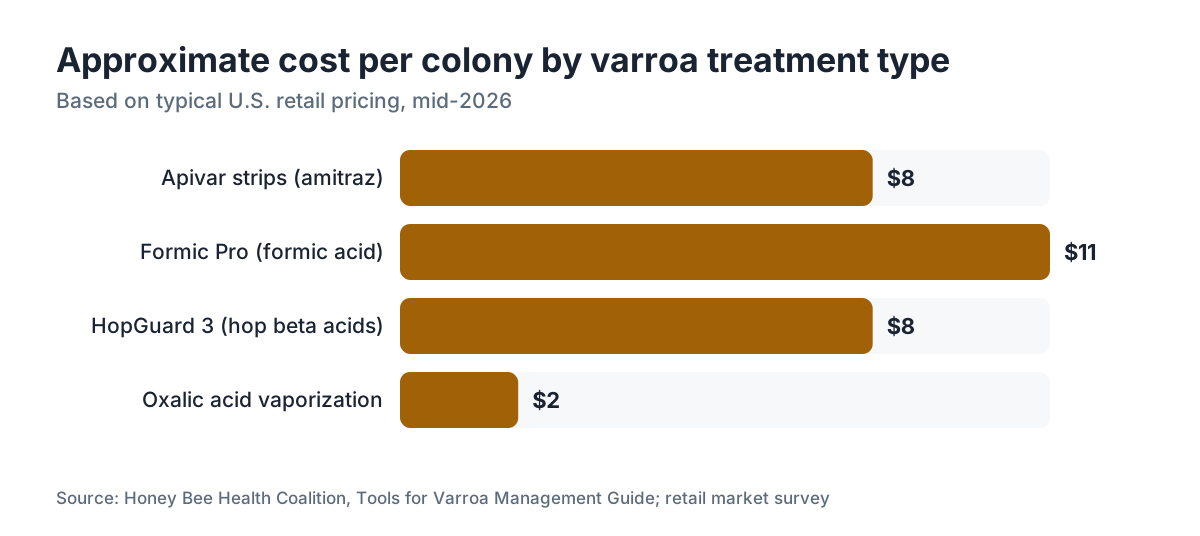
Here's a straight comparison of the four treatment categories most beekeepers reach for.
| Treatment | Active ingredient | Requires broodless period? | Temp constraints | Honey super restriction | Approx. cost per colony |
|---|---|---|---|---|---|
| Apivar strips | Amitraz | No | None (works best above 50 F) | Yes, remove supers | $6-10/colony |
| Oxalic acid (vaporization) | Oxalic acid | Yes (most effective) | Works 40 F and above | No | $1-2/treatment |
| Formic acid (Formic Pro / MAQS) | Formic acid | No | 50-92 F for Formic Pro; 50-85 F for MAQS | Remove supers during treatment | $8-14/colony |
| HopGuard 3 | Hop beta acids | No | None listed | No | $6-10/colony |
Apivar's best case is a colony with brood you can't or won't interrupt. No temperature window to hit, reliable over weeks, decades of efficacy data behind it. Its weak spots are the resistance concern, the wax residue, and the hard ban on honey supers during treatment.
Oxalic acid vaporization is my first pick for winter broodless treatments and for splits before they set brood. The per-treatment cost is a fraction of Apivar, and varroa has no registered resistance mechanism to oxalic acid as of this writing. [3]
Sourcing treatments alongside other beekeeping supplies? Buying Apivar and oxalic acid together as a planned rotation makes a sensible seasonal kit. [11]
Does Apivar affect honey you can harvest later?
Short answer: strips come out before supers go on, or before any honey you plan to harvest. Never put supers on a colony with strips in place.
Amitraz shows up in honey and wax when colonies are treated with supers on. The EPA registration and label prohibit honey super placement during treatment for exactly this reason. [1]
After you pull strips and before you add supers, there's a residue clearance period. The label sets no mandatory wait between removal and super addition the way some products do, but most extension guidance says don't rush supers onto frames right after a fresh fall treatment if you plan to harvest spring honey from them. The Honey Bee Health Coalition's guidance points to wax age and comb rotation as the levers for managing residue across cycles. [3]
Practical version: treat in fall after your last extraction, pull strips in late fall or before spring buildup, add supers when the flow starts. That calendar keeps supers out of the treatment window with no fancy timing. Penn State Extension's seasonal guidance lines up with this approach. [6]
Where can you buy Apivar Easy Rip strips and what do they cost?
Apivar sells through beekeeping supply retailers and some ag co-ops. General farm stores rarely stock it, so most hobbyists order online. Standard packaging is 10 strips per box (five colonies at two strips each), with bigger counts for sideliners and commercial outfits.
As of mid-2026, a 10-strip box runs roughly $25-35 at most U.S. retailers, about $5-7 per colony per treatment. Bulk packs (50 or 100 strips) drop the per-strip cost noticeably once you're past 15 or 20 colonies. Comparing suppliers? Options through free shipping honey bee supply companies can trim your order total.
No generic amitraz strip is currently registered in the U.S. under a competing brand, so Apivar is the only amitraz strip on the American market. Your competition is entirely different active ingredients, not a cheaper version of the same strip.
Some state departments of agriculture run subsidy or cost-share programs for varroa treatments. Check yearly, because they change. Your state department of agriculture or state apiarist office is where to look. [7]
What does the EPA registration say and are there any legal use restrictions?
Apivar is registered with the U.S. EPA under registration number 81310-1-81824. The registered use is honey bee colonies for control of varroa mites (Varroa destructor). [1]
The label is a legally binding document under FIFRA, the Federal Insecticide, Fungicide, and Rodenticide Act. Its key requirements:
No colonies with honey supers in place. No more than two treatments per year. Never exceed the labeled dose (two strips per 10-frame colony). Wear chemical-resistant gloves handling strips. Keep out of reach of children. Dispose of used strips and packaging per label instructions. [1]
The label also requires you to read it before use. Sounds obvious, but it matters: the Easy Rip label may carry updated language versus older Apivar labels, and the half-strip dosing for nucs is specific to this format. Working from instructions you memorized off an older box? Pull the current label from the National Pesticide Information Center's label system and confirm the details. [8]
Canada, the EU, and Australia each hold their own registration status for amitraz. Canadian beekeepers should verify current status with the Pest Management Regulatory Agency. This article covers U.S. use only.
How do you monitor whether the Apivar treatment actually worked?
An alcohol wash on a 300-bee sample is the standard. (Older literature calls it an ether roll; alcohol has replaced ether in modern practice.) The Honey Bee Health Coalition's varroa guide lays out the protocol: scoop roughly 300 bees (about half a cup) off a brood frame into a jar, add isopropyl alcohol, shake hard for 60 seconds, pour through a screen, count mites. [3]
Wash before you install strips to fix your starting load. Wash again at week 8, at or before removal. Go from 5% (15 mites per 300 bees) down to 0.5% (1-2 mites), and the treatment worked. Go from 5% to 3%, and something broke: placement outside the brood nest, too-short duration, reinfestation from neighbors, or early resistance.
A sticky board drop count is your backup. Heavy daily drops in the first two weeks (50 to 200-plus mites a day in a badly infested colony) tell you the strips are working. The drop tapers by week four. Board counts are less precise than a wash for calculating percent infestation, but they give real-time feedback without sacrificing bees.
Your county extension office or state apiarist may run mite-washing demos or workshops. Track down your state apiarist through your state department of agriculture site once and keep the contact. It's worth it. [7]
Frequently asked questions
Can I use Apivar Easy Rip strips with honey supers on?
No. The EPA-registered label prohibits placing or leaving honey supers on a colony during Apivar treatment. Amitraz migrates into honey and wax. Remove all supers before you install strips, and don't add new supers until strips are out and a reasonable clearance period has passed.
How long do you leave Apivar strips in the hive?
The label sets a minimum of 6 weeks and a maximum of 10 weeks. Don't pull early because the mite drop looks low. Mites in capped brood emerge across the whole window. Running the full time exposes those emerging mites after they uncap. Strips left past 10 weeks add no benefit and build wax residue.
How do you use Apivar strips in a nuc?
This is where the Easy Rip design matters most. For a 4-5 frame nuc, use one half-strip: fold at the score line and pull. Hang it in the center of the brood nest between frames. Don't skip nucs. Untreated nucs turn into mite reservoirs that reinfest your treated colonies through drifting and robbing.
Can varroa mites become resistant to Apivar?
Yes. Amitraz resistance in varroa is documented in the United States and Europe. If a treatment that used to drop your counts to near-zero now leaves loads above 1-2% post-treatment, resistance may be at play. Rotating between amitraz and treatments that kill by a different mechanism, like oxalic acid, across treatment events is the standard way to slow it.
Do you need to wear protective gear when handling Apivar strips?
The label requires chemical-resistant gloves. Nitrile works fine for the brief handling during install and removal. You're avoiding prolonged skin contact, not incidental touch. No respirator or eye protection required under normal use, though reading the full label safety section before first use is required by law.
How many times per year can you use Apivar?
The registered label limits use to two treatments per year. Most beekeepers run one in spring and one in fall, which fits the product's brood-present requirement and works around honey flows. More than twice a year is off-label and also speeds up amitraz resistance.
What temperature does Apivar work at?
Apivar has no hard minimum temperature the way formic acid does. Amitraz release slows in cold, but the product keeps working in normal brood-rearing conditions. Treating a tight winter cluster below roughly 50 F gets you nowhere because bees aren't crossing the strips freely. In that case, a broodless-period oxalic acid treatment fits better.
Can I reuse Apivar strips from a previous treatment?
No. Strips are single-use. The amitraz in a spent strip is heavily depleted after 6-10 weeks of slow release. Reinserting last season's strips gives you negligible mite control and a false sense of treatment. Dispose of used strips per label directions (usually regular household waste) and buy fresh strips for each treatment.
What's the difference between Apivar and amitraz?
Amitraz is the active ingredient. Apivar is Veto-Pharma's brand name for amitraz-impregnated polymer strips registered for honey bee colonies in the U.S. No separate generic amitraz strip is currently registered for U.S. beekeeping. Apivar is the only legal amitraz strip option for American beekeepers as of mid-2026.
How do I know if my Apivar treatment failed?
Wash before treatment and again at week 8. If post-treatment loads stay at 2% or above, the treatment underperformed. Possible causes: strip placement outside the brood nest, strips pulled early, reinfestation from neighboring colonies, or reduced efficacy from resistance. Report consistent failures to your state apiarist, who can arrange resistance testing.
Is Apivar safe to use around queens?
At label doses, Apivar is generally considered safe for queens. Field reports and extension guidance don't list queen loss as a common side effect of correctly applied treatments. If you lose a queen shortly after treatment, check whether a high pre-treatment mite load (which stresses the colony and drives brood disease) was the real cause rather than the treatment.
Can I treat a colony with Apivar right after installing a package?
Yes, but timing matters. A freshly installed package with no brood yet is near-broodless, which is a good moment for an oxalic acid dribble rather than Apivar. Once brood is established (2-3 weeks after install), Apivar makes more sense. Check mite loads on your package bees first: some packages arrive with surprisingly high counts from the source apiary.
Where do I place the strips if I have a double-deep hive?
Place strips in the active brood nest, wherever the queen is laying. In a double-deep colony brood may span both boxes. If so, put one strip in the upper brood box and one in the lower rather than both in one box. The goal is bee-to-strip contact throughout the brood area. If brood sits in one box, keep both strips there.
Sources
- Veto-Pharma / EPA, Apivar Easy Rip EPA-registered product label (Reg. No. 81310-1-81824): Label specifies two strips per 10-frame colony, 6-10 week treatment window, prohibition on honey supers during treatment, and maximum two treatments per year
- University of Florida IFAS Entomology and Nematology, Varroa destructor biology and management: Amitraz does not penetrate capped brood cells; full brood cycle exposure required for efficacy
- Honey Bee Health Coalition, Tools for Varroa Management Guide (current edition): Recommends fall treatment to protect winter bees, rotating active ingredients to slow resistance, 2% treatment threshold, and the alcohol wash protocol on a 300-bee sample
- Aufauvre et al., Scientific Reports 2018, Parasite- and pesticide-associated metabolic disorders in honeybees: Field-realistic amitraz exposure altered olfactory learning in honey bees under sub-lethal conditions
- Cornell University, College of Agriculture and Life Sciences, beeswax pesticide residue research: Amitraz and its breakdown product DMPF detected in commercial beeswax samples
- Penn State Extension, Varroa Mite Management in Honey Bee Colonies: Seasonal treatment timing guidance recommending fall treatment after final honey harvest to protect winter bee cohort
- USDA National Agricultural Library: State apiarists provide local resistance testing, treatment subsidy information, and mite management guidance
- National Pesticide Information Center (NPIC), Pesticide Product Label System: Current registered label text for Apivar available through the NPIC label database
- University of Minnesota Bee Lab, varroa mite treatment options: Comparison of varroa treatment active ingredients including amitraz, oxalic acid, formic acid, and hop beta acids for efficacy and resistance considerations
Last updated 2026-07-09