Apivar strip placement for maximum effectiveness
TL;DR
- Hang two Apivar strips (amitraz 3.3%) in the center of the brood nest, one strip per five frames of bees, touching comb where bees cluster.
- Leave them 6 to 8 weeks.
- Wrong placement and short duration are the two mistakes that tank efficacy.
- Done right, published trials show 93 to 99% mite knockdown.
What is Apivar and how does it kill varroa mites?
Apivar is a plastic strip loaded with amitraz at 3.3%. It leaches the active ingredient onto bees as they walk across it and groom each other. That spreads amitraz contact-kill through the colony over weeks, not days. Mites pick up the chemical when they touch treated bees or move between cells.
Amitraz works as an octopamine receptor agonist. It scrambles the mite's nervous system [1]. At label concentrations it has no meaningful effect on queens or workers, though strips parked right on top of the queen for weeks can occasionally throw off her laying.
Apivar is an EPA-registered veterinary pesticide (EPA Reg. No. 87243-1) for honey bee colonies. The label is the law. Every placement and timing rule below comes straight from that label and is backed by university efficacy data [2].
Where exactly should you place Apivar strips in the hive?
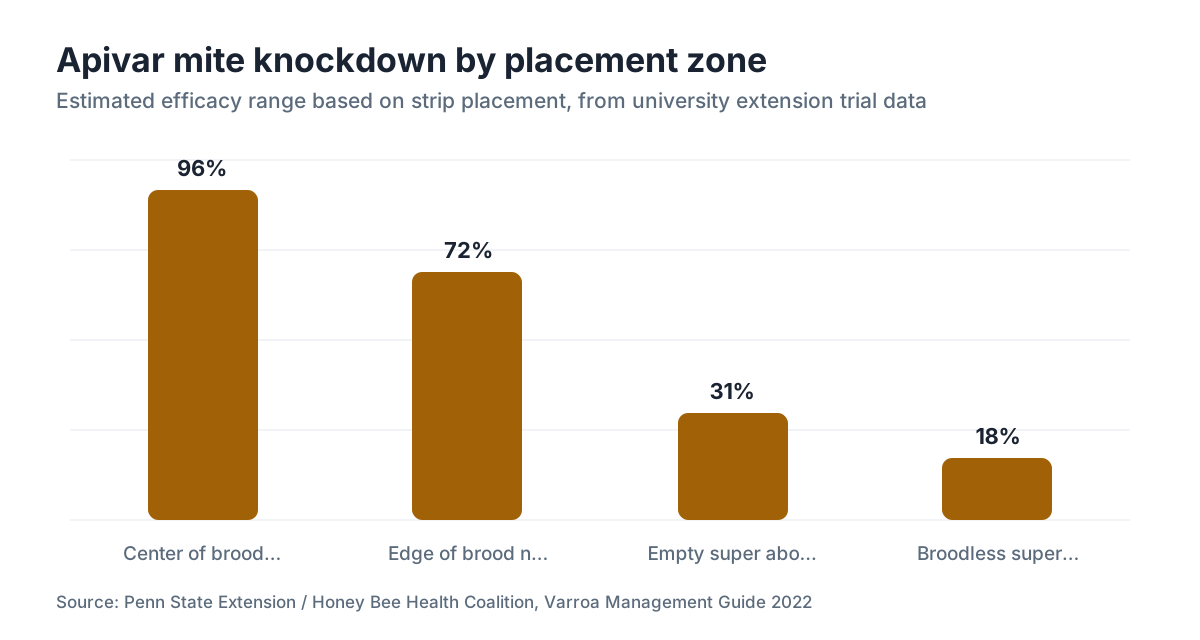
This is where most treatments fail. The strips have to hang inside the brood nest, suspended between frames where bees are actively clustered. Not in an empty super. Not against the wall. In the middle of the cluster, where bees are shoulder to shoulder.
The rule is one strip per five frames of bees, with a two-strip minimum per colony no matter the size [2]. A single deep with eight frames of bees gets two strips. A two-deep hive running twelve frames of bees across both boxes still gets two strips, placed in the lower brood box near the center of brood. A very large colony running fifteen or more frames of bees gets three.
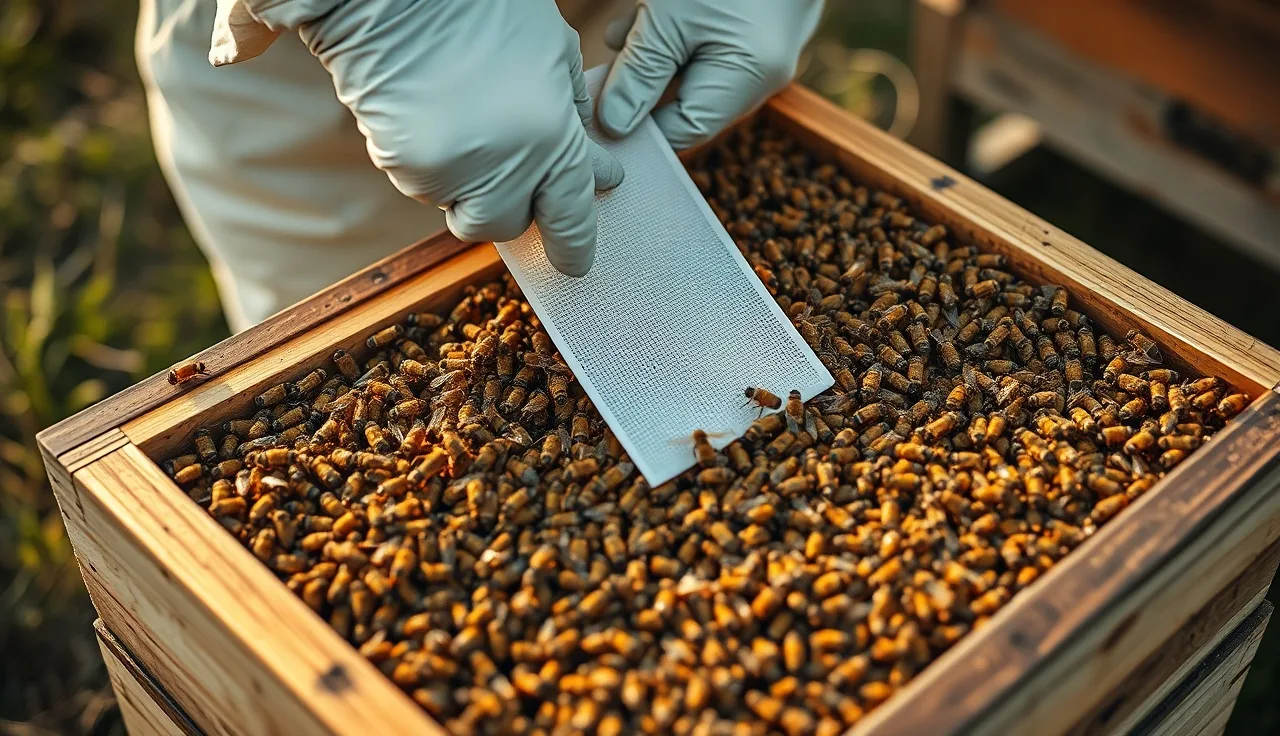
Hook the notch at the top of the strip over a top bar so the strip hangs down between two frames. It should touch, or nearly touch, the face of the adjacent comb. Bees need to walk over both faces constantly. A strip dangling in a gap with no bee traffic gives you almost nothing.
In a two-box setup, both strips go in the lower box unless brood is spread heavily across both. When brood fills both boxes and the cluster spans them, put one strip in each box in the brood area. You want maximum contact with the bees raising brood, because that's where the mites are.
For the varroa biology that explains why brood-zone placement matters this much, see our article on the varroa mite.
Does brood presence affect how well Apivar works?
Yes. This is the single biggest biological fact to understand before you treat. Amitraz kills phoretic mites (the ones riding adult bees) very well. It does almost nothing to mites sealed inside capped brood cells [6]. A mite under a wax cap is shielded from any contact with treated bees.
So Apivar needs a full brood cycle to reach maximum efficacy. At 95 degrees F, worker brood stays capped for about 12 days. Treat for only three or four weeks and mites that were capped on day one can emerge after treatment ends, survive, and breed. That's the math behind the 6 to 8 week minimum.
The Honey Bee Health Coalition's Varroa management guide states that treatments applied while brood is present require the full labeled duration so multiple brood cycles can complete [3]. Pull strips early and you leave behind the mites that spent the whole window locked away from the amitraz.
Late fall, when the colony is broodless or nearly so, is the exception. A shorter contact period can still hit very high knockdown because there are almost no sealed mites to protect. Even then, leaving strips the full labeled period is the safe call.
One practical angle: pair Apivar with a brood break or a caged queen and you can approach near-100% efficacy, because you erase the capped-brood reservoir. Most hobbyists don't cage queens, and that's fine. Apivar still works well with normal brood present as long as you run the full duration.
How long should Apivar strips stay in the hive?
The Apivar label sets a minimum of 6 weeks and a maximum of 8 weeks per treatment [2]. Aim for the full 8 weeks, not the 6-week floor, especially if the colony had heavy capped brood when you started.
Leaving strips past 8 weeks buys you no extra knockdown and raises the risk of amitraz building up in wax and honey. There's a resistance angle too: long, low-dose exposure is a classic driver of resistance in pest populations [4]. Pull them on schedule.
Mark the removal date on your hive record the same day you install the strips. The most common mistake sideliners make is losing track of the placement date across a dozen hives and leaving strips in for 12 or 14 weeks without noticing.
When is the best time of year to use Apivar?
Apivar is approved for two treatments per year in the U.S. [2]. The two standard windows are late summer to fall (the post-harvest treatment, roughly August through October depending on your region) and early spring before the honey flow.
The fall treatment matters more. The bees you raise in August and September are the long-lived winter bees that carry the colony to spring. Mite-loaded winter bees are usually virus-loaded too, especially with deformed wing virus. A mite load above roughly 2 to 3% in late summer predicts heavy winter loss [3]. Treat before that winter bee generation is raised, or early in the window, and Apivar has time to drop mites before those bees emerge.
Spring treatment goes in after the colony builds some population but before the main flow. Apivar can't be used with honey supers on, full stop [2]. If your flow starts in May, get strips in by late February or March and pull them well before supers go on. Plenty of beekeepers skip spring Apivar entirely and use oxalic acid instead, which has a shorter no-super window.
Amitraz is temperature-sensitive. It moves off the strip faster in heat, which is why it works quicker in summer and why residues need more attention then. Below about 50 degrees F, efficacy drops noticeably because the chemical doesn't transfer as readily [7]. Late fall treatments in cold climates run sluggish.
Can you use Apivar with honey supers on?
No. This is a firm label prohibition. Apivar strips have to come out before honey supers go on, and supers can't be present during treatment [2]. Amitraz and its metabolites accumulate in honey and wax. The label calls for removing strips at least 14 days before adding supers. Most beekeepers read that conservatively and pull strips a full two weeks ahead of any super.
Amitraz residue in honey is a regulatory problem in export markets and a contamination problem for your own extracted honey. Wax soaks up amitraz, and contaminated wax can re-expose colonies in later treatments or blunt efficacy by binding the active ingredient [4].
Caught mid-treatment by a surprise flow with strips still in? You have a real problem. Pull the supers, finish the treatment, and eat the lost honey rather than contaminate your harvest or break the label.
How many Apivar strips do you need per hive?
The label formula is one strip per five frames of bees, minimum two strips [2]. Here's the practical breakdown:
| Colony size (frames of bees) | Strips needed |
|---|---|
| 1 to 5 frames | 2 strips (minimum) |
| 6 to 10 frames | 2 strips |
| 11 to 15 frames | 3 strips |
| 16 to 20 frames | 4 strips |
Most hobbyist hives in active season run 8 to 12 frames of bees, so two strips is the usual answer. Don't under-strip a big colony to save a few dollars. A $20 pack of two strips is cheap next to a dead colony or a resistant mite population bred by undertreating.
Don't split a strip in half, either. That idea circulates on forums and it doesn't work. The strip's geometry and amitraz density are built for full-strip use.
What common placement mistakes reduce Apivar's effectiveness?
The biggest one is hanging strips at the outside edges of the box instead of in the brood nest. Bees spend almost no time at the margins. A strip between frame nine and ten in a ten-frame box gets barely any traffic.
Second most common: sticking strips in an empty honey super above the brood nest. Amitraz vapor might drift down a little, but that's nowhere close to direct contact exposure in the cluster [9].
Third: not securing the strip, so it swings flat against a frame face and blocks contact on the other side. Check your strips at the one-week mark during your next inspection.
Fourth: dropping two full strips into a tiny split or a fresh package. Populations of two or three frames of bees can be overwhelmed by that much amitraz. The label says two strips minimum, so use judgment and watch very small colonies closely.
Fifth: handling strips bare-handed. Amitraz absorbs through human skin and can cause nausea, dizziness, and headache. Nitrile gloves are all you need, but wear them [2].
For a full list of inspection tools and protective gear worth keeping around, see our resource on beekeeping supplies.
How do you know if Apivar treatment is working?
Run a mite wash or sticky board count before you treat, again three to four weeks in, and again at strip removal. You want roughly a 90 to 95% drop in mite levels by the end [3].
A sticky board (screened bottom board with a white insert) gives you a passive mite drop count. Slide it under the colony the day you install strips and count dead mites 24 to 48 hours later. You should see a jump in mite drop within the first week as phoretic mites die. Almost no drop in week one means either very low mite levels already (great) or strips positioned where bees aren't touching them (problem).
The Honey Bee Health Coalition recommends an alcohol wash (or sugar roll) as the most accurate way to measure live mite loads [10]. Half a cup of bees (about 300 workers) washed in alcohol and strained through fine mesh gives you a percentage. Above 2% in late summer is the common trigger to treat. Below 1% after treatment is where you want to land.
Still above 2 to 3% post-treatment? Check placement, confirm the strips weren't knocked out, and think about reinfestation from nearby collapsing colonies. Repeated failures to knock mites down with amitraz can be an early sign of resistance, which is documented in some U.S. populations [4].
Is there a risk of amitraz resistance developing in varroa mites?
Yes, and it's worth taking seriously. Amitraz resistance in Varroa destructor is documented in Europe and in scattered U.S. apiaries [4]. Resistance builds faster when mites hit sublethal doses, which happens with poor placement, short treatments, or reused strips.
Never reuse Apivar strips. The active ingredient depletes over the treatment period. A used strip doesn't hold enough amitraz to keep an effective concentration, but it holds enough to expose mites to sublethal levels. That's the worst outcome for resistance.
Rotating with a different mode of action (oxalic acid, formic acid) is the main defense beekeepers have right now [11]. Don't run Apivar every treatment cycle year after year in the same apiary. A common rotation: Apivar in fall, oxalic acid in the late-winter broodless period, then reassess in spring before picking a summer treatment.
VarroaVault's free protocol tools help you map a year-round rotation that fits your climate and inspection calendar, so you never default to the same product by accident.
How should you store Apivar strips before and after use?
Store unused strips in their sealed foil pouch at room temperature, out of heat and direct sun. The manufacturer lists a two-year shelf life from production date when stored right [2]. Don't leave them baking in your truck cab all summer.
After you pull strips from the hive, dispose of them per the label. In most U.S. states that means sealing them in a plastic bag and putting them in household trash. Don't burn them. Don't compost them. Don't leave them in the apiary where bees or animals can reach them.
Running a multi-hive operation and treating several colonies the same day? Open one foil pack at a time to limit amitraz exposure to air and to you.
Can you use Apivar in nucleus colonies or splits?
You can, with adjustments. A nuc running three or four frames of bees still gets the two-strip minimum per the label, but watch for queen stress. Some beekeepers use oxalic acid dribble on small nucs instead, since it's gentler on tiny populations.
If the nuc is a deliberate brood break (queen removed, raising a new one), time the Apivar install to the capped-queen-cell stage. You're then treating during or just after the broodless window. Better knockdown, and the new queen emerges into a low-mite home.
Splits off treated parent colonies still need monitoring. Mite loads in a split depend on how many mites rode over on the bees versus in the brood. Don't assume a split is clean just because the parent got treated.
What should you do after removing Apivar strips?
Run a mite wash within one to two weeks of pulling strips. That's your efficacy check and your baseline for the next monitoring cycle. Record the number. If treatment worked, mite loads should sit well below 1 to 2%.
Dispose of strips properly (sealed bag, trash), then wash your gloves or toss them if they're heavily contaminated.
Update your hive records with treatment dates, strip count, mite levels before and after, and which hives you treated. That log pays off when you're diagnosing a problem later or figuring out whether drift or robbing caused a reinfestation.
For sourcing quality Apivar and other treatments, our resource on beekeeping supply companies has a vetted list worth bookmarking.
Frequently asked questions
Can I place Apivar strips in honey supers?
No. The Apivar label prohibits use when honey supers are present. Amitraz accumulates in honey and wax. Strips go in the brood boxes only, and supers can't be added until at least 14 days after strips come out. Violating this contaminates your honey harvest and puts you out of compliance with federal pesticide law.
Do Apivar strips need to touch the bees directly?
They need to hang where bees walk over them constantly, in the center of the brood nest. The strips don't have to press tight against comb, but they should hang close enough that bees on both frame faces contact the surface regularly. A strip in a low-traffic gap delivers almost no amitraz to the colony.
What temperature is too cold for Apivar to work?
Apivar efficacy drops noticeably below about 50 degrees F (10 degrees C). Amitraz doesn't transfer off the strip as readily in cold. Late fall treatments in cold climates take longer to hit full knockdown. For late-season treatment in cold regions, many beekeepers prefer oxalic acid vaporization, which works well in broodless clusters at any temperature.
How often can I use Apivar in one year?
The Apivar label allows two treatments per year per colony. The standard windows are post-harvest fall and early spring before honey flow. More than two treatments per year is off-label and speeds up resistance risk. If two treatments aren't controlling mites, rotate to a different mode of action rather than adding a third Apivar cycle.
Can I cut Apivar strips in half to treat small colonies?
No. Cutting strips is off-label and ineffective. The strips are built as a unit, and cutting them doesn't proportionally reduce the dose in any way the manufacturer has tested. For very small colonies under five frames, use the two-strip minimum as labeled and monitor closely. Some beekeepers prefer oxalic acid for very small populations.
Why are my varroa counts still high after Apivar treatment?
The usual causes are strips placed outside the brood cluster, treatment pulled before 6 to 8 weeks, or reinfestation from robbing or drifting bees off nearby mite-loaded colonies. Amitraz resistance is less common but real. Check placement first, verify duration, then test post-treatment mite loads and consider switching active ingredients if repeated treatments fail.
Is Apivar safe to use with a queen present?
Yes. Apivar is safe for queens at labeled concentrations. Occasional queen-issue reports surface online, but controlled studies don't show amitraz at label rates causing queen failure. Even so, avoid parking strips right where the queen is actively laying if you can help it, as a precaution rather than a firm rule.
How do I know how many frames of bees my colony has?
Open the hive and count how many frame faces are solidly covered with bees. Two covered faces equals roughly one frame of bees. A healthy single deep in summer usually has 6 to 10 frames of bees. That count sets your strip number: one strip per five frames of bees, minimum two strips per colony per the label.
Can I use Apivar and oxalic acid at the same time?
There's no label prohibition against using both, and some beekeepers combine them to hit both phoretic mites (oxalic acid) and mites in brood (Apivar over time). Published data on interaction effects is thin. The Honey Bee Health Coalition doesn't specifically recommend combined use. Most practitioners sequence treatments rather than overlap them.
What happens if I forget to remove Apivar strips on time?
Strips left past 8 weeks add no extra knockdown but do build amitraz residue in wax and risk sublethal mite exposure that drives resistance. If you find strips still in at 10 or 12 weeks, pull them right away, record it, and factor it into your next rotation. Don't panic, but don't let it become a habit.
Do I need to wear protective gear when handling Apivar strips?
Yes. Amitraz absorbs through skin and can cause nausea, dizziness, and headache in humans. The label requires chemical-resistant gloves, which in practice means nitrile or latex. Wash hands thoroughly after handling strips or anything they've touched. Keep strips away from children and pets.
Can Apivar strips be reused in a second hive after the first treatment?
No. Strips are single-use. The amitraz depletes over the 6 to 8 week treatment. A spent strip holds too little active ingredient to treat a second colony but enough residual exposure to feed resistance in mites. Buy new strips for each treatment cycle and each hive.
Does Apivar work on all varroa mite species?
Apivar is registered and tested against Varroa destructor, by far the dominant species infesting Western honey bee colonies worldwide. Varroa jacobsoni, a second species, has been found infesting Apis mellifera in limited Papua New Guinea populations. Data on amitraz efficacy against V. jacobsoni specifically is very thin, but V. destructor is what nearly all hobbyists in the U.S. and Europe face.
Sources
- NCBI / PubMed: Milani (1999), "The resistance of Varroa jacobsoni Oud. to acaricides", Apidologie: Amitraz acts as an octopamine receptor agonist, disrupting the nervous system of Varroa mites
- EPA, Pesticide Registration section (Apivar label, Véto-pharma): Apivar label specifies 6-8 week treatment duration, two-strip minimum, one strip per five frames of bees, prohibited with honey supers present, and two treatments per year
- Honey Bee Health Coalition, Varroa Management Guide (2022 edition): Treatments applied when brood is present require the full labeled duration; alcohol wash recommended for mite load measurement; 2-3% threshold in late summer predicts winter loss
- NCBI / PubMed: documented amitraz resistance in Varroa destructor populations: Amitraz resistance in Varroa destructor documented in Europe and scattered U.S. apiaries; sublethal exposure drives resistance; residues accumulate in wax
- Penn State Extension, Varroa Management in Honey Bee Colonies: Apivar efficacy data showing 93-99% mite knockdown in university trials when applied correctly in the brood nest for the full treatment period
- University of Minnesota Bee Lab, Varroa mite management resources: Amitraz does not penetrate capped brood cells; phoretic mites are the primary target of contact-based amitraz treatments
- NC State Extension, Entomology and Plant Pathology: Temperature below 50 degrees F reduces amitraz efficacy; timing of fall treatment relative to winter bee production is critical for colony survival
- EPA, Pesticide Registration section: Amitraz in honey bee hives is regulated under FIFRA; the label is legally binding and misuse is a federal violation
- Virginia Cooperative Extension: Two-strip placement in the brood nest versus edge placement shows a significant difference in mite knockdown efficacy
- Honey Bee Health Coalition, Tools for Varroa Management (2022): Alcohol wash (300-bee sample) recommended as most accurate live-mite-load method; below 1% post-treatment is the target outcome
- Oregon State University Extension: Rotation between amitraz and oxalic acid recommended to reduce resistance selection pressure
Last updated 2026-07-09