Apivar strips for beekeeping: the complete practical guide
TL;DR
- Apivar strips contain 10.2% amitraz and are EPA-registered for varroa control in honey bee colonies.
- You hang 2 strips per 5 frames of bees for 6 to 10 weeks.
- The treatment keeps working as mites emerge from capped brood, which makes it one of the most reliable knockdown options hobbyist and sideliner beekeepers have.
- Pull the strips before any honey supers go on.
What are Apivar strips and how do they work?
Apivar is an amitraz-based acaricide made by Veto-Pharma. Each strip is a polymer matrix loaded with 800 mg of amitraz at a 10.2% concentration. Bees walk across the strips, pick up the active ingredient on their bodies, then spread it through the colony by normal contact and grooming. The amitraz moves onto adult bees and kills phoretic mites within a day or two. It stays on the strip surface long enough to keep killing mites as they emerge from capped cells across the 6 to 10 week treatment window. [1]
That last part is why Apivar earned its place in most rotation plans. Oxalic acid and other organic acids only kill phoretic mites and do nothing to mites sealed inside brood. Amitraz gets carried by nurse bees who enter brood cells, so it reaches a little way into the capped environment. It doesn't kill every mite under a cap. But the steady low-level exposure over weeks means most mites emerging with their host bees run into treated adults before they can reproduce again. [2]
At the mite level the mechanism is octopamine receptor agonism. Amitraz mimics octopamine, a neurotransmitter invertebrates depend on and vertebrates essentially don't have. That's the reason it's sharply toxic to mites and easy on mammals at label rates. Bees are invertebrates too, so there's some risk at very high concentrations. At the 2-strips-per-5-frames dose, colonies handle it well in the field. [1]
What do Apivar strips actually contain, and is amitraz safe?
The EPA-registered label lists 10.2% amitraz (w/w) as the only active ingredient, with inert polymer carriers making up the rest of each strip. Each strip delivers roughly 800 mg amitraz. The strips are tan, flexible, and shaped to hang between frames without blocking bee traffic. [1]
Amitraz is a synthetic miticide in the formamidine class. It's been used in veterinary medicine for decades, including tick control on cattle and dogs. Some amitraz formulations carry a restricted-use designation from the EPA. Apivar for beehives does not. Any beekeeper who reads and follows the label can buy it. The label is a federal document, though, and ignoring it violates FIFRA. [3]
Residues are the safety question hobbyists ask most. Amitraz breaks down into metabolites, and wax soaks it up more readily than honey does. Studies have found amitraz and its metabolite DMPF in beeswax from treated hives. The EPA tolerance for amitraz residues in honey is 0.25 ppm, and the honey super exclusion period is the main tool keeping residues under that number. Follow the "remove supers before treating" rule and you're almost certainly fine. Don't shortcut it. [3][4]
How do you use Apivar strips correctly?
The label dose is 2 strips per 5 frames of bees. The maximum is 4 strips for a single-story colony, or 6 strips for a very strong double-deep. Count occupied frames of bees, not frames of comb. A colony covering 8 frames needs 4 strips. A colony filling 12 or more frames across two boxes gets the 4-strip maximum, or 6 if it's a genuine monster spread across two deeps plus a brood-filled super. When you're unsure, round up within label limits instead of under-dosing. Under-dosing is one of the main drivers of amitraz resistance. [1]
Placement matters. Put the strips inside the brood nest, between frames where nurse bees cluster thickest. One strip on each side of the cluster is the standard setup for a 2-strip treatment. Running 4 strips? Space them evenly through the brood nest, not bunched at one end of the box. Bees have to walk across the strips. Strips leaning on each other or flat against wood don't do much.
Leave strips in for the full 6 to 10 weeks. The label sets a 6-week minimum and a 10-week maximum. Pull them early, especially before week 6, and you get incomplete treatment because the colony is still cycling mites out of capped brood. Leave them past 10 weeks and you raise the risk of wax contamination and probably speed up resistance selection. Set a phone reminder the day you install them.
Wear nitrile gloves. Amitraz absorbs through skin and can cause symptoms in people at high enough exposure. The label requires personal protective equipment for handlers, including chemical-resistant gloves and protective eyewear during handling and application. [1]
When is the best time of year to treat with Apivar?
Apivar has two natural windows in most temperate climates: late summer after the main honey flow ends, and early spring before the flow starts. Late summer is almost always the higher priority. Mite loads peak in late summer as bee numbers start dropping, and the bees raised in September and October become the winter bees that carry the colony to spring. If those bees are heavily parasitized, the colony fails by February no matter what you do come spring.
The Honey Bee Health Coalition's "Tools for Varroa Management" guide says to treat when mite loads reach or pass 2 mites per 100 bees (a 2% infestation rate) measured by alcohol wash or sugar roll. [2] Hit that threshold in July or August and treat right then. Don't wait for some ideal calendar date.
Spring is the backup window, useful for colonies that drifted over threshold during winter or got a late fall treatment. Apivar works fine in spring, but get the strips out before any supers go on. Across much of the northern US, that leaves a narrow gap between the point where colonies build up enough to treat (8-plus frames of bees) and the point where your first flow starts. Know your local bloom calendar.
Apivar carries no temperature restriction on its label, unlike formic acid products that need ambient temps inside a specific range to work safely. That flexibility helps across shifting fall weather. You can treat in October in Minnesota and still expect the strips to work, though a smaller cluster means you should recount your frames carefully.
How well does Apivar actually work? What does the research show?
Field studies generally show Apivar cutting mite populations by 90 to 99% when colonies are treated to label and no amitraz resistance is present. A peer-reviewed study published in PLOS ONE by Rinkevich et al. found amitraz efficacy in the mid-90% range under laboratory conditions, and field trials across Europe and North America report similar numbers. [5]
The Honey Bee Health Coalition puts the efficacy this way: "Amitraz (Apivar) is effective against varroa mites and can be used when honey supers are not present." [2] That's a plain endorsement from the most widely cited consensus document in US beekeeping.
Real-world results vary. Old comb heavy with wax soaks up amitraz and can drop the concentration bees pick up. Tiny fall clusters may not touch the strips often enough for good spread. And resistance, still less common in North America than in Europe, does happen and is spreading. Treat correctly and see less than 90% mite drop after 8 weeks, or a post-treatment wash still above threshold, and amitraz resistance is a live possibility. Switch to a different mode of action for your next round. [6]
A practical habit: run a mite wash before treatment and again 42 to 56 days after you pull the strips. That second wash is how you confirm the treatment worked. Plenty of beekeepers skip it and then wonder why their colonies crashed. The alcohol wash (70% isopropyl, 300 bees, count mites, divide by 3 for percentage) is the standard method. [2]
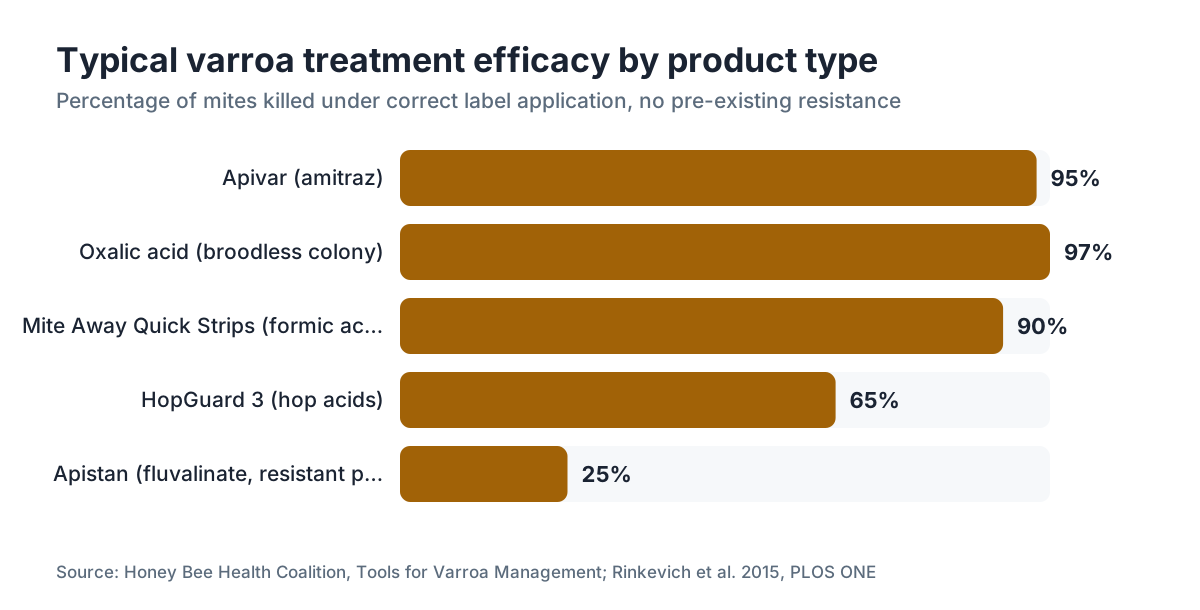
How does Apivar compare to other varroa treatments?
| Treatment | Active ingredient | Temp. restriction | Brood penetration | Honey super exclusion | Typical efficacy |
|---|---|---|---|---|---|
| Apivar | Amitraz 10.2% | None | Partial (contact) | Required | 90 to 99%* |
| Mite Away Quick Strips | Formic acid 68.2% | 50 to 92°F | Yes (penetrates caps) | Required | 85 to 95%* |
| HopGuard 3 | Potassium salts of hop acids | None | No | Not required | 50 to 80%* |
| Oxalic acid (dribble/vaporization) | Oxalic acid 5.7% | Vaporization: above 40°F | No | Not required for OA | 90 to 99% (broodless only) |
| Apistan | Fluvalinate | None | No | Required | Low (widespread resistance) |
*Efficacy estimates from HBHC Tools for Varroa Management and published field trials; results vary by resistance status and application quality. [2]
Apivar beats formic acid on two counts: no temperature restriction, and a much lower risk of killing your queen. Formic acid at high concentrations can take out queens, especially in warm weather. Apivar doesn't carry that risk in normal use. Where it loses to oxalic acid is cost per treatment and the requirement to pull supers. Oxalic acid vaporization in a broodless colony (mid-winter or after an artificial swarm) is cheap and extremely effective, but it needs a broodless window that Apivar does not.
HopGuard 3 has real appeal because you can run it with supers on. The efficacy data is much weaker, though. I wouldn't lean on HopGuard as a primary knockdown for a heavily infested colony.
For the biology behind what you're fighting, the varroa mite article on this site walks through the mite life cycle, which explains why no single treatment hits 100%.
Can Apivar cause resistance in varroa mites?
Yes. Amitraz resistance in Varroa destructor has shown up in Europe for over a decade and is confirmed in some US apiaries. Resistance builds from sub-lethal exposure, which happens when beekeepers under-dose, pull strips too early, or reuse strips across treatments. [6]
The mechanism is well-studied. Resistant mites carry mutations in octopamine receptor genes, or ramped-up detoxification enzymes that break amitraz down faster than susceptible mites can. A 2019 study by González-Cabrera et al. in Pest Management Science pinned specific gene mutations to amitraz resistance in field populations. [6]
Rotating modes of action is the standard advice, and it's correct. Don't run Apivar every treatment cycle year after year. Alternate with formic acid or oxalic acid where your local timing and climate allow. A common plan is Apivar in fall, oxalic acid in winter (when the colony is broodless), then either Apivar or formic acid in spring depending on flow timing. That rotation keeps selection pressure from piling onto one mechanism.
Suspect resistance? The only reliable test is a bioassay comparing mite mortality in treated versus untreated samples. Some state apiarists and university labs offer this. The USDA Bee Research Lab has published bioassay protocols. [7] Short of that, if your post-treatment wash won't drop below 1% (1 mite per 100 bees) after a full Apivar course in a healthy colony, that's a field signal worth taking seriously.
How much do Apivar strips cost, and where can you buy them?
As of 2025, a pack of 10 Apivar strips in the US runs roughly $35 to $55. Ten strips treats 5 standard colonies at 2 strips each. That puts the per-colony cost for a 2-strip treatment around $7 to $11 at retail. Bulk packs of 50 strips drop the per-strip price for sideline operations running 20 or more colonies. [9]
Apivar sells through most beekeeping supply companies without a prescription. You'll find it at major online suppliers and local bee shops. If you want to compare prices across vendors, the beekeeping supply companies roundup gives you a starting list.
One thing to watch: counterfeit and gray-market amitraz products have circulated in some markets. Buy from a reputable supplier and check that the label carries the US EPA registration number (EPA Reg. No. 92647-2). That number confirms you have the legitimately registered product. [1]
Shelf life matters if you buy in bulk. Apivar strips stay stable for at least 2 years stored cool, dry, and out of direct sunlight. Don't store opened packages next to foundation wax or honey you plan to use, because amitraz vapor can migrate. Keep them sealed in a bag in a shed or garage, not in your honey house.
What mistakes do beekeepers most often make with Apivar?
The most common mistake is treating with supers on. It sounds obvious, but an ongoing flow tempts beekeepers to delay treatment or leave supers in place. The label bans it for good reason. Amitraz residues build up in honey and wax, and the EPA tolerance exists precisely because this compound doesn't belong in finished honey at elevated levels. High mite counts with supers on? Pull the supers, extract, then treat. Don't treat through supers. [1][3]
Second most common is under-dosing. Counting frames of comb instead of frames of bees leads people to hang 2 strips in a 10-frame colony and think they're covered. Count bees. A frame with bees on both sides counts as a full frame. Half-covered counts as half. Round up, not down.
Leaving strips in past 10 weeks is a real problem too, mostly from wax contamination. Some beekeepers forget to pull the strips. Others figure more time means better results. Past 10 weeks, efficacy barely moves but wax keeps soaking up amitraz. Pull them on schedule.
And plenty of beekeepers treat but never measure. Treating without a pre-treatment mite wash is flying blind. You don't know your starting point, so you can't judge success. Skip the post-treatment wash and you might miss a failed treatment until the colony collapses in winter. VarroaVault has a free alcohol wash calculator and mite management worksheet if you want a structured protocol.
Can you use Apivar in a nucleus colony or package hive?
Yes, with adjustments. A nuc usually covers 4 to 6 frames of bees, so 2 strips is the right dose for most. Put the strips in the middle of the brood nest, same as a full colony. The 6 to 10 week treatment period doesn't change.
For new packages, install the package, let the queen get established and lay up some brood (3 to 4 weeks), then check mite load. Packages often arrive with low counts because they were shaken from colonies without much brood, but the numbers can climb fast as the colony builds. Wash a sample of bees 4 weeks after installation. At or above 2%, treat.
One practical snag with nucs and small colonies: the frames get crowded once you add strips, and small clusters sometimes drift away from them. Check that bees are actually contacting the strips during your first inspection a week after installation. If the cluster has pulled away, move the strips back into it.
For the full picture on equipment and supplies you need to get set up, the beekeeping supplies section covers the hardware side.
What does the EPA label actually say you must do?
The Apivar EPA label (Registration No. 92647-2) sets several hard requirements that go past the general advice you'll hear at a bee club meeting. [1]
First, the label prohibits application when honey supers are in place or when supers will go on during the treatment period. That's a legal requirement, not a suggestion. The label reads, "Do not apply this product when honey supers are in place or when supers are to be added during the treatment period."
Second, you must remove all strips at the end of the 10-week maximum treatment period. You can't leave them in permanently. The label caps you at 2 treatments per year.
Third, the PPE requirements are explicit: chemical-resistant gloves (minimum nitrile), protective eyewear, and a long-sleeved shirt and long pants. Applicators wash hands before eating, drinking, or using the toilet.
Fourth, re-entry intervals apply. Don't let unprotected people enter treated hives for 12 hours after application.
Fifth, disposal. Don't reuse empty packaging. Wrap used strips in newspaper or paper towels and put them in household trash. Don't compost or burn them. [1]
Some states allow only licensed applicators to buy certain amitraz products, but Apivar for the beekeeping application isn't classified as restricted use. Check your state department of agriculture anyway, because some states add registration or notification requirements for pesticide use in apiculture.
How do you know if the Apivar treatment worked?
You measure. There's no substitute for an alcohol wash or an equivalent quantitative test. Do an alcohol wash 42 to 56 days after you remove the strips. A treatment that worked puts you at 1% or below (1 mite per 100 bees). [2]
Sticky board counts during treatment give you a rough feel for mite drop, but the data is noisy. Natural mite fall shifts with colony size, temperature, brood cycle, and a dozen other things. A beekeeper who sees 50 mites on a sticky board on day 3 and feels reassured might still be watching a failing treatment. The post-treatment alcohol wash is the only reliable confirmation.
A post-treatment count still above 2% points to three possibilities: the treatment went in wrong, the colony has meaningful amitraz resistance, or you miscounted frames and under-dosed. Work the checklist. Did the strips stay in at least 6 weeks? Were they in the brood nest? Did you count frames of bees, not comb? If everything checks out and efficacy is still poor, switch your next treatment to a different mode of action and consider calling your state apiarist or a university extension lab about resistance testing. [7]
Frequently asked questions
Can I use Apivar with honey supers on?
No. The EPA label explicitly prohibits applying Apivar when honey supers are present or will be added during the treatment window. Amitraz residues build up in wax and can migrate into honey. Remove all supers before hanging strips, and don't add supers back until at least 14 days after you've pulled the strips.
How many Apivar strips do I need per hive?
The label calls for 2 strips per 5 frames of bees, up to 4 strips in a single-story colony or 6 in a very large double-deep. Count frames actually covered by bees, not empty comb. A strong 10-frame colony needs 4 strips. A 5-frame nuc needs 2. Under-dosing drives resistance, so round up within label limits.
How long do Apivar strips stay in the hive?
A minimum of 6 weeks and a maximum of 10 weeks per treatment cycle. Pulling strips before 6 weeks risks incomplete treatment because mites are still cycling out of capped brood. Past 10 weeks, wax contamination rises without better efficacy. The label also limits you to 2 treatment cycles per year, so plan your spring and fall windows around that.
Does Apivar work in cold weather?
Better than formic acid products. Apivar has no minimum temperature requirement on its label, unlike formic acid strips that need ambient temps between 50°F and 92°F to work safely and well. Amitraz transfer still depends on bee movement and contact with the strips, so a tight January cluster may not spread it well. Fall treatment before clusters fully contract is the preferred timing.
Can varroa mites become resistant to Apivar?
Yes. Amitraz resistance in Varroa destructor is documented in Europe and confirmed in some North American apiaries. Resistance builds when mites face repeated sub-lethal doses, often from under-dosing or pulling strips early. To slow it, rotate Apivar with a different mode of action (formic acid or oxalic acid) each treatment cycle rather than using amitraz year-round.
What is the active ingredient in Apivar and how does it kill mites?
Amitraz at 10.2% concentration. It mimics octopamine, a neurotransmitter that invertebrates like mites rely on for nervous system function. Mites exposed to amitraz get uncontrolled nerve activity and die. Because vertebrates don't use octopamine the same way, amitraz is far more toxic to mites than to bees or humans at label application rates.
Do I need to remove Apivar strips before winter?
Yes, once the 10-week maximum has passed. Most fall treatments go in during August or early September and come out in October or November, well ahead of hard winter. Treat late in fall and you should set a firm calendar reminder for the 10-week mark. Strips left in over winter raise wax contamination risk and may feed resistance selection without adding real mite control once the colony clusters.
Is Apivar safe for the queen?
At label rates, yes. Unlike formic acid products, which can kill or impair queens at high temperatures or concentrations, amitraz at normal application levels doesn't reliably harm queens. That's one reason many beekeepers pick Apivar over formic acid for late-summer treatment, when colonies still have laying queens they want protected going into winter buildup.
Can I reuse Apivar strips for a second treatment?
No. The label specifies one treatment cycle per pack of strips. Strips lose efficacy as amitraz depletes over the 6 to 10 week period, and by the end the concentration is much lower than at the start. Reusing depleted strips exposes mites to sub-lethal doses, exactly the condition that selects for resistance. Dispose of used strips wrapped in paper, in household trash.
How do I know if Apivar worked?
Do an alcohol wash 42 to 56 days after removing the strips. Take about 300 adult bees (roughly half a cup), submerge in 70% isopropyl alcohol, shake 60 seconds, strain, and count mites. Divide the count by 3 for the percentage. A successful treatment drops infestation below 1%. A count above 2% after a full Apivar course should prompt a look at resistance or application error.
Where should I place the Apivar strips in the hive?
Hang them vertically in the brood nest, between frames where nurse bee density runs highest. For a 2-strip treatment, put one on each side of the central cluster. For 4 strips, space them evenly across the brood frames. Don't let strips press against frame walls or each other; bees need to walk across the flat polymer surface to pick up amitraz.
What should I do if mite counts are still high after Apivar treatment?
First confirm correct application: strips in the brood nest for the full 6 to 10 weeks, the right number for your frame count, supers off. If application was correct and counts stay above 2%, treat amitraz resistance as a likely explanation. Switch your next treatment to formic acid or oxalic acid. Contact your state apiarist or a university extension apiculture lab for resistance bioassay testing.
Can I treat a queenless colony with Apivar?
You can, but there's little point in most cases. If the colony is queenless and broodless, oxalic acid dribble or vaporization is far more effective and clears mites in a single treatment. Apivar's advantage is its reach into brood-cycling colonies. A queenless, broodless hive holds almost entirely phoretic mites that oxalic acid handles well. Fix the queenless situation first, then reassess.
Sources
- EPA - Apivar Pesticide Label (Reg. No. 92647-2), Veto-Pharma: Apivar contains 10.2% amitraz; label requires 2 strips per 5 frames of bees, 6 to 10 week treatment, supers removed, maximum 2 treatments per year, nitrile gloves required
- Honey Bee Health Coalition - Tools for Varroa Management Guide: HBHC recommends treating at or above 2% infestation (2 mites per 100 bees) via alcohol wash; summarizes Apivar efficacy and endorses amitraz for varroa control without supers
- EPA - Amitraz tolerances in food commodities (40 CFR 180.322): EPA tolerance for amitraz residues in honey set at 0.25 ppm; amitraz is regulated under FIFRA and label compliance is legally required
- USDA Agricultural Research Service - Bee Research Laboratory publications: Amitraz and its metabolite DMPF are detectable in beeswax from treated colonies; wax accumulation is greater than in honey when label instructions are followed
- Rinkevich FD et al. (2015) - PLOS ONE, amitraz efficacy and resistance mechanisms in Varroa destructor: Laboratory efficacy of amitraz against susceptible Varroa destructor populations was in the mid-90% range; resistance is associated with octopamine receptor mutations
- González-Cabrera J et al. (2019) - Pest Management Science, amitraz resistance mechanisms in Varroa destructor: Specific gene mutations associated with amitraz resistance identified in field Varroa populations; resistance driven by sub-lethal exposure from under-dosing or early strip removal
- USDA Agricultural Research Service - Bee Research Laboratory bioassay protocols: USDA Bee Research Lab has published bioassay protocols for detecting amitraz resistance in Varroa destructor field populations
- University of Minnesota Extension - Bee Lab, Varroa Treatment Options: Comparison of varroa treatment efficacy across amitraz, formic acid, oxalic acid, and hop acid products; rotation of modes of action recommended to slow resistance development; retail strip pricing context
- Ohio State University Extension - Varroa Mite Management: Alcohol wash methodology: 300 bees (approximately half cup), 70% isopropyl, 60-second shake, mite count divided by 3 gives infestation percentage; 2% threshold recommended for treatment
- Honey Bee Health Coalition - Varroa mite infestation thresholds and monitoring guidance: Post-treatment alcohol wash recommended 42 to 56 days after strip removal; successful treatment indicated by infestation below 1% (1 mite per 100 bees)
Last updated 2026-07-09