Apivar strips label: full guide to dosage, timing, and legal use
TL;DR
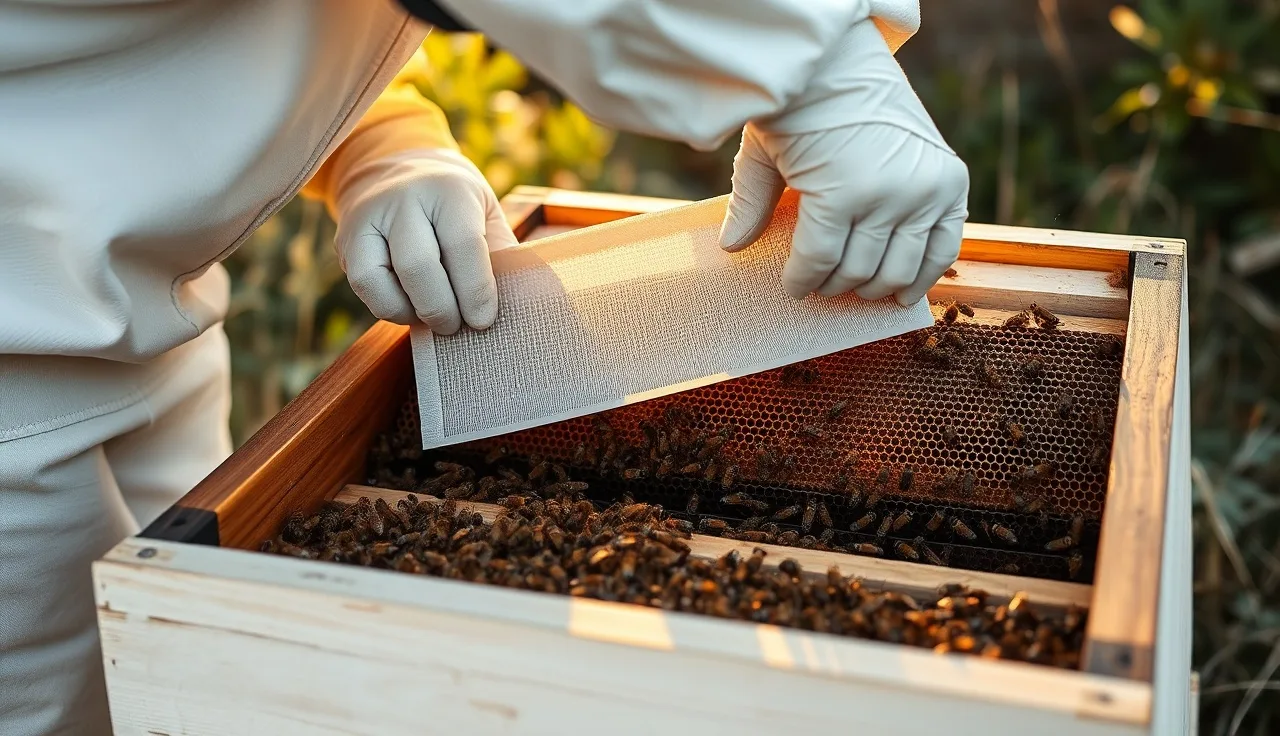
- Apivar (amitraz 3.2%) goes in at 2 strips per brood box, hung between frames where bees cluster, for a minimum of 6 weeks and a maximum of 8 weeks.
- The label bans use during a honey flow with supers on.
- One cycle covers a full colony.
- Following the label exactly is federal law in the United States.
What is Apivar and what does the label require at a glance?
Apivar is a polymer strip loaded with amitraz at 3.2% concentration. Amitraz is a formamidine acaricide. It kills Varroa destructor on contact as bees walk across the strip and groom each other. The product is registered to Véto-Pharma, and the current EPA registration number is 84524-4. [1]
The label is the law. Under FIFRA (the Federal Insecticide, Fungicide, and Rodenticide Act), using a pesticide in any way that contradicts its labeling is a federal violation. The directions below are not suggestions. [2]
Here are the core label requirements in plain terms:
- Apply 2 strips per brood box. A standard Langstroth hive with one or two deeps counts as one colony. Treat each box that holds brood separately if you run triple-deep hives.
- Hang strips between frames in the most populated brood area, one strip per side of the cluster (roughly frames 3-4 in from each wall).
- Leave strips in for a minimum of 6 weeks. Maximum contact time is 8 weeks. Remove and dispose of strips after treatment.
- Do not use when honey supers are on or when a honey flow is running.
- One treatment period per year is the labeled use in most regions. The label does allow a second application if mite pressure warrants it, with at least one brood cycle between treatments.
The Honey Bee Health Coalition's Tools for Varroa Management guide sums up the approved windows this way: spring before the main flow, and late summer or fall after honey supers come off. [3]
What does the Apivar label say about dosage and number of strips?
The dosage rule is simple. Two strips per brood box. A standard two-deep Langstroth colony gets 2 strips total when both deeps share one continuous brood cluster. Run a colony across three boxes with brood in all three and you need 6 strips. [1]
Strips ship in packs of 10 (treating 5 colonies) or packs of 50. At current retail pricing, a 10-strip pack runs roughly $22 to $30 depending on the supplier, which works out to about $4.40 to $6.00 per colony. [4] That's one of the cheaper chemical treatments you can buy.
Each strip hangs vertically between frames, never flat on the bottom board. Bees have to walk across both faces to pick up amitraz and spread it around. Placement decides the outcome. Hang them in the heaviest traffic. In a two-deep colony that usually means one strip in the upper deep and one in the lower, or both in the lower if brood sits there in fall.
Do not exceed 2 strips per brood box. Overdosing doesn't kill mites faster. It stresses bees and drives more amitraz into your wax. [5]
Splitting or nucing? A 5-frame nuc counts as one colony. Use 1 strip for a small nuc, 2 strips for a full 10-frame box.
How long do Apivar strips stay in the hive, and why does timing matter?
The labeled contact period is 6 to 8 weeks. That window isn't arbitrary. Amitraz hits phoretic mites (the ones riding adult bees) and mites emerging from capped cells. A worker brood cycle runs about 21 days, so mites sealed in cells the day you install strips get exposed later, as they emerge inside the treatment window. The 6-week minimum covers roughly two full brood cycles, which is what it takes to knock down the in-cell population. [6]
Leaving strips in past 8 weeks pushes more residue into wax without meaningfully raising kill. It can also speed resistance selection by feeding surviving mites a long, low-level dose.
Most U.S. beekeepers have two practical windows.
Spring window: after the last hard frost, before the main nectar flow. Mite numbers are usually low, diluted by the overwintering cluster's limited brood. Treat if a wash or sugar roll shows more than 2 mites per 100 bees. Pull strips before any supers go on.
Fall window: after supers come off, ideally while capped brood is still present so the treatment can reach mites in cells. The Honey Bee Health Coalition recommends monitoring in late July or early August and treating immediately if counts top 2 mites per 100 bees (2%). Colonies treated in August raise better winter bees than colonies treated in October. [3]
Got a broodless stretch, natural or induced? Strips still work, but only on phoretic mites at that point. Oxalic acid is the smarter call in that window because OAV hits near-100% of phoretic mites in a single application. Apivar still works broodless. You're just paying for 6 weeks of strips when one day of OAV does more.
When can't you use Apivar? Label restrictions on honey supers and timing
The honey super ban is the single most-broken Apivar rule. The label is blunt: do not apply when honey supers intended for human consumption sit on the colony. [1] Supers on means you wait. Full stop.
Amitraz and its metabolites (particularly 2,4-DMA) can move into honey and beeswax. Studies measuring residues in honey from treated colonies found detectable amitraz when strips went in with supers on. The European Union's maximum residue limit for amitraz in honey is 200 µg/kg. The U.S. does not currently set an MRL for amitraz in honey, but selling contaminated honey is a food safety problem no matter what. [5]
Wax contamination is real and it stacks up. Amitraz breaks down faster than some other acaricides (its half-life in wax is much shorter than coumaphos), but hit the same drawn comb with Apivar year after year and residue climbs. A 2016 study in PLOS ONE measuring pesticide residues in U.S. beeswax found amitraz metabolites in a majority of sampled hives. [5] That's not a reason to quit Apivar. It's a reason to rotate old brood comb out of service every few years anyway.
Other label restrictions:
- Don't treat a colony you know is queenless until a new queen is established and laying. Strips stress a queenless cluster trying to raise emergency queens.
- Keep out of reach of children. Amitraz is a monoamine oxidase inhibitor and can poison humans at enough exposure. Don't handle strips bare-handed. Wear nitrile gloves.
- Dispose of used strips per label directions. In most states, used Apivar strips go in household trash. They are not classified as hazardous waste under RCRA at the household level, but check your state rules.
Does Apivar work? What does the efficacy data actually show?
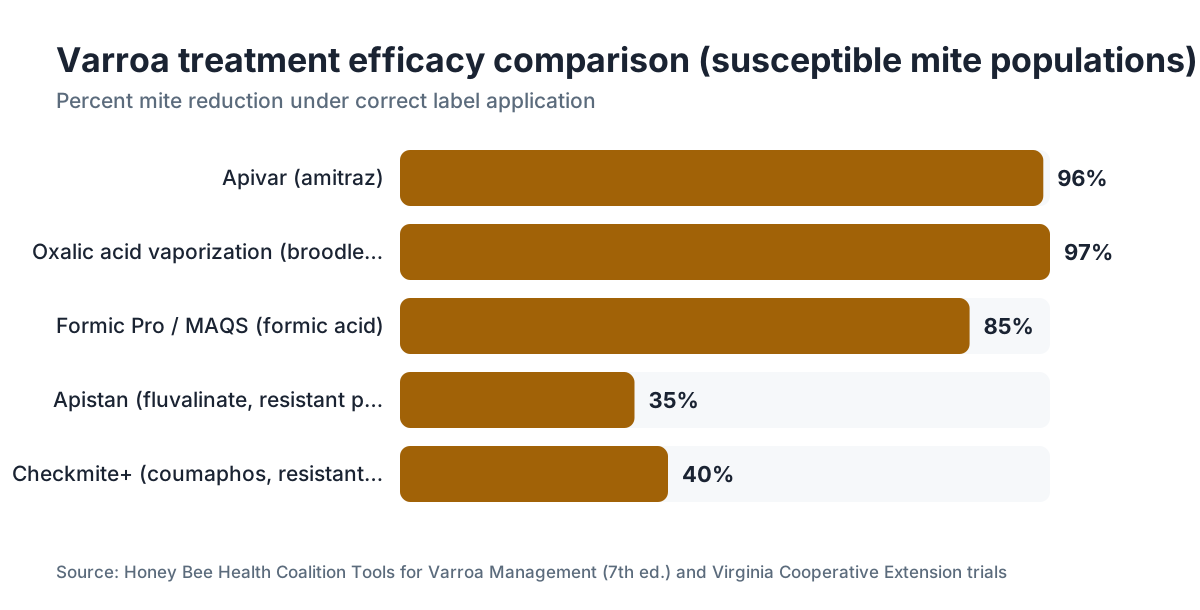
In mite populations with no prior amitraz exposure, Apivar hits hard. Virginia Cooperative Extension and similar university trials put mite reduction at 93 to 99% when the product is used correctly. [6] The Pennsylvania state apiary program has recommended Apivar as a first-line treatment for years on that track record.
Here's the catch. Amitraz resistance in Varroa is real and it's spreading. The mechanism is well-documented: a mutation in the octopamine receptor gene lowers how well amitraz binds. A 2021 paper in Scientific Reports by Millán-Leiva et al. confirmed the molecular basis in field-collected resistant mites from Europe. [7] Resistance shows up at low to moderate frequency in parts of the United States too, though solid national data is thin.
You spot developing resistance one way: mite counts don't drop to near-zero after a full 8-week treatment. Go in at 5% infestation, come out at 3%, and that's a red flag. Keep monitoring after strip removal.
The fix is rotation. Run Apivar one cycle, switch to a different mode of action (oxalic acid, formic acid, thymol-based products) the next cycle, then come back to Apivar. The Honey Bee Health Coalition guide specifically recommends rotating chemical classes to slow resistance. [3]
If you're running more than a few hives and want to track treatment dates, efficacy trends, and wash results across a season, the free protocol tracker at VarroaVault makes rotation scheduling easier to keep straight.
So, the honest read: Apivar works very well where resistance hasn't landed. It's easy to use, it doesn't demand the temperature windows formic acid does, and it's gentle on bees at label rates. It's not infallible. And it's the wrong tool for a broodless window, where OAV is faster and cheaper.
What are the signs of amitraz resistance in Varroa mites?
Resistance doesn't announce itself. You catch it by comparing mite counts before and after treatment and noticing the math doesn't work.
A fully susceptible population treated for 6 to 8 weeks should show 93% or greater reduction in a post-treatment wash. Wash 300 bees before treatment and find 15 mites (5% infestation), then wash again two weeks after removal and find 8 mites (still above 2%), and something is off. Either the strips went in wrong, the colony had untreated brood from a late-emerging queen, or you've got a resistant population. [6]
Signs worth watching:
- Post-treatment mite levels stay above 2% after a full 8-week application.
- You ran Apivar in the same yard last season and again this season with no rotation, and efficacy looks lower.
- Neighboring apiaries report the same pattern. Resistance spreads through drone drift and swarms.
Suspect resistance? Switch modes of action right away. Don't stretch strip time past 8 weeks hoping for better numbers. You won't get them. You'll just be running a resistance selection experiment.
Call your state apiarist if you see consistent post-treatment failures. State programs in Virginia, Pennsylvania, and Florida monitor for amitraz-resistant Varroa, and reporting odd failures feeds regional data. [8]
How do you actually apply Apivar strips in the hive?
The mechanics are simple, but small errors cost you. Here's the step-by-step that matches label directions.
Gear up first. Nitrile gloves are non-negotiable. Amitraz absorbs through skin. Safety glasses help too, since bees may be cranky during the manipulation.
Open the hive and find the brood cluster. In a two-deep colony in spring, the cluster usually spans parts of both deeps. In fall it often consolidates in the upper deep. Place strips where bee traffic is heaviest.
Open the package with scissors or a knife. Don't tear it by hand. You'll get amitraz on your gloves and then on everything else. Each strip has a notch at the top. Bend the top hook open slightly so it hangs over a top bar.
Hang strip 1 between frames 3 and 4 on the left side of the brood cluster. Hang strip 2 between frames 7 and 8 on the right side (in a 10-frame box). One strip on each side of the densest brood zone. Treating a 5-frame nuc? One strip centered in the brood area is the label-consistent move.
Don't lay strips flat. They hang vertically so both surfaces are open to bees.
Record the install date on your hive card or log. You have to pull them at 6 to 8 weeks. Set a phone reminder now.
At removal, use your hive tool to unhook the strips. They'll be partly degraded and maybe chewed. Drop them in a zip-lock bag and dispose of them in household trash per your local rules. Do a mite wash within 2 weeks to check efficacy. If you need gear for that, the beekeeping supplies and beekeeping supply companies pages have sourcing notes for alcohol wash kits.
Can you use Apivar with other varroa treatments at the same time?
The label doesn't recommend or describe combining Apivar with other acaricides, and there's a practical reason. Stacking treatments doesn't reliably raise efficacy, and it piles stress on the colony.
The combination to avoid is Apivar plus coumaphos (Checkmite+). They're in different chemical classes, but together they seem to synergize in a way that raises queen loss. A USDA ARS study by Elzen and Westervelt found sequential coumaphos and amitraz treatments tied to queen problems. [9] The pairing also speeds wax residue buildup.
Mixing Apivar with oxalic acid isn't labeled either. Some beekeepers do it to hit in-cell mites (amitraz) and phoretic mites (OAV) at once, but there's no published efficacy data on the combination, and you're operating off-label, which is a legal problem under FIFRA. [2]
Better approach: pick the right single tool for the situation. Broodless colony or nuc? Oxalic acid. Active brood, no supers, moderate to high load? Apivar. Temperature below 50°F making formic acid impractical? Apivar works across a wider range than formic acid products, which is exactly why it's useful for fall treatment up north.
For the mite biology behind all of this, the varroa mite overview is worth a read before you finalize your treatment calendar.
What temperature range does Apivar work in?
This is one of Apivar's real advantages over formic acid. The label sets no hard temperature minimum or maximum the way MAQS and Formic Pro do. Amitraz volatilizes a little with warmth, which may add to efficacy, but the main kill mechanism is contact, not vapor, so moderate temperatures are fine. [1]
In practice, Apivar has been used down to the mid-30s°F during winter broodless stretches (though OAV is usually preferred then) and up past 90°F in summer heat. There's no 'too cold to treat' problem like there is with formic acid.
Bee activity still matters. Strips work by bee-to-bee contact spreading amitraz across the colony. In a very cold cluster where bees barely move, that spread slows down. It doesn't make Apivar useless in fall. It means treatment in a more active colony (September rather than November in the northern U.S.) reaches more of the hive.
Summer use is fine on temperature. Just remember the honey super ban. You cannot legally treat a colony in a nectar flow with supers on.
What does the EPA registration say, and where can you find the official label?
Apivar's EPA registration number is 84524-4, registered to Véto-Pharma SA. The product holds a Section 3 registration under FIFRA, meaning it went through full efficacy and safety review. [2]
The most current official label is available through the National Pesticide Information Retrieval System (NPIRS) and the EPA pesticide label system. The label specifies:
- Active ingredient: Amitraz 3.2% w/w
- Other ingredients: 96.8%
- Signal word: Caution (the lowest tier under FIFRA labeling requirements)
- First aid: if on skin, wash with soap and water for 15 to 20 minutes. Amitraz can cause central nervous system effects in mammals at enough exposure.
- Environmental hazards: do not contaminate water. Toxic to fish.
The official label from Véto-Pharma is on their website and in the EPA FIFRA label database. University extension offices that publish Apivar guidance, including University of Minnesota Extension and Penn State Extension, link to the same label document. [8] [10]
State registrations vary a little. Some states require a specific pesticide applicator license for beekeepers using Apivar commercially. Check your state department of agriculture's pesticide program. The EPA registration is federal, but state law can add requirements on top.
The label gets updated occasionally. Verify you're reading the current version before you treat, because dosing language has been clarified in revisions since the original U.S. registration.
How do you monitor mites before and after Apivar treatment?
Treatment without monitoring is guesswork. The standard method is an alcohol wash (or sugar roll, though alcohol is more accurate) using a 300-bee sample from the brood area. [3]
The math: count mites in the wash, divide by 300, multiply by 100 for percent infestation. The Honey Bee Health Coalition and most university extension programs recommend treating at 2% during the spring and summer brood season, and 1 to 2% in late summer when you're protecting the winter bee cohort. [3]
Monitor before treatment to set a baseline. Monitor again 2 weeks after strip removal to check efficacy. If reduction comes in below 90%, suspect resistance or an application error.
A useful rule of thumb from Penn State Extension: wash every 30 days from April through September. [10] That gives you enough data to catch a mite rebound before it crosses your threshold.
The table below compares the main monitoring methods:
| Method | Accuracy | Cost | Time | Notes |
|---|---|---|---|---|
| Alcohol wash | High (~95%) | ~$5 setup | 5-10 min | Gold standard; bees die |
| Sugar roll | Moderate (~70%) | ~$2 | 10-15 min | Bees returned; less accurate |
| Sticky board | Low (relative) | $1-3 | 24-72 hr | Shows trend, not percent infestation |
| CO2 wash | High | $150+ device | 5 min | Accurate; bees die |
The sticky board doesn't give you a percent infestation figure directly, which makes it hard to cross a treatment threshold in a defensible way. Use an alcohol wash for treatment decisions.
VarroaVault's free monitoring tracker logs wash results by hive across a full season, which makes it easier to spot a colony building toward a dangerous load before you lose it. Record keeping really does change outcomes once you're past a handful of hives.
How does Apivar compare to other varroa treatments?
Here's an honest comparison. No single product wins in every situation.
| Treatment | Active Ingredient | Brood Penetration | Temp Window | Honey Super OK? | Approx. Cost/Colony | Efficacy (susceptible mites) |
|---|---|---|---|---|---|---|
| Apivar | Amitraz 3.2% | Yes (contact) | Wide | No | $4-6 | 93-99% [6] |
| Oxalic acid (OAV) | Oxalic acid | No | Wide | No (in supers) | $0.50-1.00 | 90-99% broodless [11] |
| Formic Pro / MAQS | Formic acid | Yes (vapor) | 50-85°F | No (MAQS has some window) | $8-12 | 80-90% [11] |
| Apistan | Fluvalinate | Yes (contact) | Wide | No | $3-5 | Variable (widespread resistance) |
| Checkmite+ | Coumaphos | Yes (contact) | Wide | No | $4-7 | Variable (widespread resistance) |
Apistan and Checkmite+ are here because they're still registered, but Varroa resistance is so widespread for both that neither is a first-line choice in most of the U.S. [9]
Apivar's main edge over formic acid is the lack of a temperature ceiling. In northern apiaries treating in September or October, Apivar keeps working when formic acid products are marginal. Its main downside against OAV: it needs 6 to 8 weeks of strips in the hive versus a single 10-minute OAV application, and it costs a lot more per treatment. OAV in a broodless colony is almost always the better play if you can engineer or find a broodless window.
Frequently asked questions
How many Apivar strips per hive do you need?
The Apivar label calls for 2 strips per brood box. A standard single or double-deep Langstroth colony uses 2 strips total if the brood cluster stays within those boxes. A three-deep colony with brood throughout needs 6 strips (2 per box). A 5-frame nuc generally gets 1 strip hung in the center of the brood area, though some beekeepers use 2 on larger nucs.
Can you use Apivar with honey supers on?
No. The Apivar label prohibits use when honey supers intended for human consumption are present on the colony. Amitraz and its metabolite 2,4-DMA can migrate into honey. Remove all supers before applying strips, and don't put supers back until strips are out and a full nectar flow gap has passed. This is a federal labeling requirement under FIFRA.
How long do Apivar strips need to stay in the hive?
The label requires a minimum of 6 weeks and a maximum of 8 weeks. The 6-week minimum covers two full brood cycles, which is necessary to expose mites sealed in cells when treatment started. Leaving strips in past 8 weeks does not improve efficacy and raises the risk of amitraz residue building up in beeswax.
Does Apivar work in cold weather?
Yes, better than formic acid products. Apivar has no labeled temperature minimum the way MAQS or Formic Pro do. Amitraz works mainly by contact rather than vapor, so it stays effective across a wide temperature range. It's a practical choice for fall treatment in northern climates when temperatures drop below 50°F and formic acid turns unreliable.
What is the active ingredient in Apivar strips?
Amitraz at 3.2% w/w. Amitraz is a formamidine compound that acts as an octopamine receptor agonist in mites, disrupting their nervous system. It spreads through the colony by bee-to-bee contact as bees walk across the strip and groom one another. The EPA registration number for Apivar in the U.S. is 84524-4.
Can Varroa mites develop resistance to Apivar?
Yes. Amitraz resistance in Varroa is documented and involves a mutation in the octopamine receptor gene. It's confirmed in European populations and reported at lower frequency in the U.S. Signs include mite counts staying above 2% after a complete 8-week treatment. To slow resistance, rotate chemical classes: run Apivar one cycle and oxalic acid or formic acid the next.
Where do you hang Apivar strips in the hive?
Hang them vertically between frames in the highest-traffic brood area. In a 10-frame box, place one strip between frames 3 and 4 and the other between frames 7 and 8, bracketing the brood cluster on both sides. Strips must hang vertically so bees contact both faces. Don't lay strips flat on the bottom board. Placement in active bee traffic drives efficacy.
How much do Apivar strips cost per colony?
A 10-strip pack treats 5 colonies and retails for roughly $22 to $30, putting per-colony cost at about $4.40 to $6.00. Larger 50-strip packs are available from beekeeping supply companies and usually cut the per-colony cost a little. That makes Apivar one of the more affordable chemical treatments, though oxalic acid vaporization costs far less per application.
Can you use Apivar in a nucleus colony?
Yes. A nucleus colony (nuc) counts as one colony under the label. Use 1 strip for a small 4 to 5 frame nuc, hung in the center of the brood area. A full 10-frame nuc box can take 2 strips. Watch a nuc closely, because small colonies are more vulnerable to mite pressure and can collapse faster than full-size hives if treatment gets delayed.
What do you do with used Apivar strips after removal?
Used strips go in a sealed plastic bag and into household trash in most U.S. jurisdictions. They are not classified as hazardous waste under RCRA at the household level. Don't compost them or leave them exposed where children or animals could reach them. Check your state department of agriculture's pesticide disposal guidance for anything beyond the federal label.
How do you know if Apivar worked?
Do an alcohol wash (300-bee sample) before treatment to set your baseline mite percentage, then wash again 2 weeks after strip removal. A successful treatment in a susceptible population should cut infestation by 93% or more. If your post-treatment level is still above 2%, or reduction is under 90%, investigate for application error or possible amitraz resistance and consider switching to a different treatment class.
Is a license required to buy or use Apivar?
Apivar sells over the counter in most U.S. states and needs no pesticide applicator license for hobbyist beekeepers. Commercial beekeepers in some states may face extra requirements. Check with your state department of agriculture, because state law can add restrictions beyond the federal EPA registration. The product carries FIFRA labeling requirements that apply to all users regardless of license status.
Can Apivar be used in organic beekeeping?
No. Amitraz is a synthetic acaricide and isn't approved for certified organic honey production. USDA National Organic Program rules limit varroa treatments to approved materials such as oxalic acid, formic acid, and thymol-based products. Using Apivar on certified organic colonies would cost you certification on the affected hives and honey crop.
What happens if you leave Apivar strips in longer than 8 weeks?
The label maximum is 8 weeks. Going past it doesn't improve mite kill in susceptible populations, because efficacy plateaus. It does raise amitraz residue in beeswax over time and may push resistance selection by keeping surviving mites in prolonged low-level exposure. Pull strips at 8 weeks, do a mite wash, and decide whether a second cycle is needed based on your count.
Sources
- Véto-Pharma / EPA, Apivar (amitraz 3.2%) Official U.S. Pesticide Label, EPA Reg. No. 84524-4: Label dosage: 2 strips per brood box, 6-8 week contact time, no use with honey supers present; amitraz 3.2% w/w active ingredient
- U.S. EPA, Federal Insecticide Fungicide and Rodenticide Act (FIFRA) overview: Using a pesticide inconsistent with its labeling is a federal violation under FIFRA
- Honey Bee Health Coalition, Tools for Varroa Management Guide (7th edition): Treatment threshold of 2 mites per 100 bees; recommended treatment windows spring and late summer/fall; rotation of chemical classes to slow resistance
- Mann Lake Ltd., Apivar retail pricing reference: 10-strip pack of Apivar retails approximately $22-$30, yielding per-colony cost of $4.40-$6.00
- Traynor et al., 'Multivariable Regression Analysis of Risk Factors Associated with Honey Bee Colony Losses,' PLOS ONE, 2016: Amitraz metabolites detected in majority of sampled U.S. beeswax; EU MRL for amitraz in honey is 200 µg/kg; wax residue accumulates with repeated treatment
- Virginia Cooperative Extension, Varroa Mite Treatment Efficacy Trials: Apivar efficacy 93-99% mite reduction in susceptible populations under correct application conditions
- Millán-Leiva et al., 'Amitraz resistance in Varroa destructor: molecular characterization,' Scientific Reports, 2021: Molecular basis of amitraz resistance in Varroa confirmed via octopamine receptor gene mutation in field-collected resistant mites
- Pennsylvania Department of Agriculture, Bureau of Plant Industry, Apiary Program: PA state apiary program monitors for treatment-resistant mite populations and provides Apivar label guidance to beekeepers
- Elzen & Westervelt, USDA ARS, 'Effects of coumaphos and amitraz combination on queen loss,' Apidologie, 2002: Sequential coumaphos and amitraz treatments associated with elevated queen loss risk; combination use not recommended
- Penn State Extension, Varroa Mite Monitoring and Treatment in Honey Bees: Recommended monitoring frequency: alcohol wash every 30 days April through September for brood-season mite management
- U.S. EPA, Registration of Oxalic Acid and Formic Acid Products for Varroa Control in Honey Bees: OAV efficacy 90-99% in broodless colonies; Formic Pro/MAQS efficacy 80-90%; temperature restrictions on formic acid products labeled 50-85°F
Last updated 2026-07-09