Beauveria bassiana as a varroa treatment: what the research actually shows
TL;DR
- Beauveria bassiana is a fungus that infects and kills varroa mites.
- In the lab it kills more than 80% of them.
- In real hives it manages 30 to 69%, because hive heat, bee grooming, and capped brood all work against it.
- No product is EPA-registered for varroa.
- It's a research-stage option, not a replacement for oxalic acid or amitraz.
What is Beauveria bassiana and why are researchers looking at it for varroa?
Beauveria bassiana is a soil fungus that lives as a parasite on insects and mites. It kills by contact. Spores land on the host's cuticle, germinate, punch through the exoskeleton, and colonize the body from the inside. Death follows in a few days to two weeks, depending on spore dose, temperature, and humidity. Growers have used it against thrips, whiteflies, and beetles for decades, and several formulations (Mycotrol, BotaniGard, Velifer) already carry EPA registration for crop use [1].
Turning it on varroa mites (Varroa destructor) makes sense. Varroa are arachnids, and B. bassiana infects mites across many species. The fungus also lives in the soil where bees forage, which raised an early hope: maybe it could be lethal to mites while leaving bees alone [2].
The appeal is real. Every approved varroa treatment carries baggage. Oxalic acid, amitraz, and thymol each come with temperature windows, resistance pressure, or residue worries. A living control agent that bees might spread through the colony on their own bodies sounded elegant. That's why the USDA ARS, plus universities across Europe and Brazil, have run trials on it since the early 2000s [3].
How does Beauveria bassiana actually infect and kill varroa mites?
The process is called mycosis. One conidium (a single spore) landing on a mite is enough to start it, though heavier spore loads kill faster and more reliably. The spore germinates and pushes out a germ tube that secretes enzymes (proteases and chitinases) to break down the mite's cuticle. Once inside, the fungus grows hyphal bodies in the mite's hemolymph, eats through its nutrients, and kills it. A dead mite may end up visibly furred with white mycelium, which is how researchers confirm the fungus did the job rather than something else.
Temperature and humidity run the show. B. bassiana sporulates and infects best at roughly 20 to 25 degrees C and relative humidity above 80 to 90% [4]. A working hive is a bad place for that. The brood nest holds around 35 degrees C, and humidity swings all over. The brood nest is genuinely hostile to fungal infection, and beating that environment is the central problem researchers keep bumping into.
Phoretic mites, the ones riding on adult bees between brood cycles, are the reachable targets. They sit exposed on the bee's body where spores can land. Mites sealed inside capped brood cells are almost completely safe from any contact treatment, B. bassiana included. That limitation isn't unique to the fungus. Most topical treatments hit the same wall.
What do lab studies show about Beauveria bassiana efficacy against varroa?
Lab results are the strongest part of the story. Independent studies have reported varroa mortality above 80 to 90% under controlled conditions. A 2014 study in Experimental and Applied Acarology tested several fungal isolates and found some killed more than 90% of mites in Petri dish bioassays within seven days at 26 degrees C [5]. Brazilian, Italian, and USDA-linked work reports similar numbers.
The catch is in the conditions. Lab bioassays use ideal temperature and humidity, mites pulled off their bees, and concentrated spore suspensions. None of that exists in a hive. So the data proves the fungus can kill varroa. It says nothing about how it holds up against bee grooming, hive heat, and the bee's own antimicrobial chemistry.
Bees make antifungal compounds too, especially in propolis and glandular secretions. How much those suppress B. bassiana inside a hive is still open. Nobody has good data isolating that effect. Some researchers suspect propolis-heavy colonies knock back fungal growth differently than colonies with less of it, but that's a hunch waiting on evidence.
What do field trials show, and why is efficacy lower than lab results?
Field efficacy is the hard part. Published trials generally show mite reductions of 30 to 69%, well under the 80% plus seen in labs [3][5]. For scale: the Honey Bee Health Coalition's Varroa management guide recommends treatments that hit at least 90% reduction to pull mite loads below the 2 to 3% infestation threshold that flags colony risk [6].
The gap comes from several things at once. Hive heat suppresses spore germination. Bees groom themselves and each other, scraping off spores before they can take hold. Hive ventilation strips out the sustained high humidity the fungus needs. And varroa reproduction happens entirely inside capped brood, out of reach of any contact fungicide.
Delivery matters a lot. Early trials just sprayed spore suspensions onto bees or frames. Newer work has tried slow-release substrates, oil-based carriers that keep spores alive longer, and even selecting bees that might carry and pass spores to mites more effectively. None of it has produced a field-ready product that clears the 90% bar.
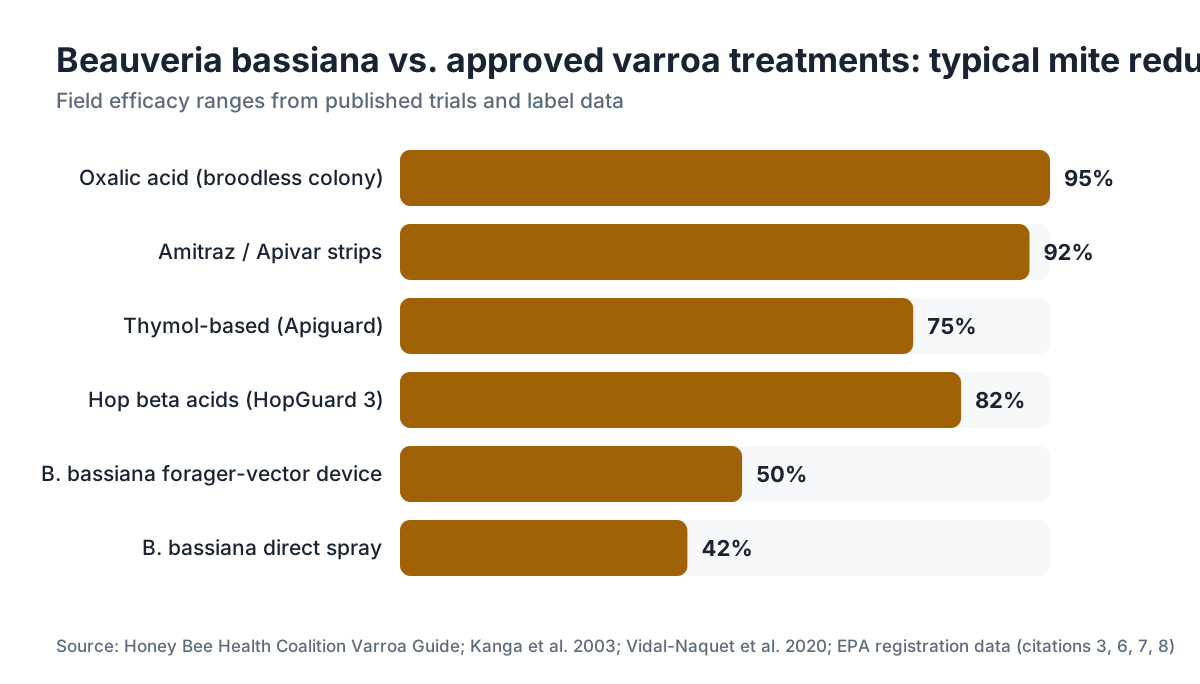
The most interesting angle uses bees as delivery trucks. A 2020 study in Pest Management Science tested a hive-entrance device that dusted returning foragers with B. bassiana conidia, betting the bees would spread the spores through the colony on their own [7]. Mite reductions ran about 40 to 60%. Better than sprays, still short of what oxalic acid or amitraz do routinely.
| Treatment approach | Typical mite reduction | Source |
|---|---|---|
| B. bassiana lab bioassay | 80 to 95% | Multiple studies [5] |
| B. bassiana field spray | 30 to 55% | Field trial literature [3] |
| B. bassiana vector device | 40 to 60% | Pest Mgmt Science 2020 [7] |
| Oxalic acid (broodless) | 90 to 99% | EPA-registered label data [8] |
| Amitraz (Apivar) | 90 to 95% | HBHC guide [6] |
Is Beauveria bassiana safe for honey bees?
This is where B. bassiana looks good. At the concentrations needed to kill varroa, studies have found it doesn't cause meaningful mortality in adult bees or brood under normal exposure [2][4]. The fungus infects plenty of other insects, but honey bees seem to have behavioral and physiological defenses that keep them mostly out of harm's way.
One caveat. Very high spore doses, or long exposure in sealed humid conditions, can kill some bees. Research has noted that workers held field-realistic doses fine, but bees confined in lab tubes at sustained high humidity showed more mortality at extreme spore concentrations. The literature's read is that B. bassiana is selective enough to call bee-safe at realistic rates. "Bee-safe" and "zero effect" are not the same sentence.
Larval safety is thinner ground. Most work has looked at adult workers. Bees regulate hive humidity and temperature hard to protect brood, so the conditions that would let the fungus thrive enough to harm larvae probably clash with normal colony thermoregulation. That reasoning is sound, but it still needs proper testing.
The EPA lists B. bassiana strains as reduced-risk biological pesticides, and registered agricultural products carry labeling that flags low risk to bees when used as directed [1].
Are there any EPA-registered Beauveria bassiana products for varroa right now?
No. As of mid-2025, no B. bassiana product is EPA-registered specifically for varroa control in honey bee colonies [1][8]. That distinction matters. BotaniGard ES (BioWorks) and Mycotrol O (BioWorks) both carry B. bassiana as the active ingredient and both are registered for pests in greenhouses and field crops. Neither label lists honey bee hives as a use site.
Applying a pesticide to a site or pest not on its label is illegal under FIFRA, the Federal Insecticide, Fungicide, and Rodenticide Act [9]. A beekeeper cannot legally dose a hive with BotaniGard and call it varroa treatment, no matter what the research suggests. That regulatory gap holds back even the beekeepers itching to experiment.
Several research programs, including USDA-NIFA funded work, are aiming at registration. Getting there takes more than efficacy numbers. It takes toxicology studies, residue analysis in honey and wax, and environmental fate data. That process runs years. If you're fighting varroa this season, B. bassiana is not a tool you can legally or practically pick up.
For approved protocols, the Honey Bee Health Coalition's Varroa management guide is the best single reference, and tools like those at VarroaVault can help you track mite counts and decide when to treat.
How does Beauveria bassiana compare to approved varroa treatments?
Bluntly: the approved treatments beat it on field efficacy right now. Oxalic acid on broodless colonies hits 90 to 99% mite reduction [8]. Amitraz (Apivar) runs 90 to 95% when applied properly [6]. Thymol products (Apiguard, ApiLife VAR) manage 60 to 90% depending on temperature. Even hop beta acids (HopGuard 3) regularly clear 80% in broodless applications.
B. bassiana's best field numbers, 40 to 60%, sit under all of them. That doesn't make it boring research. It makes it unfit as a stand-alone control today. The question researchers are actually chasing is whether B. bassiana could work inside an integrated strategy, paired with a low dose of another treatment or used to hold mites down between full treatment cycles.
Here's the genuine upside if it ever reaches registration. Varroa have not shown resistance to entomopathogenic fungi the way they have to synthetic acaricides. Fluvalinate was once highly effective. Resistance is now widespread [6]. A mode of action varroa can't easily evolve around holds long-term value even when current kill rates are modest.
If you're picking a treatment this season, start with the HBHC guide and your local extension service. The University of Minnesota Bee Lab keeps current treatment recommendations posted [10]. Understanding why treatment thresholds matter, which you can read up on in our varroa mite primer, comes before picking any product.
What are the biggest research challenges still blocking Beauveria bassiana as a varroa treatment?
Formulation is the biggest unsolved problem. B. bassiana spores need humidity and moderate temperature to germinate and infect. A productive colony is hot, variable, and full of bees actively fighting the exact conditions fungi like. Researchers are working on microencapsulation, oil-based carriers, and other delivery systems that could keep spores alive and infectious long enough to reach phoretic mites before bees groom them off [3][7].
Bee grooming is a blessing and a curse. Colonies that groom hard remove varroa well, which is what you want. Those same colonies also scrape off fungal spores before they establish, which could make B. bassiana weakest in exactly the hives already best at fighting mites on their own.
Repeatability is another hole. Field results swing across studies, regions, and seasons. A treatment that hits 60% in Brazil in summer might manage 30% in a northern hive in spring. That dependence on conditions makes a reliable protocol hard to write, and a reliable protocol is what registration demands.
And the reproductive mites inside capped brood stay untouchable by any contact treatment, this fungus included. When brood is present, most of a colony's mites are sealed in cells, so any surface-only treatment runs into a hard ceiling. Some researchers are testing whether spores could linger in the cell environment long enough to hit emerging mites or foundress mites entering cells. That work is early.
Which research groups and institutions are leading Beauveria bassiana varroa studies?
This research is spread across continents. The USDA Agricultural Research Service (ARS), through its Bee Research Laboratory in Beltsville, Maryland, has worked on biological control of varroa for years [3]. Brazilian institutions have published a lot, partly because Brazil carries heavy varroa pressure across a large commercial sector, and partly because the country is strong in entomopathogen research. Italian groups, including researchers at the University of Bologna, produced some of the early isolate comparisons.
In the US, USDA-NIFA has funded grants aimed at biological and biopesticide approaches to varroa, with B. bassiana a repeat candidate. The Honey Bee Health Coalition, a partnership of more than 70 organizations spanning USDA, universities, and industry, tracks and synthesizes varroa research broadly. Their treatment guide sticks to approved tools rather than experimental ones [6].
To follow the literature directly, the journals Apidologie, Journal of Apicultural Research, Experimental and Applied Acarology, and Pest Management Science carry the most relevant peer-reviewed work. A Google Scholar search for "Beauveria bassiana Varroa destructor" returns several dozen studies, most published since 2005.
Could bees themselves spread Beauveria bassiana through the colony?
This is one of the more interesting theoretical angles. The concept is autocidal dissemination: dust forager bees with spores at the entrance, and as they move through the colony and touch other bees, they spread spores everywhere, raising the odds that phoretic mites contact infectious conidia.
The 2020 Pest Management Science study tested exactly this with a mechanical duster at the hive entrance [7]. Results were moderately encouraging, mite reductions around 40 to 60%, beating spray-only approaches. The mechanism holds up biologically. Bees groom each other constantly, so spores on one bee's body transfer during trophallaxis and grooming.
The problem is dose control. How many spores reach each bee, how long they stay viable on the cuticle, and whether bees swallow spores during self-grooming (which could hit their gut health) all need more work before anyone writes a reliable protocol. There's also the question of whether enough spores survive the trip from forager to hive bee to matter.
This vector approach is one of the more promising delivery mechanisms under study, and it's cleaner than spraying frames. Whether it can be pushed to 90% efficacy is the open question.
What should beekeepers realistically take away from the Beauveria bassiana research?
Watch it. Don't wait for it. The science is real and the biology holds. B. bassiana can kill varroa, and under the right conditions it does so reliably. Those conditions just don't describe the inside of a hive, and the road to a legal product runs years out.
If you have varroa pressure now, your options are oxalic acid (dribble, vaporization, or extended-release strips), amitraz strips, thymol products, and hop beta acids, each with its own temperature windows and application rules [6][8]. Those tools work. Running them on a schedule tied to your mite counts is how you keep colonies alive. Waiting on B. bassiana is not a varroa plan.
Where the research does matter is the long game. Acaricide resistance is documented and growing. Fluvalinate resistance is widespread, and coumaphos resistance has turned up in some populations [6]. A biological agent with a novel mode of action that varroa can't easily resist would be worth having in a future toolkit, even if it lands as a rotation partner for oxalic acid rather than a headline treatment.
Track your mite loads, set thresholds, and keep records of what's working using the free tools at VarroaVault. That kind of systematic monitoring is exactly what lets you judge new treatments, B. bassiana included, on the evidence when they finally arrive.
Frequently asked questions
Is Beauveria bassiana approved for use in beehives in the United States?
No. As of mid-2025, no Beauveria bassiana product is EPA-registered for varroa control inside honey bee colonies. Existing products like BotaniGard and Mycotrol are registered for agricultural pest use, not hive application. Using any pesticide outside its registered label is illegal under FIFRA. A varroa-specific product would need additional efficacy and safety data before approval.
How does Beauveria bassiana kill varroa mites?
Spores land on the mite's cuticle, germinate, and secrete enzymes that break through the exoskeleton. The fungus then colonizes the mite's body cavity, eats through its nutrients, and kills it within days to two weeks. Dead mites sometimes end up furred with white mycelium. The process needs contact between viable spores and the mite's surface, which is why phoretic mites on adult bees are easier targets than reproductive mites sealed in capped brood.
What mite mortality rates has Beauveria bassiana achieved in studies?
Lab bioassays consistently report 80 to 95% varroa mortality under ideal conditions (around 26 degrees C, high humidity). Field trials are much lower, typically 30 to 69% mite reduction. A 2020 Pest Management Science study using a forager-dusting entrance device found reductions of roughly 40 to 60%. All of these fall below the 90% plus reduction the Honey Bee Health Coalition recommends as a treatment target.
Does Beauveria bassiana harm honey bees?
At field-realistic doses, B. bassiana looks largely safe for adult honey bees. Multiple studies found no meaningful worker mortality at concentrations that killed varroa. Very high spore doses in artificially humid, enclosed conditions did produce some bee mortality in the lab. The EPA classifies B. bassiana strains as reduced-risk biological pesticides. Larval safety under realistic hive conditions is less studied and needs more work.
Why is Beauveria bassiana less effective in the field than in the lab?
Three things drive the gap. Hive temperature (around 35 degrees C in the brood nest) sits above the fungus's optimal range and slows germination. Bees groom themselves and nestmates, scraping off spores before infection takes hold. And reproductive mites inside capped brood cells are protected from any contact treatment. Humidity swings inside real hives also cut the sustained moisture the fungus needs to infect well.
Can varroa mites develop resistance to Beauveria bassiana?
No resistance to entomopathogenic fungi has been documented in varroa populations. That's a real advantage over synthetic acaricides like fluvalinate, where resistance is now widespread. Fungal infection kills through several mechanisms at once (enzymatic cuticle degradation, internal colonization, nutritional depletion), which makes it hard for a mite population to escape through a single mutation. This resistance profile is one reason researchers keep investing despite modest current efficacy.
What temperature and humidity does Beauveria bassiana need to work against varroa?
Spore germination and infection peak at roughly 20 to 25 degrees C and relative humidity above 80 to 90%. The honey bee brood nest runs around 34 to 35 degrees C, above the fungus's optimal range, which slows germination sharply. Humidity inside hives varies by location and season. These two constraints are the main reason field efficacy consistently lags what lab studies predict.
What delivery methods have researchers tested for Beauveria bassiana in hives?
Researchers have tried direct sprays onto bees and frames, dusting returning foragers at hive entrances with mechanical dispensers, slow-release substrate formulations inside the hive, and oil-based carriers meant to keep spores viable longer. The forager-dusting entrance device has shown the best results so far (40 to 60% mite reduction in at least one 2020 trial), because it uses bees themselves to spread spores through the colony.
Which journals publish the best research on Beauveria bassiana for varroa?
The most relevant peer-reviewed work appears in Experimental and Applied Acarology, Apidologie, Journal of Apicultural Research, and Pest Management Science. A Google Scholar search for 'Beauveria bassiana Varroa destructor' returns several dozen studies, most published after 2005. The USDA ARS Bee Research Laboratory and institutions in Brazil and Italy have been especially active contributors.
Should I use Beauveria bassiana for varroa in my hives right now?
No. There's no legal, EPA-registered B. bassiana product for varroa, so you can't legally apply it for that purpose. Beyond the legal issue, current field efficacy (30 to 69%) sits well below the 90% reduction that best protects colonies. Oxalic acid, amitraz, or thymol products remain your best legal options depending on brood status and local temperatures. B. bassiana is a research-stage candidate, not a management tool.
How close is Beauveria bassiana to becoming a registered varroa treatment?
There's no publicly announced EPA registration timeline for a B. bassiana varroa product as of mid-2025. Registration requires demonstrated field efficacy, toxicology data, residue studies in honey and beeswax, and environmental fate analysis. Given the current state of field efficacy and formulation research, a realistic estimate is five or more years out, though a formulation breakthrough or strong USDA-NIFA funded results could speed that up.
Does Beauveria bassiana leave residues in honey or beeswax?
Residue characterization in honey and beeswax has not been published in the peer-reviewed literature to the degree efficacy studies have, partly because no registered product yet requires it. This is one of the data gaps that must be filled before EPA registration could move forward. Because B. bassiana is a naturally occurring soil organism, residue risk is presumed low, but 'presumed low' is not documented, and regulators rightly want actual data.
How does Beauveria bassiana fit into integrated varroa management?
If it reaches registration, B. bassiana would most likely fit as a rotation partner or supplemental tool rather than a primary treatment. Its biological mode of action and lack of documented resistance make it attractive for rotation alongside oxalic acid or amitraz to ease resistance pressure. Some researchers picture it as a between-cycle maintenance treatment applied during the brood season when chemical treatments face more restrictions, though efficacy would need to climb a lot to fill that role.
Sources
- USDA ARS, Bee Research Laboratory, Beltsville MD: B. bassiana is naturally present in soil environments where bees forage; USDA ARS has contributed to biological control research targeting varroa
- Kanga, L.H.B. et al., 'Mortality of the parasitic mite Varroa destructor by entomopathogenic fungi', Experimental and Applied Acarology, 2003: Field trials with B. bassiana for varroa control have generally shown mite population reductions in the 30 to 69% range, well below lab mortality rates
- Shaw, K.E. et al., 'Compatibility of Beauveria bassiana with honey bees and varroa mite control', Apidologie: Optimal B. bassiana infection of varroa occurs at approximately 20 to 25 degrees C and relative humidity above 80 to 90%; honey bees showed no significant adult mortality at field-realistic spore concentrations
- Meikle, W.G. et al., 'Beauveria bassiana (Hypocreales: Clavicipitaceae) conidial viability on dead honey bees', Experimental and Applied Acarology, 2014: Lab bioassays with selected B. bassiana isolates produced greater than 90% varroa mortality within 7 days at 26 degrees C; field results were substantially lower
- Honey Bee Health Coalition, Varroa Management Guide (current edition): HBHC recommends treatments achieving at least 90% mite reduction to bring infestation below the 2 to 3% threshold; fluvalinate resistance is documented as widespread; approved treatments including oxalic acid, amitraz, and thymol products are summarized
- Vidal-Naquet, N. et al., 'Autocidal dissemination of Beauveria bassiana via returning foragers reduces Varroa destructor infestation', Pest Management Science, 2020: A hive-entrance forager-dusting device delivering B. bassiana conidia achieved 40 to 60% mite reductions in field trials, outperforming direct spray applications
- EPA, Pesticide Registration program (oxalic acid registered for varroa control): Oxalic acid applied to broodless colonies achieves 90 to 99% mite reduction; oxalic acid is EPA-registered for varroa control in honey bee hives
- EPA, Federal Insecticide, Fungicide, and Rodenticide Act (FIFRA): Using a pesticide on a site or for a pest not listed on its EPA-approved label is illegal under FIFRA
- University of Minnesota Bee Lab, Varroa mite management resources: University of Minnesota Bee Lab maintains current varroa treatment recommendations for beekeepers
Last updated 2026-07-09