New varroa feeding behavior research: what it means for treatment
TL;DR
- A 2019 study by Samuel Ramsey and colleagues showed varroa mites feed primarily on honey bee fat body tissue, not blood (hemolymph) as assumed for decades.
- This changes how we understand mite damage, explains why colonies collapse even at moderate mite loads, and has real implications for how you time and select treatments to protect bee fat body reserves.
What do varroa mites actually feed on?
Varroa mites eat fat body tissue, not blood. For most of beekeeping history the textbook answer was hemolymph, the insect equivalent of blood, and varroa got grouped with ticks and other pests that pierce skin and drink circulatory fluid. That picture drove decades of research and treatment framing. It was wrong.
In 2019, Samuel Ramsey, then a University of Maryland doctoral researcher working with the USDA Bee Research Laboratory, published findings in the Proceedings of the National Academy of Sciences (PNAS) showing that varroa's primary food source is honey bee fat body tissue [1]. The mites are not drinking blood. They are consuming and partially digesting a fat-rich organ that touches nearly every function in a bee's life.
Ramsey's team used dye-marked fat body and hemolymph, dissection, and microscopy to trace what ended up inside feeding mites. The fat body material showed up clearly. Hemolymph did not accumulate in the mites to anything like the degree the old model predicted [1]. The study also noted the mites feed at a scar on the bee's abdomen positioned near fat body tissue, not a vascular structure.
This is not a minor taxonomic correction. The fat body is the bee's liver, immune organ, and winter energy reserve rolled into one. When a mite feeds, it does more than steal calories. It destroys tissue the bee cannot regrow.
Why does it matter which tissue varroa feed on?
The fat body does things hemolymph does not. It stores vitellogenin, the protein that lets winter bees live for months instead of weeks. It produces immune proteins. It processes pesticides. It stores the lipids young nurse bees need to make royal jelly and brood food [2].
When varroa consumes fat body tissue, the bee that survives the feeding is physiologically different. Studies on mite-parasitized bees show lower vitellogenin levels, shorter lifespan, impaired immune response, and reduced ability to detoxify pesticides [3]. Those are all fat-body functions.
This explains something beekeepers have watched for years but struggled to quantify: colonies crash hard even when mite counts look moderate. If each feeding event destroys irreplaceable tissue rather than draining fluid that can be replenished, even a small mite population can tip a colony past a functional threshold fast. The "2% is the action threshold" conversation needs to account for the cumulative fat body damage that already happened before you counted a single mite.
Winter preparation raises the stakes further. Summer bees are raising brood and dying in weeks anyway. Winter bees need intact fat bodies to survive until February. A bee that carries mite damage into September will not make it to March no matter how few mites remain by November.
How does this change the way scientists think about mite-virus interactions?
Varroa is a vector for at least a dozen honey bee viruses, and Deformed Wing Virus (DWV) is the most damaging of them [4]. The old model said varroa exposed bees to virus during feeding on hemolymph, the way a mosquito passes disease through its saliva or gut contents during a blood meal.
The fat body model adds a layer. Fat body tissue is immunologically active. Damaging it directly suppresses the bee's ability to mount antiviral defenses, apart from whatever virus the mite is introducing [1]. So the mite does two things at once: it delivers virus and it degrades the organ the bee needs to fight that virus. Those two hits together are far worse than either alone. That is a big part of why DWV titres in mite-infested bees run so much higher than in mite-free colonies, even when raw virus exposure looks similar.
The Honey Bee Health Coalition's Varroa Management Guide, which is free and updated regularly, notes that mite infestation suppresses immune function and increases virus replication, though the guide predates full incorporation of the fat body findings [5]. Expect newer editions to reflect Ramsey's framing more directly.
Does this research change which treatments actually work?
No approved varroa treatment has been withdrawn or relabeled because of the feeding behavior finding. Oxalic acid, formic acid, thymol, amitraz (Apivar), and the pyrethroids in Apistan and CheckMite all still work through the same mechanisms they always did. What the research sharpens is how you think about treatment timing, and timing is where most hobbyist losses actually happen.
Here is the practical shift. If fat body damage is cumulative and starts the moment mite feeding begins, then waiting until a colony shows visible stress is waiting too long. The bees that will form your winter cluster get produced in July and August. Their fat bodies are being damaged by mites right now, before your mite count ever reaches crisis level. Treating in late summer, specifically before the winter bee cohort is raised, is no longer just a good habit. The fat body research gives it a mechanistic reason.
On which treatments cause the least secondary harm: oxalic acid applied correctly has a very short residue window and no known fat body toxicity at label rates [6]. Formic acid (Mite Away Quick Strips, or ApiLife VAR in some formulations) is effective and leaves no residue, but temperature windows matter strictly, and off-label temperature use can kill brood and stress colonies. Amitraz (Apivar) is highly effective on phoretic mites, the life stage actually feeding, and has a strong efficacy record, though resistance is documented in some populations [7].
You can find treatment comparison tools and protocol worksheets at VarroaVault, which sorts the major options by season, brood status, and temperature range. That kind of framework beats picking one treatment and sticking with it forever.
What is the "mite wash" threshold, and does the new research change it?
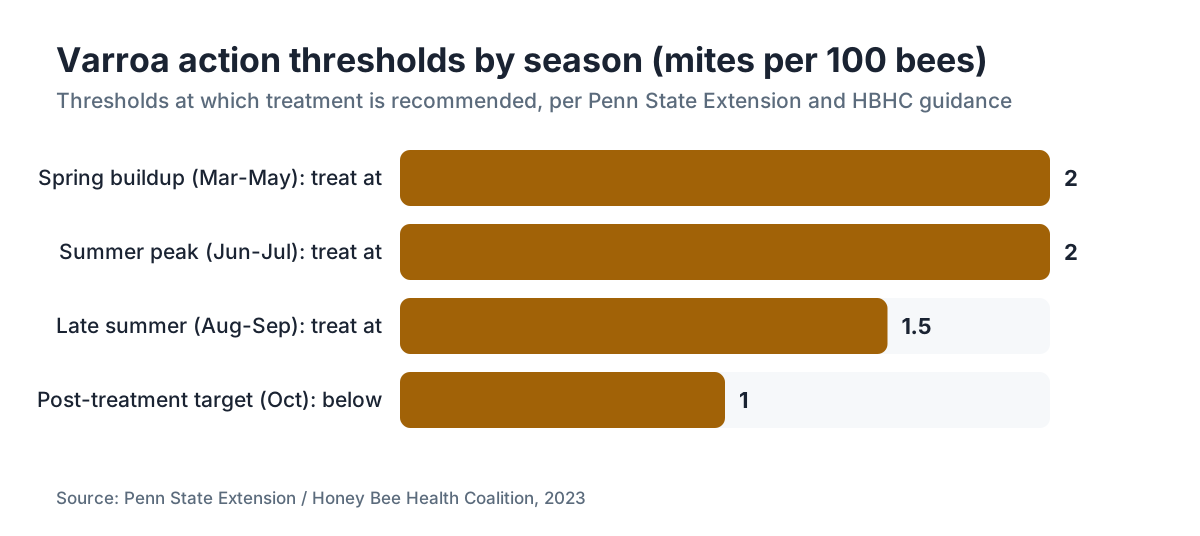
The action threshold most extension programs use is 2 mites per 100 bees (2%) for most of the active season, dropping to 1% or lower in August and September when winter bees are being raised [8]. Those thresholds come from population modeling and colony survival data, not from the fat body research directly.
The fat body findings do not replace them. They argue for treating at or below those numbers rather than waiting for clinical symptoms. Some researchers have suggested informally that the thresholds may need to drop given cumulative tissue damage, but no major extension program has published revised numbers. The honest answer is that the field is still working through it.
What you can do right now: treat before you hit the threshold in late summer, not after. The Honey Bee Health Coalition recommends treating in late summer (July through August, depending on your region) to protect winter bees, and that recommendation maps directly onto what fat body science predicts [5]. The table below shows the treatment windows and monitoring frequencies most extension programs agree on.
| Season | Monitoring frequency | Action threshold | Priority concern |
|---|---|---|---|
| Spring buildup (Mar-May) | Every 30 days | 2% | Colony growth, brood health |
| Summer peak (Jun-Jul) | Every 2-4 weeks | 2% | Rapid mite population growth |
| Late summer (Aug-Sep) | Every 2 weeks | 1-2% | Winter bee fat body protection |
| Fall/pre-winter (Oct) | Once post-treatment | Below 1% | Confirm treatment worked |
| Winter (broodless) | Optional OAV check | Any mites present | Mop up phoretic mites |
How does varroa fat body damage affect a bee's ability to tolerate pesticides?
This connection does not get enough attention. The fat body is where bees metabolize most pesticides, including the ones they meet foraging in agricultural landscapes. A bee with a compromised fat body has less detoxification capacity [3].
The practical result: colonies with high mite loads may show pesticide sensitivity at exposure levels that healthy colonies shrug off. When you see a dead-out that looks like a pesticide kill but the neighbor's bees look fine, varroa-induced fat body damage is a plausible contributing factor. That does not let pesticides off the hook. It means the two stressors compound each other in a way neither alone would predict.
There is a timing lesson here too. Driving mite levels down before peak agricultural spraying in your area gives bees better fat body integrity and better odds of surviving whatever field exposure they hit. That is not a reason to pile on unnecessary treatments. It is a reason to prioritize the timing of the varroa control you were going to do anyway.
Does varroa feed on larvae the same way it feeds on adult bees?
The fat body model applies to both phoretic mites (riding adult bees) and reproductive mites (sealed in brood cells). Inside brood cells the feeding gets more intense. The foundress mite and her offspring feed repeatedly on the developing larva and pupa across the capping period, which runs about 12 days for worker brood and longer for drone brood [9].
Developing pupae carry a lot of fat body tissue that is actively differentiating into adult structures during this window. Mite feeding disrupts that development. The most visible outcome is DWV-induced wing deformity, but fat body disruption likely drives the subtler deficits seen in adult bees that emerge from mite-infested cells without obvious deformity: shorter lifespan, worse navigation, weaker immune response [4].
Varroa's preference for drone brood matters here. Drone cells are capped longer (about 14-15 days versus 12 for workers), giving mites more time to reproduce and feed. That is why drone brood trapping works as a suppression tactic. Pulling capped drone frames before emergence removes a disproportionate share of reproducing mites before they disperse back onto adult bees. It is not a treatment, but it is a biologically sound tool during spring and early summer buildup [5].
What new treatments or strategies might the fat body research lead to?
Ramsey's paper explicitly raised the idea that the fat body feeding model could open new treatment targets [1]. If mites depend on specific fat body components, a treatment that blocks the mite's ability to digest or locate that tissue could be selective in a way current treatments are not.
Researchers are looking at RNA interference (RNAi) as a way to disrupt mite biology from the inside, feeding bees dsRNA sequences that silence essential mite genes. The USDA and several university labs have active programs, though no RNAi-based product has cleared EPA registration as of this writing [10]. The timeline for that kind of approval is genuinely uncertain.
Vaccination research is also moving. Dalan Animal Health received conditional EPA approval in 2023 for a bacterial pathogen vaccine delivered through queen rearing, targeting American Foulbrood rather than varroa. Varroa-specific immune priming for bees is further out, but the fat body link to immune function makes it a logical direction.
For now, what the research changes most is beekeeper mindset, not the product on your shelf. Treat early. Treat when thresholds are reached, not after colonies look sick. Confirm efficacy with a post-treatment mite wash. Do not assume a colony is fine just because it is bringing in pollen. Fat body damage is invisible from the outside.
How should you monitor mites differently knowing what varroa actually eats?
The monitoring method does not change. Alcohol wash and sugar roll are still the standard quantitative tools. Sticky board counts are still unreliable on their own. What changes is how you read your numbers and how much urgency you attach to acting on them.
A colony at 1.5% in late July is not comfortably below threshold. It is at a point where real fat body damage is already happening in the bees that will become your winter cluster, and you have maybe a six-week window to treat, verify, and still end up with healthy winter bees. Treat it now. A colony at 0.8% in October after a confirmed summer treatment is probably fine. Context is everything.
The UC Davis Department of Entomology extension resources and the Honey Bee Health Coalition's mite monitoring guides both spell out alcohol wash protocols in detail [5][8]. If you are not doing washes every two to four weeks during summer buildup, you are flying blind in the window that matters most. A varroa mite infestation that looks manageable in June can be catastrophic by September, because mite populations roughly double every month in a colony with capped brood.
One thing the fat body research drives home: the bees in your hive right now are not the bees that will be there in three months. You are not managing the current colony so much as managing the factory that builds the winter colony. Every mite feeding right now is a down payment on a weaker cluster in February.
What does this mean for beekeepers running treatment-free or minimal-intervention approaches?
Treatment-free beekeeping is a legitimate choice with real tradeoffs, and the fat body research makes those tradeoffs starker. If varroa damage were mostly fluid loss, a bee might recover function between feedings. If it is fat body tissue destruction, there is no recovery. The tissue is gone.
Selective breeding for varroa-sensitive hygiene (VSH) gives colonies a genuine biological tool: bees that detect and remove mite-infested pupae before reproduction finishes. That slows mite population growth without chemicals. The USDA Baton Rouge lab has maintained VSH breeding programs for decades, and queens with tested VSH traits are commercially available [11]. These genetics do not eliminate varroa, but they can hold mite growth low enough that untreated colonies sometimes survive in low-density beekeeping areas.
The honest assessment: treatment-free approaches in high-density areas face serious reinfestation pressure from neighboring colonies and feral populations. Fat body damage accumulates from every mite feeding event regardless of genetics. Even VSH colonies need monitoring. Calling yourself treatment-free does not protect your bees from fat body damage if your mite loads climb.
For beekeepers who want fewer chemical inputs without going fully treatment-free, oxalic acid (especially vaporization during broodless periods) has a very clean profile. It kills phoretic mites on contact with minimal residue and no known systemic impact on bees at label doses [6]. That is a reasonable middle path.
Where can I find reliable, current guidance on varroa treatment protocols?
The Honey Bee Health Coalition's Varroa Management Guide is the most widely referenced free resource in North American beekeeping. It covers monitoring methods, treatment options, seasonal thresholds, and resistance management in one document. The Coalition updates it periodically and it is free to download [5].
University extension programs with strong apiculture work include Penn State Extension, University of Minnesota Extension (source of the Bee Squad resources), NC State Apiculture, and UC Davis Cooperative Extension. All publish free mite management guides, and most include regional timing adjustments [8].
For EPA-approved product labels, the National Pesticide Information Center and EPA's pesticide product search let you look up current registered uses and label language for every approved varroa treatment [6][12]. The label is the law. Anything off-label, including temperature use outside the range printed on formic acid strips, is not covered.
For tracking your own mite counts over time and matching them to treatment windows by region and season, VarroaVault offers free protocol worksheets and a monitoring log that organizes this work without a spreadsheet background. These are practical tools, not substitutes for the primary guidance above.
If you are buying treatments, check the beekeeping supply companies that stock all EPA-registered options and can confirm whether the product you are ordering is current-label stock. Treatments sitting in a warehouse past their manufacture date may have reduced efficacy, especially oxalic acid products where the active concentration matters.
Frequently asked questions
What did the 2019 Ramsey study actually prove about varroa feeding?
The Ramsey et al. 2019 study published in PNAS used fluorescent dye-tracking and microscopy to show that varroa mites consume honey bee fat body tissue as their primary food source, not hemolymph as previously assumed. The mites' feeding scar position and gut contents both supported fat body consumption. This overturned a decades-old model and reframed how we understand mite-induced damage to bees.
Does the fat body feeding discovery mean varroa is more dangerous than we thought?
In practical terms, yes. Fat body tissue is the bee's primary immune, detoxification, and energy storage organ. Mite feeding destroys it in a way that does not fully repair. Hemolymph can be replenished; fat body tissue largely cannot. This means even moderate mite loads cause cumulative, irreversible physiological damage, which helps explain why colony collapse happens faster than hemolymph-loss models predicted.
Should I change which varroa treatment I use based on this research?
No currently approved treatment needs to be dropped based on the fat body findings. Oxalic acid, formic acid, thymol, and amitraz all still work. What changes is how you think about timing. Treating earlier in late summer, before the winter bee cohort is raised, protects fat body integrity in the bees that matter most. The research is about timing urgency, not product selection.
Why do colonies crash even when mite counts seem low?
Fat body damage accumulates from the start of mite feeding and does not reverse. A colony that hits 2% mites in late summer has already sustained weeks of fat body damage in the bees being produced right now. Those bees carry that damage into winter. The count at the time of treatment does not undo prior feeding events, so colonies can look numerically manageable while already being physiologically compromised.
What is the best time of year to treat for varroa based on current research?
Late summer, typically July through August in most of North America, is the most consequential treatment window. This protects the winter bee cohort during production. A second treatment during the broodless period in late fall or early winter, using oxalic acid vaporization, mops up remaining phoretic mites when no capped brood protects them. Both the Honey Bee Health Coalition and most university extension programs recommend this two-phase approach.
Does varroa fat body damage explain why infested bees are more sensitive to pesticides?
Yes, this is a documented connection. The fat body is where bees detoxify pesticides. Mite-damaged fat bodies have reduced detoxification capacity, meaning bees with high mite loads may show pesticide sensitivity at exposure levels that healthy colonies tolerate. This is one reason researchers increasingly view varroa and pesticide exposure as compounding stressors rather than independent ones.
How does varroa damage to fat body tissue connect to Deformed Wing Virus?
Varroa transmits Deformed Wing Virus during feeding, and the fat body damage simultaneously weakens the bee's immune response to that virus. The fat body produces immune proteins that fight viral replication. When mites destroy fat body tissue, the bee is less able to control DWV replication, which is why DWV titres in infested colonies are dramatically higher than in mite-free colonies even at similar initial virus exposure.
What are varroa-sensitive hygiene bees and do they prevent fat body damage?
Varroa-sensitive hygiene (VSH) is a genetically heritable trait where bees detect and remove mite-infested pupae before mite reproduction completes. This slows mite population growth. VSH genetics do not prevent individual mites from feeding and causing fat body damage, but by keeping mite populations lower, they reduce the cumulative damage load on the colony. USDA Baton Rouge has maintained VSH lines for commercial queen programs.
Is oxalic acid safe for bees given what we know about fat body damage?
Oxalic acid at EPA label rates has no documented toxic effect on honey bee fat body tissue. It kills phoretic mites through contact toxicity and leaves no meaningful residue at label doses. It is generally considered the safest approved varroa treatment in terms of bee tissue impact. The label specifies approved application methods (dribble, spray, or vaporization) and dose rates that have gone through EPA review.
Can I use the mite wash threshold of 2% the same way now, or is it outdated?
The 2% threshold for most of the active season and 1-2% in late summer remains the standard from extension programs and the Honey Bee Health Coalition. The fat body research does not replace those numbers, but it does reinforce treating promptly at threshold rather than watching and waiting. Some researchers argue the thresholds may eventually be revised downward, but no major extension program has published revised figures yet.
Are there any new varroa treatments in the pipeline that target fat body-related mechanisms?
RNA interference (RNAi) approaches, which would silence essential mite genes by feeding treated bees dsRNA sequences, are in active development at USDA and university labs. No RNAi-based varroa product has cleared EPA registration as of 2026. The fat body feeding discovery opens hypothetical targets around mite digestive enzymes, but those are further out. Dalan Animal Health's bacterial pathogen vaccine got conditional EPA approval in 2023 but targets American Foulbrood, not varroa.
Does drone brood trapping actually help reduce fat body damage in the colony?
Drone brood trapping removes capped drone frames before emergence, which removes a disproportionate share of reproducing mites. Drone cells are capped roughly 2-3 days longer than worker cells, making them the preferred reproductive site for varroa. By reducing the total mite population through trapping, you reduce aggregate fat body feeding events across the colony. It is a suppression tool, not a treatment, but it makes biological sense as a spring and early summer tactic.
How often should I do alcohol washes given what we know about cumulative fat body damage?
Every two to four weeks during the summer buildup, from roughly May through September, depending on your region. Mite populations can double monthly in a colony with capped brood. Fat body damage accumulates from the beginning of that growth, well before counts cross a threshold. Frequent monitoring lets you treat at or near threshold rather than after the winter bee cohort has already been damaged.
Where can I read the original Ramsey varroa feeding study?
The full paper is: Ramsey SD, Ochoa R, Bauchan G, et al. "Varroa destructor feeds primarily on honey bee fat body tissue and not hemolymph." Proceedings of the National Academy of Sciences. 2019;116(5):1792-1801. It is available through the PNAS website and also through PubMed Central as an open-access paper.
Sources
- Ramsey et al., Proceedings of the National Academy of Sciences (PNAS) 2019: Varroa destructor feeds primarily on honey bee fat body tissue, not hemolymph, as shown through dye-tracking, dissection, and microscopy.
- USDA Agricultural Research Service, Honey Bee Research: Fat body tissue stores vitellogenin and produces immune proteins critical to winter bee longevity and nurse bee function.
- Dainat et al., PLOS ONE 2012, on mite-parasitized bee lifespan and immune deficits: Mite-parasitized bees show lower vitellogenin, shorter lifespan, and impaired immune response compared to unparasitized bees.
- Genersch E, Journal of Invertebrate Pathology 2010, Varroa-DWV transmission review: Varroa is a vector for at least a dozen honey bee viruses; Deformed Wing Virus titres in infested colonies are dramatically higher than in mite-free colonies.
- Honey Bee Health Coalition, Varroa Management Guide: HBHC recommends treating in late summer to protect winter bees and documents mite infestation's suppression of immune function and increase in virus replication.
- U.S. EPA, Pesticide Registration for Oxalic Acid (Api-Bioxal): Oxalic acid (Api-Bioxal) is EPA-registered for varroa control in honey bees; the label specifies approved application methods and dose rates.
- Elzen PJ, Baxter JR et al., Apidologie 1999, Amitraz resistance documentation: Amitraz resistance in varroa populations has been documented in some geographic areas.
- Penn State Extension, Varroa Mite Management for Beekeepers: The standard action threshold is 2 mites per 100 bees for most of the active season, dropping to 1-2% in August and September when winter bees are being raised.
- Rosenkranz P, Aumeier P, Ziegelmann B, Journal of Invertebrate Pathology 2010, Varroa biology review: Worker brood is capped for approximately 12 days; drone brood is capped for 14-15 days, giving mites more time to reproduce in drone cells.
- USDA Agricultural Research Service, RNAi research for varroa control: No RNAi-based varroa treatment has cleared EPA registration as of current writing; USDA and university labs have active RNAi programs.
- USDA Baton Rouge Bee Breeding, Genetics and Physiology Lab, VSH breeding program: The USDA Baton Rouge lab has maintained varroa-sensitive hygiene (VSH) breeding programs for decades; queens with tested VSH traits are commercially available.
- U.S. EPA, Pesticide Product and Label System (PPLS): EPA's pesticide search tool lets users look up current registered uses and label language for every approved varroa treatment.
Last updated 2026-07-10