Blue Ridge Bee Company oxalic acid vaporizer kit: full review and how-to guide
TL;DR
- The Blue Ridge Bee Company oxalic acid vaporizer kit is a cheap way into OA vaporization, one of the most effective varroa treatments there is.
- It ships with a heating wand, battery cables, and basic protective gear.
- Paired with EPA-registered oxalic acid dihydrate (Api-Bioxal) and used in a broodless colony, it can drop mite loads by 90 percent or more.
What is the Blue Ridge Bee Company oxalic acid vaporizer kit?
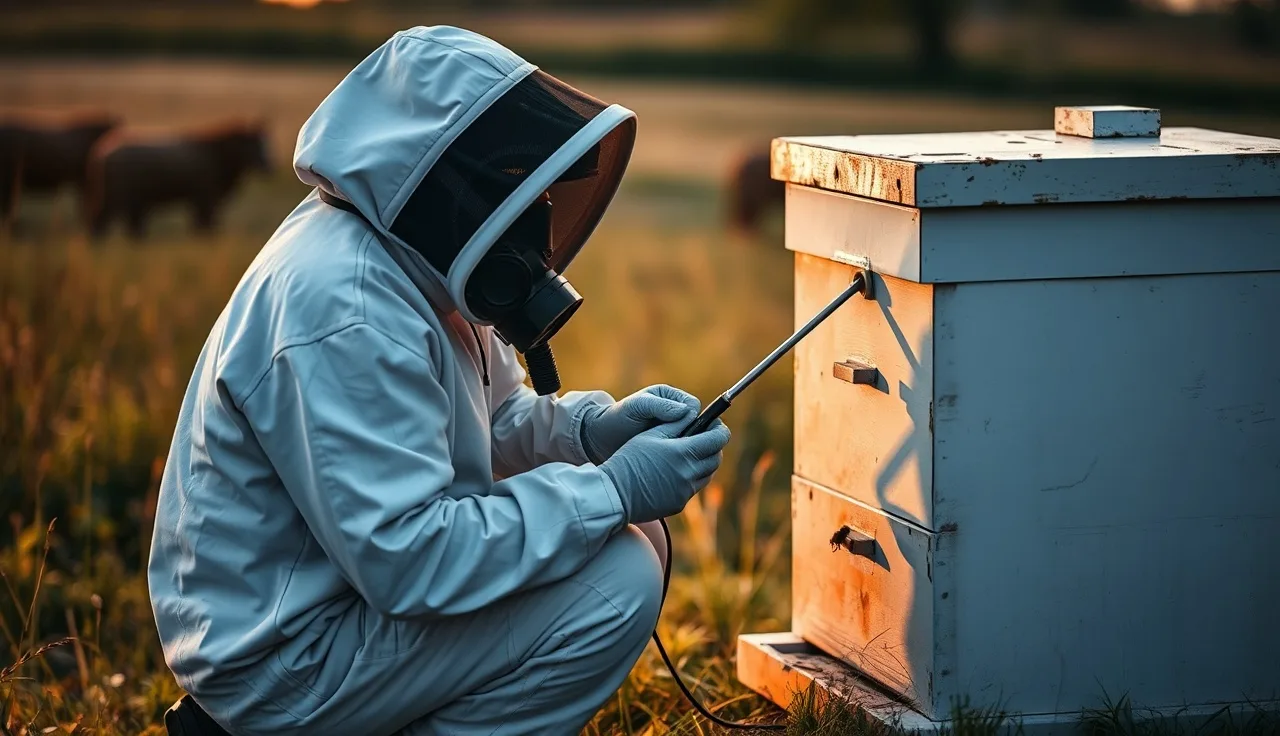
The Blue Ridge Bee Company oxalic acid vaporizer kit is a starter package for treating varroa by sublimation. Sublimation means you heat solid oxalic acid crystals until they turn straight to vapor. That vapor coats the bees and the inside of the hive and kills phoretic mites (the ones riding on adult bees) on contact.
The kit usually ships with a vaporizer wand (the heating element that holds the OA dose), battery clamp cables to run the wand off a 12-volt source like a car battery or a jump pack, a face shield or safety goggles, gloves, and sometimes a small measured scoop. What's in the box changes from run to run. Blue Ridge is a small regional supplier and their bundles have shifted over the years, so confirm the contents before you pay.
The kit does not include the oxalic acid. You buy EPA-registered oxalic acid dihydrate separately. Only one product is currently registered by the EPA for honey bee use in the United States: Api-Bioxal, made by Véto-Pharma [1]. Any other source, including raw oxalic acid sold as wood bleach at the hardware store, is illegal to use in a hive under federal pesticide law.
This kit sits at the cheap end of the market, usually $60 to $90 depending on the retailer and whatever accessories come bundled. It's not the most durable wand out there. It works, and it's a fair place to start.
Is oxalic acid vaporization actually effective against varroa?
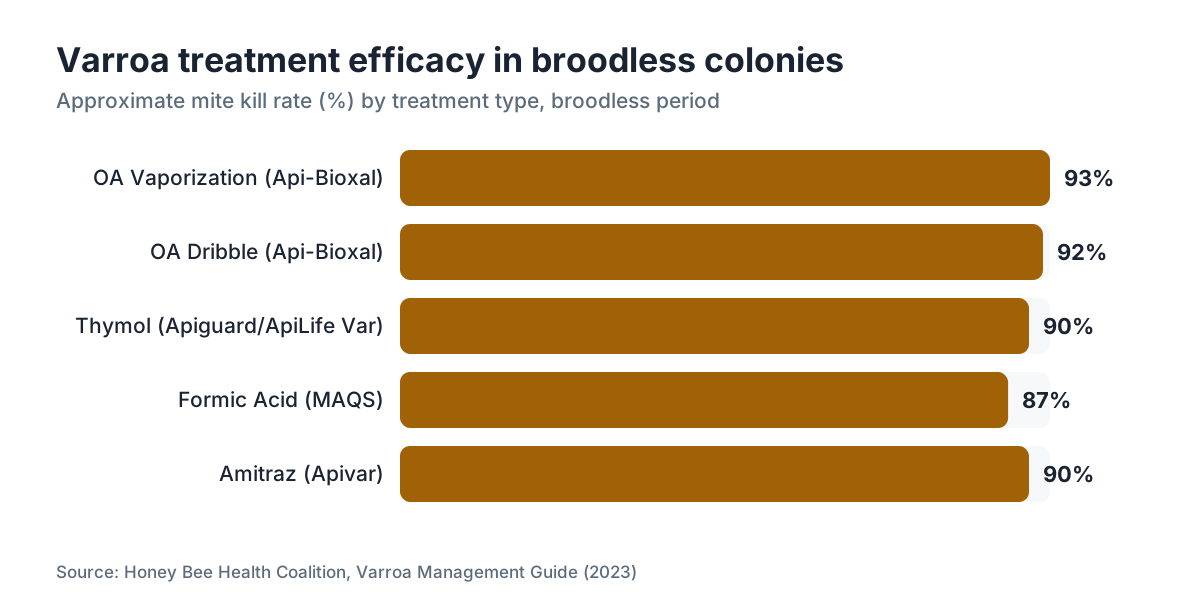
Yes, and the data back it up. OA vaporization is among the most effective treatments for phoretic varroa, with the Honey Bee Health Coalition's Varroa management guide and multiple studies putting efficacy above 90 percent in broodless colonies [2]. The mechanism is physical. Oxalic acid crystals that settle on a bee damage the mite's outer cuticle and wreck its physiology.
The whole thing hinges on one word: phoretic. Oxalic acid in any form (vaporized, dribbled, or sprayed) does not get through the wax caps on brood cells. Mites tucked under those caps are safe. That's why the treatment hits hardest when the colony has no capped brood, either naturally in winter or through a brood break you create.
One OA vapor treatment during a broodless period can cut mite loads by 90 to 97 percent in studies reviewed by the USDA Agricultural Research Service [3]. That is a big number. Repeated treatments spaced a few days apart during brood-rearing can also pull mites down a lot, but the results scatter more across apiaries and climates.
Here's how OA stacks up against the other main options, using typical broodless-colony efficacy:
| Treatment | Active Ingredient | Broodless Efficacy | Residue in Honey/Wax | Legal in US |
|---|---|---|---|---|
| OA Vaporization (Api-Bioxal) | Oxalic acid | 90-97% [3] | Negligible above natural levels [4] | Yes (EPA) |
| OA Dribble (Api-Bioxal) | Oxalic acid | 90-95% [2] | Negligible | Yes (EPA) |
| Apiguard / ApiLife Var | Thymol | 85-95% [2] | Low, temp-dependent | Yes (EPA) |
| Mite Away Quick Strips | Formic acid | 80-95% [2] | None approved threshold | Yes (EPA) |
| Apivar | Amitraz | 85-95% [2] | Low but detectable | Yes (EPA) |
OA has one edge the synthetics don't. It already occurs naturally in honey, and vaporized OA leaves no detectable residue above natural background levels in honey or wax when you use it at label rates [4]. If you sell honey, that matters a lot.
What safety gear do you actually need to use an OA vaporizer?
Let me be blunt here. Oxalic acid vapor is a serious respiratory irritant and a regulated substance. Treating it with real caution isn't overkill. It's the baseline.
The EPA label for Api-Bioxal spells out the personal protective equipment (PPE) you have to wear [1]. That means a NIOSH-approved respirator rated for organic vapors and particulates (an N95 dust mask does not cut it), chemical-resistant gloves, a face shield or splash-proof goggles, and long sleeves. The label also says not to enter treated hives until the vapor has fully cleared, usually 10 to 15 minutes.
Plenty of OA kits, including the Blue Ridge package, throw in basic safety gear. Treat those included goggles and gloves as a floor, not a ceiling. If your kit doesn't come with a half-face respirator running OV/P100 cartridges, buy one before your first treatment. A decent 3M or Moldex half-face respirator with cartridges runs $30 to $50. Skip it and you're gambling with your lungs.
Set up with the wind at your back or side. Never let it blow the vapor into your face. Seal the hive entrance with foam or a damp cloth while the vapor is working. Pick calm days when you control where you stand relative to any drift. Keep it away from open flames or sparks.
The Blue Ridge kit does one thing right on safety: most configurations include a face shield. If yours showed up without one, grab a basic polycarbonate shield before you start.
How do you set up and use the Blue Ridge vaporizer kit step by step?
Get this right the first time and you save yourself wasted treatments and a scorched brood box. Read through it before you walk up to a hive.
Step one: gather everything. You need the vaporizer wand, the battery cables, a 12-volt power source (a dedicated jump pack or a car battery both work, and running your car's engine while you draw off its battery is fine), your full PPE including the respirator, Api-Bioxal, and either the dosing scoop or a milligram-accurate scale.
Step two: measure your dose. The Api-Bioxal label calls for 1 gram of oxalic acid dihydrate per brood box treated, with a hard ceiling of 50 grams per hive per year [1]. One brood box, 1 gram. Two brood boxes, 2 grams. Most experienced beekeepers weigh the dose on a small scale instead of trusting a scoop, because consistency matters more than speed here.
Step three: load the dose into the wand's heating cup. Slide the wand in through the bottom entrance or a small port in the screened bottom board. Bottom board access is the easiest route for most hive setups.
Step four: clip on the battery cables, watching your polarity. The wand heats fast, usually hitting vaporization temperature in 60 to 90 seconds. Hold it in place about 2 to 2.5 minutes total, or until you stop seeing vapor leak from the hive. Then disconnect, seal the entrance for a minute if you can, and step back.
Step five: wait. Don't open the hive for at least 10 minutes. After that, let it ventilate and you're done.
For colonies with brood, the Honey Bee Health Coalition recommends repeating the treatment every 5 days for a total of 3 to 5 rounds through the brood-rearing period [2]. You're catching each new wave of mites as they crawl out of cells and hop onto bees before they duck back into a cell.
Want to line your timing up against a free varroa mite management calendar or a mite load calculator? The VarroaVault tools page has resources built for exactly this.
How does the Blue Ridge kit compare to other OA vaporizers?
The vaporizer market has a handful of familiar names, and it helps to know where this kit lands before you spend.
The Varomorus and Varrocleaner-style wands sit in the same price and build class as the Blue Ridge unit. They're all electrically heated wands built from similar parts, and they all do the job. The gap between a $75 wand and a $350 Lega or Lyson vaporizer is build quality, speed, and how nice it feels in the hand. It is not efficacy.
The ProVap 110 and similar plug-in (110V AC) vaporizers run off household current instead of a 12V battery. Handy at a home apiary, less so out in a field. They heat faster and cool faster, which speeds you up when you're working through 20 hives.
Battery-powered self-contained units like the Varrox Edge are the most convenient for big yards, but they run $300 to $500. For a hobbyist with two to five hives, that money is hard to justify.
My honest take: the Blue Ridge kit, or any wand in its class, is plenty for a hobbyist. I've watched beekeepers get excellent mite control out of a $70 wand used with discipline and good timing. The pricey gear doesn't treat better. It treats faster and with less hassle. If you run fewer than 10 hives, start where the Blue Ridge kit puts you and upgrade later if you actually hit a wall.
The one fair knock on budget wands is consistency. Heating element temperature varies unit to unit, and a wand that runs cool may not fully vaporize your dose, leaving crystals behind. Watch for full vapor production during your window. A pile of unvaporized residue in the cup after treatment tells you the wand is underperforming.
For a wider look at suppliers and what to check when you shop, the beekeeping supply companies guide covers the major vendors and what sets them apart.
What power source works best with a 12V OA vaporizer wand?
Any reliable 12-volt DC source in decent shape works. The wand pulls roughly 8 to 12 amps while it's running, so your source has to hold that continuous draw without a big voltage drop.
A lithium jump starter pack, the compact kind most people keep in the car, is the practical pick for an out-yard beekeeper. It's portable, recharges from a wall outlet, and a mid-range pack ($40 to $80) will run 15 to 25 treatments per charge without breaking a sweat. That's my default recommendation for anyone treating three or more hives away from home.
A standard 12V automotive lead-acid battery works fine too. Some beekeepers keep an old car battery around just for the vaporizer. Heavy, but cheap.
Running off your car's battery while the engine idles is fine as well, and the idling part matters. A vaporizer pulling 10 amps for a couple minutes at a time drains a stationary car battery faster than you'd guess over a full yard of treatments.
One thing to watch: long or thin battery cables cause voltage drop and steal heating performance from the wand. The cables that ship with most budget kits are usually adequate. If you extend them, go up a wire gauge to make up for it.
When is the best time of year to use OA vaporization?
Timing is the whole ballgame with oxalic acid, and getting it wrong is the number one reason beekeepers walk away disappointed.
The clearest window is your winter broodless period. Across most of the continental US, colonies go broodless or nearly broodless from roughly late November through January, depending on your latitude and how the temperatures fall that year. One OA vapor treatment during a confirmed broodless stretch is the most effective single shot you have. The Honey Bee Health Coalition treats it as the anchor of an integrated varroa program [2].
Confirm the broodlessness. Don't assume it. Do a quick inspection or shine a flashlight up through the screened bottom board to check for capped brood. Treating a colony that still holds a lot of capped brood gives you dramatically worse results.
The second-best window is a brood break you make yourself. Cage the queen for 21-plus days (the capping-to-emergence window for worker brood), then treat once the last worker brood has hatched out. It's more work, but it's very effective in climates with no natural broodless period, like Florida or parts of coastal California.
During active brood-rearing, the repeated protocol (every 5 days, 3 to 5 rounds) can work but demands follow-through. If your mite count has crossed the action threshold of 2 to 3 mites per 100 bees, the trigger most extension services use [2][5], and you're deep in brood season, a systemic like Apivar may be more practical than a string of OA vapor treatments for that specific spot. That's not a shot at OA. It's just honest about context.
University extension guides from Penn State and NC State both push alcohol wash or sugar roll mite counts before treatment and again 2 to 3 weeks after as the only real way to know whether a treatment worked [5][6].
Is it legal to use this vaporizer and oxalic acid in all US states?
The EPA registered oxalic acid dihydrate (Api-Bioxal) for use in honey bee colonies in 2015, which made OA vaporization federally legal across the US [1]. The registration covers vaporization specifically, along with dribble and spray.
States can pile their own restrictions on top of the federal rules, and a few have. California once required a physician's prescription for oxalic acid. That has since changed, and Api-Bioxal is now available over the counter in California under recent regulatory updates. If you're in California or another state with a history of extra OA rules, check with your state department of agriculture directly. The CDFA website is your authoritative source for California-specific rules.
The real constraint isn't legality. It's label compliance. The Api-Bioxal label sets specific rules on application rate, number of treatments per colony per year, entry-restricted intervals, and pre-harvest intervals. The label is the law under FIFRA (Federal Insecticide, Fungicide, and Rodenticide Act), and you can be cited for off-label use [7].
Running something other than Api-Bioxal through a vaporizer in a bee hive is off-label use, even when the chemical compound is technically identical. The registration is product-specific, not compound-specific.
What are common mistakes people make with OA vaporizers?
The mistakes that keep coming up cluster around a few predictable spots.
First, treating without knowing your mite load. Treat before you measure and you're flying blind. Run an alcohol wash or a sticky board count first. If your count is under the action threshold, you might not need to treat at all, and treating anyway just stresses the bees for nothing.
Second, skipping the post-treatment count. Treat, wait three to four weeks, count again. If your mite level didn't drop much, you've got one of three things: resistance (unlikely with OA, which has no documented resistance in the current literature), brood you missed, or a wand that underperformed.
Third, under-sealing the hive. OA vapor has to stay in contact with the bees long enough to work. A hive with big gaps, a screened bottom board left wide open, or a leaky telescoping cover lets a lot of vapor escape before it does anything. Close the screened bottom board insert and shrink the air gaps during treatment.
Fourth, over-treating during brood season without counting between rounds. OA at label rates is safe for adult bees, but heavy repeated exposure adds stress. More treatments don't buy better outcomes once the mite population has already crashed.
Fifth, poor battery management. A weak battery gives you a wand that never reaches full vaporization temperature, and the crystals it leaves in the cup look like unvaporized dose. If you see a lot of residue after a full treatment time, check your battery voltage under load.
How do you monitor mite levels to know if your treatment worked?
This is where your decisions get grounded in numbers instead of hope, and it's the part a lot of hobbyists skip. Don't.
The two main methods for measuring varroa in a living colony are the alcohol wash and the sugar roll. The alcohol wash is more accurate. You scoop roughly 300 bees (about a half-cup) from the brood area, wash them in isopropyl alcohol, and count the mites that float free. Divide mites by bees, multiply by 100, and you have mites per 100 bees. The action threshold most extension services use is 2 to 3 mites per 100 bees during brood season [2][5].
The Honey Bee Health Coalition's Varroa management guide has a downloadable mite count worksheet plus step-by-step instructions for both methods [2]. It's the best free resource on the topic, and I'd load it onto your phone before your next inspection.
Sugar rolls are gentler (the bees live) but tend to undercount by 20 to 30 percent against an alcohol wash. Better than nothing, and fine if you're set against sacrificing 300 bees. For treatment decisions, I go alcohol wash every time.
Timing is simple. Count before treating to confirm you need to. Count again 3 to 4 weeks after to confirm it worked. A good OA vapor treatment during a broodless period should take you from above threshold to well under 1 mite per 100 bees.
Tracking counts over time, even in a plain spreadsheet, shows you when resistance might be creeping in (it hasn't in OA, but it's real in amitraz), whether you're getting reinfested from feral colonies nearby, and whether your timing protocol actually works in your climate.
Where can you find accessories and replacement parts for the kit?
Blue Ridge Bee Company sells directly and through regional distributors, but replacement wand elements and spare parts are where small suppliers get spotty. A few practical notes.
The wand style in this kit is close to several budget vaporizer brands. If you need a new heating cup or element, a generic cup that matches your model's threading often fits. The connectors are usually standard automotive ring terminals or alligator clips, both easy to replace at any hardware store.
Api-Bioxal, the EPA-registered oxalic acid you need, is stocked by most US beekeeping vendors. Mann Lake, Dadant, and other big distributors carry it. If you're comparing suppliers and worrying about shipping, the free shipping honey bee supply companies guide covers which vendors have free shipping thresholds and how they line up.
Buy respirator cartridges directly from 3M, Moldex, or Honeywell, or from a real safety supply store. Don't buy cartridges from unknown sellers on marketplace sites. Counterfeit cartridges exist and they won't protect you.
VarroaVault's beekeeping supplies section keeps a running comparison of equipment and what to look for if you'd rather build a full treatment kit than start from one vendor's bundle.
What should you do if the vaporizer wand stops working or underperforms?
Budget vaporizer wands fail in predictable ways. Learn the symptoms and you won't blame the treatment when the tool is the problem.
Symptom: the wand heats slowly or not at all, but the connection looks fine. Check battery voltage first. A 12V battery reading below 11.5V under load won't power the wand right. Swap in a freshly charged source.
Symptom: the wand heats but leaves a lot of unvaporized crystals in the cup. Either the wand runs a little cool (a manufacturing tolerance issue on cheap units) or you overloaded the dose. Verify your dose is right. If the dose checks out and you keep seeing under-vaporization, the element is probably degrading.
Symptom: the wand glows red or heats fast but you see poor vapor production from the hive. Check your hive seal. Vapor is escaping through gaps instead of circulating through the cluster.
Symptom: the wand quits mid-season. Budget wands don't always survive multiple seasons, and the heating element is the part most likely to go. If you run more than 10 hives, keep a second wand as backup.
If you keep fighting wand problems, step up to a mid-tier model (a Varomorus Pro or a ProVap 110 equivalent) instead of burning through cheap replacements. The math usually catches up with you by the second or third failure.
Frequently asked questions
Can I use oxalic acid from a hardware store with the Blue Ridge vaporizer kit?
No. Only Api-Bioxal, the EPA-registered oxalic acid dihydrate product, is legal for use in honey bee colonies in the US. Hardware-store oxalic acid (sold as wood bleach) is not registered for this use under FIFRA. Using it is illegal, and its rate and formulation may differ, creating unknown risks for bees and honey. Always use Api-Bioxal at label rates.
How many hives can I treat on one battery charge with this kit?
With a good lithium jump pack, most beekeepers get 15 to 25 single-hive treatments per charge. A full-size automotive battery gives similar or slightly better range. Each treatment runs roughly 2 to 3 minutes of active wand heating, so draw per treatment is moderate. Cold weather cuts lithium battery output, so expect fewer treatments per charge in winter.
Is OA vaporization safe for the bees?
At label rates, yes. Multiple studies and the EPA registration review found no significant harm to adult bees or queens when Api-Bioxal is used as directed. There's some evidence that very high repeated doses can reduce brood survival, but that's not a concern at 1 gram per brood box at labeled intervals. The treatment is one of the most bee-safe varroa interventions available.
What's the maximum number of OA vapor treatments I can do per year?
The Api-Bioxal label sets a maximum of 50 grams of oxalic acid dihydrate per colony per year, regardless of application method. For a single-brood-box colony getting 1-gram treatments, that's a theoretical ceiling of 50 treatments. In practice, protocols run to 1 broodless treatment or 3 to 5 repeated brood-season treatments, well inside that limit.
Does oxalic acid vaporization work in colonies with brood?
It kills phoretic mites (those on adult bees) but has zero effect on mites in capped brood cells. In a colony with significant brood, one treatment removes only the phoretic fraction, typically 15 to 30 percent of the total mite population. Repeated treatments every 5 days improve results by catching mites as they emerge, but efficacy stays well below what you get during a broodless period.
Can I use a car battery or do I need a dedicated jump pack?
Either works. A car battery in good condition gives stable 12V power and handles the 8 to 12 amp draw easily. A lithium jump pack is more portable for out-yards. If you use your vehicle's battery, running the engine is fine and keeps you from draining it too low across a big session. Any power source needs to be in good condition and holding proper voltage.
How long does a bag of Api-Bioxal last?
Api-Bioxal is sold in 35-gram and 2.1-lb sizes. At 1 gram per brood box, 35 grams covers 35 single-box colony treatments, or about 11 to 12 colonies through a 3-treatment brood-season protocol. The 2.1-lb (roughly 950g) bag costs less per gram for beekeepers running more than 20 hives. Store it sealed, dry, and out of direct sunlight; it keeps for several years when stored properly.
What respirator do I actually need for OA vaporization?
You need a NIOSH-approved half-face or full-face respirator with OV/P100 combination cartridges (organic vapor plus particulate filtration). An N95 dust mask does not protect you against oxalic acid vapor. The EPA label for Api-Bioxal requires this level of respiratory protection. A basic 3M or Moldex half-face respirator with OV/P100 cartridges costs $30 to $50 and is reusable; cartridges need periodic replacement.
How do I know if my treatment worked?
Run an alcohol wash mite count before treating and again 3 to 4 weeks after. A successful OA vapor treatment in a broodless colony should drop counts from above the action threshold (2-3 mites per 100 bees) to below 1 per 100 bees. If counts don't fall much, check whether brood was present, whether the wand fully vaporized the dose, or whether reinfestation from nearby colonies is happening.
Does the Blue Ridge vaporizer kit include Api-Bioxal?
No. The kit includes the vaporizer wand, battery cables, and basic PPE, but not the oxalic acid itself. Api-Bioxal has to be purchased separately from a beekeeping supplier. It's sold by most major US vendors including Mann Lake and Dadant. Some states have historically had extra purchase requirements, so check your state department of agriculture rules before ordering.
Can OA vaporization be used with any hive type, including top-bar or Warré hives?
Yes, though access varies. The wand needs to enter the hive through the bottom entrance, a bottom board port, or another small opening. Standard Langstroth bottom boards work well. Top-bar and Warré hives can need improvised entry points or a foam-sealed entrance. The treatment works with any hive type as long as you can seal it well enough to hold the vapor during the treatment window.
How does OA vaporization compare to the OA dribble method?
Both use the same active ingredient and hit similar efficacy in broodless colonies (90 to 95 percent mite kill). Vaporization treats multiple boxes without disturbing the cluster and works at lower temperatures. Dribble needs direct contact with bees on each frame and is harder in cold weather. Vaporization lets you treat in winter without opening the hive, which is its main practical edge over dribble for most beekeepers.
Are there any varroa mites resistant to oxalic acid?
As of current published research, no documented resistance to oxalic acid has emerged in Varroa destructor populations anywhere in the world. That's credited to OA's physical rather than enzymatic mechanism. Resistance to amitraz (Apivar) has been documented in some US and European populations. OA's clean resistance profile is one reason it's recommended as a core part of integrated varroa management.
Sources
- EPA, Api-Bioxal Pesticide Registration (Reg. No. 86203-1): Api-Bioxal is the only EPA-registered oxalic acid product for honey bee use in the US; label specifies 1 gram per brood box, max 50 grams per colony per year, and mandatory PPE including OV/P100 respirator.
- Honey Bee Health Coalition, Varroa Management Guide (2023 edition): OA vaporization efficacy above 90 percent in broodless colonies; action threshold of 2-3 mites per 100 bees; repeated 5-day treatment protocol for brood-rearing season; OA dribble and vaporization compared.
- USDA Agricultural Research Service, Bee Research Laboratory: Single OA vapor treatment during broodless period can reduce mite loads by 90 to 97 percent in reviewed studies.
- European Food Safety Authority (EFSA), Oxalic acid residues in honey and beeswax (2016): Oxalic acid applied by vaporization leaves no detectable residue above natural background levels in honey or wax at label rates.
- Penn State Extension, Varroa Mite Management in Pennsylvania: Alcohol wash as most accurate mite counting method; action threshold of 2-3 mites per 100 bees; post-treatment counts recommended 3 to 4 weeks after treatment.
- NC State Extension Apiculture, Varroa Management: Recommends alcohol wash before and after treatment to confirm efficacy; OA vaporization highlighted as effective winter treatment option.
- EPA, Federal Insecticide, Fungicide, and Rodenticide Act (FIFRA) Overview: Under FIFRA, the label is the law; off-label pesticide use is a federal violation regardless of chemical similarity to registered products.
- University of Minnesota Extension, Oxalic Acid for Varroa Control: Explains OA vaporization application procedure, broodless period optimization, and comparison to dribble method.
- American Bee Journal / Bee Culture, Resistance in Varroa destructor review: No documented resistance to oxalic acid in Varroa destructor populations worldwide; amitraz resistance documented in some US and European populations.
Last updated 2026-07-09