Blythewood Bee Company Varrox oxalic acid vaporizer: full guide
TL;DR
- The Blythewood Bee Company Varrox is a Swiss-made oxalic acid vaporizer that sublimates 2.0 g of oxalic acid dihydrate per hive in roughly 2.5 minutes using a 12V battery.
- It is EPA-registered for use on Apis mellifera, kills phoretic varroa mites with 90-plus percent efficacy, and is legal for use on colonies with or without brood when applied per the registered label.
What is the Blythewood Bee Company Varrox vaporizer?
The Varrox is an oxalic acid vaporizer originally designed and manufactured in Switzerland by Andermatt BioVet. Blythewood Bee Company, a South Carolina-based beekeeping supplier, imports and distributes it in the United States. The tool works by placing a measured dose of oxalic acid dihydrate crystals into a small metal pan, inserting the pan into the hive entrance, and heating it with 12V DC power until the acid sublimates into a gas. That gas coats the bees and the internal surfaces of the hive, killing phoretic varroa mites on contact.
It is one of the oldest and most widely used oxalic acid vaporizers in the world. European commercial beekeepers ran it through the 1990s, long before the EPA registered oxalic acid products in the United States in 2015 [1]. The physical design is simple: a stainless steel pan attached to a long handle and a heating element, connected to a 12V car battery or equivalent power source via alligator clips. No proprietary battery pack. No complex electronics. No subscription.
The Varrox retailed in the $160-$200 range as of mid-2025, though prices fluctuate. That puts it at the higher end of 12V vaporizers sold in North America, but most serious hobbyists and sideliners who own one consider the build quality worth it. The pan is thick, the welds are clean, and the tool heats consistently to the sublimation temperature of oxalic acid (around 157°C / 315°F) without hotspots that can carbonize the dose and cut efficacy.
Is the Varrox EPA-registered and legal to use in the United States?
Yes. Oxalic acid as a varroa treatment is registered with the EPA under the product Api-Bioxal (EPA Reg. No. 87243-1), and the vaporization method is explicitly included in that registration [1]. The Varrox itself is listed on the Api-Bioxal label as an approved application device for the vaporization technique. You cannot legally vaporize any oxalic acid product on honey bees in the United States unless both the product (Api-Bioxal) and the application device are label-approved.
The EPA label for Api-Bioxal states: "For use only with Varrox vaporizer or other vaporizers approved by EPA" [1]. That language matters. If you are using a different vaporizer brand, confirm it appears on the current label before treating.
Some states layer additional pesticide registration requirements on top of the federal EPA registration. California, for example, requires a state registration in addition to the federal one. Check with your state department of agriculture if you are uncertain. The National Pesticide Information Center (NPIC) can also help you find your state's specific requirements [2].
A pesticide applicator license is generally not required for beekeepers treating their own colonies with oxalic acid under the EPA label, but a handful of states treat it differently. Confirm with your state apiarist before your first treatment season.
How does oxalic acid vaporization kill varroa mites?
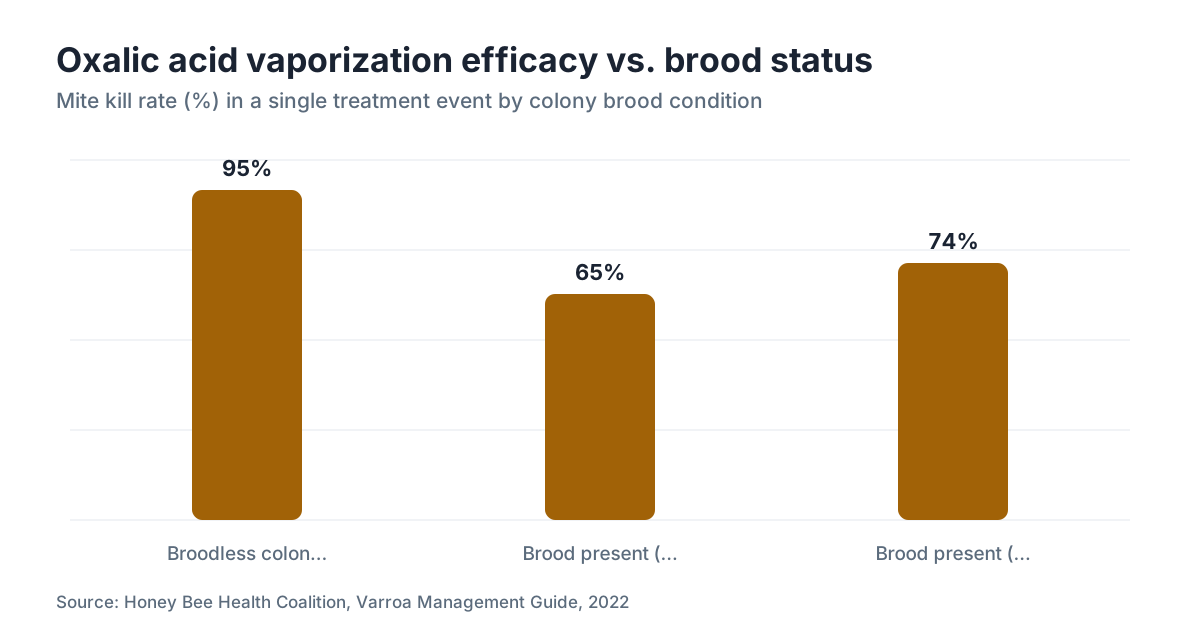
Oxalic acid (C2H2O4) is an organic acid found in many plants, including rhubarb and spinach. When vaporized and inhaled or contacted by varroa mites (Varroa destructor), it disrupts the mite's physiology, though the exact molecular mechanism is still not fully characterized in published literature. What is well-established: phoretic mites, the ones riding on adult bees rather than hidden under capped brood, die at high rates. A 2017 study published in the Journal of Apicultural Research put oxalic acid vaporization efficacy against phoretic mites above 90% in colonies treated during broodless conditions [3].
Here is the limit that trips people up. Oxalic acid vapor does not penetrate capped brood cells. Mites reproducing under cappings are completely protected during treatment. That is why timing decides everything. Treat during a natural or induced broodless period, midwinter in cold climates, or after a split or queen removal, and you get the highest kill rate because the entire mite population is phoretic and exposed.
When brood is present, the Honey Bee Health Coalition's Varroa Management Guide recommends three treatments spaced seven days apart to catch newly emerged mites before they enter the next brood cycle [4]. The Api-Bioxal label allows up to three vaporization treatments per application event, applied at seven-day intervals.
Oxalic acid residue shows up in all honey naturally, typically between 8 and 58 mg/kg depending on floral source [5]. The EPA determined that vaporization at labeled rates does not push residues above that natural background level, which is why there is no pre-harvest interval for oxalic acid treatments.
How do you use the Varrox vaporizer step by step?
Read the Api-Bioxal label in full before anything else. It is the legal document governing your treatment. You can download it directly from the EPA [1].
Equipment you need:
- Api-Bioxal oxalic acid dihydrate (the only EPA-registered product for this use)
- Varrox vaporizer
- 12V battery (a standard automotive battery works; a deep-cycle or jump-starter battery is more portable)
- Half-face respirator rated for acid vapors, minimum NIOSH P100 particulate plus OV/AG cartridge combination
- Safety glasses or a full face shield
- Nitrile or chemical-resistant gloves
- Entrance blocker or foam plug
Procedure:
- Weigh 2.0 grams of Api-Bioxal crystals. Use a small digital scale accurate to 0.1 g. Do not eyeball this dose. Too little cuts efficacy; too much wastes product and can harm bees.
- Put on your respirator, gloves, and eye protection before loading the pan.
- Pour the measured dose into the Varrox pan.
- Block the hive entrance completely with a foam plug or board. Seal any cracks larger than 3mm to keep vapor inside.
- Insert the Varrox pan through the blocked entrance (most beekeepers remove the entrance reducer, slide the handle in, then re-block around the handle with a folded cloth or foam).
- Connect the alligator clips to the 12V battery: red to positive, black to negative.
- Wait about 2.5 minutes for the acid to fully sublimate. The Varrox has no timer or indicator light. Most beekeepers watch the entrance gap for visible vapor to stop, or simply time it consistently.
- Disconnect the battery clips. Wait 10-12 minutes before removing the wand and opening the entrance so vapor doesn't rush out toward you.
- Remove the pan, re-open the entrance, and move to the next hive.
Never lean over the hive entrance during treatment. Never apply in wind that blows vapor toward you. Never apply without respiratory protection, even for one hive.
For more on sourcing the vaporizer and related gear, see beekeeping supply companies for a comparison of major suppliers.
What PPE do you actually need when using the Varrox?
This is where beekeepers get sloppy and where the consequences get serious. Oxalic acid vapor is corrosive to mucous membranes, lung tissue, and eyes. The OSHA permissible exposure limit for oxalic acid is 1 mg/m³ as an 8-hour time-weighted average [6]. A single hive treatment can generate concentrations that exceed that threshold near the application point.
A dust mask is not enough. A standard N95 is not enough. You need a half-face or full-face respirator fitted with cartridges rated for both particulate (P100) and acid gases (OV/AG, which covers organic vapors and acid gases). 3M and Moldex both make combination cartridges that cover this. Replace cartridges on the manufacturer's schedule, not when you think they smell used up.
Gloves should be nitrile at minimum, though chemical-resistant rubber gloves give you more margin if you handle the pan directly. Safety glasses or a face shield protect your eyes from any residual vapor.
The EPA label is explicit about PPE requirements. Ignoring them isn't just risky, it voids any legal protection you have if something goes wrong.
Apply treatments outdoors or in a well-ventilated apiary. Do not treat inside an enclosed structure like a garage or barn unless ventilation is exceptional. If you treat multiple apiaries in a day, watch your cumulative exposure time.
When is the best time to use the Varrox for maximum efficacy?
Timing matters more than which vaporizer you own. The Varrox, like any oxalic acid vaporizer, only kills mites it can reach, and it cannot reach mites under capped brood.
Winter broodless treatment: In climates where colonies go broodless for at least a few weeks (typically when temperatures stay below 50°F consistently), a single vaporization treatment during that window can drop mite levels hard because close to 100% of mites are phoretic. Many researchers and experienced beekeepers call this the most effective treatment timing of the year [4].
After a split or artificial swarm: A queenless split forces a broodless period in that portion of the colony while the bees wait for a new queen to emerge and start laying. Treating during that window is highly effective.
Pre-nectar flow treatment: Treating in early spring, before the colony builds to full strength and before your region's main nectar flow, gives you cleaner hives going into the production period.
The three-treatment series with brood present: If you must treat a colony with capped brood, the Api-Bioxal label allows three treatments seven days apart. The logic: mites emerging from cells between treatments get exposed as phoretics before they can re-enter brood. This works less well than broodless treatment but beats no treatment.
The Honey Bee Health Coalition's published data says treatment timing relative to the brood cycle drives outcomes, not the specific vaporizer model [4]. A well-timed single treatment with the Varrox beats a badly timed four-treatment series with any vaporizer.
Do a mite wash (alcohol wash or sugar roll) before and after treating to confirm efficacy. If counts don't drop below 2 mites per 100 bees after treatment, figure out whether treatment failure, reinfestation, or a high starting load is the cause. You can find free monitoring calculators and threshold tables at VarroaVault's tools page for context on what counts mean.
How does the Varrox compare to other oxalic acid vaporizers?
Several vaporizers compete on the North American market. The Varrox, the ProVap 110 (which runs on 110V AC), the OAV by Brushy Mountain (discontinued but still in circulation), and various budget 12V vaporizers from Chinese manufacturers on Amazon and elsewhere. The table below sorts out the practical differences.
| Vaporizer | Power | Approx. price (2025) | Heat time per hive | EPA label status | Build origin |
|---|---|---|---|---|---|
| Varrox (Blythewood) | 12V DC | $160-$200 | ~2.5 min | Listed on Api-Bioxal label | Switzerland |
| ProVap 110 | 110V AC | $230-$270 | ~1.5 min | Listed on Api-Bioxal label | USA |
| Oxalic acid vaporizer (generic) | 12V DC | $30-$80 | Varies | Check label; many NOT listed | China |
| Varomorus | 12V DC | $90-$130 | ~2.5 min | Some models listed; confirm label | Various |
The generic Amazon vaporizers cause the most confusion. Some are listed on the Api-Bioxal label; many are not. Using an unlisted device is a federal pesticide label violation. Before buying a cheaper unit, download the current Api-Bioxal label from the EPA website and check the approved applicator device list [1].
The ProVap 110 is faster per hive and popular with sideliners running 40-plus colonies, but you need a generator or extension cord at the apiary. The Varrox runs on 12V, so a jump-starter battery handles a full day's work without a power source.
Build quality: the Varrox pan is consistently reported to last five or more years with basic maintenance (cleaning the pan after each session). Budget units often warp or corrode within a season or two.
For a broader look at where to source equipment, beekeeping supplies covers what to look for in reputable retailers.
What dose of oxalic acid does the Varrox use and can you change it?
The Api-Bioxal label specifies 2.0 grams of oxalic acid dihydrate per hive body for the vaporization method [1]. That dose applies regardless of colony size, number of boxes, or time of year. You do not double the dose for a double-deep hive.
That said, the label says one treatment covers "one hive," and a hive means the complete colony. If you have a colony in three boxes, one 2.0 g dose treats the whole thing. The vapor distributes through the hive by convection and bee movement, so it reaches the upper boxes even when applied at the bottom entrance.
You cannot legally use more than 2.0 g per application or apply more than three treatments per application event. The label defines an application event as the series of up to three treatments seven days apart.
Some beekeepers ask about running the Varrox with oxalic acid products other than Api-Bioxal. In the United States, Api-Bioxal is the only EPA-registered oxalic acid product for use on honey bees. Using a food-grade or industrial oxalic acid bought from a hardware store or online is illegal under FIFRA (Federal Insecticide, Fungicide, and Rodenticide Act) and potentially dangerous, since purity and formulation differ from the registered product [7].
How do you clean and maintain the Varrox vaporizer?
Maintenance is simple, but skipping it causes problems. Residual oxalic acid in the pan and on the heating element can carbonize during the next treatment. That cuts how much acid sublimates into vapor and leaves a sooty deposit that insulates the heating element and throws off temperature consistency.
After each treatment session:
- Let the wand cool completely (10-15 minutes minimum) before touching the pan.
- Wipe the inside of the pan with a clean, dry cloth or paper towel to remove any residue.
- If carbon deposits have built up, clean the pan with a fine wire brush or fine steel wool. Do this outdoors, wearing gloves.
- Store the vaporizer in a dry location. The electrical connectors are simple, but moisture corrodes the alligator clips over time.
Check the electrical cable for wear, fraying, or cracking before each season. The Varrox runs at 12V, so the shock risk is low, but a damaged cable means inconsistent power delivery and inconsistent heat.
Don't wash the stainless steel pan with water on a routine basis. Moisture trapped in the joint between pan and handle speeds up corrosion. Dry wiping handles routine cleaning.
Replacement pans are available from Blythewood Bee Company if the pan warps or cracks, which is rare but happens if you drop the vaporizer or heat it with no acid load (never run the Varrox empty).
Does oxalic acid vaporization harm bees or affect honey quality?
At labeled rates, oxalic acid vaporization has a well-established safety record for adult bees. Studies going back to the 1990s in European literature, plus more recent EPA review data, show that 2.0 g per hive does not cause significant adult bee mortality or queen loss when applied correctly [5].
Brood is more sensitive. The EPA label cautions that vaporization may cause some brood mortality if the vapor concentration runs very high in a small colony with exposed larvae. In practice, this is rarely reported at the 2.0 g label dose with normal colony sizes.
Honey residue: as noted above, oxalic acid is naturally present in all honey. The EPA found that vaporization at labeled rates does not raise residues above the natural background range of 8-58 mg/kg [5]. The label specifies no pre-harvest interval, meaning you can treat and harvest from the same colony in the same season. Most beekeepers still treat outside the main nectar flow to keep vapor away from workers returning from forage.
There is no published evidence of oxalic acid resistance in varroa mite populations as of the most recent literature reviews, though that could change as adoption grows. The Honey Bee Health Coalition notes that rotating treatment chemistries stays a sound practice even for treatments without documented resistance [4].
For foundational background on the mite itself, see varroa mite for a full biology and lifecycle breakdown.
How much does the Varrox cost and where can you buy it?
As of mid-2025, the Varrox vaporizer sold through Blythewood Bee Company for roughly $165-$195 depending on whether you buy the vaporizer alone or in a kit that includes a carrying case and a supply of Api-Bioxal. Api-Bioxal itself retails for around $25-$40 for a 35-gram packet, enough for about 17 standard 2.0 g treatments, and $75-$110 for a 275-gram packet covering roughly 137 treatments.
Blythewood Bee Company ships nationally. Other authorized distributors of the Varrox in the US include Mann Lake Ltd. and Dadant & Sons, among others. If you are pricing total cost of ownership, add the battery (if you don't have a suitable 12V source), the respirator and cartridges, and the scale.
For hobbyists running fewer than 10 hives, the upfront cost of the Varrox is steep compared to oxalic acid dribble (which needs only a syringe and costs under $5 in equipment). But dribble is legal only on broodless colonies under the Api-Bioxal label, and many hobbyists find vaporization more practical because it doesn't require opening hives in winter.
For sideliners running 20 or more hives, the time savings of vaporization over dribble or other methods pays for the tool fast. Two to three minutes per hive means 20 hives in about an hour including setup and moving between hives.
Some beekeepers coordinate group purchases through local bee clubs to split shipping costs. See free shipping honey bee supply companies for options that might cut per-unit cost on oxalic acid and accessories.
For independent benchmarking of varroa management tools and treatment protocols, VarroaVault maintains a free tool set at varroavault.com that calculates treatment timing based on your local climate and brood cycle data.
What are the most common mistakes beekeepers make with the Varrox?
After reading extension bulletins, published trial reports, and beekeeper forum discussions, the same errors come up over and over.
Not sealing the hive. If you don't block the entrance and seal cracks, vapor leaks out before it can distribute through the colony. You lose efficacy and expose yourself to higher ambient oxalic acid. This is probably the most common cause of disappointing mite counts post-treatment.
Skipping PPE "just for one hive." Oxalic acid vapor is invisible. You cannot tell by smell or sight whether you are being exposed. The OSHA ceiling limit for occupational exposure is 2 mg/m³ for short-term exposures [6]. One poorly sealed hive treatment can generate concentrations above that near the entrance. Wear the respirator every single time.
Using the wrong product. Api-Bioxal is the only legal OA product for bee vaporization in the US. Beekeepers who buy bulk oxalic acid wood bleach or pool-grade oxalic acid are using an unregistered pesticide. Beyond the legal problem, those products vary in concentration and purity.
Treating a heavily infested colony and expecting one shot to fix it. If your pre-treatment mite wash shows 5 or more mites per 100 bees, a single vaporization will likely drop the count but not always to a safe threshold, especially with brood present. Follow up with a count 48-72 hours post-treatment and again at 10-14 days.
Not calibrating the scale. 2.0 g looks like a small amount of crystals. Eyeballing it leads to under- or over-dosing. A $10-15 digital postal scale is accurate enough and makes dosing fast.
Treating in the wrong season. Treating in late spring with a full brood nest and expecting broodless-level efficacy leads to disappointment and colony collapse by midsummer. Match your treatment to the brood cycle, not to your calendar.
What does the research say about oxalic acid vaporization efficacy?
The evidence base is solid, though most large studies come from European research groups using conditions that don't perfectly mirror North American beekeeping.
A frequently cited study by Gregorc and Planinc (2012) in the Slovenian journal Acta Veterinaria Brno found efficacy rates of 91-99% for oxalic acid vaporization in broodless colonies [3]. The Honey Bee Health Coalition's Varroa Management Guide (updated 2022) summarizes multiple trials and places efficacy for vaporization under broodless conditions above 90%, dropping to roughly 60-70% when brood is present in a single treatment [4].
The EPA's 2015 registration review concluded that the proposed use of oxalic acid dihydrate is not expected to result in unreasonable adverse effects to the environment [5]. That review included a full residue analysis supporting no pre-harvest interval.
For the three-treatment series with brood, a 2019 University of Florida IFAS extension publication found that three vaporizations seven days apart in colonies with brood cut mite loads by 68-80%, depending on initial infestation level and colony size [8]. That is meaningful suppression but not the 90-plus percent you get from broodless timing.
Nobody has great long-term resistance data for oxalic acid in the US context yet. The compound has been used in Europe for 25-plus years with no confirmed field resistance as of the most recent reviews. The working idea is that mites cannot easily evolve resistance to a compound that acts as a broad caustic agent rather than targeting a specific receptor, but that stays partly theoretical.
If you manage hives and track treatment outcomes, pairing the Varrox with a consistent mite-monitoring protocol is the only way to know if it works for your specific colonies and local mite population. VarroaVault's free monitoring tools help you structure that data collection.
Frequently asked questions
Is the Blythewood Bee Company Varrox the same as the Swiss Varrox vaporizer?
Yes. Blythewood Bee Company imports the Varrox manufactured by Andermatt BioVet in Switzerland and distributes it in the US market. The product is identical to the Swiss original. The Varrox name refers to the original Swiss design, and Blythewood is among the primary US distributors, not a separate manufacturer.
Can I use the Varrox vaporizer on hives with honey supers on?
The Api-Bioxal label permits use with honey supers present because oxalic acid does not raise honey residues above naturally occurring background levels. That said, most beekeepers remove supers or treat outside the nectar flow to avoid any chance of vapor contact with foragers returning with nectar, and because treating broodless colonies (typically fall or winter) is more effective anyway.
How long does a 12V battery last when running the Varrox all day?
A standard group-24 automotive battery or a 12V deep-cycle battery will typically power 30 to 50 Varrox treatments before voltage drops enough to affect heating time. A lithium jump-starter pack rated at 20Ah or higher usually handles 20-30 treatments. Most sideliners bring a backup battery for apiary days covering more than 25 colonies.
What is the difference between oxalic acid vaporization and oxalic acid dribble?
Dribble (or trickle) applies a 3.5% oxalic acid solution directly onto bees between frames. It is EPA-registered only for broodless colonies and produces slightly lower efficacy than vaporization in most studies. Vaporization is effective with or without brood (though less effective with brood present) and does not require opening the hive, which matters in cold weather.
How often can I treat with the Varrox in a single year?
The Api-Bioxal label allows up to three vaporization treatments per application event, with each event defined as three applications spaced seven days apart. The label does not specify a maximum number of application events per year, but exceeding what is necessary based on mite monitoring is wasteful and potentially stressful to colonies. Most beekeepers do one to two application events per year based on monitoring thresholds.
Does the Varrox work in cold weather?
Yes, and cold weather is often ideal timing. The vaporizer heats the acid to sublimation temperature regardless of ambient temperature, though in very cold conditions (below 20°F) the 12V battery delivers slightly less current, which can extend heat-up time by 30-60 seconds. Keep the battery warm in an insulated bag between hives. Many beekeepers specifically choose midwinter broodless periods as their primary Varrox treatment window.
Can I use the Varrox on package bees or nucs?
Yes. The Api-Bioxal label covers all Apis mellifera colonies including packages and nucs. A fresh package with no brood is actually an ideal treatment situation since all mites are phoretic. Use the standard 2.0 g dose and seal the package or nuc as you would a standard hive. Small enclosures may need less sealing time; watch that vapor doesn't escape through screen bottoms.
What mite count threshold should trigger a Varrox treatment?
The Honey Bee Health Coalition recommends treating when an alcohol wash shows 2 or more mites per 100 bees during the honey production period, and 2 or more per 100 bees in August and September when colonies are raising winter bees. Some extension services use a 3-per-100 threshold for the production season. The specific number matters less than testing consistently and acting before counts climb above 3-4 per 100 bees.
Is a respirator really necessary for just one or two hives?
Yes. The OSHA permissible exposure limit for oxalic acid is 1 mg/m3 as an 8-hour TWA, with a short-term ceiling of 2 mg/m3. Even a single treatment can generate concentrations above those thresholds near the hive entrance if you lean close or the wind shifts. Occupational exposure studies and OSHA guidance both specify that respiratory and eye protection are required at any exposure risk, regardless of duration.
How do I know if my Varrox treatment worked?
Do a mite wash (alcohol wash or sugar roll) 48-72 hours after treatment, then again at 10-14 days. A successful broodless treatment should drop counts to below 1 mite per 100 bees. If counts remain above 2 per 100 after treatment, investigate: was the hive sealed properly, was there more brood than expected, or is reinfestation from nearby colonies occurring? Sticky board counts alone are not reliable for efficacy measurement.
Can the Varrox be used for splits and nucs to control mites after queen removal?
Yes, and this is one of the most effective use cases. After making a split, the queenless half has no new eggs laid, so within about 9 days of removing the old queen, all remaining adult mites become phoretic as the last capped brood emerges. Treating with the Varrox at that point gives you broodless-level efficacy of 90-plus percent on that half of the colony.
Where can I find the current Api-Bioxal label to confirm the Varrox is listed?
Download the current Api-Bioxal label directly from the EPA pesticide registration database at epa.gov. Search by EPA Reg. No. 87243-1. The approved applicator device list appears in the directions for use section. Always use the label you download from the EPA site, not a copy from a retailer, since labels are updated and older versions may be out of date.
Does using the Varrox require any special training or license?
In most US states, beekeepers treating their own colonies with a registered pesticide like Api-Bioxal under the consumer label do not need a pesticide applicator license. A few states have additional requirements. Check with your state department of agriculture or state apiarist. No specialized training beyond reading the label is federally required, though taking an oxalic acid vaporization workshop through your local beekeeping association is genuinely useful.
How does the Varrox compare to Apivar strips for varroa control?
Apivar (amitraz strips) provides residual mite kill over 6-8 weeks and does penetrate the brood cycle as emerging mites contact treated strips. It generally achieves higher total mite kill in colonies with heavy brood compared to a single OA vaporization series. The tradeoff: Apivar cannot be used during a honey flow, has a 56-day pre-harvest interval, and resistance has been documented in some mite populations. Most experienced beekeepers rotate both tools across seasons.
Sources
- EPA, Api-Bioxal Registration (Reg. No. 87243-1): Api-Bioxal is the EPA-registered oxalic acid product for varroa vaporization; the Varrox is listed as an approved application device; dose is 2.0 g per hive body.
- National Pesticide Information Center (NPIC), Oregon State University / EPA: State-level pesticide registration requirements may add to federal EPA requirements for beekeeping pesticide use.
- Gregorc A, Planinc I. Acta Veterinaria Brno, 2012. Acaricidal effect of oxalic acid in honeybee colonies.: Oxalic acid vaporization efficacy against phoretic varroa mites was 91-99% in broodless colonies.
- Honey Bee Health Coalition, Varroa Management Guide (2022 edition): Vaporization efficacy under broodless conditions exceeds 90%; three treatments 7 days apart recommended when brood is present; monitoring threshold is 2 mites per 100 bees.
- EPA, Oxalic Acid Registration Review Decision Document (2015): EPA concluded oxalic acid vaporization at labeled rates does not elevate honey residues above naturally occurring background levels (8-58 mg/kg); no pre-harvest interval required.
- OSHA, Occupational Chemical Database: Oxalic Acid: OSHA PEL for oxalic acid is 1 mg/m3 (8-hour TWA); short-term ceiling is 2 mg/m3; respiratory and eye protection required at exposure risk.
- EPA, Federal Insecticide Fungicide and Rodenticide Act (FIFRA) overview: Using an unregistered pesticide product (such as hardware-grade oxalic acid) on honey bees is a violation of FIFRA.
- University of Florida IFAS Extension, Varroa Mite Management Bulletin (2019): Three OA vaporization treatments 7 days apart in colonies with brood reduced mite loads by 68-80% depending on initial infestation level.
- Cornell University College of Agriculture and Life Sciences, Honey Bee Program: Oxalic acid sublimation temperature is approximately 157°C (315°F); consistent heating is required for full sublimation and efficacy.
Last updated 2026-07-09