DIY oxalic acid vaporizer for bees: what actually works
TL;DR
- Oxalic acid vaporization kills varroa by sublimating 2.1 grams of oxalic acid dihydrate per hive body into a gas that coats mites and bees.
- The EPA-registered method is legal, cheap, and kills 90-99% of mites in broodless colonies.
- DIY vaporizers work but carry real legal and safety risks.
- Here's exactly how to do it right.
What is oxalic acid vaporization and how does it kill varroa?
Oxalic acid (OA) is a simple organic acid found in rhubarb, spinach, and lots of other plants. Heat oxalic acid dihydrate crystals to around 315°F (157°C) and they sublimate straight into a gas, skipping the liquid phase entirely. That gas drifts through the hive and drops microscopic crystals on every surface it touches. The crystals kill varroa on contact, most likely by damaging the mite's cuticle and disrupting its physiology. Bees shrug it off at labeled doses because their exoskeleton chemistry differs from the mite's. [1]
The word that matters is "labeled." Oxalic acid vaporization in the U.S. runs under EPA Registration 84449-3 (Api-Bioxal), and the label is the law. It tells you exactly how much acid to use, how many treatments you get per year, and what protective gear you have to wear. Stray from those numbers and you're violating FIFRA, the Federal Insecticide, Fungicide, and Rodenticide Act. You can also hurt your bees and yourself. [2]
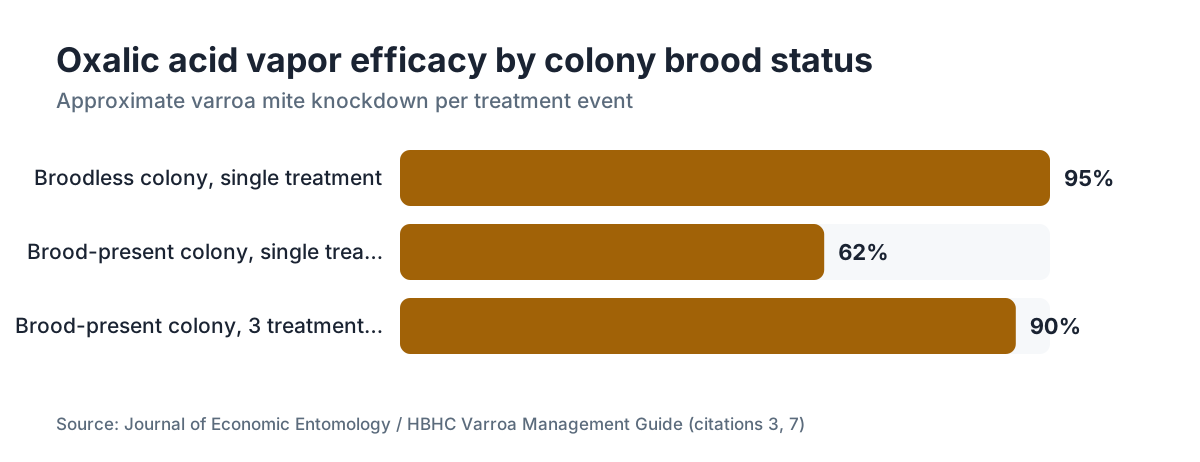
Efficacy is well documented. A 2017 study in the Journal of Economic Entomology found 90-99% mite knockdown in broodless colonies after a single oxalic acid vapor treatment. Add capped brood and that number drops hard, because the vapor cannot reach mites sealed inside brood cells. Those mites survive and repopulate. That is why timing decides everything, and why brood-present colonies need multiple treatments. [3]
Is building a DIY oxalic acid vaporizer legal?
Mostly yes, with real caveats, and this is the question most builders skip right past before they pick up a soldering iron. The Api-Bioxal label says oxalic acid must be applied "using a vaporizer/sublimator that is in compliance with all applicable local, state, and federal regulations." It does not require a store-bought device, and it does not bless homemade ones either.
What the label does require: your device has to sublimate the acid at the right rate, and you still have to meet every other label condition (dose, PPE, timing, no supers on). A DIY wand that delivers the same result as a labeled application method is generally tolerated by state apiarists. A few states are stricter. [2]
California, for one, has historically pushed harder on registered equipment configurations. Call your state department of agriculture before you build anything. No article, this one included, can give you a binding answer for your specific state.
The risk here is not theoretical. A DIY unit that delivers too much acid, scorches the crystals, or vaporizes incompletely can leave residue in your honey supers. Get inspected after a winter colony loss while running an unregistered device loaded with bulk technical-grade OA instead of Api-Bioxal, and that's a documented violation. Use Api-Bioxal, follow the label, and confirm your device actually vaporizes the acid clean. [10]
How many grams of oxalic acid do you use to vaporize honey bees?
The Api-Bioxal label is exact: 2.1 grams of oxalic acid dihydrate per hive body (brood box or super), for vaporization. That 2.1g figure holds whether the colony is broodless or full of brood. [2]
For a single-story colony, use 2.1g total. For a two-story hive, the label treats each box as a unit, so read it carefully for multi-story guidance. In practice most beekeepers treat the whole hive as one sealed unit and use 2.1g per treatment event.
Don't eyeball the dose. Buy a digital jewelry scale that reads to 0.1 gram. It costs $10 to $20 and pays for itself the first season. Under-dose and you lose mite kill. Over-dose and you don't gain much kill, you just add acid load to the hive for no reason.
On bulk oxalic acid from pottery or wood-bleaching suppliers: FIFRA requires the registered product (Api-Bioxal) for treating honey bee colonies. Api-Bioxal is 97.9% oxalic acid dihydrate, formulated and registered for exactly this. Bulk technical-grade OA is not. The price gap is real (Api-Bioxal runs roughly $30 to $50 for 350g as of 2024-2025, while bulk OA can be a fraction of that), but using unregistered material on a food-producing colony is a violation that can wreck your ability to sell honey. [4]
What makes a good oxalic acid vaporizer design?
A working OA vaporizer does one job reliably. It heats a small metal pan into the right range (roughly 315-375°F / 157-190°C), holds that heat long enough to fully sublimate the acid, and seals tight enough that vapor stays in the hive instead of hitting your face.
Commercial units like the Varrox, the ProVap 110, and various 12V battery wands have been tested to do exactly this. They set the bar a DIY unit has to clear.
The common DIY build is a bent aluminum or stainless pan welded or riveted to a heating element pulled from a cheap electric soldering iron or pipe heater, with a steel rod handle long enough to keep your hands off the hive. Battery versions run off a 12V automotive battery or a LiFePO4 pack. Some builders embed Nichrome wire in a ceramic or aluminum block. Whatever the design, it has to spread even heat without scorching the acid (scorching produces carbon monoxide and incomplete sublimation) and without leaving crystals behind.
Three things DIY builders get wrong. They pick aluminum that oxidizes and pits fast under repeated acid exposure, when stainless steel holds up far longer. They undersize the heating element, so the wand takes five or six minutes to finish 2.1g and leaves the entrance open way too long. And they skip the cord strain relief, so a bare wire eventually shorts. None of that is hard to avoid. It just takes planning.
If you're reading plans online, Rusty Burlew's Honey Bee Suite has some of the most practical, cross-referenced OA vaporizer writing in the hobbyist world. She steers a lot of beekeepers toward cheap commercial units over DIY, specifically because the liability math changes once you're mixing toxic acid with improvised electrical gear. [5]
What safety equipment do you absolutely need?
The Api-Bioxal label mandates specific PPE, and none of that language is optional. Here's the short list. [2]
You need a NIOSH-approved respirator rated for acid vapor (minimum an OV/P100 combination cartridge half-face respirator, though a full-face is smarter because it guards your eyes too), chemical-splash goggles if you run a half-mask, nitrile or chemical-resistant gloves, and long sleeves. Oxalic acid vapor is corrosive to the mucous membranes in your nose, throat, and lungs. A dust mask does nothing. A surgical mask does nothing. A paper N95 does nothing against vapor.
Some beekeepers treat OA casually because the crystals look inert sitting in a paper bag. Bad instinct. OSHA sets the permissible exposure limit for oxalic acid at 1 mg/m³ as an 8-hour time-weighted average. Brief exposure to concentrated vapor above that level burns your throat and lungs, and the irritation can linger for hours. [6]
Here's the sequence. Seal every hive opening, insert the wand, seal around it with a rag or foam, wait two to three minutes for full vaporization (or follow your device's timing), pull the wand, and keep the hive sealed another ten minutes. Step back the instant you remove the wand. Don't peer into the entrance. Don't treat on windy days when vapor blows back at you. Work upwind.
Store Api-Bioxal in its original container, cool and dry, away from kids and pets. Dispose of expired product per your state's hazardous waste rules.
When should you treat, and how many treatments does it take?
Timing is where most hobbyist OA programs fall apart. Not equipment. Timing.
Oxalic acid vapor cannot reach capped brood cells. Mites breeding inside those cells are invisible to it. So a single treatment in a colony with brood knocks down the phoretic mites riding on adult bees but leaves the capped-cell population untouched. Over the next two to three weeks that brood emerges, those mites spill back onto adult bees, and the infestation rebounds. [1]
The Honey Bee Health Coalition's Varroa Management Guide recommends this for brood-present colonies: treat every four to five days for a total of three or four treatments. Each round hits the newly emerged bees before mites can burrow back into brood cells. Some beekeepers instead build an artificial broodless window by caging the queen for 24 days, then do one treatment. Very effective, more labor. [7]
The best natural broodless window in temperate climates is midwinter, roughly December through February depending on your latitude. One OA vapor treatment during a true broodless period (confirm by checking the bottom board or briefly opening the hive on a warm enough day) can cut mite loads 90% or more in a single shot. Pair it with a late-summer OA program during the honey harvest gap and your overwintering bees get the best possible start.
The Api-Bioxal label caps you at one treatment per week during brood-present season and no more than three treatments per colony per episode of treatment. Stay under those limits. [2]
For a full seasonal mite calendar that goes past OA alone, the Honey Bee Health Coalition's guide is the most referenced free resource in American beekeeping. [7]
DIY vaporizer vs. commercial unit: which is actually better?
Honest answer: a well-built commercial unit wins for most hobbyists, and the cost gap is smaller than people think. Here's the money side.
Budget commercial OA vaporizers (12V battery or standard outlet) run about $60 to $150 for reliable models as of 2024-2025. The Varrox costs more, around $150 to $200, but it has decades of track record in Europe where OA has been standard for years. The Varrocleaner, various ProVap models, and Tom O'Brien-style wands fill the $60 to $100 range and work fine for hobbyists under 20 hives. [4]
A DIY build with quality parts (stainless pan, decent heating element, proper wiring, an enclosure) comes in under $30 to $40 in materials if you source parts yourself. But the time is real, two to four hours for a competent builder. And the savings shrink once you add a good multimeter to test the circuit and a calibrated thermometer to verify pan temperature.
DIY makes the most sense for sideliners running 20-plus hives who want several wands off one 12V battery, or a longer handle for awkward hive placements. Build four wands yourself at $35 each and you beat four commercial units at $100 each easily.
Weigh any vaporizer against what a dead colony costs. A hive lost to varroa over winter runs $150 to $250 in package or nuc replacement in 2025, plus the lost honey and the gut punch of finding a dead-out in March. The vaporizer you actually use every season beats the fancy one gathering dust because setup feels like a chore.
You can compare gear at beekeeping supply companies and check free shipping honey bee supply companies if you're ordering online.
How do you actually use an oxalic acid vaporizer step by step?
This is the sequence experienced beekeepers actually run, condensed. Follow it in order.
Before you start: load 2.1g of Api-Bioxal onto the pan while it's cold and away from the hive. Put your full PPE on before you touch the acid. Have your entrance plug or foam strips ready.
At the hive: close all entrances, screened bottom boards, and upper ventilation holes. Every gap you seal keeps vapor in and acid off your face. Slide the wand through the bottom entrance so the pan sits between the bottom board and the lowest box. Plug around the wand with foam or a damp rag.
Battery unit: connect to your 12V source. Most wands heat in 30 to 90 seconds and the acid starts sublimating almost right away. Full vaporization of 2.1g takes two to three minutes on a properly sized unit. Cut power, wait another 30 seconds, pull the wand.
Plug-in unit: same steps, wall outlet instead of battery. Follow your device's timing.
After removal: move upwind immediately. Keep the hive sealed ten more minutes. Most of the mite knockdown happens during that sealed window.
Wipe the pan between hives if there's visible residue. A stainless pan wipes clean with a damp cloth while warm but not scorching, or rinses under water once cool. Load fresh acid for each hive.
Record the date and your mite counts (alcohol wash or sugar roll before, sticky board after). Skip the monitoring and you're flying blind. The Honey Bee Health Coalition calls alcohol wash the most accurate field method. [7]
Does oxalic acid vaporization work with honey supers on?
No. Full stop. The Api-Bioxal label prohibits OA vaporization when honey supers holding honey meant for human consumption are on the hive. [2]
Oxalic acid can leave residue in honey above acceptable thresholds, and treating with supers on is a label violation that can make your honey unsellable or turn it into a food safety problem.
Time your treatments for when supers are off. For most North American beekeepers that's late fall through early spring before supers go on, plus the window right after you pull the last super in late summer or early fall. That fall window is one of the highest-stakes moments in your whole mite calendar, because the bees raised then are the long-lived winter bees that carry the colony to spring. Load those bees with varroa and your winter survival rate falls off a cliff. [7]
Pull supers in August and wait until October to treat, and you've handed mites six weeks of brood cycles to multiply unchecked. Don't do that.
What are the most common mistakes beekeepers make with OA vaporizers?
Mistake one: treating once and calling it done. A single treatment in a colony with brood is a start, not a program. You need follow-up rounds at four to five day intervals to catch mites emerging from brood cells, or you need that one treatment during a true broodless window.
Mistake two: not sealing the hive. Vapor leaking out the screened bottom board, the upper entrance, or the telescoping cover gaps is vapor that kills nothing. Tape the screen during treatment, plug upper entrances, weight the cover.
Mistake three: skipping PPE because "it's just one quick treatment." Oxalic acid vapor accumulates. Run ten hives in a row with a half-mask and year-old cartridges and you're getting dosed. Change cartridges on schedule (OV cartridges have a service life once opened; check the data sheet for your brand).
Mistake four: not monitoring before and after. If you don't check, you don't know. An alcohol wash before treatment sets your baseline. A sticky board count 24 to 48 hours after tells you it worked. No mite drop means something's wrong with your technique, your timing, or your device.
Mistake five: buying cheap OA from a non-apicultural supplier and telling yourself it's the same stuff. It may be chemically close, but it's not the registered product, and using it on honey bee colonies in the U.S. is a FIFRA violation. The Honey Bee Health Coalition and most state apiarists are clear on this. [10]
For the varroa biology behind why timing rules everything, see the varroa mite article.
Where does OA vaporization fit in a full varroa management program?
Oxalic acid vaporization is one tool. Used alone and used late, it won't rescue a colony that's already crashing under mites. Slotted into a planned seasonal protocol, it's genuinely strong and cheap.
The Honey Bee Health Coalition's Varroa Management Guide, the most cited free reference in American beekeeping, lays out the integrated approach: monitor mite loads (a 2% alcohol wash on adult bees is the standard action threshold), match the treatment to the season and the colony's brood status, rotate chemistries to slow resistance, and monitor again to confirm the treatment worked. [7]
A sensible program for most hobbyists in USDA hardiness zones 5 to 8 looks like this. Late summer (August to September, after supers come off): treat with a formic acid product like Mite Away Quick Strips or HopGuard if brood is present and you need something that penetrates capped cells. Then treat with OA vaporization in midwinter during the broodless period for a deep clean before spring build-up. Test in early spring to confirm you're starting below 2%, and treat again if you're not.
VarroaVault's free protocol tools help you build and track a seasonal schedule for your region, colony count, and treatment history. Managing the whole cycle is what separates beekeepers who overwinter colonies year after year from the ones constantly buying replacements.
Nobody has clean long-term U.S. resistance data on OA specifically, because OA works through a physical mode of action rather than the neurotoxic pathway of synthetic miticides, and field resistance hasn't been documented. The closest relevant review, a 2018 paper in Pest Management Science, found no evidence of resistance developing in European varroa populations after years of heavy use. Reassuring, but not a license to run OA as your only tool forever. [8]
Frequently asked questions
Can I build a DIY oxalic acid vaporizer legally?
The EPA label for Api-Bioxal does not ban homemade vaporizers, but it requires the device to produce conditions that match a proper vaporization application. Some states are stricter than others. You must still use registered Api-Bioxal (not bulk OA) and follow every label requirement, including PPE. Check with your state department of agriculture before building and using a DIY unit.
How many grams of oxalic acid do you use per hive when vaporizing?
The Api-Bioxal label specifies 2.1 grams of oxalic acid dihydrate per hive body per treatment. Use a digital scale accurate to 0.1 grams. Don't estimate by eye. Under-dosing cuts mite kill; over-dosing doesn't meaningfully improve it and just adds unnecessary acid to the hive.
How many times can you treat with oxalic acid vaporization per year?
The Api-Bioxal label allows up to three treatments per episode of treatment, spaced no more than once per week. During the broodless winter period, one well-timed treatment is often enough. During brood-present seasons, three treatments spaced four to five days apart target multiple waves of emerging mites. Do not exceed the label limits.
Does oxalic acid vaporization work when there is brood in the hive?
Partially. OA vapor kills phoretic mites on adult bees but cannot penetrate capped brood cells, so mites inside those cells survive. Efficacy in brood-present colonies is typically 50 to 75% per treatment, compared to 90 to 99% in broodless colonies. Multiple treatments spaced four to five days apart are needed to catch mites as brood emerges.
What respirator do I need for oxalic acid vaporization?
A NIOSH-approved half-face or full-face respirator with OV/P100 combination cartridges is the minimum. A dust mask, N95, or surgical mask gives zero protection against acid vapor. A full-face respirator is strongly preferred because it also guards your eyes and mucous membranes. Replace cartridges on the manufacturer's schedule, more than when they look old.
Can I use oxalic acid with honey supers on the hive?
No. The Api-Bioxal label explicitly prohibits vaporization treatment when honey supers intended for human consumption are present, because oxalic acid can leave residue in honey. Time all OA treatments for periods when supers are off: late fall, winter, or the window right after pulling supers in late summer before fall nectar flows begin.
What's the difference between oxalic acid vaporization and the dribble method?
The dribble method applies a dilute oxalic acid syrup directly between frames. It works but stresses bees more, requires opening the hive in winter, and has lower efficacy in brood-present colonies. Vaporization is faster, less stressful to the colony, and more effective per treatment. Vaporization is the preferred method for most modern mite management programs.
How long does it take for the mites to die after an oxalic acid vapor treatment?
Mite knockdown begins during the treatment and continues for 24 to 72 hours afterward as the deposited acid crystals keep contacting mites on bees and hive surfaces. A sticky board placed under the hive for 48 to 72 hours post-treatment is the standard way to confirm it worked. Significant mite drop should show up within the first day.
What temperature does oxalic acid sublimate at?
Oxalic acid dihydrate begins sublimating at approximately 315°F (157°C) and vaporizes most efficiently in the 315 to 375°F range. Below that you get incomplete vaporization and residue. Above 400°F you risk scorching, which produces unwanted combustion byproducts. A well-designed vaporizer holds the pan in the target range for the full two to three minutes of a treatment.
Does varroa ever become resistant to oxalic acid?
Not documented in field populations in the current literature. A 2018 review in Pest Management Science found no evidence of oxalic acid resistance in European varroa populations despite years of heavy use. The physical mode of action (contact toxicity via cuticle disruption) makes resistance harder to develop than with neurotoxic miticides, but no resistance claim is ever permanent. Keep monitoring after every treatment.
How do I know if my DIY vaporizer is actually working?
Put a sticky board or tray under your screened bottom board for 48 to 72 hours after treatment and count the mite drop. In a broodless colony, a working treatment produces a visible mite fall proportional to your pre-treatment mite load. Calibrate your device against a known-good commercial unit if you can, or use a calibrated thermometer to verify the pan hits the 315 to 375°F target range.
Can I use bulk oxalic acid from a pottery or woodworking supplier instead of Api-Bioxal?
Legally, no. FIFRA requires the EPA-registered product (Api-Bioxal, Registration 84449-3) for treating honey bee colonies for varroa in the U.S. Bulk technical-grade oxalic acid from non-apicultural suppliers is not registered for this use. Using it on a food-producing colony is a federal violation and can affect your ability to sell honey.
What is the Honey Bee Health Coalition's recommendation for OA vaporization?
The Honey Bee Health Coalition's Varroa Management Guide recommends OA vaporization as an effective tool, especially during broodless periods where a single treatment can hit 90%-plus mite reduction. For brood-present colonies, the guide recommends three treatments spaced four to five days apart. It also stresses monitoring before and after treatment to confirm efficacy.
How much does a commercial oxalic acid vaporizer cost compared to building one?
Commercial units range from about $60 to $150 for budget wand-style vaporizers to $150 to $200 for established European units like the Varrox. A DIY build using quality stainless components and a salvaged heating element runs $30 to $40 in materials, plus two to four hours of build time. For beekeepers running one or two hives, the commercial unit's convenience and known reliability usually makes more sense.
Sources
- USDA Agricultural Research Service, Beltsville Bee Research Laboratory: Oxalic acid vapor kills phoretic varroa mites on adult bees; mites in capped brood cells are not reached by the vapor
- EPA, Api-Bioxal Pesticide Registration 84449-3 Label: Api-Bioxal label specifies 2.1 grams oxalic acid dihydrate per hive body per vaporization treatment; prohibits use with honey supers present; mandates OV/P100 respirator PPE
- Journal of Economic Entomology (Oxford Academic), oxalic acid efficacy study: Single oxalic acid vapor treatment achieves 90-99% varroa mite knockdown in broodless colonies
- University of Florida IFAS Extension (EDIS), Honey Bee Varroa Mite Management: Api-Bioxal pricing approximately $30-50 per 350g pack; commercial OA vaporizers range from $60 to over $150
- Honey Bee Suite (Rusty Burlew), Oxalic Acid Vaporization Practical Guidance: Honey Bee Suite oxalic acid vaporizer content is widely referenced in hobbyist communities; Burlew recommends budget commercial units over DIY for most beekeepers citing safety and liability
- OSHA, Chemical Sampling Information, Oxalic Acid Permissible Exposure Limits: OSHA permissible exposure limit for oxalic acid is 1 mg/m³ as an 8-hour time-weighted average
- Honey Bee Health Coalition, Varroa Management Guide (current edition): HBHC recommends 2% adult bee alcohol wash as treatment action threshold; recommends 3-4 OA vapor treatments spaced 4-5 days apart for brood-present colonies; identifies alcohol wash as most accurate field monitoring method
- Pest Management Science (Wiley Online Library), Maggi et al. 2018 oxalic acid resistance review: 2018 review found no evidence of varroa resistance to oxalic acid developing in European bee populations after years of widespread use
- EPA, Summary of the Federal Insecticide, Fungicide, and Rodenticide Act (FIFRA): Under FIFRA, pesticide users must follow registered label directions; using unregistered material (bulk oxalic acid) as a pesticide on honey bees is a federal violation
Last updated 2026-07-09