Does oxalic acid affect honey? What beekeepers need to know
TL;DR
- Oxalic acid (OA) treatments do not meaningfully contaminate honey.
- Honey naturally carries oxalic acid at 8-40 mg/kg, and treated colonies show no significant increase above that background.
- EPA-registered OA products are approved for colony use, but label rules ban applying them while honey supers are on the hive.
- Follow the label and your honey stays clean, your bees stay legal.
What is oxalic acid and why do beekeepers use it?
Oxalic acid is a natural organic acid found in plants, vegetables, and honey itself. Beekeepers use it to kill Varroa destructor mites, the single biggest driver of colony loss in the northern hemisphere. It works on contact. When a mite walks through oxalic acid crystals or gets coated in an OA vapor or solution, the acid damages the mite's body and kills it.
Three delivery methods are registered with the EPA in the United States: vaporization (sublimation), dribble (also called trickle or drizzle), and extended-release sponge products like Api-Bioxal's glycerin-soaked strips. Each has a different application window, efficacy profile, and label restriction. They share one property that governs everything. They only kill phoretic mites, the ones riding on adult bees outside capped brood cells. That single limitation is why timing and repeat applications matter so much [1].
The Fat Bee Man, a well-known YouTube beekeeper from Georgia with a big hobbyist following, has posted videos on oxalic acid protocols and sometimes questioned whether the treatment ends up in honey. His audience searches for "fat bee man oxalic acid" because his style is plain and skeptical in a way backyard beekeepers trust. The question he raises is a real one worth taking seriously.
Does oxalic acid naturally occur in honey already?
Yes, and this is the context most articles skip. Honey already contains oxalic acid at measurable levels no matter what you do. Published analyses put the range at roughly 8 to 40 mg/kg in untreated colonies, depending on floral source, season, and region [2]. Some samples from certain plant sources run higher still.
That background exists because bees pick up oxalic acid from nectar, pollen, and plant exudates. When researchers compared honey from treated colonies against untreated controls, the treated honey showed no statistically significant increase above that natural range. A 2003 study by Bogdanov et al., published in Apidologie, is the most-cited work on this question. The authors reported that "oxalic acid residues in honey from treated colonies were not significantly different from those in untreated control colonies" [2].
That finding has held up in later European food safety reviews. The European Food Safety Authority (EFSA) concluded that OA treatments do not pose a consumer safety concern given the natural background levels already present [3]. The EPA reached a similar conclusion when it registered Api-Bioxal for U.S. use [1].
What does the EPA label actually require for honey supers?
This trips up a lot of beekeepers, because the regulatory answer and the contamination answer are two different questions.
The EPA label for Api-Bioxal (the only OA product with a full federal registration as of this writing) prohibits application when honey supers intended for human consumption are on the hive [1]. That rule does not exist because OA would push honey above a dangerous threshold. It exists because the label study package did not include a residue trial with supers in place, so the EPA could not set a tolerance. When a label says "do not apply with honey supers present," ignoring it is a federal FIFRA violation even if the science says the honey would be fine.
So your OA treatment window is this: after the main honey flow ends and supers are pulled, or in early spring before supers go on. Most beekeepers using OA for varroa are treating in late summer or fall anyway, which lines up naturally with the supers-off period. Treating a broodless winter cluster? There are no supers to worry about.
One more wrinkle. Some state-registered OA products and homemade OA solutions exist outside the Api-Bioxal label. Using any of those on a colony counts as unregistered pesticide use under FIFRA, no matter what the honey does or doesn't absorb. The legal and liability exposure there is real.
Does oxalic acid vaporization put more residue into honey than dribbling?
Probably not by any meaningful amount, but the two methods work differently and the vaporization data is thinner than the dribble data.
With dribble, you apply an OA-sugar syrup directly over the bees. Some of that liquid can end up on comb surfaces. With vaporization, sublimated OA crystals coat surfaces throughout the hive, comb included. In theory, both methods could deposit OA on honey stores.
The Bogdanov et al. research covered both methods and found residues stayed within the natural background range for each [2]. A later analysis of vaporization-treated colonies in an Italian study similarly found no significant residue accumulation in honey stores. The consensus in the academic literature is that the amount deposited is small relative to background and gets processed or diluted as bees keep curing and moving honey.
Here's the honest gap. Nobody has run a large-scale, multi-year, multi-climate residue study on vaporization in production colonies with supers present. If you care about data quality, that gap is worth naming. The closest we have is the collection of European studies that fed the EFSA opinion, and those are not nothing. But "the data says it's fine" is not the same as "the EPA says you can do it with supers on." Both statements are true at once.
For beekeepers building a varroa mite management plan, the practical move is to match your OA applications to the broodless or low-brood periods in fall and winter, when supers are off anyway. That alignment gives you the best mite kill and keeps you fully on-label.
How effective is oxalic acid against varroa mites compared to other treatments?
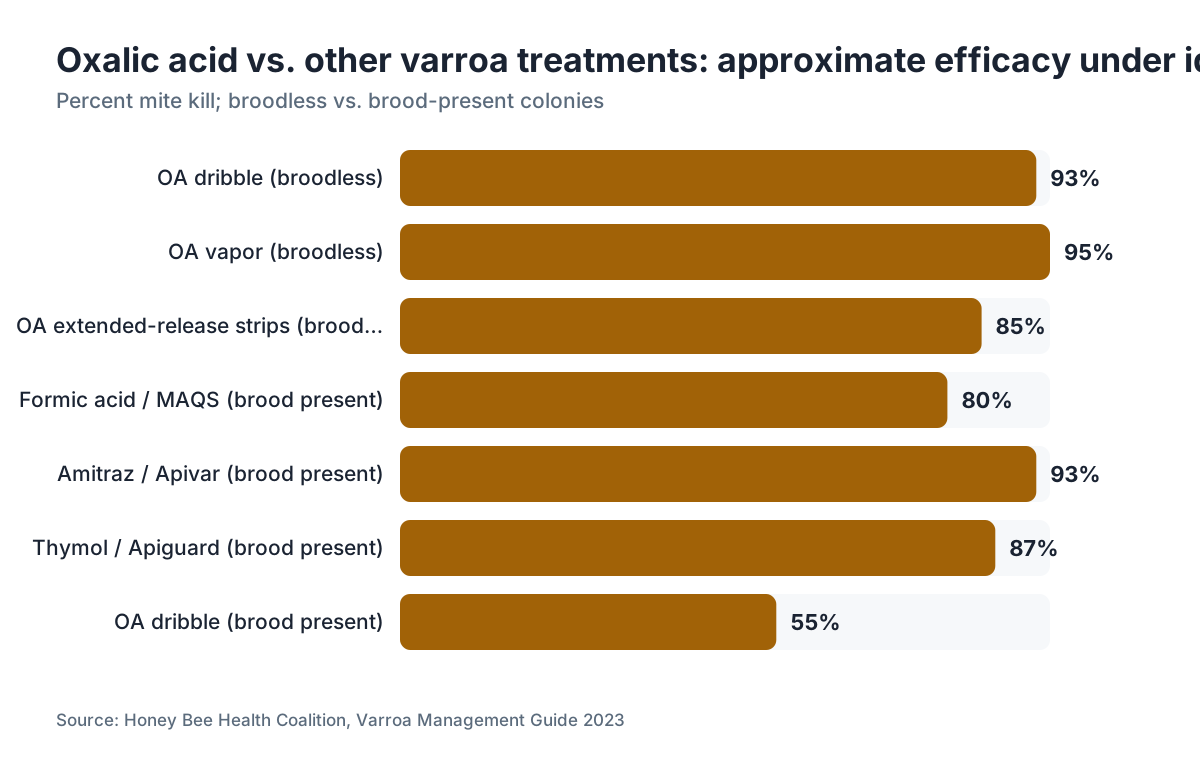
OA efficacy hangs on brood status. In a broodless colony, a single oxalic acid dribble or vapor treatment achieves 90-95% mite kill in published trials [4]. That number drops hard when brood is present, because mites hiding under capped brood are completely shielded from OA contact.
Here's a comparison of common treatment options and their approximate efficacy under ideal conditions:
| Treatment | Active Ingredient | Efficacy (broodless) | Efficacy (brood present) | Notes |
|---|---|---|---|---|
| Oxalic acid dribble | Oxalic acid | ~93% | ~50-60% (mites on bees only) | Single application, EPA label |
| Oxalic acid vapor | Oxalic acid | ~95% | ~60-70% (mites on bees only) | Can repeat; respiratory hazard |
| OA extended release (strips) | Oxalic acid + glycerin | N/A (not broodless-specific) | ~80-90% over full brood cycle | Newer method, longer contact time |
| Formic acid (MAQS, Formic Pro) | Formic acid | ~90%+ | ~70-90% | Penetrates cappings, temp-sensitive |
| Amitraz (Apivar) | Amitraz | ~95%+ | ~90%+ | Synthetic, resistance risk in some regions |
| Thymol (ApiLife Var, Apiguard) | Thymol | ~85-90% | ~80% | Temperature-dependent, not below 60°F |
Oxalic acid earns its place because it's cheap, has no known resistance issues in U.S. mite populations so far, and leaves no residue concern in honey when used per label [4][5]. The Honey Bee Health Coalition's Varroa management guide calls OA a "highly effective" treatment for broodless conditions and recommends it inside an integrated management approach [4].
If you need help tracking mite counts through treatment cycles, VarroaVault offers free varroa management tools and protocol templates that walk you through the numbers.
Is oxalic acid safe for the bees themselves?
At label rates, oxalic acid is well-tolerated by adult bees. The dribble method can cause some bee mortality at high rates or in very cold weather, but at the recommended dose of 5 mL of 3.2% solution per seam of bees, mortality stays minimal in healthy colonies [1][4].
Vaporization at label concentrations (1 gram of Api-Bioxal per brood chamber) is considered gentler on bees than dribble in some studies, partly because the bees aren't soaked in liquid. Beekeeper safety is the bigger concern with vapor. The sublimated crystals are a lung hazard, and proper respiratory protection (a NIOSH-approved P100 respirator, not a dust mask) is mandatory.
Effect on brood is minimal when OA is used correctly. OA does not penetrate capped cells, so larvae inside sealed brood are never exposed. Open larvae tolerate the concentrations present after treatment. Queens appear to handle OA treatments normally, though some beekeepers report laying interruptions after several vapor treatments in quick succession. Nobody has solid controlled data on repeated vaporization and queen health specifically. The closest evidence is anecdotal, and the label-allowed repeat schedule (three applications, seven days apart) is considered safe by the registrant's data.
Can you use oxalic acid in a hive with honey supers if you remove them first?
Yes, and that's the correct protocol. Pull the supers, treat the colony, and give the OA time to work before you replace them. In practice, most fall treatments happen well after the last super comes off, so there's no logistical conflict.
The question comes up in spring: if you treat early, can you add supers shortly after? The label doesn't set a re-entry interval for supers, but the residue studies show OA levels return to background range quickly after treatment. Many beekeepers add supers within a few days to a week of treatment without concern. To stay strictly on-label, though, apply OA only during a period with no supers present. The label language is not about a waiting period after treatment. It bans application while supers are there.
For beekeepers sourcing equipment, see our guide to beekeeping supply companies for vendors that carry Api-Bioxal and OA application tools.
What do university extension services say about oxalic acid and honey contamination?
Extension apiculture programs at land-grant universities broadly back OA as a safe, effective tool when used correctly. Penn State Extension notes that OA is approved for organic operations under the USDA National Organic Program when applied per label, and points out that natural background levels in honey make residue a non-issue at label rates [5]. Virginia Cooperative Extension and the University of Minnesota Bee Lab both recommend OA inside an integrated varroa management program and do not list honey contamination as a concern when supers are off [6][7].
The Honey Bee Health Coalition, which pulls together guidance from university researchers, USDA scientists, and industry, published its full Varroa management guide through a multi-institution process. That document recommends OA for multiple treatment windows and states no honey residue concern at label use [4]. The coalition's guide is probably the single most useful free reference for beekeepers working out a full-season varroa protocol.
None of these sources treat OA residue in honey as a real-world problem. The message is consistent. The natural background level in honey already sits higher than what treatments add, and EU and U.S. food safety reviews confirm it [2][3].
What about the Fat Bee Man's specific concerns or claims about oxalic acid?
The Fat Bee Man (a hobbyist beekeeper and YouTube creator from Georgia) built a following by questioning mainstream beekeeping advice and favoring simpler, lower-intervention methods. His oxalic acid videos have driven a lot of searches because his viewers take his skepticism seriously and want to know if he's onto something.
His general concern, repeated across several videos, is roughly this: are we treating our hives with chemicals that end up in the honey we eat? Fair question. The answer, based on the published science, is that OA does not meaningfully raise honey residues above naturally occurring levels [2]. That's not a dismissal of the question. It's just where the data points.
His preference for natural or minimal-treatment approaches is a legitimate position. Some beekeepers accept higher colony losses in exchange for less intervention. Others manage mites aggressively. Both are coherent choices. What the science does not support is the idea that OA-treated honey is chemically different in any meaningful way from untreated honey, assuming you follow the label rule about supers.
If his videos brought you here, the most useful frame is simple. Read the actual Bogdanov et al. study, read the Api-Bioxal label, and make your own call. Those two documents together answer most of the real questions.
How does oxalic acid compare to synthetic treatments for honey purity?
This is where OA has a real edge over some alternatives. Synthetic acaricides like amitraz (Apivar) and coumaphos (CheckMite+) are lipophilic. They bind to beeswax and build up in comb over time. Studies have found amitraz and coumaphos residues in beeswax and honey even when label directions were followed, and those residues can persist across multiple seasons [8].
Oxalic acid does not build up in wax. It doesn't bind to lipids. Whatever OA lands on comb surfaces either gets cleaned off by bees or dissipates. That difference is real, and it's one reason OA is favored in organic and natural beekeeping communities.
Formic acid sits in the same category as OA. It's an organic acid, it doesn't accumulate in wax, and it's approved for organic use. Thymol is also organic-approved and non-accumulating. The broader point holds. Choosing an organic acid over a synthetic miticide does matter for long-term comb cleanliness, even though short-term honey contamination at label use is not a significant concern for any registered treatment.
For beekeepers who want to understand the pest itself before picking a treatment, see our explainer on the varroa mite.
What are the actual rules for organic honey certification and oxalic acid?
The USDA National Organic Program (NOP) permits oxalic acid for certified organic bee operations [9]. The restriction matches the EPA label: no honey supers in place during application. Some certifiers add documentation requirements, but the substance itself is on the NOP's allowed materials list.
Coumaphos and amitraz are not permitted under NOP because they're synthetic and accumulate in comb. Formic acid and thymol are permitted, same as OA.
Here's a practical trap for organic producers. If you buy second-hand equipment with a long history of synthetic acaricide use, the comb may carry residues that could technically disqualify it, even if all your current treatments are organic. Some certifiers require fresh foundation or comb testing when there's any doubt about equipment history. That's a separate issue from OA treatment itself, but worth knowing if organic certification matters to you.
How should beekeepers time oxalic acid treatments for maximum effectiveness without honey concerns?
The ideal OA treatment window lines up three conditions: mite loads above threshold (typically 2-3 mites per 100 bees on an alcohol wash or sugar roll [4]), low or no capped brood, and honey supers off the hive. In most of North America, late August through October hits all three naturally.
A fall plan that works for many beekeepers goes like this. Pull supers after the main flow. Do an alcohol wash to confirm mite load. Treat with OA vapor or dribble on a broodless or near-broodless colony. Recheck mite loads 30 days later, and treat again if counts are still above threshold. The goal is to enter winter with mite loads below 1-2 mites per 100 bees.
For winter cluster treatment (December through February in cold climates), the colony is naturally broodless and OA vapor gives excellent results. Some beekeepers run a single late-fall vapor treatment as their primary annual intervention. That's defensible in low-mite-pressure situations, though most extension recommendations favor monitoring-driven treatment over calendar-based treatment.
VarroaVault's free protocol tools help you build a season-specific plan and track mite counts over time, so you're treating on actual numbers instead of guesswork.
For sourcing equipment and treatments, a list of beekeeping supply companies with OA applicators and Api-Bioxal in stock can save you a lot of searching.
Frequently asked questions
Does oxalic acid get into honey and make it unsafe to eat?
No. Honey naturally contains oxalic acid at 8-40 mg/kg from plant sources. Studies, including Bogdanov et al. 2003, found treated colonies show no significant residue increase above that natural background. EFSA and the EPA both concluded OA treatments do not pose a consumer food safety concern. The label prohibition on using OA with supers present is a registration requirement, not a safety threshold issue.
Can I use oxalic acid when honey supers are on the hive?
No. The Api-Bioxal label (the only EPA-registered OA product in the U.S.) explicitly prohibits application when honey supers intended for human consumption are on the hive. This is a legal FIFRA requirement. Violating a pesticide label is a federal offense. Pull your supers before treating. The science suggests the honey would likely be fine, but the law requires the supers to be off.
What does the Fat Bee Man say about oxalic acid and honey?
The Fat Bee Man has raised concern about chemical treatments ending up in honey. His question is reasonable, but the published science consistently shows OA does not meaningfully raise honey residues above natural background levels. His broader preference for minimal intervention is a legitimate philosophical position. For the data specifically, Bogdanov et al. 2003 and the EFSA opinion on OA are the two primary sources worth reading directly.
How long after an oxalic acid treatment can I add honey supers?
The Api-Bioxal label doesn't set a waiting period after treatment before adding supers. It prohibits applying OA while supers are present. Residue studies show OA levels in honey return to natural background range quickly after treatment. Many beekeepers add supers within a few days to a week post-treatment. To stay strictly on-label, apply OA only during super-off periods, then add supers at the start of the next flow.
Is oxalic acid approved for use in certified organic honey operations?
Yes. The USDA National Organic Program lists oxalic acid as an allowed substance for certified organic bee operations. The restriction matches the EPA label: no honey supers in place during application. Some certifiers may require documentation of your treatment records. Synthetic miticides like amitraz and coumaphos are not permitted under NOP.
Does oxalic acid build up in beeswax the way amitraz or coumaphos does?
No. Oxalic acid is water-soluble and does not bind to lipids or accumulate in beeswax. Synthetic acaricides like amitraz and coumaphos are lipophilic and have been found in beeswax even after years with no further application. This non-accumulation is one of OA's real advantages for beekeepers worried about long-term comb contamination.
What is the kill rate of oxalic acid on varroa mites?
In a broodless colony, a single OA dribble or vapor treatment achieves roughly 90-95% mite kill in published trials. Efficacy drops when brood is present because OA cannot penetrate capped cells. Mites reproducing inside sealed brood cells are fully protected. For this reason, timing OA treatment to broodless periods in late fall or winter gives the best results.
Can oxalic acid harm honey bee brood or queens?
At label rates, OA does not meaningfully harm capped brood because it cannot penetrate cell cappings. Open larvae tolerate normal treatment concentrations. Queens generally tolerate OA treatments well. Some beekeepers report brief laying interruptions after multiple vapor treatments in rapid succession, but this is anecdotal. The label-allowed schedule of three applications seven days apart is considered safe based on the registrant's data package.
How is oxalic acid applied, and which method is best for varroa?
Three EPA-registered methods exist: vaporization (sublimation), dribble, and extended-release glycerin-soaked strips. Vaporization and dribble work best on broodless colonies and achieve 90-95% kill. Extended-release strips work across a full brood cycle and reach roughly 80-90% efficacy with brood present. Vapor is faster per colony in large operations; dribble requires no special equipment. All three are on the Api-Bioxal label.
Is homemade oxalic acid solution legal to use on bees?
No. Using any pesticide in a manner inconsistent with its label is a FIFRA violation in the U.S. Homemade OA solutions are not registered and have no label. Only Api-Bioxal (and a small number of other EPA-registered OA products) are legal to use. Buying oxalic acid wood bleach or industrial grade OA and treating colonies with it is unregistered pesticide use regardless of concentration or intent.
When is the best time of year to treat with oxalic acid?
Late summer to early winter, after honey supers are pulled and when brood is minimal or absent. In most of North America, that means August through October for a fall treatment, or December through February for a winter cluster treatment. Broodless or near-broodless colonies give you the highest mite kill efficiency. Confirm mite load with an alcohol wash before treating.
What safety precautions does a beekeeper need when using oxalic acid vaporizer?
A NIOSH-approved P100 respirator is mandatory, not optional. Sublimated OA crystals are a serious lung hazard and can cause irreversible damage. Goggles and gloves are also required. Keep bystanders away. Do not stand near the vaporizer opening. The Api-Bioxal label specifies all required PPE, and the label is law. A dust mask or surgical mask provides inadequate protection.
Does oxalic acid have any effect on Nosema or other bee pathogens?
No. Oxalic acid targets varroa mites specifically through contact action. It has no documented efficacy against Nosema apis, Nosema ceranae, American foulbrood, European foulbrood, or any other common bee pathogen. If your colony has a Nosema problem alongside a mite problem, OA addresses only the mites. Nosema management requires separate interventions, and the picture is complicated by ongoing research on treatment efficacy.
How soon after treatment should I recheck mite levels?
Wait at least three to four weeks after a fall OA treatment before rechecking. If you treated a colony with brood present, allow a full brood cycle (about 21 days for workers) so newly emerged bees carry any surviving mites back into the phoretic stage where they can be counted. Use an alcohol wash on roughly 300 bees. A count above 2-3 mites per 100 bees warrants another treatment.
Sources
- EPA, Api-Bioxal Pesticide Registration (Reg. No. 80024-19): Api-Bioxal label requires honey supers to be removed before OA application; approved application methods include vaporization, dribble, and extended-release strips
- Bogdanov S. et al., Apidologie 2003, oxalic acid residues in honey: Oxalic acid residues in honey from treated colonies were not significantly different from those in untreated control colonies; natural honey OA range 8-40 mg/kg
- European Food Safety Authority (EFSA), Scientific Opinion on oxalic acid in honey bees: EFSA concluded OA treatments do not pose a consumer safety concern given natural background OA levels already present in honey
- Honey Bee Health Coalition, Varroa Management Guide (2023 edition): OA achieves 90-95% mite kill in broodless colonies; recommended mite threshold for treatment is 2-3 mites per 100 bees; OA described as highly effective for broodless conditions
- Penn State Extension, Varroa Mite Management: OA approved for use in organic operations under USDA NOP; natural background levels in honey make residue a non-issue at label rates
- Virginia Cooperative Extension, Honey Bee Varroa Mite Management: Virginia Cooperative Extension recommends OA as part of integrated varroa management and does not list honey contamination as a concern when supers are off
- University of Minnesota Bee Lab, Varroa Treatment Options: University of Minnesota Bee Lab includes OA in its varroa management recommendations for broodless and low-brood treatment windows
- Mullin C. et al., PLOS ONE 2010, pesticide residues in comb wax: Amitraz and coumaphos residues found accumulating in beeswax and honey even when label directions were followed; residues persist across multiple seasons
- USDA National Organic Program, Allowed and Prohibited Substances (7 CFR Part 205): Oxalic acid is listed as an allowed substance for certified organic bee operations under the USDA National Organic Program
- EPA, Federal Insecticide, Fungicide, and Rodenticide Act (FIFRA) Overview: Using a pesticide in a manner inconsistent with its label is a federal FIFRA violation; unregistered pesticide use is prohibited
Last updated 2026-07-09