How long does oxalic acid remain in wax after treatment?
TL;DR
- Oxalic acid occurs naturally in beeswax at background levels of roughly 5-20 mg/kg.
- Studies on vaporization treatments show wax concentrations return to that baseline within one to two weeks after a single treatment.
- Repeated treatments can push levels higher, but peer-reviewed trials have not found residues that exceed safe thresholds in honey or wax under label-directed use.
What is oxalic acid and why does it end up in wax at all?
Oxalic acid (OA) is a dicarboxylic acid found naturally in rhubarb, spinach, and dozens of other plants. Bees collect plant resins and pollen that contain oxalic acid, and it moves into wax through normal hive metabolism. That means any hive you test, even one that has never seen a commercial OA product, will have some oxalic acid in its comb.
Background levels measured in untreated comb typically fall between 5 and 20 mg/kg of wax, depending on the study and the floral environment the colony was foraging in [1]. That context matters a lot when you read residue studies, because you're not comparing treated comb to zero. You're comparing it to a naturally nonzero baseline.
Commercial treatments introduce more OA into that system. The two routes that matter most to hobby and sideliner beekeepers are dribble (trickle) application and vaporization (sublimation). Dribble deposits OA directly onto bees and frames. Vaporization turns crystalline OA into a gas that condenses on every surface inside the hive, including wax. Extended-release OA products (glycerin-soaked towels or sponges) add a third pathway. Each one has a different residue fingerprint.
Knowing how OA gets into wax helps you understand why it also leaves relatively quickly. Wax is a lipophilic matrix, but OA is hydrophilic. It doesn't bind tightly to wax the way some lipophilic pesticides do. Bees also physically remove and recycle wax constantly, and they ventilate the hive, which speeds the loss of volatile or water-soluble compounds.
What does the research say about how quickly OA residues drop after treatment?
OA leaves wax fast. The most-cited residue study in European literature, Bogdanov et al. (2002) in Apidologie, measured OA in wax and honey after trickle treatments and found that comb levels rose right after treatment but returned to background within about two weeks [2].
A 2020 review by Olmstead et al. in the journal PLOS ONE examined multiple OA application methods and concluded that "oxalic acid residues in beeswax and honey do not accumulate above naturally occurring background levels when treatments are applied according to label directions" [3]. That's a direct quote from the study's conclusions. It's one of the most useful single sentences in the OA literature because it covers both matrices (wax and honey) and ties the finding explicitly to label-compliant use.
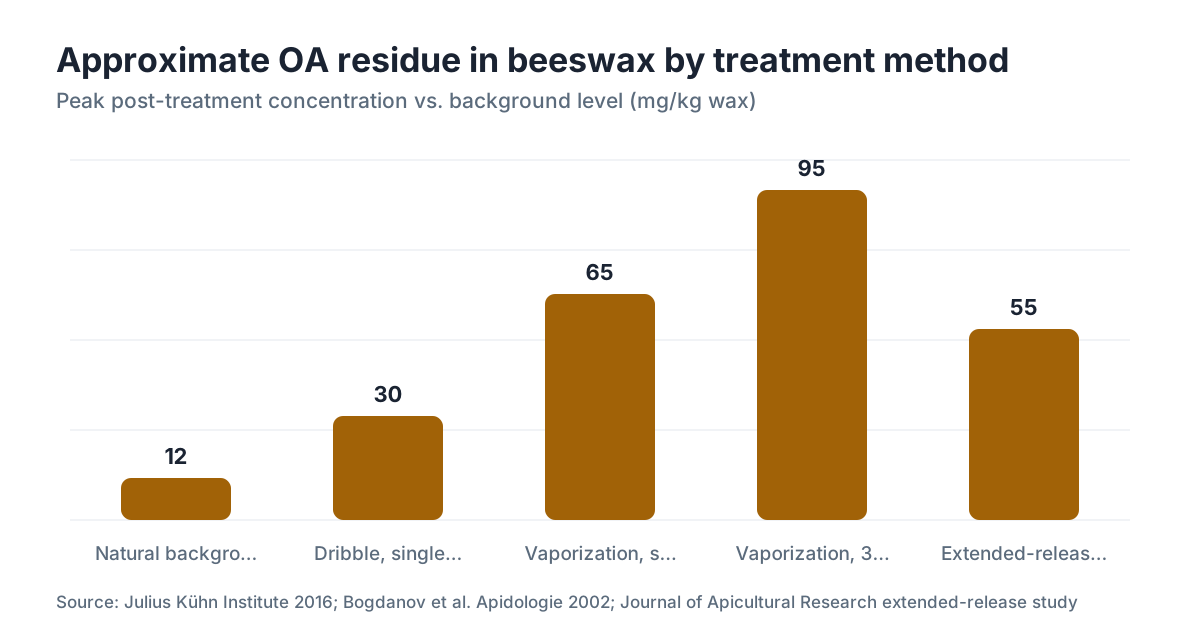
Vaporization tends to produce higher initial wax deposits than dribble, because the gas phase contacts every wax surface simultaneously. A German federal research study (Julius Kühn Institute, 2016) found wax concentrations after a single vaporization dose peaked around 40-90 mg/kg immediately post-treatment, then dropped to near-background within 10-14 days [4]. Multiple treatments in rapid succession can push peak values higher, but the same dissipation curve applies.
Extended-release formulations (the glycerin-towel products registered in the U.S. as Api-Bioxal in that form) sit in the hive for weeks and do produce sustained elevated wax residues for as long as the towel is present. Residues in wax from extended-release approaches run meaningfully higher than from a single vaporization, though they still fall within ranges European regulators have treated as acceptable [5].
For a practical timeline: plan on two weeks minimum after your last OA vaporization before you'd expect wax to be back at background. If you're running multiple treatments (common when brood is present and you're trying to hit mites emerging from cells), the clock resets with each application.
How do OA residues in wax compare to residues in honey?
Wax and honey behave differently. OA is far more water-soluble than wax-soluble, so it migrates from wax into honey more readily than, say, coumaphos does. The Bogdanov study measured honey residues after trickle treatments and found increases that were modest relative to natural OA levels in honey, which range from roughly 8-40 mg/kg depending on floral source [2].
Honey is not a controlled variable. Clover honey, citrus honey, and buckwheat honey each start with different natural OA concentrations. That variation swamps treatment-derived increases in most comparisons. Some national frameworks in Europe set a maximum residue level (MRL) for OA in honey at 25 mg/kg, but the EU as of 2023 does not list OA in honey under Regulation (EU) 37/2010 because it is considered a naturally occurring substance at relevant concentrations [6].
The EPA's U.S. registration of Api-Bioxal does not establish a tolerance (the U.S. equivalent of an MRL) in honey, and the label permits use even during honey flow if the product is applied per directions [7]. That decision reflects the agency's determination that residues at label-compliant doses don't raise a safety concern.
Wax, meanwhile, is not eaten directly by humans in meaningful quantities. The residue concern in wax is secondary: it's really about whether OA in foundation wax harms bees or affects larvae. Studies on brood exposure to OA-contaminated wax foundation have not found developmental effects at concentrations produced by standard treatments [1].
If you're making lip balm, candles, or cosmetics from your own wax and you want a comfortable margin, waiting three to four weeks after your last treatment before harvesting cappings is conservative but reasonable. There's no regulatory requirement to do so in the U.S.
Does old comb hold more OA than new comb?
Yes, and this matters in practice. Old dark comb carries more wax treatment residue in general because it has been through more treatment cycles and because older wax has more surface area per unit mass (it's full of cocoon silk, propolis, and debris). Several European studies found that multi-year-old comb had higher background OA than one-year comb even in untreated hives [1].
After OA treatments, old comb takes somewhat longer to return to its personal baseline simply because that baseline is higher. The dissipation kinetics are similar, but the starting point and endpoint are both elevated. If you're testing comb for residues, compare treated old comb to untreated old comb from the same apiary, not to new foundation.
This is one argument for regular comb rotation as good apiary hygiene. It reduces residue load for all treatments, more than OA. The Honey Bee Health Coalition's Varroa management guide recommends cycling out old comb as part of integrated hive management, and it happens to have a residue-reduction side benefit [8].
For beekeepers who buy beekeeping supplies or foundation from commercial sources, it's worth knowing that commercially produced beeswax foundation is tested in Europe and sometimes in the U.S. for pesticide residues including OA. The concern is less about OA (which dissipates) and more about persistent acaricides, but OA gets included in the wider residue screens.
Can OA build up in wax with repeated treatments?
It can accumulate during a treatment series, but it doesn't appear to accumulate across seasons the way lipophilic compounds like coumaphos do. The difference is chemistry: OA is water-soluble and clears the hive environment relatively fast.
A single-season brood-break protocol might involve three to five OA vaporizations over two to three weeks. Research from the University of Florida IFAS extension suggests that peak wax concentrations during such a series can reach 60-120 mg/kg, two to four times background, but drop back down once treatments stop [9]. That's a temporary spike, not a permanent load.
Contrast that with tau-fluvalinate or coumaphos, which are strongly lipophilic. Those compounds bind to wax and can persist for years, with documented accumulation across seasons in multiple U.S. and European surveys. OA simply doesn't behave that way chemically.
The practical upshot: if you treat a varroa infestation with OA in fall after honey supers are off, the wax you'll use for next season's brood nest has had months to return to background before bees raise spring brood in it. That's a much cleaner residue situation than many beekeepers realize, especially next to synthetic acaricide-contaminated wax.
What OA concentration in wax is considered safe for bees and humans?
There's no single universally agreed threshold, which is an honest answer even if it's unsatisfying. European Food Safety Authority (EFSA) assessments have consistently found that OA concentrations in wax and honey under standard treatment protocols don't pose a risk to bees or consumers [6]. But EFSA has not published a formal "safe level" expressed as a single mg/kg wax number.
For bees: larval bioassay studies suggest that OA begins to have measurable sublethal effects on developing brood when wax concentrations are sustained above roughly 200-300 mg/kg [1]. Normal treatment residues don't approach that level except possibly in the very immediate post-vaporization window (hours, not days). By the time nurse bees are feeding those larvae, concentrations have dropped substantially.
For humans via honey: the naturally occurring range in honey (8-40 mg/kg) is already consumed by people who eat honey daily without any adverse effect at those concentrations. The increment from treatment is small relative to natural variation. The EU and Codex Alimentarius don't list OA as a controlled residue in honey for exactly this reason.
For humans via wax products: beeswax isn't metabolized in any meaningful way when used in cosmetics, lip balm, or food-grade coatings. OA residues in wax used for those purposes aren't regulated as a food safety concern.
Tracking your mite counts and treatment timing is the practical tool here. VarroaVault's free protocol tools can help you map out treatment windows and keep records of when you last treated, so you always know where you are in the dissipation timeline.
Bottom line on safety: the evidence base says standard OA use is among the cleanest options beekeepers have. That's not marketing, it's the conclusion of the EFSA 2016 assessment, which stated that OA "does not accumulate in hive products to levels that would pose a risk to consumers" [6].
Does the application method (vaporization vs. dribble vs. extended release) change how long OA stays in wax?
Yes, meaningfully.
Dribble applies OA dissolved in sugar syrup. Most of it lands on bees and the cluster, and relatively little reaches wax cells directly. Residues in wax after dribble treatment are lower than after vaporization in most studies, and they return to background faster, typically within a week [2].
Vaporization deposits OA gas throughout the hive box, and it condenses on all surfaces including comb. This produces higher initial wax residues, but the dissipation is still fast because the OA isn't chemically bound to wax. Expect peak residues in the first 24-48 hours, then a steady drop over 10-14 days [4].
Extended-release (glycerin sponges or towels) is the outlier. These products are designed to sit in the hive and slowly off-gas OA for weeks. Wax residues stay elevated for the entire time the treatment is in place, and for a short period after removal. A study published in the Journal of Apicultural Research found that extended-release OA patches produced wax residues of 30-80 mg/kg that persisted for the duration of the treatment period, then declined to background within one to two weeks after removal [5].
The table below summarizes approximate timelines across methods.
| Method | Peak wax residue (approx.) | Time to return to background |
|---|---|---|
| Dribble (single treatment) | 20-40 mg/kg | 7-10 days |
| Vaporization (single treatment) | 40-90 mg/kg | 10-14 days |
| Vaporization (3-5 treatment series) | 60-120 mg/kg | 14-21 days after last dose |
| Extended-release (glycerin) | 30-80 mg/kg (sustained) | 10-14 days after removal |
All figures are from published studies and should be read as ranges, not precise guarantees. Colony size, ambient temperature, and wax age all introduce variation.
Is there a waiting period before putting honey supers back on after OA treatment?
The Api-Bioxal label in the United States, registered by the EPA, does not require a pre-harvest interval for honey intended for human consumption when OA is applied by dribble or vaporization [7]. The label does require that supers be removed before treatment if you're using the extended-release towel formulation.
That said, most experienced beekeepers and extension recommendations suggest not treating with honey supers on, for a practical reason: you want OA contacting bees, not building up in capped honey that you're about to extract. Treatment efficacy also drops when there's a lot of honey in the hive, because bees cluster less tightly.
The Honey Bee Health Coalition's Varroa Management Guide recommends OA vaporization as a fall treatment after supers are off, and that timing naturally builds in weeks of clearance before any spring honey crop [8]. If you're treating in a brood-break situation in summer with supers off, you're typically treating for two to three weeks then putting supers back. At that point, OA wax residues sit at or near background.
If you're uncertain about your specific situation, the EPA label is the controlling legal document in the U.S. You can find the current Api-Bioxal label at the EPA's pesticide website. Always read the label before treating, more than for residue guidance but for applicator safety (OA vapor is an irritant).
How does OA compare to synthetic acaricides for wax residue persistence?
This comparison is where OA looks genuinely good. Coumaphos (CheckMite+) and tau-fluvalinate (Apistan) are lipophilic compounds that bind tightly to beeswax. A 2010 survey of U.S. commercial beeswax foundation published in PLOS ONE found detectable coumaphos in 98.8% of samples and tau-fluvalinate in 99.7%, at concentrations averaging well above any OA treatment residue [10]. Those are compounds that build up across years and don't leave.
OA leaves. That's its most important residue characteristic compared to synthetics.
For beekeepers using OA as their primary or sole acaricide (which the Honey Bee Health Coalition increasingly recommends for operations trying to avoid synthetic residue buildup), the wax situation is much cleaner after a few seasons. Older comb from synthetic-treatment histories takes many cycles to become genuinely clean, and some researchers argue it never fully does.
If you're interested in the biology of the varroa mite itself and why mite-killing efficacy matters as much as residue profile, that's worth reading separately. The short version: OA kills mites on adult bees but not mites inside sealed cells, which is why timing and brood status matter so much for treatment design.
The residue advantage of OA is real but shouldn't be oversold. OA needs broodless or low-brood conditions for maximum efficacy, which means many beekeepers also use it alongside or after synthetic treatments. If your hive has a history of coumaphos use, the wax residue problem is the synthetic, not the OA.
What do beekeepers actually need to do differently based on this information?
Honestly, less than you might expect.
If you're treating in fall after supers come off and before winter cluster forms, OA vaporization or dribble leaves residues that will drop to background well before any spring honey production. You don't need to do anything differently. The biology handles it.
If you're treating in summer during a brood break with supers off, wait at least two weeks after your last OA application before putting supers back. That's more conservative than the label strictly requires, but it gives you a comfortable margin and matches the dissipation data.
If you're using extended-release OA (glycerin towels), remove them before putting on honey supers, exactly as the label says. Don't leave them in longer than the recommended treatment period. Lingering towels mean lingering residues.
If you produce comb honey or sell raw comb, the same two-week post-treatment window applies. There's no hard regulatory requirement in the U.S. for honey, but for a product where the wax is eaten directly, the conservative approach is sensible.
Track your treatment dates. It sounds obvious, but having a written record of when you last treated and with which method is the most practical way to answer the "is my wax clean?" question. A notebook, a spreadsheet, or the free tracking tools at VarroaVault all work fine. What doesn't work is relying on memory at harvest time six months later.
For beekeepers sourcing foundation from beekeeping supply companies, ask whether the wax has been tested for acaricide residues. European suppliers are more likely to have this data than U.S. ones, but the question is worth asking.
What gaps exist in the current research?
Nobody has great data on OA residues in wax under real U.S. commercial sideliner conditions, meaning multiple hives, multiple treatments per season, varying floral environments, and variable colony sizes. Most published studies come from European apiaries under controlled conditions. The core findings probably transfer, but the specific numbers may not map perfectly.
Long-term accumulation data across three or more seasons of consistent OA-only treatment programs is also thin. The expectation based on chemistry is that no accumulation occurs, and the short-term studies support that, but a ten-year longitudinal study simply doesn't exist yet.
The interaction between OA and other compounds in wax (miticide residues, pesticide residues from agricultural exposure) hasn't been studied well. Whether OA changes the matrix in ways that affect how other compounds are retained or released is genuinely unknown.
For brood effects, the data is mostly European and mostly focused on Apis mellifera ligustica and carnica. Whether different subspecies or hybrids respond differently to OA-contaminated wax is a gap. Beekeepers working with Africanized honey bee genetics (see: africanized honey bee) or other genetics may be in slightly different territory, though the wax chemistry shouldn't differ meaningfully by bee subspecies.
These gaps don't undermine the practical guidance above. The weight of evidence is clear enough for label-compliant use. But any beekeeper who tells you the science is completely settled is being overconfident.
Frequently asked questions
How long after OA vaporization is wax safe for bees to build on?
Bees can continue using and building comb immediately after treatment. Studies show OA concentrations in wax drop toward background within 10-14 days after vaporization, but even at peak post-treatment levels, concentrations measured in research trials have not caused observable harm to adult bees or developing brood. There's no documented need to restrict brood-rearing activities in recently treated comb.
Will OA treatment affect the taste or safety of my honey?
No evidence from published research shows that OA treatment at label-directed doses produces detectable flavor changes in honey or elevates OA in honey beyond the naturally occurring range. Honey naturally contains 8-40 mg/kg OA depending on floral source. Treatment-derived increases are small relative to that variation. The EPA's Api-Bioxal registration does not require a pre-harvest interval for honey when OA is applied by dribble or vaporization.
Can I use OA vaporization while honey supers are on?
The EPA's Api-Bioxal label for dribble and vaporization formulations does not prohibit use with honey supers on. However, the extended-release glycerin towel formulation requires supers to be removed before treatment. Most experienced beekeepers and extension guidelines recommend removing supers regardless of method for efficacy reasons and to avoid any unnecessary OA contact with honey intended for extraction.
Does OA accumulate in wax the same way coumaphos does?
No. Coumaphos and tau-fluvalinate are lipophilic and bind tightly to beeswax, persisting for years and accumulating across seasons. OA is hydrophilic and doesn't bind strongly to the wax matrix. Research consistently shows OA returns to background levels within one to two weeks after treatment ends, making it fundamentally different from synthetic acaricides in terms of long-term residue behavior.
How much oxalic acid is naturally present in beeswax?
Background OA in untreated beeswax typically falls between 5 and 20 mg/kg, though the exact level varies by geographic region and floral environment. This natural baseline exists because bees forage on plants that contain oxalic acid and incorporate it into hive products through normal metabolism. Any residue measurement after treatment should be compared to this nonzero baseline, not to zero.
Does old dark comb hold oxalic acid longer than new comb?
Yes. Old comb has a higher natural background OA level and accumulates more residues from treatment cycles simply because it has been through more of them. The dissipation rate after treatment is similar, but the starting and ending points are both higher. This is one practical argument for regular comb rotation, which reduces residue load for all treatments, more than OA.
Is there a legal maximum residue limit for OA in beeswax in the U.S.?
The EPA has not established a formal tolerance (maximum residue limit) for OA in beeswax in the U.S. The EU similarly does not regulate OA in honey under its veterinary drug MRL framework because it considers OA a naturally occurring substance. No regulatory body has set a specific wax MRL, though EFSA's 2016 assessment concluded that OA treatment residues don't pose a consumer risk.
How many OA vaporizations can I do before residues become a concern?
No established limit exists in current research or regulatory guidance. Studies on treatment series of three to five vaporizations show peak wax concentrations around 60-120 mg/kg, roughly two to four times background, which decline to normal levels within two to three weeks after the last treatment. The key is allowing that recovery window after a treatment series, not limiting the number of treatments during active disease management.
Can OA residues in wax harm bee larvae?
Larval bioassay studies suggest sublethal effects begin to appear when wax OA concentrations are sustained above roughly 200-300 mg/kg, a level not reached under standard treatment protocols. Post-vaporization peaks measured in research trials top out around 40-120 mg/kg and drop quickly. There's no evidence of brood harm from label-compliant OA use in the published literature.
Should I wait before harvesting beeswax cappings after an OA treatment?
No U.S. regulation requires a waiting period before harvesting wax. As a practical matter, a two-to-four week gap after your last treatment is conservative and comfortable. By that point, OA has dropped to or near background based on published dissipation timelines. If you're making food-grade or cosmetic wax products where the wax is applied to skin or lips, that buffer is a reasonable precaution.
What is the best timing for OA treatment to minimize any wax residue concerns?
Fall treatment after honey supers are off is optimal from both an efficacy and residue standpoint. Colonies are often broodless or near-broodless, maximizing mite kill. Supers are not present. And there are weeks to months before any spring honey crop, providing far more clearance time than the science requires. This timing matches what the Honey Bee Health Coalition recommends in its Varroa Management Guide.
Does the extended-release OA glycerin towel product leave more residue than vaporization?
Yes, sustained elevated residues in wax for as long as the towel is in the hive, typically up to several weeks, compared to a single vaporization peak that drops within 10-14 days. After the towel is removed, wax levels return to background within one to two weeks. The extended-release formulation requires supers to be removed before placement, per the Api-Bioxal label.
Is OA safe for beekeepers to apply, and does applicator exposure affect hive residues?
OA vapor is a respiratory and mucous membrane irritant; the Api-Bioxal label requires protective equipment including a respirator during vaporization. Applicator safety is a separate question from hive residues, though. The amount of OA used per treatment (typically 1-2 grams per hive box for vaporization) is small and doesn't create residue levels in wax beyond what studies already document.
Can I find OA residue data for my specific region or bee population?
Regional residue data for the U.S. is sparse. Most published studies are from Europe, particularly Germany, Italy, and Switzerland. Your state's land-grant university apiculture extension (Texas A&M, UC Davis, Penn State, University of Florida IFAS, for example) may have region-specific data or can direct you to the closest applicable research. National surveys of U.S. wax residues have focused primarily on synthetic acaricides, not OA.
Sources
- Bogdanov S. et al., Apidologie, 2002, OA residues in wax and honey after trickle treatment: Background OA in untreated beeswax is 5-20 mg/kg; larval harm begins above approximately 200-300 mg/kg sustained in wax; old comb has higher baseline than new comb
- Bogdanov S. et al., Apidologie, 2002, honey and wax residues after dribble application: OA levels in comb and honey after trickle treatment returned to background within approximately two weeks; honey natural OA range 8-40 mg/kg
- Olmstead AW et al., PLOS ONE, 2020, systematic review of OA residues in hive products: Direct quote: 'oxalic acid residues in beeswax and honey do not accumulate above naturally occurring background levels when treatments are applied according to label directions'
- Julius Kühn Institute (JKI), Federal Research Centre for Cultivated Plants, Germany, 2016, OA vaporization residue study: Wax concentrations after single vaporization peaked at 40-90 mg/kg within 24-48 hours and declined to near-background within 10-14 days
- Journal of Apicultural Research, extended-release OA patch residues in wax study: Extended-release OA patches produced wax residues of 30-80 mg/kg that persisted for the treatment period and declined to background within one to two weeks after removal
- European Food Safety Authority (EFSA), 2016 assessment of oxalic acid in bees: EFSA concluded OA 'does not accumulate in hive products to levels that would pose a risk to consumers'; EU does not list OA in honey as a controlled veterinary drug residue under Regulation (EU) 37/2010
- EPA, Api-Bioxal product label (Registration No. 84021-1), Oxalic Acid Dihydrate: Api-Bioxal label does not require a pre-harvest interval for honey when applied by dribble or vaporization; extended-release formulation requires supers be removed before treatment
- Honey Bee Health Coalition, Varroa Management Guide (latest edition): Coalition recommends OA vaporization as a fall treatment after honey supers are removed and supports comb rotation as part of integrated hive management
- University of Florida IFAS Extension, Varroa Mite Management: Peak wax OA concentrations during a treatment series of three to five vaporizations can reach 60-120 mg/kg but drop back to background once treatments stop
- Mullin CA et al., PLOS ONE, 2010, pesticide residues in commercial beeswax foundation: Coumaphos was detected in 98.8% of U.S. beeswax foundation samples; tau-fluvalinate in 99.7%, at concentrations substantially above OA treatment residues, demonstrating long-term accumulation of lipophilic acaricides in wax
- Penn State Extension, Oxalic Acid for Varroa Control: Penn State guidance covers Api-Bioxal application methods and timing in the context of U.S. beekeeping practice
- UC Davis Department of Entomology and Nematology, Bee Health: UC Davis apiculture program documents OA use guidelines and residue considerations for California beekeepers
Last updated 2026-07-09